
10A 120W Golf Cart 18V 20V 24V 36V 48V Step Down Converter
4.5Editor score
10A maximum output current
16–58V input range
IP68 protected housing
Up to 95% efficiency
Explore ten DC Step Down Voltage Converter options, comparing voltage ranges, power, efficiency, protection, displays, and fit for common projects and vehicles.
A DC step down voltage converter, also called a buck converter, reduces a higher DC voltage to a lower voltage suitable for electronics, lighting, audio, motors, and other equipment. The best choice depends on input voltage, required output power, environmental conditions, protection features, and whether you need a fixed or adjustable output.
We compared ten converters using the specifications and product information supplied for each model. The list covers compact adjustable modules, waterproof units for vehicles, fixed 12V and 5V converters, high-current models, and higher-power systems with displays, cooling fans, and selectable output voltages.
Each review explains the product's most useful characteristics, limitations, and ideal installation environment. Rankings reflect the information available in this guide rather than hands-on testing, and readers should verify current listings, availability, wiring requirements, and compatibility before making a purchase.
4.5Editor score
4.5Editor score

4.3Editor score
The table below compares input range, maximum output, adjustable or fixed voltage behavior, and the most prominent feature of each converter, making it easier to match a model to a vehicle, DIY system, or fixed-load installation.



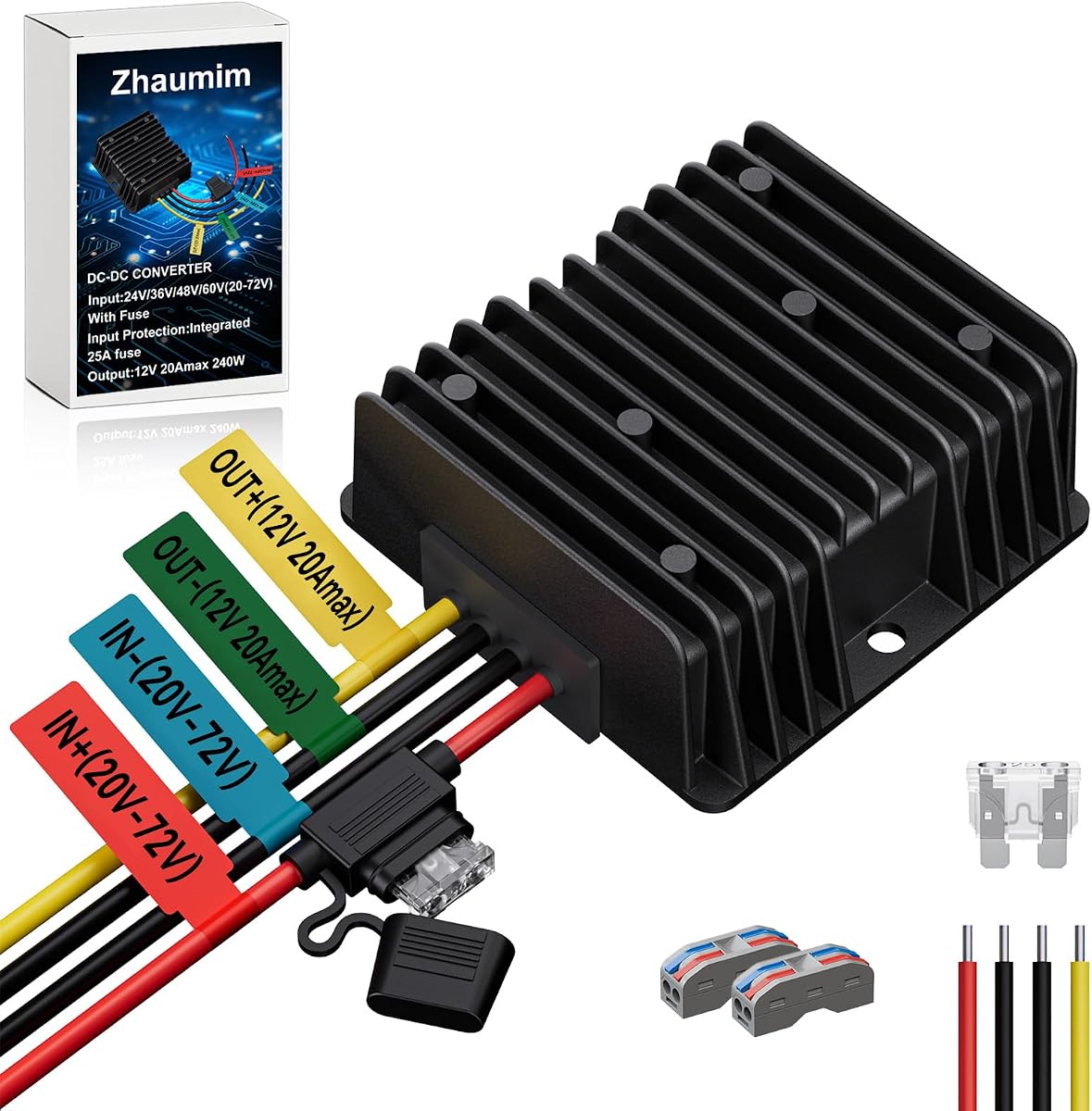
This 20A, 240W converter is the strongest all-around choice in the list for users who need a dependable 12V supply from a higher-voltage battery system. Its 20–72V input range covers common 20V, 24V, 36V, 48V, and 60V installations, while the fixed 12V output removes the need to adjust a potentiometer during installation.
We may earn a commission when you buy through this link, at no additional cost to you.
Efficiency is listed as high as 96%, and synchronous rectification is used to reduce conversion losses. The built-in input fuse and protection against over-current, overload, over-voltage, under-voltage, over-temperature, and short circuits make the unit appealing for mobile equipment where wiring faults and changing operating conditions are realistic concerns.
The die-cast aluminum enclosure and silicone potting provide IP68 waterproof, dustproof, and shockproof protection. The stated operating-temperature range is -40°C to +85°C, although heat management and local weather exposure still matter. This is a fixed-output unit rather than an adjustable bench converter, and its 20A limit requires attention to cable and load requirements.
It is best suited to golf carts, scooters, RVs, forklifts, solar installations, LED systems, audio equipment, and other projects requiring a stable 12V source. For buyers who value broad input compatibility, enclosure durability, and substantial power in one package, it is the most versatile recommendation in this guide.
The sealed aluminum construction and extensive fault protection make this converter a logical match for battery compartments, carts, and outdoor equipment where moisture, vibration, dust, and temporary electrical faults may occur.
A 240W maximum output provides more capacity than the smaller fixed-output models, allowing it to serve several 12V loads when the combined draw remains within its rating and proper wiring practices are followed.
We may earn a commission when you buy through this link, at no additional cost to you.
DC House's 20A converter is a practical option for powering 12V devices from 24V, 36V, or 48V sources. The listed 20–60V input range covers many utility-vehicle, truck, and battery-powered applications, while its 12V, 20A, 240W output matches the high-demand category represented by the leading pick.
We may earn a commission when you buy through this link, at no additional cost to you.
Conversion efficiency is stated at up to 95%, and the product includes over-voltage, over-current, over-temperature, and short-circuit protection. A die-cast aluminum housing with IP68 waterproof, dustproof, and shockproof performance is particularly relevant when the converter will be mounted near batteries or exposed to road spray, rain, dust, or vibration.
The four-wire plug-and-play connector arrangement is one of its most installation-friendly features. It avoids the need to design permanent terminal connections when the stated connector system is suitable for the vehicle or project. Its compact form factor also makes it easier to position inside a crowded battery compartment, although cable gauge, fusing, and load limits still require care.
This converter is well suited to golf carts, trucks, LED lighting, audio, monitoring systems, motors, and DIY electrical systems. Buyers seeking an adjustable module should look elsewhere, but those who need a ready-to-install, fixed 12V supply in a common vehicle voltage range will find the feature set convincing.
The connector-based setup reduces the number of separate wiring tasks, making the unit approachable for installers who want a compact 12V supply without building a custom module.
Its IP68-rated aluminum enclosure is useful in mobile and exposed installations, providing a more appropriate physical design than an open circuit board for dust, moisture, and shock exposure.
We may earn a commission when you buy through this link, at no additional cost to you.
This 10A, 120W converter delivers the essential functionality of a fixed 12V buck converter at a more modest capacity than the leading selections. It accepts a 16–58V DC input, allowing it to work with 18V, 20V, 24V, 36V, and 48V source systems, which makes it especially relevant to golf carts and smaller mobile electrical systems.
We may earn a commission when you buy through this link, at no additional cost to you.
Its stated conversion efficiency reaches 95%, while built-in intelligent protection covers undervoltage, overload, low load, short circuit, and overheating. The aluminum shell, silicone potting, and IP68 rating improve resistance to rain, shock, moisture, dust, and heat dissipation, making the unit more suitable for outdoor use than an exposed module.
The main trade-off is capacity. A 10A maximum output and 120W maximum power cannot support loads that approach the 20A and 240W limits of the larger converters. It also produces a fixed 12V output, so it is not a general-purpose adjustable regulator. Load selection and conductor sizing therefore need more attention.
The listed uses include automotive systems, surveillance equipment, railway signals, medical equipment, instruments, LED products, LED strips, cable television, and low-power test systems. For a 12V installation that fits within 120W, this is a cost-conscious and compact option with better environmental sealing than most bare-board modules.
At 120W, the converter can power a useful collection of smaller 12V accessories while remaining easier to wire and cool than the highest-current models in the list.
Undervoltage, overload, short-circuit, and thermal safeguards add useful resilience for carts, vehicles, and other installations where voltage conditions can change during operation.
We may earn a commission when you buy through this link, at no additional cost to you.
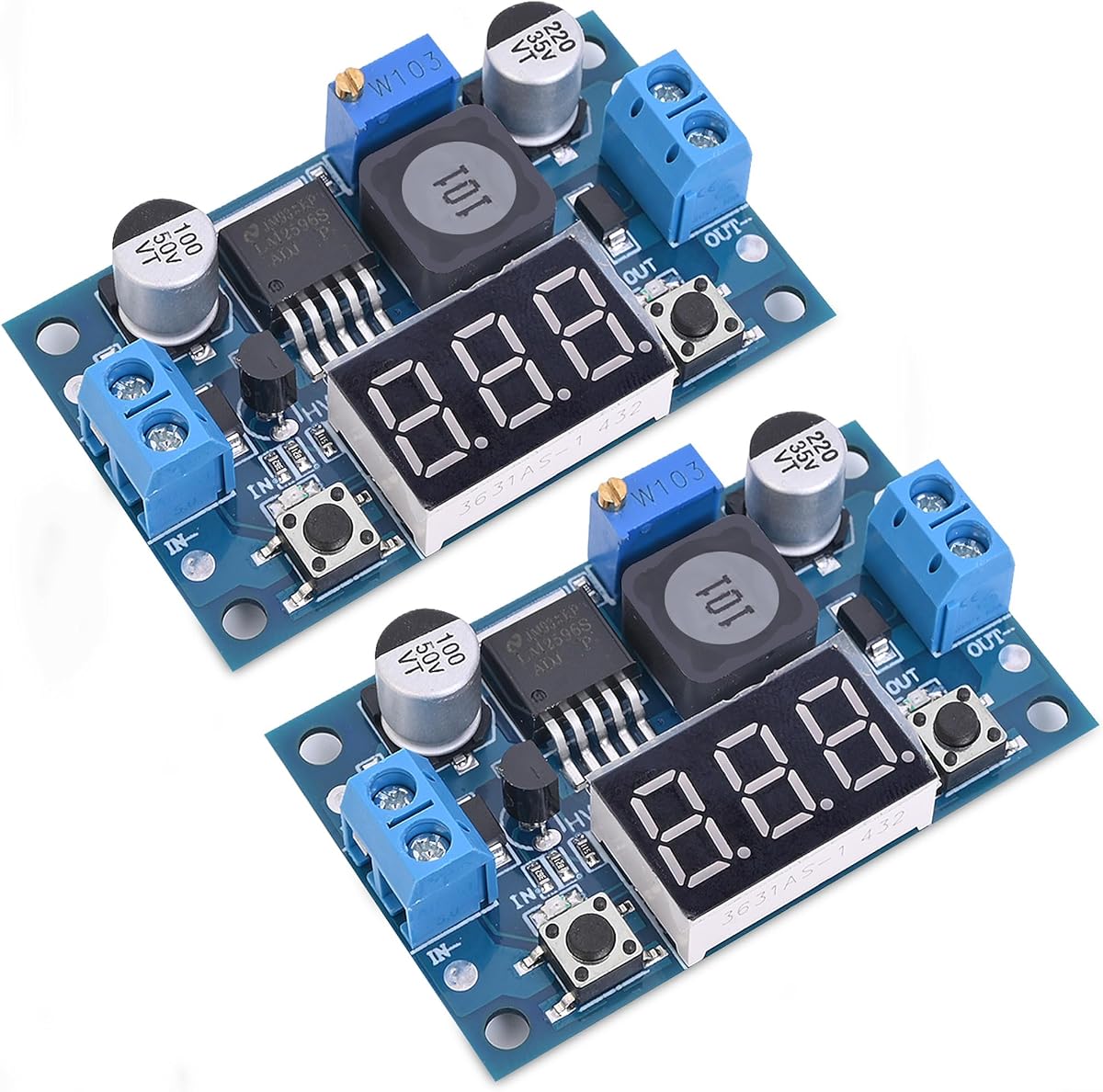
This two-pack of LM2596 modules is a convenient starting point for electronics projects that need adjustable output voltage. The 4.0–40V input range and 1.25–37V output range cover many common power levels, and the mini-screwdriver adjustment makes it possible to set the output for a specific device or experiment.
We may earn a commission when you buy through this link, at no additional cost to you.
The numerical LED voltmeter has a stated measurement error of ±0.1V, helping users monitor the output during setup. Holding the switch for more than one second but less than four seconds turns the display off, and a brief press restores it. Terminal blocks allow connections without soldering, which can make the modules accessible to beginners.
Two input diodes help protect against reverse connection, and overheat and short-circuit protection are included. Thermal performance remains important: the product information specifically advises improving heat dissipation for power above 15W. The modules are not sealed, so they are better suited to protected enclosures, prototypes, and indoor projects than rain-exposed locations.
These converters are appropriate for car power supplies, DIY projects, and industrial equipment where the voltage is known and can be adjusted. The two-module format also provides a spare or allows separate circuits. Buyers should treat the displayed voltage as a useful setup aid while still verifying the output with appropriate test equipment.
The combination of a precision adjustment control and terminal blocks simplifies experiments involving different supply voltages, especially for users who do not want to assemble their own buck-converter board.
The LED display gives immediate feedback during configuration, although the module should still be installed with suitable ventilation and handled as an open electrical assembly.
We may earn a commission when you buy through this link, at no additional cost to you.
The five-pack format makes this LM2596 option attractive for builders who need several independent regulators or want modules available for future projects. Each unit accepts a 3–40V input and provides an adjustable output from 1.25V to 35V, offering broad compatibility with common low-voltage electronics and battery systems.
We may earn a commission when you buy through this link, at no additional cost to you.
The listed components include SANYO solid capacitors, a 36-micrometer-thick PCB, high-Q inductors, and an LED output indicator. Conversion efficiency is stated at up to 92%. A precision multi-turn potentiometer supports more controlled output adjustment, and integrated thermal shutdown and current-limit protection help guard against overheating and overload.
This is a step-down-only design, not a boost converter. The input must remain at least 1.5V above the desired output, and users should not attempt to select a setting outside that relationship. Its open, compact board format makes it suitable for DIY power banks, monitors, communication equipment, solar power systems, and other electronics projects where it can be protected from moisture and debris.
The principal trade-off is that the bundle provides quantity rather than sealed construction or very high continuous power. The modules are best for learning, prototyping, and multiple low-to-moderate-power circuits. A protective enclosure, correct heat dissipation, and sound wiring remain necessary even when the individual boards include protection circuitry.
Five separately adjustable modules can support several projects, provide replacement units, or divide unrelated loads across dedicated regulators instead of combining them on one board.
The input must always be higher than the target output, so the module cannot raise a battery voltage and should not be selected for boost-only applications.
We may earn a commission when you buy through this link, at no additional cost to you.
DROK's LCD-equipped converter is designed for users who need more visibility and control than a basic adjustable module provides. It accepts 5.3–32V DC input, produces an adjustable 1.2–32V output, and displays input voltage, output voltage, output current, and output power on an LCD screen.
We may earn a commission when you buy through this link, at no additional cost to you.
The listed continuous capability is 8A and 120W for long-term use. With improved heat dissipation, the manufacturer states that the converter can reach 12A and 160W. That distinction matters because a short-term or peak capability should not be treated as the same as sustained capacity. The acrylic housing, heat sink, and stated measurement precisions of 0.05V and 0.005A make it useful for controlled installations.
Controls include buttons for turning the output on or off and setting the default state for the next use. Potentiometers adjust voltage and current, while the current-limit setting can be configured for the connected load. Reverse-connect, short-circuit, and over-current protection provide additional safeguards. The enclosure limits dust exposure but does not offer the IP68 sealing found in the vehicle-focused products.
Its listed applications include solar panels, laboratories, experiments, RVs, all-terrain vehicles, cars, battery chargers, and LED strips. It is a strong general-purpose choice when an LCD readout and current controls matter, but users planning severe-weather exposure should choose a sealed converter or install this unit in a protected enclosure.
Showing voltage, current, and power at once helps installers identify overloads, incorrect voltage settings, and load changes without relying on separate meters at every adjustment.
The 8A and 120W figures describe continuous operation, while 12A and 160W require enhanced cooling, making thermal design a central part of getting more from the unit.
We may earn a commission when you buy through this link, at no additional cost to you.
This DROK model is the most capable premium converter in the list, with a 6–70V input range, an adjustable 0–60V output, 20A maximum current, and 1200W maximum power. It is intended for demanding DC systems rather than lightweight bench use, and its size reflects the heat-management hardware needed to support that potential.
We may earn a commission when you buy through this link, at no additional cost to you.
Users can choose common fixed output levels of 5V, 9V, 12V, 24V, 36V, 48V, or 60V. A color LCD provides module-status information, and a temperature-controlled cooling fan works with a large heat sink. An input common-mode inductor is included to reduce the influence of input-supply ripple and help achieve a cleaner output.
Protection is unusually comprehensive, covering input over-voltage and under-voltage, output over-voltage, over-current, over-power, over-temperature, timeout, capacity, and energy conditions, along with external temperature protection. A one-year warranty is stated from purchase. The low 4.3 rating should still be considered alongside the advanced feature set, particularly if the installation involves tight spaces or high ambient heat.
This converter is suited to serious mobile, workshop, solar, or industrial DC installations that need high current and a broad set of selectable voltages. Buyers should confirm enclosure dimensions, cooling clearance, grounding expectations, and connector requirements. It is the premium recommendation for users who prioritize control, power capacity, and monitoring over compactness.
The combination of a large heat sink and temperature-controlled fan addresses the substantial heat associated with converters capable of reaching 1200W, while the LCD helps keep operating information visible.
The range of standard voltage presets makes the module useful across mixed projects without requiring manual calibration every time a common output level is needed.
We may earn a commission when you buy through this link, at no additional cost to you.
This sealed 5V converter is built for compact 5V loads that operate from batteries ranging from 12V through 72V. Its 11–90V input specification gives it unusual compatibility with 12V, 24V, 36V, 48V, 60V, and 72V systems, while the fixed output keeps the installation focused and uncomplicated.
We may earn a commission when you buy through this link, at no additional cost to you.
Maximum output current is 6A, and conversion efficiency is stated at more than 95%. The aluminum case supports heat dissipation, and protection includes over-current, over-temperature, reverse input connection, and short-circuit handling. Its waterproof, dustproof, moistureproof, and shockproof construction is especially valuable in vehicles, outdoor installations, and dusty working environments.
The listed applications include car audio, LED displays, motors, speakers, navigation devices, hard-disk players, media equipment, electric fans, toy cars, air-conditioning equipment, and solar-energy systems. As with every fixed 5V supply, the total current must remain within the 6A limit, and the connected load should tolerate regulated 5V rather than a varying voltage.
This is one of the strongest choices for users who specifically need weather-resistant 5V power. Its 4.8 rating reflects a favorable combination of broad input compatibility, efficient conversion, protective features, and a durable enclosure. For higher-current or adjustable requirements, the larger 20A or LCD-equipped alternatives offer more capacity and control.
The sealed case reduces the need for a separate weatherproof enclosure when the converter is mounted in a vehicle, near outdoor equipment, or inside a dusty enclosure.
High conversion efficiency and low heat generation make the unit suitable for electronics, audio, navigation, and lighting systems that require a stable 5V rail.
We may earn a commission when you buy through this link, at no additional cost to you.
The EAGWELL converter is a compact fixed-12V solution for loads up to 6A and 72W. Its 8–40V input range covers several common battery systems, including 12V, 24V, and 36V installations, making it a versatile option for adding a regulated 12V accessory circuit to an existing vehicle or equipment platform.
We may earn a commission when you buy through this link, at no additional cost to you.
Its aluminum shell and organic silicone sealing provide IP68 waterproof protection along with dustproof, moistureproof, and shock-resistant construction. Overload, over-current, over-temperature, short-circuit, and over-voltage protection are included, giving the module a useful set of safeguards for automotive, robotics, and machinery environments.
The stated uses include robots, pumps, CNC equipment, motors, and printers. That makes it a sensible option for compact control systems that need 12V without the space or current capacity required by a large converter. The fixed 12V output is an advantage for simple installations, although the lack of an adjustable output or display limits flexibility when compared with the DROK modules.
Buyers should treat the 6A and 72W ratings as firm limits, especially when starting motors or pumps, which can draw substantial surge current. With appropriate wiring, fusing, and load control, this is a focused and well-protected option for smaller 12V systems where sealed construction matters more than adjustability or high output.
A fixed 12V output simplifies installations that do not need multiple selectable rails, reducing setup complexity in control boxes, carts, robots, and compact machinery.
The IP68 aluminum-and-silicone enclosure offers meaningful physical protection without the footprint of a high-current converter with a large external heat sink.
We may earn a commission when you buy through this link, at no additional cost to you.
This converter is designed to turn an 8–40V DC source into a stable 5V output rated up to 15A. That combination gives it more current capacity than the smaller 5V and 12V sealed converters, making it relevant to automotive electronics, 5V accessories, and other loads that need more than a lightweight low-power supply.
We may earn a commission when you buy through this link, at no additional cost to you.
Protection against over-voltage, over-current, over-temperature, and short circuit is included, along with automatic recovery when conditions return to normal. The product information highlights car audio systems, other 5V automotive products, and vehicles with 24V power supplies. Other listed applications include surveillance systems, railway signals, medical equipment, instruments, meters, LED products, cable television, and low-power test systems.
A major advantage is the 15A output rating, but a fixed 5V unit cannot accommodate equipment requiring 9V, 12V, or another adjustable rail. It is also a step-down converter, so the source must remain above the output voltage. As with any high-current design, correct conductor sizing, secure connections, fusing, and heat dissipation are essential to safe operation.
This model offers a strong balance of capacity and straightforward output for 5V-specific systems. It ranks as a practical dedicated converter rather than a universal adjustable solution. Users who need multiple voltages or sealed construction should consider one of the LCD-equipped or IP68 alternatives, while a fixed 5V installation with substantial current can benefit from this model's higher rating.
The 15A rating gives this converter considerably more capacity than smaller 5V units, making it suitable for larger grouped 5V loads when the total current and thermal conditions are properly managed.
The stated recovery behavior can restore normal operation after temporary protection triggers, reducing the need for repeated manual resets in suitable electrical conditions.
We may earn a commission when you buy through this link, at no additional cost to you.
Choosing a DC step down voltage converter requires matching the source voltage, load voltage, power demand, enclosure, and protection features to the installation. The most important rule is to size the converter for both steady operating load and expected startup demand rather than selecting solely by wattage.
The converter's input range must fully encompass the voltage produced by the battery, generator, solar controller, or other source. This includes the normal operating voltage, the voltage during charging, and any transient peaks. A 48V golf-cart battery system, for example, may operate below 48V while charging, whereas a 72V system presents a different upper limit. The listed 20–72V model covers several common systems, while narrower modules may only suit a particular battery chemistry or architecture.
Choose a converter whose published input range safely includes your source, and never assume that a nominal system label represents the minimum or maximum possible voltage.
A fixed converter is often easier and less prone to incorrect adjustment, especially for 12V accessory circuits. An adjustable module is more versatile when the project includes several voltage levels or when the exact load requirement may change. Adjustable units should be checked for their full output range, resolution, and any requirement that the input remain a specified margin above the output. Models offering fixed presets combine convenience with a more limited choice.
Match the output directly to the equipment specification, and verify the selected voltage before attaching a sensitive load.
Current is often more informative than power because it shows how much the converter can supply at the desired voltage. A 120W unit at 12V provides a 10A maximum, while a 240W unit at 12V provides 20A. Loads with motors, compressors, or pumps may require extra startup current, so continuous ratings should not be treated as surge ratings. If a listing distinguishes sustained output from enhanced or peak output, use the lower sustained figure for planning unless the enclosure and cooling have been specifically designed for the higher load.
Add up the normal current of every connected device, include a sensible margin, and size wiring and fusing consistently with the load.
Voltage conversion always involves some loss, and heat must be removed to keep the converter stable. Aluminum cases, heat sinks, and temperature-controlled fans are especially relevant near the upper end of a converter's current range. Open modules need unobstructed airflow and benefit from being installed in a ventilated enclosure. Sealed converters can also become very hot because their enclosure limits convective cooling. A suitable mounting position is as important as the output rating when determining whether a model can sustain its specified load.
Allow the stated thermal conditions to be met, and do not cover a hot converter with insulation or place it in a tightly sealed compartment.
Vehicles, carts, solar installations, and outdoor electronics may encounter rain, dust, moisture, vibration, and shock. An IP68 enclosure with an aluminum shell and silicone sealing is better suited to those conditions than an exposed circuit board. Sealed does not mean immune to every environment, however, so connectors, cable entries, mounting position, and strain relief still need attention. Open modules can work well inside a dry enclosure, under a dashboard, or in a protected control cabinet when every connection is secure.
Choose a physically sealed model for exposed locations, or plan a suitable protective enclosure around an open adjustable module.
Over-current, over-voltage, under-voltage, over-temperature, and short-circuit protection are valuable across all applications. Automatic recovery can be useful in unattended or mobile systems because the converter may resume normal operation after a temporary fault. Reverse-input protection also helps prevent damage during service or installation. Protection circuits are not substitutes for correct fusing, wire sizing, or load design, but they provide a useful second layer of safety when conditions exceed expected levels.
Review the exact protection list rather than assuming every converter includes the same safeguards, and use separate fusing appropriate to the converter's input.
A voltmeter, LCD, or multi-function status screen makes setup and troubleshooting easier. Displays that show input voltage, output voltage, current, and power reveal more than a single voltage reading, particularly when identifying overloads or an incorrect adjustment. Adjustable potentiometers and configurable output buttons improve usability, but they also introduce settings that must remain correct after installation. For a fixed 12V or 5V circuit, these controls may add little value and could make the unit more complex than necessary.
Choose monitoring controls when they will be used regularly, not merely because they make a product appear more advanced.
Terminal blocks are convenient for DIY projects and allow connections without soldering. Plug-and-play four-wire arrangements can simplify vehicle retrofits, provided the connectors, wire gauge, and current rating are suitable. Permanently installed systems may benefit from robust terminal connections and clearly routed cables. In every case, input and output must be identified correctly, positive and negative conductors must be checked, and the converter should be mounted so heat and vibration do not compromise the installation.
Choose a connection method that matches your skill level and the service environment, and use appropriately rated wiring and fusing.
Before installation, identify the source system's voltage range and measure the voltage at the intended connection point. Confirm that the converter's input specification includes both the resting and charging voltage of the source. Then calculate the expected load current, choose suitable wire and fuse ratings, and decide whether a fixed or adjustable output best matches the equipment. Mount the converter in a location with airflow if it is an open module, or with the clearance recommended for a sealed high-power model.
Wire the input with the power source disconnected, double-checking polarity and conductor ratings. Connect the load only after the output voltage has been set and confirmed. For an adjustable module, ensure the input remains above the selected output and use the specified terminal blocks or connectors. Turn on the source, verify input and output readings, and then connect the load in stages where practical so unusual current draw can be identified without immediately overloading the unit.
Care involves keeping the enclosure dry when the unit is not designed for wet exposure, securing every connection, and maintaining the airflow or cooling required by the model. Inspect wiring periodically for chafing, corrosion, loose terminals, or heat discoloration. If the converter becomes unusually hot, shuts down, resets, or shows an overload, disconnect the load and investigate the source voltage, load draw, wiring, and mounting conditions before using it again.
A DC step down voltage converter reduces a higher DC voltage to a lower DC voltage so that a device can operate safely. For example, a 48V battery system can feed a converter that supplies regulated 12V for lights, audio, controls, or other accessories. The input must always be higher than the output, and the converter must be rated for the load's current and heat.
It depends on the converter's published input range. A model accepting 20–72V can generally operate from a 36V source, while a converter limited to 48V or higher may shut down or behave incorrectly as the battery voltage falls. Always compare the battery's lowest operating and charging voltages with the converter's full input specification.
Add the current requirements of all connected 12V loads, then compare that total with the converter's continuous current rating rather than its peak rating. If the load is measured in watts, divide by 12V to estimate current. Include startup surges for motors and pumps, use the lower sustained rating when thermal conditions are unclear, and allow room for future expansion.
No. A larger converter can handle more current, but it may also be physically larger, generate more heat, and cost more to operate or install. The best match provides enough continuous capacity for the actual load, accepts the source voltage, fits the available space, and has a suitable enclosure and connection system.
Only models with an appropriate IP68 rating and properly sealed connections should be considered for rain-exposed installations. Open LM2596-style modules should be placed inside a dry, ventilated enclosure. Even a weather-resistant converter can be compromised by an unsealed connector, damaged cable entry, or improper mounting, so environmental protection must cover the complete installation.
Yes, proper circuit protection is important even when the converter includes internal over-current and short-circuit protection. A fuse close to the battery or source limits current if a cable becomes damaged, a connector fails, or a fault develops elsewhere in the wiring. The fuse rating should follow appropriate current calculations and local electrical guidance rather than being copied blindly from another installation.
Heat is a normal byproduct of voltage conversion, especially near maximum current, but excessive temperature can indicate overload, undersized wiring, poor airflow, or a load with a large startup surge. Check the combined load current, input voltage, mounting position, and cooling requirements. Reduce the load or improve ventilation if the converter repeatedly overheats or enters protection.
No, a buck converter is designed only for step-down operation. The input must remain higher than the selected output, commonly by at least the margin specified by the manufacturer. A device requiring a higher voltage than the source needs a boost converter or another power-conversion approach instead.
The 20A 240W sealed converter stands out as the most versatile general recommendation, with a broad 20–72V input range, fixed 12V output, high efficiency, extensive protection, and rugged construction. The 10A 120W golf-cart model is a more modest option for smaller 12V loads, while the DROK CNC unit offers the most advanced control, monitoring, cooling, and power capacity.
Prioritize source-voltage compatibility, continuous current, thermal management, and environmental requirements before choosing a model. A display or adjustable output is useful only when the installation needs it, while a sealed enclosure and dependable protections are especially valuable in vehicles and outdoor systems. Match wiring, fusing, and mounting conditions to the selected converter as carefully as the converter itself.
Specifications and availability can change, so check the current listing, included components, connector details, warranty terms, and compatibility information before ordering. Those final checks help ensure that the chosen DC step down voltage converter is suitable for the intended load and installation environment.