
InnoGear Desktop Microphone Stand
4.6Editor score
Weighted metal desktop base
Eight-to-twelve-point-eight inch height
Universal adapter and clip
Quiet screw-in height adjustment
A home studio microphone stand should place your microphone accurately without wobbling, crowding the desk, or interfering with your recording workflow. The best options combine stable construction, smooth height adjustment, useful boom movement, secure microphone attachment, and enough flexibility for different voices, instruments, and room layouts.
We compared all 10 products using the information supplied for each model, focusing on practical attributes such as base design, adjustable ranges, boom-arm movement, included adapters, cable management, portability, and compatibility with popular microphones. The list covers floor, tripod, desktop, isolation, and professional boom-arm designs.
Each review identifies the stand's strongest qualities, practical limitations, and most suitable user, so you can choose according to your room, microphone, and recording style. Ratings reflect the supplied customer feedback, while current prices and availability can change, making it worthwhile to compare the latest listing details before buying.
4.6Editor score

4.7Editor score

4.7Editor score
As an Amazon Associate we earn from qualifying purchases.
The comparison below highlights each microphone stand's format, adjustment range, stability features, portability, and mounting versatility, making it easier to identify the right design for a home recording space.




The InnoGear Mic Stand Tripod Boom Arm Floor Microphone Stand Height Adjustable earns a 4.4 rating for its unusually broad range of positioning options. It is a floor-based stand designed to grow from seated vocal positions to standing performances, while its detachable boom arm adds lateral reach without requiring a separate desktop accessory.
We may earn a commission when you buy through this link, at no additional cost to you.
Its most impressive feature is the scale of adjustment. The main height extends from 28.1 to 89.8 inches, and the boom arm ranges from 16 to 30 inches while rotating horizontally through 360 degrees and vertically through up to 180 degrees. Removing the boom converts the unit into a conventional straight microphone stand, making it useful for users who want one base to serve several applications.
Stability comes from thickened steel poles and a tripod weighing 4.0 pounds. That footprint is substantial enough for indoor and outdoor use, although it will occupy considerably more space than a desktop model. The included carrying bag, two microphone clip styles, and a 3/8-to-5/8-inch adapter improve portability and compatibility, but the boom and stand require more deliberate setup.
This is a strong choice for singers, streamers, podcasters, and mobile performers who need both vertical range and a removable horizontal boom. It is less suitable for a compact desk-only studio, but for a flexible home or rehearsal space, the combination of conversion capability, broad reach, and accessory packaging makes it unusually versatile.
The detachable boom is the key convenience: leave it attached for angled or extended placement, or remove it and use the microphone clip on the straight pole. This flexibility lets the same unit support vocals, instruments, streaming sessions, and mobile recording.
The unusually tall adjustment range accommodates different performers and seated or standing applications. A tripod of this size needs a clear floor area, so position the legs before raising the microphone and ensure the boom is tightened before recording.
We may earn a commission when you buy through this link, at no additional cost to you.
The InnoGear Mic Stand Microphone Stand Floor with Weighted Base for Singing carries a 4.3 rating and focuses on a stable, straightforward floor configuration. It combines a round weighted base, a vertically adjustable pole, and a rotating microphone clip in a design aimed at singers, streamers, and home studio users who value solidity over an expansive adjustment range.
We may earn a commission when you buy through this link, at no additional cost to you.
The 4.5-pound base has a 9.8-inch diameter, non-slip pads, and a metal gasket between the base and upright section. Those details work together to reduce unwanted movement and preserve the microphone's position. The pole uses 1.5mm-thickened steel, while height adjustment runs from 34 to 60 inches and the microphone clip rotates through 180 degrees.
The design is easier to move than a large tripod because it separates into three components. That makes it appropriate for rehearsals, sessions, outdoor events, and temporary recording locations. However, the relatively compact height range provides less positioning freedom than the taller InnoGear model in the previous review, and the round base may need careful placement near a busy recording desk.
Choose this model when you want a dependable weighted-base floor stand, a straightforward adjustment system, and compatibility with popular USB and dynamic microphones. It is a sensible option for fixed home-studio positions and vocalists who want one dependable stand that can be dismantled for transport without relying on a full-size tripod.
The weighted round base, rubber pads, and metal gasket reduce the shifting and wobbling that can degrade a recording. Position the stand on a level surface and check the base connection before raising the microphone to its final height.
The listed microphone compatibility covers major USB, dynamic, and condenser models, including Blue, HyperX, Shure, Razer, and Fifine options. Its three-piece construction also makes it easier to move between a permanent studio corner and a temporary session.
We may earn a commission when you buy through this link, at no additional cost to you.
The Hola! Music Mic Stand w/Adjustable Height for Home, Studio, Office or Stage Use – Standard Clutch Single Unit earns a 4.7 rating, making it one of the strongest-reviewed products in this guide. It combines a traditional locking tripod base with a telescoping boom and straightforward height adjustment for home studios, offices, rehearsal spaces, and stages.
We may earn a commission when you buy through this link, at no additional cost to you.
A patented leg housing locks the legs when opened, removing the need to secure them with a separate screw. The ergonomic center clutch adjusts the main height from 40 to 63 inches, while separate clutches control the metal boom's length and angle. It extends four to 27 inches beyond the vertical pole, providing useful reach for singers and instruments.
Cable organization is a notable extra. Standard US 5/8-27 threads support common microphone attachments, and two clip-on holders help route wires without allowing them to cross the working area. The traditional tripod design requires more floor space than a desktop stand, and its maximum main height is lower than some adjustable models, but the locking mechanism offers a mature alternative to screw-tightened legs.
This is our Editor's Choice because it balances adjustment convenience, cable management, construction, and customer feedback without committing to a single specialized use. It is a particularly good fit for home studio owners who record vocals, need a long boom for instruments, and value a setup that can move from seated work to standing performance.
The center clutch handles main-column height, while separate boom clutches make it easier to fine-tune reach and angle. Check each control after raising the stand so the pole and boom lock securely before the microphone takes on a heavy accessory.
Two clip-on cable holders reduce tangled leads around the boom and working area. Route the cable along the stand where possible, leaving enough slack near the microphone to avoid pulling it off axis during a recording.
We may earn a commission when you buy through this link, at no additional cost to you.
The BILIONE Microphone Stand Floor with Tray & Boom Arm, 5.5lbs Weighted Base combines a low-profile weighted base with a long adjustable pole and a practical tray. Its 4.4 rating reflects a balance of stable construction, broad positioning, cable organization, and compatibility with several common microphone mounting standards.
We may earn a commission when you buy through this link, at no additional cost to you.
The stand uses a 1.5mm steel arm and a 25mm reinforced rod for support, while the microphone height spans 22 to 70 inches. A 180-degree swivel clip helps establish the final angle. The 5.2-pound base uses EVA pads for grip and floor protection, and its square shape is intended to occupy less space and reduce tripping hazards.
A particularly useful feature is the inclusion of a tray. In a home studio, that surface can hold an external sound card, mobile phone, headphone amplifier, or other small accessory within reach. Dual-thread clips and a 3/8-to-5/8-inch adapter expand compatibility, while the described quick-detach construction allows the stand to break down into portable parts in under 20 seconds.
This model fits creators who want a floor stand that can reach both low seated positions and higher standing setups without the visual bulk of a wide tripod. The trade-off is that the base, tray, and adjustable arm create a more substantial assembly than a simple desktop stand, so it works best where floor space and accessory organization are priorities.
The attached tray turns the stand into a small equipment station. Keeping an interface or phone on the tray can shorten the signal path, but avoid loading the surface with items heavy enough to affect balance or create unnecessary desk clutter.
The square weighted base is designed to occupy less floor area than a conventional spread-leg tripod. Its padded underside protects the floor and improves grip, while the high adjustment range gives the setup considerable positioning flexibility.
We may earn a commission when you buy through this link, at no additional cost to you.
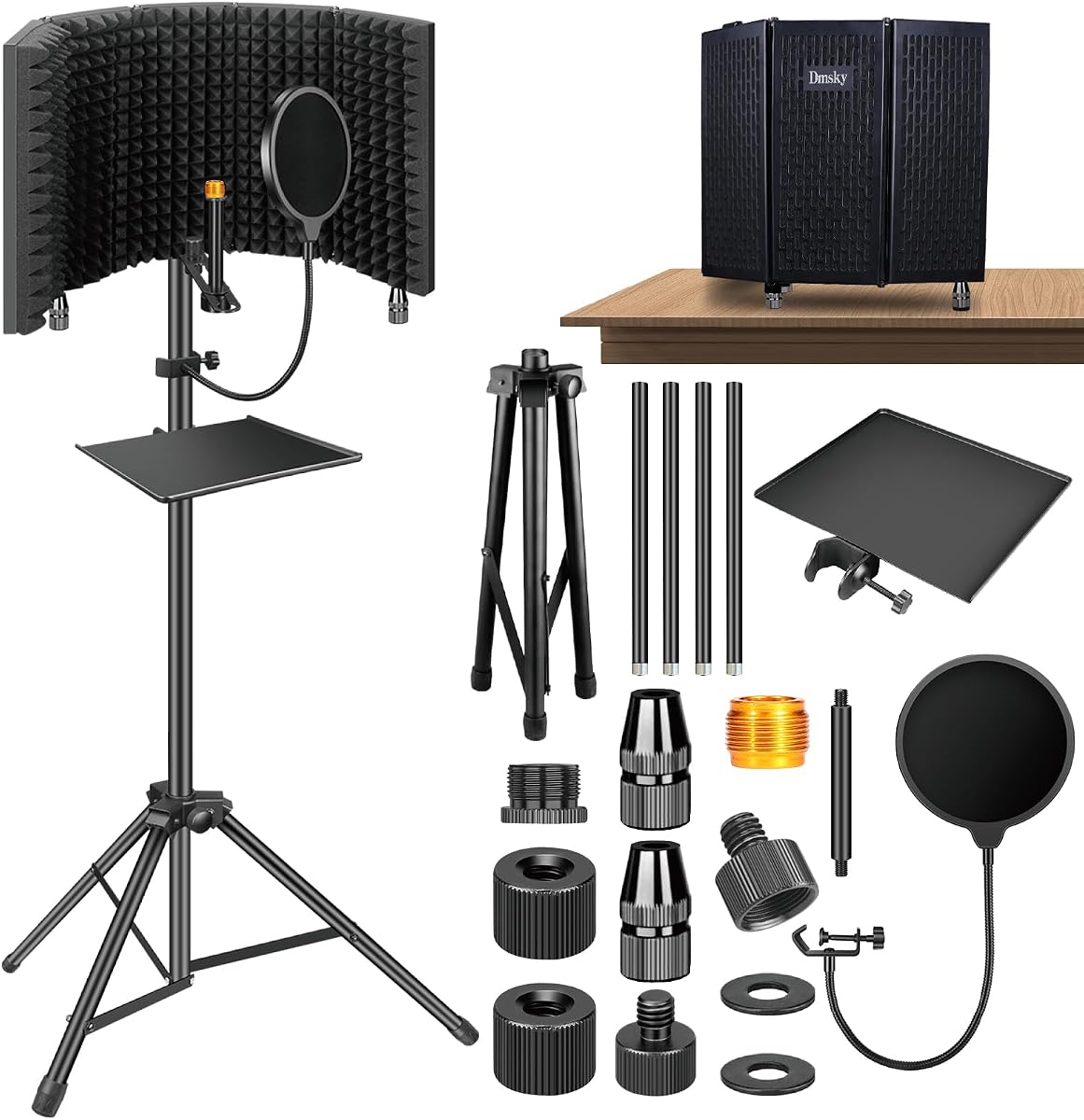
The Dmsky Microphone Isolation Shield with Pop Filter & Tripod Stand earns a 4.6 rating by combining a microphone stand, pop filter, accessory tray, and foldable acoustic shield. It is designed for podcasting, singing, broadcasting, and home recording situations where room reflections and ambient noise can compete with the voice.
We may earn a commission when you buy through this link, at no additional cost to you.
The shield uses three layers: a reflective layer, a filter layer, and an absorbing layer made with high-density acoustic foam. Five folding panels can be adjusted through 180 degrees, allowing the user to shape the enclosure around the microphone. Steel construction, anti-slip support points, and a heavy-duty tripod provide a stable structure, while the stand can be used on a desktop or mounted to a boom.
The height system offers multiple arrangements. The shield itself adjusts from 42 to 71.5 inches, the supplied microphone stand reaches 78.7 inches, and the shield can be placed on a table. The included pop filter, 3/8-to-5/8-inch adapters, and storage tray make it a more complete setup than a basic stand.
This product is a strong option for creators who need acoustic treatment directly around the microphone rather than only around the room. It does require more room and assembly than an ordinary stand, and the enclosure can change the sound by reducing reflections and isolation. For close-mic podcasting and vocals, that controlled trade-off is often valuable.
Combining reflection, filtering, and absorption gives the shield more ways to control stray sound than a single foam panel. Adjust the panels gradually and monitor the result, because reduced room reflections can also remove natural vocal space.
The system works as a desktop enclosure, a standing shield, or a shield attached to a boom. This flexibility lets creators choose a compact seated arrangement or elevate the microphone for standing performances without purchasing separate components.
We may earn a commission when you buy through this link, at no additional cost to you.
The Microphone Stand With Isolation Shield is a 4.4-rated recording accessory that pairs a folding acoustic screen with a 72.8-inch stand. It targets home studios, voiceover booths, podcast rooms, and live-streaming stations where a microphone needs separation from surrounding reflections.
We may earn a commission when you buy through this link, at no additional cost to you.
The shield uses an acoustic sandwich design consisting of a sound-reflective layer, a precision filter layer, and an absorption layer. Its studio-grade foam front is backed by lightweight ABS plastic, creating a combination the manufacturer describes as offering 26dB of noise reduction. The foldable screen measures 17.1 inches in diameter, giving the creator several panels with which to shape the recording environment.
A weighted triple-leg base supports floor use, while an industrial-strength steel clamp allows the shield to attach to a boom. The included quick-release adapters support positioning, and two universal thread adapters allow the assembly to fit common 3/8-inch and 5/8-inch microphone connections. Desktop and boom-arm arrangements cover both compact and elevated setups.
This is a useful choice when room treatment is limited but the microphone needs a local acoustic boundary. The stated reduction should not be treated as a guaranteed result in every room, since placement, reflections, and the voice's frequency range all matter. Even so, the foldable design makes it easier to experiment than a permanently installed acoustic panel.
The layered screen works closest to the microphone, where small reflections and nearby noise can be most noticeable. Positioning it behind and beside the capsule can improve clarity, although users should monitor the result for any loss of room liveliness.
The clamp, adapters, and quick-release components simplify changes between desktop, floor, and boom configurations. Make sure every screw and adapter is fully tightened before moving the microphone or adjusting the enclosure.
We may earn a commission when you buy through this link, at no additional cost to you.
The Amazon Basics Sturdy Portable Microphone Boom Arm Stand, Height Adjustable with Cable Management, Foldable Tripod Base, Up to 85.75", Black has a 4.5 rating. It is a portable boom stand for singers, speakers, and instrumentalists who want to move a microphone between standing and seated positions.
We may earn a commission when you buy through this link, at no additional cost to you.
Its main vertical height reaches 85.75 inches, and the long boom includes a molded plastic counterweight to balance the microphone. The 21-inch base supplies a stable foundation, while the steel structure keeps the product relatively light for transport. A clip-on cable holder helps prevent the lead from hanging directly from the microphone.
The most important limitation appears in the product details: the microphone clip is sold separately, and the maximum supported microphone weight is 2 pounds, or 1 kilogram. That restriction makes the stand better suited to lightweight dynamic and compact USB microphones than to a heavy studio condenser with a large shock mount. Users should also confirm that their desired clip is included before ordering.
This model makes sense for mobile creators who need one lightweight stand for rehearsals, small performances, and temporary recording locations. Its folding design also allows it to operate as a straight stand. For users who already own a compatible clip and use a lightweight microphone, it offers a generous height range, cable management, and easy portability in a straightforward package.
The folding tripod base can be configured as a straight stand or used with the boom arm. That makes it easy to switch between speaking positions, singing, and instrumental applications without transporting multiple stands.
The stated maximum load is 2 pounds, so heavy microphones and large shock mounts may be unsuitable. Check the microphone's weight and account for the holder before choosing this stand for a permanent home studio setup.
We may earn a commission when you buy through this link, at no additional cost to you.
The InnoGear Desktop Microphone Stand Holder Mic Stand Desk Mount for Fifine earns a 4.6 rating and is our Best Budget pick for focused home studio setups. It provides a compact alternative to floor tripods while still using a weighted metal base, substantial vertical adjustment, and broad microphone compatibility.
We may earn a commission when you buy through this link, at no additional cost to you.
The circular base measures 5.12 inches in diameter and weighs 1.85 pounds. Four non-slip rubber pads improve grip and protect the desk surface. Height adjusts from 8 to 12.8 inches using a screw-in knob designed to remain tighter than a snap-style mechanism, helping the microphone maintain a consistent position during long recording sessions.
Load capacity is listed at 3.3 pounds, which covers a broad selection of desktop and USB microphones. A 3/8-to-5/8-inch adapter supports models such as Blue Yeti, HyperX QuadCast, SoloCast, Fifine, AT2020, and Razer Seiren X, while the included clip has a maximum diameter of 1.26 inches for compatible dynamic microphones such as Shure SM58 and SM48 models.
This stand is ideal for podcasters, streamers, voice-over artists, and remote workers who want an uncluttered desk without giving up a stable microphone position. Its short height range means it is not intended for a standing singer, but for desktop recording it combines useful capacity, compact dimensions, and simple adjustment at a restrained design level.
The weighted base and rubber pads give the stand a settled feel while its small diameter limits desk usage. This makes it practical for a home office where the microphone must coexist with a laptop, keyboard, and writing space.
The screw-in knob locks firmly at the chosen height and avoids the gradual slipping associated with looser adjustment styles. Once positioned, the microphone remains consistent during speech, streaming, or voice-over sessions.
We may earn a commission when you buy through this link, at no additional cost to you.
The K&M König & Meyer 21090.500.55 Tripod Microphone Stand earns a 4.6 rating for its professional positioning and durable construction. Its adjustable telescoping pole, two-piece boom, and folding leg base make it a conventional choice for stages, rehearsal rooms, studios, and other environments where a reliable floor stand is needed.
We may earn a commission when you buy through this link, at no additional cost to you.
The supplied information emphasizes German-made construction and a commitment to world-class build standards. That makes the stand especially appealing to users who want equipment designed for repeated use rather than a lightweight temporary accessory. The boom and vertical column can be configured independently, supporting the kinds of microphone positions often required by singers and instrumentalists.
Exact measurements are not provided in the supplied listing details, so buyers should consult the current product page and manual for dimensional confirmation. It is also worth checking the included hardware and boom length against the available recording space. Those points are less significant for experienced users familiar with professional stands but important for first-time buyers specifying a home studio layout.
K&M backs the product with a five-year warranty and states that replacement parts will remain available for ten years. This is a compelling ownership detail for a permanent setup. The stand is best for creators who prioritize longevity, repeatable construction, and traditional professional hardware over a compact desktop footprint or built-in acoustic isolation.
German-made construction and a five-year product warranty distinguish this model from lightweight stands intended for occasional use. For a permanent home studio, long-term parts availability can be a meaningful advantage when adjustments or repairs are eventually needed.
The folding tripod, telescoping upright, and two-piece boom form a recognizable stage-style configuration. Before purchase, confirm the current dimensions and included counterweight against your floor area and microphone requirements.
We may earn a commission when you buy through this link, at no additional cost to you.
The RØDE PSA1+ Professional Studio Boom Arm with Spring Damping, Black earns a 4.7 rating and is the Best Premium selection. It is a desk-clamped boom arm for podcasting, streaming, voice-over, and music creation, with a professional focus on smooth movement, clean positioning, and low handling noise.
We may earn a commission when you buy through this link, at no additional cost to you.
The arm clamps to desks up to 70 millimeters thick and supports microphones from 0.25 to 1.2 kilograms, including units fitted in shock mounts. Full 360-degree rotation provides extensive reach around the work surface, while the internal spring damping allows the arm to move during a recording without producing creaks or obvious handling sounds.
Integrated cable management keeps XLR runs hidden, giving the workstation a cleaner appearance and reducing loose cables around the microphone. The package includes the arm, desk clamp, and thread adaptors for both 3/8-inch and 5/8-inch microphone mounts. This broad support makes it practical for dynamic broadcast microphones, side-address condensers, and compact USB models when their weight falls within the stated range.
This premium boom is ideal for creators who want a permanent desk installation and regularly reposition a microphone during live recording. It requires a suitable desk edge and cannot function as a freestanding floor stand. For those who can secure it properly, the quiet damping, clean routing, and wide reach deliver the most polished desktop workflow in this selection.
The internal spring damping is the defining feature, allowing the arm to glide during a live take without the creaks commonly produced by friction-based joints. This is especially useful for video calls, interviews, and streaming sessions where movement happens close to an active microphone.
The clamp and integrated cable path create a more permanent studio appearance than a portable desktop stand. Check desk thickness before installation and tighten the clamp securely without damaging the surface.
We may earn a commission when you buy through this link, at no additional cost to you.
Choosing a microphone stand means balancing the physical needs of your recording space with the weight and mounting style of your microphone. Height range, base stability, boom reach, acoustic treatment, cable routing, and portability should all be considered before purchase.
A floor stand is the better choice when the microphone must sit beside a chair, in front of a performer, or above an instrument without taking up desk space. Desktop and boom-arm models are more appropriate when a permanent workstation already has a suitable edge and you want quick access to controls. Floor tripods generally require more clearance, while clamp-based arms can preserve desk surface area but may not fit every tabletop thickness.
Match the stand's adjustment range to your recording posture rather than choosing the tallest model available. A seated user may only need a desktop range, while a standing vocalist may need a tall tripod with an adjustable boom. Boom reach matters when the microphone must extend over a desk, sit in front of a musician, or avoid obstructing a keyboard. Independent height and angle controls make positioning easier and reduce the need to reposition the entire stand.
A stable base keeps the microphone in a consistent position and reduces unwanted vibration or movement. Consider the weight and diameter of the base, the type of floor or desk pads, and whether the stand sits beside a busy chair. Wide tripod legs can resist tipping but occupy substantial space. A weighted round or square base offers a smaller footprint, while a desktop clamp can feel stable when attached to a thick, sturdy desk.
Check the stand's stated load limit and the weight of the entire assembly, including the microphone, shock mount, pop filter, and other accessories. A 2.2-inch or 5/8-inch connection is common, but some products require an adapter. Confirm that the included clip fits the microphone body or that a suitable shock-mount thread is available. Larger condenser microphones may need a heavier stand than a compact USB model used for streaming.
Isolation shields create a local acoustic boundary around the microphone and can reduce reflections, plosives, and nearby environmental noise. They are most useful in untreated rooms where close-mic vocals otherwise pick up obvious room character. However, a shield changes how the microphone hears the room, so it should be adjusted gradually and monitored. It cannot replace comprehensive room treatment, and its effectiveness depends on placement, spacing, and the source of the unwanted sound.
Good cable management keeps cables away from feet, reduces strain on microphone connections, and makes the studio easier to use. Integrated channels or clip-on holders are especially helpful on boom arms and telescoping poles. Route the cable along the stand, leave a small amount of slack at the microphone, and secure loose sections before recording. A hidden XLR path can make a permanent installation look cleaner than loose cables hanging from a desktop microphone.
A home studio may also serve rehearsals, performances, or remote sessions, making portability important. Tripods that fold or break down into a few pieces are convenient for transport, while a carrying bag adds convenience for a floor model. A permanently clamped boom arm sacrifices mobility for a tidier and more stable workstation. Before buying, consider who will assemble the stand, how many controls must be tightened, and whether it can be stored without missing pieces.
A microphone stand should not introduce creaks, squeaks, or unexpected movement during a take. Spring-damped arms, solid clutch locks, and tightened joints help keep the microphone stable, but quiet operation also depends on how the stand is handled. Raise and position it before recording, avoid dragging the base, and do not repeatedly move the boom near a sensitive condenser microphone. A less expensive stand can still work well when setup is complete before the session.
Begin by assembling the stand on a level surface. Spread tripod legs evenly, secure the base or clamp, and attach the microphone holder before raising the stand to operating height. If using an isolation shield, position it behind and beside the microphone rather than directly in front of the capsule, then confirm that the acoustic panels do not block the intended sound path.
Set the microphone height using the appropriate clutch or adjustment knob, and tighten it only after the stand is at its final height. Next, adjust the boom angle and length, allowing the microphone to approach its natural speaking or playing position without forcing the cable. Route the cable through holders or along the arm, leaving enough slack to avoid tension on the XLR, USB, or audio connection.
For maintenance, wipe metal surfaces with a soft, dry cloth and remove dust from screw locks and telescoping sections. Inspect rubber pads, adapters, clips, and threaded connections periodically, especially after moving the stand. Avoid exposing the equipment to moisture or abrasive cleaners, and never exceed the stated microphone load limit. Before each session, check that every adjustment remains locked.
The best type depends on how you record and how much space you have. A weighted desktop stand works well for streaming and voice-over, a tripod is more flexible for vocals and instruments, and a clamp-mounted boom arm provides a permanent workstation with less desk clutter. Evaluate the room and microphone before choosing the format.
A boom arm is useful for podcasting because it keeps the microphone in a repeatable position and frees desk space for notes or equipment. It is not strictly necessary, but it makes it easier to bring the microphone closer, move it safely, and maintain a consistent distance. A sturdy desk stand can work well for solo recordings with limited movement.
Most microphones use a 3/8-inch or 5/8-inch threaded connection, and a shock mount may use a different fitting. Check the product's adapter and clip specifications, then compare them with the microphone's mount and maximum diameter. Remember to include the weight of the microphone, shock mount, pop filter, and other attached accessories.
Yes. A heavy microphone can pull a lightweight stand downward or make its joints less stable, particularly when a boom is extended. Compare the complete assembly's weight with the stand's load limit and choose a reinforced base, thicker arm, or higher-capacity model for large studio condensers and extensive accessory setups.
No. An isolation shield controls sound in the immediate area around the microphone, making it particularly useful for reducing reflections and nearby interference. It cannot correct low-frequency room problems, eliminate all background noise, or treat the entire recording space. Professional room treatment remains important for demanding music and voice production.
Cable management is beneficial in nearly every studio because it reduces strain, keeps wires away from feet, and makes the recording area cleaner. Holders, clips, or integrated channels are especially useful on boom arms and telescoping stands. Leave a small amount of slack near the microphone so tension does not pull it out of position.
A clamp arm is better when you want a permanent, tidy desktop setup and the desk is sturdy and within the clamp's thickness range. A tripod is better when you need to move the microphone, work beside instruments, record standing performances, or use different rooms. Neither is universally superior; the working environment determines the most practical choice.
Place the stand on a level surface, spread the legs evenly, and tighten every clutch, screw, and counterweight before recording. Check that the microphone and holder are securely attached, and avoid overextending a boom beyond the base's comfortable range. For desktop use, confirm that pads grip the surface or that the desk clamp is firmly secured.
The Hola! Music Telescopic Boom stands out as the Editor's Choice for its balanced adjustment system, locking tripod legs, cable holders, and 4.7 rating. The InnoGear Desktop Stand is the Best Budget option for compact workspaces, while the RØDE PSA1+ earns the Best Premium position with silent spring damping, wide reach, and clean cable routing.
Prioritize the features your recording process actually needs. Choose a stable weighted base for a permanent floor setup, a clamp arm for a tidy desk, or an isolation shield when reflections are the main problem. Confirm the adjustment range, load limit, mounting thread, and available floor or desk space before committing to a model.
Ratings and product features offer a strong starting point, but current prices, availability, microphone bundles, and included accessories can change. Check the latest listing and manufacturer information before purchasing, especially if you rely on a particular clip, adapter, counterweight, or acoustic attachment.