
LIT-10 Pro Battery
5.0Editor score
10,500mAh rated capacity
Charges fully in five hours
Fits several SPYPOINT models
Compare the best rechargeable lithium batteries for trail cameras, including capacity, compatibility, charging, weather resistance, and field runtime needs.
Rechargeable lithium batteries can give trail cameras longer, more dependable power while reducing disposable battery waste. The right pack depends on exact camera compatibility, usable capacity, charging method, cold-weather performance, and how long the unit must operate between visits to a remote hunting or wildlife-monitoring location.
This guide compares ten relevant battery and trail-camera products using the supplied specifications, customer ratings, compatibility claims, charging details, and intended use. It includes purpose-built camera battery packs, rechargeable AA options, a camera with an integrated lithium battery, and two conventional battery products that provide useful comparisons.
Each review explains the strongest reason to consider the product, along with its limitations and ideal camera setup. The top picks reflect practical fit for different needs, including high capacity, broad Stealth Cam use, and rechargeable AA convenience. Product details and pricing can change, so verify current specifications and listings before purchasing.
5.0Editor score
4.8Editor score
4.6Editor score
The comparison below separates purpose-built camera packs from general-purpose rechargeable batteries, an integrated-battery trail camera, and conventional alkaline or lithium alternatives. Capacity, voltage, compatibility, charging method, weather tolerance, and power-system design are the most important distinctions.


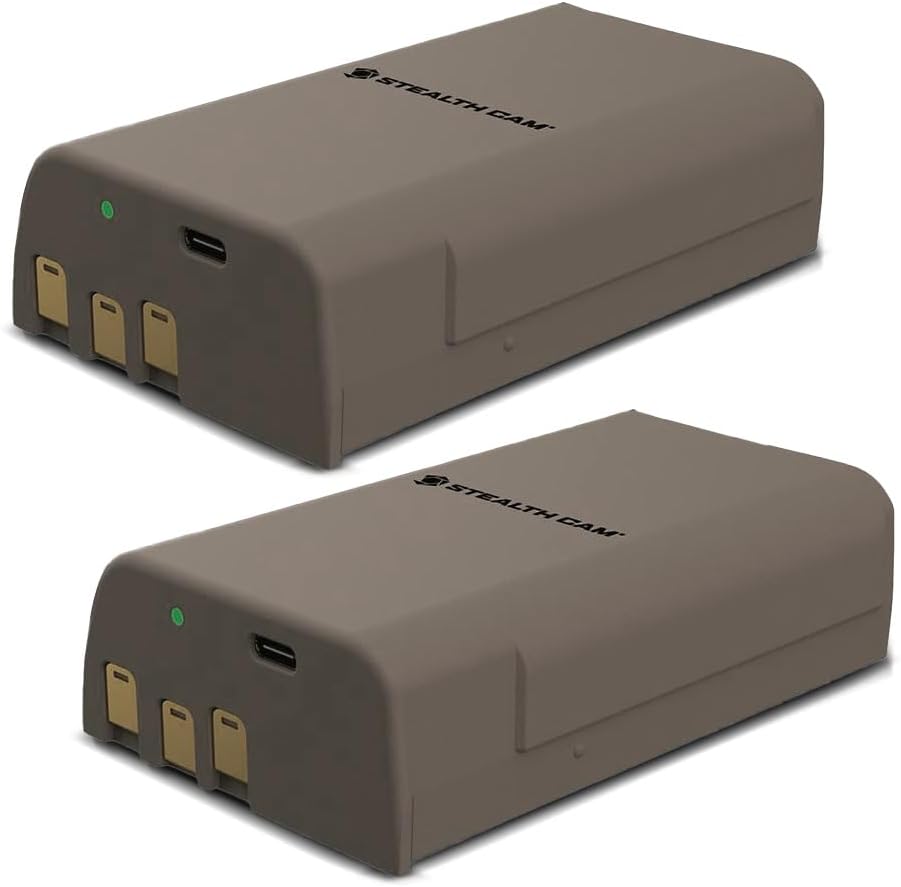
The Stealth Cam FieldMax MAX-PAK two-pack combines a rated 12-volt, 5,000mAh lithium-ion format with two interchangeable cartridges. Its 4.6 rating reflects a well-regarded purpose-built option, while the inclusion of two packs gives users a practical way to rotate batteries or maintain a spare for a remote installation.
We may earn a commission when you buy through this link, at no additional cost to you.
Its standout strengths are the direct compatibility with the Flashback, Deceptor MAX, Fusion MAX, and Connect MAX cameras, plus the included USB charging cable. The cartridges are described as weather resistant and built for temperature swings, making them more convincing in exposed woods than generic batteries designed primarily for indoor electronics. Two packs also offer more scheduling flexibility than a single cartridge.
The trade-offs are compatibility and bulk. This is not a universal rechargeable AA solution, and each 12V cartridge may feel more substantial than standard cells. A buyer should confirm the exact camera model and understand that two cartridges are useful for rotation only if the camera's charging and deployment workflow allows it. Within that narrower Stealth Cam ecosystem, however, the format is clearly tailored to the job.
This is the strongest premium-style choice in the roundup for anyone using a compatible MAX-series trail camera, particularly when low sunlight makes solar charging uncertain. The two-pack format adds resilience, the 5,000mAh capacity supports extended monitoring, and the lack of disposable cells simplifies long-term field maintenance. It is less suitable for mixed-brand camera networks.
Keeping a charged second cartridge can help avoid an unplanned trip when one pack reaches a low state of charge. Rotation also gives owners a practical way to recharge while another pack remains ready for deployment.
The stated resistance to temperature swings and suitability for wooded, low-light deployments make this battery system more purpose-built for outdoor monitoring than a general rechargeable AA cell.
We may earn a commission when you buy through this link, at no additional cost to you.
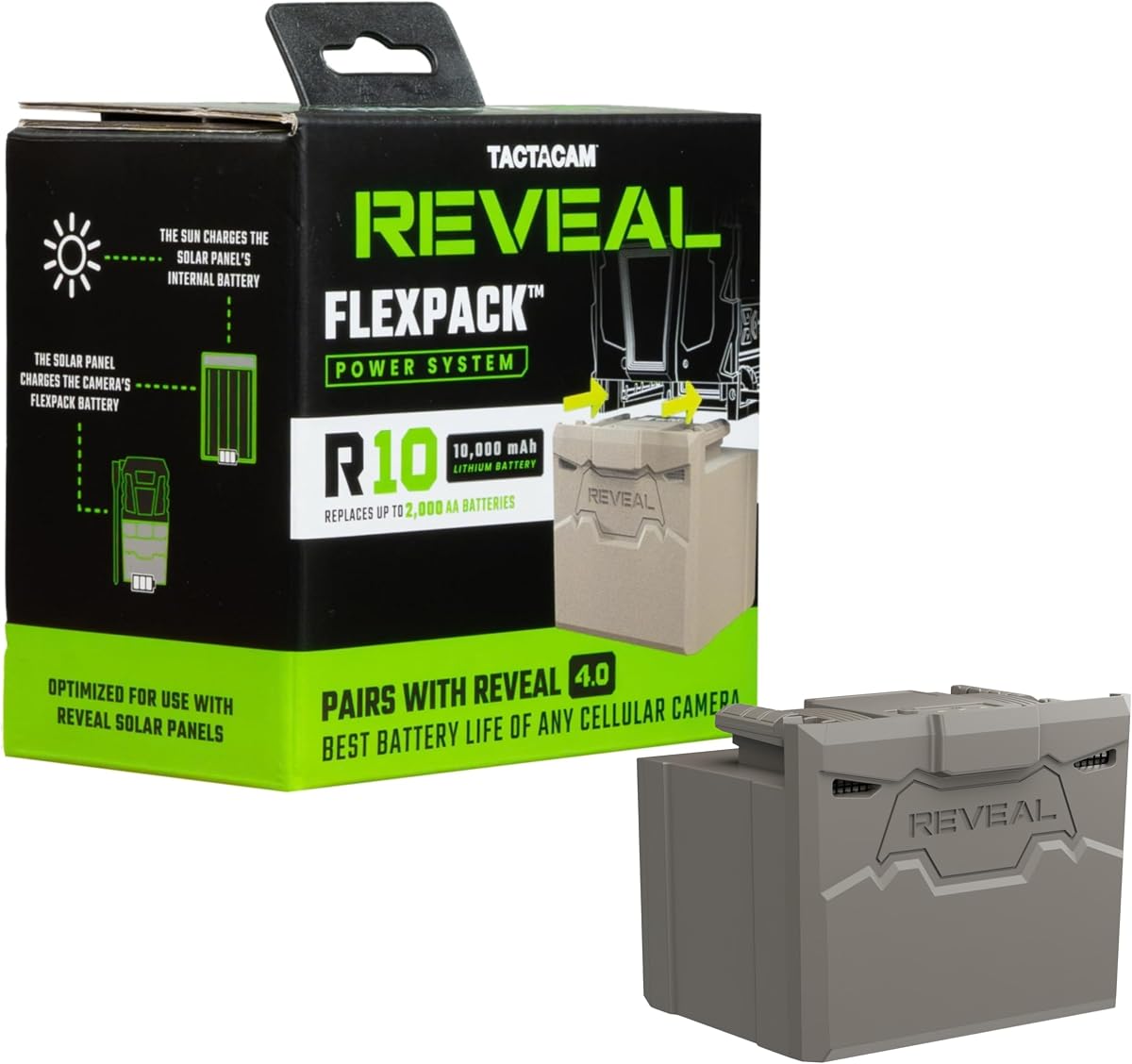
The TACTACAM Reveal FlexPack R10 is presented as REVEAL's most powerful rechargeable battery, with a rated capacity of 10,000mAh. Its 4.8 rating is the highest among the products with published scores, and the emphasis on extended field deployment makes it especially interesting for hunters and wildlife watchers who want to reduce time spent changing power sources.
We may earn a commission when you buy through this link, at no additional cost to you.
The major advantage is its balance of capacity and handling. A 10,000mAh pack can provide a substantial energy reserve, and the quick-swap format is intended to make battery changes less complicated. It can also pair with the Solar Panel R5 or other suitable REVEAL power accessories, creating a path toward a more self-sustaining installation where sunlight and compatible hardware are available.
Its limitations come from the integrated design. Buyers need to own a REVEAL setup that accepts this class of battery and should not interpret the headline capacity as a guaranteed number of recording days. Trigger frequency, video length, temperature, signal strength, and night recording can all affect power consumption. It is also less versatile than a standard rechargeable AA set when cameras use several different battery formats.
The R10 is the most attractive pick for extended REVEAL deployments where minimizing battery changes matters. It offers high capacity, straightforward swapping, and an ecosystem path involving solar accessories. For owners of compatible REVEAL cameras seeking the strongest stated capacity in this list, it is a particularly compelling dedicated power solution.
The 10,000mAh rating gives this pack a larger stated energy reserve than most camera-specific alternatives here. That can translate into fewer maintenance visits, although recording demands will determine the real interval between charges.
Compatibility with the Solar Panel R5 and other suitable REVEAL accessories offers a more integrated power strategy. The setup remains dependent on sunlight, compatible hardware, and sound placement.
We may earn a commission when you buy through this link, at no additional cost to you.
The LIT-10 Pro is a high-capacity rechargeable battery for SPYPOINT Link-Micro, Cell-Link, LM2, and Link-Micro-S-LTE cameras. It has a 5.0 rating and a stated rating of 3.85 volts, 10,500mAh, and 40.42 watt-hours, giving it one of the most substantial capacity claims among the dedicated options reviewed.
We may earn a commission when you buy through this link, at no additional cost to you.
The pack is designed to reduce routine battery replacement while providing the energy needed for field recording. Its supplied information says a full charge takes approximately five hours. A built-in smart chip and listed protections against overcharging, over-discharging, over-voltage, over-current, and overheating improve confidence in regular charging and field use.
The main drawback is that this is not a universal pack. Its fit is tied to named SPYPOINT models, and owners should compare the camera label and battery shape before buying. Actual runtime may vary considerably with cellular signal quality, video activity, PIR triggers, and night illumination. The stated customer-service terms also differ from the physical product, so they should not be treated as a battery-performance guarantee.
For a compatible SPYPOINT setup, this is an excellent practical pick. The combination of a 5.0 rating, high stated capacity, a reasonable claimed charge time, and multiple compatibility points makes it versatile within its supported range. It is especially attractive to users who want a sealed rechargeable option instead of managing loose AA cells.
The 10,500mAh rating exceeds the stated capacity of several other camera-specific packs. A sealed format can also simplify weather exposure and reduce the chance of cells being inserted incorrectly.
The listed overcharge, over-discharge, over-voltage, over-current, and overheating protections make the built-in circuit a meaningful feature. These safeguards support controlled use but do not eliminate the need to follow the manufacturer's charging guidance.
We may earn a commission when you buy through this link, at no additional cost to you.
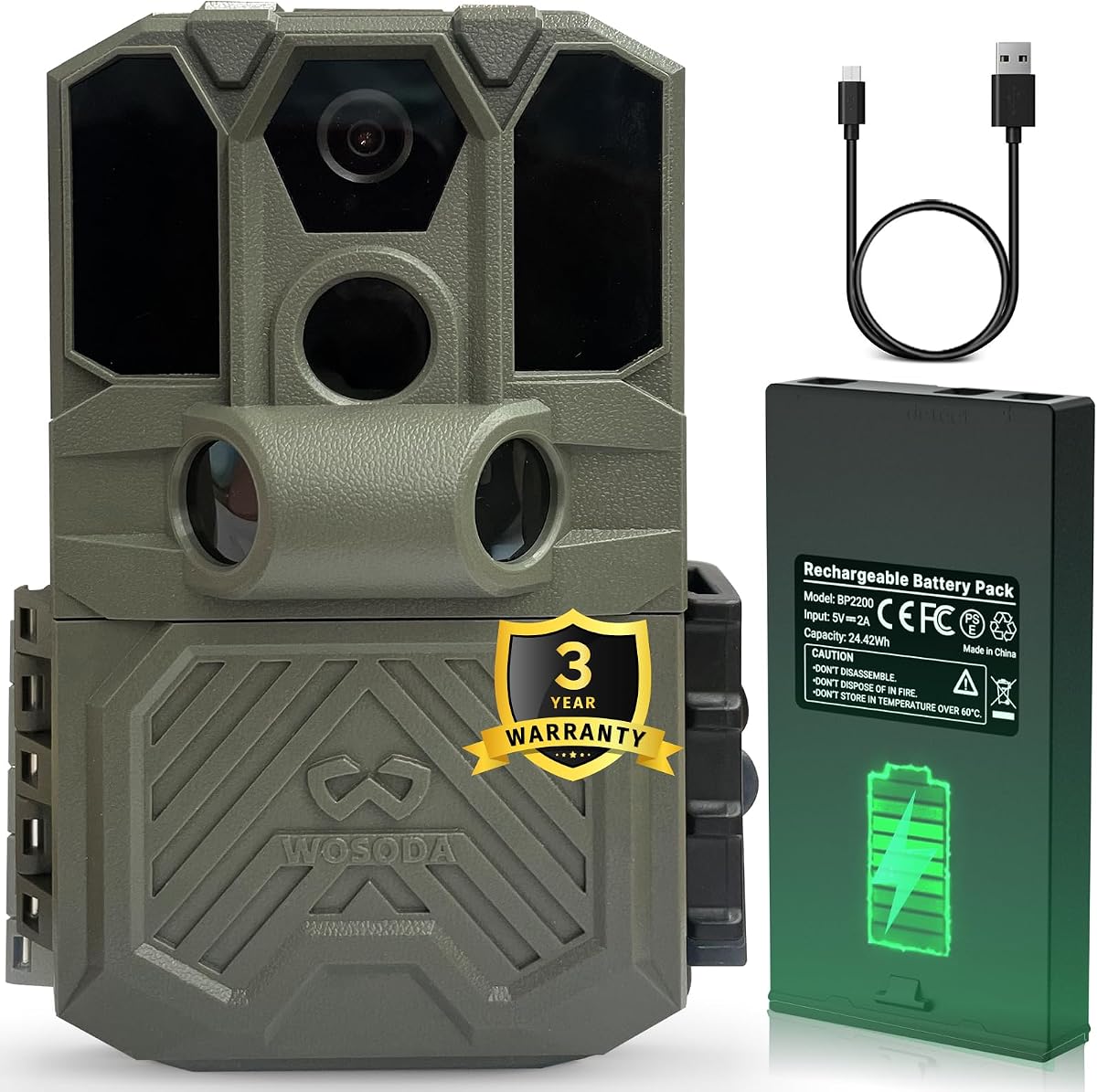
The WOSODA Rechargeable Trail Camera is a complete camera system rather than a replacement battery, with a built-in 2,200mAh lithium battery that must be removed for separate charging. Its 4.3 rating makes it the most accessible way in this list to obtain a trail camera and rechargeable power in one package.
We may earn a commission when you buy through this link, at no additional cost to you.
The camera supports 40MP still images, 2K video, a 0.2-second stated trigger speed, a 120-degree detection field, and local storage on an SD card up to 256GB. Because it is neither cellular nor Wi-Fi connected, users do not need a connectivity subscription for standard local recording. The IP66 enclosure and adjustable PIR controls also support outdoor monitoring.
This product does not solve the problem of replacing a battery in an existing camera. Its 2,200mAh capacity is also lower than the dedicated packs in this roundup, and recording settings such as frequent video capture, burst mode, and low-light operation can affect runtime. Removing the battery for charging means the camera cannot operate while it is being recharged.
Choose it when you need a new non-connected trail camera rather than a battery upgrade. It is a good integrated option for wildlife tracking, property observation, and basic hunting scouting, especially for users who value local storage over remote viewing. Existing camera owners should focus on the purpose-built packs instead.
Footage remains on a local SD card rather than moving to a cloud service. That approach may appeal to users who do not need cellular alerts and want direct control over their recordings.
The removable 2,200mAh battery makes charging possible, but this package cannot be treated as a universal power upgrade. Its primary value is as a complete camera with rechargeable power built in.
We may earn a commission when you buy through this link, at no additional cost to you.
This eight-pack of rechargeable lithium AA batteries is a general-purpose option for AA-powered trail cameras and a wide range of other devices. Its 4.5 rating and 3,800mWh stated energy per battery make it appealing for users who want one charging system across several cameras rather than a model-specific battery cartridge.
We may earn a commission when you buy through this link, at no additional cost to you.
The batteries maintain a constant 1.5-volt output according to the supplied information, which distinguishes them from nominal 1.2-volt NiMH cells. The flip-top charger holds all eight batteries, displays individual charging progress on an LCD, and includes a USB-C cable. Stated operating limits span minus 20 to 131 degrees Fahrenheit, making the set more plausibly suited to outdoor and vehicle storage than basic household rechargeables.
Compatibility requires care. The listing specifically says the batteries are not suitable for smoke alarms, Nest Protect, solar lights, or camera flashes, and notes that some Blink models may display a low-battery warning even while operating. A trail camera designed for 1.5-volt AA cells may work, but a camera with strict battery-type detection or unusual contacts may not. Buyers should confirm the camera manual before relying on the set.
This is a strong choice for mixed fleets of AA-powered cameras, provided the device voltage and battery detection are compatible. The eight-cell quantity makes rotation easy, while the charger and organizer simplify charging logistics. It is less predictable than a camera-specific sealed pack and should be viewed as a flexible standard-cell solution rather than a universal answer.
Eight cells can serve trail cameras, outdoor cameras, game controllers, and other compatible AA-powered equipment. That flexibility can make the charging setup worthwhile for a household with several types of electronics.
The constant 1.5-volt output is useful for devices designed around standard alkaline cells. The explicit exclusions and possible low-battery warnings make it important to check the camera's requirements before purchase.
We may earn a commission when you buy through this link, at no additional cost to you.
The Burflo three-pack provides 7,000mAh rechargeable replacements for LIT-22-style batteries used in numerous SPYPOINT Flex series cameras. No numerical customer rating was supplied, so its evaluation must rest on the stated capacity, compatibility list, charging design, and protection-oriented positioning rather than a rating-based score.
We may earn a commission when you buy through this link, at no additional cost to you.
The three-pack is practical for users who want to rotate batteries between several cameras or maintain spares. It claims a full charge in six hours, integrates USB-C charging, and includes an LED charging indicator. The supplied data also lists a 7.7-volt upgraded output and notes that a 5V, 3A wall plug is recommended for stable charging.
The voltage difference deserves attention: the listing describes the replacement as upgraded from a 7.4-volt original while simultaneously referring to 7.7-volt and LIT-22PRO battery families. That variation can make terminology confusing, so a buyer should verify the camera's accepted battery specification and connector. The product's broad list of Flex models is helpful, but it should not replace checking the exact camera model.
This is a sensible three-battery option for compatible SPYPOINT Flex cameras, particularly when rotation and spare capacity matter. It offers more cells than a single pack and combines charging status visibility with a broad compatibility claim. The lack of a published rating and the charging guidance make careful model verification especially important.
Having three cells allows one battery to charge while another supports a camera. The extra units can also serve as backups for installations located far from reliable charging facilities.
The listing warns that its recommended 5V, 3A wall plug produces more stable charging than a 2A plug. Following the supplied guidance can help avoid uncertain charging behavior.
We may earn a commission when you buy through this link, at no additional cost to you.
The Stealth Cam FieldMax 5000mAh External Battery Combo combines an internal 5,000mAh lithium rechargeable battery with compatibility for a separate solar charging pack. Its 1.0 rating is the lowest published score in this group, so potential buyers should place greater weight on model compatibility and the current product listing rather than assuming a mature customer-review history.
We may earn a commission when you buy through this link, at no additional cost to you.
The core concept is flexible field power. Users can recharge the unit through USB at home, in a vehicle, or at a remote location, and a compatible external solar pack can charge the camera directly in the field. Compatibility extends across MAX, Fusion, Deceptor, and Revolver series, giving the product broader coverage within the Stealth Cam range than the more narrowly named MAX-PAK cartridge.
The solar accessory is sold separately, so the package does not by itself provide a complete off-grid charging system. The low rating may reflect early customer experience, limited reviews, or an issue specific to a unit or setup; the supplied information does not establish the cause. Buyers should inspect recent customer feedback and verify the exact camera and solar-pack connections before committing to a field deployment.
It is most appropriate for Stealth Cam users who want a rechargeable system with a direct path to solar assistance. The onboard charging approach could reduce battery changes and disposable waste, while the 5,000mAh internal battery provides a useful reserve. Given the rating, it deserves more verification than the higher-scoring alternatives.
A compatible external solar pack can charge the camera in the field, potentially reducing the need to carry every battery home. The result depends on sunlight, panel placement, and the separate accessory being available.
Support for MAX, Fusion, Deceptor, and Revolver series makes the combo more adaptable across a mixed Stealth Cam property. Exact fitment should still be confirmed for the specific camera.
We may earn a commission when you buy through this link, at no additional cost to you.
The Artman three-pack is designed as a plug-and-play rechargeable replacement for the battery systems in Moultrie Edge, Edge PRO, Edge 2, and Edge 2 PRO trail cameras. With 6,700mAh per pack and no published numerical rating, it is best evaluated on its compatibility claim, charging system, stated temperature range, and built-in protections.
We may earn a commission when you buy through this link, at no additional cost to you.
A USB-C connection and included cable support a stated full charge in four hours. The LED indicators show charging status and turn off when the batteries are fully charged. According to the supplied information, each pack contains a chip matching the original battery, which supports a straightforward installation without the need to replace traditional loose AA cells.
The operating range is listed as minus 20 to 60 degrees Celsius, or minus 68 to 140 degrees Fahrenheit. That is a strong weather-readiness claim for outdoor monitoring, while overcharge, over-discharge, and short-circuit protection add useful electrical safeguards. As with any replacement pack, the user should confirm that the camera recognizes the battery correctly and that the connector and physical form match.
This is a good rotation-oriented choice for owners of supported Moultrie Edge cameras. Three packs mean one can charge while another remains in service, and the 6,700mAh capacity is meaningful for extended deployments. Its lack of a published rating makes a careful compatibility check and attention to current customer feedback especially important.
The Power Mag design is described as a drop-in alternative to traditional AA batteries. Magnetic positioning may make swaps more orderly, but users should still follow the camera's installation instructions.
A stated range of minus 20 to 60 degrees Celsius suggests attention to year-round outdoor use. Actual performance still depends on the camera, weather, and battery age.
We may earn a commission when you buy through this link, at no additional cost to you.
The Trail Camera AA Alkaline Batteries set includes eight disposable alkaline cells and carries a 4.5 rating. Although it does not meet the rechargeable lithium focus of the guide, it belongs in the comparison because alkaline batteries remain a practical emergency option for many AA-powered trail cameras.
We may earn a commission when you buy through this link, at no additional cost to you.
The product's main advantage is convenience. It can provide immediate power without a charger, specialized connector, or rechargeable battery dock. That makes the set useful as a temporary backup when a rechargeable pack fails, when a camera unexpectedly requires standard cells, or when a user needs a short deployment that does not justify a larger rechargeable setup.
It also lacks the benefits sought from lithium rechargeable systems. Users must repeatedly replace consumed cells, carry enough spares into the field, and handle disposal. The pack is described as mercury and cadmium free, which addresses two specific material concerns, but it does not reduce the recurring need to buy replacement batteries.
This set is best treated as a backup rather than the main recommendation for an extended hunting or wildlife-monitoring deployment. It may suit short trips, temporary testing, or owners who want a dependable fallback. For regular operation, one of the rechargeable camera-specific packs or a compatible high-quality rechargeable AA set is generally more consistent with the guide's goal.
Eight standard cells can be invaluable if a rechargeable pack is depleted, damaged, or incompatible. Keeping them with vehicle or camp equipment provides a straightforward contingency.
Disposable alkaline cells do not reduce battery changes or field-supply weight. They are better viewed as a limited backup for short-term or emergency use.
We may earn a commission when you buy through this link, at no additional cost to you.
The Surefire six-pack consists of 123A lithium batteries optimized for high-drain flashlights and carries a 4.7 rating. These cells are not a rechargeable trail-camera solution, but their long shelf life, temperature tolerance, and high-drain design make them relevant to a limited category of camera equipment that accepts 123A lithium chemistry.
We may earn a commission when you buy through this link, at no additional cost to you.
The stated 10-year shelf life makes primary lithium cells attractive for emergency kits, infrequently used equipment, and storage where the batteries may sit for long periods before use. Built-in heat and fault protection adds a safety layer, and the cells are made to Surefire specifications. Their value comes from being ready when needed rather than from rechargeable convenience.
Compatibility is the decisive issue. Standard AA trail cameras will not accept 123A cells, and even specialized cameras may specify a different chemistry, voltage, holder, or protection circuit. The term lithium also does not automatically mean rechargeable; these are primary cells and are not intended to be routinely recharged. Using them in an incompatible camera could cause damage or create safety concerns.
Choose this product only when a piece of equipment explicitly calls for 123A lithium batteries, perhaps as part of a prepared emergency or maintenance kit. It is not a direct answer for a mainstream AA-powered trail camera and should not compete with the rechargeable camera-specific packs. Its strongest advantage is dependable long-term storage for the right device.
A stated 10-year shelf life is useful when batteries need to remain available but unused. They can provide a prepared reserve for compatible high-drain equipment.
123A lithium is not interchangeable with standard AA rechargeable cells in most trail cameras. Confirm the battery specification and holder before making a purchase.
We may earn a commission when you buy through this link, at no additional cost to you.
The correct rechargeable battery begins with exact camera compatibility, but capacity, voltage, connector design, charging method, and expected weather exposure determine whether it will be convenient in the field. Compare the camera manual and the battery listing together rather than relying on a broad family name or an unfamiliar model number.
Trail cameras use several different power arrangements. Some accept ordinary AA cells, while others use a proprietary lithium cartridge with a specific voltage, shape, connector, and communication chip. The LIT-10 Pro is limited to named SPYPOINT models, the Artman pack targets Moultrie Edge cameras, and the FieldMax options serve particular Stealth Cam lines. A battery that appears similar in shape may still be rejected if its voltage, contact arrangement, or required chip differs.
Confirm the exact camera model, battery model number, voltage, cell format, and charging method before buying. If the camera uses AA cells, check whether it accepts 1.5-volt rechargeable lithium chemistry or expects 1.2-volt NiMH. When a manufacturer lists several compatible series, verify the specific model in the camera manual or current support documentation. Contact the seller when a model number is not clearly listed.
Capacity is commonly advertised in mAh, but the most meaningful comparison also considers voltage. A 10,000mAh pack at one voltage does not necessarily deliver more energy than a smaller pack at a higher voltage. The LIT-10 Pro is rated at 3.85 volts, 10,500mAh, and 40.42 watt-hours, while the Surefire 123A product and the general rechargeable AA set describe different formats and use cases.
Treat advertised capacity as a relative indicator rather than a guarantee of recording days. High trigger rates, long videos, night illumination, weak cellular signals, and cold temperatures can increase consumption. Choose enough reserve to tolerate a missed recharge, but also consider the weight of multiple batteries. For remote properties, three or more rotatable packs can provide more operational resilience than one larger unit that cannot be used while charging.
A convenient battery is one you can recharge correctly without specialized equipment. The FieldMax MAX-PAK includes a USB cable, the Artman pack uses USB-C and claims a four-hour recharge, and the Burflo set uses an integrated USB-C connection with a six-hour charging claim. The LIT-10 Pro is stated to charge fully in five hours. The WOSODA camera requires its removable battery to be charged separately.
Match the charging connector and electrical guidance to the instructions supplied with the battery. Some listings recommend a particular wall plug for stable results, and using a mismatched adapter may lead to slow or inconsistent charging. Consider whether you will charge at home, in a vehicle, or at camp. A battery that takes too long to recharge can be a poor choice when you need to rotate several packs before a trip.
A trail camera is often exposed to freezing nights, direct sun, rain, snow, and dust. The FieldMax MAX-PAK is specifically described as resistant to temperature swings, the Artman pack states an operating range of minus 20 to 60 degrees Celsius, and the rechargeable AA set states a range of minus 20 to 131 degrees Fahrenheit. These claims indicate outdoor intent, but they are not guarantees for every season, charging state, or camera load.
Look for weather-oriented construction, protected contacts, and a stated temperature range. Recharge batteries indoors in moderate conditions before a cold trip, keep spares from freezing, and allow enough time for a full charge. If a battery is exposed to moisture or extreme temperature, inspect it before deployment. Storage conditions also matter because a battery left in a hot vehicle or cold shed can age faster.
The number of batteries included can be more important than the capacity of a single cell. The FieldMax MAX-PAK includes two cartridges, the Burflo and Artman options include three packs, and the rechargeable AA set includes eight cells. Rotation makes it possible to charge one group while another remains deployed, which is particularly useful on a long hunting trip or at a remote property without reliable electrical access.
Consider the full weight and bulk of the rotation set. A sealed camera-specific cartridge may simplify installation, while loose AA cells are easier to share across different cameras. Plan a labeling system so partially charged batteries are not mixed with full ones, and record the charge date for each set. For cameras that draw substantial power, three or more batteries reduce the chance that all reserves will be depleted at once.
Lithium battery packs benefit from built-in circuit protection because improper charging, voltage spikes, overheating, or short circuits can create safety and reliability problems. The LIT-10 Pro lists overcharge, over-discharge, over-voltage, over-current, and overheating protection. The Artman pack lists overcharge, over-discharge, and short-circuit protection, while the Surefire primary cells include heat and fault protection.
Prefer products that state their protection features and include clear charging instructions. Do not use a charging cable or wall adapter that conflicts with the manufacturer's guidance, and never attempt to modify a proprietary battery. Inspect a pack for swelling, impact damage, corrosion, heat, or an unusual odor. A protective circuit is useful, but correct charging and reasonable handling remain the user's responsibility.
For cameras installed in open, sunny areas, a rechargeable ecosystem can reduce manual servicing. The FlexPack R10 is described as compatible with the Solar Panel R5 and other REVEAL power accessories, while the FieldMax Combo works with a compatible external solar charging pack and can charge the camera directly in the field. Neither solar path removes the importance of stored battery capacity because sunlight varies by season, tree cover, and weather.
Check the electrical and physical compatibility of every component before relying on a solar arrangement. Position the panel where it receives unobstructed sunlight, and keep the camera and battery connectors protected from moisture. If your property is heavily wooded or the deployment is brief, USB charging and a larger battery reserve may be more dependable than depending on solar input.
Rechargeable packs can lower recurring battery replacement needs and reduce the number of loose cells carried into the field, but they introduce charging and compatibility responsibilities. Disposable alkaline batteries remain useful for emergency backup, and non-rechargeable primary lithium cells can provide exceptional shelf life for compatible specialized equipment. A mixed strategy can be practical: use rechargeable power for routine monitoring and keep a small, compatible alkaline reserve for failures.
The general rechargeable AA set is not automatically suitable for every camera. Its stated 1.5-volt output and explicit device exclusions require careful review, and some Blink models may display low-battery warnings while operating. Likewise, 123A lithium cells are a different size and chemistry and are not replacements for standard AA batteries. Treat chemistry, voltage, holder design, and charger requirements as essential compatibility criteria.
Begin by confirming the battery model, camera model, voltage, charging connector, and installation procedure in the documentation for both products. Inspect the battery and camera compartment for dirt, corrosion, bent contacts, moisture, or physical damage. Charge the new pack fully under the stated conditions before deployment, and confirm that the camera recognizes the battery and begins recording normally.
When the battery needs service, remove it according to the camera instructions, wipe the contacts with a clean dry cloth, and charge it with the specified cable and power source. Avoid damaged cables, incompatible wall adapters, moisture around charging connections, and charging outside the recommended temperature range. Do not leave a pack connected to a charger indefinitely merely because its indicator remains illuminated, and do not use a swollen, leaking, or unusually hot battery.
For field planning, rotate multiple packs and record which set was charged most recently. Store spare batteries in a moderate, dry environment rather than a vehicle exposed to extreme heat or freezing. If a camera will be idle for a long period, remove the battery according to the manual, charge it to an appropriate level, and inspect it periodically. Replace any pack that has suffered impact, shows corrosion, or no longer provides the expected runtime.
No. Trail cameras may use standard AA cells, proprietary cartridges, or model-specific battery packs with different voltages and connectors. Check the exact camera model and its accepted battery specifications before purchasing. A battery can fit physically yet still be incompatible if the voltage, contact design, or required communication chip is different.
Runtime depends on capacity, recording mode, trigger frequency, video length, cellular signal, night illumination, temperature, and battery age. Advertised mAh alone cannot produce a reliable number of recording days. For predictable planning, review the camera manufacturer's guidance and test a full charge under conditions that resemble your actual deployment.
Only if the camera explicitly supports that chemistry and voltage. Some AA-powered cameras expect disposable alkaline cells or 1.2-volt NiMH batteries and may use battery-type detection. A set may still operate while showing a low-battery warning, as noted for some Blink models. Verify the camera manual and test the batteries before relying on them in the field.
Several smaller packs provide easier rotation. You can charge one set while another remains in the camera, and a spare protects against an unexpected depletion. One large pack may reduce connector handling and clutter, but it cannot be used while charging and offers less redundancy if it fails. The best choice depends on access, weight, and the number of cameras at the site.
Charge in a moderate, dry environment whenever possible. Lithium-ion charging at freezing or very high temperatures can be unsafe or can damage the cells, even when outdoor operating-temperature claims are relatively broad. Bring packs indoors to charge after cold field use and allow them to reach an appropriate temperature before applying power.
Usually not completely. Solar panels can reduce charging visits when they receive adequate sunlight and the camera, panel, and battery are electrically compatible. A stored battery still provides resilience during cloudy periods, heavy tree cover, or high winter power demand. The FlexPack R10 and FieldMax Combo offer paths to compatible solar-assisted setups, but each requires the correct accessories and placement.
A small compatible backup can be useful for an emergency or temporary failure, even when a rechargeable system is the primary choice. Keep the spare cells dry and within their usable period, and do not mix cell types in the same camera unless the manufacturer explicitly allows it. For routine long-term monitoring, rechargeable lithium or compatible high-quality NiMH cells are generally more convenient.
Store them fully or partially charged according to the manufacturer's instructions, in a dry location at moderate temperature. Avoid leaving them in a hot vehicle, direct sunlight, a freezing shed, or with contacts touching metal objects. Inspect them before the next trip and recharge any set that has sat unused, especially if you notice reduced runtime or physical deterioration.
The TACTACAM Reveal FlexPack R10 stands out for owners of compatible REVEAL cameras who prioritize a large 10,000mAh stated capacity, quick swaps, and solar-accessory integration. The LIT-10 Pro is a strong alternative for several supported SPYPOINT models, offering a 5.0 rating, 10,500mAh rated capacity, and a stated five-hour recharge. The Stealth Cam FieldMax MAX-PAK two-pack is the most flexible premium-style choice for compatible MAX-series cameras because it includes two cartridges.
Prioritize exact fit, voltage, and charging method before comparing capacity. A proprietary pack is usually simpler and more dependable for a matching camera, while a rechargeable AA set can serve a mixed fleet if the camera supports its 1.5-volt chemistry. Choose the number of batteries based on rotation needs, remote access, weight, and how often the installation can be serviced. Cold-weather claims and LED indicators are useful, but they should complement rather than replace careful compatibility checks.
Product specifications, ratings, and pricing can change, and the supplied information does not represent personal field testing. Before purchasing, confirm the current camera model, battery model, charging instructions, included accessories, and latest customer feedback. Comparing the final listing details with your deployment plan will help avoid an expensive mismatch and keep the camera running when monitoring matters most.