
Samsung DU9000
4.0Editor score
4K Crystal UHD upscaling
Motion Xcelerator 120Hz
Samsung Tizen smart platform
HDR and Mega Contrast
A 95 Inch Smart TV can transform a living room, home theater, or media room, but choosing the right model requires balancing screen size with picture processing, sound, gaming features, and viewing-room conditions. The most practical set adds useful convenience without overshadowing the core experience of watching movies, live sports, and streaming shows.
The products in this guide are compared using their published specifications, including display technology, refresh rate, HDR support, gaming features, smart-platform functions, audio capabilities, and processor-driven enhancements. The list also covers several 98-inch and 100-inch models because they occupy the same extra-large screen category and offer important alternatives for shoppers searching around 95 inches.
Each review identifies the strongest reason to consider a particular television and the compromises worth understanding before purchase. The three featured picks highlight budget, balanced, and premium approaches, while the full rankings cover QLED, Mini LED, UHD, and smart-platform alternatives. Prices and promotions can change, so confirm current availability and terms before ordering.
4.0Editor score

4.2Editor score

4.4Editor score
As an Amazon Associate we earn from qualifying purchases.
The comparison highlights the most important differences across ten extra-large televisions, including panel type, refresh rate, HDR support, gaming tools, smart platform, and audio. It also shows why screen size alone does not determine picture quality or value.



The Samsung DU9000 is a 98-inch 4K Crystal UHD television designed to deliver an extra-large viewing experience without moving into the more advanced Neo QLED range. It carries a 4.0 rating and stands out through its Supersize Picture Enhancer, AI-assisted 4K upscaling, Motion Xcelerator 120Hz, and Mega Contrast. Those features are particularly relevant when content is displayed across such a wide panel.
We may earn a commission when you buy through this link, at no additional cost to you.
Its picture engine is built around clarity rather than the precise local dimming associated with premium Mini LED sets. The Supersize Picture Enhancer reduces noise and increases sharpness at large screen sizes, while the Crystal Processor 4K applies 3D color mapping, adaptive sound, and upscaling. HDR support, automatic brightness and contrast adjustment, and Q-Symphony compatibility help the television present movies and television more convincingly than a basic UHD panel.
The trade-offs are most apparent in dark-room contrast, fine highlight control, and the degree to which the panel can control light around bright objects. It also lacks the 144Hz performance and premium spatial-audio specification found in higher-end choices. For most viewers, however, the practical combination of smart features, gaming tools, and large-screen processing makes it a sensible entry into this category.
Choose the DU9000 if your priorities are a huge screen, 4K clarity, 120Hz motion handling, and a mature smart platform without moving into flagship pricing. It is especially appropriate for a bright living room, casual sports viewing, and families who want premium conveniences at a more restrained level. The result is a well-rounded budget-focused model rather than a miniature flagship.
The Supersize Picture Enhancer specifically targets the visibility challenges created by a 98-inch display. It reduces noise and increases sharpness, helping streamed and lower-resolution material remain legible from normal seating distances.
Tizen provides direct access to streaming applications, while Alexa Built-In adds voice navigation. Game Bar features such as AI Auto Game Mode, Mini Map Auto Detection, and Virtual Aim Point make the set more useful for modern consoles as well as everyday viewing.
We may earn a commission when you buy through this link, at no additional cost to you.
The TCL 98Q651G is a 4.2-rated 98-inch QLED television that offers one of the most balanced feature sets in this roundup. Its QLED Pro quantum-dot technology, High Brightness+ LED backlight, 120Hz native panel, and broad HDR support make it a strong all-round choice for movies, sports, streaming, and gaming. The television also runs Google TV and includes a voice remote.
We may earn a commission when you buy through this link, at no additional cost to you.
Color and motion are the main strengths. QLED PRO covers nearly the entire DCI-P3 color space, while the TCL AIPQ PRO processor uses deep-learning analysis to optimize color, contrast, clarity, and HDR. Dolby Vision, HDR Pro+, HDR10+, HDR10, and HLG support provide flexibility across streaming services and broadcast sources. For motion, the 120Hz panel, 144Hz variable refresh rate, Motion Rate 480, and MEMC frame insertion target fast sports and action.
Gaming features are unusually comprehensive for this class. Game Accelerator 240 supports variable refresh rates up to 240Hz, while Auto Game Mode automatically engages ALLM to reduce input lag. The built-in subwoofer also gives the set more bass potential than many conventional television speakers. Its limitation is that it remains a QLED LED-backlit design rather than a Mini LED set, so it cannot match the deepest black levels and most precise local dimming of the premium models here.
This is the most versatile recommendation for shoppers who want one large television to handle every major category of content. It is particularly compelling for mixed-use households, since the combination of color accuracy, gaming acceleration, HDR formats, and Google TV avoids forcing a choice between sports capability and cinematic picture quality. It is the strongest balanced pick in the list.
Quantum-dot color and High Brightness+ backlighting provide a meaningful upgrade over standard UHD panels. Support for Dolby Vision, HDR Pro+, HDR10+, HDR10, and HLG ensures the television can take advantage of a wide range of source formats.
The 120Hz native panel, 144Hz variable refresh rate, Game Accelerator 240, and automatic low-latency mode make this a strong option for consoles and PC gaming. The built-in subwoofer also improves the sound presentation without requiring immediate external-speaker investment.
We may earn a commission when you buy through this link, at no additional cost to you.
The Samsung 98Q7F brings QLED color, 4K upscaling, and Samsung's Vision AI approach to a 98-inch 2025 model. Its 4.3 rating reflects a broadly capable specification, with Quantum HDR, up to 4K 120Hz performance, motion-based sound, and a Gaming Hub. The television is designed to improve streamed material and keep fast action smooth on a very large panel.
We may earn a commission when you buy through this link, at no additional cost to you.
Its Q4 AI Gen1 processor provides the main point of differentiation. AI-enhanced color and audio, large-screen noise reduction, 4K upscaling, and deep-black and bold-contrast processing work together to make mixed content more polished. The panel can also operate at up to 4K 120Hz, while tear-free, low-latency HDR gaming targets competitive console and PC experiences. Motion-Based Sound adds spatial cues as objects move across the screen.
Samsung also provides a substantial smart-platform ecosystem. The listing highlights more than 2,700 free channels, including more than 400 premium Samsung TV Plus offerings, and the TV includes Alexa. Knox provides triple-layer protection for personal information, connected services, passwords, and harmful applications. The main limitation is that QLED backlighting cannot deliver the pinpoint highlight control of a Mini LED panel, while Object Tracking Sound Lite is less elaborate than the premium spatial-audio implementation.
The 98Q7F is a good match for viewers who prioritize intelligent processing, a polished smart platform, and high-speed gaming without stepping into flagship pricing. It works especially well for streaming, sports, and mixed-content homes where AI upscaling can make a meaningful difference. Buyers seeking the deepest blacks and most granular dimming should instead consider one of the Mini LED alternatives.
The Q4 AI Gen1 processor combines large-screen noise reduction with 4K upscaling and AI-enhanced color. These tools can make older programs, compressed streams, and lower-resolution sources appear cleaner and more defined on the expansive display.
The Gaming Hub supports up to 4K 120Hz output and low-latency, tear-free gaming. Samsung TV Plus adds a large library of subscription-free channels, making the platform useful even when viewers do not want to pay for another streaming service.
We may earn a commission when you buy through this link, at no additional cost to you.
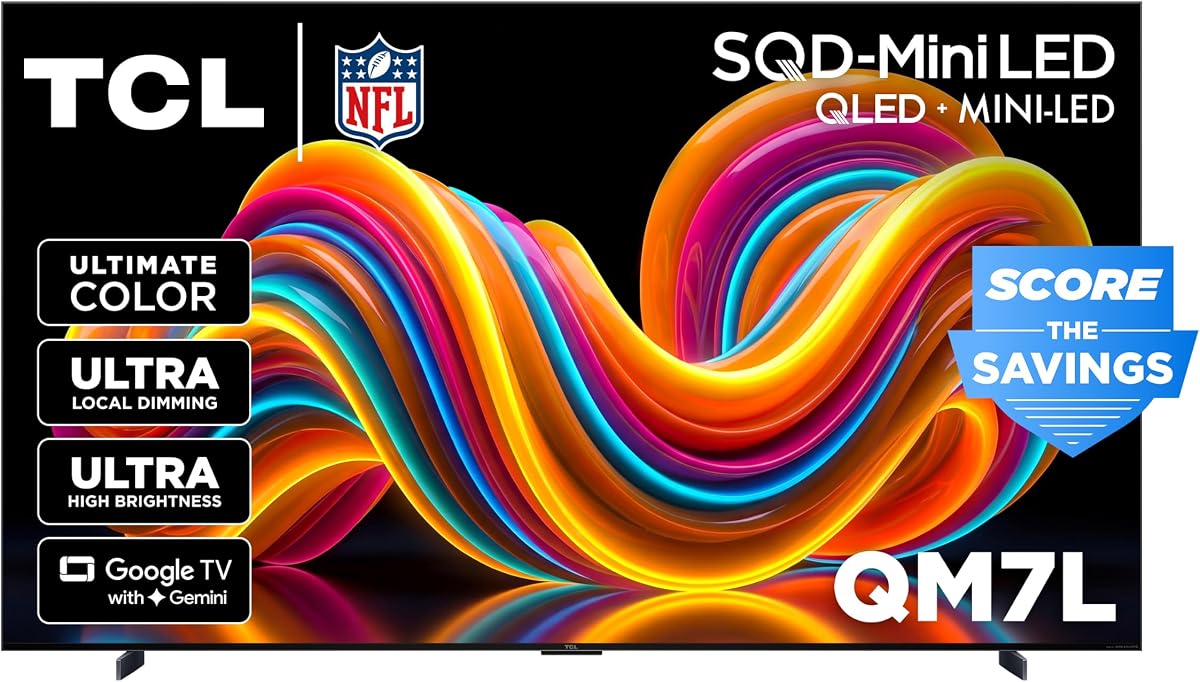
The TCL 98QM7L is a 4.3-rated 98-inch SQD-Mini LED set for viewers who want more precise dark-scene performance than a conventional QLED can offer. Its headline technologies include up to 2,100+ discrete local-dimming zones, a 144Hz refresh rate, an anti-reflective HVA 2.0 Pro panel, and TCL's advanced five-nanometer color filter. Together, they establish it as a serious premium Mini LED option.
We may earn a commission when you buy through this link, at no additional cost to you.
Picture performance is managed by the AIPQ Pro processor, which dynamically adjusts clarity, contrast, color, motion, upscaling, and backlight behavior according to the incoming signal. The Halo Control System works in concert with the deep-color system to reduce blooming and preserve shadow detail. The anti-reflective treatment is especially valuable in a large, bright room, where reflections can otherwise overwhelm a massive display.
Gaming performance is supported by Game Accelerator 288 VRR, AMD FreeSync Premium Pro, the Game Bar, and a 144Hz panel. Audio by Bang & Olufsen adds a more refined sound option, with support for an optional wireless subwoofer and satellite speakers. Complete HDR support covers the major formats, but buyers should recognize that the many advanced picture and gaming menus add complexity compared with a simpler entry-level set.
The QM7L suits enthusiasts who regularly watch dark movies, follow sports, or play games and want advanced dimming without moving to the very top of the range. It is particularly useful in rooms where screen reflections could distract from the image. If that level of control is important, its picture features justify a step up from ordinary QLED and entry Mini LED televisions.
Thousands of independently controlled dimming zones allow the backlight to darken around bright objects while retaining detail elsewhere. That granularity is especially noticeable around subtitles, stars, dark uniforms, and other small highlights.
The ultra-color filter uses finer particles than the standard version specified by the manufacturer, supporting more precise color reproduction. The anti-reflective HVA 2.0 Pro panel also helps preserve contrast in rooms with windows or strong ambient lighting.
We may earn a commission when you buy through this link, at no additional cost to you.
The Samsung 98U9000H is a 2026 98-inch Crystal UHD television that uses the NQ4 AI Gen2 processor to bring advanced enhancements to a more mainstream panel category. It offers 144Hz performance, AI color transformation, 4K upscaling, HDR-like conversion, and a 3.0 rating. The emphasis is on making ordinary and older content look more polished on a large display.
We may earn a commission when you buy through this link, at no additional cost to you.
The processor analyzes incoming video scene by scene to improve sharpness, motion, color, contrast, and perceived depth. Its foreground-contrast analysis is intended to create more dimensional images, while AI HDR conversion gives non-HDR material a more HDR-like appearance. For audio, the AI Sound Controller lets viewers adjust voices, music, and effects independently, which is useful during mixed dialogue-and-action content.
The set also targets fast sports and gaming with 144Hz performance, variable refresh rate, and tear-free motion. Samsung TV Plus provides access to thousands of streaming options, including more than 750 subscription-free channels. The principal concern is the 3.0 rating, which is lower than every other model's score and warrants more attention before purchase. Its UHD foundation also places it below the QLED and Mini LED sets in terms of native contrast and highlight control.
The U9000H is most appropriate for a shopper who wants contemporary AI processing, high refresh rates, and a strong free-content ecosystem in a large television. It may appeal to sports-focused buyers, but its rating and UHD panel category make the TCL Q65 or one of the Mini LED models a safer all-around choice. Prospective buyers should weigh the importance of native picture quality against the appeal of processor-based improvements.
The NQ4 AI Gen2 processor works across sharpness, color, contrast, motion, and upscaling rather than improving only one source type. This broad approach can be particularly helpful for older movies, standard-definition clips, and compressed streaming files.
The AI Sound Controller independently adjusts voices, music, and sound effects. That flexibility helps viewers balance difficult dialogue against loud action sequences without repeatedly changing the master volume.
We may earn a commission when you buy through this link, at no additional cost to you.
The Hisense 100E6QF is the only 100-inch model in the group, making it the natural choice for viewers who want as much screen as possible. It combines QLED color, native 144Hz performance, Dolby Vision IQ, Dolby Atmos, HDR10+, and Fire TV. Its 4.0 rating and broad specification make it appealing for large home theaters, sports rooms, and open living spaces.
We may earn a commission when you buy through this link, at no additional cost to you.
Picture quality is supported by an AI Light Sensor, AI 4K upscaler, and Filmmaker Mode. Quantum-dot color is advertised as capable of more than a billion shades, while the Total HDR Solution includes Dolby Vision, adaptive HDR10+, HDR10, and HLG. AI Smooth Motion uses MEMC, noise reduction, and a responsive panel to improve the clarity of fast action, and the native 144Hz panel supports variable refresh rates from 48Hz to 144Hz.
The built-in audio includes Dolby Atmos, while the Fire TV platform integrates live channels and streaming applications into the home screen. Alexa can be accessed through the remote's Press & Ask feature. The main limitation is that Fire TV's application ecosystem differs from Google TV, Tizen, and webOS, so buyers should confirm that their preferred services and voice routines fit their habits. The physical footprint is also substantial.
Choose the 100E6QF when maximum dimensions, high-refresh gaming, and familiar streaming access matter more than having a Mini LED panel. It is a strong fit for a dedicated media room with controlled lighting and a large viewing distance. For homes with less space, the 98-inch alternatives offer a slightly more manageable size while retaining many of the same headline capabilities.
The native 144Hz panel and variable refresh range of 48Hz to 144Hz provide a useful foundation for responsive console and PC gaming. AMD FreeSync Premium support further aligns the television's refresh behavior with compatible graphics.
The AI Light Sensor adjusts screen brightness in response to ambient conditions, balancing visibility and energy use. Filmmaker Mode preserves the intended aspect ratio, frame rate, color, and audio settings for a more creator-focused presentation.
We may earn a commission when you buy through this link, at no additional cost to you.
The LG 98NU850BPUB combines a 98-inch Nano AI 4K panel with the company's Alpha 8 processing, webOS 2026, and a strong set of gaming and cinematic features. Its 4.0 rating reflects a capable mainstream model with 144Hz variable refresh, HDR10 Pro, Filmmaker Mode, and AI Super Upscaling. It is particularly appealing to buyers who prioritize smart-platform flexibility and processor-led enhancement.
We may earn a commission when you buy through this link, at no additional cost to you.
Alpha 8 drives the Nano Detail Enhancer, which refines textures, contours, and colors, and AI Super Upscaling, which raises HD or even SD content toward near-4K clarity. HDR10 Pro dynamically adjusts brightness to preserve visible information in bright and dark scenes. Filmmaker Mode is designed to preserve the director's original color, settings, and frame rates, while LG Channels provides more than 400 free channels and access to a large on-demand library.
The gaming specification includes 144Hz refresh, Motion Booster 288, AMD FreeSync Premium, ALLM, the LG Game Dashboard, and Game Optimizer. These tools make the television convenient for consoles and cloud gaming. The listing also identifies Google Gemini and Microsoft Copilot as part of webOS 2026, adding conversational and organizational features, while Alexa compatibility provides another voice-control option.
This LG is a sensible choice for viewers who want a large, smart television with strong upscaling and flexible game settings. It does not use Mini LED local dimming, so black levels and highlight blooming are not as controlled as on the premium TCL and Samsung choices. Its appeal lies in the combination of webOS, AI processing, Filmmaker Mode, and extensive gaming customization rather than flagship backlight control.
The processor's super-upscaling function is designed for lower-resolution streaming, broadcast, and older media. Its detail enhancer analyzes image data to improve contours and textures, which is useful when large screens make imperfections more visible.
The Game Dashboard and Game Optimizer let users adjust gaming-related settings without navigating deeply through the television's menus. ALLM, 144Hz VRR, and Motion Booster 288 support fast action and responsive input across compatible devices.
We may earn a commission when you buy through this link, at no additional cost to you.
The TCL 98QM6K brings QD-Mini LED technology to a 98-inch Google TV and carries a 4.3 rating. Its most persuasive combination includes quantum-dot color, Mini LED local dimming, a native 144Hz panel, Dolby Vision, Dolby Atmos, Onkyo audio, and support for four major HDR formats. It is positioned as an accessible premium option for sports, gaming, streaming, and movies.
We may earn a commission when you buy through this link, at no additional cost to you.
The panel uses ultra-precise Mini LEDs to improve brightness and contrast, while the TCL Halo Control System manages local dimming to reduce blooming and improve shadow detail. Quantum-dot technology provides more than a billion advertised colors. Dolby Vision, HDR10+, HDR10, and HLG ensure compatibility with current high-dynamic-range sources, and the 144Hz native rate plus Motion Rate 480 target clear motion during live sports.
Dolby Atmos and Onkyo audio distinguish this model from many entry-level 98-inch sets, while Google TV offers familiar app-based navigation and voice control. The main limitation is that its published specifications do not detail the same number of dimming zones or brightness figures as the higher TCL QM7L and QM8L. That means buyers prioritizing explicit peak brightness or premium local-dimming granularity may want to compare those models directly.
The QM6K is an attractive middle ground for buyers who want Mini LED benefits without selecting the category's most advanced model. It suits a bright media room, competitive gaming setup, or household that regularly watches films and sports in 4K. Compared with the Q65, it offers more sophisticated backlight control; compared with TCL's upper models, it asks for fewer specifications to understand and is simpler to recommend as a balanced step-up.
QD-Mini LED combines quantum-dot color with finely controlled backlighting to improve contrast and brightness. The Halo Control System focuses on reducing haloing and preserving detail in dark scenes without requiring the extensive specification of TCL's advanced models.
A native 144Hz panel and Motion Rate 480 target fast live action, while broad HDR support helps films and broadcasts retain visible detail. Onkyo speakers with Dolby Atmos provide more deliberate audio integration than a basic television setup.
We may earn a commission when you buy through this link, at no additional cost to you.
The TCL 98QM8L is the most technically advanced Mini LED option in the roundup, with a 4.3 rating and specifications that include more than 4,000 discrete dimming zones, up to 6,000 peak nits, and a stated 7000:1 static contrast ratio. It combines those television-focused capabilities with a 144Hz panel, SQD-Mini LED technology, and Bang & Olufsen audio for buyers who want the highest level of control.
We may earn a commission when you buy through this link, at no additional cost to you.
The enhanced Halo Control System includes advanced micro LEDs, condensed micro lenses, reduced optical distance, an ultra panel, super quantum crystals, fast transient response, and a 26-bit dynamic-dimming controller. TCL's AI suite separately handles color, contrast, clarity, motion, upscaling, and sound. The result is a package designed to produce deep blacks, bright highlights, and minimal blooming around high-contrast edges.
Gaming is supported by Game Accelerator 288 VRR, AMD FreeSync Premium Pro, and the Game Bar. Google Gemini offers interactive AI functions, while optional wireless subwoofer and satellite speakers can extend the Bang & Olufsen audio configuration. The complete HDR format support ensures compatibility with Dolby Vision and other current standards. These features also make the television demanding to operate and may require deliberate room calibration for the best results.
The QM8L is best for a dedicated home theater or premium media room where brightness, contrast, and fine dimming can be appreciated. It also makes sense for gamers who want high refresh rates alongside exceptional HDR performance. Buyers seeking the same Mini LED fundamentals at a lower specification level can consider the QM6K or QM7L, while those who prefer Samsung's object-tracking audio may favor the Neo QLED alternative.
More than 4,000 independently controlled zones allow the backlight to track small bright details with greater precision. This helps dark scenes retain depth while reducing the visible haze that can appear around letters, lamps, or windows.
The stated peak brightness of up to 6,000 nits is designed to support impactful HDR highlights in controlled rooms. A high static contrast ratio complements the dimming system, although actual results depend on room conditions, content, and settings.
We may earn a commission when you buy through this link, at no additional cost to you.
The Samsung QN90D is the highest-rated model in this guide at 4.4 and represents a complete flagship approach to an extra-large television. Its 98-inch Neo QLED panel uses Quantum Matrix Mini LED backlighting, Neo Quantum HDR+, a 144Hz Motion Xcelerator rate, and Samsung's NQ4 AI Gen2 processor. Dolby Atmos and Object Tracking Sound+ provide the strongest integrated audio specification in the lineup.
We may earn a commission when you buy through this link, at no additional cost to you.
Quantum Matrix Mini LED lighting helps the television reveal detail across the range from dark shadows to bright highlights. Neo Quantum HDR+ is designed to preserve the director's intended contrast, color, and fine detail, while Real Depth Enhancer Pro detects focal points and creates a more dimensional image. The NQ4 AI Gen2 processor uses specialized neural networks for Smart TV Hub functions, Dolby Atmos processing, and scene-by-scene 4K upscaling.
Gaming is another major strength. Motion Xcelerator 144Hz supports smooth action, while Auto HDR Remastering and the HDR Brightness Optimizer improve presentation across different content and room conditions. Object Tracking Sound+ moves sound effects to follow visible objects, creating a more convincing soundstage on a screen of this scale. Tizen OS, Alexa, and a broad application catalog make the platform suitable for mixed entertainment needs.
This is the premium recommendation for buyers who want a television that is exceptional at films, sports, gaming, and smart-platform use. The Mini LED backlight offers a more sophisticated alternative to standard QLED and UHD models, while the audio system and AI processing make the package feel more complete. The total ownership commitment is high, so it makes most sense in a dedicated room where the entire wall and sound system can be planned around it.
Quantum Matrix Mini LED lighting provides granular control across the display, supporting deeper blacks and more visible detail in bright scenes. Neo Quantum HDR+ then adapts the image to preserve contrast, color, and highlight information.
Object Tracking Sound+ follows visible objects as they move through the frame, while Dolby Atmos creates a wider soundstage. The result is particularly useful on a 98-inch display, where the distance between the speakers and on-screen action can make basic television audio feel detached.
We may earn a commission when you buy through this link, at no additional cost to you.
An extra-large television is a substantial room and lifestyle commitment. Picture technology, gaming performance, sound, smart features, installation needs, and the viewing environment should be evaluated together rather than treating the diagonal measurement as the only meaningful specification.
A screen near 95 inches is intended to fill a wide wall and can feel overwhelming if the seating distance is too short. Consider both the television's dimensions and the space required for its stand or wall mount, including ventilation and access to cables. Wider rooms and greater viewing distances make very large panels easier to integrate without forcing viewers to track fast movement across an excessively broad image.
The product list includes Crystal UHD, QLED, QD-Mini LED, and SQD-Mini LED panels. UHD is the simplest option, QLED uses quantum-dot color for a wider and more saturated palette, and Mini LED adds numerous backlight zones that can improve black levels and reduce blooming. Advanced Mini LED models can also provide much higher brightness specifications, which matters for specular highlights and a dedicated dark viewing room.
Every model here offers 4K-class output, but not all sources are natively 4K. Streaming services, broadcasts, older movies, and game consoles may deliver lower-resolution video, making the processor's upscaling important. AI upscaling can sharpen edges, reconstruct textures, and reduce visible noise, though it cannot create genuine detail that was never captured. The best approach is to pair a strong processor with high-quality source material.
Refresh rates range from 120Hz to 144Hz across the list, with some models adding higher variable-refresh ranges or motion-rate processing. Native 144Hz provides smoother motion when a console, PC, or source can deliver the required frame rate. For sports, frame interpolation can clarify fast movement, although it may alter the cinematic look of original content. Variable refresh rate is especially valuable for gaming because it synchronizes the display more closely with the console.
Dolby Vision, HDR10+, HDR10, and HLG appear across many of the models, but support alone does not guarantee strong performance. Brightness, local dimming, color volume, and processor behavior determine how effectively those formats are presented. If cinematic HDR is important, compare Mini LED models for contrast and brightness rather than relying only on the number of format logos.
ALLM or automatic game mode can reduce input lag, while VRR keeps frame presentation aligned with compatible consoles and PCs. The strongest models add 144Hz operation, high advertised variable-refresh ranges, AMD FreeSync support, mini-map tools, and game-specific picture menus. Ensure the television includes the connections and bandwidth needed for the resolution, refresh rate, and HDR mode you intend to use.
The guide covers Tizen, Google TV, Fire TV, and webOS, each with a different interface, application catalog, content organization, and voice ecosystem. Samsung supports Alexa, LG and Google TV models offer broad voice options, and Hisense uses Fire TV with Alexa. Because interfaces and service availability can change, verify that your preferred streaming applications, live-TV service, voice assistant, and account setup method align with your habits.
A 98-inch screen can make built-in speakers sound less immersive because the audio originates from a much wider image. Dolby Atmos, Bang & Olufsen, Onkyo, and object-tracking audio can improve the presentation, while some models support optional wireless subwoofers or satellite speakers. Also consider reflections, furniture placement, and whether a soundbar or surround system would deliver a more convincing result for the room.
Begin with installation planning rather than unboxing. Confirm the television's weight, stand footprint, wall-mount compatibility, ventilation clearance, cable routing, and the intended viewing distance. If mounting it, use appropriate hardware and follow the manufacturer's instructions, particularly around tilt adjustment and the weight limits of the mounting system.
After setup, spend time calibrating the picture in the room where the television will actually be used. Ambient light, wall color, and screen reflections influence the result. Start with the appropriate picture mode, then adjust brightness, contrast, color, and local-dimming settings gradually. Avoid changing several controls at once, because it becomes difficult to identify which adjustment improves or harms the image.
For daily care, dust the screen with a soft microfiber cloth and avoid aggressive cleaners or liquid applied directly to the panel. Manage cables to reduce clutter, update the television's software when prompted, and check that the mount or furniture remains secure. Allow adequate airflow around the set, and avoid placing objects against its vents or leaving heat-producing equipment directly underneath it.
It depends on the room's width, seating distance, and wall layout. A very large television can work well in a dedicated media room or wide living space, but it may feel overpowering when viewers sit close to the screen. Measure the available area, check the product's exact dimensions with its stand, and consider the viewing distance before committing.
Mini LED generally provides more precise backlight control, deeper black levels, and better highlight control than conventional QLED. QLED remains a strong option when excellent color, strong value, and simpler panel design are priorities. The best Mini LED models are most compelling in dedicated rooms where their brightness and contrast can be appreciated.
A high refresh rate can make fast sports and action look smoother, particularly with compatible content and gaming systems. It is not the only factor affecting motion clarity, since processing and source quality also matter. If gaming is important, variable refresh rate and low-latency features may be more valuable than a higher advertised motion-rate number.
For most living-room viewing distances, a high-quality 4K television can deliver a more practical balance of picture quality, processing, and cost. Native 8K content remains limited, and the products in this guide emphasize 4K output with AI upscaling. Shoppers should prioritize contrast, brightness, viewing distance, and room lighting rather than treating resolution as the only quality measure.
There is no universal winner because platform strengths vary and services change over time. Tizen, Google TV, Fire TV, and webOS all provide familiar app-based navigation, but the best choice depends on preferred applications, voice assistants, live-TV integration, and interface preferences. Confirm support for the services you use before purchasing.
A soundbar or surround system is often worthwhile because the wide image can make compact built-in speakers seem less immersive. Models with Dolby Atmos, object-tracking audio, or support for wireless speakers provide a good foundation, but room acoustics and soundbar size matter. Consider adding audio equipment as part of the overall installation rather than as an afterthought.
The exact requirement depends on the model because bezels, stand dimensions, and wall-mount arrangements vary. Because TVs near this size are generally mounted, compare the product's listed dimensions with the available wall area and account for ventilation. Leave enough room for cables, speakers, and access to side or rear connections.
No. Screen size increases the visual impact, but processor quality, panel technology, local dimming, brightness, contrast, and source material determine image quality. Two large sets can look very different under the same conditions. Compare technical specifications and display features rather than assuming the largest or newest television is automatically the most accurate.
The Samsung DU9000 stands out as a budget-focused extra-large option with 4K upscaling, 120Hz motion processing, HDR, and Tizen. The TCL 98Q651G is the most balanced all-around choice, offering QLED color, multiple HDR formats, 120Hz native refresh, and useful gaming acceleration. At the premium end, the Samsung QN90D combines Mini LED picture hardware, high-refresh gaming, AI processing, and the strongest integrated audio specification in the group.
The right priority depends on the room and the viewer. Mixed-use households may favor the TCL 98Q651G, sports fans can examine the Hisense 100E6QF, Samsung 98U9000H, and LG 98NU850BPUB, and dedicated theater buyers should scrutinize the advanced Mini LED models. Before finalizing, measure the installation area, check supported streaming services, confirm gaming and HDMI requirements, and ensure the set is not larger than the room can comfortably support.
Pricing, discounts, and product availability can change, and the screen sizes in this guide include closely related 98-inch and 100-inch alternatives. Review the latest listing details before purchasing, especially for panel specifications, refresh-rate support, included accessories, and warranty terms. Taking the time to compare the current offer can make the large-screen investment far more satisfying.