
KODAK PIXPRO AZ405
4.1Editor score
40x optical zoom
20MP CMOS sensor
Optical image stabilization
AA battery operation
Compare best Superzoom Bridge Camera options by zoom reach, stabilization, video, autofocus, controls, and features for travel, wildlife, and sports.
Superzoom bridge cameras combine the familiar controls of a point-and-shoot with the long telephoto reach of a dedicated interchangeable-lens camera. They are especially useful for wildlife, travel, sports, performances, and scenic details where moving close is impractical, while offering more framing flexibility than a typical compact camera.
The cameras in this guide were compared using the supplied specifications, focusing on optical zoom range, stabilization, sensor resolution, video formats, viewing options, connectivity, battery design, and specialized shooting modes. The list covers models from Nikon, Panasonic, Kodak, and Minolta, including standard, bundle, and renewed configurations.
Each review highlights the most useful features and practical trade-offs of its camera. The selections span approachable point-and-shoot designs, advanced high-zoom models, and value-oriented options, but ratings and specifications do not tell the whole story. Product availability and pricing can change, so confirm the current listing before purchasing.
4.1Editor score

4.4Editor score

4.2Editor score
The table below provides a side-by-side view of optical reach, stabilization, video capabilities, and the most distinctive feature of every camera in the guide.




The Panasonic Lumix FZ80 is a well-rounded superzoom bridge camera with a 4.2 rating, a 60x optical zoom, 4K video, and a large electronic viewfinder. Its standout quality is the combination of a bright 2,360K-dot viewfinder and a compact point-and-shoot format, which makes it appealing for travelers who want long reach without handling a large interchangeable-lens body.
We may earn a commission when you buy through this link, at no additional cost to you.
The 0.74x electronic viewfinder is designed to remain easy to see in bright sunlight, addressing a common weakness of bridge cameras that rely only on a rear display. POWER O.I.S. optical image stabilization helps suppress hand shake at the tele end, while 4K video and 4K Photo capture add flexibility. The Post Focus function is especially interesting because it allows a selected area to be brought into focus after the frame has been recorded.
The trade-off is optical reach. A 60x zoom can handle birds, sporting events, distant buildings, and stage performances, but it falls short of the 83x and 125x cameras in this guide when a subject is extremely distant. The supplied specifications also do not list RAW capture, so photographers wanting extensive editing latitude may prefer one of the Nikon models. Even so, the FZ80 balances easy handling, stabilization, 4K recording, and a usable viewfinder better than many basic superzooms.
This is the strongest all-around choice for travel, family events, wildlife, and everyday shooting. It is particularly suitable for anyone who values a bright viewfinder and post-focus convenience but does not need maximum telephoto magnification. Choose the FZ80 when it is important to have a capable bridge camera that remains conceptually simple to operate.
The 2,360K-dot electronic viewfinder offers a more substantial way to frame distant subjects than a small screen alone. Its 0.74x equivalent magnification also makes handheld long-zoom compositions more practical in daylight.
Post Focus lets the photographer identify an area after taking the picture, while 4K Photo can extract an 8-megapixel frame from recorded footage. Together, these features make missed-focus moments and changing subjects less damaging.
We may earn a commission when you buy through this link, at no additional cost to you.
The Nikon COOLPIX P950 combines an 83x optical zoom with a 4.4 rating, 16-megapixel resolution, 4K UHD video, RAW capture, and a rotating LCD screen. It is a versatile bridge camera for users who want serious telephoto reach without moving to a much larger interchangeable-lens system.
We may earn a commission when you buy through this link, at no additional cost to you.
Its 83x optical zoom is backed by 166x Dynamic Fine Zoom, giving photographers plenty of room to isolate birds, athletes, performers, ships, and architectural details. Bird and Moon modes simplify settings for two common long-zoom subjects, while the vari-angle screen supports overhead, low-angle, and self-facing compositions. RAW format gives more latitude for editing than models limited to standard still-image files.
Its main compromise is the 16-megapixel sensor, which provides less pixel detail than 20-megapixel alternatives. The P950 also offers many controls and modes, so it may feel more complex than a basic automatic camera. However, those features reward users who want to move beyond fully automatic operation without carrying a separate interchangeable-lens kit.
The P950 is best for travelers, birders, sports fans, and travelers who want to be prepared for distant scenes. It is a strong alternative to the FZ80 when maximum zoom, RAW capability, and 4K video are more important than a particularly bright viewfinder. It also represents a balanced bridge-camera experience at 4.4 stars.
Built-in Bird and Moon modes reduce the need to configure a complex settings profile every time a common subject appears. They are convenient starting points, although responsible framing and stable technique remain important at extreme focal lengths.
The rotating LCD makes framing easier when holding the camera high, low, or toward the photographer. It is especially helpful for self-portraits, tabletop recordings, wildlife observations, and compositions taken below eye level.
We may earn a commission when you buy through this link, at no additional cost to you.
The KODAK PIXPRO AZ405 is an approachable 40x optical-zoom camera with a 4.1 rating, a 20-megapixel CMOS sensor, optical image stabilization, and straightforward automatic shooting. It is one of the most straightforward ways to gain bridge-camera reach without moving to an advanced interchangeable-lens setup.
We may earn a commission when you buy through this link, at no additional cost to you.
The lens begins at a 24mm wide-angle position, allowing group portraits and broad landscapes before zooming toward wildlife, athletes, or performers. A 20MP CMOS sensor supplies more resolution than many bridge cameras, while OIS helps reduce hand-shake blur at longer focal lengths. Automatic scene detection keeps the controls approachable, and 1080p Full HD video covers everyday travel and family memories.
Its limitations are clear: it records at 1080p rather than 4K, and the supplied feature list does not mention RAW capture, Wi-Fi, or an electronic viewfinder. It also uses standard AA batteries rather than a rechargeable lithium-ion pack. These drawbacks matter for dedicated video creators or photographers who want immediate wireless transfers, but they do not undermine the camera's core purpose as an affordable optical-zoom model.
The AZ405 is ideal for beginners, families, travelers, and anyone who wants dependable zoom capability with minimal setup. It is the budget recommendation in this guide because it combines a useful 40x lens, modern 20MP resolution, stabilization, and broadly available battery technology. Choose it when ease of use and value matter more than 4K video or advanced connectivity.
The use of standard AA cells means a photographer can carry a small supply of familiar batteries instead of relying on a proprietary charger. That convenience is valuable on long road trips, outdoor excursions, and visits to places where charging access may be limited.
A 40x optical zoom and 24mm wide-angle starting point provide enough range for family gatherings, local wildlife, events, and scenic travel photography. It is less extreme than the 83x and 125x options, but the difference may rarely matter for typical subjects.
We may earn a commission when you buy through this link, at no additional cost to you.
The KODAK PIXPRO AZ425 delivers 42x optical zoom, a 20-megapixel backside-illuminated CMOS sensor, optical image stabilization, and a 4.0 rating. It is a natural step up from simpler compact cameras for people who want better low-light gathering and greater creative control without paying for an advanced Nikon or Panasonic system.
We may earn a commission when you buy through this link, at no additional cost to you.
Its backside-illuminated design is intended to gather light more efficiently, which is useful for golden-hour scenery, indoor gatherings, and overcast conditions. A 24mm wide-angle beginning provides room for group shots and landscapes, while 42x optical reach helps with birds, stadium action, and stage performers. Panorama and custom modes add room for experimentation beyond automatic scene selection.
The AZ425 records 1080p Full HD rather than 4K, and the listed specifications do not identify RAW support or wireless connectivity. Its rechargeable lithium-ion battery is rated for roughly 240 shots per charge and works with Class 10 SD, SDHC, or SDXC cards up to 512GB. Compared with the AA-powered AZ405, it offers a more modern power and storage arrangement but loses some battery flexibility.
This camera is well suited to travel, family documentation, outdoor events, and users who want manual-style features without a large body. It makes sense as the value-focused middle ground between a 40x budget model and a much more capable premium bridge camera. Choose the AZ425 when light-gathering performance and rechargeable convenience are the deciding priorities.
The 20MP backside-illuminated CMOS sensor is designed to collect light efficiently. That makes it relevant for indoor family events and natural scenes where a less capable sensor may produce duller or noisier results.
Compatibility with Class 10 SD, SDHC, or SDXC cards up to 512GB provides ample room for still images and Full HD recordings. USB transfer supports archiving and sharing, while the rechargeable battery simplifies routine charging.
We may earn a commission when you buy through this link, at no additional cost to you.
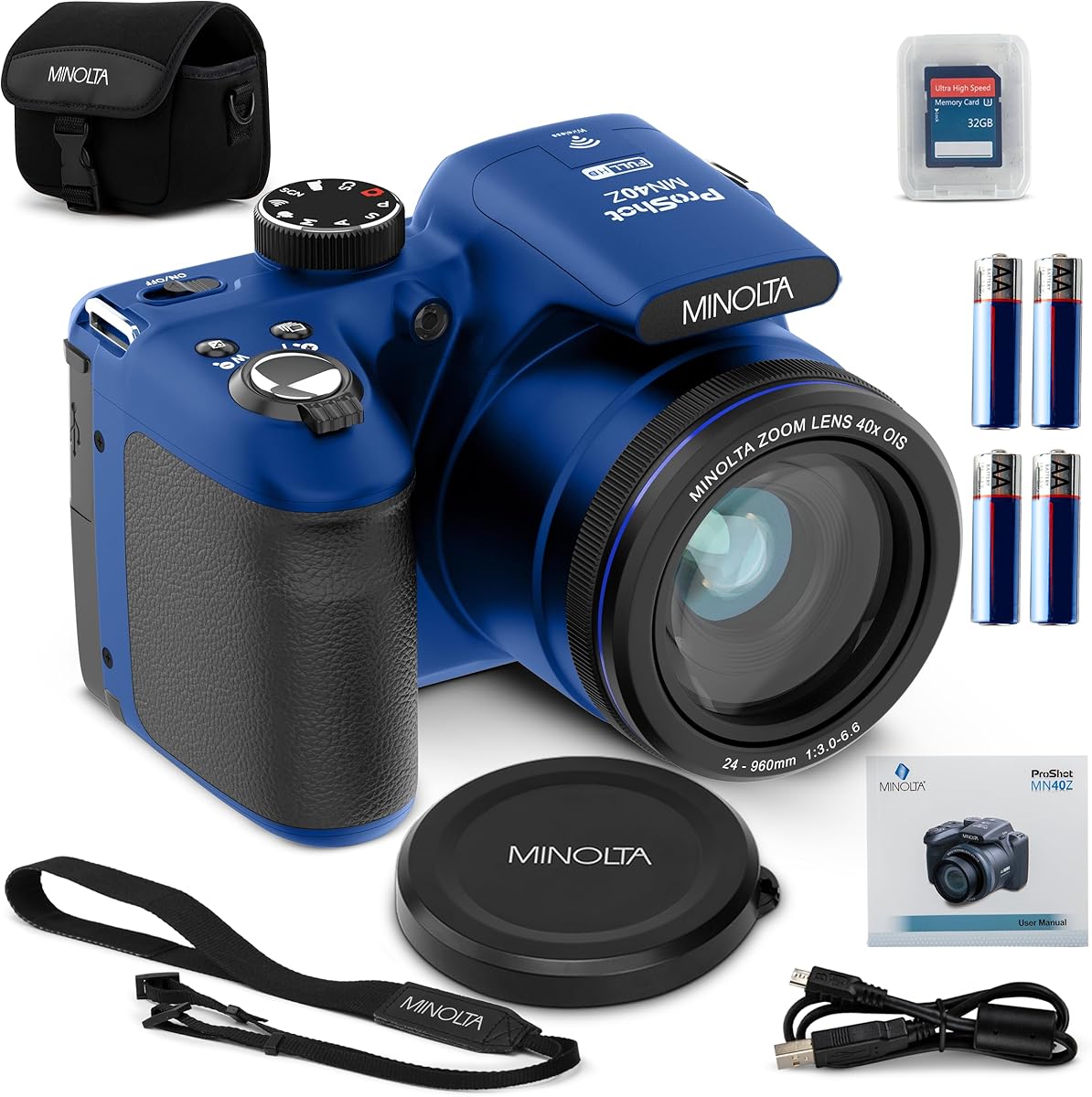
The Minolta MN40Z ProShot is a user-friendly bridge camera offering 40x optical zoom, 20-megapixel still images, 1080p video, a 3-inch LCD, and Wi-Fi app integration. Its 4.1 rating places it alongside the strongest Kodak options, while the connectivity distinguishes it from cameras that rely only on physical media transfers.
We may earn a commission when you buy through this link, at no additional cost to you.
The camera is positioned for both novice and experienced photographers, with a 40x zoom that is useful for distant travel details, sports, and casual wildlife. Wi-Fi and app support can simplify moving images to a compatible phone or tablet, reducing the need to rely exclusively on a card reader. Four AAA batteries are included, making the power solution approachable for casual users.
The video specification stops at 1080p FHD, so the ProShot is not the natural choice for a buyer whose priority is 4K footage. The supplied information also provides fewer details about stabilization, RAW support, viewfinder design, and advanced shooting modes than it does for the Nikon models. That limited documentation does not make the camera unusable, but it offers less basis for anticipating enthusiast-level performance.
The MN40Z ProShot is a solid selection for families, casual travelers, and beginners who prioritize simplicity, zoom, and wireless sharing. It offers enough resolution for ordinary prints and screen viewing, and its 40x reach provides genuine photographic flexibility. Choose it when convenience and app-based sharing matter more than 4K recording or extreme telephoto reach.
Built-in Wi-Fi and app integration offer a convenient path for transferring images without repeatedly swapping cards. For vacations and family events, that can make it easier to share selected photos while the moments are still fresh.
The 20-megapixel sensor, 40x zoom, and familiar automatic point-and-shoot approach provide useful capability without requiring advanced camera knowledge. It is a practical middle ground for users stepping up from a phone or basic compact camera.
We may earn a commission when you buy through this link, at no additional cost to you.
The Minolta MN68Z combines 20-megapixel still images, 4K Ultra HD video, 68x optical zoom, and optical image stabilization. It has no supplied rating, so its numerical customer feedback cannot be evaluated here, but its specifications position it as a modern, high-reach bridge camera with an emphasis on both photography and video.
We may earn a commission when you buy through this link, at no additional cost to you.
The 68x lens provides useful middle ground between the 40x and 42x budget models and the 83x or 125x Nikon cameras. It can bring distant wildlife, performers, and sporting subjects into tighter compositions without requiring the extreme framing flexibility of a super-telephoto model. Optical image stabilization supports handheld shooting, while 4K recording gives video creators a higher-resolution option than the 1080p alternatives in the guide.
The bundle includes a carrying case, 32GB SD card, and rechargeable battery, reducing the need to purchase basic accessories separately. Built-in Wi-Fi, USB-C connectivity, and HDMI output provide several ways to transfer or display content. The camera is also described as having a durable build and being available in multiple colors, although the listed configuration shown here is black.
The MN68Z is worth considering for travelers and content creators who want 4K video and substantial optical reach without moving to the very top of the bridge-camera range. Its lack of a supplied rating warrants checking current customer feedback, and the provided information does not mention RAW capture or an electronic viewfinder. Even so, the overall feature mix is attractive for a general-purpose superzoom.
A 68x range offers meaningful reach for distant subjects while avoiding the largest, most specialized bodies in the category. It is a useful compromise for travel, events, and casual wildlife photography.
4K Ultra HD recording, Wi-Fi, USB-C, and HDMI create several paths for creating and moving content. The included memory card and rechargeable battery also make the bundle more immediately useful for travel.
We may earn a commission when you buy through this link, at no additional cost to you.
The Nikon COOLPIX P1100 is the premium choice in this guide because it delivers exceptional 125x optical zoom alongside 4K UHD video, RAW capture, Dual Detect Optical VR, and dedicated bird-watching functions. Its 4.2 rating reflects a capable package for photographers who genuinely need to photograph subjects that cannot be approached closely.
We may earn a commission when you buy through this link, at no additional cost to you.
The 125x optical zoom corresponds to an equivalent 24–3000mm range, while 250x Dynamic Fine Zoom provides additional cropping flexibility. Dual Detect Optical VR is stated to be equivalent to a four-stop stabilization improvement, helping control shake at the long end. Bird-watching mode, close-focus macro at approximately 1 centimeter, RAW files, and a customizable control ring give the camera both specialized and enthusiast-oriented features.
The sensor remains 16 megapixels, so the P1100 does not offer the same pixel count as several 20MP alternatives. Its extreme focal length also demands more precise technique than a moderate zoom: camera movement is magnified, shallow depth of field can be shallow, and subjects may move out of frame quickly. A tripod or monopod can still help with static distant scenes and long exposures, even though stabilization is built in.
This is the top recommendation for serious birding, distant wildlife, celestial photography, field sports, and detailed architectural work. It also serves travel photographers who want maximum reach without an interchangeable-lens kit. The premium designation is justified by the class-leading 125x zoom and advanced feature set rather than by sensor resolution alone.
The 24–3000mm equivalent range is the key attraction. It gives the photographer far more framing flexibility when a bird perches high, a player crosses a wide field, or a landscape feature sits beyond comfortable walking distance.
Dual Detect Optical VR works alongside a customizable control ring for manual focus, exposure compensation, or white balance. These tools support a more deliberate shooting process while retaining point-and-shoot convenience.
We may earn a commission when you buy through this link, at no additional cost to you.
The Nikon COOLPIX P950 Bundle packages the 83x optical-zoom camera with a 64GB UHS-I memory card, a three-piece 67mm lens filter kit, a camera bag, and an EN-EL20 battery. It has no supplied rating, but the specification set is one of the most complete for travelers and wildlife photographers in this guide.
We may earn a commission when you buy through this link, at no additional cost to you.
The camera uses a 16-megapixel CMOS sensor and EXPEED processing to support still images, RAW capture, and 4K UHD video at 30p. Its 2.36-million-dot OLED electronic viewfinder should assist with precise framing in bright conditions, while the 3.2-inch vari-angle LCD supports low and high shooting positions. Dual Detect Optical VR helps maintain handheld sharpness across the zoom range.
Built-in Wi-Fi and Bluetooth enable image transfer and remote control through the SnapBridge app. The listed ISO ceiling of 6400 and continuous shooting rate of approximately seven frames per second are useful for moving subjects, although the P1100 offers more extreme optical reach. Since this is a bundle, buyers should compare the included accessories and overall package against the standard P950 listing.
This configuration is ideal for anyone who wants a complete camera kit without researching each accessory separately. It offers the same core strengths as the standard P950—83x reach, RAW, 4K video, stabilization, and flexible screens—while adding storage, filters, a bag, and a battery. Choose the bundle when convenience and readiness for travel or field use are priorities.
A 64GB memory card, protective filters, carrying bag, and spare-style battery cover the common essentials. The package reduces the chance of missing an important storage or protection item before a trip.
The OLED viewfinder supports detailed telephoto framing, while SnapBridge connectivity adds transfer and remote-control functions. Together, they make the camera practical for both wildlife observation and self-directed group or wildlife shots.
We may earn a commission when you buy through this link, at no additional cost to you.
The Nikon COOLPIX P900 is a proven-looking alternative to newer models, combining an 83x optical zoom with a 4.4 rating, 16MP CMOS sensor, optical VR, an electronic viewfinder, and a vari-angle TFT LCD. It remains relevant for users who value long zoom, traditional camera ergonomics, and dependable physical controls more than 4K recording.
We may earn a commission when you buy through this link, at no additional cost to you.
Its NIKKOR super ED VR lens covers a 24–2000mm equivalent range, with 166x Dynamic Fine Zoom and 332x digital zoom for additional framing flexibility. The electronic viewfinder makes long-zoom composition more comfortable, and the vari-angle screen helps with overhead, low-angle, and self-facing views. ISO sensitivity up to 6400 provides additional exposure latitude, although video remains Full HD rather than 4K.
Wi-Fi and NFC support convenient image transfer, while the 1080/60p mode is capable of smoother motion than lower-frame-rate Full HD recording. The camera does not match the P950 or P1100 in video resolution, RAW support as listed for those models, or maximum zoom. Its 16MP resolution also places it below the 20MP Kodak and Minolta options in pixel count.
The P900 is a good choice for travel, birding, and events when the preference is an established 83x bridge-camera design with a strong supplied rating. Buyers who routinely need 4K should look to the P950, while the P1100 serves those who need much greater reach. Within those constraints, the P900 remains an attractive, well-rounded superzoom option.
The combination of an electronic viewfinder and optical stabilization reduces the difficulty of keeping a distant subject framed. The vari-angle display provides flexibility when the viewfinder is not the most convenient composition tool.
Full HD recording at up to 60p is suitable for many travel and event clips. It cannot match 4K models for cropping flexibility or high-resolution detail, but it may still meet the needs of viewers watching on ordinary screens.
We may earn a commission when you buy through this link, at no additional cost to you.
The renewed Nikon COOLPIX P1100 pairs exceptional 125x optical zoom with a supplied rating of 5.0, 16MP resolution, 4K UHD video, RAW capture, and Dual Detect Optical VR. It is an attractive way to access premium superzoom capabilities, provided the buyer accepts the condition considerations associated with a renewed product.
We may earn a commission when you buy through this link, at no additional cost to you.
The 125x optical zoom covers an equivalent 24–3000mm range and is supported by 250x Dynamic Fine Zoom. Its stabilization is stated to equal a four-stop shutter-speed advantage, which is valuable when handholding distant subjects. Bird-watching mode, close-focus macro at approximately one centimeter, and a control ring for manual focus, exposure compensation, or white balance add genuine enthusiast functionality.
The most important caveat is condition. A renewed camera may show cosmetic wear, and its warranty, included accessories, battery health, and return terms should be checked directly with the listing. The 16MP sensor is also less detailed than the 20MP sensors in several competing models. Nevertheless, maximum optical reach remains a feature that no modest increase in resolution can replace.
This is a compelling choice for birders, wildlife enthusiasts, sports fans, and dedicated travelers who specifically need 125x reach and value the 4K, RAW, and stabilization features. Choose the renewed P1100 when its condition report is acceptable and the package provides meaningful savings over a new configuration. Treat the 5.0 supplied rating as encouraging rather than a substitute for reviewing the seller's condition details.
The renewed designation can make advanced bridge-camera features more attainable for buyers focused on value. The decision should still be based on the exact condition, battery information, warranty, and accessories rather than on the renewed label alone.
Bird-watching mode and close-focus macro are useful additions for nature photographers. The adjustable control ring also provides a path toward more deliberate exposure and focus adjustments without abandoning the familiar bridge-camera body.
We may earn a commission when you buy through this link, at no additional cost to you.
The most important choice is how much optical reach you actually need, followed by stabilization, video capability, viewing tools, and convenience. These factors help separate a casual travel camera from a serious birding or sports system.
Optical zoom changes the lens focal length while preserving more captured detail than digital cropping. The models here range from 40x and 42x to 60x, 68x, 83x, and 125x. Moderate ranges suit family events, local wildlife, and travel, while 83x or more becomes valuable when photographing distant animals, stadium action, performers, and isolated landscape details.
Choose the least extreme zoom that reliably covers your subjects. A camera is easier to handle when its maximum magnification is not constantly needed, and the difference between 83x and 125x can become decisive when a subject moves beyond the frame.
Long focal lengths magnify hand movement, making stabilization important even when a camera remains relatively still. Optical VR, Optical OIS, and Dual Detect stabilization systems are available in this group. Stabilization cannot freeze every moving subject or prevent missed focus, but it can substantially reduce blur caused by small hand movements.
Look for optical stabilization rather than relying only on higher ISO or digital processing. A monopod or tripod remains useful for static subjects, long exposures, and the most extreme zoom settings, even on a well-stabilized camera.
The list includes 16-megapixel Nikon models and 20-megapixel Kodak and Minolta cameras. More pixels can preserve finer detail when printing large images or cropping photos, but sensor quality, processing, optics, and stabilization also influence results. A 20MP sensor does not automatically make every scene sharper than a 16MP sensor.
Consider how you use the images. Smaller screens and social sharing rarely demand the highest pixel count, while large prints and substantial cropping benefit from added resolution. RAW capture is also valuable for flexible editing, and the Nikon P950 and P1100 models are the listed options that explicitly support it.
The Nikon P950, P1100, and Minolta MN68Z list 4K or 4K Ultra HD recording, while the P900 records Full HD at up to 60p and the Kodak and entry-level Minolta models list 1080p. Higher resolution offers more room for cropping and large-screen playback, but it also requires capable storage and creates larger files.
Frame rate matters when recording moving subjects. A 60p Full HD mode can produce smoother motion than 30p, while 4K recording gives more detail when the camera is stationary or the subject moves slowly. Check the complete recording format rather than judging video quality from the resolution label alone.
An electronic viewfinder makes framing at high zoom easier because the image appears larger and is less affected by screen glare. The Panasonic FZ80, Nikon P950 bundle, and P900 list electronic viewfinders, with the P950 bundle specifying an OLED panel. A rotating or vari-angle LCD helps with low-angle, overhead, and self-facing compositions.
For serious outdoor telephoto work, an eye-level viewfinder is particularly valuable. For casual travel and indoor events, a large articulated screen may offer more versatility. The best setup is one that feels comfortable in the situations where the camera will be used most often.
Bird, Moon, macro, panorama, scene, and custom modes can reduce the effort required for particular subjects. The Nikon P950 and P1100 include bird-oriented functions, while the P1100 adds close-focus macro and a customizable control ring. These options are particularly useful to users who want guidance without manually configuring every setting.
Modes are helpers, not substitutes for understanding exposure, focus, and shutter behavior. Consider whether you want ready-made profiles, manual adjustment, or both. A camera with accessible controls and useful modes can grow with the photographer rather than forcing an either-or decision.
Wi-Fi, Bluetooth, NFC, app integration, USB-C, and HDMI affect how images and videos can be transferred or displayed. Wireless sharing is convenient for travelers, while a complete bundle can be helpful if you do not already own a suitable memory card, battery, case, or filters.
Avoid paying automatically for a bundle simply because it contains accessories. Compare the standard configuration with the bundle and confirm that included items meet your needs. It is also important to verify battery compatibility, storage-card requirements, and whether remote control through an app is important to your workflow.
Battery choice affects charging logistics. The AZ405 uses widely available AA batteries, while the AZ425 and several bundle configurations use rechargeable lithium-ion batteries. AA cells reduce dependence on a proprietary charger, whereas a rechargeable pack can simplify routine use when its charging kit is available.
For extended travel, carry an appropriate power reserve and check whether spare batteries are included. Cold conditions, Wi-Fi transfers, video recording, stabilization, and bright-screen use can increase power consumption, so battery capacity deserves attention even when the camera is otherwise travel-ready.
Before the first outing, charge the battery, install a compatible memory card, and confirm the date, time, and basic still-image format. Read the camera's quick-start guide for the battery, card, zoom, and playback controls. Take a few test frames at the widest angle and at several zoom settings, then review them on the camera's screen before relying on the camera for an important event.
For distant subjects, compose at the required focal length before focusing because digital cropping and fine adjustment are less effective than optical zoom. Stabilize the camera with both hands, keep the lens supported, and use a monopod when practical. Focus on the subject rather than the background, use a faster shutter speed for movement, and avoid holding the camera tightly enough to transmit shaky movements through the lens.
Clean the lens and front element with a soft microfiber cloth, and use lens air or a blower to remove loose dust before touching the glass. Keep the camera in a padded bag away from moisture, direct heat, and unstable surfaces. Check the lens barrel for cracks, the battery compartment for corrosion, and the card contacts for dirt. After using the camera near water or sand, power it off, remove the battery if appropriate, and let the body dry before storage.
A superzoom bridge camera combines a long built-in lens with point-and-shoot-style controls and automatic modes. A DSLR generally uses interchangeable lenses and offers deeper control over exposure, lenses, and shooting performance. Bridge cameras are usually easier to carry and quicker to operate, while a suitable DSLR or mirrorless system can provide superior flexibility for demanding work.
Optical zoom changes the lens focal length and captures detail using the camera's sensor. Digital zoom enlarges an existing image, which generally produces less detail and may introduce software artifacts. For wildlife, sports, and performances, optical zoom is strongly preferable, so models with 60x to 125x reach offer more genuine framing flexibility.
Yes, stabilization is particularly useful whenever the optical focal length is long. Small hand movements are magnified along with the subject, and optical stabilization can reduce blur caused by camera shake. It cannot prevent blur from a moving subject or incorrect shutter speed, so it should be combined with suitable exposure settings, steady technique, and a support when practical.
The Nikon COOLPIX P1100, including its renewed configuration, has the greatest listed reach at 125x optical zoom. Its equivalent 24–3000mm range is particularly useful for distant wildlife, celestial subjects, field sports, and isolated architectural details. The standard P950 and P900 offer 83x, while the Panasonic FZ80 reaches 60x.
It depends on how the recordings will be used. Four-K video provides extra detail and more room for cropping, which can help with large-screen viewing or edited clips. Full HD is often sufficient for ordinary travel memories and uses less storage. The Nikon P950, P1100, and Minolta MN68Z list 4K capabilities, while other models offer 1080p recording.
The KODAK PIXPRO AZ405 is among the most approachable because it emphasizes automatic scene detection, a straightforward point-and-shoot layout, AA battery operation, and 1080p recording. The Minolta MN40Z ProShot is also beginner-friendly and adds Wi-Fi. Beginners should still compare zoom reach and stabilization if wildlife or sports are central to their plans.
A renewed camera can be worthwhile when the condition is accurately described and the included warranty or return protection is adequate. Inspect the listing for cosmetic wear, lens condition, battery health, screen damage, and included accessories. Renewed status changes the purchase considerations rather than the underlying capability of the camera model.
A tripod is not strictly required because the Nikon P1100 includes Dual Detect Optical VR, but it can improve stability for static distant subjects and long exposures. For wildlife or sports, a monopod may be more practical because it is quicker to deploy and easier to move. Good hand technique remains important even when stabilization is active.
The Panasonic Lumix FZ80 is the most balanced overall choice because it combines a bright electronic viewfinder, 60x optical zoom, POWER O.I.S., 4K video, and post-focus convenience. The Nikon COOLPIX P950 offers more zoom, RAW capture, and a vari-angle screen, while the KODAK PIXPRO AZ405 stands out as the simplest budget selection with useful 40x reach and widely available AA batteries.
Prioritize optical reach when the subject is genuinely distant, stabilization for handheld long-lens work, and a viewfinder for outdoor telephoto framing. Video creators should compare 4K support, frame rate, and storage requirements, while travelers may place more value on connectivity, battery logistics, and the included accessory package. The Nikon P1100 and its renewed counterpart lead the group in maximum zoom.
Before purchasing, check the current listing for availability, condition, warranty, included accessories, and the latest selling details. Ratings and specifications can change, and prices fluctuate over time. Comparing the exact configuration against your subjects and shooting style will produce a more useful result than focusing on one specification alone.