
Flashfish 100W Solar Panel
4.4Editor score
100W folding panel capacity
USB-C PD up to 65W
DC output for larger devices
Our Solar Charger for Fishing Electronics guide compares 10 leading models for powering phones, GPS units, cameras, and 12V boat batteries safely on trips.
Solar chargers for fishing electronics range from lightweight panels for phones and GPS units to larger systems that maintain 12V boat batteries. The right choice depends on the devices you use, the duration of your trip, available sunlight, and whether you need portable power or permanent battery support.
This guide compares ten solar chargers across power output, ports, battery compatibility, portability, weather resistance, and intended use. It includes direct-charging panels for electronics as well as maintenance systems designed for boats, vehicles, trailers, and other 12V applications.
Each review explains the strongest reasons to consider a model, along with practical limitations. The top selections cover general-purpose charging, higher-capacity portable power, and budget-conscious portability, while current pricing and availability should be checked before purchasing.
4.4Editor score

4.5Editor score

4.2Editor score
The comparison below separates direct solar charging panels from 12V battery maintainers, making it easier to match each product to the electronics and power system used aboard a fishing boat or at a remote fishing location.



The GEYOTO 45W Solar Panel Charger Fast Charging for Phone PD 25W USB-C/USB-A is the most versatile direct-charging option in this guide. It earns a 4.5 rating from customer feedback and combines a reasonably substantial panel with three USB outputs. Its ability to serve phones, tablets, power banks, and smaller accessories makes it a natural center point for a day on the water.
We may earn a commission when you buy through this link, at no additional cost to you.
The standout feature is the choice of two USB-C ports and one USB-A port. A compatible device connected to the USB-C port can receive up to 25W PD charging, while multiple devices can be connected at once. Monocrystalline cells provide up to 26% conversion efficiency under suitable conditions. The IP68-rated panel surface also gives anglers greater confidence when spray, dust, or changing weather reaches the equipment area.
There are important limitations. This is a direct-charging panel without an internal battery, so its output falls when clouds pass overhead or when the panel is shaded. The three ports are useful for lighter electronics, but the 45W panel is not intended to supply a large power station or perform as a complete 12V boat-maintenance system. The ports should remain dry despite the panel's water-resistance rating.
It is best suited to anglers who want one portable panel to charge several USB devices while fishing, hiking to a launch, camping overnight, or spending time in an exposed area. For that broad use case, the combination of output, portability, and weather resistance is difficult to overlook. Pairing it with a compatible power bank can also extend useful charging beyond periods of strong sunlight.
The three-port arrangement allows a phone, GPS unit, camera accessory, or power bank to draw from the same panel. Direct USB-C fast charging is particularly useful when a compatible phone needs a quick top-up during a break.
The laminated panel is rated IP68 for water and dust resistance and folds to approximately 8.44 by 12.52 by 1.26 inches. The included pouch, carabiners, and extension cable make it practical to keep organized in a dry compartment or attach it to a pack.
We may earn a commission when you buy through this link, at no additional cost to you.
The SOLUPUP 30W Solar Panel offers a middle ground between small phone panels and larger foldable systems. It holds a 4.4 rating and uses monocrystalline silicon cells with conversion efficiency above 23%. Its folding format and adjustable stand make it straightforward to deploy on a deck, picnic table, tailgate, or shoreline campsite.
We may earn a commission when you buy through this link, at no additional cost to you.
USB-A and USB-C outputs can charge two compatible devices simultaneously, with a stated maximum of 15W. A built-in smart chip identifies connected devices and is designed to reduce overcurrent, overvoltage, and short-circuit risks. The auto-optimization function reconnects the system when sunlight returns following an interruption, which can be helpful when the panel is exposed to moving cloud shadows.
The main limitation is that the 30W panel does not translate into 30W of simultaneous USB output. Its listed USB output is lower, and real charging performance still depends on season, temperature, panel angle, and cloud coverage. It also lacks internal storage, so it cannot supply power after sunset. The IPX5 construction supports resistance to rain and dust, but it does not make the panel suitable for immersion.
This product suits anglers who need two USB connections, a straightforward stand, and a reasonable balance of portability and output. It works well for phones, smaller tablets, and power banks but is not the strongest choice for laptops or demanding electronics. Buyers wanting more output and stronger IP68 protection may prefer the GEYOTO 45W model.
The USB-A and USB-C ports support simultaneous charging of two compatible devices. That makes the panel useful for a phone and GPS unit or for carrying a power bank alongside a phone.
The built-in adjustable stand lets the panel be repositioned as the sun moves. Keeping the surface unobstructed and directed toward strong sunlight is still necessary for consistent output.
We may earn a commission when you buy through this link, at no additional cost to you.
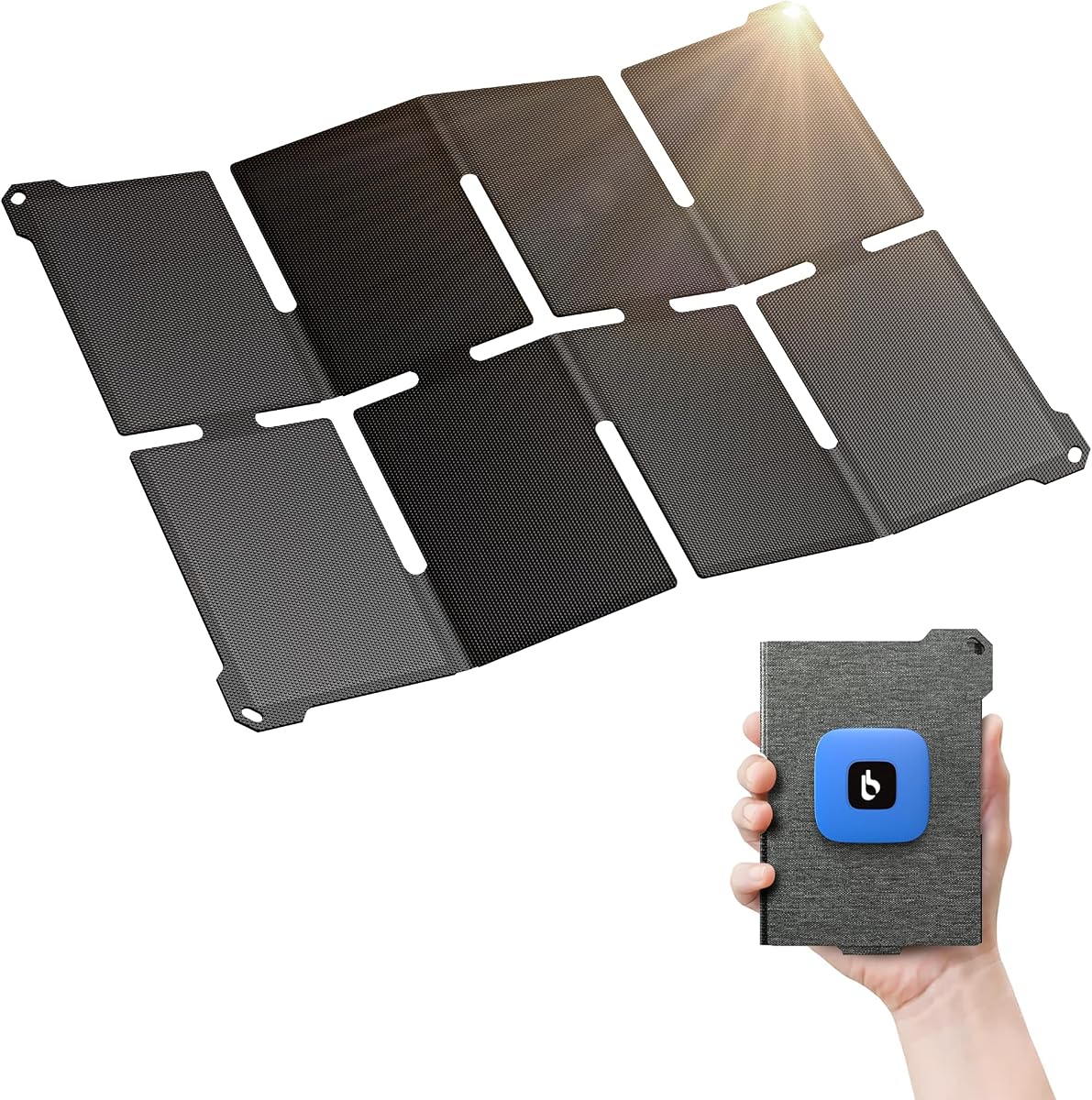
The Flashfish 100W Solar Panel is the premium high-output selection here, with a 4.4 customer rating. Its 100W folding design is aimed at anglers and campers who want more flexibility than a small phone charger can provide. It can serve compatible laptops, tablets, phones, drones, cameras, and other electronic devices when they are connected to the appropriate output.
We may earn a commission when you buy through this link, at no additional cost to you.
Three output options distinguish it from simpler portable panels. The USB-C port supports PD output up to 65W, the USB-A port supports QC3.0 output up to 18W, and a direct DC port is available for compatible equipment. Monocrystalline cells convert approximately 22 to 23% of available solar energy, while four integrated kickstands create a stable platform that can be adjusted across different surfaces.
This is not a lightweight pocket solution. Even though the panel folds for transport, unfolding four sections creates a much larger footprint than a 25W or 30W model. The higher wattage also does not guarantee that every connected device will receive its maximum supported charging rate. Sunlight, device protocols, heat, cable quality, and panel orientation can all affect the result.
It is best for anglers carrying more demanding electronics, working from an RV, or using a larger portable power station. A serious offshore setup or an expedition where reliable high-current charging matters can benefit from the extra headroom. For a simple phone-and-GPS kit, however, a smaller panel may be easier to manage and less costly.
A 100W panel offers substantially more nominal generation than the compact choices in this guide. That headroom is useful when a compatible laptop, drone, camera, or tablet draws more current than a basic phone charger can support.
The four kickstands allow the panel to sit securely on a deck or other suitable surface. Keeping it clear of shadows from railings, cabins, and fishing gear helps preserve the available output.
We may earn a commission when you buy through this link, at no additional cost to you.
The POWOXI 7.5W 12V Solar Battery Charger Trickle Maintainer Kit is designed to preserve a vehicle or boat battery rather than directly charge a phone. It has a 4.4 rating and works with common 12V rechargeable battery types, including LiFePO4, lithium-ion, and lead-acid applications. Its low output makes it more appropriate for maintenance than for rapidly restoring a deeply discharged battery.
We may earn a commission when you buy through this link, at no additional cost to you.
Installation can be as simple as inserting the unit into a cigarette-lighter socket or connecting the supplied panel to a battery with alligator clips. A smart internal protection system and blocking diode are designed to guard against overvoltage and short circuits. Red and green indicator lights communicate whether sunlight is being received and whether the battery connection is active.
The rigid ABS and polycarbonate frame is a practical alternative to a flexible panel that might be scratched or bent. Low-iron tempered glass is used for the solar surface, and the stated conversion efficiency is between 25 and 30%. Even so, actual charging depends on sunlight and the battery's condition; a 7.5W panel is not intended to compete with shore power for a depleted battery.
This kit works well for anglers who leave electronics in a boat with a 12V battery and need a small maintainer to counter discharge. It also suits cars, motorcycles, tractors, and ATVs. It should not be selected as the primary solar solution for a phone, GPS, or camera unless those devices are connected to a separate USB charging arrangement.
The low-power design is useful for maintaining a compatible 12V battery over time. It is best viewed as supplemental support rather than a substitute for a charger when the battery is severely depleted.
Separate red and green lights provide a quick indication of solar reception and battery charging status. This makes it easier to determine whether the installation is operating as expected.
We may earn a commission when you buy through this link, at no additional cost to you.
The FlexSolar 40W Foldable Solar Panel Charger is a versatile option for anglers who need both USB and DC connections. It carries a 4.4 rating and combines a 40W panel with QC3.0 USB-A, PD 2.0 USB-C, and 19V DC outputs. An LED light indicates charging status, while an integrated chip is designed to recognize connected devices and optimize their output.
We may earn a commission when you buy through this link, at no additional cost to you.
The folding panel weighs 1.76 pounds and measures 8 by 11.1 by 1.8 inches when folded. That compact profile is valuable in crowded fishing gear, and the stated 24% conversion rate is competitive among the portable models reviewed. Its ETFE laminate provides resistance to rain, dust, and abrasion, although the junction box should be stored indoors during heavy rain.
The 19V DC output can directly power compatible small power stations, making this more flexible than a panel limited to phone charging. However, the product's smart load-distribution recommendation favors using one port at a time for peak efficiency. Partial shading may reduce performance sharply, and the stated 40W rating refers to the panel rather than a guaranteed 40W from every port.
It is a good match for an angler carrying a phone, tablet, power bank, and a small DC-compatible station. The panel can be oriented at approximately a 45-degree angle toward direct sunlight, but keeping it unobstructed is critical. For users who require the highest IP68 rating, the GEYOTO or compact BigBlue models offer a more clearly defined full-panel protection standard.
The 19V DC port expands the panel beyond ordinary USB charging and can support compatible small stations. USB-A and USB-C remain useful for phones, tablets, and power banks.
At 1.76 pounds, the folded panel is light enough for a backpack or compact boat storage area. Its relatively small footprint also leaves more room for rods, tackle, and other essential equipment.
We may earn a commission when you buy through this link, at no additional cost to you.
The SOLPERK 20W Solar Panel Kit is a strong permanent-mounting solution for maintaining a 12V battery. It has a 4.5 rating and includes a monocrystalline solar panel, a smart MPPT controller, an adjustable mounting bracket, an alligator clip, and installation hardware. It supports rechargeable battery types including LiFePO4, lithium-ion, AGM, SLA, GEL, EFB, and MF.
We may earn a commission when you buy through this link, at no additional cost to you.
The adjustable bracket can rotate through 360 degrees, allowing the panel to be oriented toward available sunlight. The controller uses a three-stage charging design intended to prevent overcharging, overvoltage, and short circuits. Indicator lights make the charging status easier to understand, and plug-and-play connections simplify installation without complicated wiring.
The panel's low-iron tempered glass and corrosion-resistant aluminum frame are built for long-term outdoor exposure. Listed performance figures include cell efficiency of 21 to 30%, wind-pressure resistance up to 2400Pa, and snow-load resistance up to 5400Pa. Those figures describe the panel construction; actual charging still depends on sunlight, mounting angle, battery condition, and system losses.
This kit is ideal for anglers installing a fixed solar maintainer on a boat, trailer, RV, or vehicle. It offers more installation control than a plug-in trickle charger. It is not a direct phone or GPS charger, so anglers needing both functions should consider a dedicated USB panel alongside a battery-maintenance system.
The 360-degree bracket allows the panel to be installed away from shadows and adjusted toward the sun. Pre-drilled holes and supplied hardware help create a stable, repeatable installation.
The included MPPT controller and broad battery compatibility make the kit useful across boats, trailers, cars, motorcycles, tractors, and other 12V equipment. Confirm the battery type and terminal configuration before installation.
We may earn a commission when you buy through this link, at no additional cost to you.
The BigBlue 28W High-Efficiency Solar Panel Charger with Dual USB-C and USB-A is a familiar portable design with a 4.3 rating. It folds to 11 by 6 by 1.4 inches and weighs 1.5 pounds, making it a practical size for boat lockers, tackle bags, and camping equipment. Its three USB outputs can charge compatible phones, GPS units, flashlights, and small electronics.
We may earn a commission when you buy through this link, at no additional cost to you.
BigBlue uses a surface without front-facing metal lines and describes the cell technology as providing strong low-light efficiency. Conversion efficiency is stated at 25.4%, while each USB port can deliver up to 5V and 3A. The charging system is intended to identify connected devices and regulate output, and a solid blue LED signals that charging is functioning properly.
The panel has IP44 protection, but the USB junction box is explicitly not waterproof. It also has no internal battery, which means it must operate in direct sunlight while devices are connected. The output is not sufficient for laptops or larger power stations. Keeping phones and tablets shaded while they charge can reduce heat-related slowdowns or interruptions.
This model is a solid choice for anglers who want several USB connections from a reasonably compact panel. It is particularly relevant for marine electronics that use standard USB charging, provided the junction box is protected from rain. It is less suitable than the GEYOTO model for buyers who prioritize a higher stated IP68 rating and faster 25W USB-C output.
Two USB-C ports and one USB-A port allow several compatible accessories to charge together. The arrangement is useful for a phone, GPS unit, and power bank without carrying separate panels.
Although the panel surface carries an IP44 rating, its junction box is not waterproof. Keeping that connection enclosed and dry is important on an open boat or during wet weather.
We may earn a commission when you buy through this link, at no additional cost to you.
The BigBlue Ultra-Light Portable 25W Solar Panel Charger is the lightest full-size portable model highlighted here, weighing 0.84 pounds. It has a 4.2 rating and folds to 4.65 by 6.42 by 1.38 inches, a compact size that can fit into a small backpack or be hung from a pack or tent using the included carabiners.
We may earn a commission when you buy through this link, at no additional cost to you.
USB-A and USB-C outputs support charging two compatible devices at once. N-type solar cells without front-side metal lines are stated to achieve up to 25.4% conversion efficiency. The construction combines ETFE coating, UV-resistant EVA, high-efficiency cells, and a solid baseplate intended to resist hidden damage and maintain consistent outdoor performance.
Its IP68 rating covers resistance to splashes, spills, dust, and light rain, making it a reassuring choice for exposed fishing locations. It still does not store energy, so users must connect devices while the panel receives direct sunlight. The smaller 25W capacity and limited port count make it less versatile than the GEYOTO 45W panel for charging several larger devices.
This is the most portable recommendation for anglers who carry only a phone, small GPS, camera, or power bank and value low weight over maximum output. Its compact dimensions also make it easy to protect in a tackle locker. It is less suitable for a full day of heavier charging or for maintaining a boat's 12V battery.
The 0.84-pound weight and small folded size reduce the burden of carrying solar power to a remote bank, launch, or fishing position. The included elastic strap offers another simple way to secure the panel.
The IP68 rating makes this model more clearly suited to splashes and dusty outdoor conditions than panels whose junction boxes are not waterproof. Dry the panel and inspect connections before storage.
We may earn a commission when you buy through this link, at no additional cost to you.
The SUNER POWER Waterproof 12W Solar Battery Charger and Maintainer Pro is designed to keep compatible 12V batteries charged. It has a 4.4 rating and uses Ultra-Smart MPPT technology, with stated tracking efficiency up to 99% and peak conversion efficiency of 98%. It is a strong option for maintaining the battery bank of a boat, trailer, RV, or vehicle.
We may earn a commission when you buy through this link, at no additional cost to you.
A three-stage algorithm moves through bulk, absorption, and float phases. The charger stops when the battery reaches full charge and resumes after a discharge, reducing the need for manual intervention. Multiple protections cover overcharge, overdischarge, overvoltage, overcurrent, overload, short circuit, reverse polarity, and excessive temperature.
The Grade A+ solar cells are stated to achieve efficiency from 21 to 30%. Tempered glass and a corrosion-resistant frame are designed to withstand UV exposure, erosion, hail, rust, and sandstorms. As with any solar maintainer, actual performance depends on sunlight and the placement of the panel. This unit does not directly charge USB electronics.
Pre-drilled holes and included suction cups allow quick mounting, while plug-and-play cables simplify connection. It supports flooded, gel, AGM, SLA, maintenance-free, deep-cycle, and LiFePO4 batteries. It is best for anglers seeking automatic long-term battery care, especially where several electrical accessories could gradually drain a stored 12V system.
The bulk, absorption, and float sequence provides a more structured charging cycle than a basic trickle charger. Automatic stop and restart behavior makes the system practical for equipment that is not connected continuously to shore power.
Reverse-polarity, short-circuit, overcurrent, and temperature protections help reduce installation and operating risks. Correct wiring remains essential even with protective electronics.
We may earn a commission when you buy through this link, at no additional cost to you.
The 15W Portable Small Solar Panel Charger Smart Display is the budget-focused selection in this guide. It carries a 4.2 rating and is designed for anglers who need a lightweight emergency or backup charger for a phone, GPS unit, camera, power bank, or camping light. Its low weight makes it especially convenient to keep in a pocket, small tackle bag, or emergency kit.
We may earn a commission when you buy through this link, at no additional cost to you.
The built-in digital display reports power, voltage, and current. That visibility helps users adjust the panel toward stronger sunlight and identify whether conditions are changing. The panel uses 23.5% monocrystalline cells with an ETFE coating designed to resist scratches, heat, and outdoor wear. USB-C and USB-A outputs cover common device connections.
Its 15W capacity is the main limitation. It can charge smaller electronics effectively in good sunlight, but it cannot match the output of the 30W, 40W, 45W, or 100W selections. There is no built-in battery, so the display and ports remain dependent on incoming solar energy. A phone or GPS device may also experience slower charging if it draws power during periods of weak light.
This is a sensible choice for occasional use, travel, hiking, camping, and emergency preparation. Anglers who only need to keep a phone or GPS unit topped up and want to minimize weight will find it especially useful. For long days with multiple devices, a higher-capacity panel or a system paired with a power bank will provide more flexibility.
The integrated display shows key electrical information, helping users identify stronger sunlight and make better panel adjustments. It is a useful feature in a compact unit intended for portable use.
The 0.82-pound foldable format makes this model easy to keep available for an emergency or an extra fishing trip. Charging speed improves with direct, unobstructed sunlight.
We may earn a commission when you buy through this link, at no additional cost to you.
The right solar charger depends on whether you need to power USB devices directly, maintain a 12V battery, or balance portability with higher output. Consider device requirements, trip length, sunlight, mounting conditions, and the need for stored energy before selecting a model.
Direct-charging solar panels use USB-A, USB-C, or DC outputs to power phones, GPS units, cameras, tablets, and other compatible devices while sunlight is available. Battery-maintainer kits work differently: they use a controller and wiring to maintain a 12V rechargeable battery. A maintainer can support a boat's electronics indirectly when those devices run from the battery, but it does not replace a USB charging panel for a standalone phone or camera.
Choose a direct panel if your priority is portable device power. Choose a maintainer if your concern is preventing a stored battery from becoming depleted. Some anglers benefit from both categories, using one compact USB panel and one permanently mounted battery-maintenance system.
A smaller panel may adequately serve a phone, GPS, flashlight, or small power bank, while a larger model offers more headroom for tablets, laptops, cameras, drones, or power stations. Check each device's charging protocol and connector requirements. USB-C PD, USB-A QC3.0, and 19V DC outputs are not interchangeable, and a port does not guarantee its full rated output in every condition.
Match the panel to the largest electronics you realistically expect to charge. For occasional top-ups, prioritize weight and simplicity. For sustained work or several devices, select more generation capacity and confirm that the outputs support your equipment.
Nominal panel wattage indicates the maximum energy the panel is designed to collect under ideal conditions, while conversion efficiency describes how effectively it converts sunlight into usable electrical power. The reviewed portable models range from 15W to 100W and list conversion efficiencies between 22% and 26%, while the 100W Flashfish panel uses a stated range of 22 to 23 percent. Higher efficiency can improve output in constrained spaces, but panel size, sunlight, temperature, orientation, and shading remain decisive.
Do not treat the efficiency number as a guaranteed charging speed. Treat the complete charging system as the relevant measure, and give priority to adequate area, direct sunlight, and a clean surface.
Portable panels range from 0.82 pounds for the two smallest models to 1.65 pounds for the GEYOTO, while the 30W SOLUPUP and 40W FlexSolar fall within the middle. The 100W Flashfish unfolds into a much larger surface even though its folding design remains transportable. Consider where the panel will be stored aboard the boat and whether it can be repositioned without blocking access to tackle or navigation equipment.
For shore anglers and hikers, low weight should be a major criterion. For fixed or semi-fixed installations near a campsite or dock, a larger panel and stable stand may provide more useful power.
Outdoor fishing exposes charging equipment to spray, humidity, dust, and changing weather. The GEYOTO and compact BigBlue panels carry IP68 ratings for their stated constructions, while the SOLUPUP has IPX5 protection and the standard BigBlue 28W panel has an IP44 rating. The FlexSolar panel has IP67 protection, but its junction box is not fully waterproof. Always distinguish the protection of the panel surface from the protection of its cable connections and junction box.
Keep ports dry, inspect seals after severe weather, and dry the surface before packing it away. Even a highly rated panel should not be submerged unless the manufacturer expressly permits it.
Battery-maintainer kits must be compatible with the battery's chemistry and voltage. The reviewed systems support common 12V rechargeable types, including AGM, SLA, GEL, flooded lead-acid, lithium-ion, and LiFePO4 in varying combinations. An MPPT controller can improve energy capture compared with a basic controller, but correct wiring and battery selection remain necessary. Reverse polarity and short-circuit protection do not excuse incorrect installation.
Review the battery labels, terminal arrangement, and controller instructions before purchase. For a boat with multiple batteries or specialized electronics, confirm that the maintainer is intended to connect to the correct battery group rather than assuming every battery can safely share one circuit.
A portable charging panel needs direct, stable sunlight. Some models include an adjustable stand, while battery-maintainer kits often provide a mounting bracket or suction cups. A bracket with wide angle adjustment can help maintain a sun-facing orientation after installation. Portable models benefit from carabiners, straps, and storage pouches that keep them attached to a backpack or secured in a dry compartment.
Choose mounting hardware that suits the environment. Suction cups may be convenient on a smooth surface but should be checked regularly. Permanent brackets are more suitable for a fixed boat or trailer installation, provided wiring is protected from movement and abrasion.
Before deployment, identify what each port or battery connection supports and test the setup with the electronics you intend to use. Unfold or unmount the panel, clean the surface, and place it in direct sunlight with no shadows from cabins, rod holders, trees, or clouds. Keep phones and other heat-sensitive devices shaded while their cables run to the panel. For battery maintainers, confirm battery chemistry, polarity, and the appropriate connection point before attaching the leads.
Solar charging is weather-dependent. Cloud cover, incorrect angles, high temperatures, and partial shadows can reduce output or interrupt it. A panel with a display or indicator light can help confirm that energy is being collected. If charging stops, move the panel toward stronger light, check for obstructions, inspect the cable connections, and review the device's charging requirements. Do not expect a panel without internal storage to power electronics after sunset.
After use, disconnect sensitive devices and remove the panel from prolonged exposure. Wipe away salt, spray, dirt, and mud, let the surface dry fully, and inspect the seams, ports, and cable jackets. Store the panel in its pouch or a dry compartment, and do not place a hot panel inside a closed bag. For mounted systems, periodically clean the glass, verify the bracket, inspect wiring, and confirm that the controller's indicators show the expected operating state.
A solar panel can directly charge compatible USB devices such as phones, GPS units, and cameras. It can also maintain a 12V battery system when paired with an appropriate controller and wiring. It is generally not intended to operate high-draw electronics continuously or replace shore power for a deeply discharged battery.
None of the listed portable USB charging panels is described as having an internal battery. They generate output only while exposed to sunlight, so connected devices may stop or slow down at night or under heavy clouds. Pairing a compatible panel with a power bank can provide energy storage for later use.
It depends on the device mix and expected use. A phone, small GPS, and lightweight accessories can work with a 15W to 45W panel in good sunlight. A 100W panel offers more headroom for compatible laptops, drones, cameras, tablets, or supported portable power stations, but it also requires more space and setup.
Clouds usually reduce the amount of sunlight reaching the cells, so charging will slow or become unstable. Output may recover when the clouds move away, although the exact response depends on panel design, device behavior, and environmental conditions. A power bank offers a more reliable buffer when sunlight is inconsistent.
An MPPT controller can improve solar energy utilization and provides a more structured charging process than a basic trickle controller. It is useful for long-term maintenance of a compatible 12V battery. Confirm the controller supports the battery chemistry and follow the manufacturer's wiring instructions carefully.
Some product guidance specifically discourages using a foldable BigBlue panel behind a window or windscreen because glass, heat, and filtering can reduce performance. Direct outdoor sunlight produces more consistent results. Avoid leaving devices or panels in a hot, enclosed vehicle where damaging heat can accumulate.
Position the panel where spray is less likely to reach its connections, and keep the junction box or port cover dry even when the panel surface has a strong water-resistance rating. Use compatible weather covers where appropriate, reconnect cables only when they are completely dry, and inspect the equipment after severe weather.
The BigBlue 25W and 15W small panel are the lightest portable choices reviewed, each weighing under one pound. The BigBlue model offers a higher stated 25.4% efficiency and IP68 protection, while the 15W option includes a digital operating display. Both are better suited to occasional device charging than high-power workloads.
The GEYOTO 45W panel is the strongest all-around selection because it combines three ports, 25W USB-C fast charging, a 45W panel, and IP68 protection in a portable format. The Flashfish 100W model is the premium option for anglers who need more output and broader device support, while the compact 15W panel provides a budget-conscious way to keep essential electronics powered.
Prioritize the function your equipment actually requires. Choose a direct USB panel for phones, GPS units, and cameras; select a 12V maintainer when the goal is to protect a boat, trailer, RV, or vehicle battery; and use a larger panel when several demanding devices need energy. Portability, weather resistance, connector support, and the likelihood of getting direct sunlight are equally important.
Before purchasing, verify the current listing, compatibility details, included accessories, warranty information, and latest product specifications. Pricing and availability can change, so compare the final offer against the charging task rather than selecting solely by panel wattage or the lowest cost.