
Tapo P110M
4.4Editor score
Matter-certified multi-platform support
Real-time energy statistics
Configurable overcurrent protection
Our smart plug with energy monitor guide compares ten options for usage tracking, scheduling, app control, safety, Matter support, and easy setup.
A smart plug with energy monitor does more than turn an appliance on or off. It records real-time and historical consumption, revealing which devices waste electricity and helping users build schedules around rates, routines, or changing household needs. The best models combine reliable monitoring with useful automation, clear apps, safe electrical design, and straightforward connectivity.
This guide compares ten smart plugs using the specifications and feature information supplied for each product. We evaluate energy data, scheduling, app and voice control, wireless compatibility, safety protections, maximum load ratings, Matter support, outlet design, and multi-pack convenience. The list includes four-packs, two-packs, and models from Tapo, Kasa, Govee, Emporia, meross, and other brands.
Each review explains the strongest use case, notable limitations, and who should consider that particular model. Ratings reflect the supplied customer feedback, while technical conclusions are based on listed features rather than claims of personal testing. Features, app behavior, availability, and pricing can change, so verify current product details and network requirements before purchasing.
4.4Editor score

4.5Editor score

4.6Editor score
The comparison below highlights the key differences among all ten plugs, including monitoring depth, connectivity, Matter compatibility, load ratings, app support, pack size, voice assistants, and physical design.


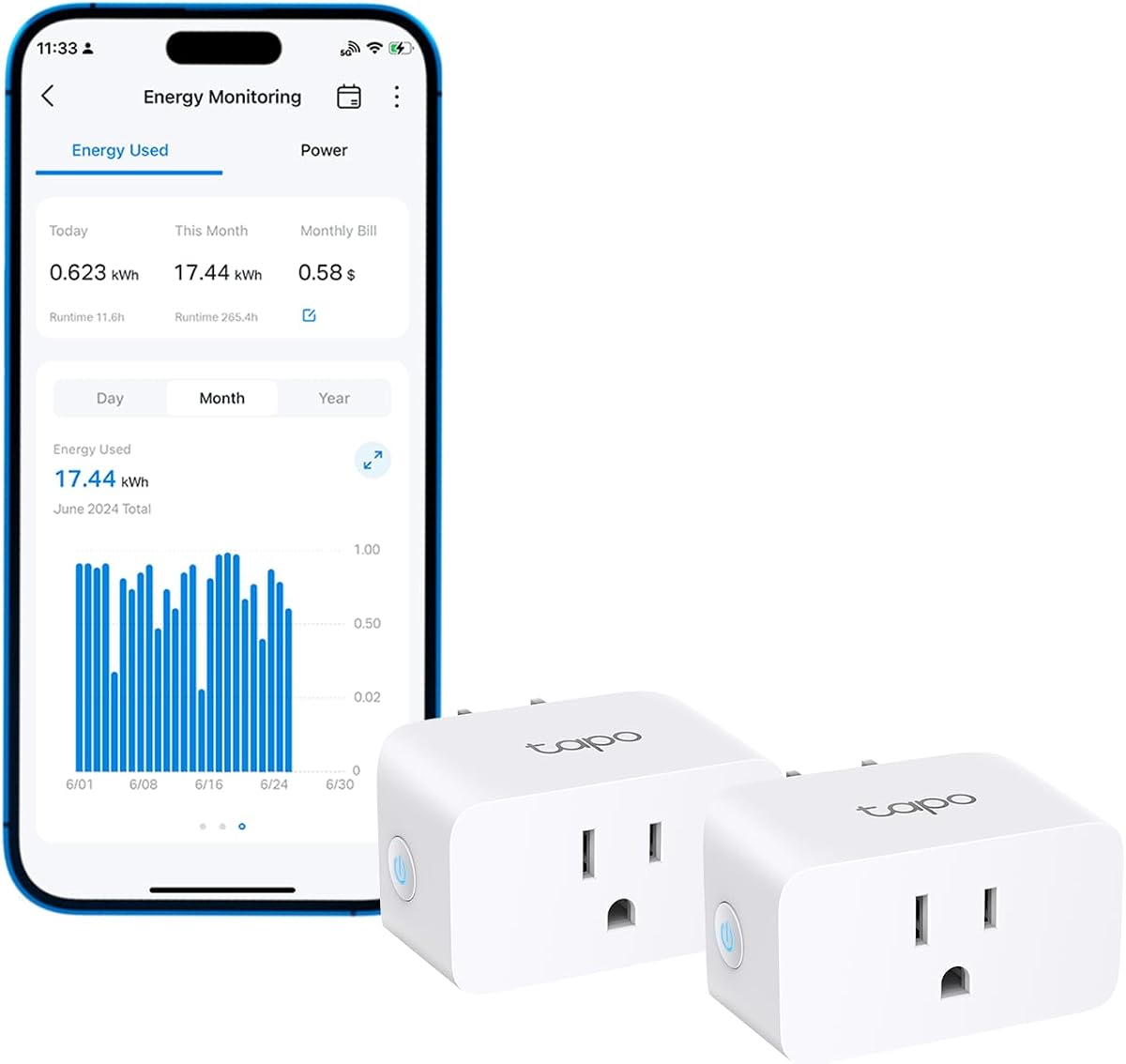


The Tapo P115 is the strongest all-around choice in this group, combining a 4.5 rating with thoughtful energy-management tools and a 15A rating. Its most compelling feature is not merely switching power remotely, but turning measured usage into understandable charts and statistics. That makes it useful for identifying standby waste, comparing appliance behavior, and deciding when high-consumption devices should operate.
We may earn a commission when you buy through this link, at no additional cost to you.
Its energy dashboard goes beyond a basic on-or-off status by supporting single and periodic bill estimates through billing-system integration. Users can also schedule high-consumption equipment for off-peak periods, a practical feature when electricity rates vary by time. Automatic shutdown after a defined battery threshold is helpful for compatible charging setups, while an auto-shutoff function responds when a connected device draws more power than expected.
The trade-offs are modest. The listed capabilities do not mention Matter certification, so buyers who want one standardized ecosystem across Apple Home, Amazon Alexa, Google Home, and Samsung SmartThings may favor the Tapo P110M. A four-pack can also be more than necessary for a first-time buyer. Even so, the P115 combines monitoring, scheduling, remote control, and voice control in a well-rounded package, making it a sensible default recommendation.
Choose the Tapo P115 if you want detailed energy history without committing to a specific smart-home standard. It suits households monitoring several appliances, office equipment, entertainment systems, or devices that benefit from automatic shutoff. For the strongest combination of analytics, protection, and broad everyday utility, this is the plug to prioritize.
Clear statistics and intuitive charts make consumption patterns easier to interpret than a raw list of readings. That visibility helps users identify appliances that consume power unexpectedly, compare usage across periods, and focus their next energy-saving effort where it can make the greatest difference.
Automatic overload shutdown and configurable charging limits add useful safeguards. These features can reduce unnecessary runtime, help prevent overcharging for supported devices, and create a more predictable operating pattern for connected equipment.
We may earn a commission when you buy through this link, at no additional cost to you.
The Tapo P110M earns the premium recommendation by combining a 4.4 rating with Matter certification, extensive monitoring features, and a four-pack format. It is especially attractive to households that do not want a smart plug permanently tied to one brand's ecosystem. It works with major platforms including Amazon Alexa, Apple HomeKit, Google Home, and Samsung SmartThings.
We may earn a commission when you buy through this link, at no additional cost to you.
Energy tracking includes in-depth statistics and clear visuals, while billing-system integration can show cost estimates for both individual and recurring readings. Its scheduling capabilities are designed to move high-consumption devices to off-peak windows. The model also supports user-defined thresholds and durations for overcharge prevention, along with shutdown when consumption exceeds configured power limits.
The main limitation is that users pursuing cross-platform control must understand Matter setup and the requirements of their chosen platform. Matter adds long-term interoperability value, but it does not make every app function or voice command identical. Buyers who only need basic scheduling and energy readings may find the standard P115 more direct. Even with those caveats, the P110M offers a richer ecosystem proposition and four useful plugs in one package.
Choose this model if you already use a Matter-centered smart home or are specifically trying to avoid platform lock-in. It is also a strong choice for monitoring multiple devices throughout a home or office. When flexible ecosystem support matters alongside precise consumption analytics, the P110M is the more forward-looking option.
Matter certification allows the plug to participate in a broader smart-home setup rather than relying on a single manufacturer's ecosystem. This is valuable for users mixing devices from different brands or planning to change platforms over time.
Billing integration and off-peak schedules help connect measurements to potential savings, while configurable thresholds add protection against overcharging and excessive current. Together, these features extend the plug beyond simple remote switching.
We may earn a commission when you buy through this link, at no additional cost to you.
The Govee Energy Monitoring Smart Plug stands out with a 4.6 rating, the highest among the ten products, and a broad set of monitoring capabilities at a budget-oriented position. It tracks real-time power, current, and voltage through the Govee Home app, allowing users to review daily, weekly, monthly, and even up to one year of usage data.
We may earn a commission when you buy through this link, at no additional cost to you.
Connectivity includes both Wi-Fi and Bluetooth, which can make initial setup more resilient and provides an alternative path to the app. The plug supports detailed minute-level schedules, shared household access, group control, and voice commands through Alexa and Google Assistant. Its stated 15A, 120V rating also makes it suitable for higher-power appliances, including coffee makers, subject to the appliance's own electrical requirements.
There are two notable constraints. The product explicitly does not support 5GHz Wi-Fi, so the user's router must provide a 2.4GHz network. It is also not described as Matter compatible, which may narrow its appeal for a standards-focused setup. Despite those limitations, the combination of detailed electrical readings, long history, flexible scheduling, Bluetooth, and a four-pack makes it an unusually capable budget selection.
Choose the Govee plug for users who want detailed real-time measurements and historical reports without moving into a premium smart-home ecosystem. It is particularly suitable for tracking several appliances, establishing recurring schedules, and sharing control with household members. For accessible monitoring and excellent feedback, this is a compelling pick.
The ability to inspect usage from daily summaries through a full year makes it possible to compare short-term behavior with longer consumption patterns. Users can investigate seasonal changes, recurring routines, and devices that remain active unexpectedly.
Wi-Fi handles everyday remote access, while Bluetooth adds a useful local setup path. The Govee Home app also supports shared access and grouped control, making it easier to coordinate multiple plugs across a household.
We may earn a commission when you buy through this link, at no additional cost to you.
The Emporia Energy Monitoring Smart Plug has a 4.0 rating and a straightforward focus on controlling 120V appliances while revealing their energy use. It is a practical option for lights, fans, lamps, humidifiers, and other electronics. The included scheduling function and mobile-app access make it straightforward to automate devices that otherwise remain powered or run longer than intended.
We may earn a commission when you buy through this link, at no additional cost to you.
Its core appeal is reducing standby consumption and improving awareness of individual device demand. Users can schedule automatic on-and-off behavior, remotely check real-time status, and toggle appliances from the Emporia app. Voice support through Alexa and Google Home adds another control route, while the four-pack provides broad coverage across several rooms.
Load limits require careful attention. The specification lists a 10A maximum continuous load and permits a 15A maximum peak load for up to one hour per day. That differs from the 15A continuous ratings emphasized by several competing plugs, so it may be less suitable for demanding appliances or circuits that routinely draw high current. Remote control also requires a 2.4GHz network because 5GHz is unsupported.
Choose the Emporia plug for straightforward energy awareness, especially around standby-prone household electronics and simpler devices. It is less compelling for heavy loads or users who require unrestricted 15A continuous operation. Within those boundaries, it delivers an uncomplicated way to automate and monitor several plug-in devices.
One of the most practical ways to reduce household waste is to disconnect devices that remain active without doing visible work. Emporia's monitoring and scheduling tools make it easier to see which electronics contribute standby draw and set automatic cutoff times.
The distinction between 10A continuous and 15A short-duration peak use is important for safety and compatibility. Check an appliance's rated draw and avoid treating the peak allowance as a continuous operating capacity.
We may earn a commission when you buy through this link, at no additional cost to you.
The AiSeek Energy Plug is a compact four-pack with a 4.3 rating and a 15A, 1800W capacity. Its integrated meter reports real-time power and energy, while timers and schedules can automatically switch connected devices on or off. The product is particularly relevant for seasonal decorations, televisions, lamps, fans, humidifiers, blenders, and light bulbs that do not need to remain connected continuously.
We may earn a commission when you buy through this link, at no additional cost to you.
Safety and placement are important parts of its appeal. The listing states that the plug is FCC certified, uses fire-resistant materials, and provides protection against short circuits and overloads. Its compact format is intended to preserve access to neighboring outlets. Setup does not require a hub: users plug in the device, open the SmartLife app, and follow the app's configuration process.
Voice control has an important limitation. Alexa and Google Assistant are supported, but the SmartLife app must be configured first, and direct connection to Alexa is not supported. The plug also requires 2.4GHz Wi-Fi. It is also not described as Matter compatible, so users seeking standardized cross-platform operation should look at the Kasa or meross alternatives.
Choose the AiSeek plug if compactness, real-time monitoring, timers, and multi-plug control are priorities. It is a good fit for temporary loads, seasonal equipment, and household devices that benefit from scheduled shutdowns. For users already comfortable with SmartLife and seeking simple automation, it offers a capable set of tools in a practical four-pack.
The small form factor can help preserve access to adjacent receptacles, especially on desks, entertainment centers, and countertop power strips where space is limited. It is useful where a larger plug would make daily access inconvenient.
The app-first setup keeps configuration centralized in SmartLife, where users can create timers, schedules, and groups. Voice assistants must be linked through third-party services afterward, which adds one step but supports familiar hands-free control.
We may earn a commission when you buy through this link, at no additional cost to you.
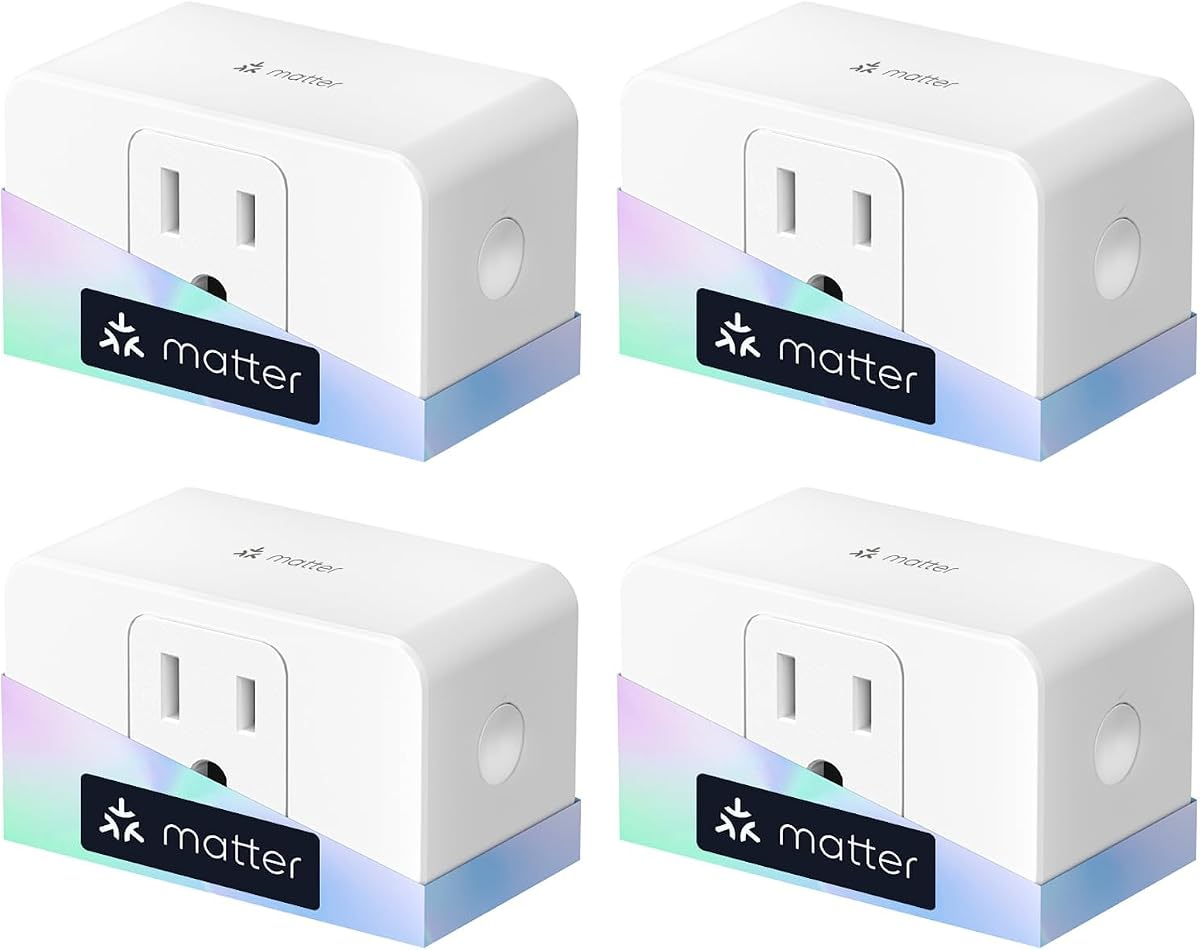
The Kasa KP125MP4 is a four-pack Matter-compatible smart plug with a 4.3 rating and a 15A, 1800W maximum load. It fits well within a mixed smart home because it works with Matter-certified platforms including Apple Home, Amazon Alexa, Google Home, and Samsung SmartThings. Energy usage is tracked over time, allowing users to examine patterns rather than viewing only instantaneous readings.
We may earn a commission when you buy through this link, at no additional cost to you.
One of its most valuable features is local Matter communication. After configuration, compatible devices can communicate directly over the local network, supporting control even when the home's internet connection is unavailable. This reduces dependence on a cloud service for certain local interactions and makes the plug a natural fit for users building a resilient smart-home environment.
Physical design is another strength. The compact form is designed to avoid blocking nearby outlets, and the product features a UL-certified flame-retardant design with a two-year limited warranty. The limitation is that Matter still requires an appropriate ecosystem or controller, so users should ensure their chosen platform supports the device before installation.
Choose the KP125MP4 if you want four monitored outlets, broad Matter compatibility, and local-network control. It works especially well for users with mixed-brand devices who value offline-capable local communication. If one or two plugs are enough, the two-pack KP125MP2 offers the same core platform features in a smaller bundle.
Matter's local communication allows compatible devices to interact without routing every command through a cloud service. This can preserve useful control during an internet outage and reduce the plug's reliance on remote infrastructure.
A four-pack simplifies deployment across multiple rooms or device groups. It gives users enough units to establish consistent monitoring and automation rather than building the system one isolated outlet at a time.
We may earn a commission when you buy through this link, at no additional cost to you.
The Tapo P115 two-pack provides the core Tapo monitoring experience with a 4.5 rating, detailed energy statistics, and a more moderate quantity than the four-pack version. It is an attractive option for users who want to monitor two important loads rather than outfitting an entire home immediately. The two units are enough for comparing appliances, establishing a baseline, or controlling separate areas.
We may earn a commission when you buy through this link, at no additional cost to you.
Its tracking features include understandable charts, billing-system integration, and cost visualization for both single and periodic readings. Programmable scheduling can place high-consumption devices in off-peak periods. The plug also includes a smart charging cutoff based on a user-defined low-battery threshold and an automatic shutoff response when connected equipment exceeds safe power limits.
There is a listing inconsistency worth flagging. The supplied title identifies the item as a four-pack, while the product data and product imagery identify this selection as a two-pack. Shoppers should confirm the package quantity on the listing before ordering. Matter certification is also not stated, so this remains a Tapo-oriented choice rather than a standards-based one.
Choose the Tapo P115 two-pack if two monitored appliances are sufficient and you want the established Tapo app with strong energy analytics. It is especially compelling for testing a smart-energy workflow before expanding or for monitoring two particularly energy-intensive devices. Confirm package details, but the underlying feature set remains strong.
Two monitored loads can provide a useful comparison without creating unnecessary setup work. Users can see whether one appliance consumes significantly more than another, then adjust schedules or investigate unusual standby behavior.
The charging threshold and automatic shutoff functions make the plug useful beyond basic scheduling. They provide added control for compatible batteries and offer a response when a connected device draws more current than expected.
We may earn a commission when you buy through this link, at no additional cost to you.
The Kasa KP125MP2 is a compact two-pack option with a 4.3 rating, Matter compatibility, and a 15A, 1800W maximum rating. It gives users a focused way to introduce monitored smart plugs without deploying four units. The two plugs are especially useful for comparing two devices or bringing energy visibility to two high-traffic locations.
We may earn a commission when you buy through this link, at no additional cost to you.
Matter support covers major ecosystems such as Apple Home, Amazon Alexa, Google Home, and Samsung SmartThings. Its local network communication can support direct device interaction without a cloud service, allowing compatible controls to continue working when the internet is down. Energy monitoring tracks consumption over time, helping users identify patterns associated with particular schedules or appliances.
Its compact, flame-retardant construction is UL certified, and the product includes a two-year limited warranty. The compact shape reduces obstruction of adjacent outlets, which is valuable in crowded work areas and homes with frequently used receptacles. As with other Matter products, however, users need a suitable controller and must complete the relevant platform setup.
Choose the KP125MP2 if you want Matter compatibility, local control, and energy tracking for a small number of outlets. It is a particularly good fit for Apple Home, Google Home, SmartThings, or Alexa users who value compactness. If the goal is to monitor a larger collection of appliances, the KP125MP4 provides the same core capabilities in a larger configuration.
A smaller profile makes the plug easier to position where outlet access matters. The flame-retardant construction and listed safety certification provide reassurance for routine household use, while the two-year warranty adds a practical ownership benefit.
After configuration, Matter-compatible devices can communicate across the local network. This makes the plug valuable for routines that should remain functional even when the home loses its external internet connection.
We may earn a commission when you buy through this link, at no additional cost to you.
The TOPELER 15A Smart Plug has a 4.1 rating and a useful dual-mode design that combines 2.4GHz Wi-Fi with Bluetooth. It tracks real-time power, current, and voltage in the Smart Life app, with daily, weekly, and monthly reports intended to reveal usage patterns. Two plugs allow users to monitor more than one load while keeping the setup manageable.
We may earn a commission when you buy through this link, at no additional cost to you.
Its standout operational advantage is Bluetooth fallback. Even if Wi-Fi is offline, the plug can still be controlled locally through Bluetooth. That makes it more resilient for immediate device control, while timers and remote app access handle broader automation. Voice control through Alexa and Google Assistant is also available once the Smart Life app is connected and the assistants are linked through third-party services.
The product is ETL and FCC certified, built with fire-resistant materials, and rated for 15A and 1800W. It also has a compact design intended not to block adjacent outlets. Its limitations include no stated Matter support and a lower customer rating than the leading models, so buyers should not assume feature parity beyond the supplied specification.
Choose TOPELER if dependable local Bluetooth control during a Wi-Fi interruption is important. It is well suited to monitoring appliances that need timers, especially where 2.4GHz-only Wi-Fi is acceptable. For users seeking cross-platform standardization or deeper historical analysis, one of the Matter-enabled alternatives may be a stronger fit.
Bluetooth control remains available when the Wi-Fi connection is offline, giving users a way to operate the plug locally. This fallback is useful for quick actions and reduces the inconvenience of a temporary network disruption.
Daily, weekly, and monthly views make it possible to examine both immediate and recurring consumption. Users can compare readings over time, spot unexpectedly active equipment, and refine schedules based on observed behavior.
We may earn a commission when you buy through this link, at no additional cost to you.
The meross Matter Smart Plug combines a 4.4 rating with a privacy-centered approach to smart-home control. It supports Matter-certified platforms including Apple Home, Alexa, Google Home, and SmartThings, while its built-in meter provides real-time consumption and historical data through the Meross app. The absence of registration and data tracking may appeal to users who want functionality without creating a separate product account.
We may earn a commission when you buy through this link, at no additional cost to you.
Direct local access is the defining feature. Users can access the plug without relying on a cloud connection, and the product is described as continuing to work when the internet goes offline. For compatible Echo users, zero-touch discovery can simplify Matter setup, provided the purchasing account matches the Echo account. Traditional Matter pairing remains available when the accounts do not align.
There are meaningful technical requirements. The plug operates over Matter using 2.4GHz Wi-Fi and an IPv6 network, does not support Thread, and needs a Matter-compatible hub for the selected platform. The phone must run iOS 16.1 or later or Android 8.1 or higher. These requirements make advance compatibility checking essential for a smooth installation.
Choose the meross plug if local control, privacy, and reduced cloud dependence are your priorities. It is well suited to users with a compatible Matter infrastructure and a specific need to monitor one important load. Confirm network and platform support before buying, but for the right household it offers a refined and security-conscious experience.
No registration and direct local access limit the plug's reliance on account-based cloud services. This design is attractive for privacy-conscious users who still want energy history, scheduling, and broad Matter interoperability.
Compatible Echo devices can discover the plug through a simple Matter setup route when account conditions are met. Users outside that arrangement can still pair through the standard Matter process and manage the plug through the Meross app.
We may earn a commission when you buy through this link, at no additional cost to you.
The right smart plug with energy monitor depends on measurement depth, network setup, automation needs, connected-appliance load, and ecosystem preferences. Compare these factors before choosing a model or pack size.
In short, choose richer resolution and longer history for ongoing analysis, and simpler monitoring for occasional switching.
In short, favor Matter for long-term flexibility, but verify that your exact platform and desired controls are supported.
In short, choose a rating above the appliance's sustained demand, and pay closer attention to any continuous-versus-peak limitation.
In short, verify the required band, IP configuration, and router behavior before purchasing or installing the plug.
In short, prioritize the scheduling tools and automatic protections that directly support the appliances you plan to connect.
In short, look for documented protections and certifications, then follow the stated load limits and proper electrical practices.
In short, prioritize local control if uninterrupted operation matters, but verify which functions remain available without cloud access.
In short, choose a pack that fits both your monitoring plan and the physical space available at each outlet.
Begin by confirming that the plug, connected appliance, outlet, and circuit are suitable. Check the appliance's voltage and current requirements against the plug's stated rating, then verify the home network provides the required 2.4GHz connection. Download the manufacturer's app, create the necessary account where applicable, and follow the in-app pairing process. Position the plug where it will not be obstructed, overheated, or easily unplugged.
After pairing, label each plug according to the appliance it controls. Test the remote on-and-off function first, then explore real-time readings, historical charts, timers, schedules, groups, and sharing options. Set conservative limits for charging cutoffs or overload protection, and schedule high-consumption devices only after confirming how their normal operation fits the configured thresholds. Linking a voice assistant usually requires completing setup in the manufacturer's app and then enabling the relevant third-party service.
Review energy history regularly and compare it with expected appliance behavior. Investigate sudden spikes, persistent standby draw, or schedules that leave equipment running longer than necessary. Keep the app updated, review connected third-party services, and change account credentials when needed. For physical care, unplug the smart plug before cleaning it, avoid moisture around the outlet, and never exceed its continuous load rating. Periodically check that the plug remains secure and that its ventilation and outlet clearance have not been compromised.
Depending on the model, it may report real-time power, current, voltage, and accumulated energy use. These readings can reveal how much electricity a connected appliance is using at a particular time and how that usage changes over days or months. The level of detail varies by product, so compare the app's live readings and historical reports before buying.
No. Most products in this guide specifically require 2.4GHz Wi-Fi, and several explicitly state that 5GHz is unsupported. A dual-band router can usually provide both bands, but its 2.4GHz network may need to be enabled separately during setup. Check the router settings and the manufacturer's app instructions before beginning.
Matter is not necessary if you are happy to use one manufacturer's app and its supported assistants. It is valuable when you want a standards-based option across Apple Home, Amazon Alexa, Google Home, SmartThings, or other certified platforms. Matter models may also support direct local communication, although the exact setup requirements depend on the controller and network.
Only when the appliance's continuous electrical demand falls within the plug's stated rating. Several models support up to 15A and 1800W, while the Emporia model lists a 10A continuous maximum and limits 15A peak operation to one hour per day. Heating devices, large appliances, and other sustained high loads need especially careful review.
Historical charts can reveal appliances with unusually high standby consumption, recurring daytime activity, or usage that differs from expectations. You can compare periods, identify the best candidates for scheduling, and estimate whether moving a device to an off-peak window could reduce costs. The precise report periods vary, with some options supporting views up to a year.
Not automatically. Savings depend on how you use the measurements and controls. Turning off unnecessary standby loads, stopping devices after use, and shifting suitable appliances to lower-cost periods can reduce consumption, but a plug cannot make an appliance inherently more efficient. Its value comes from the visibility and automation it adds.
It depends on the model and ecosystem. The Govee and TOPELER products include Bluetooth connectivity, while Matter products such as Kasa and meross emphasize local network control. Local operation may cover essential commands but not every cloud-dependent feature, so review the specific offline behavior before relying on it for critical routines.
A two-pack is usually better for testing the experience, comparing two appliances, or monitoring the most important loads. A four-pack makes more sense when you already know several devices need remote control, timers, or monitoring. Consider both the quantity you will use immediately and whether compact placement matters in crowded outlets.
The Tapo P115 is the strongest overall recommendation because it combines useful energy charts, billing estimates, scheduling, charging controls, overload shutoff, and a 4.5 rating. The Tapo P110M is the premium choice for buyers who prioritize Matter compatibility across major ecosystems, while the Govee Energy Monitoring Smart Plug delivers strong real-time measurements, long history, and dual-mode connectivity at a budget-oriented position.
Prioritize the details that match your setup: Matter if you want interoperability, local control if outages concern you, detailed electrical readings if you are studying appliance behavior, and adequate continuous load capacity for the equipment involved. A two-pack is a sensible starting point for most households, while four-packs make more sense once monitoring several loads is part of the plan.
Before purchasing, recheck the current product listing, package quantity, supported networks, platform requirements, and electrical limits. Features and app behavior can evolve, and ratings may change as more customers review a product. Comparing current details with the strengths and trade-offs in this guide will help you select the most suitable smart plug with energy monitor for your home.