
Garmin Approach CT10
4.3Editor score
Fourteen automatic club sensors
Compatible Garmin golf watch required
Fairway and green accuracy data
Discover the best GPS tracking golf balls and compare ten options for shot tracking, course data, visibility, launch metrics, and performance in 2026.
GPS tracking golf balls sound like a single product category, but the available options use several different technologies to improve your game. Some balls contain electronics, while others are ordinary tour-quality balls designed to work with radar launch monitors, club sensors, NFC tags, and course-aware mobile applications.
This guide compares all ten products by tracking method, compatibility, shot data, performance features, and practical usefulness. It also explains that the strongest solution for one golfer may be a sensor-based system rather than an electronic ball, especially when the goal is reliable distance, club, accuracy, and course information.
Each review identifies what the product actually tracks, who it suits, and where it may disappoint. The three highlighted picks offer distinct paths for budget-conscious golfers, golfers wanting direct ball-level tracking, and players willing to invest in a full automatic system. Prices and availability can change.
4.3Editor score

2.5Editor score

4.0Editor score
The table below compares every product by its core tracking approach, key technology, compatibility needs, and most practical benefit. Because only one option is explicitly an electronic GPS-enabled ball, the list also includes the club sensors, mobile tagging systems, and launch-monitor-compatible balls that golfers can use to build a more complete tracking setup.



The Chiping GPS Tracked Golf Balls are the only product in this list presented as a set of six GPS-enabled balls with a companion app. That makes the concept unusually direct: instead of attaching a sensor to a club or tapping a tag before every shot, the system is built around the ball itself. Its 2.5 rating is the lowest among the ten choices, so the product should be approached with realistic expectations rather than treated as a proven favorite.
We may earn a commission when you buy through this link, at no additional cost to you.
The supplied feature information emphasizes both tracking and performance. Golfers receive access to an app covering more than 35,000 courses worldwide, while each ball uses a four-piece design with a urethane core, active mantle, Surlyn cover, and a special rubber core intended to support distance and feel. The stated Swiss manufacturing origin adds manufacturing context, although the provided information does not specify battery life, charging method, water resistance, or update schedule.
Those missing technical details matter. A GPS-enabled ball must communicate reliably, survive a full round, and avoid distracting the player or affecting performance. The 2.5 rating suggests that real-world experiences may involve setup, app, tracking, or product-quality issues. Because the source data does not document the exact causes, it would be unfair to invent them, but potential reliability concerns are sufficient to make informed research important before purchase.
This set is most appropriate for an early adopter who specifically wants electronics inside the ball and values a large mapped-course library. It is a less conservative recommendation than sensor-based alternatives with stronger customer ratings. Buyers should verify app compatibility, course coverage at their regular venues, charging logistics, and the complete instruction process before committing. For golfers who primarily want reliable club and shot data rather than experimental ball electronics, one of the automatic sensor systems may be the more dependable path.
A sensor mounted on a grip can infer a shot from club movement, while an NFC tag requires a deliberate tap. The Chiping concept removes those manual steps by placing the tracking technology directly in the ball, making it the closest match to the literal idea of a GPS tracking golf ball.
Access to more than 35,000 courses is a major strength for frequent travelers, but the software ecosystem is central to the experience. Confirm that mapped venues appear in the app and that the smartphone used for the system is supported before buying.
We may earn a commission when you buy through this link, at no additional cost to you.
Golf Pad TAGS use small NFC tags attached to club grips to create a lightweight shot-tracking system. Before each shot, the golfer taps the relevant tag to a compatible phone, and Golf Pad records the club, distance, and accuracy information without the repeated number entry associated with many basic apps. The system has a 4.0 rating, giving it a stronger customer history than the Chiping electronic balls.
We may earn a commission when you buy through this link, at no additional cost to you.
The tags require no electricity, charging cables, or separate tracking hardware. That simplicity makes them appealing for golfers who want structured statistics without committing to a full set of powered sensors. After the round, the app can present putting statistics, club averages, accuracy percentages, and scoring trends. Rounds can also be edited, exported, and shared with friends or a coach, making the system useful for both casual review and deliberate practice.
The main compromise is that tagging is manual. A missed tap means a missing or incorrect shot, and the system does not automatically infer the club from sensor-equipped GPS hardware. Compatibility is also narrower than the broad “works with your phone” language might suggest: NFC-enabled Android devices and iPhone 7 or later are supported, except for the original iPhone SE. Older phones may require a different workflow or another tracker.
Golf Pad TAGS is a strong choice for budget-conscious golfers who are comfortable adopting a short pre-shot routine. It is especially useful for players who want to compare club averages, study putting, and identify accuracy trends over a season. Those who dislike manual input or want a completely hands-free experience should instead consider the Garmin Approach CT10 or Arccos sensor systems.
The tap process is quick, but consistency matters. Building the habit before address keeps the digital record aligned with the actual shot and gives golfers useful data to review after the round.
Club averages, putting information, accuracy percentages, and scoring trends give the system more value than simple distance recording. Exporting and sharing those figures can also make it easier to work with a coach.
We may earn a commission when you buy through this link, at no additional cost to you.
This Titleist Pro V1x RCT listing is not a self-tracking electronic ball. It is a tour-oriented golf ball designed for use with radar ballistic measuring instruments such as Trackman, and its 4.8 rating is among the strongest in this roundup. Its value comes from pairing a proven ball model with a launch monitor so golfers can collect performance measurements during practice.
We may earn a commission when you buy through this link, at no additional cost to you.
The supplied specifications identify the model as Pro V1x RCT with a urethane elastomer cover in white. The RCT designation is important because it indicates compatibility with radar-based measuring equipment. Golfers can use it to observe how launch conditions and club delivery affect the ball, while the familiar Pro V1x name may provide extra confidence for players who already prefer that construction on the course.
The limitation is equally clear. The ball does not locate itself through GPS, and it will not record your round by itself. Measurement depends on owning a compatible launch monitor and using the ball during an appropriate practice session. Some golfers may also find that a single-ball format is less convenient for regular play, especially compared with a multi-ball pack listed elsewhere in this guide.
The product is best for golfers who already use a radar launch monitor and want the Pro V1x feel during ball-testing sessions. It is less relevant as a standalone answer to a search for GPS tracking golf balls, but it can become part of a sophisticated measurement setup. If your goal is course round data, choose a club sensor or app-based tracker instead.
A radar launch monitor needs a compatible ball to compare club speed, ball speed, carry, and related outcomes consistently. The RCT version provides that link while preserving the feel of a tour-oriented Pro V1x model.
The urethane elastomer cover and Pro V1x identity focus on playing characteristics rather than electronics. It is a useful companion to measurement equipment, not a substitute for GPS shot tracking.
We may earn a commission when you buy through this link, at no additional cost to you.
The Titleist Pro V1 RCT 12-Pack carries a 4.9 rating, the highest score among the products compared. It is designed for radar ballistic measuring instruments and is not an electronic GPS ball, but it offers a convenient way to keep a consistent supply of compatible balls for launch-monitor sessions and repeated practice tests.
We may earn a commission when you buy through this link, at no additional cost to you.
A twelve-ball format is more practical for a golfer who expects to use the same model regularly. The supplied information describes urethane elastomer construction and identifies the ball as a white tour model. Because the same model can be used across multiple shots, it is easier to compare changes in performance than when every test uses a different construction or cover.
Its limitations are the same basic distinction that applies to all radar-compatible balls. It cannot report club, lie, wind-adjusted yardage, or course position, and it does not turn an ordinary round into a digital scorecard. A radar launch monitor must be acquired separately, while the ball itself offers no screen, application, or sensor network. The value proposition therefore depends on a larger practice-technology investment.
This 12-pack is a sensible companion for golfers who want a steady supply of radar-compatible Pro V1 balls. It is particularly attractive for regular launch-monitor practice because it avoids running out of a consistent ball model. It should not be chosen as a primary GPS tracker. Players seeking automatic course and club data should review Golf Pad TAGS, Garmin, or Arccos instead.
Using one ball model repeatedly creates a more controlled comparison between swings. A full pack supports that consistency without requiring frequent replacement of the measurement-compatible ball.
Twelve balls offer greater convenience than a single unit. That makes the product easier to keep on hand for range sessions, club comparisons, and repeated ball-testing routines.
We may earn a commission when you buy through this link, at no additional cost to you.
The Garmin Approach CT10 is a full automatic club tracking system rather than a GPS-enabled ball. It includes 14 sensors, and once a sensor is installed in a club, the system can track the shot and connect with a compatible Garmin golf watch. Its 4.3 rating reflects a solid customer reception and makes it the strongest premium recommendation in this list for golfers who value hands-free data collection.
We may earn a commission when you buy through this link, at no additional cost to you.
A major advantage is that the system records the club being used, eliminating the need to remember a separate tag. Pulling a club from the bag makes that club’s statistics appear on the watch, while the sensors collect information that can be reviewed for shot location, distance, accuracy, and strokes gained. The watch can also show how far the golfer normally hits each club and how consistently shots find the fairway or green.
The most important requirement is compatibility. The CT10 does not operate as a standalone phone tracker; it pairs with compatible Garmin golf watches, so buyers without a supported device should account for that additional ecosystem. Installation also takes time, and the sensors add hardware to every club. As with any sensor-based system, careful charging and regular use are necessary to maintain a consistent record.
The CT10 is ideal for golfers who want automatic club identification and detailed analysis in a familiar Garmin watch environment. It is less suitable for someone who only wants a few distances or who does not own a compatible watch. Compared with Arccos, it offers a different approach involving sensor-equipped clubs and Garmin compatibility; compared with manual NFC tags, it removes a repeated pre-shot action.
The installed sensors identify the club and recognize the stroke, removing the tap-before-shot routine. That hands-free workflow is especially useful when a round already involves concentration, pace, and repeated course management.
Distance, accuracy, and strokes gained can reveal more than a generic score. The watch interface also helps golfers compare typical club carries and see how consistently each club performs into the fairway or onto the green.
We may earn a commission when you buy through this link, at no additional cost to you.
The Rapsodo Golf Launch Monitor is the most technically elaborate product in the roundup, but it does not track ball location on a course. It uses Doppler radar and a dual-camera setup to capture detailed swing and ball-flight data indoors or outdoors. Its 3.8 rating is respectable, and the included three Titleist Pro V1 balls give users a starting point for immediate measurement.
We may earn a commission when you buy through this link, at no additional cost to you.
Fifteen key metrics include spin rate, spin axis, carry distance, club speed, club path, and launch angle. The camera system can also show the swing from different angles and provide slow-motion views of club-to-ball contact. These features make the system more relevant to deliberate practice than to a typical on-course tracking need, especially for golfers working with a coach or seeking more precise technical feedback.
The product includes a 45-day premium trial that unlocks features such as simulated courses, third-party app integration, a target range, impact vision, combined tools, and speed training. Its premium membership also provides access to more than 30,000 home simulator courses. After the trial, some advanced functionality may require a continuing membership, so the long-term ownership experience depends on the services the golfer expects to use.
This launch monitor is best for a golfer who wants a dedicated practice laboratory and is prepared for a substantial equipment and software commitment. It is the wrong choice for someone seeking inexpensive on-course GPS logging because a launch monitor focuses on swing mechanics rather than shot location. A club sensor system is more appropriate for a round, while this product is better for diagnosing why a particular strike produced a particular result.
Spin, launch, speed, and path data can help golfers understand why two swings with similar speed can produce different flight. Visual replay adds context that a distance number alone cannot provide.
The system can operate in indoor and outdoor environments, giving golfers flexibility when weather, space, or scheduled range time changes. Its simulator features also support structured practice without a full course.
We may earn a commission when you buy through this link, at no additional cost to you.
Titleist Velocity is a performance golf ball rather than a tracking device, yet it can be useful to readers who want a dependable ball for a club-sensor setup. The 4.7 rating is among the strongest here. Its stated priorities are distance, speed, a high trajectory, alignment support, and playable greenside feel rather than electronic measurement or course data.
We may earn a commission when you buy through this link, at no additional cost to you.
The ball uses a high-speed LSX core intended to produce fast speed on full swings. Its 350 octahedral dimple design is intended to create a high ball-flight trajectory, while the fast NAZ plus cover seeks playable performance around the green. A distinctive arrow alignment design provides a visual aiming reference, which can make it more approachable for golfers who struggle to square a conventional ball consistently.
Because the product has no GPS, sensor, NFC tag, or stated radar function, it cannot generate its own data. A golfer interested in performance feedback would need to pair it with a separate launch monitor or club-tracking device. The alignment graphic may aid basic aim, but it does not show where a ball traveled, how far it landed, or which club produced the shot.
Velocity is best for golfers who want a speed-oriented ball with a visible alignment aid and do not require technology inside the ball. It can also be a practical playing ball in a broader tracking setup. Those searching specifically for GPS-based round analytics should view it as a performance accessory rather than the tracking solution itself.
The arrow graphic helps golfers direct the intended line before the swing. It is a simple aiming aid that can support consistency without an electronic device or course-connected analysis.
A high-speed core and dimple structure target fast, high-flight performance. The playable cover is intended to preserve useful feel as golfers move from full shots to approach and greenside play.
We may earn a commission when you buy through this link, at no additional cost to you.
This listing provides another route into the Titleist Pro V1x RCT platform, with a 4.7 customer rating. Like the other RCT products, it is a radar-compatible golf ball rather than an electronic tracker. The limited supplied description confirms the model and its role in measured golf, but it does not provide detailed construction or performance claims beyond the product title.
We may earn a commission when you buy through this link, at no additional cost to you.
Its main strength is compatibility with a practice measurement workflow. A golfer can use the ball with a radar instrument to compare club performance and observe changes in launch or ball data. Keeping the ball model consistent makes those comparisons more meaningful, while the Pro V1x identity may be reassuring to players who already recognize the Titleist model line.
The product is not a substitute for a GPS golf ball. It cannot report the course location of a shot, automatically identify the club, record a scorecard, or calculate wind-adjusted distances. A launch monitor is required for those deeper measurements, and the limited product information means buyers should examine the ball’s full specifications on the listing before making a selection.
This option is best for a golfer who wants a single Pro V1x RCT ball for a specific launch-monitor session and already owns compatible radar equipment. Golfers who want a complete supply should consider the twelve-ball Pro V1 RCT set. For on-course tracking, choose an app, NFC tag, or automatic club sensor system instead.
Using the same ball model across tests reduces one source of variation. That makes launch-monitor results easier to interpret when comparing grip changes, delivery differences, or club adjustments.
Radar compatibility describes how the ball interacts with measuring equipment. It does not mean the ball contains a sensor, transmits location data, or records the round on its own.
We may earn a commission when you buy through this link, at no additional cost to you.
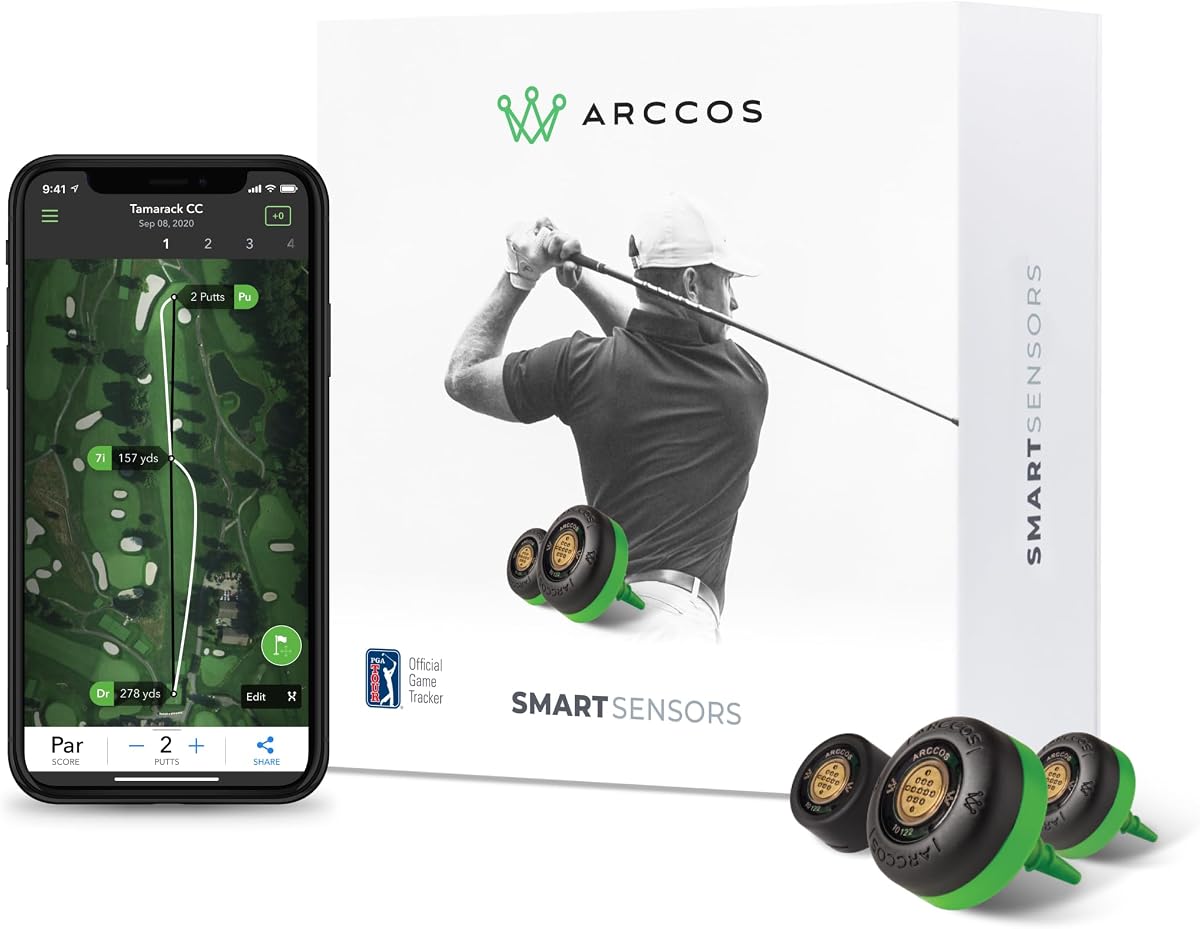
Arccos Smart Sensors combine automatic club tracking with an AI-powered GPS rangefinder and the Arccos Caddie app. The GEN 3+ set includes 14 weather-resistant, lightweight sensors, consisting of 13 regular sensors and one putter sensor. Its 4.1 rating supports consideration for golfers who want course-aware distances without tapping a club tag before every shot.
We may earn a commission when you buy through this link, at no additional cost to you.
The sensors capture shots automatically, and the app uses GPS information to provide smart club distances. Its rangefinder adjusts for wind, including gusts, elevation, temperature, humidity, and altitude. That weather-aware calculation is a meaningful distinction from a basic map pin because it seeks to provide a more relevant playing distance under the conditions actually present on the course.
The central long-term consideration is membership. The package includes the first year of the Arccos Caddie app following activation, but a membership is required afterward. Buyers should therefore consider the system as a combination of hardware and an ongoing service rather than viewing the sensor purchase as a one-time data solution. Phone compatibility, app quality, charging habits, and sensor placement can also influence the daily experience.
Arccos is best for golfers who prioritize automatic capture and course-specific, weather-adjusted numbers. It is a strong alternative to the Garmin CT10 for players who want GPS intelligence in a phone-based app rather than a compatible watch. The best choice between them depends on hardware preferences, existing devices, and the value placed on the range of data supplied by the caddie application.
The AI-powered rangefinder considers wind, elevation, temperature, humidity, and altitude. Those variables can make a fixed course map more useful when the recommended number changes with real conditions.
The sensor system records the club and shot without a manual pre-shot tag. For golfers who want clean round data without remembering a step, that automation is the product’s central appeal.
We may earn a commission when you buy through this link, at no additional cost to you.
Chromax High Visibility Distance Golf Balls prioritize visual detection rather than electronic tracking. The six-pack has a 4.6 rating, making it one of the better-reviewed products in the guide, but it does not include GPS, sensors, or an application. It is included because easy ball finding can complement a tracking setup and because visibility remains a practical concern for golfers searching for wayward shots.
We may earn a commission when you buy through this link, at no additional cost to you.
The product uses Chromax technology intended to improve visibility in all light conditions. It comes in green, gold, and silver, giving golfers options based on sky color, vegetation, hazards, or personal preference. The translucent soft Surlyn cover and 90 compression construction are designed for golfers with faster swing speeds and lower handicaps, while the stated performance is aimed at distance-oriented play.
Visibility does not replace tracking. Even a bright ball cannot identify the club, record its starting position, calculate a shot map, or provide a course distance. The listed design may make the ball easier to find after a wayward strike, but golfers still need a separate system for meaningful shot analytics or launch measurement.
The Chromax set is best for higher-speed golfers who lose balls around hazards or wooded areas and want a bright, distance-focused option. It can also be a practical companion to club sensors because better visibility helps recover the actual ball after tracking a shot. A golfer searching primarily for digital data should prioritize Golf Pad, Garmin, Arccos, or the Chiping system instead.
A high-visibility color can reduce the time spent searching through rough, trees, or shaded areas. This practical benefit is separate from any digital tracking capability.
The stated 90 compression and soft Surlyn cover target golfers with faster swing speeds and lower handicaps. Players with different swing profiles may prefer a ball designed around their own feel and compression requirements.
We may earn a commission when you buy through this link, at no additional cost to you.
The right tracking product depends on whether your priority is the ball itself, automatic club data, manual tagging, launch measurement, or simply finding a lost ball. Compare the technology, required devices, recurring services, and type of feedback before making a purchase.
A genuine GPS-enabled ball is the most literal option because the tracking hardware is described as part of the ball. Club sensors identify a shot through the club instead, while NFC tags require the golfer to tap the relevant club. Radar-compatible balls have a narrower purpose: they allow a launch monitor to measure the ball during practice. Buying begins with defining whether you want a complete round record, a repeatable practice measurement, or simply a ball that is easier to locate.
Compatibility can determine which system is usable. Golf Pad TAGS works with NFC-enabled Android devices and iPhone 7 or later, excluding the original iPhone SE. Garmin Approach CT10 requires a compatible Garmin golf watch. Arccos centers its functionality on its phone application and membership. Before buying any electronic system, confirm that your phone, watch, operating system, and other equipment are supported and that the relevant course data or accessory is available in your region.
Automatic tracking reduces the chance of forgotten or missed shots because the system detects the club and stroke without a tap. Manual NFC tagging takes only a moment, but it becomes part of your routine and can introduce errors. The Chiping concept aims to eliminate club-side manual interaction by putting the technology in the ball, although its low customer rating makes careful research advisable. The best workflow is the one you will follow consistently for an entire round.
Distance is only one part of a useful record. Golf Pad TAGS includes club averages, accuracy percentages, putting statistics, and scoring trends. Garmin supports distance, club type, shot location, accuracy, and strokes gained when paired with a compatible watch. Arccos emphasizes automatic capture, smart club distances, and a GPS rangefinder that adjusts for wind, elevation, temperature, humidity, and altitude. Rapsodo goes deeper into launch and swing measurements rather than mapping a round.
A hardware purchase may not include every software feature indefinitely. Arccos includes the first year of membership after activation and requires one afterward. Rapsodo includes a 45-day premium trial, with some advanced simulator and analysis functions tied to the premium offering. Golf Pad emphasizes tags that need no charging, while the Chiping system depends on its companion app. Review the service terms and recurring requirements as part of the total ownership decision.
A tracker cannot compensate for a ball that does not suit your game. Titleist Velocity emphasizes speed, high flight, and an alignment aid. The Pro V1 and Pro V1x RCT products are urethane tour-oriented models intended for measured play. Chromax uses a 90 compression, soft translucent Surlyn cover aimed at golfers with faster swing speeds and lower handicaps. Consider compression, feel, visibility, and intended use alongside the technology.
A mapped-course library is useful only if the venues you play are included or can be handled accurately. The Chiping app is advertised with more than 35,000 courses worldwide, while Arccos uses GPS-based course intelligence and Golf Pad depends on its software ecosystem. Check current coverage for your home course, favorite travel destinations, and preferred practice facilities. Also determine whether course maps are downloadable in advance for places with unreliable mobile service.
Powered sensors need charging, while passive NFC tags and conventional balls avoid that routine. Automatic systems are more convenient during a round but create one more device to maintain. Radsar-compatible balls do not need charging but require compatible measuring equipment. Electronic ball users should also confirm battery guidance, charging method, water resistance, and replacement information. A charging routine that fits your schedule is more valuable than an advanced feature you rarely use.
Begin with a short setup session before your next full round. For an app-based system, install the required application, confirm account and device compatibility, update the software, and check that your usual courses are available. For club sensors, install each unit in the intended club, pair it with the relevant watch or phone, and complete a test swing. For NFC tags, attach them carefully to the grips and practice tapping the correct club before relying on the resulting statistics.
Keep the data workflow consistent during play. Charge automatic sensors as directed, carry the compatible phone or watch, and use the same supported ball with a radar launch monitor when comparing performance. When using a manual system, tap before the shot rather than afterward, because accurate timing makes club and distance records more dependable. Review the app after the round and look for missing shots, misplaced club data, or course-location issues before drawing conclusions.
Clean and store the equipment according to the manufacturer's instructions, and avoid assuming that water, impact, extreme heat, or repeated charging will have no effect. Conventional balls should be kept dry and away from unnecessary heat, while electronic components benefit from periodic inspection and responsible charging. If a sensor behaves inconsistently, confirm the pairing and update before changing equipment, and if a tracked ball shows physical damage, stop using it until its condition has been evaluated.
Yes, the Chiping GPS Tracked Golf Balls are presented as an electronic six-ball set designed to work with a companion GPS app and more than 35,000 courses. Their 2.5 customer rating is lower than the ratings of the other products, so buyers should check app compatibility and current user feedback carefully. Most other tracking products in this guide track the club rather than the ball itself.
A GPS tracker can help record a shot location, but that is not the same as continuously revealing the ball's position after it has been lost. The bright Chromax balls focus on visual detection in all light conditions, while the sensor systems are intended to map shots and support course analysis. Check the product description carefully to understand whether the data concerns the shot, the club, or actual ball recovery.
GPS ball tracking places the relevant technology inside or around the ball, while club sensors are installed on clubs and identify the shot from the equipment being used. Club sensors commonly pair with a phone or watch for distance, location, accuracy, and club data. GPS-enabled balls are more literal but can introduce more technical and maintenance questions.
No, but requirements differ by product. Garmin Approach CT10 requires a compatible Garmin golf watch, Golf Pad TAGS uses an NFC-enabled phone, and Arccos centers on its phone application and membership. The Rapsodo launch monitor operates as its own measurement system. Always check the current device requirements before buying, because a tracker may be unusable without a supported phone, watch, or service.
Not by themselves. The Titleist Pro V1 and Pro V1x RCT models are designed for radar ballistic measuring instruments during practice, where the launch monitor can evaluate ball flight. They do not automatically record your course position or club for an entire round. You would still need a separate tracker for comprehensive on-course data.
The Garmin Approach CT10 and Arccos Smart Sensors are designed to capture shots automatically once the equipment is installed and configured. Golf Pad TAGS requires a tap before each shot, while the Chiping balls are intended to place tracking technology directly in the ball. Automatic operation does not eliminate charging, setup, or app-related maintenance, so the most convenient option still depends on your equipment habits.
Some do. Arccos includes the first year of membership following activation and requires a membership afterward, while the Rapsodo launch monitor includes a 45-day premium trial for its advanced features. Golf Pad TAGS relies on its app and compatible phone, and the Chiping system relies on its companion application. Review the current service terms before making a long-term purchase.
A launch-monitor system is the clearest option for indoor measurement because the Rapsodo device is explicitly designed for both indoor and outdoor use. Course-oriented trackers are most useful on mapped courses and during real rounds, where GPS and club-position data have practical context. Indoor putting or swing practice may still benefit from a compatible launch monitor and a consistent radar-compatible ball.
The three leading choices serve different needs. Chiping offers the most literal ball-level GPS concept, Garmin delivers established automatic club tracking within a watch-based ecosystem, and Golf Pad TAGS provides a lightweight, budget-friendly path to distance, accuracy, putting, and scoring statistics. Each should be judged against the type of technology you actually want rather than a generic promise of tracking.
Prioritize consistency, compatibility, and the information you plan to use. Automatic systems are attractive when uninterrupted data matters, manual tags are economical and simple, and launch monitors are strongest for technical practice. The ball itself still matters, so consider swing profile, construction, visibility, and the requirements of your measurement equipment before buying.
Finally, check current product availability, device support, app course coverage, trial terms, and recurring membership details before checkout. Prices and availability can change, and the information in this guide reflects the supplied November 2026 product data. A final check of current listings will help ensure the chosen tracker remains the best fit for your equipment and goals.