
ST to LCU Fiber Optic Adapter
5.0Editor score
ST/UPC to LC/UPC
Single-mode fiber support
Two-adapter pack
Tool-free installation
Our Lc to St Fiber Optic Adapter guide compares connector types, fiber compatibility, construction, packaging, and applications to help you choose the right
Lc to St Fiber Optic Adapter options help technicians connect equipment or patch cables with different connector styles without replacing an entire network installation. The right adapter must match the fiber type, connector ends, polarity, wavelength requirements, and physical connection method, so appearance alone is never a reliable buying guide.
We compared all ten products by examining their connector gender, single-mode or multimode support, simplex or duplex format, included components, documented optical specifications, and stated uses. The guide includes compact inline couplers, one-foot adapter cables, and a broader interchangeable testing kit, giving readers several ways to complete an LC-to-ST connection.
Each review explains the most useful features, possible limitations, and likely installation scenarios. The top picks include a straightforward two-pack for budget-conscious work, a well-specified two-pack for general testing, and a versatile multi-connector kit for technicians who handle varied fiber assignments. Product details and current pricing can change, so confirm specifications before ordering.
5.0Editor score
5.0Editor score

5.0Editor score
The table below compares every adapter in the guide by configuration, fiber support, physical format, and primary use. It highlights the important differences between inline couplers, short duplex adapter cables, and the multi-connector testing kit.



This Poyiccot set provides three simplex hybrid adapters that convert an ST/UPC male connection into an LC/UPC female connection. It carries a 4.8 rating and stands out for providing a generous three-piece package in a compact, tool-free format. The adapter is intended for single-mode 9/125-micron fiber and supports both 1310 nm and 1550 nm working wavelengths.
We may earn a commission when you buy through this link, at no additional cost to you.
The strongest feature is its clearly documented optical performance. Insertion loss is listed at no more than 0.2 dB across 1310 nm and 1550 nm, while return loss is listed at no less than 50 dB. Ceramic and metal sleeve materials are also specified, and the manufacturer states that the coupling can withstand more than 1,000 plug insertion cycles. These details make the set more informative than a basic no-name coupler.
The main limitation is its specialization. It is a simplex, single-mode UPC adapter rather than a duplex or multimode solution, so it cannot cover every fiber assignment encountered by a technician. The inline construction also means cable support and strain relief remain the responsibility of the connected patch leads. Despite those constraints, the three included adapters provide useful redundancy for field service, bench testing, and multiple instrument connections.
This is a strong choice for a technician who repeatedly needs ST-to-LC single-mode conversion, particularly when working with optical power meters, visual fault locators, CATV networks, and telecommunications maintenance. Buy this pack when the matched ST/UPC and LC/UPC interfaces are known and several adapters will make the job easier. For broader connector coverage, the Sabary kit is the more versatile alternative.
The three-piece configuration lets technicians carry spare adapters or connect more than one test lead without making an additional order. It is particularly useful for service kits where lost or contaminated adapters can interrupt a troubleshooting session.
Stated insertion-loss, return-loss, wavelength, and temperature ranges give installers useful reference points. The adapter is specifically intended for 9/125-micron single-mode systems rather than legacy 62.5/125-micron multimode networks.
We may earn a commission when you buy through this link, at no additional cost to you.
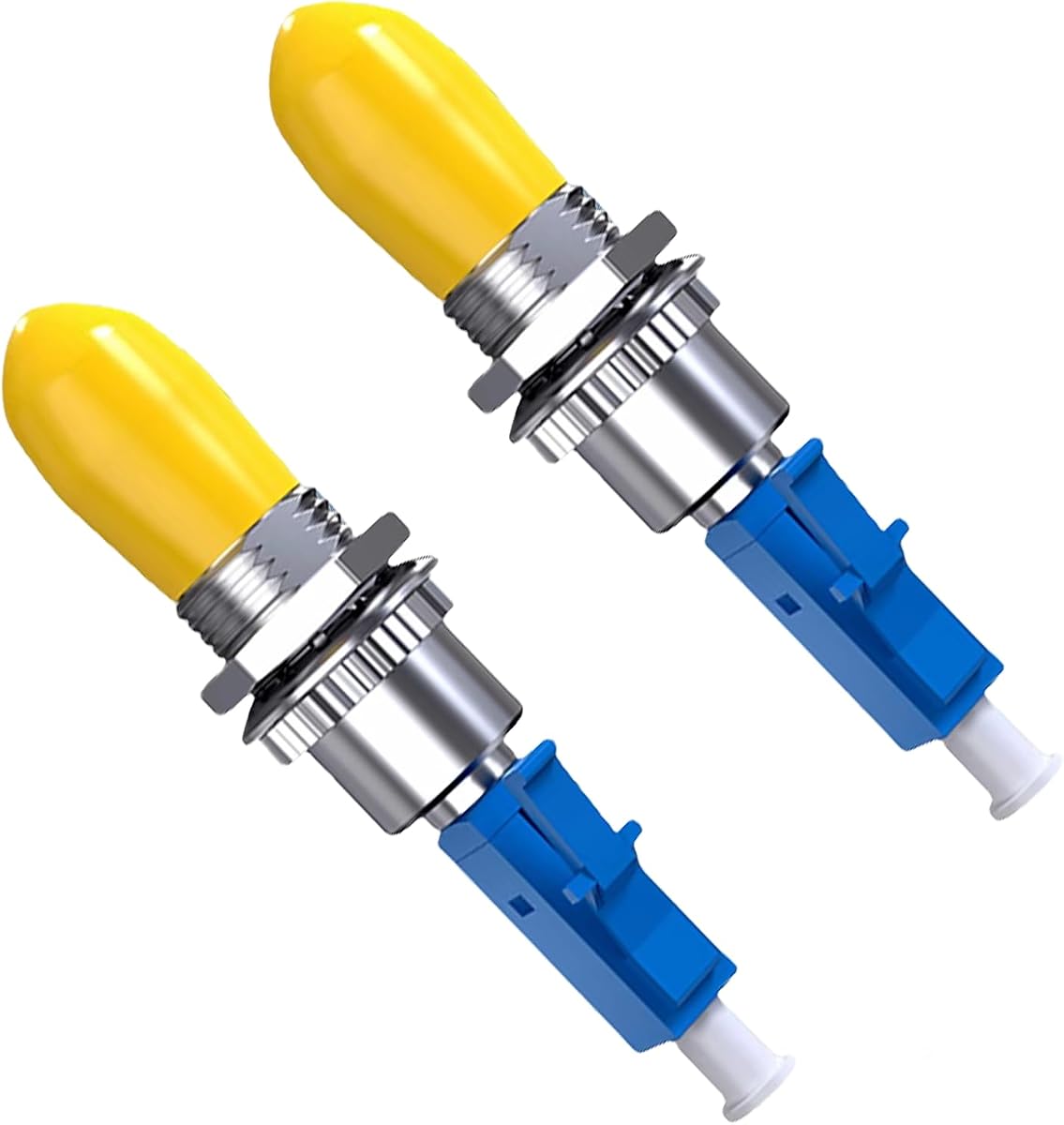
This two-pack reverses the direction of the common inline transition by accepting an LC/UPC male plug and presenting an ST/UPC female interface. It has a 5.0 rating and offers a balanced choice for technicians who need a compact adapter with well-stated performance. Each unit is designed for 9/125-micron single-mode fiber.
We may earn a commission when you buy through this link, at no additional cost to you.
Its specifications cover the factors that matter during network installation and testing. The listed insertion loss is no more than 0.2 dB at both 1310 nm and 1550 nm, and return loss is no less than 50 dB. The operating-temperature range is listed from -40°C to +95°C. A ceramic-and-metal sleeve construction is specified, along with resistance to flame, high temperature, and impact.
The product is limited to simplex single-mode connections. That is not a flaw in itself, but it means it is not suitable for a 62.5/125-micron multimode duplex run or for a task requiring two independent strands in one cable assembly. It also does not provide a long cable, so the connected leads must be supported carefully to avoid mechanical stress on the mating interfaces.
This adapter is an excellent choice for optical power meter work, visual fault locator work, local area networks, and general single-mode maintenance. Its two adapters give users a spare while avoiding an unnecessarily large package. It is the strongest all-around recommendation here for users who already know they need the LC-male-to-ST-female orientation and do not need a multimode or duplex alternative.
The stated loss and return figures are particularly useful when an adapter is used between a patch lead and an optical power meter or visual fault locator. That makes the product more than a simple physical connector conversion.
Two adapters are enough to create separate test links or to keep one in reserve. The compact inline format also works well in temporary setups where a long patch cable would be unnecessary.
We may earn a commission when you buy through this link, at no additional cost to you.
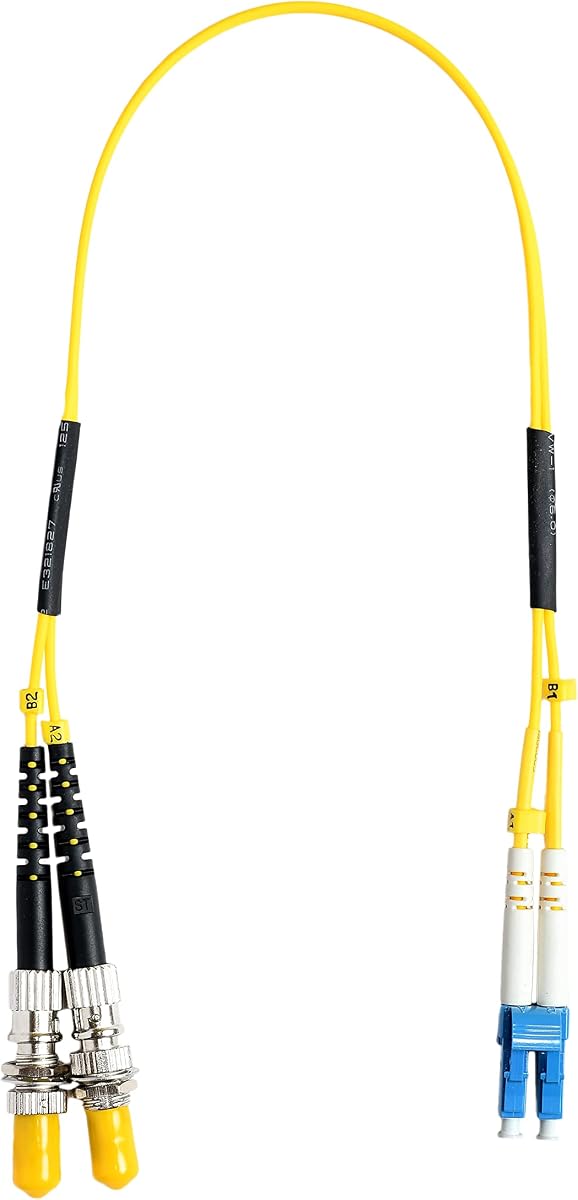
The OpZonik option is not merely an inline coupler; it is a factory-terminated, one-foot duplex cable with an LC male connector on one end and an ST female connector on the other. It is designed for single-mode 9/125-micron fiber at 1310 nm. Unlike the hybrid adapters, it provides a short physical cable between mismatched connector types.
We may earn a commission when you buy through this link, at no additional cost to you.
The cable uses a two-strand tight-buffered zip cord with an outer diameter of 2.0 mm. Its jacket is described as LSZH, meaning low smoke and zero halogen, which can be valuable in controlled environments where cable emissions and flame behavior matter. The manufacturer also states that the cable is factory terminated and tested for link loss and return loss.
A potential drawback is that the supplied information lists only a 1310 nm wavelength, whereas some single-mode adapters explicitly cover both 1310 nm and 1550 nm. The product has no available customer rating, which means buyers cannot use its rating history as a supporting signal. In addition, the fixed one-foot length may be too short for some panel layouts or too long for a closely spaced test interface.
This cable is best for installers or testers who need a ready-made duplex transition rather than a standalone adapter. Its factory-finished construction reduces the need to terminate mismatched connectors in the field. Choose it when single-mode duplex connectivity, short reach, and an LSZH jacket matter more than the broader wavelength range offered by some inline couplers.
A preassembled duplex cable can simplify panel work and instrument testing because both strands are already terminated. It also provides a short length of cable for managing bend radius and connector placement.
The stated LSZH jacket is notable for installations where low smoke and zero-halogen cable construction is preferred. Buyers should still verify local building and safety requirements for their specific environment.
We may earn a commission when you buy through this link, at no additional cost to you.
This Ultra Spec Cables adapter is a one-foot duplex transition for multimode systems, with an LC male end and an ST female end. It supports 62.5/125-micron fiber at 850 nm and carries a 4.8 rating. It is a natural choice for legacy multimode infrastructure, laboratory benches, and short test links where the two devices use incompatible connector shapes.
We may earn a commission when you buy through this link, at no additional cost to you.
The ready-made duplex format reduces the work required compared with building the transition from separate connectors and cable. Standard zip-cord duplex jacket construction makes the unit straightforward to route, label, and connect. At 12 inches long, it also avoids excess slack in a dense patch panel, although actual bend-radius requirements should still guide the final placement.
The primary trade-off is that this cable is purpose-built for multimode rather than single-mode fiber. Its 850 nm specification and 62.5/125-micron construction do not match the requirements of modern 9/125-micron single-mode links. It also lists no broad operating-temperature or insertion-loss data, so users seeking detailed optical specifications may find the inline adapters better documented.
Buy this adapter cable when working with older multimode equipment or infrastructure at 850 nm. It is especially helpful for technicians who need a short, preassembled duplex bridge between LC and ST ports. For a new single-mode deployment, the OpZonik or Ultra Spec single-mode alternatives are the safer choices.
The 62.5/125-micron fiber and 850 nm wavelength identify this as a legacy-oriented multimode solution. It can bridge older ST infrastructure to an LC-equipped device without confusing single-mode and multimode connector types.
The 12-inch length is useful for instrument connections and compact panels. A factory-finished duplex assembly also removes the need to field-terminate two connectors.
We may earn a commission when you buy through this link, at no additional cost to you.
The Sabary package is the most versatile product in this guide because it includes six interchangeable fiber optic connectors rather than one repeated LC-to-ST configuration. It has a 5.0 rating and supports both single-mode and multimode work. The included set covers LC, SC, ST, FC, an FC-male-to-LC-female transition, and an SC/UPC-male-to-SC/APC-female transition.
We may earn a commission when you buy through this link, at no additional cost to you.
Its metal housings are designed for structural stability, corrosion resistance, and repeated use. The stated insertion loss is below 0.2 dB, while return loss is above 45 dB. A plug-and-play design allows the adapters to be used without tools, which is valuable during OTDR launches, visual fault locator checks, optical power meter work, FTTX deployment, and network maintenance.
The trade-off is that this package does more than the narrow search term implies. Buyers who need only one ST-to-LC inline coupler may find the broader assortment unnecessary. It is also important to select the correct included hybrid because connector gender, polish type, and fiber mode all affect whether an adapter is physically and optically appropriate.
This kit is the strongest option for a field technician, installer, or laboratory that supports several fiber connector standards. It is especially attractive for OTDR testing because a comprehensive set can solve transition problems without requiring separate adapters for every device encountered. Choose it when versatility and metal housings outweigh the simplicity of a dedicated two-pack.
The six adapters cover several common transitions encountered in optical networks. This breadth is especially useful for technicians who do not know which connector an older piece of equipment will use.
The listed metal housings offer a durable alternative to simple plastic couplers. Their claimed corrosion resistance and structural stability make the set appropriate for repeated testing and maintenance work.
We may earn a commission when you buy through this link, at no additional cost to you.
This two-pack is a focused solution for converting ST/UPC equipment to LC/UPC in a single-mode network. It has a 5.0 rating and emphasizes straightforward installation, compact dimensions, and interoperability with standard UPC connectors. It is designed for technicians who need a dependable inline transition without a full cable or multi-connector kit.
We may earn a commission when you buy through this link, at no additional cost to you.
Precision ceramic sleeves and a metal housing are highlighted as the central construction features. The ST side uses a threaded coupling, while the LC side uses a familiar push-pull connection, allowing installation without tools. Its compact form is also claimed to fit standard adapter panels, wall outlets, and other space-conscious telecommunications locations.
As with the other dedicated single-mode adapters, it is limited to one strand and does not support multimode fiber. The product information discusses signal integrity and standard compatibility, but it does not provide the same detailed wavelength-by-wavelength insertion-loss and return-loss figures as the Poyiccot and QIANRENON products. That makes it a practical choice, but one that may appeal less to buyers who require numerical performance data.
This adapter is well suited to legacy ST systems being connected to modern LC equipment, including telecom and enterprise backbone work. It is also useful for compact patch panels and temporary test interfaces. The two-piece pack offers a spare while keeping the solution focused, making this one of the most approachable selections for the exact LC-to-ST conversion task.
The push-pull LC connection and threaded ST coupling create a familiar installation process. No specialized tool is needed, which speeds temporary testing and permanent panel work.
The small inline format is designed to conserve space in high-density patch panels and wall outlets. It is most useful when a direct connector transition is preferable to a longer adapter cable.
We may earn a commission when you buy through this link, at no additional cost to you.
This Ultra Spec Cables product provides the opposite connector-gender arrangement from several other entries in the guide: an LC female end connects to an ST male end. It is a one-foot, two-strand multimode cable for 62.5/125-micron fiber at 850 nm. Its 4.9 rating makes it one of the strongest customer-rated options in the list.
We may earn a commission when you buy through this link, at no additional cost to you.
The preterminated duplex construction is convenient for technicians who need a ready-made bridge instead of a standalone inline adapter. Standard zip-cord jacket construction and the compact 12-inch length suit bench testing, patch-panel work, and temporary links. The two strands remain packaged together, which can make routing and labeling more organized than managing separate simplex cables.
The important qualification is multimode compatibility. A connector adapter cannot make a 62.5/125-micron cable suitable for a single-mode 9/125-micron system, so using the wrong category can produce poor results or damage sensitive equipment. Only 850 nm is specified, and the product does not list the same operating-temperature or detailed optical-loss data found in several of the dedicated inline couplers.
This cable is an excellent match for legacy multimode equipment with an ST male port and an LC female port. It is also useful for installers who prefer the female-to-male orientation because it directly accepts the corresponding cable ends. Select it for 850 nm multimode work and use one of the single-mode models when servicing a 9/125-micron network.
The LC female to ST male arrangement solves a specific mating problem and complements the more common LC male to ST female cable. Checking equipment gender before ordering prevents a mechanically incompatible setup.
Keeping both fibers in one zip-cord assembly simplifies temporary test links. It is especially convenient when both channels must be carried between nearby pieces of equipment.
We may earn a commission when you buy through this link, at no additional cost to you.
This Ultra Spec Cables adapter cable is a one-foot duplex transition for single-mode networks, using an LC male connector and an ST female connector. It supports 9/125-micron fiber at 1310 nm and has a 4.3 rating. It fits common field needs where a ready-made short cable is more convenient than a standalone inline coupler.
We may earn a commission when you buy through this link, at no additional cost to you.
Its duplex zip-cord format provides two factory-terminated strands in one manageable cable. That arrangement can reduce the number of separate items a technician must carry and make it easier to route the link between a patch panel and an instrument. The 12-inch length keeps the cable compact for dense work areas.
Its 4.3 rating is lower than those of the leading selections, and the supplied information gives no customer comments explaining the variation. Only 1310 nm is stated as the working wavelength. While this may be entirely appropriate for the intended link, it offers less documented flexibility than couplers explicitly rated for both 1310 nm and 1550 nm.
This is a sound option for a standard 1310 nm single-mode duplex transition. It is particularly useful when the required connector genders are already known and a factory-assembled cable is preferred. For installations requiring broader wavelength coverage, the Poyiccot or QIANRENON inline adapters provide more detailed single-mode specifications.
The 9/125-micron construction and 1310 nm rating align with conventional single-mode links. It is a direct solution for connecting LC and ST equipment without a separate bulk fiber run.
The paired cable is ready to connect, avoiding the separate connector and patch-cable components used with an inline adapter. This can simplify inventory and temporary test arrangements.
We may earn a commission when you buy through this link, at no additional cost to you.
The QIANRENON converter is a simplex hybrid adapter that accepts an ST/UPC male connector and presents an LC/UPC female interface. It is designed for 9/125-micron single-mode fiber and carries a 4.8 rating. Its detailed optical figures distinguish it from simpler adapters that provide few measurable performance details.
We may earn a commission when you buy through this link, at no additional cost to you.
The listed insertion loss is 0.12 dB at 1310 nm and 0.04 dB at 1550 nm. Return loss is specified at 53.3 dB and 52.3 dB respectively. The product uses UPC contacts and is recommended for ST/UPC and LC/UPC patch cords or pigtails. The information also identifies common uses including FTTH, FTTP, FTTA, LAN, CATV, red-light pens, optical power meters, and fiber optic instruments.
The product remains limited to one strand and one fiber category. It is not a duplex or multimode solution, and the specific recommendation to use matching UPC components is important because mismatched polish types can create unnecessary loss. It is also a bare inline adapter, so it does not provide cable strain relief or a managed bend radius.
This converter is a compelling choice when measurement quality and documented performance matter more than having multiple adapters. It is particularly useful for technicians connecting a red light pen, optical power meter, or other instrument to differently terminated single-mode cabling. Its combination of a 4.8 rating, explicit loss values, and clear application guidance makes it a strong technical option.
The adapter lists separate insertion-loss and return-loss values for both common single-mode wavelengths. This makes it easier for technicians to compare the expected link performance with other components.
The recommendation to use ST/UPC and LC/UPC leads helps maintain a consistent optical interface. Checking polish types before connection is a simple step that can prevent avoidable attenuation.
We may earn a commission when you buy through this link, at no additional cost to you.
This Ultra Spec Cables unit is a one-foot duplex single-mode adapter cable with an LC female end and an ST male end. It is rated for 9/125-micron fiber at 1310 nm and has a 4.6 customer rating. It fills a useful gap in the list because several other LC-to-ST cables use the opposite connector-gender orientation.
We may earn a commission when you buy through this link, at no additional cost to you.
The ready-assembled duplex cable can be connected directly between compatible equipment. Its 12-inch length works well for short bench, panel, and instrument links, while the standard zip-cord jacket keeps the two strands organized. A factory-terminated format can also reduce deployment time compared with assembling a coupler and separate patch leads.
The stated 1310 nm wavelength is the main technical limitation for buyers who may operate in the 1550 nm band. No broader temperature, insertion-loss, or return-loss details are supplied, so users needing documented optical performance may prefer the QIANRENON or Poyiccot products. The fixed length may also be unsuitable where a longer reach or more slack is required.
This cable is best for technicians working with single-mode equipment that specifically requires an LC female to ST male connection. It is a straightforward solution for 1310 nm duplex links, especially where a short preassembled lead is preferable to a standalone inline adapter. Confirm connector genders and wavelength requirements before making the final selection.
This cable allows newer LC hardware to connect with an ST male port without confusing multimode and single-mode systems. Its 9/125-micron construction makes it appropriate for standard single-mode links.
The one-foot factory-terminated assembly is easy to carry and deploy. It is best suited to nearby equipment where compactness is more valuable than extended reach.
We may earn a commission when you buy through this link, at no additional cost to you.
The correct LC-to-ST adapter depends on more than connector names. Fiber category, connector gender, end-face polish, strand count, wavelength, physical format, and intended testing environment should all be confirmed before purchase.
Single-mode fiber typically uses a 9-micron core with 125-micron cladding and is intended for longer-distance, higher-capacity links. Multimode fiber usually has a 50-micron or 62.5-micron core, with the products in this guide specifically listing 62.5/125-micron construction. An adapter does not convert one fiber category into the other, so the transition must match the actual fiber, equipment, and test equipment used in the link.
Choose single-mode only when every connected component is designed for single-mode operation. Choose 62.5/125-micron multimode for older short-reach infrastructure operating around 850 nm.
Connector gender determines which side can physically accept the other. An LC male adapter has a protruding plug and requires an LC female socket, while an LC female adapter requires an LC male plug. The same principle applies to ST connectors. A male-to-female hybrid can also be described in reverse depending on which end is being introduced, so it is important to distinguish the product title from the direction of the cable being attached.
Write down the gender and type of both ports before ordering. Reversing male and female may leave a cable that appears usable but cannot be physically mated.
UPC and APC are different polish standards, and mixing them can cause significant optical loss and reflection. UPC typically has a slightly different end-face geometry than APC, while color conventions commonly identify the connection type. Several adapters in this guide explicitly use UPC contacts, which makes them suitable for matching UPC patch cords and pigtails.
Verify the polish of the adapter, patch cable, and equipment ports. Do not force a connector that appears physically similar but uses a different polish configuration.
A simplex adapter carries one optical strand, while a duplex assembly carries two. Simplex inline couplers are compact and often pair naturally with a single test lead. Duplex adapter cables keep transmit and receive strands together, which can simplify panel organization and full-duplex test arrangements.
Choose simplex for a single connection or instrument interface. Choose duplex when both directions of a link must be present in one cable assembly.
A connector that physically fits can still be unsuitable if its specified operating range does not cover the wavelength carried by the link. Single-mode systems may operate around 1310 nm, 1550 nm, or both, while the classic multimode products here are associated with 850 nm. Some inline adapters explicitly list both 1310 nm and 1550 nm, making them more flexible for broader single-mode testing.
Confirm the source wavelength and the wavelength range of connected test instruments. Use a broadly specified single-mode adapter when the exact operating band is uncertain.
An inline adapter is a compact coupler that sits between two existing patch cords. It offers minimal bulk and allows separate cable lengths to be chosen for the installation. A one-foot adapter cable is factory terminated, combines the transition and link in one item, and can reduce assembly steps. Neither style is universally better; the panel layout, cable management needs, and field-testing habits determine the most convenient option.
Use inline adapters for flexible temporary setups and dense panels. Use short adapter cables when a ready-made, supported duplex connection is more convenient.
Ceramic sleeves, metal housings, documented insertion loss, and return-loss figures provide useful evidence of adapter quality. A low insertion-loss specification indicates that the transition should add little signal attenuation, while strong return loss helps control reflected light. Temperature ratings can also matter in telecom enclosures, workshops, and other environments with variable conditions.
Prioritize products with clear specifications, but also consider the purpose of the connection. A bench adapter for occasional testing may require less documentation than an inline unit intended for permanent network use.
A dedicated two- or three-pack is convenient when the same LC-to-ST conversion appears repeatedly. A multi-adapter kit is more valuable for field technicians who encounter LC, SC, ST, and FC equipment across different sites. Such a kit can prevent delays caused by an unexpected connector type, but it does not eliminate the need to verify fiber mode, gender, and polish for each connection.
Choose a focused pack for predictable work. Choose a broad kit when connector variety and testing readiness are the leading priorities.
Begin by identifying the fiber type, connector genders, polish type, and wavelength at both ends of the intended connection. Inspect every mating surface under suitable lighting, looking for dust, scratches, fibers, fingerprints, or contamination. Clean the connector ferrules and adapter sleeves with an approved fiber-optic cleaning method before attempting to connect anything.
Align the adapter correctly and insert the connector straight without twisting. Tighten a threaded ST connection only as needed to achieve a secure fit, while LC push-pull connectors should seat firmly without excessive force. For an adapter cable, route the cable with a gentle bend and avoid sharp edges, crushing points, tension at the connector, and bends tighter than the cable or connector manufacturer permits.
For testing, connect the adapter to the appropriate optical power meter, visual fault locator, OTDR, or network equipment, then begin with the lowest safe optical output. Keep unused ports and sleeves protected from dust, store the adapter in a clean case when it is not in use, and inspect it periodically. Replace or reclean a connector when damage or persistent contamination is found rather than forcing a compromised connection.
An LC to ST fiber optic adapter is a connector transition that lets an LC connection communicate with an ST connection without replacing the entire cable run. It may be a compact inline coupler or a short factory-terminated cable. The correct product must match the fiber type, connector gender, polish, wavelength, and strand count of the equipment being connected.
No. The adapter should match the fiber category used by the cable and equipment. A 62.5/125-micron multimode adapter is intended for legacy multimode links, generally around 850 nm, while a 9/125-micron adapter is designed for single-mode links. Connecting mismatched categories may produce unreliable measurements and can risk damage to sensitive equipment.
Choose an inline adapter when you already have suitable LC and ST patch cords and want a compact, flexible transition. Choose a short adapter cable when a ready-made duplex link is more convenient or when factory termination is preferable. Neither option changes the required fiber mode, connector gender, or polish, so those specifications always take priority.
Yes. The male end must physically enter the female end. Common configurations include LC male to ST female, ST male to LC female, LC female to ST male, and ST female to LC male. Because some descriptions refer to the same hybrid from opposite perspectives, check the physical connector type on both ends and the gender of your patch cables before purchasing.
It is generally best to avoid mixing UPC and APC end faces because the different polish geometries can introduce excessive loss and reflection. Match the adapter to the UPC or APC connectors already present in the system. Several products in this guide are explicitly UPC, making them appropriate for matching UPC patch cords, pigtails, and test equipment.
Look for a stated insertion loss and return loss, then compare those figures with the performance required by your link. Lower insertion loss generally means less added attenuation, while higher return loss indicates better control of reflected light. Also verify the supported wavelengths, operating temperature, sleeve material, and housing construction when environmental durability matters.
A simplex adapter handles one strand, while a duplex adapter cable or paired connection handles two. They can serve different purposes, but a simplex unit cannot independently carry the second strand of a duplex link. Choose based on the number of fibers that must pass through the transition and the layout of the connected equipment.
Keep the adapter protected from dust when it is not in use and inspect both mating surfaces before connecting. Clean the ferrule and sleeve with an approved fiber-optic cleaning procedure when contamination is visible. Store inline adapters in a clean case, avoid cable stress at the connection, and never force a connector that does not seat smoothly.
The ST to LCU two-pack is the most focused budget-friendly option for standard single-mode work, while the Poyiccot LC-to-ST two-pack is the strongest all-around choice for technicians who value clear optical specifications, a 5.0 rating, and testing compatibility. The Sabary kit stands apart as the most versatile selection because it includes six interchangeable adapters for several connector types and both single-mode and multimode applications.
Before ordering, prioritize the physical match: verify fiber category, connector gender, end-face polish, wavelength, and simplex or duplex format. Match the physical format to your setup, choosing a compact inline adapter for flexible panel work or a one-foot adapter cable for a ready-made duplex connection. Do not rely on a shared connector label alone when several of the included products use similar names but opposite gender arrangements.
Product listings and current pricing can change, so review the latest specifications, included quantities, and compatibility details before checkout. A careful connector check is essential, but selecting the right fiber mode and wavelength is equally important for a dependable installation or an accurate optical test.