
KNIPEX 97 53 04 Crimping Pliers
4.7Editor score
DIN 46228 compliant crimping
AWG 5-28 wire capacity
Integral self-releasing lock
Reduced manual operating force
Narrow ergonomic handle design
Ferrule crimping tools compared for wire range, crimp profile, ratchet design, terminal selection, ergonomics, and complete kit value.
Ferrule crimping tools create dependable connections by compressing wire ferrules around stranded conductors. A suitable tool combines the correct wire capacity, a consistent crimp profile, secure positioning, and manageable operating force. These qualities matter most in control panels, automotive wiring, marine systems, industrial equipment, and detailed electronics projects.
This guide compares ten ferrule crimping tools and kits based on stated wire ranges, crimp mechanisms, die design, adjustment systems, included terminals, storage, and intended applications. It covers dedicated professional tools, self-adjusting ratcheting crimpers, square-crimp kits, and comprehensive assortments for light wiring through heavier power conductors.
Each review highlights the most useful strengths, practical limitations, and type of user best served by that model. Ratings reflect the supplied product information rather than personal testing, and availability, included accessories, ratings, and pricing can change. Always verify the latest listing and current wire specifications before purchasing.
4.7Editor score

4.9Editor score
4.7Editor score
The comparison below organizes every tool by its intended range, crimp system, ratchet behavior, and practical advantages. It shows which options bundle terminals, which are designed for lighter precision work, and which provide broader capacity for professional or heavy-duty wiring.


This comprehensive kit pairs a self-adjusting ferrule crimper with 760 insulated terminals covering AWG 24 through 4. Its 4.6 rating and extensive accessory package position it as a broad solution for technicians, installers, and serious DIY users who want both a tool and a ready supply of ferrules. The crimper creates a six-sided hex profile intended to provide uniform contact around the wire.
We may earn a commission when you buy through this link, at no additional cost to you.
Its strongest feature is the expanded capacity. A selector knob separates AWG 24-8 and AWG 8-4 operating ranges, allowing the tool to handle delicate electronics wiring alongside heavier power conductors. The stated configuration accommodates single wires through 4 AWG and twin ferrules through AWG 2×8. An index-finger release lever helps open the jaws when a terminal is lodged, while the ratcheting action supports repeatable placement.
The assortment is another major advantage. It includes tinned copper ferrules with nylon insulation organized in a custom-molded hard case, and the stated color coding follows DIN 46228 conventions for easier size identification. That combination can be particularly valuable for control panels, switchgear, circuit breakers, solar inverters, custom car audio, RVs, and marine systems where a broad mixture of wire sizes is common.
There are trade-offs. The extensive package takes up more space than a dedicated crimper, and users moving between light and heavy wire sections must understand the selector and the tool's operating range. Buyers who only work with one small wire size may not need so many components. Even so, its flexibility, organized storage, and ability to cover both single and twin terminations make it a compelling all-in-one kit.
The two-range selector is useful when a workshop handles both delicate signal wiring and heavier power lines. Rather than changing tools, the user can move between AWG 24-8 and AWG 8-4 operating bands while retaining a consistent ratcheting workflow.
With 760 ferrules spanning 11 sizes, the kit reduces the need to source compatible terminals separately. The molded case also keeps the tool and color-coded components together, which is useful for mobile technicians and organized workbenches.
We may earn a commission when you buy through this link, at no additional cost to you.
The Klein Tools 34056 is a dedicated hex ferrule crimper for 10-22 AWG stranded wire. Its 4.7 rating, built-in ratchet, and six precision dies make it a practical choice for installers who want controlled crimps without purchasing a large terminal kit. The tool is particularly relevant when an existing supply of compatible ferrules is already on hand.
We may earn a commission when you buy through this link, at no additional cost to you.
The ratchet automatically adjusts to the ferrule size, helping the user complete the intended compression before the handles release. A separate adjustment dial offers finer tuning for customized results. Combined with the six-sided dies, this design gives the tool a clear identity focused on consistent hex crimps and strong 360-degree contact around the terminal.
One limitation is that the stated AWG 10-22 range does not cover the lightest hookup wire or the heavy power cable handled by broader kits. Another is the absence of an included ferrule assortment. For a technician who already owns a well-organized inventory, that can be an advantage because the purchase remains focused on the tool itself.
The 34056 suits electricians, control-panel builders, automotive technicians, and advanced hobbyists working primarily within AWG 10-22. It is easier to justify than a comprehensive kit when the user needs a dependable ratcheting crimper and already knows which terminal sizes are required. It is not the choice for the broadest possible range, but it is a focused, well-specified tool.
The automatic ratchet helps hold the work in position and complete a repeatable cycle. For users who already have ferrules, this focused package avoids unnecessary terminal volume while retaining the controls needed for consistent results.
The fine-tuning dial provides a way to adapt the crimper to different terminal sizes. It is particularly useful in mixed installations where slightly different terminal dimensions appear within the same AWG range.
We may earn a commission when you buy through this link, at no additional cost to you.
The Klein Tools 34060 is an all-in-one square ferrule crimping set with a 4.9 rating, the highest listed rating in this group. It includes a ratcheting crimper, 1,200 terminals, and a soft storage case. The combination makes it especially attractive to electricians, automotive installers, and serious enthusiasts who want a functional project kit immediately.
We may earn a commission when you buy through this link, at no additional cost to you.
Unlike conventional hex compression, the tool uses four precision dies to produce a square crimp around the terminal. The design is described as creating strong, 360-degree crimps, while a built-in ratchet automatically adjusts to the ferrule size. An adjustment dial allows fine tuning, helping the user obtain consistent compression across the stated AWG 10-22 range for stranded wire terminals.
The square profile is the key decision point. It differentiates the 34060 from hex-focused alternatives and may be valuable where the intended terminals or installation standard call for that geometry. However, users with established hex-ferrule workflows should confirm compatibility rather than assuming crimp profiles are interchangeable.
Despite the 1,200-piece assortment, the package is logically organized in a soft case, which helps keep the tool and components together. Overall, the 34060 is the strongest all-around choice in this comparison for users who want a ready-to-use square-crimp system and value a very large terminal supply.
The large terminal assortment gives users a broad supply of compatible components for repeated electrical work. Combined with the dedicated crimper and storage case, it reduces the need to assemble a kit from separate tools, ferrules, and containers.
Four precision dies and a self-adjusting ratchet support a consistent square finish. The adjustment dial adds another level of control for technicians working with varied terminal sizes within the tool's AWG 10-22 capacity.
We may earn a commission when you buy through this link, at no additional cost to you.
The SOMELINE kit combines a ratcheting ferrule crimper with 23 kinds of wire terminals covering AWG 24-8. Its 4.7 rating and broad assortment make it suitable for electronics, controls, automotive wiring, machinery, household projects, and professional maintenance. The double-layer box is designed to keep the many terminal variations accessible and portable.
We may earn a commission when you buy through this link, at no additional cost to you.
The terminals are described as tinned copper with nylon insulating sleeves. Tinned copper supports conductivity and corrosion resistance, while the nylon provides insulation and flame-retardant characteristics. Color and size differences help users identify appropriate ferrules more quickly, especially when several small wire gauges are in use.
The crimper includes an efficient ratcheting mechanism, a professional-grade crimp die, and ergonomic handles. Compared with the largest kits, however, its AWG 24-8 upper limit excludes heavy power conductors. Buyers working on high-current equipment, thick battery cables, or industrial power distribution would need a broader-capacity crimper.
This is a good option for technicians and DIY users who repeatedly assemble panels or small electrical systems and value terminal variety and storage. It is less attractive for someone needing only a single terminal size because the kit adds bulk. Within its intended range, it offers a strong balance of useful assortment, portability, and crimp mechanism.
Twenty-three terminal variations make the kit useful when a project uses several related wire sizes. The color-coded sleeves also simplify visual identification during repetitive assembly work.
Tinned copper addresses conductivity and corrosion concerns, while the nylon sleeve adds insulation around the crimped area. Together, these features suit organized permanent connections in equipment and vehicles.
We may earn a commission when you buy through this link, at no additional cost to you.
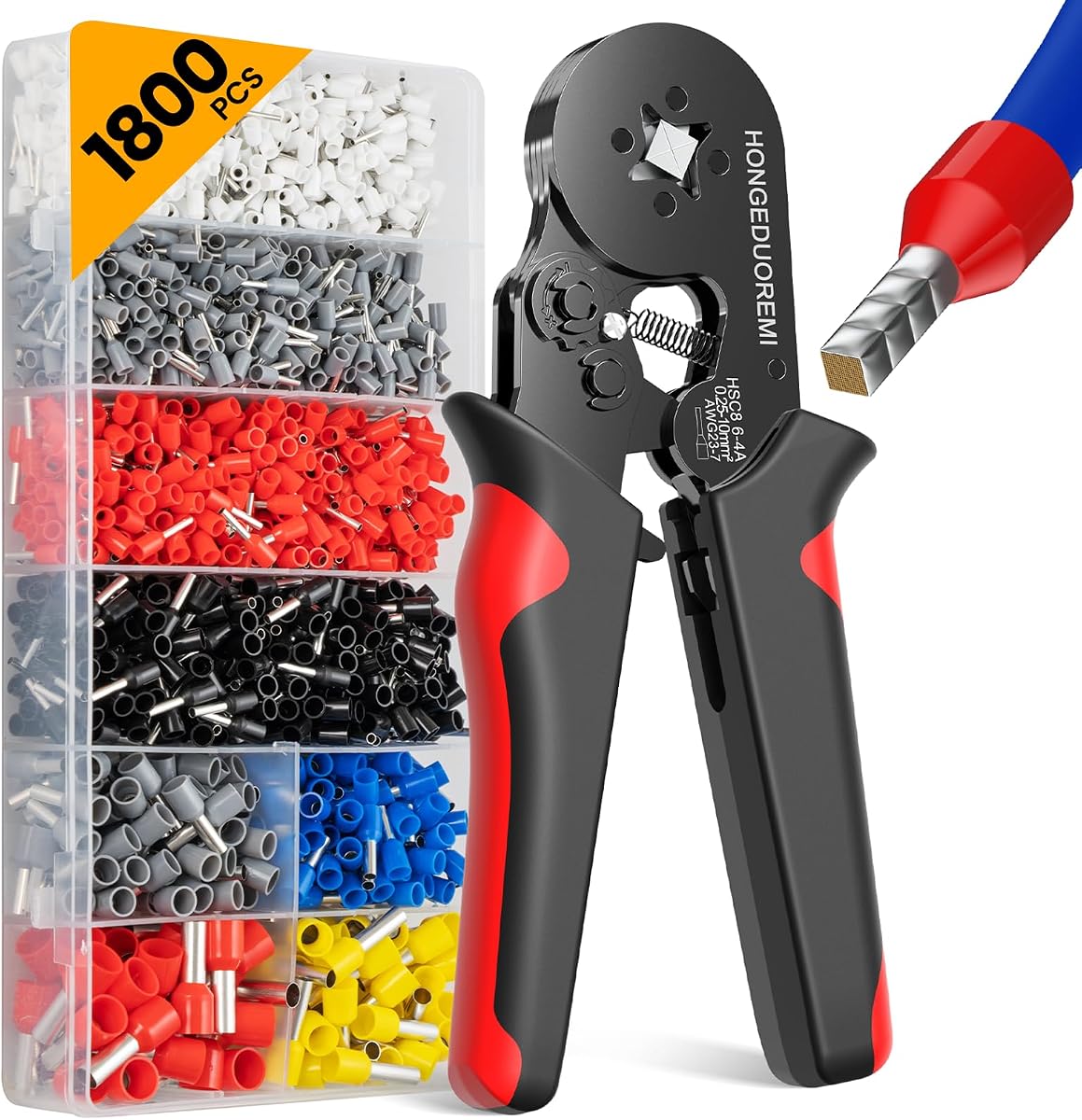
This ferrule crimping tool kit stands out for its enormous stated inventory of 1,800 terminals. It includes a self-adjusting ratchet crimper with a four-corner design and covers 0.5-10mm², or 20-8 AWG wire. The 4.7 rating and large supply make it a value-oriented option for extensive hobby projects, car audio work, battery wiring, and electronics assembly.
We may earn a commission when you buy through this link, at no additional cost to you.
The terminals are made from copper with nylon collars and are sorted in the box by standard and color. This organization helps users distinguish sizes while reducing the chance of selecting an unsuitable ferrule. The insulating sleeves also help contain wire strands and protect the connection area from fraying, cutting, and accidental contact.
Its main appeal is supply and accessibility. A 1,800-piece kit can support numerous projects without immediate replenishment, and the broad 20-8 AWG range covers many common electrical tasks. The four-corner mechanism and ratchet are also useful for maintaining consistent positioning during repeated crimps.
The trade-off is obvious: 1,800 components can overwhelm a small workbench, and users needing only a few ferrules may not use the majority of the kit. The product description also indicates the crimper is part of the package, while most of the physical bulk comes from the terminal assortment. For high-volume users, however, that supply is a major advantage.
The unusually large inventory can reduce repeated terminal purchases during multiple vehicle, audio, battery, or electronics projects. The color-coded organization makes it easier to locate the required gauge after opening the case.
The four-corner crimper covers 20-8 AWG, a practical middle range for many household, automotive, and electronic connections. Its ratchet helps users close the jaws consistently while the crimper surrounds the terminal.
We may earn a commission when you buy through this link, at no additional cost to you.
The HKS ratcheting crimper is built for a much heavier wire range than most compact alternatives. It handles AWG 10-2, corresponding to 6-35mm², and is intended for sleeves, ferrule ends, and related pin or cord-end applications. Its 4.5 rating reflects a tool aimed primarily at thick conductors and demanding electrical work.
We may earn a commission when you buy through this link, at no additional cost to you.
A key mechanical benefit is the ratchet sequence: the user can secure the connector first and then insert the wire into the crimp. Once the handles pass through a complete cycle, they release automatically. A knob adjusts crimp strength for different projects, and a quick-release lever opens the jaw from any position when repositioning is necessary.
The finish-machined die is intended to provide a solid, repeatable crimp. Ergonomic, cushioned, non-slip handles support a steady grip, while numerical jaw markings help users identify the applicable size more quickly. These details make the tool well suited to battery, power, and industrial applications where hand control matters.
It is less appropriate for very fine hookup wire, and it does not arrive with a large collection of terminals. Buyers also need the correct compatible sleeves for their conductor size. Even with those limitations, it is a focused heavy-wire option for installers who already have the necessary terminals and want a substantial crimper without a large kit.
The AWG 10-2 range and 6-35mm² capacity put this tool in a different class from light precision crimpers. It is more appropriate for power distribution, batteries, machinery, and larger permanently installed conductors.
The adjustable force knob, ratchet cycle, quick release, and cushioned handles all support controlled work. These features help the user maintain alignment and reduce the chance of a partially completed crimp on larger terminals.
We may earn a commission when you buy through this link, at no additional cost to you.
The Preciva kit is one of the broadest in the group, covering AWG 28-5 or 0.08-16mm². It includes a hexagonal self-adjusting ratchet crimper, 950 single ferrules, 350 twin ferrules, and a double-layer storage box. The 4.6 rating and mixed-terminal supply make it especially useful for installers working with both individual and paired conductors.
We may earn a commission when you buy through this link, at no additional cost to you.
Its bow-shaped handle and flexible shaft are designed to offset some applied pressure, reducing the force needed at the hand while maintaining the crimping effect. A star-shaped adjustment disk provides further control over wire thickness, and limit points in the jaws help prevent them from closing excessively and becoming stuck.
The inclusion of twin ferrules differentiates it from many general-purpose sets. Those terminals are useful when two wires must be held in a common connector, but the user must follow the correct twin-ferrule coding procedure and ensure that both conductors meet the terminal's individual size requirements. The tool's stated range should not be confused with permission to combine arbitrary wire gauges.
This kit is best for electricians, panel builders, and advanced users who work across fine signal wires and moderately heavy conductors. The extensive assortment and layered case support organized, repeatable work, although the package is substantial and the specialized handle geometry may require a short adjustment period.
The mix of 950 single ferrules and 350 twin ferrules supports more connection layouts than a single-terminal assortment. This makes the kit useful for control panels and structured wiring where one or two conductors may enter a termination.
The flexible bow-shaped handle offsets part of the pressure applied during compression. An adjustable star disk and jaw limit points give the user additional control over the closing cycle and terminal release.
We may earn a commission when you buy through this link, at no additional cost to you.
The KNIPEX 97 53 04 is a dedicated self-adjusting ferrule crimper made for end sleeves according to DIN 46228 parts 1 and 4. Its 4.7 rating reflects a focused professional tool with a 0.08-16mm² capacity, corresponding to AWG 5-28. It is built for solder-free electrical connections where consistent compression and repeatable quality are priorities.
We may earn a commission when you buy through this link, at no additional cost to you.
Ferrules load laterally into the tool, allowing the user to position the terminal and wire with good visibility. An integral lock supports repetitive, consistent crimping and releases automatically at completion. The narrow handle design and stated 20-percent reduction in manual force make the tool more comfortable during repeated production or maintenance work.
What distinguishes it from bundled kits is the absence of a large collection of unrelated accessories. The result is a specialized instrument rather than a general electrical supply package. This can be preferable for professional users who already maintain a controlled inventory of standards-compliant ferrules and want one dependable crimping tool.
The main drawback is that the tool may be more than a casual user needs, especially when a compact ratcheting crimper and a small terminal selection would satisfy the work. It also lacks the square profile offered by one competing kit. For users who value DIN 46228 alignment, self-adjustment, and reduced operating force, the 97 53 04 is an excellent professional choice.
Crimping end sleeves according to DIN 46228 parts 1 and 4 makes this a strong option for installations where terminal specification and repeatable compression are central. The focus avoids the compromises of a general-purpose multi-function crimper.
The self-adjusting mechanism, automatic release, lateral loading, and reduced manual force support efficient repeated work. These details matter when an installer is producing many terminations across a panel or service schedule.
We may earn a commission when you buy through this link, at no additional cost to you.
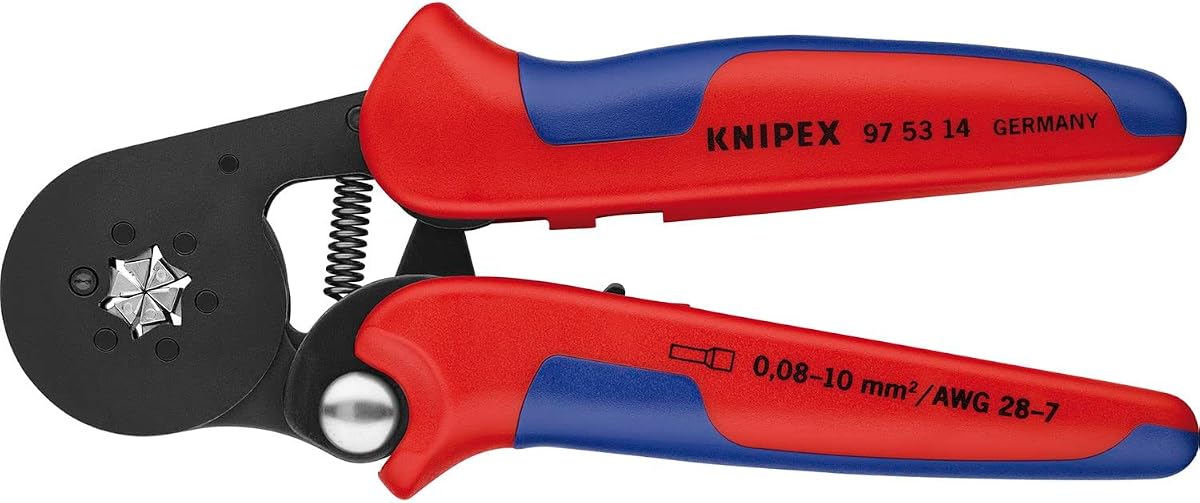
The Knipex 97 53 14 is a self-adjusting crimping tool designed specifically for end sleeves. Its 4.8 rating is the second highest listed among these products. With a 0.08-10mm² range, it serves many control, electronics, and light-to-medium industrial applications while maintaining a focused professional design.
We may earn a commission when you buy through this link, at no additional cost to you.
A major feature is hexagonal compression for confined connection dimensions. The product information also specifically calls out suitability for twin end sleeves up to 2x6mm², or 2x AWG 10. That makes it relevant for installers who regularly work with paired conductors and need a crimp that fits into a restricted terminal area.
The self-adjusting concept reduces the need to manually select a crimp position for each sleeve size. Self-adjustment also encourages repeatability because the tool determines the appropriate compression as it closes. The result is a streamlined workflow for users who already understand ferrule sizing and need a dependable dedicated crimper.
The trade-off is capacity. Its 10mm² maximum is below the 16mm² upper end of the KNIPEX 97 53 04 and 97 53 09. It also does not include ferrules. For compact panels, paired-wire terminations, and users who do not need the largest conductors, the 97 53 14 is a particularly attractive professional option.
Hexagonal compression is designed to create a useful connection geometry in confined spaces. This is a practical advantage when the terminated wire enters a tight terminal block, compact enclosure, or crowded control cabinet.
Support for twin end sleeves up to 2x6mm² makes this model relevant to applications with two conductors entering one termination. Users should still follow the ferrule manufacturer's coding and stripping instructions.
We may earn a commission when you buy through this link, at no additional cost to you.
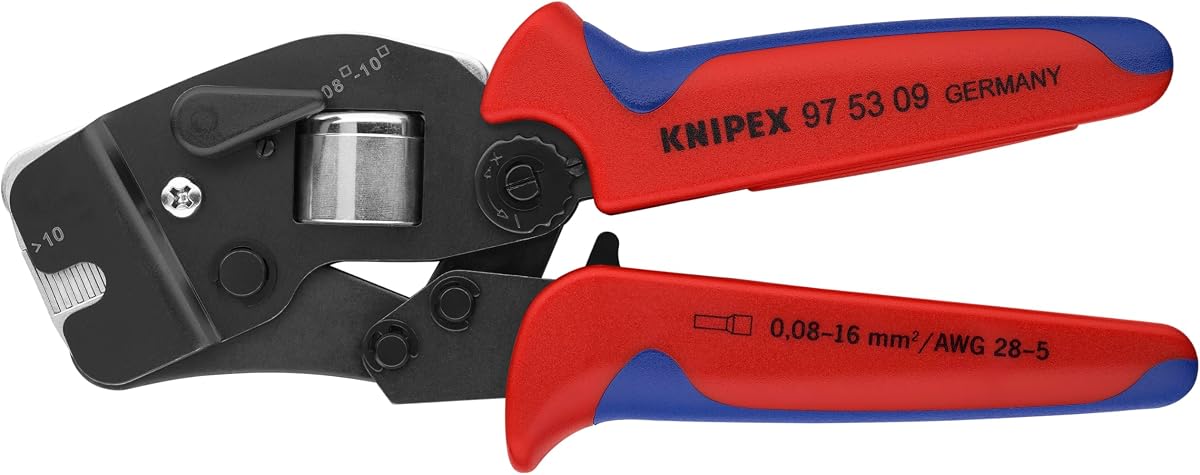
The KNIPEX 97 53 09 is a self-adjusting ferrule crimper with a selectable operating range. It handles AWG 7-28 for 0.08-10mm² and can be set to AWG 5 for conductors up to 16mm². Its 4.4 rating is the lowest listed in this comparison, but the underlying specification identifies it as a capable professional-grade option for a broad range of connections.
We may earn a commission when you buy through this link, at no additional cost to you.
The selector lever is central to the design. Rather than relying on one continuous profile, the user selects the appropriate crimping area before starting the cycle. Ferrules load laterally, improving access and visibility, while the integral self-releasing lock supports repetitive, consistent crimp quality.
Compared with the 97 53 04, this model offers an explicit mode for the heavier AWG 5 range. It is therefore attractive to technicians who move between fine electronics wiring and larger power conductors but want a single dedicated tool for both tasks. The self-adjusting behavior simplifies operation once the desired range has been selected.
Its lower listed rating may give cautious buyers pause, although ratings should be considered alongside the established product specification and user needs. The lack of included terminals also makes it a tool rather than a kit. For professionals who want selectable capacity and automatic release, it remains a versatile, specialized choice.
The selector changes the crimping area from AWG 7-28 to AWG 5. This allows one tool to address both fine wiring and larger conductors while keeping the range choice deliberate.
The integral self-releasing lock is intended to support consistent results across repeated operations. Lateral loading makes the terminal easier to place, which can improve workflow on complex connection assemblies.
We may earn a commission when you buy through this link, at no additional cost to you.
The right ferrule crimper depends on conductor size, terminal geometry, production volume, and the working environment. Comparing capacity and crimp standards before buying is more important than choosing from the largest or smallest assortment.
Begin with the smallest and largest stranded wire sizes you expect to terminate, then check the tool's AWG and metric capacity against the terminals you use. A listed range can include both single and twin ferrules, but those formats may have different limits. Some products reach only AWG 10, while others extend to AWG 2 or 5 depending on the conductor and terminal format. The crimper's capacity should be matched carefully rather than inferred from general usefulness.
Hexagonal and square crimp tools create different terminal geometries, and the selected profile should match the ferrule design, equipment specification, and applicable standard. DIN 46228 compatibility is especially relevant for professional European-style work. A tool that merely accepts a ferrule is not necessarily the right tool if its compression shape differs from what the terminal manufacturer expects. Review the geometry and installation requirements before choosing between otherwise similar ratcheting crimpers.
A ratchet mechanism holds the tool in position while the terminal and wire are arranged, then releases or signals completion at a defined point. Self-adjusting designs determine the crimping position for different terminal sizes, reducing the chance of a partial compression. Manual or tool-specific adjustment controls provide additional fine tuning. The number of controls should be understandable to the user: a simple automatic system is convenient, while a clearly labeled selector or dial can offer greater control.
Kits with many ferrules are convenient for frequent projects, but quantity alone does not indicate quality. Look for coverage across the actual sizes and lengths used, useful color coding, and storage that keeps similar parts separate. A smaller, well-selected assortment may be better than a large collection of redundant sizes. Users who maintain their own terminal inventory may prefer a dedicated tool and avoid the added bulk of a kit.
Consider grip shape, handle width, non-slip surfaces, release levers, and the force required for the largest crimp. Smaller wires are usually comfortable to terminate, while thick conductors demand more control. A quick-release lever can help when a tool jams or must be opened before completion, and an offset or flexible handle can reduce fatigue during repetitive work. Always disconnect power and follow safe handling procedures when using any crimping tool.
A fixed workshop may favor a large case and broad assortment, while mobile technicians often value a compact, dedicated crimper or a layered portable box. Consider available storage, access to the terminals, and whether the work site is dusty, confined, or shared. Soft cases can organize and protect components, whereas hard cases generally offer more rigid protection for transport. The most portable choice is not always the one with the fewest accessories; it is the one that can be carried and used safely in the intended location.
A good crimper should support a complete, repeatable compression rather than deforming the terminal unpredictably. Confirm the tool's die and ratchet are intended for ferrule use, and avoid substituting generic pliers that can mark or distort a sleeve. Strip only the conductor length specified for the terminal, insert every strand fully, and inspect the finished crimp for exposed copper, uneven compression, or an incomplete closure. Electrical safety depends on both correct tooling and correct technique.
Begin by identifying the wire size, terminal type, and required crimp profile. Strip the stranded conductor to the length specified by the ferrule manufacturer, taking care not to nick individual strands. Insert the bare conductor fully into the sleeve and confirm that no strands are trapped outside the barrel or nylon collar. If the kit includes a wire-size chart or color coding, use it to double-check the selection before placing the terminal in the crimper.
Load the ferrule according to the tool's design, whether from the front or laterally. Close the handles until the ratchet begins to hold, then adjust the wire and terminal so they remain centered and seated. Continue through the full crimping cycle until the mechanism releases or the completion point is reached. Do not force the tool past an intentional limit point. For a tool with an adjustment dial or force knob, use the manufacturer guidance for the terminal's conductor range.
After crimping, inspect the ferrule. The sleeve should be firmly compressed, the conductor should be fully enclosed, and the crimp should look even and symmetrical. Follow a pull test appropriate to the installation when required by local code or project specifications, and do not use a damaged or visibly loose termination. Clean the tool with a dry brush after use, keep the jaws free of metal fragments, and store it in its case with the ratchet and adjustment mechanism protected from impact.
Capacity varies by model, ranging from fine electronics wire to heavy power conductors in the products reviewed. The listed limits span approximately AWG 28-5 for the Preciva kit, AWG 24-8 for the SOMELINE kit, and AWG 10-2 for the HKS crimper. Always check the exact conductor range, terminal format, and manufacturer instructions before use.
They create different crimp geometries, so they should not be assumed to be interchangeable. The appropriate tool depends on the ferrule design, equipment specification, and any applicable standard. Klein Tools 34056 uses hex compression, while the 34060 uses a square profile, and professional KNIPEX models are identified with DIN 46228 applications.
A kit is convenient for new users and frequent project work because compatible terminals are immediately available. A standalone tool can be more economical for technicians who already maintain a large inventory or need only one precise tool. Compare the assortment's gauge and length coverage rather than judging the package solely by terminal count.
Some can, but only within their stated limits. The Hex Ferrule Crimping Tool Kit specifies twin ferrules up to AWG 2×8, the Preciva kit includes twin connectors, and the Knipex 97 53 14 supports twin sleeves up to 2x6mm². Follow the terminal coding system and ensure that each conductor matches the individual wire size required by the sleeve.
Look for a complete, even compression around the sleeve, no exposed conductor outside the terminal, and no visible gap between the crimp and insulation. The connector should remain firmly attached when checked according to the project or code requirements. If the result is uneven, the terminal is loose, or the tool did not complete its ratchet cycle, replace the ferrule and repeat the process.
A ratchet improves consistency because it holds the tool and guides the user toward a completed compression cycle. This is particularly helpful with small wires, where it can be difficult to keep the terminal centered with ordinary pliers. The exact ratchet behavior varies among products, so users should still follow the model-specific operating instructions.
Some broad-range models can, but their limits still apply. The Hex Ferrule Crimping Tool Kit uses two selector ranges covering AWG 24-8 and AWG 8-4, while the KNIPEX 97 53 09 offers selectable AWG 7-28 and AWG 5 ranges. For repeated heavy work, a dedicated high-capacity crimper may provide better leverage and control.
Store the tool in a dry case or protected drawer with its jaws and adjustment mechanism free of dirt and metal debris. A dedicated or layered case is helpful when the tool includes many terminals because it keeps different sizes organized. Avoid placing heavy objects on the crimper, and ensure the case is closed before transporting it to a job site.
The Klein Tools 34060 stands out as the most complete square-crimp package, combining a ratcheting tool, 1,200 terminals, and organized storage. The KNIPEX 97 53 04 is the premium choice for professional work centered on DIN 46228 ferrule standards, while the Ferrule Crimping Tool Kit offers a budget-friendly way to obtain 1,800 terminals and a four-corner ratcheting crimper for everyday wiring.
Above all, prioritize the wire range, crimp profile, and terminal standard over the number of accessories. A broad kit is valuable for frequent work, but a correctly specified dedicated tool may be better for a technician with established inventory. Consider ergonomics for repetitive jobs, storage for mobile work, and whether twin ferrules or heavier conductors are genuinely part of your requirements.
Ratings, product configurations, and prices can change, so check the current listing and included components before purchasing. Also verify that the listed capacity matches the exact wire size and ferrule type being used. With those checks completed, the right ferrule crimping tool can provide cleaner organization, repeatable terminations, and greater confidence in electrical work.