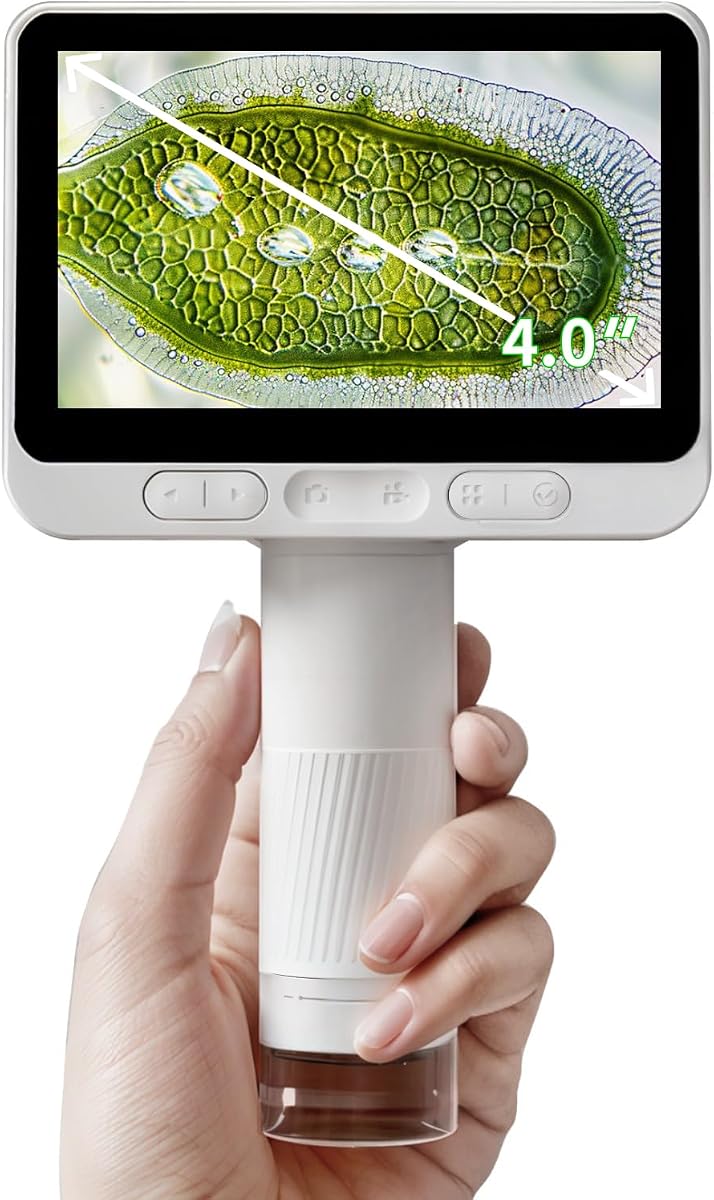
BEAVERLAB Finder 4.0" Microscope for Kids, Handheld Miniscope, 1600X Portable Kids Digital Mini Pocket Microscope for Boys Girls, Educational Science Kit Toys
4.6Editor score
1600X maximum magnification
4.0-inch IPS display
1080P photo video
A digital microscope turns leaves, coins, fabric, insects, and prepared slides into large, vivid images that children can explore on a built-in screen. The right model for kids balances magnification, easy focusing, durable construction, clear illumination, simple controls, and enough storage or computer connectivity to preserve discoveries rather than limiting the experience to instant observation.
We compared the 10 featured microscopes using the information supplied for each product, focusing on practical differences such as magnification range, display size, camera resolution, LED lighting, battery life, portability, included slides, recording options, and file-transfer methods. The list covers handheld models, complete science kits, higher-magnification options, and gift-ready choices for different ages and interests.
Each review explains what that particular microscope does best, where its trade-offs appear, and which child or learning situation may suit it. Ratings and specifications reflect the supplied product data, while product availability and prices can change, so readers should confirm current listings and terms before making a purchase.
4.6Editor score

4.5Editor score

4.6Editor score
As an Amazon Associate we earn from qualifying purchases.
The table below places all 10 microscopes side by side, highlighting the factors that most strongly affect usability for children: magnification, viewing display, imaging capability, lighting, and overall feature set.

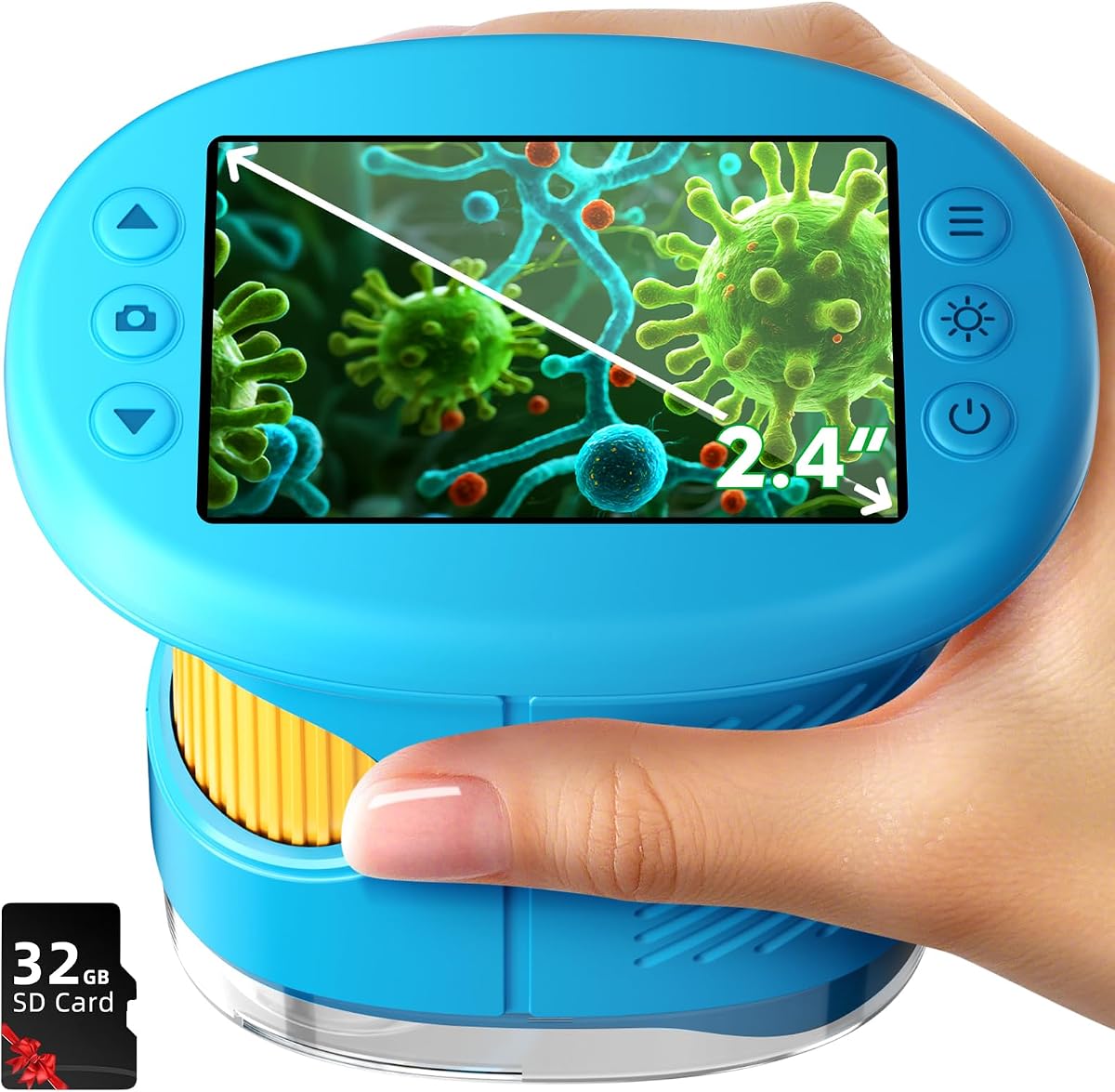


This handheld microscope combines 1000X magnification, a 2MP camera, and a 2.0-inch IPS display in a body designed specifically for young scientists. Its 4.5 rating reflects a balanced package in which imaging, portability, safety certifications, and easy operation come together. It is especially appealing for children who want to investigate natural objects without needing a stationary microscope or complicated setup.
We may earn a commission when you buy through this link, at no additional cost to you.
The strongest feature is its combination of manual focus and eight adjustable LEDs. Oversized focus dials help children make controlled adjustments, while three brightness levels and an anti-glare diffuser make it easier to inspect textured leaves, insects, coins, and other specimens under changing conditions. The 2MP camera captures photos and AVI video, and the supplied 32M of internal storage can hold more than 200 high-resolution photos. USB connectivity makes those discoveries transferable to compatible Windows or Mac computers.
The 600mAh rechargeable battery supports approximately two hours of use and can be powered through USB, which is helpful for travel and long outings. A 200-gram body, shock-absorbent rubber casing, smooth ABS construction, and a lanyard support regular handling by children. The main limitations are the relatively compact 2.0-inch display and finite built-in storage. Families expecting extensive photo libraries may need to export files regularly rather than treating the internal memory as an unlimited archive.
This is a strong choice for families seeking a portable microscope that feels approachable from the beginning. It suits backyard exploration, museum visits, homeschool activities, and simple science projects, and its recording features give children a way to document what they find. For most users, the balance of portability, illumination, magnification, and accessibility makes it the most versatile overall pick in this guide.
Manual focusing encourages children to make deliberate adjustments rather than simply holding a magnifier over an object. The enlarged dials and stabilization design make that process more manageable for small or excited hands, particularly when examining insects, fabric, and plant material.
Photo and AVI video recording turn a microscope into a tool for science journals, presentations, and family observations. USB export to compatible computers also allows young scientists to organize close-up images after an outdoor expedition or classroom activity.
We may earn a commission when you buy through this link, at no additional cost to you.
This complete science kit is designed for children ages 4-12 and pairs a handheld digital microscope with five real glass prepared slides, a 32GB memory card, and a fitted EVA case. Its 4.4 rating indicates a well-rounded educational set, particularly for parents who want more than a basic standalone device. The included case and specimens make it ready for both organized study sessions and field exploration.
We may earn a commission when you buy through this link, at no additional cost to you.
Storage is a defining advantage because the 32GB card can hold thousands of pictures or hours of video. That capacity reduces the need to delete observations constantly, allowing children to build a larger collection of insects, leaves, coins, fabrics, rocks, and household objects. The upgraded 3mm viewing slot is designed to help real glass slides pass through smoothly, while five adjustable magnification levels from 200X to 1000X cover both broad and close observations.
The scope weighs only 0.34 pound and includes a wide neck strap, making it portable for camping, backyard trips, classroom work, and homeschool lessons. A rechargeable battery provides approximately two and a half hours of continuous use, and the included Type-C cable supports recharging. The controls are intentionally straightforward: children turn the focus wheel, adjust the distance, and use LED lighting to bring a specimen into view. The supplied manual remains important for understanding setup and operation.
This kit is best for a child who wants a ready-made collection of examples and enough storage to record many discoveries. The principal trade-offs are the unspecified display size and battery endurance of around two and a half hours, but the extensive accessory set more than compensates for a child who will use prepared slides and take photos or video on trips.
The fitted EVA case keeps the viewer, slides, charging cable, neck strap, and other components together. That organization is useful for families sharing one kit among several children or for anyone who wants to move between a classroom, a table, and an outdoor location without losing small parts.
Five high-clarity glass specimens provide a more authentic biology activity than printed cards alone. Children can first make predictions, examine a sample, adjust the focus, and then compare what they observe with other natural or household objects.
We may earn a commission when you buy through this link, at no additional cost to you.
The Odatay 4K 1000X combines a relatively large 2.4-inch screen with four selectable magnification levels, a 4K HD camera, and a 32GB TF card. Its 4.5 rating and broad age positioning make it a versatile option for children interested in bugs, plants, classroom demonstrations, and travel. Long-distance viewing at lower magnification also gives it more flexibility than a microscope intended only for tiny specimens.
We may earn a commission when you buy through this link, at no additional cost to you.
Three brightness levels and eight built-in LEDs help children see clearly in low-light settings, while the camera supports photos, video recording, browsing, and deletion directly on the device. The 32GB card provides generous room for an extended collection of discoveries, and twelve prepared slides give younger users immediate subjects to examine. A lanyard supports hands-free carrying, while the tripod hole offers a more stable setup for detailed viewing or presentations.
At only 0.5 pound, the microscope is light enough for a pocket or bag and practical for indoor, outdoor, and classroom use. It can connect to a PC for file transfer or extended observation, helping children move from the small integrated display to a larger presentation screen. The tradeoff is that maximum magnification is 1000X rather than 1600X, and only four magnification levels are offered, so buyers seeking the highest zoom in this list will find better options elsewhere.
This model is well matched to children who travel, make nature recordings, or want more screen visibility than a 2.0-inch model provides. It is also a sound first microscope because the card and slides remove several common barriers to immediate use. For families balancing portability, image quality, and included accessories, it is one of the strongest all-around choices.
The 2.4-inch display offers a broader view than many compact handheld scopes, helping children frame moving insects or tiny specimens more easily. It remains portable enough for field use while improving the experience of reviewing a photograph immediately after capture.
The included TF card, twelve slides, cable, lanyard, viewing cover, and protective screen case create a ready-to-use package. Young explorers can test the microscope indoors before taking it outdoors, then document insects and plant material without requiring a separate accessory purchase.
We may earn a commission when you buy through this link, at no additional cost to you.
The BEAVERLAB Finder 4.0-inch Microscope stands out with the largest display and highest maximum magnification among the featured products. It offers 100X to 1600X magnification, 1080P imaging through a 2MP CMOS sensor, and eight adjustable lights. Its 4.6 rating makes it one of the strongest-rated options in the guide and a compelling premium choice for children who want to examine very fine details.
We may earn a commission when you buy through this link, at no additional cost to you.
The 4.0-inch IPS screen gives children a generous view of specimens without requiring an adult eyepiece. A built-in hotspot allows captured photos and full-HD videos to be uploaded to a mobile phone, which is useful for sharing discoveries with family or presenting them after a field activity. Its compact body and pocket-oriented design make it easy to carry for nature walks, museum visits, and everyday inspection of coins, jewelry, textiles, leaves, or insects.
Compared with smaller 2.0-inch models, this microscope offers more room for children to position a subject and recognize fine structures. The maximum 1600X can reveal greater detail, although actual clarity still depends on lighting, focus, distance, and the nature of the sample. The main omitted details are substantial: the supplied information does not list prepared slides, included storage, battery capacity, or runtime. Those gaps make it more important to check the current package contents before buying when a ready-made specimen collection is a priority.
This microscope is best for a child who is already deeply interested in microscopy, frequently studies fabric, leaves, coins, or small insects, and values screen size and sharing. It is also a good fit for home science presentations because the larger display and hotspot simplify collaboration. For maximum magnification and viewing comfort in a portable body, it stands clearly above the other models.
A 1600X upper limit gives this model an advantage when examining tiny fibers, insect wing textures, or intricate coin patterns. Children can start at lower magnification to locate a subject and then zoom in after learning how focus and working distance affect the image.
The built-in hotspot provides a practical route for moving photos and videos to a phone. This can simplify family sharing and allow a child to present a specimen to classmates or relatives without relying on cables for every viewing session.
We may earn a commission when you buy through this link, at no additional cost to you.
This cat-themed microscope is designed to make independent use approachable for children ages 3-12. It combines a 2.4-inch IPS screen with up to 1000X magnification, a textured focus wheel, a 600mAh rechargeable battery, and three viewing modes. Its 4.5 rating reflects a feature-rich design that feels friendly without sacrificing the basic functions expected from a serious handheld scope.
We may earn a commission when you buy through this link, at no additional cost to you.
Computer observation mode can use a Type-C connection to display the live image on a larger computer screen and save new photos or videos directly to that computer. Memory card mode supports an SD card, while device observation mode permits standalone use and charging. A memory card is not included, and the internal storage of roughly 200 photos cannot be directly transferred to another device. As a result, families should treat the SD-card workflow as the long-term storage method if regular export is important.
The oversized textured focus wheel is designed for little hands, and the distinct cat housing gives the product a friendly appearance. Eight lights and three brightness options improve visibility, while the 600mAh battery supports up to three hours of exploration. USB or power-bank charging adds flexibility. The IPS display is larger than many entry-level alternatives and should make fine structures easier for children to recognize.
This microscope is a good fit for a child who wants to explore independently and occasionally work with a parent at a computer. It offers strong screen size, battery life, and magnification for a compact handheld product. Buyers who prioritize uncomplicated file export should purchase a compatible memory card and consult the manual for the compatible software before transferring files.
Standalone viewing, computer observation, and memory-card recording give children different ways to engage with a specimen. This flexibility is valuable for independent play, parent-guided projects, and larger-screen demonstrations, although each mode has a distinct file-saving workflow.
The cat-shaped housing, smooth ABS and food-grade silicone materials, and oversized focus wheel make the product feel intentionally child-oriented. Multiple safety certifications add confidence for families choosing a science tool that children may use frequently.
We may earn a commission when you buy through this link, at no additional cost to you.
The Odatay 1000X Digital Kids Microscope Kit combines a compact 2.0-inch IPS display, 1080P camera, 100X to 1000X magnification, and twelve included plastic slides. Its 4.6 rating places it among the most highly rated products in this comparison. It is a particularly appealing budget-oriented choice for parents who want a complete first microscope rather than a bare device.
We may earn a commission when you buy through this link, at no additional cost to you.
Eight built-in LED fill lights brighten specimens in low-light environments, and the camera records both photos and video. Internal storage can hold up to 500 photographs, while a Micro SD card can expand that capacity. The card is not included, but expansion gives families a straightforward way to build a larger library. PC connectivity enables real-time viewing on a larger display, which is useful for presentations, shared observation, or detailed study.
The body is designed for small hands, with top-positioned buttons that allow a child to operate the microscope while holding it. A lanyard can be attached around the neck or to a backpack, and the rechargeable battery supports portable use. Twelve slides cover plants, vegetables, insects, and animals, providing varied subjects. Their plastic construction makes them less formal than the real glass slides supplied with another model in this guide, but the broad assortment still supports immediate exploration.
This microscope is best for younger children, beginners, and gift buyers seeking a well-rounded package. It combines a strong rating, useful resolution, expandable storage, and ready-made samples at a comparatively accessible position in the category. Families who prioritize authentic lab-style glass slides can choose a complete kit with real specimens, but most families will find this set easier and more cheerful to introduce.
The slide assortment introduces children to different biological categories without requiring them to find outdoor material first. It also makes the microscope useful on days when weather, time, or local insect availability limits spontaneous field exploration.
Five hundred photos of internal capacity provide a useful starting library, while Micro SD expansion supports longer projects. PC connectivity adds another route for viewing and sharing, so children can move from a quick handheld observation to a larger group presentation.
We may earn a commission when you buy through this link, at no additional cost to you.
This microscope pairs 100X to 1600X magnification with a large 4.0-inch IPS screen and 1080P photo and video capture. Its 4.3 rating is the lowest in the guide, but the product differentiates itself with a detachable three-in-one design that supports desktop, handheld, and portable configurations. That versatility makes it interesting for children who alternate between stationary experiments and outdoor exploration.
We may earn a commission when you buy through this link, at no additional cost to you.
The desktop arrangement can provide steadier viewing when studying a prepared sample, while the handheld and portable modes suit insects, fabric, coins, grains of sand, and other portable subjects. Six LED fill lights offer three brightness modes for low-light viewing. The 4.0-inch display makes the microscope more suitable for shared observation than many pocket-oriented models, while 1600X magnification supports detailed inspection of fine structures.
The rechargeable battery is stated to provide up to four hours of continuous use, giving it one of the longer stated runtimes in this group. A PC connection allows real-time viewing on a larger screen for study or presentation. The tradeoff is that the supplied information does not list prepared slides, a memory card, or other accessories, and its 4.3 rating is slightly below the other models. Buyers should verify the current package contents and storage configuration before purchase.
This is a compelling option for a child who wants one device to serve several exploration styles. It is particularly useful for desk-based science projects, home presentations, and trips where portability matters. It may be less attractive than the Beaverlab option for hotspot sharing, or the Odatay 4K model for bundled storage, but its long stated runtime and flexible construction add distinctive value.
The detachable construction lets children use the microscope as a desktop unit for controlled activities and as a handheld tool for natural specimens. That flexibility supports both focused experiments and spontaneous investigations without requiring separate equipment.
An asserted runtime of up to four hours reduces the need to pause long observation sessions. Combined with PC connectivity and a four-inch screen, it works well for learners who want to examine a subject together and then discuss what they see.
We may earn a commission when you buy through this link, at no additional cost to you.
This blue handheld microscope offers 200X to 1000X magnification, a 4K HD camera, a 2.0-inch display, and eight built-in LED lights. Its 4.2 rating is the lowest among the ten products, but the feature set remains appealing for children who want high-resolution video and flexible viewing distances. It is designed for ages 3-12 and supports both indoor and outdoor learning.
We may earn a commission when you buy through this link, at no additional cost to you.
Three brightness levels help illuminate specimens in shaded or dim locations. The camera supports photo taking, video recording, playback, and file management, while a 200X setting allows observation from farther away and higher levels reveal close details. The scope weighs only 0.5 pound and comes with a neck strap, making it straightforward to carry in a bag or around a child's neck during a nature walk.
PC connectivity allows file transfer and extended use, which can help a child organize images or display discoveries on a larger monitor. The main limitations are the modest screen size and the 4.2 rating. Because the provided information does not specify storage capacity, battery life, or the number of included accessories, shoppers should compare the current package carefully with the more fully specified kits in the guide.
This microscope is best for a child who enjoys recording nature and insects, especially if higher-resolution video is more important than extra bundled accessories. It also suits families who want a simple neck-carried tool for outdoor use. Although it does not lead the guide in rating or magnification, its 4K camera, compact body, and PC transfer support make it a practical option for video-focused exploration.
The 4K camera is particularly useful when a child wants to document a moving insect or examine a textured specimen in video. Four magnification levels offer a compromise between distant orientation and close-up detail.
At half a pound, the scope and its neck strap are easy for a child to carry during an outdoor investigation. A bright image can be obtained without a separate lamp because the built-in LEDs surround the viewing area.
We may earn a commission when you buy through this link, at no additional cost to you.
The 1000X Digital Handheld Microscope is built for children ages 5-13 who want to document backyard insects, leaves, and other natural subjects. It offers 100X to 1000X magnification, a 2MP camera, a 2-inch color display, eight LEDs, and four brightness levels. Its 4.4 rating reflects a capable outdoor-focused design with a particularly thoughtful lighting system and straightforward file transfer.
We may earn a commission when you buy through this link, at no additional cost to you.
The anti-glare diffuser and selectable illumination levels help a child inspect specimens under shaded or nighttime conditions without harsh reflections. An enhanced stabilization design supports steadier images, and an oversized textured focus wheel helps small fingers obtain sharp results. The product information also states that 92% of tested children mastered the microscope on the first try, although this guide does not independently verify that testing.
Built-in storage can hold more than 200 photos and AVI videos without requiring an SD card, which keeps the device simple for children. The included USB-C cable supports transfers to Windows or Mac computers, making the microscope useful for nature journals, class projects, and growing digital collections. A 600mAh rechargeable battery supplies up to three hours of continuous use, and the detachable neck strap helps prevent accidental drops. BPA-free ABS construction and CPC, CE, and FCC certifications add another layer of reassurance.
This is a good choice for a child who spends time outdoors and wants a straightforward microscope without a complicated memory-card setup. The compact display is less suitable for group viewing, and buyers wanting removable storage should confirm whether expansion is supported. For portable observations that must be saved and transferred easily, however, its integrated workflow is highly convenient.
Four brightness settings and an anti-glare diffuser make the microscope more adaptable to changing outdoor conditions. Children can use softer illumination for pale samples and stronger light when examining darker or deeply textured surfaces.
Integrated photo and AVI video storage means a child can document an outing without first configuring removable media. USB-C transfers then make it simple to sort discoveries into a computer-based collection or add them to a school project.
We may earn a commission when you buy through this link, at no additional cost to you.
The WINWEND Kids Microscope Pocket Microscope is a compact 1000X digital scope designed for children ages 3-10 and adults who may share it. It has a 4.6 rating, an adjustable 100X-to-1000X range, a 2-inch display, eight LED lights, and six brightness levels. Its strongest distinguishing feature is the flexible lighting control combined with separate fine and coarse focusing.
We may earn a commission when you buy through this link, at no additional cost to you.
The illuminated viewing area can be adjusted across six brightness levels, which provides useful control when examining pale leaves, reflective coins, fabric fibers, or other specimens with different light requirements. Precision fine and coarse focusing helps bring images into view more quickly, while the real-time screen makes observation accessible to children who are uncomfortable looking through a traditional eyepiece. Built-in storage holds up to 400 photographs, and video recording becomes available when a personal storage card is inserted.
The microscope weighs less than 300 grams and includes a wrist band to reduce the chance of dropping it during an outdoor activity. USB connectivity allows PC viewing for a broader field of view and shared exploration. The main trade-offs are the lack of listed prepared slides and the fact that video depends on a separately supplied card. Families primarily interested in photos can use the internal memory, while young video creators need to plan for additional storage.
This model suits children who want a lightweight pocket microscope for coins, stamps, jewelry, plants, and insects. It is especially helpful for families needing multiple brightness levels and straightforward fine adjustment. It is less comprehensive than the slide-equipped kits, but its strong rating and focused control design make it a capable independent exploration tool.
Six brightness levels offer finer adjustment than most competing models. This can help children reduce glare on reflective objects or brighten a dark specimen without changing devices or moving the microscope away from the subject.
Separate fine and coarse focusing helps children first locate a specimen and then refine the image. The two-stage arrangement reduces the need to make abrupt movements while the subject remains under observation.
We may earn a commission when you buy through this link, at no additional cost to you.
Choosing a digital microscope for kids involves balancing image quality, magnification, ease of use, portability, storage, and the type of activities a child will undertake. The most important step is to identify how the microscope will be used and which features will make learning feel engaging rather than complicated.
Most of the featured models top out at 1000X, while two reach 1600X. A broad range beginning around 100X or 200X gives children room to start with distant or larger subjects before moving closer to tiny details. Maximum magnification is useful but not the only measure of image quality; focus, lighting, camera resolution, working distance, and digital stabilization also influence how useful the resulting image appears. A 1000X scope is suitable for common home exploration, while 1600X can benefit children studying fine fibers, insect wings, or intricate coin surfaces.
The display sizes in this guide range from 2.0 inches to 4.0 inches, with one handheld set not specifying its screen dimensions. A larger IPS screen is easier for a child to frame moving specimens and can make the device more suitable for shared viewing. Smaller screens preserve compact portability and may be easier for very young children to hold steady. The real advantage of a digital display is that several children or an adult can watch the image at the same time without taking turns peering through a small eyepiece.
The listed cameras range from 2MP to 4K HD, with most models offering 1080P capture. Resolution matters when a child wants to revisit fine structures or produce images for a presentation, but it should be considered alongside focus and lighting. Photo and video support is valuable for documenting experiments, making a digital nature journal, or recording insect movement. Check how files are saved and transferred: built-in memory is convenient, a removable card offers more capacity, and PC connectivity can support live viewing on a larger display.
Built-in LED lighting is essential for viewing dark, shaded, or translucent specimens. The featured scopes offer different configurations, including six, eight, or multiple brightness levels, and some include an anti-glare diffuser. More lighting options can help children adapt the image to a pale leaf, dark insect, shiny coin, or textured fabric. Focus controls should also be easy for small hands. Oversized textured wheels, fine and coarse adjustment, stabilization, and beginner-friendly instructions can make a meaningful difference when a child first encounters a blurry image.
Prepared slides give children immediate subjects and make it easier to begin a structured activity. One kit includes five real glass slides, while two others include twelve plastic slides categorized by plant, vegetable, insect, and animal subjects. Glass can provide an authentic microscopy feel, whereas plastic slides are lighter, less likely to break, and often more colorful. Kits that also include cases, protective covers, straps, and cables offer greater organization, although the absence of a case does not prevent a capable standalone microscope from working well.
A digital microscope becomes more useful when it can move from a table to the backyard, a museum, a campsite, or a classroom. Most models weigh between approximately 0.34 and 0.5 pound, with one described as 200 grams, and include a lanyard or wrist strap. Rechargeable batteries are standard in the featured list, with stated runtimes ranging from approximately two hours to four hours. Consider how long and how far a child will explore, as well as whether a USB cable, Type-C cable, or power-bank connection suits the family's available accessories.
Young users benefit from smooth edges, lightweight bodies, accessible buttons, and controls that do not require fine motor precision. The featured products use ABS or BPA-free ABS in their construction, and several list CE, CPC, FCC, UKCA, or related safety certifications. A rubberized or shock-absorbent exterior can help with playground drops, while food-grade silicone parts may improve comfort. Ages matter too: some models expressly target children as young as three, while others are better suited to independent users around five and older.
USB or Type-C connectivity can add live observation, file transfer, and larger-screen presentation. Hotspot sharing provides a convenient wireless route for moving images to a phone, while direct computer connections support organized archives and classroom demonstrations. Storage details require close attention because some devices use built-in memory, some include a card, others support expansion, and a few cannot directly transfer internally stored files. Checking the complete workflow before purchase is important if saving and sharing discoveries is a central goal.
Begin by charging the microscope according to its manual and cleaning the lens with a soft, lint-free cloth. Insert the required memory card if the model supports one, then power on the device and begin with a prepared slide or a familiar object on a stable table. A leaf, coin, piece of fabric, or printed paper provides an easy first target because its shape and texture are familiar to the child.
Place the subject under the lens, start at the lowest magnification, and turn the focus control slowly while adjusting the distance. Use the LED brightness setting that produces a clear image without washing out pale details or creating glare on reflective surfaces. Once the image is sharp, photograph or record it, label the file, and explain what the child expects to see before showing the magnified result. For outdoor use, keep the device in its case or attached to the strap and avoid moisture, dust, and direct contact with soil.
After the session, disconnect any card or cable carefully, remove the battery only if the manufacturer instructs you to do so, and store the microscope in a dry place. Use the supplied case when one is included, keep lenses covered when possible, and clean the body with a lightly dampened cloth rather than immersing it. Review the manual for software compatibility, file locations, warranty coverage, and age-specific safety guidance before transferring files or allowing younger children to use the device independently.
A range topping out at 1000X is suitable for most home learning, including leaves, fabric, coins, prepared slides, and many insects. A 1600X maximum can provide extra detail for advanced observations, but focus and lighting remain important because nominal magnification does not guarantee a perfectly clear image. Younger children may also find it easier to work at lower settings before zooming in.
A digital microscope is often easier for children because the image appears on a screen rather than requiring one person at a time to look through an eyepiece. Recording, playback, and computer connectivity also make it useful for science projects and nature journals. A traditional microscope can still provide a more familiar laboratory experience, but a digital model generally makes shared observation and documentation easier.
Most of the featured models are portable, lightweight, and equipped with LED lights, making them suitable for backyard and nature observation. The included lanyards or wrist straps help reduce drops, while rechargeable batteries support mobile sessions. Children should avoid rain, wet soil, direct contact with insects that might sting, and any sample that could be unsafe to touch without adult guidance.
The right amount depends on whether the child mainly takes still photographs or records frequent videos. Internal capacities in this guide range from roughly 200 to 500 photos, and some models include a card or support expansion. A larger card is advantageous for a long-term nature journal, while built-in storage is simpler for a child who mainly wants to photograph and review occasional discoveries.
Transfer methods depend on the model. Some devices export files directly from internal storage through USB, while others save newly captured files to an inserted memory card that can be read by a computer. A few also support live viewing through a computer connection. Check the manual because some internally stored files cannot be moved directly and may need to be copied to a card first.
No. A higher-resolution camera can preserve more visible detail, but focus, lighting, subject distance, and steady handling are equally important. A 1080P model with eight adjustable LEDs may produce clearer results for a child than a higher-resolution device used with unstable focus. Consider the complete feature set and the ease of operating the controls rather than selecting on resolution alone.
The featured products are positioned for children ranging from about three to 14 years old. Younger users generally benefit from larger controls, simple menus, prepared slides, and close adult guidance. Older children can use the more advanced magnification, recording, and computer features independently, although the manufacturer instructions and local safety guidance should still be followed.
Replacement slides are optional rather than necessary, but they can expand the variety of subjects a child studies. Glass slides provide a more traditional laboratory feel, while plastic slides are durable and suitable for younger users. Outdoor samples should be collected and handled responsibly, and parents should check whether household materials or biological samples are safe for independent use.
The 1000X Handheld Digital Microscope with a 2.0-inch IPS screen is the strongest overall option because it combines 1000X magnification, a 2MP camera, adjustable LEDs, manual focus, rechargeable power, and computer transfer in a child-friendly package. The BEAVERLAB Finder is the premium choice for a larger 4.0-inch display and 1600X maximum magnification, while the Odatay 1000X kit with twelve slides is the best budget-oriented complete set.
For a child focused on guided science activities, prioritize prepared slides, simple focusing, and a protective case. For outdoor exploration, look for a light body, secure strap, adjustable illumination, long battery life, and easy photo transfer. Larger screens and 1600X magnification are worthwhile for shared viewing and fine details, while included storage can matter more to families that want a complete package without separate accessories.
Ratings, specifications, package contents, and prices can change over time, so confirm the current listing before buying. Compare the magnification, screen, lighting, storage, and included accessories against the type of discovery your child is most likely to enjoy, and check that the product's recommended age range and safety guidance fit the intended user.
