
DURFICST Color Screen Meter
4.6Editor score
±1.5 dB stated accuracy
Color LCD with 0.1 dB
FAST and SLOW response
MAX, MIN, and hold
Our Decibel Meter guide compares ten sound level meters for accuracy, features, displays, portability, logging, and practical home or workplace use in 2026.
A decibel meter turns an invisible environmental condition into a number you can monitor, compare, and record. A capable model should balance stated accuracy with a readable display, suitable weighting modes, responsive controls, and enough portability for home, office, workshop, classroom, or field checks.
We compared the ten meters using their supplied specifications, including measurement range, stated accuracy, frequency response, weighting, time response, display, alarms, logging, power options, and included accessories. The list covers basic handheld instruments, color-screen models, a wall-mounted alarm, and a data-logging device with computer connectivity.
Each review identifies the product's strongest use case, practical limitations, and ideal buyer, while the comparison table makes the major differences easier to scan. Retailer pricing and availability can change, so verify the current listing and accessories before purchasing.
4.6Editor score

4.5Editor score

4.2Editor score
The following comparison highlights measurement range, stated accuracy, display style, and the most useful distinguishing features. All ten products cover at least the 30–130 dB range, but they differ in weighting options, alarms, logging, power design, and intended setting.


The orange TopTes TS-501B combines a generous 30–130 dB range, stated accuracy of ±1.5 dB, and a readable 2.25-inch backlit LCD. It earns a 4.5 customer rating and stands out as a well-rounded general-purpose meter for household, office, workshop, and industrial checks without requiring a specialized computer workflow.
We may earn a commission when you buy through this link, at no additional cost to you.
Its condenser microphone covers a frequency range of 30 Hz to 8,000 Hz, while A- and C-weighting allow the user to match the response to perceived environmental sound or stronger mechanical noise. MAX, MIN, and data-hold functions help preserve meaningful readings during a check. The backlight makes the large display useful in dim rooms, and the non-slip housing is comfortable for one-handed operation.
The meter is battery-operated, includes three AAA batteries, and has automatic power-off plus a low-battery indicator. A carry case is also included, which makes storage easier than a loose handheld instrument. The limitations are practical rather than dramatic: it does not document computer connectivity, spreadsheet export, a graphical trend display, or adjustable threshold alarms.
This is the strongest general recommendation for someone who wants an easy-to-read meter with accurate specifications and everyday conveniences. It works particularly well for checking appliances, comparing household noise, monitoring an audio setup, or recording peaks in a workshop. The combination of display size, weighting modes, hold functions, and included accessories makes it a confident all-around choice.
The green TS-501B variant adds temperature and humidity readings, so shoppers should compare the two listings if environmental conditions are important. For most buyers focused strictly on sound levels, however, the orange model provides the cleaner feature set and the stronger general-purpose recommendation.
The 2.25-inch backlit screen makes the meter practical for quick readings in kitchens, living rooms, shops, and poorly lit work areas. A large numerical display reduces the need to move the instrument close to your face while checking a sound source.
A-weighting suits everyday environmental sounds, while C-weighting is useful when evaluating machinery or other stronger, lower-frequency sources. FAST, SLOW, MAX, MIN, and data-hold controls help preserve useful results during changing conditions.
We may earn a commission when you buy through this link, at no additional cost to you.
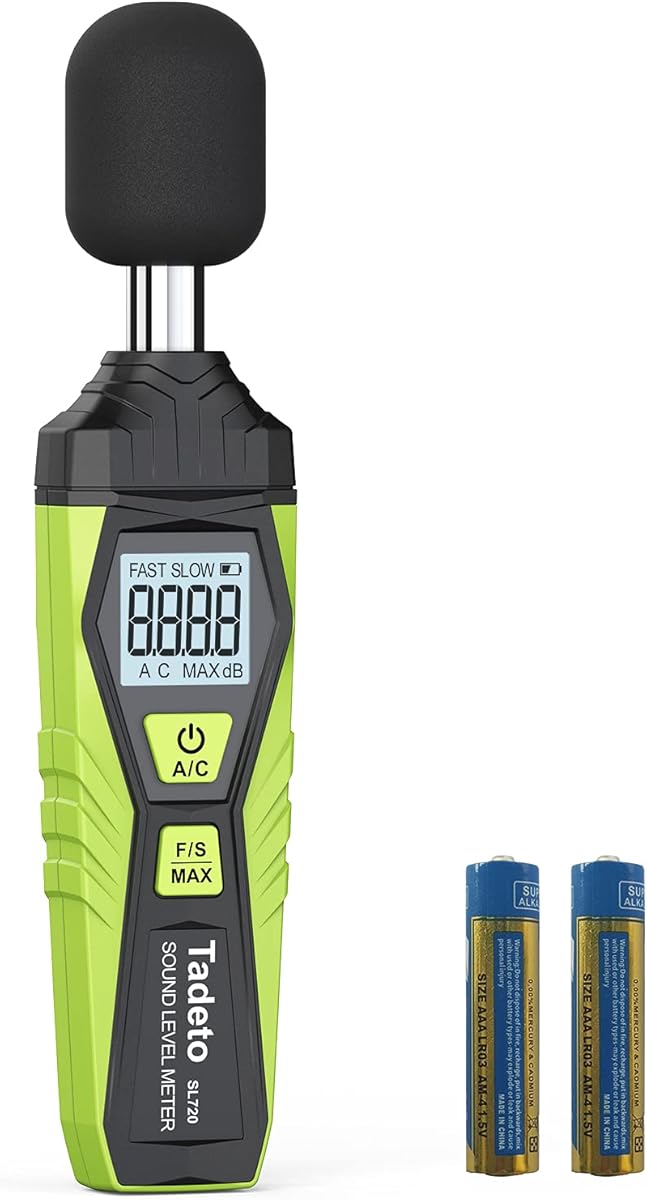
The Tadeto 30–130 dB model is a straightforward portable SPL meter with a 4.5 customer rating. It offers a four-digit backlit LCD, 0.1 dB resolution, A/C weighting, MAX, and data hold. Its light construction and broad measurement range make it convenient for homes, vehicles, offices, schools, construction sites, and routine equipment checks.
We may earn a commission when you buy through this link, at no additional cost to you.
The meter's 0.125-second FAST mode is intended for general environmental measurement and rapidly changing sounds, while the one-second SLOW mode suits levels that change relatively gradually. A low-voltage indicator helps prevent unexpected shutdowns, and the backlit display remains useful in darker environments. These controls cover the core needs of a basic sound-level survey without adding a graph or data logger.
Its stated accuracy is ±2.0 dB, which is less precise on paper than the ±1.5 dB figures given for many competing models. The product information also lists MAX and data hold but does not explicitly document MIN tracking. Those limitations matter if you need tight comparisons, certification-grade work, or a complete statistical record.
For general users who want a portable meter and value straightforward controls, this Tadeto is a sensible choice. It is particularly helpful for comparing appliances, checking a room before and after adding soft furnishings, or monitoring general noise around the home. Users needing more detailed trend analysis should consider a color-screen or logging model instead.
The 0.125-second FAST setting reacts quickly enough for traffic, conversation, appliances, and other fluctuating sources. The one-second SLOW setting provides a steadier reference when you want the display to reflect a relatively stable environment.
Its lightweight housing makes it easy to carry between rooms, into a vehicle, or around a small workplace. The backlit display and low-battery warning support repeated checks without demanding a separate power system.
We may earn a commission when you buy through this link, at no additional cost to you.
The DURFICST Color Screen Meter pairs a 4.6 customer rating with a 30–130 dB range and stated accuracy of ±1.5 dB. Its color LCD, 0.1 dB resolution, and support for both dB and SONE units make it visually distinctive and well suited to home audio, instrument, office, classroom, and environmental checks.
We may earn a commission when you buy through this link, at no additional cost to you.
The condenser microphone covers 31.5 Hz to 8 kHz, providing broad coverage for general-purpose measurements. A-weighting supports environmental sound assessment, while C-weighting is intended for stronger mechanical and industrial noise. FAST mode uses a 0.125-second time constant, and SLOW mode uses one second, giving users a practical choice between responsiveness and stability.
MAX and MIN recording plus data hold help identify peaks and preserve readings. The package also includes a windbreak ball, cloth carrying case, and soft rubber wrapping. The meter does not document computer connectivity or data export, so its color display is primarily a visual convenience rather than a route to detailed analysis.
This is an attractive choice for buyers who want more than a bare numeric display without moving into a dedicated logging system. It is well suited to tuning a home theater, checking speakers and instruments, comparing room noise, and taking general workplace readings. For most of those tasks, the stated accuracy and resolution are especially reassuring.
Buyers primarily concerned with recording trends over time should compare a data logger instead. Everyone else gets a capable, portable instrument with a distinctive screen and an unusually useful combination of measurement modes at a budget-friendly position in this list.
The color display provides clearer visual separation between the numerical reading, operating indicators, and changing values. That makes the meter approachable for users who are new to sound-level checks and useful for quick comparisons in a busy environment.
The dB unit is appropriate for routine environmental and workplace measurements, while SONE mode is intended for perceived loudness in acoustic and musical settings. Supporting both expands usefulness for home audio and instrument-related checks.
We may earn a commission when you buy through this link, at no additional cost to you.
The Goldeep SL750A carries the highest customer rating in this group at 4.7 and offers a balanced set of specifications: a 30–130 dB range, ±1.5 dB stated accuracy, and a 31.5 Hz–8 kHz frequency response. It is a versatile choice for home noise, traffic, offices, construction, factories, classrooms, baby rooms, and instruments.
We may earn a commission when you buy through this link, at no additional cost to you.
A/C weighting supports both environmental and industrial measurements, while the dB and SONE modes add value for music and audio-system checks. FAST and SLOW time responses help users alternate between changing and stable sources. MAX and MIN tracking preserves high and low readings over a period, while data hold freezes the current value for reference.
The supplied information emphasizes ease of use rather than sophisticated analysis. It includes a clear LCD, anti-slip grip, windbreak ball, two AAA batteries, and a manual. There is no documented export function, graph, threshold alarm, or computer connection, so those requirements would point toward a more specialized model.
This meter is a good recommendation for someone who wants a well-rounded handheld instrument across several environments. Its combination of A/C weighting, SONE support, peak tracking, and stated accuracy also makes it more versatile than a basic A-weighted-only meter. The bright orange housing is easy to spot in a toolbox or on a workbench.
Choose it when you want broad capabilities and a straightforward interface rather than data logging. It is particularly appropriate for checking appliances, musical instruments, classroom noise, construction sounds, and machinery in settings where a simple peak-and-minimum record is enough.
A/C weighting, dual time responses, and dB/SONE selection let the same instrument handle ambient noise and stronger mechanical sources. It is therefore a practical choice for a home, small workplace, or mixed bag of monitoring tasks.
MAX and MIN tracking retain the highest and lowest values observed during a test, while data hold preserves the current reading. These functions are enough for many comparative checks and do not require a computer.
We may earn a commission when you buy through this link, at no additional cost to you.
The green TopTes TS-501B is a strong general-purpose sound level meter with the added ability to display temperature and humidity. It has a 4.5 rating, a 30–130 dB range, ±1.5 dB stated accuracy, and a 2.25-inch backlit LCD, making it useful when noise conditions are only one part of the diagnosis.
We may earn a commission when you buy through this link, at no additional cost to you.
Its condenser microphone covers 30 Hz to 8,000 Hz, and A/C weighting allows selection between perceived environmental noise and stronger mechanical sources. MAX, MIN, and data-hold functions support comparisons, while automatic power-off and a low-battery indicator help manage the three included AAA batteries. The carry case makes it suitable for mobile use.
The temperature and humidity readouts are the defining additions, but the supplied information does not specify their sensor range, accuracy, or response time. It is therefore important not to treat those environmental values as equivalent to laboratory-grade environmental measurements. The sound-level specifications are much more clearly documented.
This model is a good fit for homeowners, teachers, office users, and workshop staff who want to document whether a high reading coincides with a hot, humid, or otherwise uncomfortable environment. The orange TS-501B remains the simpler choice when only sound levels matter, while this version adds useful context.
For users seeking a broad monitoring tool without computer connectivity, the green TS-501B is easier to recommend than a bare numeric meter. Its combination of backlighting, environmental readouts, and standard sound-measurement functions is especially practical for home and workplace troubleshooting.
Temperature and humidity readings can add context during a sound check, particularly in a home, classroom, workshop, or office where comfort and equipment performance may be relevant. It is a useful supplement rather than a substitute for dedicated environmental instruments.
The model retains the TS-501B's broad measurement range, backlit display, A/C weighting, MAX, MIN, and hold functions. That familiar core keeps it approachable while the environmental readouts broaden its role.
We may earn a commission when you buy through this link, at no additional cost to you.
The RISEPRO HT-80A is a compact, approachable meter for checking, monitoring, or controlling sound in personal, family, business, study, and industrial settings. Its 4.4 customer rating reflects a practical package, while the 30–130 dB range and ±1.5 dB stated accuracy provide a useful baseline for common noise checks.
We may earn a commission when you buy through this link, at no additional cost to you.
The meter uses A weighting and a 125-millisecond FAST time response. Data hold, maximum and minimum readings, automatic power-off, and a backlit display cover the most common needs without a complex menu. A carrying pouch and color gift box are included, adding convenience for storage and gifting.
Compared with A/C-weighting models, the HT-80A lacks a documented C-weighting mode. Its frequency response is also listed as 31.5 Hz to 4 kHz, narrower than several alternatives extending to 8 kHz. Those distinctions may matter when evaluating machinery, musical instruments, or sound with substantial high-frequency content.
The HT-80A is best for a buyer who wants a straightforward meter for everyday environmental monitoring, appliance comparisons, or basic room checks. It is less compelling for specialist acoustic work, detailed trend analysis, or machine testing that benefits from additional weighting choices and broader frequency coverage.
Its simplicity is the central benefit. Rather than trying to be a multifunction instrument, it focuses on the readings, hold controls, backlight, and record functions that most casual users need.
The focused feature set avoids unnecessary complexity for a first purchase. A numerical display, backlight, hold, and maximum/minimum readings are straightforward to learn and adequate for common household and workplace comparisons.
Automatic power-off reduces unnecessary battery drain, while MAX and MIN functions make it easier to notice a brief peak or an unusually quiet period. The included pouch also supports convenient storage between checks.
We may earn a commission when you buy through this link, at no additional cost to you.
The DANOPLUS Data Logger is the most specialized instrument in this guide, with up to 43,000 stored records, PC connectivity, Excel export, a three-color alarm system, and a line chart on a color screen. Its 4.2 rating is lower than several simpler competitors, but the added workflow makes it the premium choice for longitudinal monitoring.
We may earn a commission when you buy through this link, at no additional cost to you.
The meter measures 30–130 dB with stated accuracy of ±1.5 dB. A/C frequency weighting, adjustable FAST and SLOW response, analog bars, date and time, and a DC voltage output extend its usefulness beyond a basic point reading. Users can set a threshold and rely on green, yellow, or red indicators to show low, medium, and high conditions.
The device supports Windows 7, 10, and 11 for connecting, exporting, analyzing, and printing data. It stores information for viewing on the instrument or a computer, and records can be exported in Excel format. A rechargeable 1,000mAh battery is listed with an approximately 1.5-hour charging time, making the meter more suitable for extended sessions than a simple disposable-battery model.
Its limitations are largely tied to its sophistication. PC setup and data management require a more deliberate workflow than pressing a hold button on a handheld meter. The lower customer rating is worth noting, and buyers handling sensitive measurements should verify whether the instrument's specifications satisfy their professional standards.
Choose the DANOPLUS when a timeline matters, when measurements must be exported for analysis, or when a visual threshold alarm is more useful than manual observation. It is ideal for facility monitoring, workplace studies, noise investigations, and any project requiring a record rather than a single reading.
Storing up to 43,000 records changes the meter from a momentary tool into a monitoring instrument. A visible line chart can reveal when noise rises, while date and time fields help place events within a larger monitoring period.
The green, yellow, and red alarm indicators provide an immediate visual indication of low, medium, and high conditions. A manually adjustable threshold makes the system useful for establishing a site-specific reference.
USB connection and Excel export allow readings to be transferred, analyzed, and printed on compatible Windows systems. This is the defining advantage for professional documentation, though it adds more complexity than a basic handheld meter.
We may earn a commission when you buy through this link, at no additional cost to you.
The SW-525A differs from the handheld meters by using a wall-hanging format and a large red LCD. Its 30–130 dB range and audible alarm make it relevant to fixed monitoring in a home, office, classroom, workshop, or other space where a permanent visual indication is useful.
We may earn a commission when you buy through this link, at no additional cost to you.
A wall-mounted meter can provide a consistent reference location, which is valuable when comparing conditions over time or checking whether a recurring noise event occurs. The large red display should be easy to identify at a distance, while the alarm can draw attention without requiring someone to stand beside the instrument.
Published product information is limited compared with the other options. There is no detailed statement about accuracy, weighting modes, response speeds, peak memory, power source, or export capability in the supplied data. Those omissions make it harder to compare specifications such as the stated ±1.5 dB accuracy offered by several handhelds.
This model is a specialized choice for fixed-location use rather than mobile surveying. Buy it when you want a visible, always-present noise indicator and do not need a full report of frequency response, weighting, or historical data. For an adjustable, portable instrument, a handheld model is more versatile.
Its appeal lies in simplicity and placement. Rather than asking users to carry an instrument between locations, it creates a permanent monitoring point that can be viewed whenever needed.
Wall mounting allows a consistent position and an always-visible reading. This is helpful for tracking a recurring appliance, traffic, workshop, or neighboring sound without repeatedly setting up a handheld meter.
The red LCD is designed for quick visual recognition, while the alarm can notify users that the measured level has reached a notable condition. It is useful in spaces where visual checks are not continuous.
We may earn a commission when you buy through this link, at no additional cost to you.
The Tadeto Five-Range meter combines a 30–130 dB measurement range, ±1.5 dB stated accuracy, and five adjustable measurement ranges with both audible and visual alarms. Its 4.3 rating reflects a feature-oriented design for users who need more than a simple point reading but do not require computer-based logging.
We may earn a commission when you buy through this link, at no additional cost to you.
A/C weighting supports environmental and machinery-focused measurements, while FAST and SLOW response modes provide different time constants for changing and stable sound. MAX and MIN capture noteworthy values, and data hold freezes the current reading. The backlit display and low-voltage icon help users work in dark areas and maintain battery awareness.
The five selectable ranges and dual alarm system are the main distinctions from simpler Tadeto models. Adjustable ranges can be useful when working across quiet and loud environments, while audible and visual alerts make the meter suitable for monitoring a source from a short distance or for temporary noise investigations.
The product information does not mention data export, a trend chart, or a rechargeable battery, so it remains a standalone monitoring instrument. It may also feel more complex than necessary for a first-time buyer whose sole goal is a quick appliance comparison.
Choose this model for workshops, quality-control tasks, office studies, family noise checks, and applications where alarms are more valuable than exported data. It is a capable middle ground between a basic handheld meter and a full logging system.
Audible and visual alarms let the meter provide attention-grabbing feedback when a measured condition changes. That makes it more useful for temporary monitoring than a simple display-only instrument.
The adjustable measurement ranges give users more control across different sound levels. Combined with A/C weighting and FAST/SLOW response, the model can adapt to ambient conditions and machinery-related noise.
We may earn a commission when you buy through this link, at no additional cost to you.
The FNIRSI FDM-02 is a compact, modern sound meter designed for real-time monitoring around the home and workplace. It has a 4.4 rating, a 30–130 dB range, stated accuracy of ±1.5 dB, and a two-inch IPS screen with light and dark themes for visibility in different environments.
We may earn a commission when you buy through this link, at no additional cost to you.
Its condenser microphone supports A/C weighting and FAST/SLOW response. The 30-second curve mode displays changes in sound level, which is useful when adjusting home theater settings, matching speakers, placing a subwoofer, or calibrating a television and soundbar. High and low thresholds can also be set, and the 30 most recent alarms can be reviewed.
A rechargeable 1,500mAh battery, auto-off, and sleep mode make the meter convenient for repeated use without disposable batteries. Its small body and carrying case make it easy to carry between rooms or take on the go. The internal alarm history is useful, but there is no documented computer export or long-term database.
This model is particularly attractive to home theater enthusiasts, musicians, parents, office workers, and power-tool users. It is less appropriate for formal environmental studies requiring extensive historical analysis, but its curve display and thresholds cover many common monitoring needs in a compact package.
The FDM-02 balances portability, a readable screen, and flexible home-oriented features. It is a strong choice when you want more visual context than a plain LCD meter without stepping up to a computer-connected logger.
The 30-second curve shows how the sound level changes while you adjust a television, soundbar, speaker, or subwoofer. It provides context that a single instantaneous number cannot.
The rechargeable 1,500mAh battery avoids routine disposable-battery changes, while auto-off and sleep help conserve power. The carrying case and compact housing suit quick checks in multiple rooms or locations.
Configurable high and low thresholds support monitoring of parties, construction, traffic, appliances, or nearby bars. The 30 most recent alarm records add a short history without requiring a separate computer.
We may earn a commission when you buy through this link, at no additional cost to you.
The right decibel meter depends on the sounds you need to measure, the amount of history you need to keep, and how often the instrument will move. Compare accuracy, weighting, response, display, alarms, power, and accessories rather than looking only at the measurement range.
Most general-purpose sound level meters in this guide cover 30–130 dB, which spans a broad range of everyday environmental and equipment noise. The stated accuracy varies from ±1.5 dB to ±2.0 dB. If your comparisons need to be as consistent as possible, a model advertising ±1.5 dB is preferable, especially when recording only small differences between two settings.
Accuracy figures are manufacturer specifications, not the result of an individual review. For the most reliable results, keep the microphone position, orientation, and distance consistent, and avoid interpreting a meter as a substitute for certified occupational-noise instrumentation. Choose a tighter specification when fine comparisons matter most.
A-weighting emphasizes the frequencies that the human ear is generally more sensitive to at lower levels, making it appropriate for many environmental and daily sound checks. C-weighting is more useful for stronger mechanical, industrial, or lower-frequency noise. Instruments supporting both can serve a wider range of home, workshop, classroom, and workplace tasks.
A-only devices can be perfectly reasonable for a basic appliance or room-noise comparison. Choose A/C support if you may evaluate fans, motors, construction equipment, or other sources where C-weighting could be informative. Always record which weighting mode was used when comparing results.
FAST response reacts quickly to changing noise and is useful for traffic, speech, appliances, and other fluctuating sources. SLOW response smooths the display over a longer interval and is better for relatively steady conditions. The listed fast time constant is 0.125 seconds, while slow mode uses approximately one second.
A meter with both modes gives you more meaningful displays in different environments. Use FAST when you need to catch peaks and SLOW when you want a steadier reference. Choosing the wrong mode can make a changing source look inconsistent or a stable source appear unnecessarily active.
A large backlit LCD makes a meter easier to read in workshops, entertainment rooms, and dim spaces. Color screens can further distinguish operating states, and curve displays help reveal how a reading changes over time. These features matter most if the meter will be used for audio-system setup rather than a one-time reading.
If you only need a quick number, a backlit numeric display is enough. If you want to understand peaks, changing levels, or threshold events, look for MAX/MIN, curve mode, and visual alerts. Screen size should be balanced against portability, especially for a meter carried around a home or workplace.
Data hold freezes a reading, MAX tracks the highest observed value, and MIN records the lowest. These functions are valuable for comparing a source before and after a change or for catching a short event while you are not staring at the display. Audible and visual alarms are more useful when monitoring from a distance.
Start with MAX and data hold for routine comparisons. Add MIN when a low background reading is important. Choose a model with adjustable audible or visual alarms for temporary monitoring, parties, construction, or an area where you cannot watch the display continuously.
A data logger stores readings over time, turning isolated measurements into a record that can reveal patterns. The DANOPLUS model supports up to 43,000 records, PC viewing, Excel export, and compatibility with specified Windows systems. A graph with date and time is also more informative than a single value when studying recurring noise.
Computer export is valuable for facilities, workplace investigations, acoustic tests, and long monitoring sessions. It is unnecessary for casual appliance comparisons and introduces setup complexity. Buyers should also consider whether they need a long-term internal history, a short alarm list, or no storage beyond MAX and MIN.
Disposable-battery meters are simple and dependable, while rechargeable models reduce recurring battery purchases. Automatic power-off, sleep mode, and low-battery indicators help preserve operating time. Portability also depends on size, grip, included case, and whether the meter needs to remain in one location.
Choose disposable batteries for simple, infrequent checks or when AA and AAA cells are easy to obtain. A rechargeable battery is more convenient for frequent use. Portable users should favor a secure grip and case, while fixed monitoring buyers may prioritize a wall-mounted design and large display.
Decibels measure sound pressure level, while SONE is intended to express perceived loudness. Supporting both units can be helpful around musical instruments, audio systems, and performance spaces. Environmental, traffic, construction, classroom, and machinery checks are primarily decibel-oriented tasks.
Match the meter to the environment rather than adding features you will never use. A simple A-weighted handheld model is sufficient for many household checks, while A/C weighting, alarms, environmental readings, or logging become more valuable as the task becomes broader. Professional acoustic work may require specifications beyond anything stated here.
Before measuring, read the included manual, install or charge the batteries, and allow the meter to warm up as directed. Select the appropriate measurement range, weighting, and time-response mode. Hold the instrument steadily, keep the microphone pointed toward the sound source, and maintain a consistent distance when comparing readings.
For a meaningful comparison, measure the background first, activate the noise source, and record the result under the same conditions. Use data hold to preserve a representative value and MAX or MIN to capture notable peaks. If the source fluctuates, select FAST mode for changes or SLOW mode for a steadier result. Label each record with the location, source, mode, and date.
Keep the microphone protected from dust, moisture, and impact, and avoid speaking directly into it. Store the meter in its case with the batteries removed if it will remain unused for a long period. Clean the exterior with a dry or slightly damp cloth according to the manufacturer's instructions, and replace batteries promptly when the low-power warning appears.
All ten products listed here cover 30–130 dB, which is a useful general-purpose range for household, office, classroom, traffic, workshop, and machinery checks. It is wide enough to compare quiet background conditions with louder operating equipment. Specialized acoustic standards may use different limits, so confirm the full specifications before professional use.
A-weighting is usually more appropriate for everyday environmental sounds at lower levels because it reflects the ear's frequency sensitivity. C-weighting is more useful for stronger mechanical and industrial sources, including motors and machinery. If you compare several environments or noise types, a meter with both modes offers more flexibility.
A standard decibel meter primarily shows sound pressure level rather than judging musical quality, speech clarity, or whether a sound is pleasant. A SONE unit can provide a different view of perceived loudness, but that still does not replace frequency analysis. Detailed acoustic evaluation requires more advanced measurement equipment.
FAST mode uses a short time constant, approximately 0.125 seconds in the listed models, so it reacts quickly to changing sounds. SLOW mode uses approximately one second and provides a steadier display for relatively stable conditions. FAST is helpful for peaks and traffic, while SLOW is better for maintaining a consistent reference.
You should not assume that a consumer meter satisfies every legal, workplace, or regulatory requirement. Professional assessment may require calibration, specific standards, dosimeter functions, approved measurement procedures, and documented equipment. Use these products for general monitoring unless the manufacturer explicitly certifies them for the applicable purpose.
A data logger is helpful when the noise is intermittent, the timeline matters, or you need to share a detailed record. For a consistent sound such as an appliance or ventilation system, a handheld meter with MAX, MIN, and data hold may be sufficient. The premium logger adds storage and export, but it also requires a more involved computer workflow.
Place it near the location of interest, point the microphone toward the source, and keep it away from reflective surfaces when possible. Do not speak directly over the microphone, and hold it steadily. For comparisons, keep its height, orientation, and distance from the source consistent.
Disposable batteries are simple to replace, while rechargeable models are more convenient for frequent use and often support longer sessions. Automatic power-off and low-battery indicators help reduce interruptions. Follow the manual's battery or charging guidance, especially for models with a built-in rechargeable cell.
The TopTes TS-501B in orange is the strongest all-around choice because it combines a large backlit display, stated ±1.5 dB accuracy, A/C weighting, MAX and MIN, data hold, and included accessories. The DURFICST Color Screen Meter offers an attractive budget-oriented alternative, while the DANOPLUS Data Logger is the premium option for anyone who needs stored history, threshold alarms, and computer export.
Prioritize the features that match the actual task. A basic household comparison may need nothing more than a backlit display and hold function; machinery checks benefit from A/C weighting; changing sources are easier to interpret with FAST and SLOW modes; and recurring or disputed noise is much easier to document with MAX, MIN, alarms, or logging.
Before ordering, verify the current retailer listing, compare the full specifications, and confirm that the included batteries, case, manual, or connection cable meet your needs. Retailer pricing can change, and availability may vary, so use the guide as a feature-based shortlist rather than assuming every listing remains identical.
