
Cosmo Mini 100 Copy Stand
4.3Editor score
Compact portable base
Adjustable phone support
Floating magnetic board
Compare the best copy stands for film scanning and photo digitizing, with expert guidance on stability, alignment, camera support, portability, and setup.
A copy stand keeps a camera, smartphone, document, negative, or small object aligned while you photograph it from above. A quality model reduces guesswork, limits shake, and makes it easier to capture evenly framed images for archives, creative projects, listings, records, and family collections.
The products in this guide differ in working area, camera support, adjustment range, included alignment aids, portability, and intended level of use. We compared the supplied specifications and customer ratings, covering compact phone-based stands, larger document and creative-work systems, and dedicated camera and film options.
Each review highlights the most useful capabilities and the trade-offs to consider. The badges identify three standout choices, while the comparison table makes the structural differences easier to see. Prices and availability can change, so confirm current listings and compatibility before buying.
4.3Editor score

4.8Editor score

4.6Editor score
This side-by-side comparison covers platform size, included alignment aids, supported devices, adjustment systems, and the most important design distinctions for each copy stand.


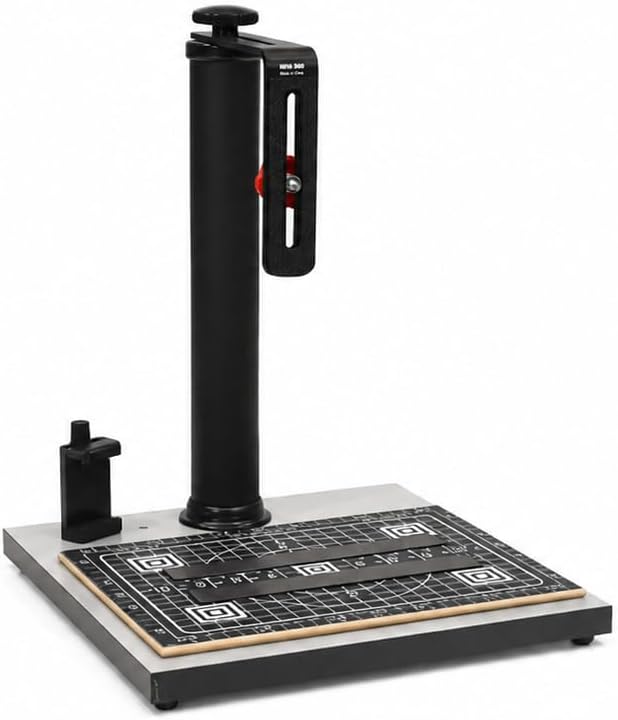


The Cosmo Mini 100 is a compact digitizing stand rated 4.3 stars by customers. It is designed for small photographs, documents, checks, jewelry, coins, and other compact objects photographed with a smartphone. Its defining advantage is straightforward portability: the base measures 10.5 by 8.5 inches, and the listed assembly time is under one minute.
We may earn a commission when you buy through this link, at no additional cost to you.
A 9-by-7-inch Floating Magnet Board provides a flat placement surface with half-inch grid lines for focusing, sizing, and positioning. Two magnetic strips help secure originals without relying on adhesive. The column adjusts from 11 to 16 inches, while the aluminum L-bracket offers multiple vertical and horizontal positions and a holder for phones between 2.25 and 3.5 inches wide.
The principal limitation is scale. A center opening accommodates only light cameras under one pound, and the compact base leaves less room for oversized photographs, books, or negative work than the larger Cosmo systems. It is also explicitly intended for casual, hobby, and student use rather than professional or large-format production.
Choose the Mini 100 when portability matters more than workspace and your main device is a smartphone. It is a capable entry point for household archives, check capture, social-media images, and small-object records. For a larger table, heavier camera, or extended professional workflow, move up to the Mini 500 or Mini 700.
The foldable-style portable design and sub-one-minute assembly make this stand practical when digitizing tasks happen at different tables or locations. Its structure is simple enough for occasional users while still offering repeatable vertical and horizontal camera positioning.
The included magnetic board adds useful reference lines to a basic platform. Those guides help with initial focusing, sizing, and centering, while the side opening provides a dedicated position for smartphone camera alignment over the board.
We may earn a commission when you buy through this link, at no additional cost to you.
The Cosmo Mini 300 carries a 4.2-star customer rating and bridges the gap between a phone-only stand and a larger camera platform. It supports cameras up to three pounds as well as smartphones 2.25 to 3.5 inches wide, giving users flexibility in how they digitize old photographs, documents, and other flat originals.
We may earn a commission when you buy through this link, at no additional cost to you.
Its 12-by-9.5-inch base is more substantial than the Mini 100, and the included 10-by-7.5-inch Floating Magnet Board provides half-inch alignment grids and two magnetic strips. The reversible anodized aluminum bracket adjusts vertically from seven to 17 inches, with two horizontal positions one inch apart, while the steel column adds rigidity.
The Mini 300 is positioned for amateur and hobbyist use, not professional production. Its seven-inch lower adjustment limit may be restrictive for especially small subjects, and the two horizontal bracket positions offer less freedom than the larger Mini 500 and Mini 700 models. It is also less expansive than a full Kaiser system.
This stand is a strong middle option for someone who wants camera support without moving to a large copy-stand platform. It works well for family photo collections, checks, printed records, and general document capture. Consumers who regularly photograph larger subjects or require broader positioning should consider the Mini 500 or 700.
Supporting cameras up to three pounds makes this system more versatile than compact phone-focused models. Users can begin with a smartphone and move to a compact interchangeable-lens or high-resolution camera when sharper archival images are needed.
The Floating Magnet Board keeps originals flat while leaving the user free to reposition the board for better framing. Its printed grid provides a consistent reference for focusing, alignment, and image sizing.
We may earn a commission when you buy through this link, at no additional cost to you.
The Copy Macro Stand is a purpose-built film digitizing platform rather than a general document copier. It is intended for 135 and 120 negatives as well as slides, with a quick-release plate, adjustable mounting height, a sturdy aluminum base, and adjustable leveling feet designed to improve stability during close-up photography.
We may earn a commission when you buy through this link, at no additional cost to you.
Its full-metal construction and 240-by-200mm base create a more specialized working system for camera-based film workflows. The quick-release clip accepts DSLRs, mirrorless cameras, and L-brackets. A bubble level and locking knob help maintain camera alignment, reducing the chance that the lens will sit at an unintended angle.
This listing has no supplied customer rating, so there is no numerical customer feedback to weigh. It also does not state that a negative light source is included. A camera copy stand for negatives typically benefits from appropriate transmitted illumination, and users may need to arrange suitable lighting separately for consistent results.
Select the Copy Macro Stand if digitizing 135 or 120 negatives is a primary objective and you already use an interchangeable-lens camera. Its leveling and quick-release features are more directly relevant to film than general document photography. For a broad phone-based archive workflow, one of the Cosmo systems will be easier.
Adjustable feet and an integrated bubble level make it easier to establish a flat shooting plane. This is especially helpful for film, where even small perspective differences can affect frame coverage and consistency between negatives.
The quick-release plate simplifies mounting and changing camera bodies. Compatibility with DSLRs, mirrorless cameras, and L-brackets also gives photographers flexibility in building a dedicated digitization setup around gear they already own.
We may earn a commission when you buy through this link, at no additional cost to you.
The Kaiser RS 2-XA is a precision-oriented copy stand with a 4.6-star rating, the highest rated result among the supplied products that includes customer feedback. It combines a non-reflective matte gray base with a fine printed grid and inch and centimeter scales, helping operators position documents and frame images with repeatable references.
We may earn a commission when you buy through this link, at no additional cost to you.
The matte black anodized aluminum column rotates 180 degrees, while the camera arm adjusts vertically and moves horizontally by approximately 2.7 inches. A quarter-inch mounting thread supports smaller SLR cameras, digital cameras, and CCD or CMOS camera systems. The maximum stated load is 3.3 pounds, with optional lighting kits available separately.
Its strongest advantages are precise scales, a non-reflective shooting surface, and a compact, rigid-looking design. The trade-offs are the premium purchase tier, the absence of an included magnetic document board, and the relatively low load rating. It is also a camera-arm system rather than a phone-focused stand with an integrated holder.
This is an excellent choice for photographers and serious archivists who already own a suitable camera and prioritize measured alignment. The Kaiser RS1 offers greater rigidity and weight compensation, but the RS 2-XA delivers an excellent balance of precision and compactness. Confirm your camera mounting thread and planned load before ordering.
Fine grids and dual-unit scales provide a dependable visual reference when positioning originals and camera travel. These details are valuable for batch work because operators can return to a known placement rather than estimating each time.
The rotatable column and adjustable arm provide meaningful positioning control in a relatively compact footprint. That makes the RS 2-XA suitable for studios where every available surface matters.
We may earn a commission when you buy through this link, at no additional cost to you.
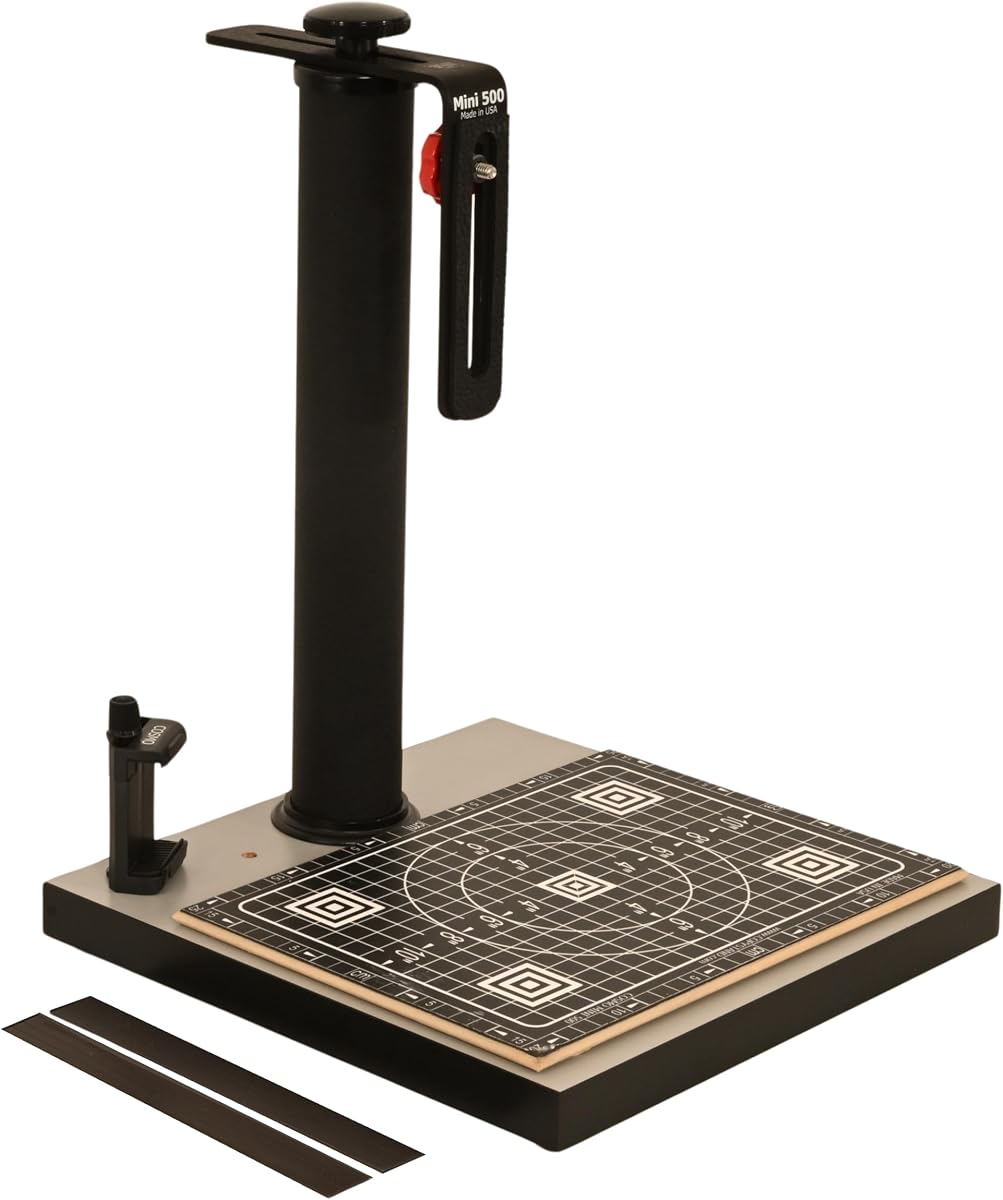
The Cosmo Mini 500 is a versatile mid-size copy stand with a 4.2-star customer rating. It is designed for digitizing slides, negatives, artwork, calligraphy, sketches, tattoos, restorations, presentations, and video projects. That broad range makes it more useful for creative professionals and hobbyists than a stand focused only on checks or documents.
We may earn a commission when you buy through this link, at no additional cost to you.
The 12-by-12-inch base gives the system more stability than the Mini 100 and Mini 300, while the 8.5-by-11.5-inch Floating Magnet Board holds flat originals with two magnetic strips and a half-inch precision grid. Cameras up to three pounds and phones between 2.25 and 3.5 inches wide are supported.
Its reversible L-bracket adjusts from nine to 19 inches vertically and offers approximately four inches of horizontal travel. That range is useful for changing between small objects and large sheets. However, the product is explicitly not intended as a professional copy stand, and an LED light box may be required for some tasks but is not included.
Choose the Mini 500 when you want one platform for archival photographs, artwork, presentations, and general overhead imagery. It offers more workspace and adjustment than the smaller Cosmo models without reaching the footprint of the Mini 700. Photographers working with negatives should plan appropriate illumination before beginning.
The square 12-inch base creates a stable platform for common letter-size and larger paper subjects. It also gives the camera and support structure more room to move without crowding the original.
The same setup can document artwork, restore scans, record sketches, photograph tattoos, or create overhead video. That versatility is the main reason to choose this model over a smaller document-only stand.
We may earn a commission when you buy through this link, at no additional cost to you.
This Cosmo Mini 500 listing combines the familiar Mini 500 platform with a slightly larger 13-by-12.5-inch base. It is aimed at digitizing photographs, documents, and small objects with a high-pixel camera or smartphone, and no customer rating is provided for this specific listing.
We may earn a commission when you buy through this link, at no additional cost to you.
The larger footprint improves working room while retaining a 9-by-19-inch vertical adjustment range and approximately four inches of horizontal travel. The two-inch steel column and reversible anodized aluminum bracket support the camera arm, while the included phone holder accommodates devices 2.25 to 3.5 inches wide.
An 8.5-by-11.5-inch Floating Magnet Board supplies two magnetic strips and a half-inch alignment grid. This remains smaller than the base but large enough for common photographs and documents. As with other Cosmo Mini 500 systems, the product is not intended for professional copy-stand use.
The main appeal is the balance between portability, stability, and creative flexibility. It is well suited to old-family-photo projects, small-object records, and overhead documentation. Buyers should evaluate it as a hobby-oriented system and confirm that their light source meets the requirements of the subject. The larger Kaiser systems are more appropriate for controlled professional work.
The expanded base gives the column and camera more physical separation from the subject area. That can make it easier to reposition equipment without bumping the platform or disturbing a carefully aligned original.
The side opening is intended to align a smartphone camera over the board, while the integrated holder keeps the device supported. This makes the stand convenient for users who do not need a dedicated camera body.
We may earn a commission when you buy through this link, at no additional cost to you.
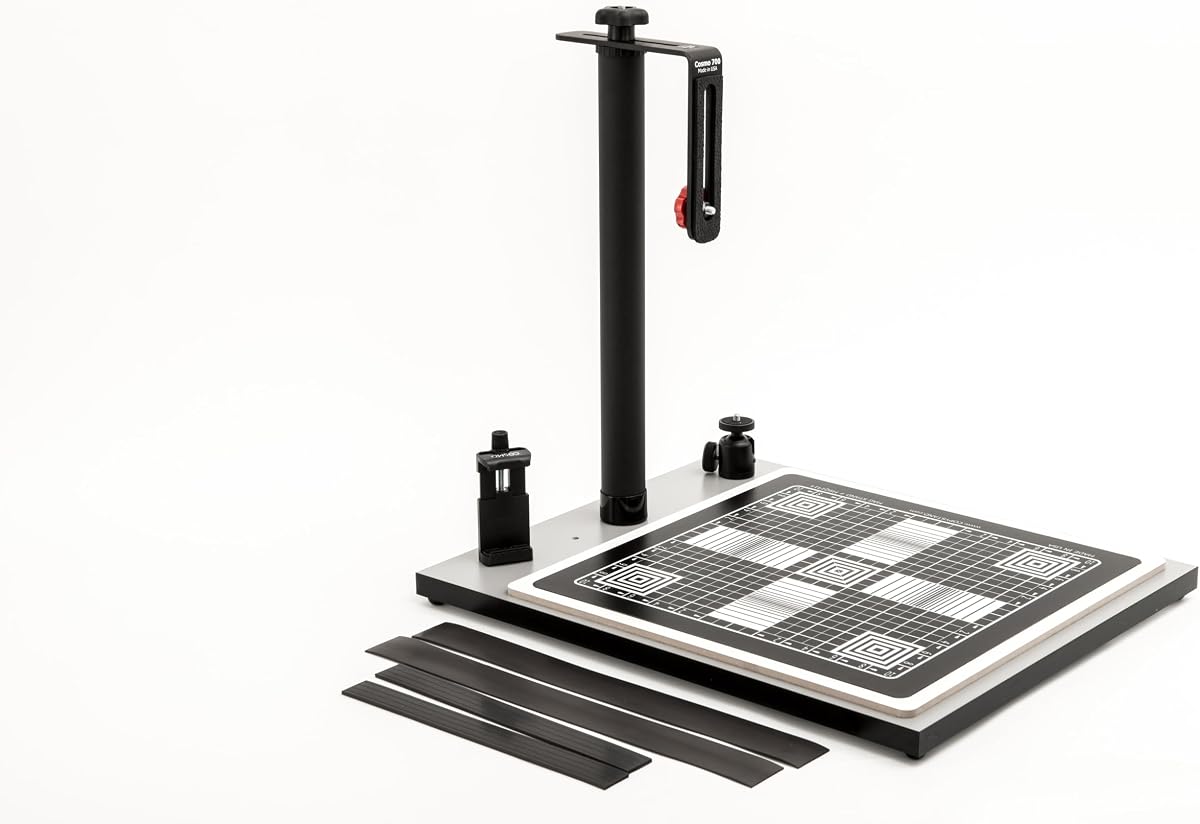
The Cosmo Mini 700 is the largest of the compact Cosmo hobby stands in this guide, with a 15.5-by-18.5-inch base and a 15-by-15-inch Floating Magnetic Board. It is intended for large documents, photographs, food plates, jewelry, coins, collectibles, and other three-dimensional objects.
We may earn a commission when you buy through this link, at no additional cost to you.
Four magnetic strips define a 14-by-14-inch working area, and the board's half-inch grid helps with alignment, focus, sizing, and placement. The support system combines a 16-inch powder-coated steel column, an aluminum L-bracket with vertical and horizontal options, a ball head, and a holder for most modern smartphones.
The ball head is particularly useful when a perfect overhead angle is not the only requirement. Cameras under three pounds are supported, but the stand remains explicitly identified as a nonprofessional product. Its 14-pound weight and broad base make it less convenient for mobile or space-limited workflows than the smaller Cosmo models.
Choose this version when large originals, plated food, or dimensional objects are central to your work and you need a roomy, flexible platform. It offers a stronger combination of subject area and positioning control than the Mini 500. Users seeking professional-grade rigidity and weight compensation should investigate the Kaiser RS1 instead.
A large magnetic working area gives users more freedom to position oversized photographs, documents, dishes, and collectibles. It is particularly useful when framing needs extend beyond the smaller board sizes offered by compact stands.
The included ball head allows smoother camera-angle changes than a simple fixed holder. That makes it easier to transition between straight-down reproduction and slightly angled views of three-dimensional objects.
We may earn a commission when you buy through this link, at no additional cost to you.
This Cosmo Mini 700 listing has a 4.8-star customer rating, the highest rating among the ten supplied products. It combines a substantial 15.5-by-18.5-inch base with a 15-by-15-inch Floating Magnetic Board, making it well suited to large pictures, documents, chef plates, meals, collectibles, and other three-dimensional subjects.
We may earn a commission when you buy through this link, at no additional cost to you.
The board provides a 14-by-14-inch magnetic area with four strips and half-inch grid lines. A 1.5-inch powder-coated steel column supports an aluminum L-bracket with multiple positions, a ball head for angle adjustment, and a smartphone holder. Cameras weighing under three pounds are also supported, giving users both phone and camera options.
Its main limitation is its size. The stand weighs 14 pounds and occupies a large table area, so it is less attractive for quick, mobile, or small-document tasks. The listing also explicitly says it is not a professional copy stand. Larger professional systems may offer better rigidity, load handling, and camera-arm control.
This is the most well-rounded pick for hobbyists, food creators, online sellers, art students, and photography enthusiasts who want a roomy overhead platform. The included alignment board reduces the need for separate accessories, while the ball head expands framing options. It earns the Editor's Choice for combining customer feedback with broad practical versatility.
The large board, printed grid, and magnetic strips create a ready-to-use platform rather than a bare support. Users can position originals quickly and keep them flat while working from a phone or compact camera.
Document archiving, food presentation, collectibles, artwork, and large photographs can all be handled on one system. That variety reduces the need to move between several dedicated stands as projects and subjects change.
We may earn a commission when you buy through this link, at no additional cost to you.
The Kaiser RS1 is a premium, camera-oriented copy stand with a 4.2-star customer rating. It is built around an extra-wide, vibration-resistant column made from matte black anodized aluminum tubing, offering a more substantial structure than the smaller RS 2-XA and the compact Cosmo hobby stands.
We may earn a commission when you buy through this link, at no additional cost to you.
Its key mechanical advantage is the roll-off spring mechanism, which provides weight compensation for the camera arm. Interchangeable threaded one-quarter-inch and three-eighth-inch bushings, an included camera adjustment tool, and a height-adjustable arm support several mounting approaches. The gray base also carries a printed fine grid for alignment.
The RS1 requires a substantial financial commitment and does not include a smartphone holder. Its sophisticated camera arm may be unnecessary for someone who only wants to scan checks, digitize prints with a phone, or make occasional product images. Setup will also be less approachable than a basic magnetic platform and stand.
This is the option to prioritize when camera stability, substantial equipment, and repeatable arm positioning matter most. It suits a dedicated studio, a serious photography workflow, or an archival setup that will be used repeatedly with a compatible camera. For casual phone use, the Cosmo Mini 100 or 500 is more direct and approachable.
The spring-assisted arm helps support camera mass as the arm position changes. That can make fine adjustments more consistent and reduce unwanted movement when a heavier camera body or lens is mounted.
Interchangeable quarter-inch and three-eighth-inch bushings give users options for compatible camera equipment and accessories. The included adjustment tool also supports a more considered setup than a basic friction joint.
We may earn a commission when you buy through this link, at no additional cost to you.
The Mag Stand 1612DTM has a 5.0-star customer rating, making it the highest-rated product in the supplied group. It is a 16-by-12-inch magnetic document holder rather than a complete copy stand, providing an alignment surface for use on a desk or on the base of a separate copy-stand system.
We may earn a commission when you buy through this link, at no additional cost to you.
Its construction uses three layers of wood, rubber steel, and laminated car-wrapping film. The printed and laminated surface carries half-inch precision grids and squared corners for initial setup, focusing, alignment, adjustment, and sizing. Two magnetic strips hold originals in place while the platform can be repositioned for shooting or panning.
Because it does not include a column, camera arm, or phone holder, users must supply those components or photograph with a separate camera setup. It therefore cannot provide the convenience of an integrated stand. Its strength is the broad, flat, alignment-oriented platform rather than complete capture hardware.
Choose the Mag Stand when you already own a sturdy copy stand and want a superior document surface. It is also useful for creative tabletop photography with an independently supported camera. For a complete, ready-to-assemble digitizing solution, choose one of the Cosmo systems or a Kaiser stand instead.
The printed grid and squared corners provide a dependable starting point for repeated captures. This is valuable when replacing a basic flat surface without buying another complete support system.
Two magnetic strips keep the original attached while allowing the entire platform to slide. That mobility supports overhead shooting, video panning, and quick changes in framing.
We may earn a commission when you buy through this link, at no additional cost to you.
Choose a copy stand by matching its working area, camera support, alignment features, and construction to your subjects and shooting equipment. The most important distinction is whether you need a complete system, a camera-specific mount, or only a refined flat platform.
The base and removable working board should be large enough to hold the largest original you expect to photograph without crowding the support. Compact models with bases around 10 to 12 inches suit checks, loose photographs, and small objects. Larger systems with bases around 13 inches or more accommodate letter-size artwork, documents, dishes, and oversized prints. Always compare the usable board area rather than the overall base measurement alone.
Check both the type of mount and the weight limit. Phone holders generally fit devices between 2.25 and 3.5 inches wide, while camera systems may use a quarter-inch thread, quick-release plate, or interchangeable bushing. Some Cosmo models support cameras up to three pounds, whereas the Kaiser RS 2-XA lists a 3.3-pound maximum. Do not assume a physical fit means the camera is supported safely.
A rigid column, broad base, and low center of gravity help prevent motion during long exposures and close-focus captures. The Kaiser RS1 emphasizes vibration resistance, while the Copy Macro Stand uses an aluminum base and leveling feet. The Cosmo systems are described as compact and portable rather than professional, so consider the frequency and seriousness of your workflow as well as the advertised materials.
Printed grids, inch and centimeter scales, and square reference lines make setup more repeatable. Magnetic strips or a floating board hold originals flat without adhesive residue, and they allow the board to move while the camera remains fixed. Dedicated film systems may require careful manual alignment, whereas the Cosmo and Mag Stand products place more emphasis on visible grids and magnetic positioning aids.
Vertical adjustment determines how close the camera can sit to a small subject, while horizontal travel determines how easily it can move over a large board. A ball head adds useful angle control for three-dimensional subjects. The Mini 500 and 700 offer broader vertical and horizontal ranges than the smaller models, and the Kaiser systems focus on camera-arm movement for fine positioning.
Phone-based household archiving, professional film digitization, and food or product photography have different requirements. The Cosmo Mini 100 is explicitly compact and light-duty, the Copy Macro Stand targets 135 and 120 negatives, and the Mini 700 accommodates large documents and three-dimensional subjects. The Kaiser RS1 is better suited to a dedicated camera studio than occasional phone capture.
A copy stand provides alignment and support, not necessarily the illumination needed for every subject. Reflective artwork, slides, and negatives may need controlled diffuse light, while transparent film generally requires transmitted lighting. The Cosmo Mini 500 notes that an LED light box may be required but is excluded, and the Copy Macro Stand does not list a negative light source as included. Plan the entire imaging system rather than the stand alone.
If the stand will move between rooms or be stored away, size and weight become decisive. The Mini 100 is the most compact option, the Mini 300 and 500 offer larger supported equipment, and the Mini 700 weighs 14 pounds. A platform-only product such as the Mag Stand offers another approach because the user can add a separate stand whenever needed. Measure storage space and assess the weight before ordering.
Assemble the stand on a level, sturdy surface away from direct sunlight and vibration. Lock the column, camera arm, bracket, and adjustment knobs before placing the original. For a magnetic system, position the working board using the printed grid, secure the subject with the magnetic strips, and make sure the camera is centered directly over the required area.
Set the camera to manual mode when possible, disable automatic adjustments, and use a timer or remote release to avoid introducing shake. For film, choose suitable transmitted illumination; for reflective documents or artwork, use soft, even lighting that does not create a visible hotspot. Check the preview for perspective, focus, color, and clipping before capturing the full sequence.
After use, power down and detach the camera or phone gently. Wipe the base and working board with a soft, dry cloth, and avoid liquid cleaners on printed or laminated surfaces. Keep magnetic strips free of grit, protect the column from impact, and periodically check every locking point. Retighten or service any component that develops play before the next archival session.
Yes, a copy stand can photograph film negatives, but the stand must be paired with a suitable camera, close-focus capability, and appropriate illumination. The Copy Macro Stand is specifically designed for 135 and 120 negatives, while the Cosmo Mini 500 and 700 list negatives among possible applications. Transparent negatives generally require controlled transmitted light, which may not be included with the stand.
A copy stand is often better when you want flexible lighting, creative backgrounds, high-resolution camera capture, or the ability to photograph dimensional objects. A flatbed scanner remains convenient for rapid, contact-based document capture and automatic handling. For fragile or valuable originals, a camera copy stand can reduce contact, provided the subject is supported and handled carefully.
Most Cosmo models include a phone holder and a side opening intended to position a smartphone camera over the board. The listed phone-holder range is generally 2.25 to 3.5 inches wide. Camera performance depends on the phone's lens, stabilization, resolution, and software, so a stand can improve alignment without determining the final image quality.
A floating magnetic board provides a flat surface while allowing the entire platform to slide beneath a stationary camera. Magnetic strips keep the original from shifting, and printed grids help with focusing, sizing, and positioning. The board can be used on the included base or independently on a desk in some models, making it a versatile capture aid.
A bubble level is especially useful for film work because a tilted camera can change the perspective and leave part of a negative outside the frame. Dedicated film stands often include leveling feet or a bubble level. Other copy stands can still be used successfully if the base is placed on a flat surface and the camera is checked visually or with a spirit level.
Weight limits vary substantially by model. The Cosmo Mini 100 lists a center camera opening for compact cameras under one pound, while several Mini 300, 500, and 700 models support cameras up to three pounds. The Kaiser RS 2-XA has a 3.3-pound maximum. Always follow the lower limit of the specific model, camera, lens, bracket, and mounting hardware being used.
Yes, a grid helps establish repeatable placement and makes it easier to judge scale, centering, and focus. It is particularly useful for batch digitizing, where consistent camera distance and framing reduce reshooting. Printed grids are not a substitute for careful checking, but they provide a useful reference during setup and quality control.
Buy a complete stand if you want a ready-to-use system with a column, bracket, camera support, and phone holder. A platform such as the Mag Stand 1612DTM makes more sense if you already own a stable copy stand and only need a better-aligned surface. Consider storage space, existing equipment, and the range of subjects you plan to photograph before deciding.
The Cosmo Mini 100 is the most budget-conscious compact option for phone-based archiving and small objects. The Cosmo Mini 700 Copy Stand is the most versatile all-rounder, offering a large work area, strong customer rating, and flexible overhead positioning. For precision-oriented camera work, the Kaiser RS 2-XA stands out with measured scales and an adjustable arm.
Prioritize the subject area, camera and phone compatibility, stability, and required lighting over features that do not match your workflow. Small casual projects may need very little, while repeated archival work benefits from a rigid base, precise grid, and smoother arm or bracket controls. Dedicated negative work also calls for a purpose-built film platform.
Before ordering, verify the current listing, included accessories, device dimensions, and weight limits. Prices, configurations, and availability can change, so the product details and comparison table should be checked against the latest Amazon page. That final check helps prevent buying a platform that is too small, too light, or missing the light source your subject requires.