
WD-40 Specialist Contact Cleaner
4.8Editor score
Targets flux and condensation
Quick-drying contact cleaning
Metal and plastic compatibility
Our Circuit Board Cleaner guide compares ten contact cleaners for residue, drying speed, material compatibility, precision, PCB use, and electronics maintenance
Circuit board cleaners are specialized contact-cleaning products used to remove flux, oxidation, grease, dust, condensation, and other contaminants from sensitive electronic connections. A good cleaner dries quickly, leaves no residue, reaches confined areas, and remains compatible with the materials surrounding the components being serviced.
This guide compares ten electronic and circuit-board cleaners using information supplied for each product. We evaluate the stated cleaning applications, drying behavior, residue claims, aerosol or brush-based application methods, material cautions, precision accessories, and suitability for professional maintenance, electronics repair, and consumer projects.
Each pick reveals how the product distinguishes itself through its formula, container, included applicator, and intended applications. Ratings and product details reflect the supplied listings, while availability and pricing can change. Always check the current listing, instructions, and material-compatibility warnings before applying a cleaner.
4.8Editor score

4.8Editor score

4.7Editor score
The comparison below places all ten options side by side, emphasizing their supplied formats, drying characteristics, cleaning targets, application methods, and stated compatibility considerations.




CRC 05103 QD Electronic Cleaner earns a 4.8 rating and stands out as the most complete general-purpose option in this guide. Its petroleum-distillate and alcohol-based formula is designed to clean sensitive electronic surfaces quickly, evaporate rapidly, and leave no residue, all of which are central requirements when working around populated circuit boards.
We may earn a commission when you buy through this link, at no additional cost to you.
The listed applications are unusually broad. The cleaner is intended for computer components, circuit breakers, circuits, coin mechanisms, contacts, sockets, relay switches, plugs, lighting equipment, plastics, nylon, and PVC, as well as for flux removal. That range makes it useful for electronics repair, general equipment maintenance, and cleaning connectors without changing products for every task.
Its main trade-off is the aerosol format. Aerosols are effective for reaching many recesses, but they require careful control around components that may be sensitive to overspray. The listing does not mention an extension straw, so precise application may depend on the can's supplied nozzle and the user's ability to keep the spray directed.
This is a strong recommendation for a user who wants one dependable cleaner for circuit boards, contacts, sockets, switches, and related electronic assemblies. Its combination of fast drying, residue-free performance, plastic-safe claims, and unusually broad application coverage makes it an excellent all-around choice.
Rapid evaporation is particularly valuable around powered or densely populated assemblies because the cleaner is intended to leave no residue behind. That characteristic reduces the need for extensive post-cleaning work and supports routine maintenance where speed and clean results both matter.
The product's applications extend far beyond bare boards to sockets, relay switches, plugs, coin mechanisms, and lighting. That versatility makes it practical for repair benches and maintenance kits where a single electronics-focused aerosol can serve many small cleaning jobs.
We may earn a commission when you buy through this link, at no additional cost to you.
WD-40 Specialist Contact Cleaner Spray has a 4.8 rating and delivers focused cleaning performance in an accessible specialist formula. It is designed to remove oil, dirt, flux residue, and condensation from sensitive electrical equipment, covering several common causes of unreliable connections with one product.
We may earn a commission when you buy through this link, at no additional cost to you.
The quick-drying, residue-free formula is appropriate for printed circuit boards, controls, switches, precision instruments, and electrical panels. Its stated compatibility with metals and most plastics broadens the range of assemblies it can address, while the warning to test plastic first reflects the importance of confirming compatibility before spraying a sensitive enclosure.
The product's limitations are clear rather than hidden. Users should avoid adhesives, device screens, and keyboards, and testing on plastic is recommended. Like other aerosols, it also requires controlled application to prevent unintended contact with nearby parts.
For technicians, hobbyists, and electronics owners seeking a straightforward specialist cleaner without moving to a specialist nozzle system, this is an excellent choice. Its strong 4.8 rating, clear contaminant targets, and suitability for printed circuit boards support its position as the best budget option.
Oil, dirt, flux residue, and condensation are among the contaminants most likely to interfere with electrical contacts. Formulating the cleaner around those four issues gives it a clear purpose when restoring switches, controls, panels, and board-level connections.
The quick-drying formula is valuable in repair environments where equipment needs to return to service quickly. Its residue-free claim also distinguishes it from heavier general-purpose lubricants that may be inappropriate around certain electronic contacts.
We may earn a commission when you buy through this link, at no additional cost to you.
This 250ML Electronic Contact Cleaner has a 4.4 rating and distinguishes itself through a matching brush that allows controlled application to oily areas. That method can be useful when an aerosol would be difficult to direct precisely around a component, connector, or densely assembled board.
We may earn a commission when you buy through this link, at no additional cost to you.
The cleaner evaporates quickly and is presented as suitable for computer motherboards, mobile-phone repairs, and industrial control boards. Its brush-based workflow is straightforward: apply the cleaner to the affected area, wipe repeatedly, and allow the surface to dry. This gives the user more visible control over where the liquid goes.
Material compatibility is the main concern. The listing specifically says the cleaner is not suitable for ABS resin, PS, PC, and other listed plastic materials. Those exclusions are important because many electronic housings use plastics that may be present near the very contacts being serviced.
Buyers who can confirm that the components and enclosure materials are compatible will find this a practical brush-assisted option. It is best suited to controlled repair work where targeting matters more than the rapid application associated with an aerosol, particularly around motherboards and industrial control boards.
The included matching brush lets the user place cleaner only where it is needed. That control is helpful on crowded boards and in phone repairs, where overspray or liquid spreading across unrelated components can create avoidable risk.
The suggested method is designed around applying the product to an oily region, wiping the area repeatedly, and then allowing it to dry. This makes the cleaner especially relevant to visible contamination that can be addressed without soaking an entire assembly.
We may earn a commission when you buy through this link, at no additional cost to you.
The BW-100 Non-Flammable Electronic Contact Cleaner carries a 4.6 rating and offers a useful combination of electrical-contact focus and application control. Its included extension straw is designed to reach confined areas and deliver pinpoint cleaning around contacts, computer components, and compatible plastic housings.
We may earn a commission when you buy through this link, at no additional cost to you.
The listing identifies dust, dirt, and other contaminants as targets and states that the formula improves conductivity by removing material from sensitive electrical equipment. Its non-flammable, quick-evaporating, zero-residue characteristics are particularly attractive for maintenance work where a heavy or lingering cleaner would be inconvenient.
Users should still observe the stated cautions. Compatibility testing on a small area is recommended for rubber, metal, and most plastics, while keyboards, screens, and adhesives should be avoided. Non-flammability does not mean that every material or every application is safe without basic precautions.
This cleaner is a strong option for anyone who regularly works on compact electronics, including compatible game-controller components, computers, and PCBs. The extension straw gives it a practical edge for reaching specific contact points, while the non-flammable and residue-free claims support controlled maintenance use.
The attached extension straw helps direct the spray toward hard-to-reach contacts. On compact assemblies, this can reduce the amount of overspray compared with using a standard nozzle and helps focus the cleaning action where contamination is present.
The combination of quick evaporation and zero residue supports maintenance tasks where the cleaned part should be ready for use soon afterward. It also reduces the likelihood of leaving a film in the contact area after the aerosol disperses.
We may earn a commission when you buy through this link, at no additional cost to you.
This 250ML Electronic Contact Cleaner has a 4.0 rating and focuses on rapid evaporation, PCB cleaning, and controlled application to contaminated surfaces. The product is presented for motherboards, mobile-phone repairs, and industrial control boards, giving it relevance across both consumer and industrial electronics.
We may earn a commission when you buy through this link, at no additional cost to you.
Its core application method is direct and uncomplicated: apply the cleaner to an oily area, wipe repeatedly, and let it dry. The formula is advertised as a non-damaging option for electronic components and as a way to remove surface contamination and restore conductivity.
The product's claims should be interpreted within the supplied listing. Regular use is said to help prevent failures and extend device lifespan, but actual results depend on the contaminant, device construction, application method, and prior damage. Its 4.0 rating is also the lowest among the products compared here.
It remains a reasonable choice for controlled bench work involving compatible boards and a need for rapid drying. Buyers should favor it when they specifically prefer a non-aerosol container and straightforward wipe application, while recognizing that the product information provides less detail about included accessories than some alternatives.
A fast-drying formula is useful when a technician is moving through several cleaning tasks and needs cleaned contacts to become ready for reassembly promptly. The stated drying within seconds supports that efficient workflow.
The stated applications include industrial control boards as well as motherboards and mobile-phone repairs. That range makes the cleaner relevant to both hobbyist and professional service environments, provided the materials are compatible.
We may earn a commission when you buy through this link, at no additional cost to you.
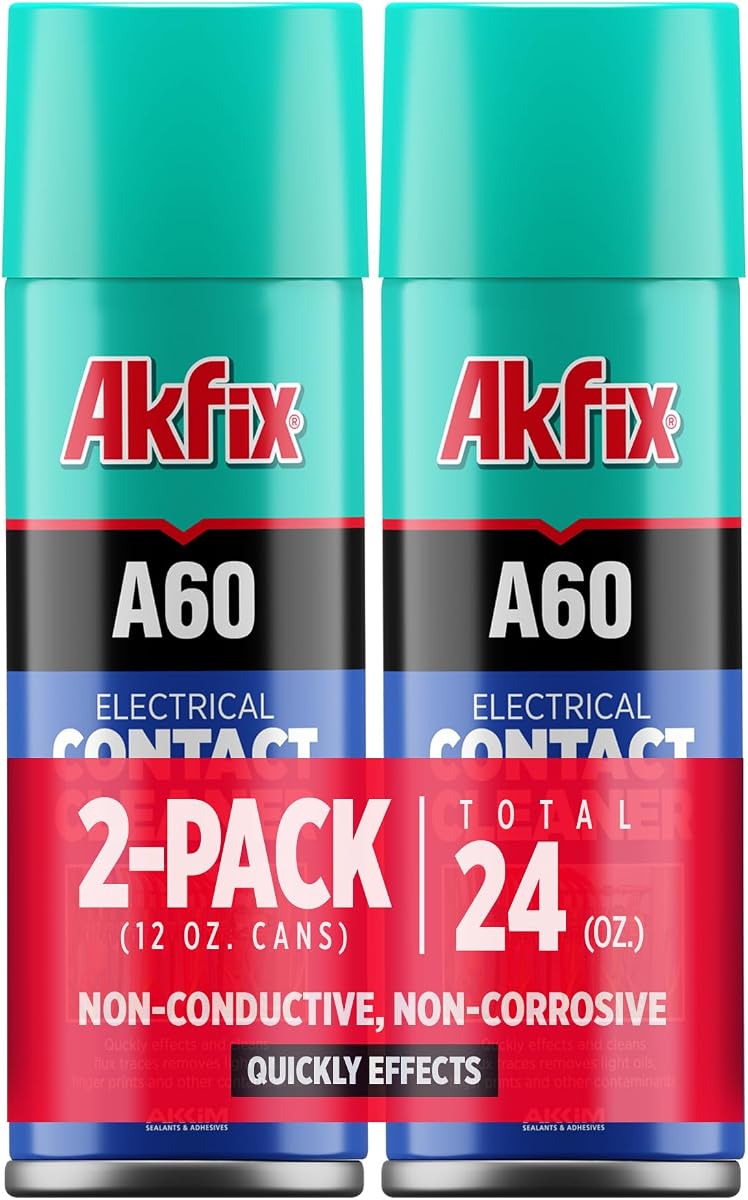
The Akfix A60 Electrical Contact Cleaner has a 4.5 rating and is supplied as two 12-ounce aerosol cans. The bundle format is practical for workshops or frequent maintenance work, providing more than one container for separate benches, storage locations, or extended use.
We may earn a commission when you buy through this link, at no additional cost to you.
The special formula is intended to evaporate swiftly and leave no residue while removing dirt, light oil, grease, flux, and dust. A non-corrosive approach is emphasized for connectors and contact parts, and the product is listed for computers, batteries, keyboards, and digital equipment as well as circuit boards and electronics.
The manufacturer's guidance still calls for testing on sensitive plastics and caution around adhesive-mounted or stressed parts. A fast-drying contact cleaner is not automatically suitable for every keyboard, display assembly, or enclosure, so the user's knowledge of the equipment remains important.
This is a compelling pick for technicians who perform repeated contact cleaning and prefer a two-can bundle. It combines several common contaminant targets, rapid evaporation, and a stated non-corrosive formula, while the packaging supports keeping a dedicated cleaner near more than one workspace.
Two individually sized aerosol cans make it easy to distribute the cleaner across work areas or keep one available for mobile repair work. The format is especially relevant to technicians who expect regular use rather than a single delicate cleaning job.
The stated non-corrosive formula focuses on preserving connector and contact efficiency while removing common contaminants. It is intended for electronics ranging from battery and digital equipment to full circuit boards.
We may earn a commission when you buy through this link, at no additional cost to you.
CRC QD Electronic Cleaner 05101 holds a 4.7 rating and offers the same core QD cleaning concept as the larger 11-ounce can in a compact 4.5-weight-ounce package. Its fast-evaporating, residue-free formula is described as plastic safe and suitable for sensitive electronics.
We may earn a commission when you buy through this link, at no additional cost to you.
The applications cover computer components, circuit breakers, circuits, contacts, sockets, relay switches, plugs, lighting, plastics, nylon, PVC, and more. Flux removal is also listed, giving the product a clear role in both routine contact maintenance and residue-related repair tasks.
The smaller container is the defining trade-off. It is easier to store in a compact tool bag and may be more practical for occasional service, but it will run through sooner than larger aerosol options. As with the 11-ounce version, the supplied information does not list a precision straw.
This is an excellent choice for mobile technicians and careful hobbyists who want a proven electronics-focused cleaner without carrying a large can. It combines a strong rating, rapid drying, residue-free performance, and explicit plastic-safe positioning in a convenient smaller format.
The smaller aerosol size is easy to organize alongside diagnostic tools, small screwdrivers, and other service equipment. It is a sensible option when portability and focused availability matter more than maximum container capacity.
From sockets and plugs to circuit breakers, relay switches, lighting, and computer components, the listed uses show substantial versatility. That range lets one cleaner address several types of electronic connections and housings.
We may earn a commission when you buy through this link, at no additional cost to you.
WD-40 Specialist Contact Cleaner Spray with Smart Straw earns a 4.7 rating and combines the familiar Specialist contact-cleaning formula with a two-can package. Each 11-ounce can offers a practical capacity for regular maintenance, while the Smart Straw provides a more directed way to reach contact points.
We may earn a commission when you buy through this link, at no additional cost to you.
The cleaner removes oil, dirt, flux residue, and condensation from sensitive electronics and electrical equipment. Its applications include printed circuit boards, controls, switches, precision instruments, and electric panels, so its use extends well beyond general household electronics.
Important cautions remain: test on plastic before use, and avoid adhesives, device screens, and keyboards. The two-can package may also be more than necessary for occasional cleaning, but it is well suited to shared benches, mobile repair kits, or technicians who regularly service electrical equipment.
For users who want both WD-40 Specialist Contact Cleaner and improved directional application, this twin pack is a strong choice. Its 4.7 rating, residue-free drying, contaminant coverage, and Smart Straw make it particularly suitable for controlled PCB and precision-instrument work.
The Smart Straw helps users direct cleaner into confined areas and toward specific electrical contacts. On populated boards, that added control can make it easier to treat the intended point without flooding surrounding components.
Two full-size cans are convenient for professional use because a cleaner can remain available at separate work locations. They also reduce the interruption of ordering another supply during a period of regular service.
We may earn a commission when you buy through this link, at no additional cost to you.
Electronic Contact Cleaner, Quick Drying, Deep Cleans and Protects, 8.5 Oz has a 5.0 rating, the highest numeric rating among the supplied products. It combines contact cleaning with a claim of long-lasting protective lubrication, giving it a broader maintenance profile than products described only as cleaning solutions.
We may earn a commission when you buy through this link, at no additional cost to you.
The included soft brush is intended to agitate stubborn dust, grease, flux, and rosin on delicate electronic surfaces. The formula is also presented as removing oxidation and built-up contaminants that impede electrical flow, supporting more stable and low-resistance connections between metal contacts and circuit paths.
Its fast-evaporating formula is said to dry within seconds without leaving moisture, streaks, or residue. Unlike basic contact cleaners, it also claims to deposit a thin protective film that reduces friction, guards against wear, and helps shield metal surfaces from future oxidation. Users should confirm whether any film is appropriate for a particular connector or mechanism.
This product is best suited to maintenance professionals or electronics enthusiasts who want cleaning and protection in one operation. Its perfect rating, brush-assisted workflow, broad component compatibility claims, and protective-film feature make it one of the most feature-focused options in the guide, though material-specific information is less detailed than for some established brands.
The formula does more than remove contamination; it is said to leave a thin lubricating film over metal surfaces. For exposed contacts that experience friction or recurring oxidation, this two-in-one maintenance approach may be especially useful.
The included soft brush gently agitates dust, grease, flux, and rosin without requiring a harsher tool. It gives the user a controlled way to work residue away while limiting mechanical abrasion around delicate components.
We may earn a commission when you buy through this link, at no additional cost to you.
Hosa CAIG Laboratories D5S-6 CAIG DeoxIT Contact Cleaner has a 4.7 rating and a focused product identity. It is explicitly a contact cleaner in a five-ounce container with a five-percent spray specification, offering a more specialized alternative to products marketed broadly as multi-surface electronic cleaners.
We may earn a commission when you buy through this link, at no additional cost to you.
Hosa is especially associated with professional audio and electrical maintenance, and the DeoxIT name is widely recognized within those fields. The compact spray format is useful for service kits where technicians want a dedicated contact treatment rather than a general aerosol for many chores.
The supplied product information is concise and does not state detailed contaminant targets, drying speed, plastic-compatibility limits, or whether residue is left behind. Buyers should therefore consult the current label and instructions before applying it to a particular board, display, keyboard, adhesive, or enclosure.
This product earns the premium pick for buyers who place priority on a specifically branded contact-cleaning solution rather than the broader feature sets of competing formulas. Its 4.7 rating, five-percent concentration, and compact professional format make it particularly attractive to audio technicians, installers, and experienced electronics users.
The product is named and marketed specifically as a contact cleaner rather than as a multipurpose household spray. That focus can be reassuring for technicians who want a dedicated treatment for connectors and electrical interfaces.
A five-ounce container is easy to carry and store, making this cleaner practical for mobile service work. Its smaller size may also encourage controlled use around individual contacts rather than broad application across an entire assembly.
We may earn a commission when you buy through this link, at no additional cost to you.
The right circuit board cleaner depends on the contaminants involved, board construction, working conditions, and how precisely you need to apply the product. The following factors help narrow the field before you buy.
A cleaner that dries quickly and leaves no residue is generally easier to use around live electronics, densely populated boards, and precision instruments. Residue can interfere with conductivity, collect dust, or create a new cleaning problem, while slow evaporation increases the amount of time the assembly must remain open and unattended.
Prioritize products explicitly described as fast-evaporating, quick-drying, or residue-free. These claims are especially valuable when the cleaned component will be powered soon afterward or when maintenance is performed in a busy workshop.
Different cleaning problems call for different formulations. Flux residue, light oil, grease, dust, condensation, and oxidation are not identical contaminants, so check whether the product expressly addresses the material found in the affected connector or component.
Products listing several targets are useful for general maintenance, while specialized products may be preferable when a known type of residue must be removed. A cleaner should not be selected merely because it sounds powerful; its intended contaminants should match the actual service need.
Circuit boards combine conductive metals, solder, coatings, adhesives, plastics, laminates, and sensitive semiconductors. Even a cleaner described as safe for electronics may have exceptions, so inspect the materials surrounding the connection before applying liquid or aerosol cleaner.
Look for explicit plastic-safe language, but follow the instruction to test a small area whenever the product listing recommends it. Avoid screens, keyboards, adhesives, and stressed components unless the manufacturer specifically approves them.
Precision matters when a board is crowded, a connector is recessed, or liquid could migrate toward a sensitive component. Aerosols with extension straws or smart-straw attachments offer directional delivery, while brush-equipped products can provide closer control over the treated area.
Match the applicator to the job. A broad spray is efficient for accessible contacts, a straw is helpful in confined spaces, and a soft brush can agitate stubborn residue without directing a large amount of liquid at once.
Small aerosols are convenient for mobile tool kits and occasional cleaning, while larger cans and two-can bundles suit frequent maintenance. Non-aerosol containers may appeal to users who prefer direct application, although the supplied products provide fewer details about included accessories in some cases.
Consider both storage and frequency of use. Carrying a large can for a single task adds unnecessary bulk, whereas a compact bottle may run out during intensive service. Availability and portion size should match the volume of work expected.
Some contact cleaners focus only on removing contaminants, while others claim to leave a lubricating or protective film. Added protection may help exposed metal contacts resist friction and future oxidation, but it is not automatically desirable for every connector, switch, sensor, or assembly.
Choose a protective formula when the manufacturer identifies the product for the exact contact type. If residue-free cleaning is the priority, verify whether the product's protective film conflicts with that goal or requires additional process steps.
The safest workflow begins with the manufacturer's instructions, including ventilation, distance, test area, and material restrictions. The products in this roundup include aerosol formats, and several listings specifically instruct users to avoid screens, keyboards, adhesives, or sensitive plastics.
Use controlled bursts, keep the nozzle directed away from nearby components, and allow the product to dry before reassembly or energization. If the device is powered down, disconnected, or otherwise prepared according to its service documentation, the risk of spreading contamination is easier to control.
Professional repair work often prioritizes consistent delivery, easy availability, specialized application, and enough supply for repeated jobs. Hobbyist and occasional users may prioritize a compact container, easy availability, and enough guidance for safe application on a familiar board.
The highest customer rating is not the only criterion. A well-matched cleaner with appropriate warnings and an applicator suited to the task can be more valuable than a broadly popular option that does not fit the materials or precision required.
Begin by identifying the contaminant and the materials around the affected contact. Disconnect or power down the equipment according to its service guidance, and move nearby components that could be affected by overspray. Test the cleaner on a small, inconspicuous area whenever plastic compatibility is uncertain.
Choose the application method that matches the product. Shake an aerosol as directed, use short controlled bursts, and aim a supplied straw directly at the contaminated contact when precision matters. For brush-equipped products, apply a small amount to the target area, agitate gently with the included brush, and wipe with a suitable lint-free material.
Allow the cleaner to evaporate fully before reassembly or energization. Inspect the contact for remaining contamination, verify that no visible residue or liquid remains, and reconnect the equipment only when the assembly is dry. Store the container upright as directed, keep it away from heat or ignition sources as applicable, and consult the label for disposal and handling guidance.
The safest approach is to power down and disconnect the circuit board before cleaning. Aerosol and liquid cleaners can spread across the board, and volatile spray may create electrical or handling risks around energized components. If service documentation gives different instructions, follow the manufacturer's procedure and the cleaner's label.
Not necessarily. A contact cleaner is formulated to remove contamination from electrical interfaces and often emphasizes fast evaporation and low or no residue. General-purpose lubricants may leave a film and are not automatically appropriate for connectors, switches, sensors, or other devices that require clean electrical contact.
Several products in the guide specifically list flux residue or flux removal among their uses. Whether they are suitable depends on the flux type and the board materials, and a cleaner may remove surface residue without replacing more specialized chemical cleaning for heavily contaminated or visibly corroded assemblies.
Yes, whenever the manufacturer or product listing recommends it. Circuit-board housings, connectors, buttons, and nearby covers may use plastics such as ABS, PS, or PC that can discolor, craze, or otherwise react. A small hidden-area test helps confirm compatibility before full application.
No. A non-flammable formula addresses one safety characteristic but does not make the product compatible with every material or application. Users must still follow handling instructions, avoid unsupported surfaces, provide appropriate ventilation, and control overspray around sensitive components.
Cleaning may improve a connection when contamination or oxidation is the primary cause, but it cannot repair worn, bent, corroded-through, or otherwise damaged contacts. If the problem persists after cleaning and the manufacturer permits further inspection, the connector, switch, or board may need replacement or professional repair.
An aerosol is convenient for reaching many areas quickly and can cover recessed contacts, although overspray must be controlled. A brush-applied product gives the user more direct control over the target and may include a soft tool for agitating residue, making it useful when the board is crowded or liquid placement matters.
Let the board dry completely, inspect for remaining residue, and reconnect or power it only when no liquid or visible film remains. Use clean, lint-free handling practices and avoid touching contacts with fingers or contaminated tools. If the cleaner includes protection claims, confirm that the deposited film is appropriate for the connection.
CRC 05103 QD Electronic Cleaner is the strongest all-around choice because it combines a 4.8 rating with rapid evaporation, residue-free performance, and broad support for circuit boards, contacts, sockets, switches, and other electronics. WD-40 Specialist Contact Cleaner delivers similarly strong value for users focused on oil, dirt, flux, and condensation, while Hosa CAIG DeoxIT provides a compact specialist option for contact maintenance.
Prioritize the contaminant, material compatibility, drying behavior, and delivery method that match the actual repair. A brush may offer better local control, a straw may help in confined areas, and a two-can bundle may suit frequent professional work. Always read the current instructions and avoid screens, keyboards, adhesives, and unverified plastics.
Ratings, product details, availability, and prices can change, so check the current listing before purchasing. Comparing the supplied characteristics against the job at hand will help you select a circuit board cleaner that is effective, compatible, and convenient for your maintenance setup.