
Pyle PLMRMB4CB
3.9Editor score
Four independently controlled channels
Compact low-profile marine design
Remote head-unit turn-on
Discover the best compact marine amplifier options, comparing power, channel count, marine protection, connectivity, and installation flexibility.
A compact marine amplifier should provide enough clean power for boat speakers without consuming valuable space in a console, storage compartment, or transom area. The right model also needs marine-oriented protection, dependable connections, and a form factor suited to the demands of life on the water.
We compared all ten products by examining channel configuration, power ratings, marine and weather protection, signal inputs, crossover controls, mounting considerations, and source integration. The list covers traditional four-channel units, dedicated monoblock bass amplification, wireless systems, and highly compact Class D models.
Each pick highlights a different reason to consider it, from budget-friendly four-channel amplification to sealed monoblock construction and advanced crossover flexibility. Product ratings reflect the supplied marketplace feedback, while prices and availability can change, so verify current details before purchasing.
3.9Editor score

4.2Editor score

4.0Editor score
The table below compares the ten amplifiers by channel layout, power, marine protection, and the control features most relevant to compact boat installations.



The Pyle Hydra Marine PLMRA402 is a four-channel marine amplifier rated at 100 watts maximum per channel and 400 watts overall maximum output. It holds a 4.0 rating and offers a useful combination of independent amplification, familiar source connections, and a compact four-channel layout for boat installations.
We may earn a commission when you buy through this link, at no additional cost to you.
Its dual MOSFET power supply, aluminum alloy heatsink, and thermal-overload and speaker-short protection form the core of the design. The amplifier accepts premium RCA stereo inputs as well as high-level speaker-output leads, making it adaptable to head units with or without RCA jacks. Adjustable gain controls cover a 1–300mV input range, while 4- and 8-ohm speaker impedance options broaden speaker compatibility.
The main tradeoff is its IP-01 marine rating. The manufacturer describes it as waterproof ready, but it does not offer the sealed enclosure or higher ingress ratings found with the KENWOOD monoblock or DS18 model. It also lacks a documented Bluetooth receiver, so modern devices still require a wired source connection.
This is a strong choice for boat owners who need four channels, flexible input options, and straightforward short-circuit protection without moving to a larger network amplifier. It is especially relevant for conventional marine head-unit systems where separate bow, stern, port, and starboard speakers need individual amplification.
RCA inputs provide a direct route from a conventional marine receiver, while the high-level terminals allow integration with a head unit that offers only speaker outputs. This versatility can simplify system planning without adding another signal converter.
The aluminum heatsink, short-circuit protection, LED indicator, and gold-plated output terminals address common marine installation concerns. For exposed areas, careful sealing and cable management remain important parts of a reliable setup.
We may earn a commission when you buy through this link, at no additional cost to you.
The KENWOOD KAC-M5001 is a compact monoblock Class D amplifier made specifically for subwoofers in cars, boats, and outdoor audio systems. It carries a 4.0 rating and provides up to 600 watts maximum power, including 300 watts RMS at 2 ohms and 200 watts RMS at 4 ohms.
We may earn a commission when you buy through this link, at no additional cost to you.
Its most compelling feature is the sealed construction, which is designed to resist water intrusion better than an amplifier with only a coated exterior. The chassis carries IP67 and IP66 waterproof and dust protection, can withstand submersion up to 3.3 feet for 30 minutes, and has been tested to ASTM B117 salt-spray standards. A rugged die-cast aluminum body further supports its suitability for demanding installations.
Polymer multilayer capacitors in the LC filter circuits are intended to reduce distortion, while magnetically shielded output coils help limit radiated noise. Speaker-level input, signal-sensing turn-on, RCA connectivity, LPF frequency adjustment, bass boost selection, and a wired waterproof level control provide installation flexibility. As a monoblock, it is not intended to replace a four-channel full-range amplifier.
This model fits best when the priority is dedicated, controlled bass in a demanding marine environment. A boat owner seeking the strongest sealed weather protection in this group should give it particular attention, especially if the amplifier will be mounted in a splash-prone compartment.
The fully sealed approach, high ingress ratings, corrosion testing, and die-cast chassis distinguish this amplifier from conventional coated designs. Those qualities are especially valuable where spray, humidity, and occasional water exposure are difficult to avoid.
The adjustable low-pass filter, selectable bass boost, RCA inputs, speaker-level input, and included waterproof level control let an installer tune the subwoofer system and adjust it from a convenient remote location.
We may earn a commission when you buy through this link, at no additional cost to you.
The NVX VADM4 v2 combines four-channel capability with one of the smallest footprints in this roundup. It measures 6.49 by 3.3 by 1.48 inches and has a 4.2 rating. Its compact Micro Class D design delivers RMS output from 80 watts per channel at 4 ohms to 125 watts per channel at 2 ohms.
We may earn a commission when you buy through this link, at no additional cost to you.
The conformal-coated marine-grade circuit board is designed for use in marine vessels and powersports vehicles. Balanced differential and low-level RCA inputs support integration with existing systems, while LED power and protection indicators provide at-a-glance status. Four-way protection covers thermal overload, speaker shorts, and DC offset concerns.
Crossover control is unusually flexible for a compact amplifier. FULL, HPF, and LPF modes are available, with variable filters spanning 40–400 Hz. That allows separate high-pass or low-pass assignments depending on the speakers connected to each channel, although the correct speaker impedance and configuration must be maintained.
This is the ideal pick when available space is exceptionally limited but four channels of clean, usable power remain necessary. Its combination of compact dimensions, marine-oriented construction, and granular crossover settings makes it a particularly versatile choice for modern boat audio systems.
Measuring only 6.49 inches in length, the VADM4 v2 is well suited to tight compartments, small electronics lockers, and installations where every inch of usable space matters.
FULL, HPF, and LPF modes offer a practical way to assign different frequency ranges across a multi-zone speaker system. Variable filtering from 40–400 Hz provides finer control over the transition between drivers.
We may earn a commission when you buy through this link, at no additional cost to you.
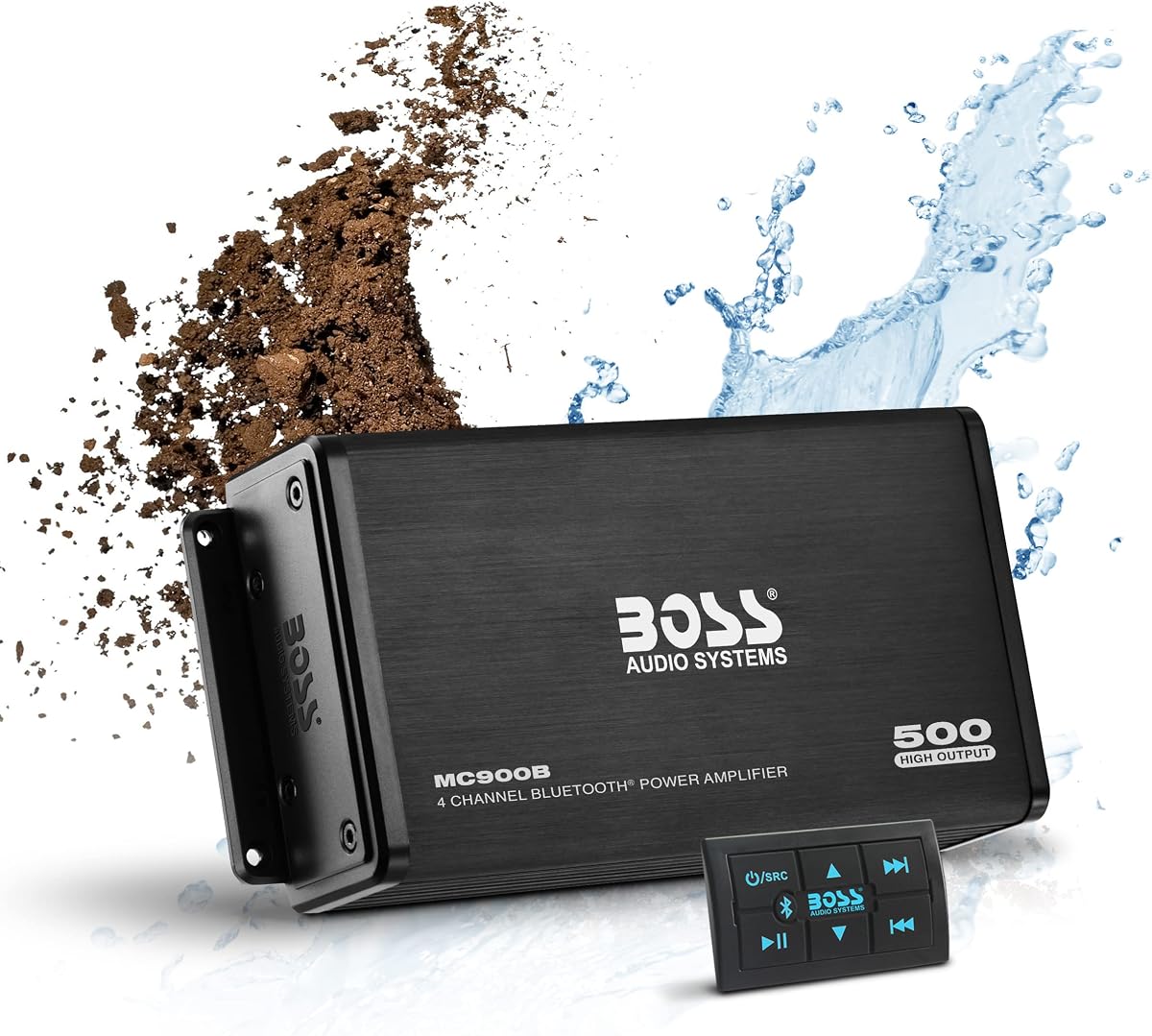
The BOSS Audio Systems MC900B is a four-channel, full-range marine amplifier with a 4.2 rating. It is designed for boats and ATVs and can operate without a conventional head unit because its included Bluetooth remote handles wireless audio streaming.
We may earn a commission when you buy through this link, at no additional cost to you.
The remote is compatible with smartphone audio output and MP3 players, and its three-color LED indicator identifies the active source. A USB charging port is also included. The amplifier produces 125 watts maximum per channel at 4 ohms and 94 watts RMS per channel, with dimensions of 1.75 by 6.6 by 1.75 inches.
Its key limitation is the description of the weather resistance as handling some light weather conditions. It is therefore not as comprehensively sealed as the KENWOOD or rated to IPX67 like the DS18. As a Class AB amplifier, it also follows a less space-efficient design philosophy than the compact Class D models in the list.
This amplifier is most convenient for owners who want music without installing a full marine head unit. The included remote makes the system approachable, while four-channel and full-range capability provide more flexibility than a basic two-channel Bluetooth unit.
The included Bluetooth remote allows a phone or MP3 player to become the central music source. This reduces the need for a permanent marine display while retaining convenient volume and playback control.
At just over six inches long, the MC900B accommodates full-range amplification without taking up excessive space. It can serve conventional speakers as well as compatible subwoofers, depending on the installation configuration.
We may earn a commission when you buy through this link, at no additional cost to you.
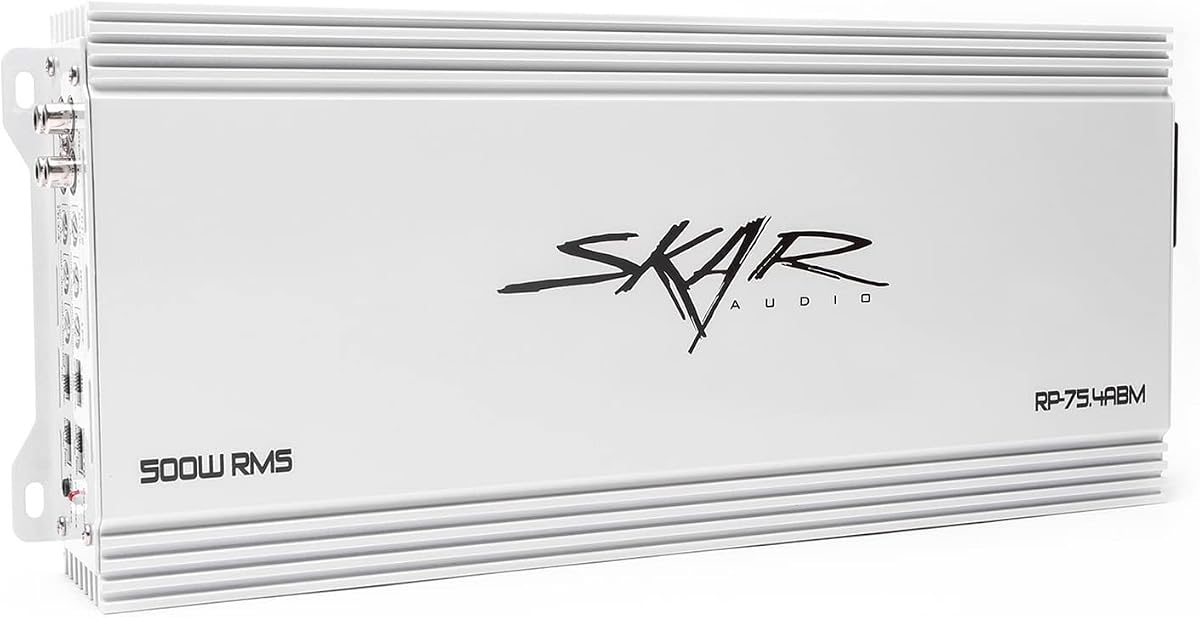
The Skar Audio RP-75.4ABM is a 500-watt, four-channel Class A/B marine amplifier that holds a 4.5 rating, the highest rating among the supplied products. It supplies 75 watts RMS per channel at 4 ohms and 125 watts RMS per channel at 2 ohms.
We may earn a commission when you buy through this link, at no additional cost to you.
Its user-adjustable controls include gain, variable low-pass and high-pass filters, and a bass EQ switch with 0, +6, and +12 dB positions. Four-way protection circuitry and large power and ground terminals are intended to support dependable operation and current flow. The circuit board has a waterproof coating, while the mechanical case uses rust-resistant paint.
The 105 dB signal-to-noise ratio is another notable specification. Compared with the micro Class D models, however, a Class A/B architecture generally presents a different space trade-off, making it most attractive to installers who prioritize this conventional design and its control set.
This amplifier suits a boat with four full-range zones and a preference for detailed manual tuning. Its rating, filtering options, and bass adjustment make it a strong general-purpose marine choice when compactness is desirable but not limited to the smallest possible enclosure.
Adjustable gain, separate high-pass and low-pass filters, and three bass EQ positions provide broad control over how the amplifier drives different speaker zones. This is useful for builds with dedicated drivers or carefully matched speaker pairs.
A waterproof-coated circuit board and rust-resistant case treatment acknowledge the moisture and salt exposure associated with marine use. These measures support longevity, although they do not make the amplifier fully sealed.
We may earn a commission when you buy through this link, at no additional cost to you.
The Pyle PLMRMB4CB is a four-channel marine amplifier designed around independent speaker-zone control. Its 3.9 rating reflects a solid marketplace reception, while the listed 200-watt figure and independent channels position it as a flexible multi-zone amplifier.
We may earn a commission when you buy through this link, at no additional cost to you.
The major benefit is that bow, stern, port, and starboard speakers can operate on separate channels rather than sharing a two-channel arrangement. The brushed aluminum housing is designed to resist heat, moisture, and vibration, while the low-profile enclosure supports mounting under consoles, inside storage compartments, or on transom walls.
A blue 12VDC remote turn-on wire allows the amplifier to power and shut down with the head unit, reducing unnecessary battery drain. Red, black, and blue color coding simplifies identification during installation. The product title mentions Bluetooth wireless audio streaming, but the supplied feature list does not detail the wireless control method, so buyers should confirm that functionality in the current listing.
This model is most appealing to multi-zone boat owners who want individual control without a larger amplifier. It also offers useful automatic shutdown and a clean compact enclosure, although its rating is lower than several alternatives in this comparison.
Four independent channels allow separate level and crossover adjustments for different areas of the boat. This flexibility is valuable when bow and stern speakers need distinct settings or when the system includes more than two speaker groups.
The remote turn-on connection helps the amplifier follow the head unit's operating state. Color-coded leads also reduce confusion, although proper fusing, grounding, and marine-safe wire routing remain the installer's responsibility.
We may earn a commission when you buy through this link, at no additional cost to you.
The Pyle Hydra PLMRA200 is a two-channel, bridgeable marine amplifier with a 4.0 rating. It provides 400 watts maximum output and is aimed at straightforward stereo reproduction, making it a natural fit for a smaller speaker system or a secondary installation.
We may earn a commission when you buy through this link, at no additional cost to you.
Premium RCA stereo inputs are accompanied by high-level terminals for head units without RCA outputs. Dual adjustable gain controls, an aluminum alloy heatsink, thermal-overload protection, speaker-short protection, and an LED indicator provide a familiar feature set. Gold-plated speaker output terminals are designed to resist corrosion over time.
The amplifier carries an IP-01 marine rating and is described as waterproof ready, but it is not fully sealed like the KENWOOD model. Its two-channel arrangement also means it cannot independently control four speaker locations unless deployed in a more limited configuration.
Choose the PLMRA200 when a simple stereo source and pair of speakers are the priorities. It delivers a compact, approachable option without requiring a wireless controller or advanced crossover menu, making it useful for smaller boats and uncomplicated audio layouts.
The amplifier can accept either conventional RCA stereo signals or high-level speaker-output connections. That flexibility makes it easier to reuse an existing marine head unit without replacing the entire source unit.
An aluminum heatsink, short and thermal protection, status LED, and corrosion-resistant output terminals address several practical concerns. Installation remains most reliable when the enclosure and connections are protected from standing water and direct exposure.
We may earn a commission when you buy through this link, at no additional cost to you.
The DS18 NXL-N2 is an ultra-compact, two-channel Class D marine amplifier with a 4.1 rating. Its listed output includes a maximum of 900 watts, 150 watts RMS per channel at 2 ohms, and 100 watts RMS per channel at 4 ohms.
We may earn a commission when you buy through this link, at no additional cost to you.
The IPX67 waterproof rating and stable four-layer PCB layout position it for boats, ATVs, UTVs, and other outdoor environments. Its compact Class D construction makes it practical where installation space is scarce, and its full-range capability allows the amplifier to handle different speaker types, including mids, tweeters, and compatible subwoofers.
HPF, LPF, and FULL crossover modes allow an installer to tailor the output to different driver arrangements. The lack of a wireless source is the clearest limitation for buyers who want a modern Bluetooth-ready system without a head unit. Otherwise, the model focuses on rugged power and flexible speaker control.
The NXL-N2 is a strong recommendation for compact installations that require high ingress protection and useful crossover options. It is especially relevant to owners who already have a conventional source unit and need durable, space-efficient two-channel amplification.
An IPX67 rating supports use in wet outdoor environments, while the four-layer PCB design is intended to maintain stable performance under mobile and powersports conditions.
The two-channel full-range design can serve different kinds of speakers, and selectable crossover modes help match their frequency needs. This makes the amplifier suitable for both standard music systems and specialized multi-driver arrangements.
We may earn a commission when you buy through this link, at no additional cost to you.
The Marine Bluetooth Amplifier is a four-channel Class D unit designed for hidden installations in boats, golf carts, motorcycles, and UTVs. It has a 4.2 rating and supplies 60 watts per channel, making it better suited to moderate-output speaker packages than the higher-power amplifiers in the roundup.
We may earn a commission when you buy through this link, at no additional cost to you.
A three-meter wired remote includes a three-color LED indicator for USB, auxiliary, and Bluetooth sources. The controller and S-terminal connector are positioned for a compact installation where the main amplifier can be concealed while essential controls remain accessible. The remote also supports direct smartphone audio output.
The critical installation detail is the warning to keep the remote cable connection tight. A loose connection could interrupt control or create reliability issues, so the supplied connector should be securely seated and protected from movement.
This product is ideal for a simple, tidy installation where wireless music and discreet hardware matter more than maximum power. It is a straightforward option for smaller speaker systems, while buyers seeking stronger output should consider one of the higher-RMS four-channel models.
Bluetooth streaming removes the need for a conventional head unit, while the wired controller keeps essential adjustments within reach. Its LED indicator makes the selected USB, auxiliary, or Bluetooth source easy to identify.
Separating the amplifier from the controller allows the larger electronics component to be placed out of sight. That arrangement is useful under seats, inside storage areas, and within other concealed marine compartments.
We may earn a commission when you buy through this link, at no additional cost to you.
The Pyle Hydra PLMRMP3B is a compact four-channel marine micro amplifier that has a 3.7 rating, the lowest listed rating in this group. It is designed for boat and vehicle use and includes both RCA stereo input and a 3.5mm connection path for compatible mobile devices and MP3 sources.
We may earn a commission when you buy through this link, at no additional cost to you.
An included 3.5mm-to-RCA adapter makes it easier to connect a phone or another line-level source, and a remote is included for volume control. Adjustable input gain supports source matching, while built-in power protection and soft turn-on and turn-off functions are intended to protect the amplifier and vehicle electrical system.
Its headline 800-watt figure describes maximum power rather than continuous RMS output. Buyers should therefore focus on their actual speaker requirements and wiring rather than treating that number as a sustained output target. The four-channel layout remains useful for zone control, but the amplifier offers fewer documented tuning features than several rivals.
The PLMRMP3B makes sense for a simple installation where compact size, four channels, and direct device connectivity matter. Its simple feature set and lower rating make it less compelling for advanced systems, but it remains a functional option for basic marine audio.
RCA inputs, a 3.5mm-to-RCA adapter, and the included remote volume control give owners a direct way to play music from compatible phones or MP3 devices without necessarily adding a separate marine head unit.
Soft turn-on and turn-off behavior is intended to reduce abrupt electrical events, while the built-in protection circuitry adds a safeguard against power-related problems. Proper installation still requires suitable fusing and secure connections.
We may earn a commission when you buy through this link, at no additional cost to you.
The best compact marine amplifier for a boat balances usable power, environmental protection, connection options, accurate controls, and an enclosure that fits the available installation space.
Begin with the compartment where the amplifier will live, not just the product dimensions. Measure the available length, width, and height while allowing room for cables, mounting brackets, airflow, access to terminals, and the lid or cover. A model that fits perfectly on paper can still be difficult to service if its connections face into a tight wall or the enclosure is buried beneath other equipment. Micro Class D models are especially attractive for hidden installations, while conventional Class A/B designs may need more depth and ventilation space.
Count the speaker zones you actually intend to amplify. A four-channel amplifier offers independent control for bow, stern, port, and starboard positions, while a two-channel model is usually adequate for one matched pair. A monoblock serves a different purpose: it is designed to drive a subwoofer and may need to be paired with a separate full-range amplifier. Independent channels are useful when different areas need different gain or crossover settings, but they are not a substitute for choosing the correct number of outputs for the system.
Peak and maximum wattage figures describe different operating conditions from continuous RMS output. Compare RMS power at the impedance of the speakers you intend to use, because the same amplifier can produce different output at 2, 4, and 8 ohms. The NVX, DS18, KENWOOD, Skar Audio, and BOSS products provide specific RMS or maximum-per-channel figures, while some Pyle listings emphasize overall maximum output. A headline peak number should not replace speaker-level requirements, impedance limits, and realistic continuous-output expectations.
Marine protection ranges from a waterproof-coated circuit board to a fully sealed enclosure with a high ingress rating. The KENWOOD KAC-M5001 uses sealed construction and carries IP67 and IP66 ratings, while the DS18 NXL-N2 is rated IPX67. Coated models may be appropriate in protected compartments, but exposed installations benefit from stronger protection. Also consider corrosion-resistant terminals, salt-spray resistance, and whether the amplifier will sit where standing water, spray, or UV exposure can reach it.
The amplifier must accept the signal available from the boat's head unit. RCA inputs provide a direct, low-level connection, while high-level or speaker-level inputs allow integration with a source that lacks RCA outputs. The Pyle PLMRA402 and PLMRA200 support both types, and the KENWOOD includes speaker-level input for flexible setup. If the priority is streaming from a phone without a permanent head unit, the BOSS MC900B and the dedicated Marine Bluetooth amplifier are more directly oriented toward wireless playback.
Full-range amplifiers can reproduce music across a wide frequency range, but crossover controls determine which frequencies reach each driver. Variable high-pass and low-pass filters are valuable when a dedicated subwoofer or separate tweeters are part of the design. The NVX offers FULL, HPF, and LPF modes with 40–400 Hz adjustment, the Skar Audio includes variable filters and bass EQ, and the KENWOOD focuses on low-pass and bass boost for subwoofer use. Match the controls to the speaker layout rather than paying for complexity that will remain unused.
Short-circuit and thermal protection are important, but they work best alongside correct wiring, secure terminals, and properly sized power connections. Four-way protection is listed for the NVX and Skar Audio models, while thermal and speaker-short protection appear in the Pyle Hydra specifications. Large-gauge power and ground terminals are helpful for current flow, yet they do not replace sound electrical workmanship. Make sure the amplifier is properly fused close to the battery and grounded according to the boat's electrical system.
Bluetooth control can simplify a boat by eliminating a permanent head unit, but it is not automatically better for every system. The BOSS MC900B includes a Bluetooth remote, and the dedicated four-channel Bluetooth amplifier supports USB, auxiliary, and Bluetooth sources through its wired controller. Conventional RCA-based amplifiers often integrate more cleanly with an existing marine head unit and can offer lower-latency wired control. Decide whether a discreet, wireless-centered installation or a traditional integrated audio system best fits the boat.
Plan the installation before connecting speakers. Identify the amplifier's input connections, speaker outputs, power input, remote turn-on lead, and any crossover controls. Match speaker impedance to the amplifier's supported range, keep power and signal cables properly separated, and confirm that the enclosure has enough space for heat dissipation and future maintenance.
Connect the source using the appropriate RCA, high-level, auxiliary, 3.5mm, or Bluetooth method. Set gain conservatively before adding heavy volume, and use the high-pass, low-pass, full-range, or bass controls to match the connected drivers. With a remote level control, establish a comfortable position and avoid abrupt increases that could expose distortion or excessive output.
Marine care includes checking connections after the first outing, keeping terminals clean and secure, and preventing water, sand, salt, and direct sunlight from accumulating on the enclosure. If the amplifier is exposed to salt spray, rinse it with fresh water when appropriate and dry it thoroughly. Inspect the wiring and mounting regularly, especially after rough transport or changes to the boat's electrical system.
The most important feature depends on the installation location. A fully sealed amplifier with a strong ingress rating is valuable in exposed or splash-prone compartments, while a conventional coated model may be sufficient in a protected enclosure. Channel count, continuous output, source compatibility, and crossover controls should then be matched to the boat's speaker system.
Class D amplifiers are often more compact and efficient, which makes them attractive when installation space is limited. Class AB designs may fit a different set of sound-system and installation preferences. The better choice depends on enclosure space, output needs, thermal considerations, controls, and the protection required for the mounting area.
Only if you need four independently controlled speaker zones or more total output than a two-channel model can provide. A basic stereo installation may work with two channels, while a dedicated subwoofer system may call for a separate monoblock. Counting the speakers and deciding which zones need independent settings is the best starting point.
Some can, but the model and wiring must be designed for the job. The KENWOOD KAC-M5001 is a dedicated Class D monoblock for subwoofers, with low-pass and bass controls. The DS18 NXL-N2 and the BOSS MC900B also support lower-frequency configurations, but their power delivery and channel arrangements differ, so speaker impedance and crossover requirements should be checked carefully.
IPX67 indicates protection against dust ingress and temporary immersion in water under the specified test conditions. It does not mean the amplifier can remain submerged or withstand every possible marine condition. It should still be installed according to the manufacturer's instructions, with connections secure and the enclosure positioned away from locations where constant standing water is expected.
A Bluetooth amplifier can reduce complexity by letting a phone act as the main source and providing a remote controller. This works well for simple systems and hidden installations. Boats with a more elaborate marine head unit, multiple source zones, or a preference for integrated system control may receive a more consistent result from conventional RCA-connected amplification.
Choose the amplifier by comparing each speaker's continuous or RMS power requirement with the amplifier's clean RMS output at the planned impedance. Avoid relying on peak or maximum ratings, and do not assume a higher headline wattage always produces better results. The number of speakers, enclosure design, sensitivity, and desired listening level all influence the appropriate match.
Proper installation requires attention to polarity, grounding, fusing, speaker impedance, cable routing, and moisture exposure. Some manufacturers encourage professional installation, particularly for higher-power or complex systems. If you are unfamiliar with marine electrical systems, having an experienced installer inspect the setup can help prevent faults and improve reliability.
The Pyle PLMRMB4CB stands out as the best budget-oriented choice because it combines four independent channels, a low-profile housing, and automatic head-unit shutdown. The NVX VADM4 v2 earns the Editor's Choice designation for its exceptionally compact enclosure, four-channel output, marine-coated board, and flexible crossover modes, while the KENWOOD KAC-M5001 is the premium pick for sealed construction and dedicated subwoofer amplification.
Before choosing, prioritize the protection level required by the actual mounting location, then confirm that the amplifier supplies enough continuous output for the connected speakers. Channel layout, input method, crossover needs, and service access are just as important as compact dimensions or maximum-wattage claims.
Finally, verify the current product listing, included accessories, specifications, ratings, and price before ordering. Marine electronics and installation conditions vary, and both product offerings and marketplace feedback can change. Matching the amplifier to the boat's layout, speakers, source equipment, and exposure level remains the surest route to a successful installation.