
50W Reptile Heat Lamp
4.4Editor score
50W infrared heat output
Non-light night heating
Two-bulb backup pack
E26-compatible ceramic base
Our Ceramic Heat Emitter Bulbs guide compares wattage, heat-up speed, light output, durability, safety features, and ideal uses for reptiles and pets at home.
Ceramic heat emitter bulbs create radiant heat without visible light, making them useful for reptiles, amphibians, incubators, and brooders that need steady warmth. A dependable model should pair the correct wattage with a suitable fixture, provide consistent heat, and operate without disrupting an animal’s natural sleep cycle or day-and-night routine.
This guide compares ten ceramic heat emitter bulbs across wattage, heating speed, light emission, construction, expected lifespan, fixture compatibility, and intended applications. It includes compact 25W and 50W options, versatile 60W and 100W models, and high-output 150W and 250W bulbs for larger enclosures or broader heat coverage.
Each pick highlights the features that matter most for a particular setup, from overnight heating and humidity-compatible ceramic construction to multipack convenience and temperature-control compatibility. Ratings and specifications reflect the available product information, while current prices and availability can change at any time.
4.4Editor score
4.6Editor score

4.4Editor score
The comparison below places all ten options side by side, showing the principal differences in power, light emission, ceramic construction, heating performance, pack quantity, and intended use. The most suitable choice is the model whose output and safety requirements match the enclosure, fixture, and animal rather than simply the highest-wattage option available.




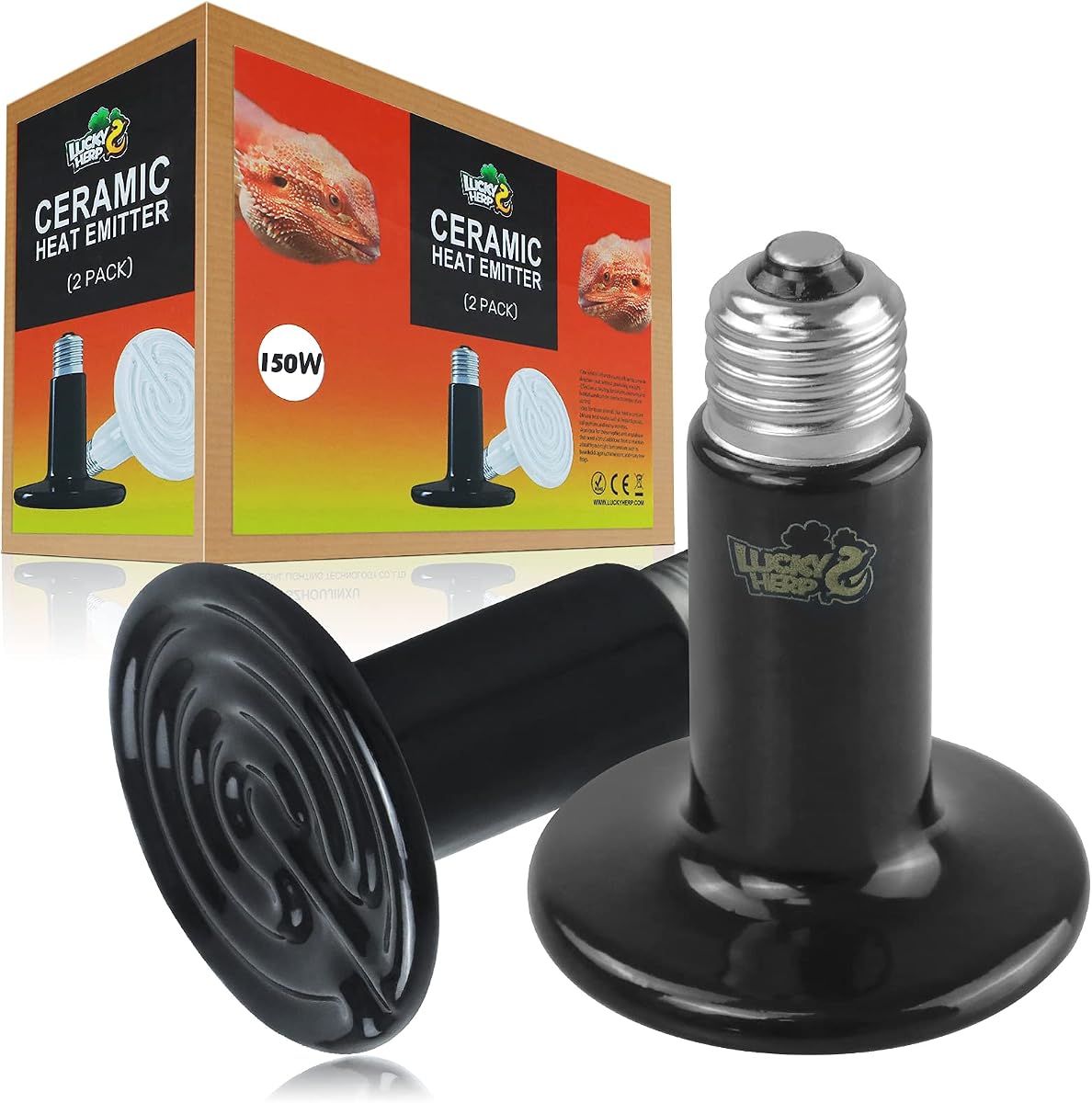
The LUCKY HERP 150W Ceramic Heat Emitter is a high-output, non-light-emitting option rated 4.6 out of 5 by customers. It is designed for reptile and amphibian enclosures, poultry brooders, and other heated spaces where a visible lamp would be undesirable. Its two-bulb configuration also gives keepers a spare or a way to divide heating across separate zones.
We may earn a commission when you buy through this link, at no additional cost to you.
Its most useful feature is the combination of fast warmup and steady radiant heat. The product information states that a noticeable temperature increase can occur within 10 seconds and that the emitter reaches its rated temperature in approximately four minutes. Thick special ceramic is used for the shell, and the stated lifespan is up to 10,000 hours. It works with a standard E26 socket on 120 volts.
The tradeoff is that 150W is a substantial heat load, so the fixture and enclosure must be designed for it. The listed safety guidance calls for a quality ceramic lamp holder and more than 30 centimeters of clearance from reptiles. It also warns against switching the bulb off and immediately turning it back on, or cycling it frequently, because repeated abrupt starts and the high surface temperature can shorten working life.
This is a strong choice for an owner seeking substantial, rapid, light-free warmth without moving beyond the widely used E26 format. It is especially relevant for reptiles, amphibians, chicks, dogs, and cats that need a dependable thermal zone. Buyers should pair it with a properly rated ceramic fixture, allow the specified clearance, and monitor the enclosure rather than assuming one wattage works for every habitat.
The advertised four-minute warmup makes this emitter useful when an enclosure needs a quick thermal adjustment. It provides radiant warmth without adding visible light during nighttime heating.
The thick ceramic shell is built for repeated heating in environments where ordinary bulbs may be less durable. A quality ceramic holder remains essential because the socket and wiring must tolerate the unit's high operating temperature.
We may earn a commission when you buy through this link, at no additional cost to you.
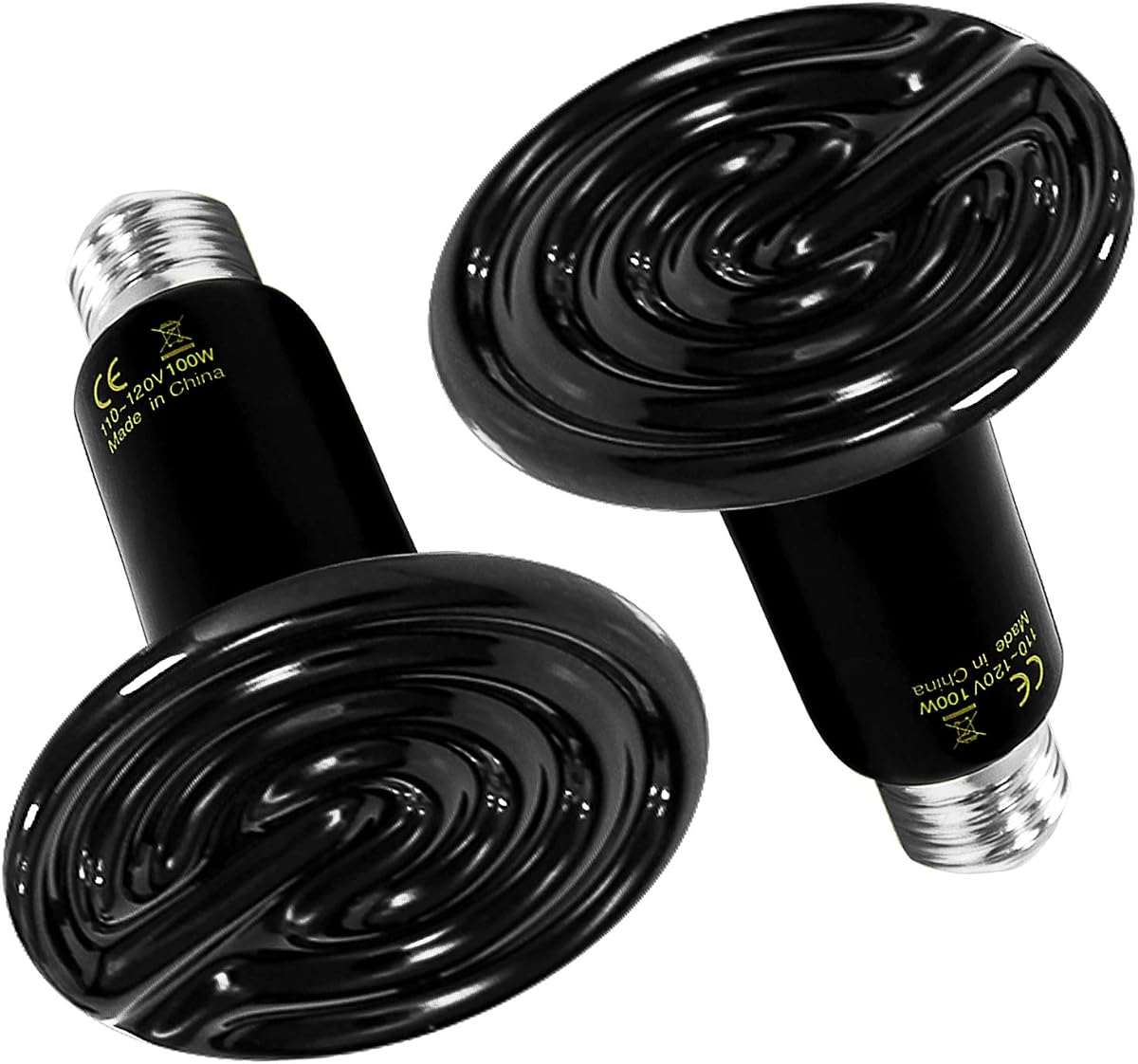
The 50W Reptile Heat Lamp is a compact, non-light-emitting ceramic emitter with a 4.4 rating. It is intended for terrariums, brooders, incubators, and habitats for turtles, lizards, bearded dragons, snakes, birds, amphibians, chicks, and other small animals. The pair provides backup coverage or the option to establish two separate heat zones.
We may earn a commission when you buy through this link, at no additional cost to you.
Its defining advantage is restrained power output combined with continuous infrared heating. The product uses industrial-grade ceramic and a pure tungsten filament, with the listing stating that it lasts five times longer than standard bulbs and reduces energy costs by 30%. It can operate day and night without emitting light that would interfere with an animal's photoperiod or sleep cycle.
That lower output is also the main limitation. A 50W emitter may be better suited to smaller or more compact environments than a large habitat needing a broad heated zone. The bulb still becomes very hot during operation, and the safe approach remains to keep it away from animals, dry vegetation, and other flammable materials. Its value proposition depends on using the lower wattage efficiently rather than expecting the reach of a 150W or 250W model.
This is a sensible pick for small reptile enclosures, nocturnal animals, and keepers who need an inexpensive backup bulb for overnight heating. It also works for incubation and brooder applications where visible light is unnecessary. Choose it when a smaller thermal area is enough, and confirm that a high-temperature-rated E26 socket is available before installation.
The bulb provides infrared warmth without visible light, helping preserve daytime and nighttime routines. This makes it useful for nocturnal reptiles and stress-sensitive animals that should not receive unwanted illumination.
Having two units allows one bulb to serve as a backup or allows two separately positioned heat sources. Positioning must still follow the enclosure's temperature requirements and safe-clearance guidance.
We may earn a commission when you buy through this link, at no additional cost to you.
The LUCKY HERP 100W Reptile Heat Lamp provides a middle ground between lower-power heating and high-output ceramic emitters. It carries a 4.6 rating and comes as a single bulb in a standard E26 format. The product is intended for reptiles, amphibians, poultry brooders, eggs, pet pups, and other applications that benefit from warmth without visible light.
We may earn a commission when you buy through this link, at no additional cost to you.
The emitter uses high-quality ceramic and is stated to last up to 10,000 hours. Its warmup performance is particularly useful: the description reports a significant temperature increase within 10 seconds and rated temperature in four minutes. Operation is specified at 110 to 120 volts, making it broadly compatible with common North American fixtures when the socket and wattage are suitable.
Unlike many multipack alternatives, this product includes one bulb, so buyers needing immediate backup coverage must purchase another unit. The 100W output is not automatically quieter or cooler than a higher-wattage bulb; it still develops a high surface temperature. The product guidance specifies a quality ceramic lamp base and at least 30 centimeters of distance from reptiles.
This model fits owners who want more heat than a compact 25W or 50W bulb but do not need the output of a 150W or 250W emitter. It is a straightforward choice for a moderate-size habitat, especially where nighttime heating should not introduce visible light. Accurate thermometer placement and regular temperature checks remain more informative than wattage alone.
The 100W rating offers a versatile middle ground for many reptile, amphibian, and brooder applications. It can serve as a primary nocturnal source when positioned and monitored correctly.
The listed warmup time makes the bulb convenient for quickly establishing warmth after switching it on. The enclosure should still be allowed to stabilize before judging the overall temperature.
We may earn a commission when you buy through this link, at no additional cost to you.
The REPTI ZOO 60W Ceramic Heat Emitter is a two-bulb option rated 4.6 by customers. It is marketed for round-the-clock reptile and amphibian heat, including turtle, bearded dragon, gecko, lizard, snake, and chicken habitats. Its 60W rating is moderate, making the bulb most relevant to appropriately sized enclosures rather than large spaces demanding maximum output.
We may earn a commission when you buy through this link, at no additional cost to you.
A major selling point is the use of high-purity ceramic described as crack-resistant and suitable for high-humidity glass terrariums. The bulb is non-light-emitting, allowing infrared heat to support a normal sleep cycle without adding illumination. The stated lifespan is 10,000 hours, and the product information says it is CE-certified and RoHS-compliant.
Buyers should not interpret the certification statements as permission to use any socket or to bypass safe operating distances. Ceramic emitters operate at high temperatures, and a fixture must be suitable for the load. The output also must be balanced with the enclosure's size, ventilation, ambient temperature, and species-specific requirements. A 60W source can create useful warmth while producing less broad coverage than a 150W or 250W unit.
This is a well-aligned option for a moderately sized, humid terrarium that needs steady overnight warmth. The multipack format is useful for keeping a spare on hand or operating two positioned heat zones. It is particularly attractive to buyers who prioritize ceramic durability, non-light operation, and documented compliance standards.
The high-purity ceramic construction is specifically described as crack-resistant and suitable for humid glass terrariums. That makes the material a better fit for moisture-prone habitats than less durable bulb designs.
The non-light-emitting design provides infrared warmth while supporting natural sleep behavior. It can be paired with a separate daytime light source when a full visual spectrum is needed during daylight hours.
We may earn a commission when you buy through this link, at no additional cost to you.
The DOMICA 150W Ceramic Heat Emitter is the premium selection in this guide, with a customer rating of 4.5. It is a two-bulb, non-light-emitting product designed for large reptile habitats and other heated environments. The listing specifically names bearded dragons, turtles, lizards, snakes, amphibians, birds, and young animals as possible applications.
We may earn a commission when you buy through this link, at no additional cost to you.
Its high-density ceramic body is listed as tolerant of temperatures up to 500°F without warping. The product also emphasizes rapid heating and infrared output intended to distribute heat more evenly than a traditional incandescent bulb. Dimensions of approximately 3 by 3 by 4.3 inches make it relatively compact for its output, while the standard E26 interface simplifies replacement in suitable 110-to-120-volt fixtures.
The important qualification is that the fixture must be rated for 150W or higher. A lamp rated only for lower wattage can become a serious hazard when used with this emitter. The bulb generates substantial surface heat, so it must remain away from flammable materials and be positioned to protect the animal. A temperature display sticker helps remind the keeper when the emitter is hot, but the product still needs safe handling.
This is the right premium choice when an enclosure requires more heat than a 60W or 100W model can efficiently provide and the fixture can safely accommodate 150W. It is also attractive for owners who value a compact ceramic design and plan for two heated locations. Correct wattage compatibility, secure positioning, and continuous temperature monitoring are essential to getting good results.
The emitter uses high-density ceramic rated in the product information for temperatures up to 500°F. This construction is intended to withstand substantial heat while maintaining a relatively compact form.
At 150W, the bulb is positioned as a higher-output option for reptiles, amphibians, birds, and brooder applications. Its coverage still depends on enclosure dimensions, fixture placement, ventilation, and measured temperatures.
We may earn a commission when you buy through this link, at no additional cost to you.
The MIXJOY 250W Ceramic Heat Emitters deliver the highest listed wattage in this roundup and carry a 4.4 rating. The two-pack is designed for reptiles, amphibians, poultry brooders, egg incubators, and other habitats that need powerful, continuous, non-light-emitting warmth. It is a specialized option rather than a default choice for every enclosure.
We may earn a commission when you buy through this link, at no additional cost to you.
The ceramic bulbs are specified at 250W, 110 to 120 volts, with dimensions of 105 millimeters in diameter and 115 millimeters in length. They use an E26 base, heat noticeably within 10 seconds, and reach an operating temperature in approximately three to five minutes. An upgraded temperature display sticker provides a visual reminder of when the bulb is hot, while a six-month warranty and online support are also listed.
This amount of power demands careful setup. The surface can become extremely hot, so the product guidance requires adjusting the distance from the animal and keeping the emitter away from flammable materials. A porcelain socket or another appropriately rated ceramic fixture is appropriate, but the fixture must be able to handle the load. Two high-output bulbs also require careful positioning so that they do not create dangerously hot zones.
Choose this model for a large enclosure or brooder that genuinely benefits from high-output radiant heat and has suitable electrical and physical infrastructure. It may be excessive for a small terrarium, where easier temperature control is preferable. Within that narrower use case, the rapid warmup, non-light design, and robust ceramic construction make it the most powerful option reviewed.
The 250W rating is the highest in the group and is intended for larger thermal demands. The output should be paired with substantial clearance, proper fixture ratings, and repeated temperature checks.
An upgraded temperature display sticker provides a convenient indication that the emitter is operating and hot. It supplements rather than replaces safe handling and cool-down procedures.
We may earn a commission when you buy through this link, at no additional cost to you.
The Simple Deluxe 100W Ceramic Reptile Heat Lamp is a two-bulb model with a 4.6 rating. It supplies visible-light-free infrared heat for reptile and amphibian terrariums, poultry incubation, and other animal habitats. The straightforward 100W rating makes it a practical middle-level option for owners who need more output than a small bulb but do not require maximum heat.
We may earn a commission when you buy through this link, at no additional cost to you.
The bulbs use ceramic, metal, and NiCrAl construction and are rated for AC 110-to-120-volt operation. They fit standard E26 lamp bases and have a stated lifespan of up to 10,000 hours. Because the ceramic surface runs hot, the manufacturer specifically recommends waiting at least one hour for the lamp to cool after turning it off.
That cool-down guidance is worth considering in daily operation. It is particularly relevant for owners who move fixtures, clean around the lamp, or rotate bulbs, because touching a recently switched-off emitter could cause a burn. The product also warns against placing the hot surface too close to pets or flammable materials. Nevertheless, the non-light output is a major benefit for nocturnal reptiles and animals that require an undisturbed sleep cycle.
This is a good general-purpose pick when a moderate enclosure needs reliable overnight warmth and two-bulb availability is desirable. It can support reptiles, amphibians, incubating poultry, or young animals that need an additional heat source. Buyers should plan around the one-hour cooling period, use a quality heat-rated socket, and verify actual habitat temperatures with reliable instruments.
At 100W, this model provides a useful balance of power and heat for medium-scale applications. Two bulbs add installation or backup flexibility without moving to the extreme output of a 250W emitter.
The emitter produces no visually detectable light, making it suitable for overnight heating. Animals can receive thermal support without unwanted illumination during rest.
We may earn a commission when you buy through this link, at no additional cost to you.
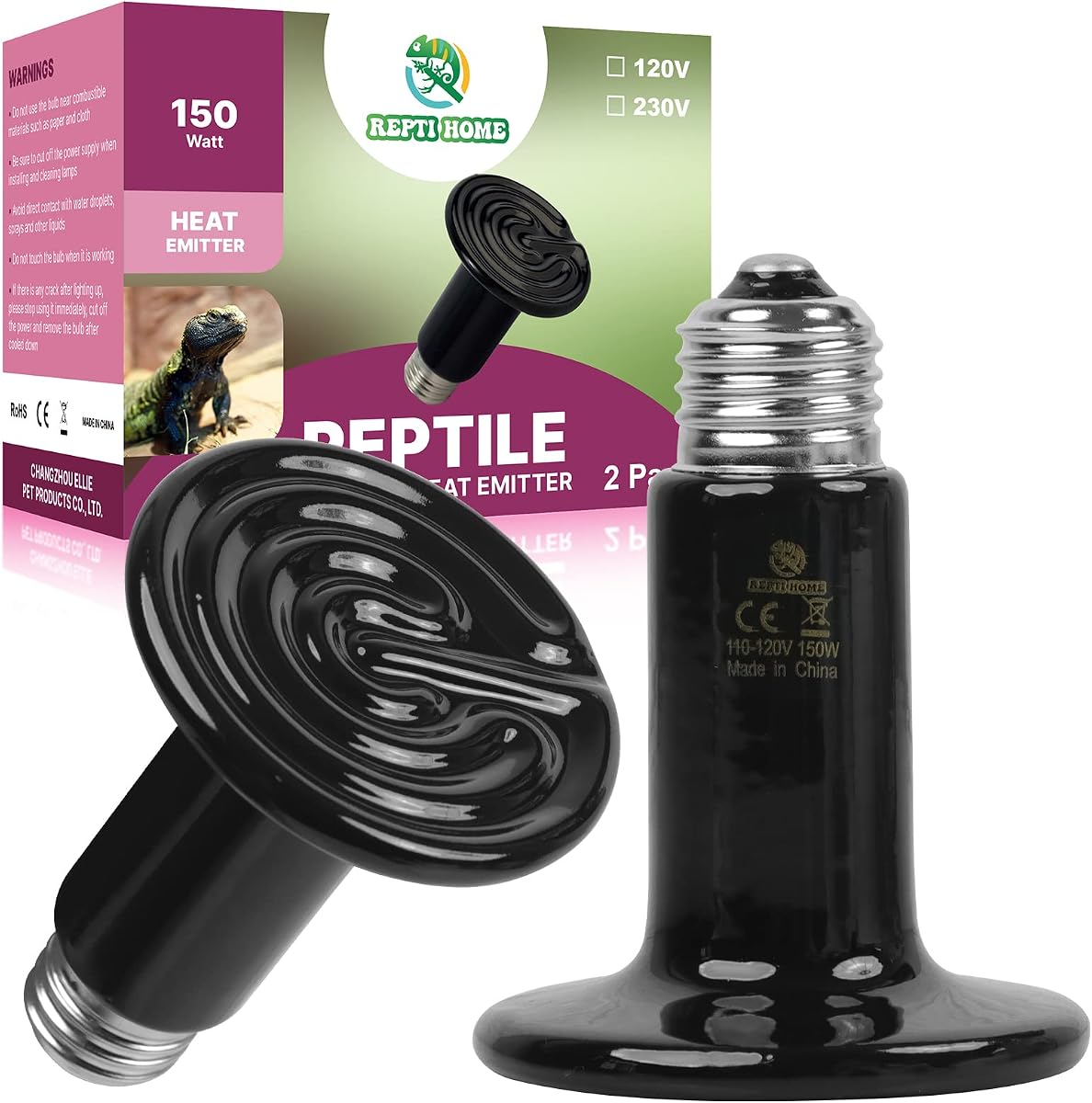
The REPTI HOME 150W Ceramic Heat Emitter is a two-bulb option rated 4.6. It is marketed for a constant 24-hour heat source and can serve reptiles, amphibians, poultry, and other warm-blooded pets. Its listed uses include leopard geckos, ball pythons, monitors, bearded dragons, chameleons, and tree frogs, either as a primary source or overnight supplemental heat.
We may earn a commission when you buy through this link, at no additional cost to you.
The product uses a solid ceramic element and is described as stronger and more durable than ordinary heating lamps. It emits directional infrared heat without producing visible light, and the listing states a warmup of about four minutes after the initial 10-second temperature rise. It uses a standard E26 base, operates on 120 volts, and can be used with temperature-control equipment.
The important constraint is safe placement. The instructions specify a quality ceramic lamp holder, more than 30 centimeters of distance from reptiles, and no hand-testing of the bulb's temperature. They also advise against immediately restarting a recently switched-off bulb and discourage frequent on-and-off cycling. These are sensible precautions for a hot ceramic element that may remain hazardous after power is removed.
This model is a strong fit for owners who want a 150W source, prefer a two-bulb pack, and plan to combine the emitter with separate daytime lighting or environmental controls. It can support a larger thermal area than lower-wattage models, but enclosure measurements and installed thermometers should determine the correct distance. It is less appropriate for small habitats where that much output would be difficult to regulate.
The emitter can be used with compatible temperature-control equipment, allowing a controlled setup to manage the heating cycle. It still needs independent monitoring because a controller cannot correct unsafe placement.
The ceramic element radiates heat in a directed pattern without adding visible light. That makes it useful for animals requiring warm nighttime conditions without a bright bulb.
We may earn a commission when you buy through this link, at no additional cost to you.
The HealSmart 100W Ceramic Heat Emitter has the highest customer rating in this group at 4.7 out of 5. It is a two-bulb, non-light-emitting model for reptile and amphibian terrariums, poultry brooders, egg incubation, and warming young animals. The 100W rating and E26 base give it broad relevance for everyday heat-only setups.
We may earn a commission when you buy through this link, at no additional cost to you.
The bulb uses a Ni-Cr-Alloy resistance wire within a high-purity pottery-clay shell. The manufacturer highlights crack prevention, moisture resistance, and an exposed threaded heating section intended to improve efficiency and speed temperature rise. The listed operating life is up to 10,000 hours, and the product can be used continuously in a compatible porcelain socket with stable radiant heat.
Its main safety issue is the same one shared by all ceramic emitters: a high surface temperature. The instructions warn against testing the heat with a hand and advise adjusting spacing so the animal cannot overheat. Keeping the unit away from flammable materials is equally important. Owners also need a fixture capable of handling the load, not merely a socket that physically accepts the E26 threads.
This is an attractive choice for a keeper seeking a highly rated 100W emitter with a backup bulb and a moisture-resistant ceramic design. Its dimensions of 85 millimeters in diameter and 100 millimeters in length are specified in the product information, making it possible to check enclosure and fixture clearance before ordering. It is a balanced pick for moderate heat needs rather than extreme high-output applications.
The internal Ni-Cr-Alloy resistance wire and clearly defined heating section are designed to raise temperature efficiently. The result is a responsive heat-only source without visible illumination.
Its 4.7 rating is the highest among the products reviewed. That makes the HealSmart a strong candidate for buyers who prioritize a well-received general-purpose ceramic emitter.
We may earn a commission when you buy through this link, at no additional cost to you.
The Simple Deluxe 25W Ceramic Heat Lamp is the lowest-output selection and carries a 4.6 rating. It is a two-bulb package designed for reptile and amphibian terrariums, poultry brooders, and incubation. Its compact size and modest 25W rating make it most useful in smaller spaces or localized applications where a higher-wattage bulb would be excessive.
We may earn a commission when you buy through this link, at no additional cost to you.
The specifications state AC 110-to-120-volt operation, ceramic, metal, and NiCrAl materials, and a 75-millimeter heating-surface diameter. The unit fits a standard E26 lamp base and is rated for up to 10,000 hours. It emits no visually detectable light, allowing the bulbs to provide warm conditions during nighttime without interrupting normal sleep patterns.
Because ceramic emitters retain substantial heat after being switched off, the manufacturer recommends waiting at least one hour before handling the lamp. Flammable materials and animals should also remain at an appropriate distance. Low wattage reduces the total output, but it does not make the surface safe to touch during operation or immediately afterward. The enclosure still needs an accurate thermometer and frequent temperature checks.
This is a useful option for a compact terrarium, a small brooder, or a supplementary heat point where a full-size high-output emitter would be difficult to regulate. It may be less effective for a large habitat or an animal requiring a broad warm zone. Buyers should select it for its low-output niche and use two units only when the fixture arrangement and temperature distribution are appropriate.
The 25W output and 75-millimeter heating diameter are suited to compact setups where controlled, localized warmth is preferable. A larger model may be needed as enclosure size increases.
The two-pack provides a spare or permits two carefully positioned heat points. Each bulb still needs its own safe clearance from animals and combustible materials.
We may earn a commission when you buy through this link, at no additional cost to you.
The right ceramic heat emitter bulb depends on enclosure size, the animal's thermal requirements, fixture compatibility, and whether the lamp must operate without visible light. Use the following factors to narrow the field before making a purchase.
Wattage is the first consideration because it influences how much heat the bulb can produce. The products reviewed cover 25W, 50W, 60W, 100W, 150W, and 250W, but wattage alone does not determine the correct choice. Enclosure dimensions, ventilation, room temperature, substrate, and the animal's required heat range all influence the result. A compact 25W or 50W bulb may be appropriate for a small habitat, while 100W, 150W, or 250W models can serve broader heat demands when the enclosure and fixture are designed for them.
Most models use a standard E26 base and operate on 110 to 120 volts, but the socket must also be rated for the bulb's wattage. A physically fitting socket is not necessarily safe for a 150W or 250W ceramic emitter. High-temperature ceramic or porcelain fixtures are emphasized throughout the product information because the socket, wiring, and surrounding components must tolerate sustained heat. Verify voltage, wattage capacity, ceramic socket construction, secure mounting, and the distance required by the fixture manufacturer before installation.
All ten products are described as non-light-emitting, which is a central benefit for nocturnal reptiles, amphibians, and other animals that require an undisturbed photoperiod. A ceramic emitter can supply radiant heat during the night while a separate daylight fixture provides visible illumination. That arrangement can be particularly useful for stress-sensitive animals, but the daytime system still needs to satisfy the species' lighting requirements. Non-light operation does not remove the need to provide an appropriate day-night cycle.
Fast warmup can make an emitter convenient for establishing a warm zone promptly. LUCKY HERP's 150W and 100W models and the REPTI HOME 150W list a four-minute period to reach rated temperature, while the MIXJOY 250W specifies approximately three to five minutes. The 50W model emphasizes efficiency but does not provide the same detailed warmup figure. Warmup speed should not be confused with a complete enclosure heat cycle, because walls, substrate, furnishings, and ventilation can continue changing the measured temperature after the bulb reaches its own operating condition.
Ceramic construction is a major reason to choose a heat emitter over a conventional bulb. Several products specify thick, high-purity, or high-density ceramic, while REPTI ZOO highlights crack resistance and HealSmart emphasizes moisture resistance. These characteristics are especially relevant in humid terrariums. Several brands also state a lifespan of up to 10,000 hours, although real longevity depends on operating cycles, fixture quality, voltage stability, physical handling, and the distance at which the bulb operates.
Ceramic heat emitters become dangerously hot during normal use. LUCKY HERP specifies more than 30 centimeters of clearance from reptiles, while other products direct owners to maintain an appropriate distance from pets and flammable materials. Keep the bulb away from dry foliage, paper, wood structures, and other combustible items. Do not touch the surface to test its temperature, and allow recently switched-off bulbs to cool. Simple Deluxe models recommend waiting at least one hour. A secure guard or dome may add protection where appropriate, provided it does not obstruct radiant heat or create a fire hazard.
Nine of the ten products include two bulbs, while the LUCKY HERP 100W is a single-bulb pack. A two-pack is useful for maintaining a backup, replacing a failed bulb quickly, or creating separate heat zones. Two bulbs are not automatically better: placing both together can create excessive heat, while positioning them in different areas may produce uneven gradients. Decide whether the second bulb is a reserve or an active heat source, and plan its location and safe distance before ordering.
The listed uses extend beyond terrariums to poultry brooders, egg incubators, amphibian habitats, and warming young animals. Those uses require different temperature targets, and the product description alone cannot establish the correct setting for every species or setup. Choose a bulb whose listed applications include your intended use, then use reliable thermometers and the animal's established care requirements to set safe operating levels. For specialized incubation or brooding, confirm that the fixture, temperature monitoring, and enclosure design are appropriate for that exact application.
Begin by confirming that the enclosure, wiring, and socket are appropriate for the bulb's voltage and wattage. Use a high-temperature ceramic or porcelain fixture rated to handle the selected emitter, secure the bulb according to the fixture's instructions, and position it at a safe distance from animals, decorations, vegetation, bedding, and other flammable materials. Install reliable thermometers at animal level and near the heat source so that the warmest and coolest areas can be compared.
Run the emitter while observing the enclosure rather than testing the bulb with your hand. Allow the ceramic surface and the habitat to stabilize, then adjust the fixture's height or position to establish the animal's required temperature gradient. Keep the emitter on a suitable schedule, avoid unnecessary rapid cycling, and provide separate daytime lighting if visible light is needed. If two bulbs are used, position them deliberately and confirm that their combined output does not create an overheated zone.
For maintenance, switch off the unit and let it cool completely; Simple Deluxe specifically recommends waiting at least one hour. Clean the fixture and surrounding area without splashing water into electrical components, and do not handle a hot bulb. Replace a cracked, discolored, or damaged emitter, and avoid frequent off-and-on cycles that create thermal stress. Recalibrate or check the thermometers regularly, since even a stable enclosure can change as seasons, ventilation, décor, and animal size alter its heat distribution.
The ceramic heat emitter bulbs in this guide are described as producing heat without visible light. That makes them useful for nighttime heating because they can support a dark enclosure without adding unwanted illumination. Animals that need daytime light still require an appropriate separate lighting setup. Confirm that the bulb is positioned and functioning as intended if you notice unexpected visible light.
The correct wattage depends on enclosure size, ventilation, ambient temperature, and the animal's required heat range. The guide includes options from 25W through 250W, but a larger number does not automatically mean a better choice. Begin with the lower-output options for compact spaces and use higher wattage only when the habitat and fixture can support it. Always verify the result with thermometers.
All products reviewed use an E26 base, but the socket must also be rated for the bulb's wattage and operating temperature. A standard household socket may not be suitable for a 150W or 250W ceramic emitter. Use a quality ceramic or porcelain fixture rated for the load, follow its mounting instructions, and never bypass safety components. The bulb's physical fit alone does not establish electrical and thermal compatibility.
LUCKY HERP specifies more than 30 centimeters of clearance from reptiles for its 100W and 150W models. Other manufacturers emphasize an appropriate distance from animals and flammable materials, with the exact safe distance depending on wattage and enclosure design. Place the bulb where animals cannot touch it, monitor the surface-temperature zone, and adjust the fixture if the habitat becomes too warm.
Some products are explicitly described as suitable for continuous 24-hour heat, provided they are installed correctly and monitored. The operating schedule should ultimately reflect the animal's biological needs and the enclosure's measured temperatures. Avoid unnecessarily rapid cycling, and do not switch a recently hot bulb back on immediately. Consistent temperature control is generally more important than repeatedly running the bulb in short bursts.
Several products are specifically designed with ceramic construction that is crack-resistant or moisture-resistant. REPTI ZOO highlights high-purity ceramic for high-humidity glass terrariums, while HealSmart describes moisture resistance and LUCKY HERP uses thick ceramic. Even so, moisture should be kept away from the socket and electrical connections. Use a suitable fixture and maintain clearance from wet surfaces and other materials that could create hazards.
The REPTI HOME 150W is specifically described as usable with temperature control, and compatible ceramic emitters can generally be used in a controlled setup when the equipment is rated properly. A thermostat can help manage the heating cycle, but it cannot make an incorrect wattage or unsafe distance safe. Use independent thermometers and confirm the actual temperature at the animal's level.
Do not touch the bulb immediately after shutdown because the ceramic surface remains hot. Simple Deluxe recommends waiting at least one hour for the bulb to cool, and the same caution is sensible for the other models. Keep the area clear of animals and flammable materials until the fixture has cooled. If a bulb is cracked, discolored, or otherwise damaged, replace it rather than reusing it.
The LUCKY HERP 150W stands out as the editor's choice for a strong combination of rapid warmup, substantial output, visible-light-free heating, and a two-bulb package. The 50W Reptile Heat Lamp is the best budget-oriented option for smaller habitats and low-power use, while the MIXJOY 250W is the premium high-output selection for large heat demands with properly rated equipment.
Prioritize the complete setup rather than wattage alone. Match the bulb to the enclosure dimensions and animal's temperature needs, use a high-temperature fixture rated for the load, preserve safe clearance, and monitor both warm and cool areas. A ceramic emitter works best when it supplements a properly designed habitat with accurate thermometers, appropriate daytime lighting when needed, and stable environmental conditions.
Finally, check the current product listing, ratings, specifications, availability, and prices before purchasing, since all can change. Compare the exact fixture requirements and safety guidance in the current listing, and choose the ceramic heat emitter bulb that offers the correct combination of power, heat control, and non-light operation for the intended habitat.