
Hydroponic Tower Planter for 18 Plants
4.6Editor score
Eighteen-plant vertical capacity
Remote Wi-Fi controls
Full-spectrum LED lighting
Quiet circulation pump
Automated microgreen growing systems combine dedicated trays or pods with features such as integrated lighting, water circulation, humidity control, or self-watering reservoirs. The most useful setup is not always the most technically elaborate; it is the system that matches your space, preferred crop, experience level, and tolerance for routine maintenance.
We compared all ten products by examining their growing capacity, lighting, irrigation, drainage, ventilation, included accessories, seed support, material construction, and suitability for year-round indoor use. The list covers fully automated countertop gardens as well as simpler tray and jar systems that can support a controlled microgreen routine.
Each review explains what the product does well, where its compromises may matter, and who it is best suited for. Product ratings and availability can change over time, so check the current listing, included components, and retailer terms before making a purchase.
4.6Editor score
4.5Editor score

4.2Editor score
As an Amazon Associate we earn from qualifying purchases.
The following comparison highlights each system's core format, growing capacity, automation features, and included components, making it easier to identify the right option for a countertop, windowsill, or vertical indoor garden.


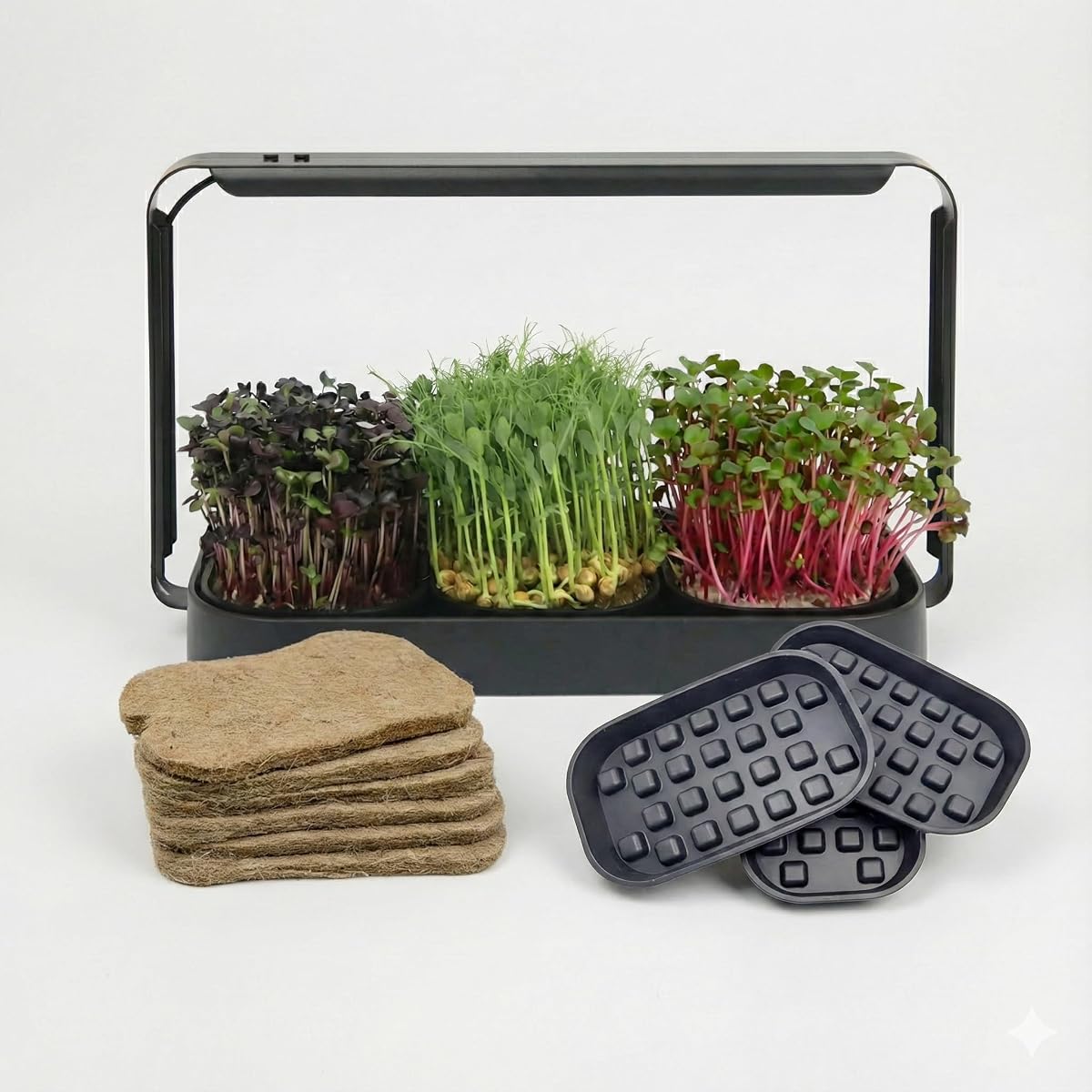
This Microgreens Growing Kit Indoor combines three specialized silicone trays, a built-in LED spectrum lamp, six jute mats, and three blackout lids in a coordinated countertop system. Its 4.5 rating reflects a thoughtful balance of automation and user control. Unlike a simple humidity tray, it integrates illumination, moisture monitoring, and a staged growing process into one format.
We may earn a commission when you buy through this link, at no additional cost to you.
The most distinctive feature is the three-tray succession-planting arrangement. One batch can remain under a germination lid while another develops under the lamp and a third reaches harvest readiness. Side holes align with empty space in the trays, allowing water levels to be checked without disturbing roots. The breathable jute mats offer a soil-free medium, while the blackout lids support a weighted-dark germination phase that can encourage stronger stems.
The trade-offs are that no seeds are included, so buyers must choose their own varieties and manage lighting and watering. It is also a focused microgreen and herb setup rather than a large-capacity indoor garden. Some users who want broad crop variety or automated remote scheduling may find a pump-driven pod system more flexible.
This is an excellent choice for dedicated home growers who value an organized process, attractive materials, and a repeatable rotation. It is especially suitable for beginners who want clear physical stages and experienced growers interested in continuous countertop harvests. For those priorities, it offers one of the most thoughtful systems in the group.
Three trays make it possible to spread planting dates without maintaining three unrelated setups. The dedicated lids, viewing holes, and central lamp work together to reduce guesswork while preserving a clean countertop appearance.
The soil-free jute mats contain the growing medium, while the tray design separates root-zone space from excess water. Side monitoring holes let the grower check moisture without lifting the cover or disturbing sensitive young roots.
We may earn a commission when you buy through this link, at no additional cost to you.
The Hydroponic Tower Planter is the most technically advanced option in this roundup, offering a vertical hydroponic format, 18 growing positions, full-spectrum lighting, quiet water circulation, and Wi-Fi control. Its 4.6 rating is the highest among the listed products, reflecting a strong combination of capacity, convenience, and space efficiency.
We may earn a commission when you buy through this link, at no additional cost to you.
Its tower configuration concentrates a substantial number of plants into a footprint measuring approximately 17 by 17 inches and 38 inches tall. The Wi-Fi connection allows the grower to monitor and adjust watering schedules and lighting remotely, making the system practical for travel or busy homes. A silent pump continually supplies nutrients, and reusable net cups help reduce disposable plastic use.
This is still a substantial indoor garden rather than a minimal windowsill accessory. It requires enough vertical clearance, regular tank attention, and the patience to learn the controls. Hydroponic methods also demand more active management than passive humidity trays, and the product's broader crop capacity does not automatically mean it is the simplest route for a complete microgreen beginner.
Choose this system when you want to grow numerous herbs and greens in one vertical footprint and value remote convenience. It suits apartment dwellers, experienced indoor gardeners, and households that want a polished central growing station. It is our premium choice for scale and control rather than for minimalism.
Eighteen growing sites are arranged vertically, which makes the tower practical where broad counter space is limited. It is especially useful for herbs, leafy greens, and a mixed collection of compact indoor plants.
Remote watering and lighting controls reduce the need to interrupt the system whenever schedules change. This convenience is most valuable to users who travel, work irregular hours, or maintain several plants at once.
We may earn a commission when you buy through this link, at no additional cost to you.
The mizuna Microgreens Growing Kit is a straightforward windowsill starter set built around two ceramic trays, coconut coir, and broccoli seeds. Its 4.4 rating reflects a convenient first project with attractive materials and a short learning curve. It prioritizes simplicity over built-in automation, making natural light or a separate lamp part of the setup.
We may earn a commission when you buy through this link, at no additional cost to you.
Both trays measure 11.5 inches long, 4.5 inches wide, and 1.5 inches tall, which suits a standard kitchen windowsill. Their lack of drainage holes is intentional: moisture is retained naturally, and a small gap beneath the stacked upper tray allows air to circulate during germination. Once established, the trays can be separated to grow both batches simultaneously.
The product is less suitable for buyers who want integrated lighting, pumped irrigation, remote controls, or automatic watering. It also includes broccoli seeds rather than a broad seed assortment, so growers seeking multiple simultaneous varieties would need to add their own. The absence of plastic is a genuine advantage, but it also means there is no integrated electronics to maintain.
This kit is best for first-time growers, gift buyers, and minimalists who want an uncomplicated introduction to microgreens. The two-tray rotation helps maintain a steady harvest, and the included coir and seeds allow immediate setup. Choose it when attractive design and easy handling matter more than built-in automation.
The included medium and seeds remove much of the setup friction. A new grower can focus on watering, light, and harvesting without learning a complex control panel or assembling multiple electronic components.
Stacking the trays during germination and separating them later creates a simple staggered schedule. Planting one tray a week before the other can help maintain continuity instead of harvesting a single large batch all at once.
We may earn a commission when you buy through this link, at no additional cost to you.
The 40 Cells Seed Starter Tray with Grow Light and Integrated Heating is a broad indoor germination system rather than a dedicated microgreen appliance. It combines a 40-cell tray, bottom heating base, LED grow light, humidity dome, and timer. Its 4.2 rating reflects a versatile approach to starting herbs, vegetables, flowers, microgreens, and other seedlings.
We may earn a commission when you buy through this link, at no additional cost to you.
Built-in heating delivers warmth directly beneath the growing cells, helping maintain a more consistent root-zone temperature while reducing heat loss compared with a separate mat. The light and heat functions operate independently, and the grow light offers a one-to-24-hour timer. Adjustable dome vents allow the grower to balance retained humidity with airflow as seedlings develop.
Because the heating and lighting schedules can overlap, users should calibrate them to the crop and ambient room conditions. The 40-cell format also demands more seed starting medium and space than a small microgreen tray. While it can produce microgreens, its design is optimized more broadly for germination and early seedling care.
This system makes sense for a home gardener who starts many kinds of seedlings or wants temperature and lighting controls in one base. It is less compelling for someone wanting a compact, continuous microgreen rotation, but it offers strong value for broader indoor propagation tasks.
Separating the heat and light functions allows a grower to provide warmth during germination and adjust illumination as seedlings mature. This flexibility is useful across different crops and seasonal indoor conditions.
The 40 individual cells accommodate multiple seed types, making the kit useful beyond microgreens. It can support a mixed propagation plan involving herbs, vegetables, flowers, and seedlings.
We may earn a commission when you buy through this link, at no additional cost to you.
The Two-Pack Microgreens Growing Trays offer a compact, reusable way to grow sprouts in wide-mouth mason jars. The set includes two sprouting lids and internal trays designed for hydroponic jar cultivation. Its 4.0 rating reflects an affordable and flexible option for growers who already own suitable jars.
We may earn a commission when you buy through this link, at no additional cost to you.
The system needs only water and sunlight, avoiding pumps, timers, and electrical connections. Its mesh design supports different seed sizes, including pea, mung bean, sunflower, bok choy, kale, and basil. Because there are two lids, users can cultivate separate varieties at the same time and compare their growth or stagger harvest dates.
The requirement to supply compatible jars is an important limitation. The listed inner-diameter specification is somewhat difficult to parse, so buyers should measure their jars carefully before ordering. There is also no lighting or automatic watering, meaning light placement and moisture checks remain daily responsibilities.
This kit is best for budget-conscious beginners, renters who already use mason jars, and growers wanting a simple countertop sprouting method. It is less appropriate for anyone seeking unattended operation or a polished all-in-one indoor garden.
Separate lids make it possible to run two seed varieties in parallel. This supports crop trials, mixed salads, and staggered harvests without needing a larger electronic system.
Using familiar jars for the reservoir reduces dedicated equipment and makes the growing setup adaptable. As long as the jar dimensions and ventilation needs are suitable, the same basic setup can be reused for multiple crops.
We may earn a commission when you buy through this link, at no additional cost to you.
The Four-Tier Seed Sprouting Kit uses corrugated, stackable trays to create several growing levels while conserving counter space. Its 5.0 rating is the highest numerical rating in the list, reflecting a well-regarded passive design. It is built for bean sprouts, alfalfa, cat grass, wheatgrass, and other small-seed crops rather than a high-tech appliance.
We may earn a commission when you buy through this link, at no additional cost to you.
The rippled surface helps keep seeds from moving during rinsing, while drainage holes collect excess water efficiently. A bottom tray captures runoff, and small openings provide ventilation and humidity regulation. The tiers can be stacked for growth and reversed for compact storage, making the system flexible in a small kitchen.
The kit is not dishwasher safe, so cleaning requires rinsing with water and allowing the components to dry. It also lacks a grow light, pump, timer, or self-watering reservoir. Users must provide suitable illumination and monitor moisture, meaning its high rating should not be interpreted as evidence of complete automation.
This is a strong choice for growers who want a durable, soil-free sprouting setup with excellent space efficiency. It suits budget-conscious beginners and anyone regularly preparing sprouts for cooking. Choose it when passive drainage and stackability matter more than electronic convenience.
Four tiers increase the number of usable growing levels without requiring four separate footprints. Corrugated surfaces and drilled holes work together to support seeds while directing excess water toward the collection tray.
The soil-free configuration can be cleaned by rinsing and reusing rather than replacing soil or disposable growing media. Users should avoid the dishwasher and store the dry components in their reversed stacked configuration.
We may earn a commission when you buy through this link, at no additional cost to you.
The MG-15 Hydroponic Growing System combines 15 planting pods, a 24-watt full-spectrum LED light, a built-in timer, a quiet pump, and a 5.5-liter tank. Its 4.2 rating reflects a generous feature set for an indoor hydroponic garden, making it our budget pick among the more automated options.
We may earn a commission when you buy through this link, at no additional cost to you.
Vegetable and fruit-and-flower modes let growers tailor the light mix to different crop types. The detachable light panel rises to 14 inches as plants grow, while the pump circulates water and oxygen on a 30-minute cycle. A visible tank window assists with refill checks, and the included package includes sponges, baskets, labels, support poles, nutrients, and an adapter.
Its performance depends on plant size and environmental conditions, so the stated once-per-month refill interval should not be treated as universal. The tank size is also modest for 15 actively growing plants, and the compact vertical format is better suited to herbs, leafy greens, and other small crops than oversized fruiting plants.
This system is a good value for beginners who want a complete, integrated indoor garden without paying for premium connectivity. It also appeals to families seeking a hands-on growing project with automated lighting and circulation. Choose it when you want substantial functionality at a more accessible level.
The sixteen-hour timer creates a repeatable light cycle, while the pump keeps water moving on a scheduled interval. Together, these features reduce the number of daily tasks compared with a basic tray.
The height-adjustable stand helps maintain a useful distance between the lamp and foliage as plants mature. Removable trays and baskets also make it easier to access individual crops for inspection and harvesting.
We may earn a commission when you buy through this link, at no additional cost to you.
The Misting Hydroponic Growing System is a feature-heavy 15-pod garden with an LCD touch panel, misting technology, a six-liter tank, and three selectable lighting modes. Its 3.8 rating is the lowest in the roundup, but the product still offers an unusually broad control interface and a substantial list of automated functions.
We may earn a commission when you buy through this link, at no additional cost to you.
The panel provides one-touch access to settings, and the lighting offers seedling, vegetable, and bloom modes along with brightness adjustment and twelve-, fourteen-, or sixteen-hour timer options. The misting system is designed to maintain a moist, oxygen-rich root environment, while an ultra-quiet pump circulates water. The removable tank and visible level indicator simplify cleaning and refilling.
Many controls can make a new system feel more complicated than necessary. Buyers should compare the product's performance claims with the need for close monitoring, especially since its rating trails the other listed products. The 15.7 by 7.9 by 19.7-inch maximum dimensions also require sufficient counter space and overhead clearance.
This system suits an enthusiast who values a visible interface, multiple lighting programs, and a large removable reservoir. It may appeal to users accustomed to smart appliances, though it is not our first recommendation for someone seeking the simplest path to microgreens. Its feature breadth is the main attraction.
The LCD screen makes schedules and light settings visible at a glance. For users who want direct access rather than small switches, the interface offers a more polished and informative experience.
Separate seedling, vegetable, and bloom modes allow the lamp to be adapted as crops change. Timer choices and brightness controls add further flexibility for different plants and indoor conditions.
We may earn a commission when you buy through this link, at no additional cost to you.
The Four-Pack Humidity Dome Trays provide four complete microgreen growing assemblies, each with a clear dome, fine mesh tray, and bottom reservoir. Its 4.4 rating reflects an effective passive setup for users who want to run several varieties or batches at the same time.
We may earn a commission when you buy through this link, at no additional cost to you.
Each unit measures approximately 5.9 inches square and stands 6.7 inches tall. The 1.2-millimeter mesh gives fine support for small seeds, while adjustable dome vents help the grower manage humidity and airflow. The base tray catches excess water, and its food-grade, BPA-free construction makes routine rinsing and cleaning straightforward.
The domes should not be placed in the dishwasher, although the bottom trays can. The system also has no lamp, pump, timer, or self-watering mechanism, so growers must supply suitable light and check moisture themselves. The recommended water amount should not completely cover the seeds.
This kit is ideal for growers who want several varieties in parallel without purchasing four separate setups. It also works for sprouts, wheatgrass, cat grass, and a wide assortment of small-seed crops. Choose it for passive countertop flexibility rather than fully unattended automation.
Four identical assemblies make it easy to compare seed varieties or stagger sowings. Each crop has its own tray and reservoir, limiting the need for separate containers and storage pieces.
The domes retain warmth and moisture during early growth, while adjustable vents allow more airflow as needed. This balance is especially helpful during germination and the transition to stronger seedling growth.
We may earn a commission when you buy through this link, at no additional cost to you.
The Sproutlet Self-Watering Microgreens Growing Kit is a three-pack starter system combining reusable trays, humidity domes, compostable grow mats, and organic seeds. Its 4.0 rating reflects an approachable design focused on consistent moisture, compact storage, and minimal mess.
We may earn a commission when you buy through this link, at no additional cost to you.
The built-in self-watering mechanism delivers moisture to the grow mats without requiring frequent manual watering. The kit is ready to use after adding water and seeds, and the included materials remove the need to source a separate growing medium. Its small footprint suits kitchens where counter space is limited.
The system does not include a grow light, pump, electronic timer, or remote control, so lighting and occasional reservoir checks remain the grower's responsibility. The three-tray format also creates less capacity than larger pod gardens or multi-tier towers. Some users may want additional seed varieties rather than the included selection.
This is a strong match for beginners, busy households, and anyone who wants microgreens without soil or repeated watering. It also works as a gift because the included components make setup immediate. Choose it when simple moisture management is the priority and separate lighting is already available.
The self-watering design provides steadier access to moisture than a conventional shallow tray. That can simplify daily care and reduce the chance of allowing the growing medium to dry out.
Organic seeds, compostable grow mats, reusable trays, and domes provide a complete starting setup. Users can begin immediately and reuse the durable components for later batches.
We may earn a commission when you buy through this link, at no additional cost to you.
The best automated microgreen growing system depends on how much automation you need, which crops you want to grow, and how much space and maintenance you can comfortably devote. These factors help separate true indoor gardens from passive propagation accessories and guide realistic purchasing decisions.
Automation can range from a humidity dome that maintains moisture to a hydroponic garden with a timed lamp, circulation pump, adjustable controls, and remote access. More automation reduces manual interventions, but it also introduces electronics, moving components, and settings that may need occasional adjustment. A passive tray may be sufficient for a few sprouts, while a larger indoor garden is more useful for frequent harvests across multiple crops.
A two- or three-tray setup can support staggered microgreen batches, while 15- and 18-site systems offer room for mixed herbs and leafy greens. Consider whether you want one crop at a time, several varieties for comparison, or a broad indoor garden. Greater capacity usually requires more light, water, and counter space, and the largest systems should not automatically be assumed to be better for dense microgreen mats.
Strong indoor light is essential when a windowsill receives limited direct sun. Integrated LEDs offer consistency and convenience, while passive systems usually require a separate lamp. Look for full-spectrum output, a suitable timer, adjustable height, and crop-specific modes if you plan to grow beyond microgreens. Also consider whether the light can reach every tray evenly and whether the housing is easy to clean.
Hydroponic systems circulate nutrient solution through net cups or pod baskets, requiring attention to tank levels and roots. Self-watering trays use a reservoir to move moisture into grow mats, while passive trays rely on manual soaking and draining. Whichever method you select, check drainage, airflow, and the risk of standing water. The best setup should keep roots hydrated without trapping excess moisture around them.
Microgreens benefit from humidity during germination but need airflow as they mature. A humidity dome with adjustable vents gives a passive system more control than a fixed cover. Hydroponic pumps can improve circulation, although they do not replace fresh air in every location. Position any system where it receives suitable light and ventilation, and avoid placing a covered tray in a stagnant, overly warm corner.
Food-grade materials are valuable in a kitchen, and reusable components can reduce ongoing replacement needs. Ceramic offers a clean appearance and easy washing, while polypropylene is lightweight and easy to rinse. Check whether every part is dishwasher safe, because many kits specify that only the base tray can be washed in a dishwasher. Removable tanks, baskets, and trays also make routine cleaning more practical.
Some systems include seeds, grow mats, coir, nutrients, baskets, labels, and other accessories, while others require separate purchases. The three-tray LED system, for example, excludes seeds but includes jute mats, and the mason-jar kit requires suitable jars that are not included. Compare the complete contents rather than relying on broad terms such as complete kit. This prevents surprise purchases and makes setup easier on the day it arrives.
Measure both the footprint and the required vertical clearance. Tower and pod systems need overhead room for lights and plants, while low trays may fit beneath a cabinet. Consider access to outlets for powered systems, the distance from a water source, and whether dripping or refilling could damage the surface. A compact system that fits its intended space is usually more practical than a larger model with awkward clearance requirements.
Begin by cleaning and assembling the system according to its instructions, then position it in an area with the appropriate light and ventilation. For passive trays, add the recommended water without fully submerging the seeds. For hydroponic systems, prepare the reservoir, add the specified nutrients, seat the seeds or seedlings in the baskets, and confirm that the pump and timer are operating correctly.
Check moisture and root-zone conditions regularly rather than following a rigid schedule for every crop. Passive systems often need rinsing, draining, and humidity adjustments. Hydroponic systems require periodic reservoir checks, while self-watering trays should be refilled when their indicator or media shows drying. Keep vents or domes appropriately adjusted as seedlings grow, and avoid a wetter environment once stems become taller and more vulnerable to mold.
Harvest greens at the appropriate stage using clean, dry tools, and remove damaged material promptly. Afterward, clean trays, baskets, mats, and reservoirs according to the care instructions, allowing wet components to dry fully before reuse. For continuous harvests, start another batch before the current crop is exhausted, and rotate varieties so the system does not have to support every planting at exactly the same time.
An automated system typically manages one or more routine tasks such as lighting, moisture delivery, water circulation, humidity, or scheduling. The level of automation varies widely: a dome and reservoir simplify watering, while a hydroponic tower may include a pump, timer, full-spectrum light, and remote controls. Choose the level of automation that matches your experience and the time you want to devote to maintenance.
Hydroponic systems can provide steadier water and nutrient delivery and are useful for larger or more continuous crops, but they require more equipment and attention. Passive trays are simpler, less expensive, and often adequate for small batches or beginner projects. The better choice depends on capacity, crop variety, available space, and how much automation you actually want.
It depends on the light available in the growing area. A bright windowsill may support some short crops, while a dedicated LED grow light usually offers more consistent results indoors. Kits without built-in lighting, including the ceramic, mason-jar, tiered tray, humidity-dome, and self-watering options in this guide, should be matched with suitable illumination when natural light is inconsistent.
The correct distance depends on the lamp, plant stage, and heat output of the fixture. Adjustable-height stands are useful because seedlings generally need a different distance from mature greens. Follow the manufacturer's guidance and watch the plants for stretching, pale growth, or heat stress, moving the lamp as the crop develops.
Most reusable systems can be used for different crops after thorough cleaning. Remove roots and plant debris, wash the components as directed, and let them dry before replanting. Some included grow mats or seed supplies may be single-use, so check the product description and care instructions before discarding anything.
The Sproutlet Self-Watering Kit and the MG-15 Hydroponic Growing System are approachable options for different reasons. The Sproutlet offers a simple passive workflow with included seeds and mats, while the MG-15 automates lighting and circulation but introduces more components. The best first system is the one that matches your desired crop volume and the amount of routine care you genuinely enjoy.
Use clean water, provide appropriate airflow, and avoid keeping the seeds fully submerged. Adjust the humidity dome vents as the seedlings emerge, especially if condensation accumulates or the seedlings show signs of poor vigor. Stagger sowings rather than filling every tray with the same batch, and remove any remaining seeds or decaying material promptly.
A kit with seeds can be convenient because everything needed for the first crop arrives together. However, seed choices are often limited, and serious growers may prefer to select specific varieties. If seeds are excluded, verify that you can obtain suitable varieties locally and prepare the correct growing medium before assembly.
The Hydroponic Tower Planter stands out for 18-site vertical capacity, Wi-Fi controls, full-spectrum lighting, and quiet circulation, while the three-tray Microgreens Growing Kit offers a more focused succession-planting workflow. The MG-15 provides the strongest budget combination of automated lighting, 15 pods, a circulation pump, and a clear reservoir. For minimalists, the ceramic starter and passive tray systems remain practical alternatives.
Prioritize the crop type, capacity, available light, counter space, and cleaning routine before selecting a system. A compact passive kit may be ideal for a few weekly batches, whereas an automated indoor garden makes more sense for varied herbs, frequent harvests, or users who value scheduled lighting and irrigation. The best setup is one you will actually maintain consistently.
Ratings, product availability, included accessories, and retailer terms may change, and current pricing should be checked on each listing before buying. Review the dimensions and care requirements as well as the feature list to ensure the system fits your intended location and growing routine.