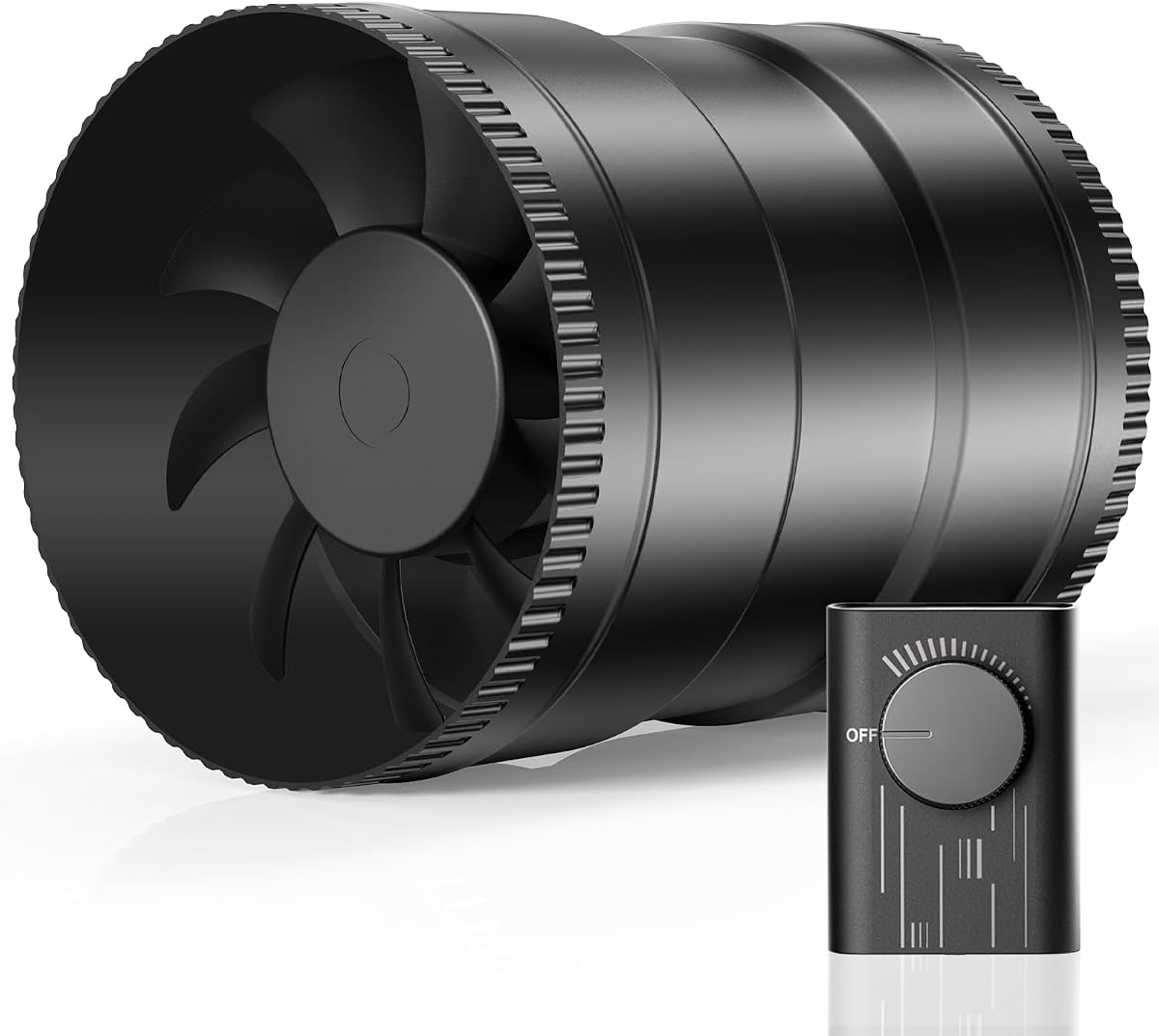
Hon&Guan 6 Inch Fan
4.4Editor score
345 CFM airflow
19.2W maximum consumption
Upgraded AC controller
100-240V operating range
A 6 inch inline duct fan is a compact ventilation component that moves air through a narrow duct, exhaust system, grow tent, or existing HVAC line. The best model balances usable airflow against noise, energy use, control options, installation demands, and the ability to operate reliably in restrictive or elevated ductwork.
This guide compares ten 6 inch inline duct fans using the supplied product specifications, including rated airflow, sound levels, motor design, control functions, dimensions, application notes, and construction details. It covers general exhaust and air-transfer uses as well as models intended to boost HVAC airflow, manage grow-room conditions, or remove unwanted humidity and odors.
Each review explains the product's strongest benefits, practical limitations, and most suitable installation. The leading choices include a feature-rich premium model from AC Infinity, a value-focused Hon&Guan option, and a metal-construction Tjernlund fan. Product availability and pricing can change, so verify current listing details before buying.
4.4Editor score
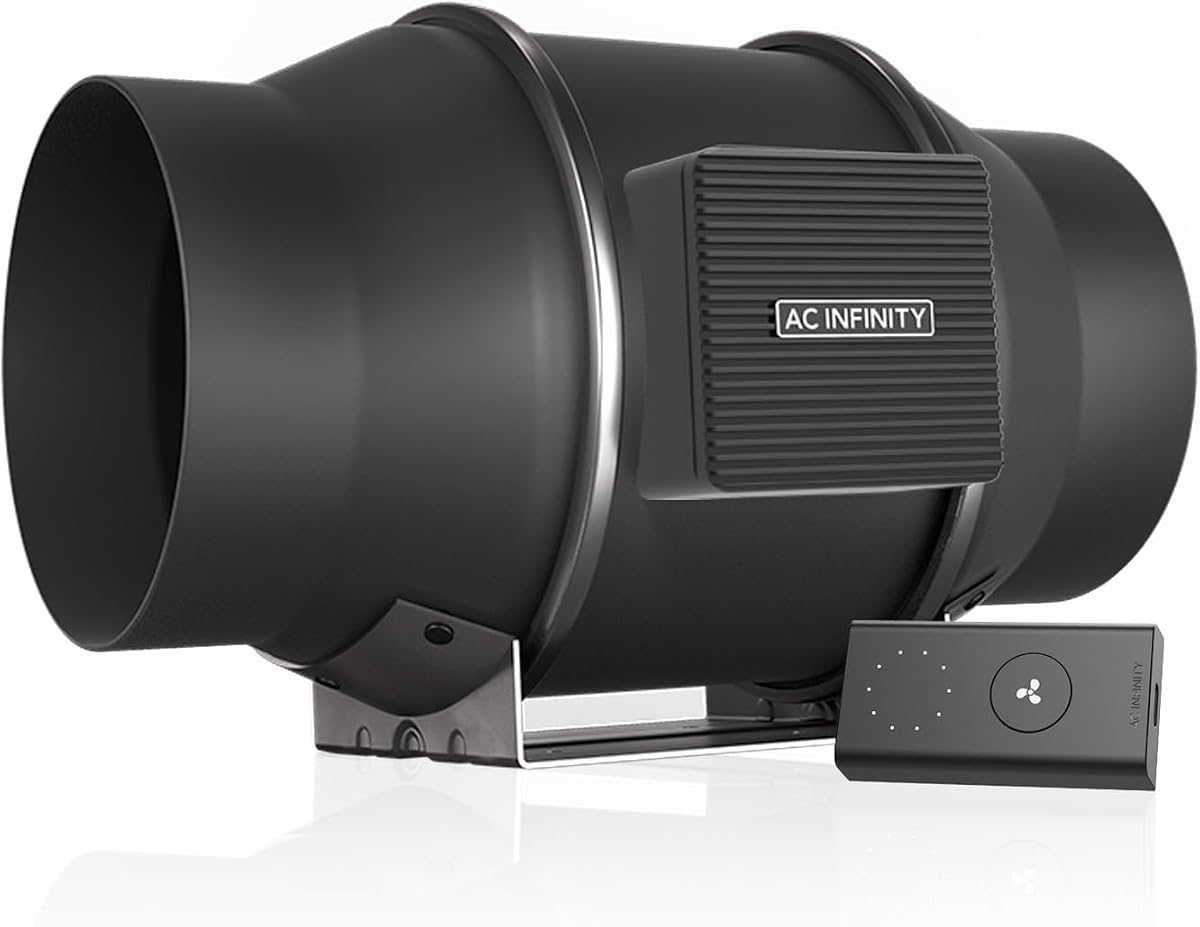
4.8Editor score

4.4Editor score
As an Amazon Associate we earn from qualifying purchases.
The comparison below highlights the major differences in airflow, sound level, motor type, and control capabilities, helping narrow the field before reviewing each fan in detail.
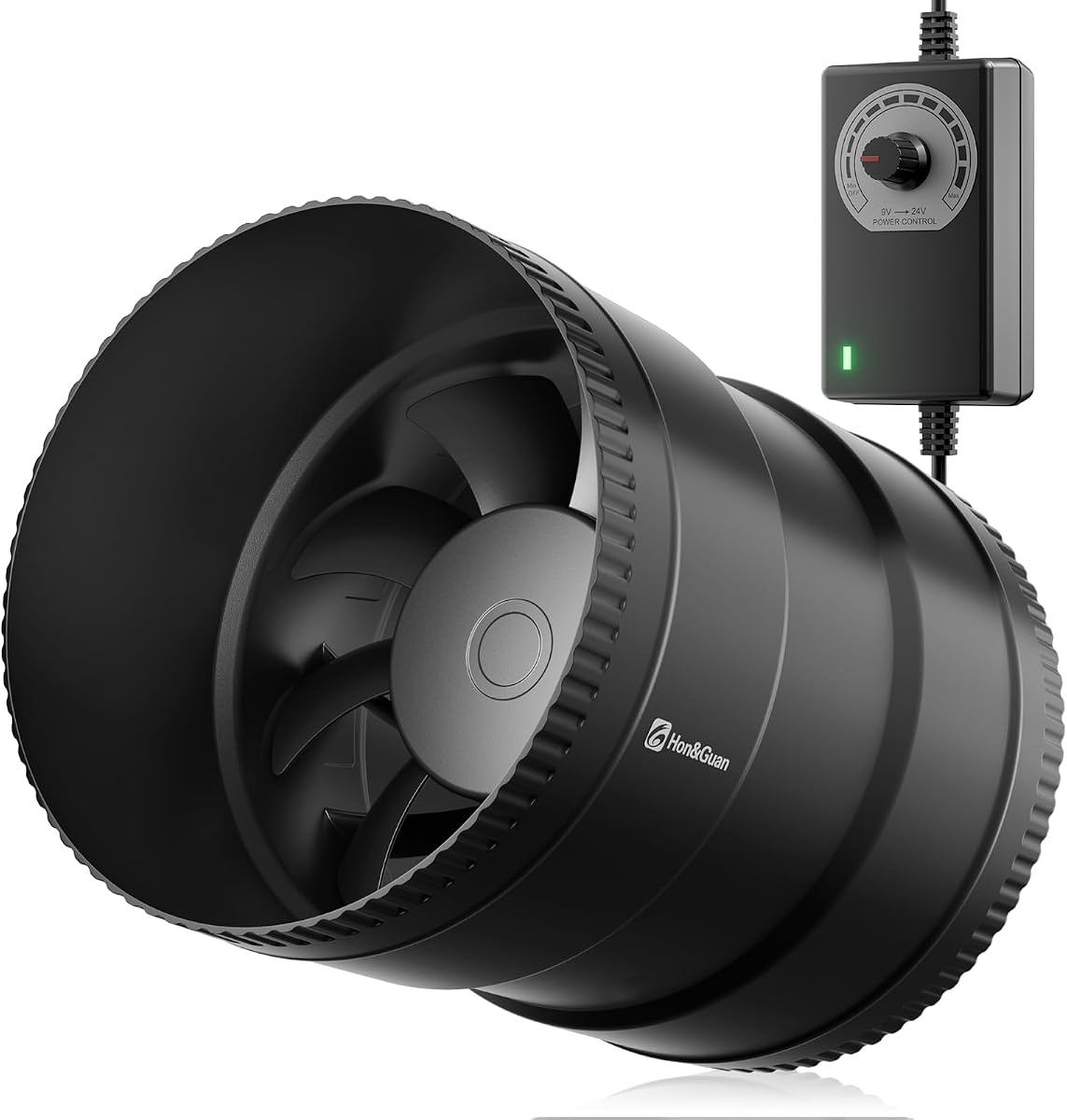


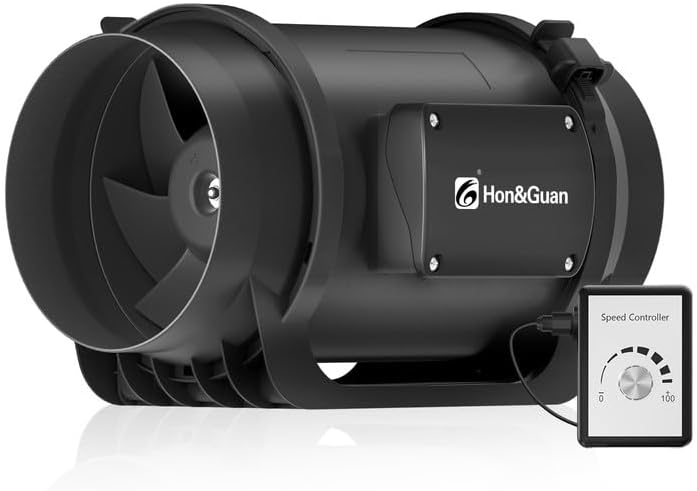
The AC Infinity CLOUDLINE S6 is a feature-rich inline fan with a 4.8 rating, the highest among the products in this guide. Its mixed-flow design, 402 CFM airflow rating, and PWM-controlled EC motor make it a strong all-around choice for grow tents, room ventilation, AV racks, and moving heated or cooled air through a building. It also offers quieter operation than many larger-output alternatives.
We may earn a commission when you buy through this link, at no additional cost to you.
The fan's defining advantage is its combination of airflow and useful controls. A wired 10-speed controller lets the user reduce output when full ventilation is unnecessary, while compatibility with UIS controllers adds a path toward intelligent programming. The stator blade and hydrodynamic wheel design are specifically intended to maintain useful air delivery in high-resistance duct systems, where a basic axial fan may lose efficiency.
There are trade-offs. This is not the simplest or least expensive unit on the list, and speed adjustment depends on the included controller and compatible controls. Its listed noise level of 32 dBA represents the manufacturer's specification rather than a promise that every installation will sound identical; ductwork, load, and airflow settings all influence perceived noise. Even so, the motor, bearing, and airflow specifications are unusually well balanced.
Choose the CLOUDLINE S6 when you want a single fan that can handle serious ventilation duties while remaining adaptable. It is especially appropriate for users who value fine speed control, quiet operation, and smart-system potential over the lowest purchase cost. For most variable-airflow installations, it remains the strongest overall recommendation in this roundup.
Unlike a conventional axial approach, the mixed-flow wheel and stator configuration are designed to move air through higher-resistance paths. This makes the CLOUDLINE S6 useful for longer ducts, bends, filters, or other installations where maintaining useful air volume is the priority.
The included wired controller offers ten speeds for gradual adjustment, and the fan's UIS compatibility creates opportunities for automated ventilation. That makes it well suited to grow environments or other installations where conditions change throughout the day.
We may earn a commission when you buy through this link, at no additional cost to you.
The Hon&Guan 6 Inch Inline Booster Duct Fan combines a 345 CFM airflow rating with a maximum power consumption of 19.2W. It is a straightforward option for improving ventilation in bathrooms, kitchens, workshops, basements, attics, grow rooms, and existing HVAC systems. Its 4.2 rating places it behind several higher-rated alternatives, but the core specifications remain relevant for value-conscious buyers.
We may earn a commission when you buy through this link, at no additional cost to you.
One of the most attractive figures is the 19.2W maximum consumption, which is notably lower than the listed power draw of the Hon&Guan 469 CFM model in this guide. The upgraded DC motor is described as quiet and energy efficient, while the controller allows users to balance airflow and sound according to the task. A rated 142 Pa air pressure also suggests that the fan is intended to move air through meaningful resistance rather than function only as a lightweight circulator.
The body and blade are made from plastic, which supports a relatively lightweight design and easy removal for maintenance. That portability is useful when a duct fan needs to be inspected or cleaned. The primary limitation is that the product data does not describe a digital display, memory function, or integration with a broader control system, so users who value sophisticated automation may prefer a more specialized model.
This Hon&Guan fan is most compelling for straightforward ventilation and boosting where adjustable output, low energy use, and easy maintenance matter. It offers sufficient airflow for many residential and hobby applications without introducing the more elaborate electronics seen in premium controllers. It is a practical choice for a simple, controllable upgrade.
A 19.2W maximum power draw can be valuable in installations expected to run frequently. Combined with adjustable speed, it allows operators to reduce energy use when full airflow is not required rather than running the motor continuously at its maximum setting.
The lightweight plastic blade and body make the unit easier to handle during installation or inspection. Removable duct components also simplify routine cleaning, which is important in kitchens, workshops, and grow spaces where dust or residue can accumulate.
We may earn a commission when you buy through this link, at no additional cost to you.
The VEVOR Inline Duct Fan is a 400 CFM option intended for exhaust, cooling, dehumidification, and air circulation. It carries a 4.4 rating and stands out through its combination of relatively high airflow, a listed 34 dB operating level, manual speed adjustment, and included installation accessories. Its stated uses include grow tents, hydroponic rooms, kitchens, basements, and electronic equipment rooms.
We may earn a commission when you buy through this link, at no additional cost to you.
Manual knobs provide direct airflow control, allowing the user to reduce output when a room does not require maximum ventilation. The AC motor is presented as a low-noise design that also reduces energy consumption by 30% according to the product information. The fan can be suspended with the supplied straps or mounted on a wall using the included rubber mats and straps, which gives installers some flexibility where space is limited.
The main drawback is the type of motor. AC motors are generally less electronically refined than EC or PWM-controlled systems and may consume more power at equivalent output. The controls also appear more manual than the ten-speed, memory-equipped, or programmable controllers offered by some other products here. In addition, the stated energy-saving figure is a product claim that should be considered in the context of the complete installation.
Buyers seeking a strong, uncomplicated exhaust fan will find this VEVOR model practical. It suits users who want a visible controller, adjustable performance, and a broad list of residential or hobby applications. It is less attractive for advanced automation, but it delivers the core ventilation functions without requiring a complex control system.
The 400 CFM rating supports demanding exhaust and circulation tasks, while the manual controls make it easy to tune the fan. This is useful in rooms where daytime and nighttime ventilation requirements differ or when nearby equipment generates intermittent heat.
Included slings, straps, and non-vibration mats make the fan adaptable to overhead suspension or wall mounting. Reducing transmitted vibration can also help keep the installation stable and make surrounding equipment or occupied rooms less disruptive.
We may earn a commission when you buy through this link, at no additional cost to you.
The AC Infinity RAXIAL S6 is a compact inline booster with a 4.4 rating and a 265 CFM airflow rating. It is designed to increase existing airflow in HVAC systems and ventilate spaces such as attics and workshops. Its smaller output makes it most appropriate when the objective is augmentation rather than replacing a high-volume exhaust system.
We may earn a commission when you buy through this link, at no additional cost to you.
Construction is a major strength. The unibody die-cast design eliminates welded seams, helping reduce vibration and support smoother airflow. Steel blades, lubricated bearings, and dual ball bearings provide a durable mechanical foundation, while the variable speed controller allows users to balance output and noise. The stated operating level of 35 dBA keeps the fan within a range suitable for many occupied spaces.
The important limitation appears directly in the supplied specifications: the fan is not suitable in restricted airflow applications. It works best with reasonably open, straight duct paths rather than heavily restricted vents, long convoluted runs, or restrictive filters. Its 265 CFM rating is also the lowest in this group, so it should not be judged against high-output mixed-flow models as though the categories are equivalent.
Choose the RAXIAL S6 when a compact, smooth-running booster is needed in an HVAC run with ample airflow and the duct layout does not create excessive resistance. It is particularly useful for workshops, attics, and general air-moving tasks. Those wanting greater volume or high-resistance performance should move up to a mixed-flow design.
The seam-free unibody shell is intended to reduce turbulence and vibration. That makes the RAXIAL S6 a sensible option when smooth, low-disturbance airflow is more important than maximum air volume.
Because the manufacturer does not recommend this axial fan for restricted airflow, it should be paired with clean, adequately sized ductwork. Inspect the full path before installation to avoid a performance mismatch.
We may earn a commission when you buy through this link, at no additional cost to you.
The VIVOSUN P6 is a 345 CFM inline fan designed for home ventilation, grow tents, greenhouses, basements, bathrooms, kitchens, attics, and workshops. Its 4.3 rating reflects a balanced package, with a 32 dB(A) listed sound level and an EC motor that emphasizes efficient operation. It is a versatile option for users who do not need the highest possible airflow.
We may earn a commission when you buy through this link, at no additional cost to you.
A stepless regulator allows more continuous adjustment than a controller with a limited number of fixed positions. The fan can be mounted on walls, ceilings, or duct openings, and the wide-voltage power adapter adds installation flexibility. Safety-oriented features include low-voltage protection and stall protection, while the ABS housing and PBT blades are designed to resist wear and deformation.
Compared with the VIVOSUN G6, the P6 does not offer PWM ten-speed control, cycle modes, backup memory, or app-based expansion. Its listed 345 CFM figure is also below the 388 to 390 CFM range of the other two VIVOSUN models in this guide. These omissions matter for automated environmental control, but they do not prevent the P6 from serving as a capable manually controlled exhaust fan.
The P6 is a good match for a quiet residential or hobby installation that values smooth adjustment, safety features, and a manageable motor. It is less suited to a large room requiring maximum circulation or a controlled environment that depends on scheduled fan cycles. For those needs, a more programmable model is the better choice.
The continuous regulator makes it possible to fine-tune the fan instead of selecting among a few preset speeds. This can help users balance ventilation against noise and tailor the output to changing room conditions.
Low-voltage and stall protection improve the installation's resilience. These features are particularly relevant for users who want additional safeguards in continuously operating ventilation setups.
We may earn a commission when you buy through this link, at no additional cost to you.
The VIVOSUN R6 offers a 390 CFM airflow rating, a 4.5 customer rating, and a listed sound level below 34 dB. It combines axial and centrifugal fan characteristics to circulate air through a 6 inch inline installation. The product is marketed for indoor grow rooms, bathroom moisture removal, basements, kitchens, 3D-printing workshops, and other ventilation tasks.
We may earn a commission when you buy through this link, at no additional cost to you.
The fan operates at 2450 RPM and uses a stepless controller on the power cord, giving the user continuous control over output. Its reinforced plastic housing and smoothly rotating blades support durability and reduced noise. Installation is aided by a compact, lightweight body, a bracket that indicates airflow direction, and removable duct ends secured by locking tabs.
Its main limitation is the absence of listed automated controls. Unlike the G6, it does not have PWM ten-speed settings, three cycle modes, backup memory, or app integration. Buyers who need scheduled airflow changes will have to manage those requirements separately. The 390 CFM rating also should be considered alongside duct resistance, because a connected system's actual output can vary from the isolated rating.
The R6 is a strong general-purpose choice for a home or hobby ventilation upgrade. It provides more rated airflow than the P6 and RAXIAL S6 while remaining under the 400 CFM mark occupied by several other choices in this guide. It is especially attractive for users seeking straightforward, continuously adjustable operation with convenient removable duct components.
The R6 is described as combining axial and centrifugal characteristics to circulate a large air volume. That design goal makes it versatile across exhaust, heating and cooling transfer, and grow-room applications.
Removable duct ends with locking tabs simplify attaching the fan to a duct run and taking it apart again. The directional bracket also helps installers establish the intended airflow path.
We may earn a commission when you buy through this link, at no additional cost to you.
The VIVOSUN G6 is the most automation-focused product in this guide. It delivers 388 CFM with a PWM-controlled EC motor, operates at a listed 32 dB, and includes an E12 controller with ten speeds, three on-off cycle modes, and backup memory. Its 4.6 rating places it behind the CLOUDLINE S6 but ahead of the remaining products.
We may earn a commission when you buy through this link, at no additional cost to you.
The programmable features distinguish it from ordinary variable-speed fans. Users can select among ten PWM levels, schedule repeating cycles to conserve power, and have the controller remember the last selected speed after shutdown. The system can also be upgraded to an E42A multi-device controller and integrated with the GrowHub app for remote automation, creating a scalable path for controlled indoor environments.
That flexibility introduces complexity. Users who only need a simple on-and-off exhaust fan may find the control system unnecessary, while the extended features depend on owning compatible VIVOSUN equipment. The controller and long power cord also need careful routing so that cables remain protected and do not interfere with ventilation or access. As with any listed airflow rating, performance will also depend on the duct layout.
The G6 is the preferred choice for grow tents, greenhouses, and other spaces that benefit from changing ventilation demands. Its combination of high airflow, low sound, and scheduled control is more versatile than the R6 or P6. For a simple residential exhaust, however, the R6 may deliver the essential performance with less complexity.
Three on-off cycle patterns allow airflow to pulse according to a recurring schedule. That can reduce unnecessary run time and support environments in which temperature, humidity, or odor conditions fluctuate.
Compatibility with the E42A multi-device controller and GrowHub app opens a route to remote, multi-fan automation. Users interested in a connected ventilation system will get more value from these options than from a basic manual controller.
We may earn a commission when you buy through this link, at no additional cost to you.
The Tjernlund M-6 is a metal inline duct booster with a 460 CFM airflow rating and a 4.4 rating. It is among the highest-output products in the guide and is particularly suited to exhausting high-moisture areas. Its construction and inclusion of mounting brackets and hardware make it look more specialized than the typical lightweight plastic household fan.
We may earn a commission when you buy through this link, at no additional cost to you.
High airflow is the main attraction. The fan can move a large volume of air through a 6 inch duct, making it relevant for demanding ventilation, moisture removal, and HVAC boosting. It is speed controllable, allowing the operator to reduce output where full power is unnecessary. The manufacturer also describes it as low in noise and power usage, although the supplied data does not provide a numerical sound or wattage figure.
The important trade-off is that the speed-control device is not included. Buyers must plan for a compatible controller if they want adjustable operation. The high output also means that duct sizing, secure mounting, and adequate ventilation routes are important. Although the product description highlights metal construction, buyers should still consider the complete installation and local electrical requirements.
Choose the M-6 when maximum air volume and a metal-bodied design are priorities, particularly in damp locations or ventilation paths that demand strong exhaust. It is our premium pick for buyers seeking a robust, high-output booster. Those who need a complete speed-control package may prefer one of the models that includes a controller.
A 460 CFM rating gives the M-6 an advantage in high-moisture applications where substantial air removal is important. The rated output makes it a strong choice for upgrading an existing ventilation path rather than simply adding gentle circulation.
The metal construction differentiates the fan from many plastic-bodied alternatives, and the supplied brackets and hardware simplify installation planning. Secure mounting remains essential because the weight and operating force of a high-output fan should be properly supported.
We may earn a commission when you buy through this link, at no additional cost to you.
The Hon&Guan 6 Inch Inline Duct Fan with Upgrade Controller combines a 345 CFM airflow rating, 19.2W maximum power consumption, and a 4.4 rating. It is a value-focused booster for grow rooms, bathrooms, kitchens, workshops, basements, attics, and HVAC systems. The model offers many of the features buyers seek without the more elaborate programmability of premium ventilation systems.
We may earn a commission when you buy through this link, at no additional cost to you.
Its upgraded AC controller is intended to provide more stable voltage and longer service life. Users can adjust the balance between airflow and noise as conditions change, which is useful for a fan that may run in a living space, work area, or grow room. The 32 dBA sound rating, 142 Pa pressure figure, and broad 100-240V voltage range complete a capable specification set.
Its airflow is lower than the 400 CFM VEVOR, 460 CFM Tjernlund, and 469 CFM Hon&Guan models in this roundup. It also does not list programmable cycles, app integration, or backup memory. These are reasonable compromises for a budget-oriented purchase, but the fan is not the strongest choice for an unusually long or restrictive duct run where more pressure capability would be beneficial.
This is the best budget pick for buyers who want adjustable speed, low energy use, and broad application support in one package. It works especially well for ordinary residential ventilation and HVAC boosting. Buyers willing to invest more should consider the VIVOSUN G6 for automation or the AC Infinity CLOUDLINE S6 for high-resistance mixed-flow performance.
The upgraded controller is intended to deliver more stable voltage and support longer service life. That focus on the electrical component is useful because speed controllers are central to the fan's convenience and operating flexibility.
At 19.2W maximum power, the fan can provide useful airflow without the comparatively high listed draw of the 469 CFM Hon&Guan model. Adjustable output further improves efficiency by allowing a lower setting during lighter ventilation demands.
We may earn a commission when you buy through this link, at no additional cost to you.
The Hon&Guan 469 CFM model has the highest airflow rating in this guide and is built around an EC motor with a mixed-flow design. Its listed output is 469 CFM at 4300 RPM, making it a strong candidate for large-volume heating and cooling transfer, grow-room ventilation, AV closet cooling, and odor exhaust. The product carries a 4.4 rating.
We may earn a commission when you buy through this link, at no additional cost to you.
A variable speed controller allows the user to optimize output and energy use, while the mixed-flow wheel is intended to move air through longer duct runs. The durable plastic housing is specified for temperatures from -4°F to 140°F. An IP44 rating indicates protection against solid objects larger than one millimeter and protection against splashing water from various directions, which is useful in damp installations.
The principal disadvantage is sound. Its listed 55 dB is considerably higher than the 32 to 35 dBA figures associated with several quieter competitors. The 77W power draw is also the highest specified in this group. This fan may therefore create more noise and consume more energy than a lower-output model, even though it delivers greater rated air volume.
Choose this Hon&Guan fan when maximum airflow is the overriding requirement and the installation can accommodate greater sound. It may suit equipment cooling, substantial grow-room ventilation, or HVAC transfer where the duct path needs a high-output motor. For quiet bedrooms, offices, or living areas, one of the 32 dBA-rated models is likely a better fit.
The combination of a 469 CFM rating and mixed-flow construction supports serious air-transfer duties. It is a more compelling choice than a small booster when the target area is large or the exhaust requirement is consistently high.
The IP44 rating and wide stated temperature range add suitability for demanding environments, but the 55 dB sound level should be considered carefully. Installing the fan near occupied areas or choosing a lower controller speed can improve the practical experience.
We may earn a commission when you buy through this link, at no additional cost to you.
The most useful 6 inch inline duct fan is not necessarily the one with the highest isolated airflow rating. Air volume, sound, control, motor efficiency, duct resistance, installation space, and environmental conditions should all influence the decision.
Choose airflow based on the ventilation load rather than the highest number alone. A mixed-flow model may also be more effective than a higher-rated axial model when the duct path creates resistance.
Match the fan design to the duct route. Use axial models with open, straight ductwork and consider mixed-flow options when bends, filters, length, or other restrictions are significant.
Prioritize lower listed noise for quiet spaces, then reduce the controller setting when full airflow is unnecessary. High-output fans are still useful in workshops or mechanical areas where stronger ventilation outweighs extra sound.
For frequent or continuous operation, compare maximum power draw and select a lower setting when possible. EC or PWM models offer finer control, while a simple AC motor can be sufficient for basic exhaust duty.
Match the controller to the installation. Manual controls are simple and dependable, while programmable and app-based systems are valuable for grow rooms or other changing environments.
Measure the installation cavity and inspect the full duct path before choosing. Leave service access, use secure supports, and avoid forcing a fan into a space that prevents proper airflow or maintenance.
Look for smooth housings, durable blades, secure bearing systems, and vibration-isolating installation. Moisture, dust, heat, and cleaning frequency should influence the material and protection features you prioritize.
List the room's main problems and operating conditions before comparing models. A feature-rich controller helps in changing environments, while high airflow and secure construction matter more for demanding exhaust routes.
Begin by measuring the duct opening and available installation space, then inspect the intended airflow path for obstructions, loose joints, excessive bends, and restrictive filters. Confirm that the fan's 6 inch connection matches the ductwork and that the listed voltage, power, and control requirements suit the electrical supply. Mount the fan securely using the supplied hardware or an appropriate bracket, following the airflow direction indicated by the housing, bracket, or installation instructions.
Connect the controller before operating the fan and begin at a low setting. Increase the speed gradually while listening for vibration, rubbing, or unusual motor sound. Use the lowest setting that meets the ventilation requirement, and allow the fan to run long enough to verify that air is moving through the intended outlets or exhaust paths. For automated controllers, establish schedules gradually and confirm that shutoff, restart, and backup settings behave as expected.
Inspect the duct connections and fan housing periodically, especially in dusty kitchens, workshops, and grow spaces. Disconnect power before opening or cleaning the unit, and clean removable blades and duct ends according to the manufacturer's instructions. Check that straps, brackets, rubber isolation pieces, and locking tabs remain secure. If airflow declines, check for blocked filters, debris, crushed ductwork, or an obstructed intake before assuming the motor itself is at fault.
A 6 inch inline fan is designed to connect with nominal 6 inch ductwork, but the entire duct path matters. Clean, straight runs generally support airflow more effectively than long sections filled with tight bends or restrictive filters. The actual air volume can fall below the fan's listed rating when the duct system is restrictive, so the full installation should be evaluated before purchase.
No. A higher CFM figure indicates greater rated airflow, but the fan must also suit the duct resistance, space, electrical system, and acceptable noise level. A quieter, lower-output model may work better in a bedroom, while a high-output model can be justified in a large grow room, workshop, or high-moisture exhaust location.
It can provide inline exhaust or boost air through an existing duct system, provided the duct size, airflow capacity, and installation method are appropriate. A dedicated exhaust fan may have different housing, weatherproofing, or control characteristics, so installers should compare those requirements before making a direct replacement.
Published noise figures usually describe controlled operating conditions and may not capture every installed system. Running at maximum speed, vibrating against a rigid surface, resonating ductwork, or operating near rated load can make a fan sound louder. Add flexible isolation, secure supports, clean straight ductwork, and lower the controller speed where possible.
It depends on the model. The CLOUDLINE S6, Hon&Guan 345 CFM options, VEVOR, VIVOSUN P6, VIVOSUN R6, VIVOSUN G6, and Hon&Guan 469 CFM model include speed-control features, while the Tjernlund M-6 is speed controllable but does not include the control device. Check the package contents and listing details before ordering additional equipment.
Yes, every product in the guide is suitable for at least some grow-room or horticultural ventilation use according to the supplied descriptions. Grow applications often benefit most from variable speed, cycle modes, and quiet operation. Users should also protect the fan and controller from condensation, mist, and excessive moisture in accordance with the installation instructions.
A booster fan adds airflow to an existing duct run, helping move air farther or overcome resistance. An exhaust fan is responsible for drawing air out of a room or enclosure and discharging it outside. Some inline products perform both functions, but the final installation must provide an appropriate intake, exhaust route, and sealed connections.
Cleaning frequency depends on the environment. Kitchens, workshops, basements, and grow spaces may need inspections every few months or sooner when airflow visibly declines. Power should be disconnected before opening the housing, and removable components should be cleaned according to the manufacturer's guidance. Avoid introducing water into the motor or controller.
The AC Infinity CLOUDLINE S6 is the most well-rounded choice, combining 402 CFM of rated airflow, a 32 dBA noise level, a PWM EC motor, ten-speed control, and mixed-flow performance. The Hon&Guan Upgrade Controller stands out as the best budget option, while the Tjernlund M-6 earns the premium designation through its metal construction and 460 CFM output. The VIVOSUN G6 is the leading choice for programmable and app-expandable control.
Prioritize the factors that shape the installation rather than chasing a single specification. Quiet users should examine the 32 dBA models, high-resistance installations should favor mixed-flow designs, and large exhaust tasks may justify the higher output and sound of the 469 CFM Hon&Guan. Measure the space, inspect the duct path, confirm the control package, and check electrical compatibility before ordering.
Ratings and specifications provide a useful starting point, but current product details and prices can change. Review the latest listing, included accessories, warranty information, and installation requirements before making a final purchase. Comparing current availability with the airflow, noise, and control needs of the intended room will lead to the most practical 6 inch inline duct fan choice.