
Belkin 12-Outlet Rotating Strip
4.8Editor score
Twelve surge-protected outlets
Rotating and standard receptacles
4320-joule protection rating
Surge Protector for Aquarium buying guide compares ten options for safe power, scheduling, outlet capacity, surge protection, and flexible installation.
An aquarium relies on uninterrupted electricity for filtration, heating, lighting, pumps, and automated equipment, making surge protection and dependable power management essential. A suitable protector should provide grounded outlets, solid surge suppression, overload protection, and enough capacity for every device without creating unsafe extension loads.
The products in this guide were compared using their listed outlet counts, cord lengths, timer functions, surge ratings, mounting options, safety certifications, and USB charging capabilities. The list includes indoor strips, a weather-resistant model for suitable damp locations, and models intended for higher-wattage equipment.
Each review identifies the product's strongest use case, practical trade-offs, and suitability for aquarium installations. Details such as availability, certification, and ratings can change, so readers should confirm the current specifications and compare their equipment load before purchasing.
4.8Editor score
4.8Editor score

4.8Editor score
The comparison highlights the features that matter most around aquariums: safe outlet spacing, usable cord length, surge capacity, timers, grounding, and installation flexibility. None of the indoor models should be treated as waterproof, and the outdoor-rated model still requires careful placement and a safe connection.


The BN-LINK 8 Outlet Surge Protector with Mechanical Timer is a straightforward option for aquariums that need to automate lighting, feeding accessories, or other nonessential equipment without relying on a phone or network connection. It carries a 4.4 rating and stands out for its simple mechanical timer, split outlet layout, circuit breaker, and three-line surge protection.
We may earn a commission when you buy through this link, at no additional cost to you.
Four outlets are controlled by the timer and four remain powered at all times. The timer dial can be programmed in increments as low as 15 minutes, and its schedule repeats every 24 hours. Colored row indicators make it easier to see whether the timed and always-on sections are energized, while the override switch allows the timed row to remain on temporarily.
The product is ETL listed and conforms to UL standards 1449, 1363, and 917, with listed protection across hot-to-neutral, line-to-ground, and neutral-to-ground connections. Its rated maximum is 125VAC, 15A, and 1875W. The main compromise is the listed three-foot cord, which is shorter than the title suggests and may be insufficient when the nearest outlet is not directly above or beside the stand.
This is a strong fit for a compact aquarium installation where reliable daily lighting control matters more than elaborate programming. It should be positioned above the tank in a dry area, with its cord routed so it cannot enter the splash zone. Buyers should also verify the combined load of every connected device before operation.
The repeating 24-hour mechanical schedule is dependable and easy to understand. It is particularly useful for fish-room lighting, night lighting, or automatic feeding devices that should follow the same routine every day.
Keeping four receptacles always energized lets essential equipment remain connected while timers manage less critical loads. The manual override provides a convenient way to suspend the programmed cutoff temporarily.
We may earn a commission when you buy through this link, at no additional cost to you.
This 18-outlet surge protector is built for installations with many low-to-moderate powered accessories. Its 4.8 rating, eighteen AC receptacles, four USB ports, six-foot cord, and ETL certification make it a practical central power hub for a large aquarium, fish room, or nearby equipment stand.
We may earn a commission when you buy through this link, at no additional cost to you.
The wide spacing is important because aquarium setups often use bulky pump adapters, timer modules, heater plugs, and USB power supplies. A flat right-angle plug helps the strip sit closer to a wall, while reusable cable ties allow the unused cord to be secured neatly. A protected indicator light shows when surge protection is active.
The strip provides 2100 joules of surge protection along with overcurrent and overload protection. Its flame-retardant PC shell is described as resistant to temperatures up to 1382 degrees Fahrenheit, and a resettable current-limiting switch helps prevent overheating when the connected load is excessive. The four USB ports add convenient charging without requiring separate wall adapters.
The trade-off is physical size. Eighteen outlets may be more than a small nano tank needs, and a crowded power board can still be difficult to manage even when the receptacles are spaced well. Aquarium owners should keep this dry indoor strip above the tank, reserve it for equipment within its electrical rating, and avoid daisy-chaining it with another power strip.
Eighteen receptacles can consolidate filters, heaters, lights, controllers, feeders, and monitoring devices in one location. This reduces the need for multiple adapters while keeping cords easier to inspect and organize.
The angled flat plug and included reusable ties help reduce wasted space behind furniture. These details are useful when the aquarium cabinet is close to the wall and a deep plug would otherwise prevent the strip from sitting flush.
We may earn a commission when you buy through this link, at no additional cost to you.
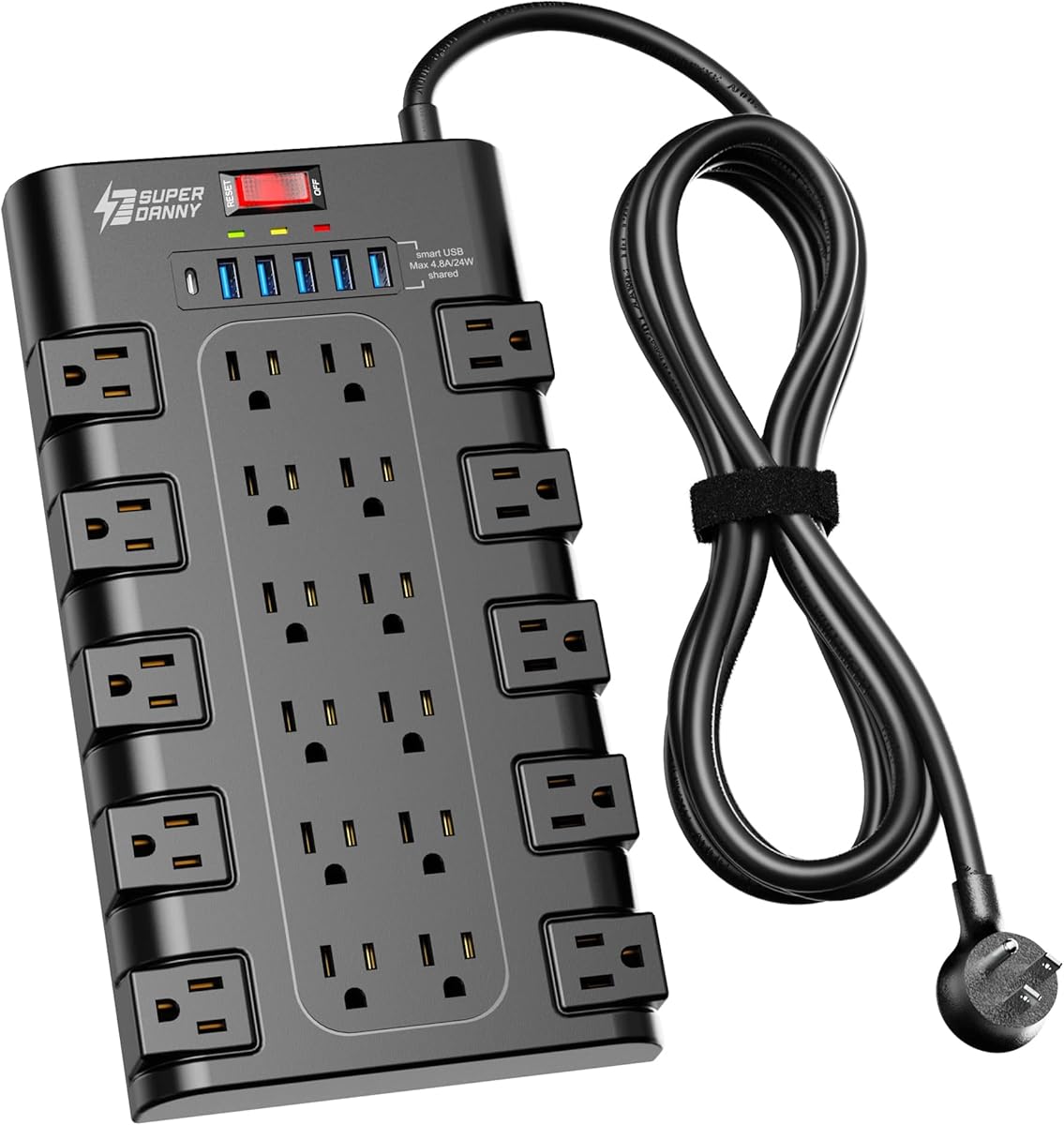
The SUPERDANNY 22 AC and 6 USB power strip combines extensive capacity with thoughtful outlet spacing, mounting provisions, and integrated charging. Its 4.8 rating and broad 1875W rating make it an especially versatile option for aquariums that operate several filters, heaters, lights, pumps, controllers, and accessories from a single dry location.
We may earn a commission when you buy through this link, at no additional cost to you.
Twenty-two grounded three-prong outlets are distributed across four rows, with enough spacing to reduce blocked receptacles. Six USB ports include five USB-A connections and one USB-C connection, and the smart charging system is rated to deliver up to 5V and 3A through USB-C. The 6.5-foot cord adds more placement flexibility than a short aquarium strip.
Installation features add to its appeal. Four rear keyholes allow wall or furniture mounting, and the hardware and marking sheet are included. Its 45-degree angled flat plug is designed to fit behind narrow furniture without covering the lower receptacle of a duplex outlet. The listed protections include surge, overload, grounded, short-circuit, overcurrent, overvoltage, and overheat protection.
Its size is the main drawback, and the side receptacles cannot rotate. Even so, the combination of outlet capacity, spacing, charging, and mounting flexibility makes this the most versatile overall pick. It should remain indoors in a dry, ventilated position above the aquarium, and the total connected wattage should stay comfortably below the stated limit.
The four-row layout separates outlets into usable groups rather than placing every adapter in one dense bank. This is especially helpful when a tank uses large heater plugs, inline timers, and external pump adapters.
The rear keyholes and included screws make it possible to secure the strip beneath a cabinet or on a wall. A mounted installation reduces clutter and keeps connections accessible for routine inspection.
We may earn a commission when you buy through this link, at no additional cost to you.
The Qiyuan weatherproof power strip is the only model here explicitly designed for outdoor and damp environments, making it relevant to pond equipment, patio installations, and aquarium systems located in humid utility areas. It has a 4.6 rating, six widely spaced outlets, three USB ports, and a six-foot cord.
We may earn a commission when you buy through this link, at no additional cost to you.
Its IPX6-rated sealed housing and spring-loaded covers are intended to resist wind-driven rain, snow, and sprinkler spray. The product information explicitly states that it is not designed for submersion or placement in standing water. That limitation matters: an aquarium splash zone is not the same as a fully exposed outdoor location, and the strip should never be dropped into a tank.
The electrical specification is clearly listed at 13A, 1625W, and 125V. A resettable circuit breaker interrupts power if the load exceeds the limit, while surge and overload protection address abnormal electrical conditions. Two USB-A ports and one USB-C port provide up to 5V, 2.4A, and 12W per port for compatible charging devices.
A sealed master switch allows the entire installation to be shut down without unplugging each component, and rear keyhole slots provide hanging options. The six-foot cord reaches from a wall outlet toward ponds, patios, or outdoor accessories. It is a sensible choice for protected damp locations, but indoor aquariums generally benefit from one of the more compact indoor models.
IPX6 protection is useful for rain and heavy splashing, but it does not make the strip submersible. It should be elevated above runoff and never connected or exposed while standing water surrounds the housing.
The wide-spaced outlets can accommodate large adapters associated with pond pumps and outdoor lighting. A master switch and hanging slots simplify seasonal setup and routine shutdown.
We may earn a commission when you buy through this link, at no additional cost to you.
The LeZone 4800-joule power strip combines a ten-foot cord with twelve AC outlets and four USB charging ports. Its 4.6 rating and ability to mount on a wall make it a practical option when an aquarium stand is separated from the nearest outlet or when a neat, reachable power hub is preferred.
We may earn a commission when you buy through this link, at no additional cost to you.
Its most useful feature for aquarium installations is the long cord. A ten-foot reach can connect equipment located on a wider stand or allow the strip to be mounted above and behind the cabinet without creating a tight, strained connection. The listed 4800-joule protection also exceeds the surge capacities stated for several competing strips in this guide.
The charging section includes two USB-A and two USB-C ports, with the USB-C connections described as supporting 15-watt power delivery. Its 0.31-inch flat plug is intended to slide behind furniture and reduce the gap created by a projecting wall plug. The product can also serve as a desk charging station, though aquarium owners should prioritize the AC receptacles for pumps, heaters, and lighting.
The product information does not provide the same extensive list of safety mechanisms or certification standards found in some competing listings, so buyers should verify the current product details and certification markings. Its long cord must be routed carefully to avoid snagging. Overall, it is a strong fit for a dry installation that values reach, mounting, and charging flexibility.
The extended cord makes it easier to place the strip where aquarium cords remain visible and accessible. It also reduces the temptation to use a separate extension cord, which can introduce an additional connection point.
A 4800-joule rating indicates substantial listed surge-energy capacity. It does not guarantee protection from every power problem, but it provides a useful comparison point among the strips reviewed here.
We may earn a commission when you buy through this link, at no additional cost to you.
The Nuetsa eight-outlet power strip delivers a balanced set of features for an aquarium installation that needs several grounded AC connections without carrying the footprint of a much larger strip. It holds a 4.8 rating and includes 2700 joules of surge protection, a six-foot cord, four USB ports, and ETL certification.
We may earn a commission when you buy through this link, at no additional cost to you.
Three of the four USB connections are USB-A and the fourth is USB-C. The USB-A ports are listed at up to 2.4A each, while the USB-C port is listed at up to 3A. Smart charging is intended to identify connected devices and deliver suitable output, although the product specifically notes that the USB-C port does not support devices requiring 9 to 22 volts.
The eight AC receptacles offer enough capacity for a modest aquarium composed of a heater, filter, light, and a few accessories. A flat plug eases placement behind narrow furniture, and a protected indicator light shows when surge protection is active. Overcurrent protection is designed to prevent the strip from becoming hot under excessive loading.
The absence of a built-in timer is the main limitation for aquariums seeking automatic lighting or feeding control. However, a separate inline timer can be added, or an aquarium controller can handle scheduling. The Nuetsa remains a compelling compact and budget-oriented choice because it combines ETL certification, useful charging, and a more generous surge rating than many similarly sized strips.
Eight grounded outlets are enough for most small and medium freshwater or reef systems. The shorter housing is easier to conceal than a strip with twenty or more receptacles.
The integrated USB-A and USB-C ports reduce the number of wall chargers surrounding the tank. Aquarium controllers, phones, and compatible accessories can share the same accessible power hub.
We may earn a commission when you buy through this link, at no additional cost to you.
The ROOTOMA six-outlet heavy-duty surge protector is especially relevant to aquariums because it offers individual switches for connected equipment. Its 4.7 rating, ten-foot cord, 1875W rating, and multiple protection functions make it a flexible option for pumps, heaters, lights, and accessories that need to be disabled independently.
We may earn a commission when you buy through this link, at no additional cost to you.
Each AC outlet has a separate on/off switch and indicator light. This makes it easy to cut power to one device without unplugging it or disrupting the rest of the tank. The arrangement can simplify troubleshooting, maintenance, and routines involving lighting, feeding devices, or circulation equipment.
The strip is described as a UL-approved 14AWG heavy-duty extension cord with a 15A capacity, a one-piece copper bar, and a fire-resistant PC shell. Listed protections include surge, circuit breaker, overload, short-circuit, overcurrent, overvoltage, and overheating functions. Mounting holes allow the unit to be secured under a cabinet or against a wall.
There is no integrated digital timer, so users requiring a precise schedule must add a compatible timer or aquarium controller. The ten-foot cord also needs careful routing to avoid creating a trip or snag hazard. Even so, the independent switching and long reach distinguish this model as one of the most operationally convenient options for a busy aquarium stand.
Individual switches let an owner turn off a heater or light without disturbing other connected equipment. The status lights also provide a quick visual check of which devices are receiving power.
A ten-foot 14AWG cord provides room to route the strip cleanly and a suitable reach for larger stands. Mounting holes help keep the power connections fixed and less likely to be pulled accidentally.
We may earn a commission when you buy through this link, at no additional cost to you.
The BN-LINK seven-day digital timer strip provides more precise control than a basic mechanical dial. With a 4.4 rating, four programmable outlets, four always-on outlets, and timing intervals down to one minute, it suits aquariums that follow weekday, weekend, feeding, or lighting routines.
We may earn a commission when you buy through this link, at no additional cost to you.
Up to eight on-and-off programs can be assigned to the four timed grounded outlets. Users can choose individual days or convenient preset day combinations, and the timer includes a daylight-saving adjustment mode. A backup battery preserves the programmed settings if the aquarium temporarily loses power, which is particularly helpful for longer unattended schedules.
All eight outlets have surge protection, while a circuit breaker provides an additional safety layer. The product is ETL listed and conforms to UL standards 1449, 1363, and 917, with listed 800-volt three-line protection. Separate colored row indicators show whether the timer-controlled and always-on sections are active.
The trade-off is a slightly steeper setup process than a mechanical timer, and the display is less convenient when the strip is mounted out of sight. It is still a strong match for owners who value granular weekly programming and a minimum one-minute interval. The unit is for indoor use and should be mounted or placed in a dry location above the aquarium.
Eight programs allow different routines to coexist, such as daytime lighting, evening feeding, and weekend maintenance cycles. One-minute settings are more precise than many simple aquarium timers.
The backup battery helps prevent a complete schedule reset after a brief power interruption. It does not keep filters or heaters running, but it helps the timer resume the intended schedule when power returns.
We may earn a commission when you buy through this link, at no additional cost to you.
The Belkin 12-outlet power strip is a premium choice for aquarium installations where many bulky adapters need flexible placement. Its 4.8 rating, eight rotating outlets, four standard outlets, eight-foot cord, and 4320-joule protection capacity distinguish it from the basic rectangular strips in this roundup.
We may earn a commission when you buy through this link, at no additional cost to you.
Rotating receptacles make it easier to accommodate large power bricks, heater plugs, and pump adapters without wasting the fixed outlets. The angled three-prong plug is useful in tight spaces, while the eight-foot cord offers enough reach for a stand positioned away from the wall. The additional standard outlets remain available for less bulky connections.
This model includes more than AC surge protection. Listed features include one-in, two-out RJ11 telephone or fax protection and coaxial protection for cable or satellite connections. Its eight-point safety system addresses over-temperature, overcurrent, overload, short circuit, clamping, and three-line AC surge conditions, with LED indicators for surge and ground status.
The product is independently tested and certified to UL safety standards and includes a two-year warranty along with a stated connected-equipment warranty. It lacks integrated USB charging, which may be a drawback for modern control systems. Nevertheless, its rotating design, long list of protections, and high surge capacity make it the most premium-oriented pick for complex aquarium installations.
Eight adjustable receptacles can be turned to accommodate large pump and heater plugs from different directions. This reduces blocked outlets and makes a crowded aquarium power setup more manageable.
The strip combines 4320 joules of AC surge protection with over-temperature, overload, short-circuit, and grounding-related safeguards. The added telephone and coaxial protection broadens its value for mixed electronics installations.
We may earn a commission when you buy through this link, at no additional cost to you.
The Belkin 12-outlet USB-C surge protector combines twelve AC receptacles, two fast-charging USB-A ports, and one USB-C port. Its 4.6 rating, 3480-joule protection, flat plug, mounting option, and UL safety certification make it a polished choice for a modern aquarium control setup.
We may earn a commission when you buy through this link, at no additional cost to you.
The twelve outlets are described as widely spaced, which helps when multiple AC adapters are connected simultaneously. A single master switch controls the connected devices, while the flat plug reduces the gap behind furniture. The six-foot cord is shorter than the Belkin premium rotating model but remains adequate for many standard aquarium stands.
The USB-A and USB-C connections make the strip useful for phones, tablets, and other compatible accessories without requiring separate wall chargers. Its listed 3480-joule overcurrent and overload protection is substantial among the reviewed products, and the product has been independently lab tested and certified to UL safety standards.
The main limitations are the lack of rotating receptacles and the absence of telephone or coaxial protection. The master switch also removes the fine-grained control offered by the ROOTOMA strip's individual switches. Still, the combination of modern charging, ample AC capacity, mounting, and strong surge protection makes this an attractive finished choice for aquariums with several powered devices.
Two USB-A ports and one USB-C port support convenient charging for compatible accessories. Consolidating power near the tank also keeps adapters and cables in a single, visible location.
The flat plug and included mounting option allow the strip to be secured behind or beneath a cabinet. This helps protect connections from accidental pulls while preserving access to the outlets.
We may earn a commission when you buy through this link, at no additional cost to you.
Choosing an aquarium surge protector requires balancing electrical capacity, physical placement, scheduling, and environmental exposure. The most important starting point is the number and type of devices connected, followed by where the strip can safely be installed without exposing it to water.
Add the nameplate wattage of every heater, filter, pump, light, controller, and other connected device, then compare the total with the strip's listed capacity. A strip labeled 1875W or 1625W should not be treated as a target to approach; maintaining a margin is wiser because motors, heaters, and pumps can draw differently under real operating conditions. Also consider whether the aquarium shares a wall receptacle with other high-draw appliances, since overloaded circuits can trip independently of the surge protector.
Choose a strip with enough rated headroom for your equipment and the intended future setup. Do not increase capacity by connecting one power strip to another unless both products and the instructions explicitly permit that arrangement.
Aquarium equipment is commonly metal and water-intensive, so a grounded three-prong outlet and reliable ground-fault awareness are important. The listed products with three-line protection cover line-to-neutral, line-to-ground, and neutral-to-ground surge paths according to their stated specifications. Surge protection is not the same as a ground-fault circuit interrupter, so aquarium owners should also use GFCI protection where required and keep the strip itself within the electrical code requirements for the location.
Prioritize a clearly grounded, certified design and never bypass the grounding pin. A surge protector supplements, rather than replaces, sound wiring and properly installed circuit protection.
A nominal outlet count tells only part of the story. Large heater plugs, inline timers, pump transformers, and charging bricks can occupy a surprising amount of horizontal space. Models with widely spaced outlets or rotating receptacles are often more useful than a strip with a higher headline count but tightly packed connectors. Choose enough receptacles for the present equipment and leave at least a few open positions for maintenance and future additions.
For most small and medium tanks, eight to twelve outlets provide ample capacity. Large reef systems, fish rooms, and equipment stands with numerous pumps often benefit from sixteen or twenty-two outlets.
Choose a cord that reaches from the wall outlet to the intended dry mounting point without being stretched taut. Three feet can work when the receptacle is directly above the stand, while six to ten feet offers more freedom for wider stands and cabinet layouts. A flat or right-angle plug can reduce the gap between the strip and wall, and a long cord should be secured so it cannot snag or be pulled by a moving aquarium lid.
Cord length should not be used to place the strip inside the tank stand where splashes, condensation, or maintenance water could reach it. Route the cable away from wet surfaces and avoid creating trip hazards.
Aquarium lighting, feeding devices, and some circulation routines may benefit from automatic scheduling. Mechanical timers are simple and dependable for a repeated daily routine, while digital timers allow multiple weekly programs and shorter intervals. A strip with four always-on outlets and four timed outlets is especially convenient because essential pumps and heaters can remain connected while less critical equipment follows a schedule.
If an aquarium controller already manages lighting and feeding, a simple non-timer strip may be preferable. Match the timer feature to your actual routine rather than paying for complexity you will not use.
Most products in this guide are intended for indoor use and should be mounted above the aquarium or on a dry wall where ordinary splashes cannot reach them. The Qiyuan model is explicitly designed with an IPX6 weather-resistant housing for outdoor and damp settings, but it still must not be submerged or left in standing water. No indoor strip should be placed inside the tank, on a wet cabinet top, or directly behind a splash-prone aquarium lid.
Use drip loops in any permitted low-voltage cable routing, keep wall receptacles away from water, and make sure maintenance access remains possible. Environmental suitability must always follow the product instructions.
A larger joule figure indicates greater listed energy absorption, while overload and overcurrent protection address sustained excessive loads. Compare surge ratings across the list: 2100, 2700, 3480, 4320, and 4800 joules are among the stated figures. The rating alone does not prove a strip can withstand a direct lightning strike, so it should be understood as one layer of protection rather than a guarantee against every power event.
Look for a resettable breaker, protected indicator, and multiple stated safeguards. After a major surge event, inspect the strip and replace it if its protection indicator no longer behaves as expected or physical damage is visible.
Mounting holes, keyholes, and flat plugs help create a safer, cleaner installation than a loose strip behind a cabinet. Integrated USB ports are useful for compatible controllers and personal devices, but USB output specifications vary. The SUPERDANNY model lists a USB-C connection up to 5V and 3A, while the Nuetsa USB-C port is limited to 3A and does not support devices needing 9 to 22 volts. Check charging requirements before connecting specialized aquarium hardware.
Cable ties, visible placement, and accessible switches also reduce accidental disconnections. The best setup is one an owner can inspect quickly for heat, discoloration, a tripped breaker, or a loose plug.
Choose a dry location before plugging anything in. Mount the strip above the aquarium, beneath a cabinet, or on a nearby wall, ensuring that neither the housing nor its receptacles can be reached by splashes, condensation, or maintenance water. Keep aquarium cords clear of the tank edge, and do not place the strip where the cabinet may periodically become wet.
Connect essential equipment first and calculate the operating load. Plug pumps, heaters, and lighting into the appropriate outlets, leave the switch off while connecting, and use the master or individual switches only after every connection is secure. Route longer cords with a gentle drip loop if low-voltage leads are involved, and use the provided mounting holes or keyholes to prevent accidental pulls.
Inspect the strip periodically. Check for discoloration, a hot plug, a tripped breaker, loose receptacles, or a surge indicator that appears abnormal. Unplug the device if you notice heat, a burning odor, buzzing, or visible damage, and do not reset a breaker repeatedly without identifying the load causing the trip. Replace the protector after a significant surge or if its status indicator no longer provides the expected protection signal.
Only if the installation area remains completely dry and the product instructions permit it. Most indoor surge protectors are not waterproof, so placing one inside a wet cabinet risks shock, corrosion, and damage. Mounting it above the tank, on a dry wall, or beneath the cabinet is generally safer.
No. A surge protector is intended to divert or absorb transient voltage spikes, while a GFCI is designed to interrupt power when current leakage is detected. Aquarium installations may require GFCI protection under local electrical codes, and a listed surge protector can be used with one when the products and instructions are compatible.
Count the heater, filters, pumps, lights, controllers, feeding devices, and any other powered accessories, then add a few open receptacles for future use. Eight to twelve outlets are common for a single aquarium, while large systems or fish rooms may benefit from a strip with eighteen or twenty-two outlets and generous spacing.
A higher listed joule rating generally indicates greater surge-energy absorption capacity, but it does not guarantee protection from every event. Correct grounding, suitable circuit protection, careful installation, and compliance with the product's ratings remain just as important. Compare joule ratings along with outlet layout, cord length, and safety features.
Only if the device explicitly supports USB power and its voltage and current requirements match the listed output. Some aquarium controllers use proprietary connectors or require higher charging voltages, such as the 9-to-22-volt range that the Nuetsa USB-C port is said not to support. Verify device requirements before connecting it.
Its IPX6 housing is intended to resist rain, snow, and heavy splashing, making it more appropriate for pond and patio power than ordinary indoor strips. It must still remain above standing water and must never be submerged. The wall connection, mounting point, and entire electrical installation also need appropriate weather protection.
An always-on outlet is generally more appropriate for essential circulation and heating equipment because it avoids accidentally scheduling a shutoff. Timed outlets are better suited to lighting, feeding accessories, and other equipment with a predictable operating cycle. Follow the heater manufacturer's instructions and local safety requirements.
Do not daisy-chain strips unless the instructions for both products explicitly allow it. Connecting multiple strips can increase the load on a wall circuit, create additional failure points, and potentially violate the manufacturer's guidance. Use one properly rated strip or consult a qualified electrician for a larger installation.
The SUPERDANNY 22-outlet strip stands out as the most versatile overall choice because it combines abundant capacity, wide spacing, USB charging, mounting hardware, and a generous 1875W rating. The Belkin rotating model is the premium option for complex installations with many bulky adapters, while the Nuetsa eight-outlet strip provides the best budget-oriented balance of compact size, USB connectivity, ETL certification, and 2700-joule protection.
Prioritize the features your aquarium actually requires. Simple setups may need only eight grounded outlets, a suitable cord length, and reliable surge protection. Larger systems may benefit from individual switches, precise digital scheduling, more widely spaced receptacles, or a weather-resistant model designed for a protected damp location.
Before buying, confirm the current specifications, certification details, plug compatibility, and electrical ratings. Prices, package contents, and product details can change, so check the current listing and compare the final connected load before selecting a surge protector for your aquarium.