SEAC Partner
4.0Editor score
Records up to 99 dives
100-meter water resistance
Backlit display
Our dive watch for freediving guide compares 10 models for depth tracking, display clarity, safety features, durability, navigation, and everyday versatility.
A dive watch for freediving should do more than tell time. It should provide dependable depth information, track individual dives, remain legible underwater, and help you build safer training habits without distracting you from the breath-hold discipline that defines the sport.
We compared ten dive watches and watch-style computers using their stated depth capabilities, display features, safety functions, navigation tools, construction, connectivity, and suitability for everyday wear. The list covers purpose-built freediving computers as well as broader dive computers with relevant apnea or freediving functions.
Each review explains what distinguishes the model, where it fits into a freediving setup, and which divers may find it worthwhile. Product ratings and availability can change over time, and prices fluctuate, so readers should confirm current details before purchasing.
4.0Editor score

4.8Editor score

4.6Editor score
The table below compares all ten watches by their most relevant stated features, including depth handling, underwater visibility, safety functions, construction, and additional tools. It is a quick way to identify the right balance of simplicity, data, and advanced features for freediving.


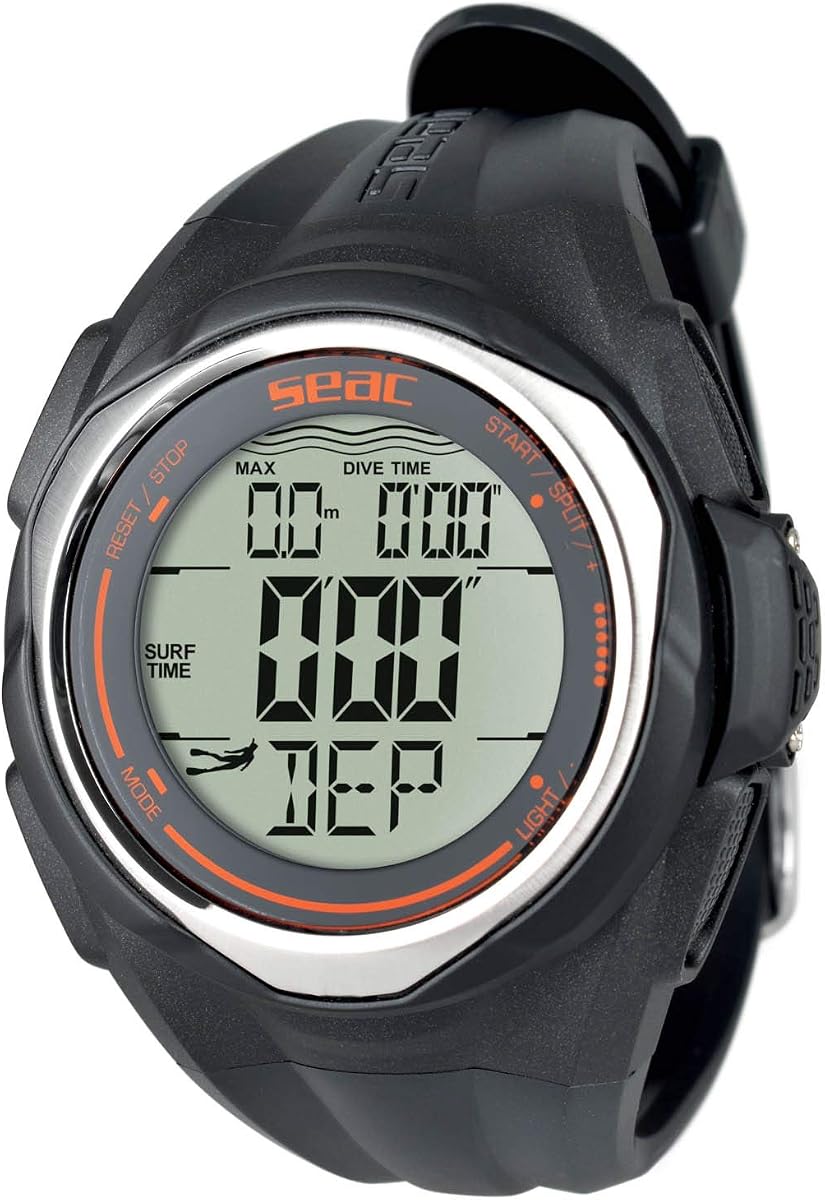
The SEAC Partner is a straightforward, wrist-mounted freediving computer with a 4.0 customer rating. Its appeal comes from focusing on the essential parts of dive tracking rather than presenting a large collection of scuba and smartwatch functions. It records a session of up to 99 dives, includes a stopwatch and countdown, and provides a backlit display for underwater visibility.
We may earn a commission when you buy through this link, at no additional cost to you.
For new freedivers, the compact feature set can be easier to understand than a multifunction computer. The 100-meter water resistance gives it a credible level of protection for pool training, shore diving, boat dives, and snorkeling. A standard CR2032 battery is also a practical feature for users who do not want to depend on proprietary rechargeable batteries or a charging dock.
The main compromise is that the listed functionality does not include the deeper analytical tools found in premium models. There is no stated wireless pairing, advanced navigation bundle, elaborate health tracking, or broad collection of programmable alarms. It is therefore better suited to a diver who wants clear depth-and-time data without paying for features that may never be used.
Choose the SEAC Partner if you are building a first freediving setup, training regularly, or prefer a purpose-built computer with uncomplicated controls. It is also a sensible option for divers who want an inexpensive backup computer and understand that a backup should be configured and familiarized with before it is needed.
Recording up to 99 dives gives the watch a useful session history, while the stopwatch and countdown functions complement breath-hold training. This focused approach makes it easier for divers to identify the essentials without navigating a crowded scuba menu.
The standard CR2032 battery removes the need for a dedicated charging cable and allows a diver to carry a familiar spare. The backlit display and 100-meter water resistance reinforce its suitability for regular aquatic use.
We may earn a commission when you buy through this link, at no additional cost to you.
The SALVIMAR One Plus is a watch-style wrist computer designed for freediving, spearfishing, snorkeling, and underwater training. Its 4.2 rating reflects a broadly capable feature set centered on depth tracking to 100 meters, real-time dive time, surface interval information, and water temperature monitoring.
We may earn a commission when you buy through this link, at no additional cost to you.
The EL backlight is a major practical advantage because freedivers often work in low light or need to check information with minimal attention. A depth gauge, dive timer, and recovery tracking can help divers understand the rhythm of a session, while the additional stopwatch and countdown functions support land-based breath-hold practice.
This model also extends beyond the water. World time, five programmable alarms, and a long-term calendar make it useful for travel and everyday wear. That versatility does not compensate for every missing technical feature, however. The supplied specifications do not mention wireless log transfer or advanced decompression configuration, so it is more suitable for monitoring than for detailed technical analysis.
The SALVIMAR One Plus is a good match for a recreational freediver who wants more than a basic stopwatch and still appreciates a watch for everyday use. It is particularly attractive for spearfishers and snorkelers who value temperature, elapsed time, and an illuminated display in one relatively compact device.
The EL backlight helps a diver read depth, elapsed time, and temperature in dark water or dim surface conditions. A screen that can be checked quickly supports better situational awareness without taking attention away from the surrounding environment for long.
World time, calendar functions, a stopwatch, and programmable alarms give the watch value between training sessions. For travelers or users who want one device for training, travel, and general daily wear, that combination can be more practical than a narrowly specialized computer.
We may earn a commission when you buy through this link, at no additional cost to you.
The SUUNTO D5 is a general dive computer with a color display, 100-meter water resistance, wireless tank pressure support, vibration alarms, a digital compass, and wireless mobile connectivity. It carries a 4.0 rating and is most compelling for divers who use the same watch across freediving and tank-based activities.
We may earn a commission when you buy through this link, at no additional cost to you.
Its wireless connection allows the watch to interact with a compatible phone, which can be useful for reviewing information and keeping software workflows connected. The digital compass also adds a surface navigation tool, while the color display offers more visual information than a monochrome screen. Vibration alerts are useful because they can provide a discreet prompt when watching a wrist device is inconvenient.
Its biggest limitation for a freediving-focused shopper is that the supplied information does not identify it as a dedicated apnea computer. Wireless tank pressure is irrelevant to a freediver, and the broader feature set may not be necessary. Buyers who only want depth, time, and session data may find a purpose-built model simpler.
The SUUNTO D5 makes the most sense for a diver who wants a versatile, connected dive watch and may also scuba dive. It is less compelling as a first dedicated freediving tool unless its freediving functionality has been confirmed against current manual information and the diver's specific requirements.
The D5 is designed as a general-purpose dive computer rather than a freediving-only device. Divers who move between apnea training, snorkeling, and scuba can benefit from carrying one watch that supports several activities and mobile integration.
Vibration alerts can communicate important information without relying solely on sound. This is useful in noisy conditions and when the wearer wants to avoid drawing attention to the watch.
We may earn a commission when you buy through this link, at no additional cost to you.
The Cressi Nepto is a compact computer explicitly designed for freediving. With a 4.1 rating, its most distinctive qualities are its specialized protection algorithm for taravana risk, a function intended to avoid pulmonary edema risk, a high-contrast 35-millimeter display, and resistance to 120 meters of water pressure.
We may earn a commission when you buy through this link, at no additional cost to you.
A 48-millimeter case diameter keeps the watch more compact than many general-purpose dive computers. The high-contrast screen is a meaningful advantage because a diver must interpret core information quickly. Mineral glass, steel buttons, a rubber strap, and a stainless steel buckle are also well suited to an aquatic tool expected to endure frequent handling.
The Nepto is less versatile than the smartwatch-style alternatives in this list. Its appeal comes from being designed around freediving needs rather than combining fitness features, smart notifications, contactless payment, and a large color screen. Buyers who want a watch that can replace several everyday devices may need to look elsewhere.
This is a strong recommendation for divers who place particular value on dedicated safety functions, a compact profile, and a readable display. It may be especially persuasive for those who want a clearly specialized freediving computer rather than adapting a scuba-focused model to breath-hold training.
The stated taravana-protection algorithm and pulmonary-edema avoidance function distinguish the Nepto from general dive watches. These features reflect the company's effort to address risks associated with breath-hold diving rather than merely recording depth and elapsed time.
The 48-millimeter case and 35-millimeter high-contrast display balance a wrist-wearable format with visibility. Mineral glass and steel buttons add durability where a freediving watch is likely to encounter pressure, impact, and salt water.
We may earn a commission when you buy through this link, at no additional cost to you.
The Cressi Leonardo 2.0 is a scuba dive computer with a 4.2 rating, a single-button interface, Air, Nitrox, and Gauge modes, critical audible and visual alarms, and connectivity for iOS and Android devices. It is a capable general dive watch, although its listed strengths center on scuba rather than freediving.
We may earn a commission when you buy through this link, at no additional cost to you.
The single-button control scheme is useful for anyone who prefers not to navigate complex underwater menus. Gauge mode can provide a basic depth-and-time framework, and the dive log can be transferred by USB or infrared for later review. For a scuba diver who also freedives, the watch may be more relevant than the supplied description first suggests.
However, a freediver should not assume that an Air or Nitrox scuba mode provides the same protections and information as a dedicated apnea computer. The data supplied does not explicitly identify a freediving mode, specialized breath-hold metrics, or an apnea safety algorithm. Those details should be checked in the manual before using it for serious depth training.
The Leonardo 2.0 is best recommended to a diver who values simple controls, established dive-watch features, and connectivity, and who also needs a capable scuba computer. A dedicated freediving watch remains the more obvious choice for safety-focused breath-hold work.
A single-button interface reduces control complexity and can make the computer easier to operate underwater. This is particularly useful when the wearer needs to make a quick adjustment without navigating a crowded series of controls.
USB and infrared transfer, along with stated iOS and Android pairing, make it easier to preserve and examine dive history. This adds value for divers who want to compare sessions or review information after returning from the water.
We may earn a commission when you buy through this link, at no additional cost to you.
The Garmin Descent G1 combines a rugged watch-style dive computer with smartwatch functions and holds a 4.6 rating. Its sapphire lens, silicone band, monochrome display, 25-hour battery in dive mode, and support for recreational, technical, freediving, and spearfishing make it a credible all-around option.
We may earn a commission when you buy through this link, at no additional cost to you.
Surface entry and exit markers are especially useful for freedivers who repeat a specific site. GPS, GLONASS, and Galileo support can improve surface positioning, while the compass and onboard storage of up to 200 dives support both navigation and review. More than 30 sports apps and advanced training features also make the watch useful between sessions.
The monochrome display is less visually rich than the AMOLED screen on the Descent Mk3i, and the watch may feel more substantial than a 48-millimeter dedicated freediving computer. Its health features should be treated as estimates rather than medical measurements, as Garmin itself notes. None of these points prevents it from being a strong freediving tool, but they affect who will value it most.
The G1 is a good choice for an active diver who wants freediving tools in a durable watch with training, navigation, and daily wearable functions. It is especially attractive for divers training at repeatable shore or boat entry points where marking the surface location is valuable.
The ability to mark entry and exit points helps a diver retrace the surface route after a session. This is particularly useful around reefs, wrecks, or rocky coastlines where surface orientation can be difficult.
Built-in sports apps and training metrics extend the watch beyond the dive log. They can help a freediver monitor workload, recovery, and broader fitness habits that influence how prepared they feel for demanding breath-hold sessions.
We may earn a commission when you buy through this link, at no additional cost to you.
The Garmin Descent Mk3i is a high-end watch-style dive computer with a 4.6 rating, a 1.4-inch AMOLED display, sapphire lens, 51-millimeter titanium bezel, and a 200-meter dive-rated case. It supports multiple dive modes, including freediving, and brings together navigation, communications, training, and wellness tools.
We may earn a commission when you buy through this link, at no additional cost to you.
The large AMOLED screen offers a clear and visually rich way to check depth, time, navigation, and other information. A built-in LED flashlight with variable intensity and strobe modes provides valuable visibility above or below water. The ABC sensors include an underwater compass, while DiveView maps offer bathymetric contours and access to more than 4,000 listed dive sites.
Its 51-millimeter dimensions may feel substantial on a smaller wrist, and the extensive feature set can demand more attention during initial setup. Optional SubWave communication and tank-monitoring functions require compatible hardware, with the Descent T2 transceiver sold separately. The dive-readiness tool and health readings are estimates rather than medical determinations.
The Mk3i is the premium recommendation for a diver who wants the most capable general-purpose option in this roundup. Its display, construction, mapping, flashlight, and training functions justify that focus for divers who view the watch as a long-term piece of equipment. Freedivers who only need depth and time will find simpler models more efficient.
The 1.4-inch AMOLED screen makes maps, depth information, and training metrics easy to distinguish. Sapphire glass protects the display, while the titanium bezel and sealed inductive buttons suit a demanding aquatic environment.
Multi-band GPS, an underwater compass, and DiveView maps help with orientation, while the integrated flashlight adds a practical source of light. Together, they reduce the need to carry several separate tools on a dive.
We may earn a commission when you buy through this link, at no additional cost to you.
The Cressi Raffaello is a four-mode dive computer with a 4.4 rating. Its stated modes include apnea and gauge, while the built-in digital compass, mixed-gas planning, Bluetooth and USB transfer, and user-replaceable battery broaden its usefulness for divers who move between breath-hold and other diving styles.
We may earn a commission when you buy through this link, at no additional cost to you.
Apnea mode is the most important feature for this audience because it confirms that the watch is equipped for breath-hold diving rather than merely offering a generic depth gauge. The digital compass also removes the need to carry a separate compass, and the replaceable battery is attractive for anyone who prefers a long service interval without relying on a proprietary charger.
The trade-off is breadth rather than focus. RGBM-based mixed-gas planning has limited relevance to a freediver who never uses compressed gas, and the watch does not present itself in the same way as a compact computer built around freediving-specific safeguards. Divers seeking automatic breath-hold warnings may need to confirm the exact behavior of apnea mode in the current documentation.
The Raffaello is best for a diver who wants dependable apnea support plus a compass and the option to use other dive modes. It is particularly practical for spearfishers and traveling freedivers who appreciate a replaceable battery and simple digital navigation.
Explicit apnea and gauge modes make the Raffaello more relevant to freediving than a watch with only compressed-gas profiles. Gauge mode can support basic instrument-style monitoring, while apnea mode provides a purpose-built operating option.
A user-replaceable battery with an expected life of four years can simplify ownership compared with sealed rechargeable systems. Bluetooth and USB transfer make it convenient to move stored dive information to a phone or computer.
We may earn a commission when you buy through this link, at no additional cost to you.
The Shearwater Research Teric has the highest customer rating in this roundup at 4.8. It combines a wrist-watch form factor with Open-Circuit, Fixed PO2, Gauge, and Freediving modes, giving it broader relevance than a freediving-only watch while still treating breath-hold diving as a specific operating mode.
We may earn a commission when you buy through this link, at no additional cost to you.
Its Bühlmann ZHL-16c algorithm with configurable Gradient Factors appeals to divers who want control over decompression modeling. Switchable audible and vibration alerts provide flexible ways to receive prompts, and the 316 stainless steel bezel and buttons add a durable, corrosion-resistant exterior. Optional wireless tank transmitters can extend the watch for scuba use without limiting its core freediving role.
That sophistication also creates a learning curve. A diver who wants only a stopwatch, maximum depth, and bottom time may find the menus excessive. The configurable algorithm is primarily meaningful to experienced users who understand decompression concepts, and optional accessories add further considerations when building the complete system.
The Teric is an excellent choice for an experienced freediver who wants detailed information, reliable alerts, and a computer capable of growing into technical diving. It is also our top recommendation when data quality and configuration matter more than smartwatch extras or a large color display.
Freediving mode provides a relevant starting point for breath-hold sessions, while Gauge, Open-Circuit, and Fixed PO2 modes extend the watch to other forms of diving. This makes it a strong option for divers whose activities change from one season to the next.
The Bühlmann ZHL-16c algorithm and adjustable Gradient Factors offer sophisticated control for users familiar with decompression planning. Audible and vibration alerts can be switched according to the environment, improving awareness without requiring a single notification style.
We may earn a commission when you buy through this link, at no additional cost to you.
The Shearwater Research Peregrine carries a 4.7 rating and is built around a simple two-button interface with a state-aware menu structure. Its 316 stainless steel buttons, wireless charging station, and stated battery life of up to about 30 hours at medium brightness make it a durable, practical computer for frequent wear.
We may earn a commission when you buy through this link, at no additional cost to you.
The interface design is notable because it aims to reduce menu complexity without making the watch feel like a general-purpose smartwatch. A two-button system can be quicker to learn than a crowded touch display, particularly when a diver wants to access core data with minimal interaction. The included charging dock also adds convenience at home or before a trip.
The supplied product information gives less detail about the Peregrine's specific freediving mode, depth functions, and safety alerts than it does for the Teric. A prospective buyer should therefore verify those functions in the current manual. This is the most important limitation in comparing it with the more explicitly specified models on this list.
The Peregrine is a worthwhile option for a diver who values a rugged case, straightforward controls, and a strong customer rating over smartwatch breadth. It may serve as a practical everyday dive computer, but a shopper focused specifically on breath-hold safety should confirm its freediving features before deciding.
The state-aware menu structure is designed to keep navigation direct. Two durable stainless steel buttons can be easier to operate reliably than a touchscreen when the wearer is focused on the dive rather than the device.
A stated battery life of about 30 hours at medium brightness supports multiple sessions when managed sensibly. The included USB wireless charging station provides a dedicated place to recharge the computer between dives.
We may earn a commission when you buy through this link, at no additional cost to you.
The right freediving watch depends on your experience, training style, dive environment, and tolerance for menus. Start with essential depth and time data, then consider safety features, visibility, battery management, and whether the computer must also serve scuba or everyday needs.
A dedicated apnea or freediving mode is the clearest sign that a watch was designed to interpret breath-hold dives rather than merely act as a generic depth gauge. The supplied information explicitly identifies apnea or freediving modes in the SALVIMAR One Plus, Cressi Nepto, Cressi Raffaello, Shearwater Research Teric, and Garmin Descent models. General dive computers may still record basic depth and time, but their behavior around surface intervals, breath-hold timing, and freediving alerts can differ.
Prioritize an explicit freediving mode when safety and session interpretation are your main requirements.
Maximum rated depth should comfortably exceed the depths you actually plan to reach. The products in this guide state limits ranging from 100 meters for the SEAC Partner, SALVIMAR One Plus, and SUUNTO D5 to 120 meters for the Cressi Nepto, while the Garmin Descent Mk3i has a 200-meter dive-rated case. Water resistance and depth-tracking capability are related but should not be treated as interchangeable without checking the manual.
Choose a rating that safely covers your planned dives and leaves a sensible margin for deeper excursions.
A freediver needs to read essential information quickly and with minimal visual focus. The Cressi Nepto emphasizes a high-contrast 35-millimeter display, the SEAC Partner and SALVIMAR One Plus include backlighting, and the Garmin Descent Mk3i uses a large 1.4-inch AMOLED screen. The monochrome Garmin Descent G1 is rugged and readable but offers less visual richness, while the SALVIMAR One Plus uses an EL backlight for low-light conditions.
Prioritize contrast, backlighting, display size, and information layout over decorative screen quality.
Alerts can be valuable when a freediver is focused on the surface, environment, or another diver. The Cressi Nepto highlights protection related to taravana and pulmonary edema risk, while the Shearwater Research Teric offers switchable audible and vibration alerts. The SUUNTO D5 also provides vibration alarms, and the Cressi Leonardo 2.0 includes visual and audible critical alerts. No watch should replace training, buddy procedures, conservative depth progression, or sound judgment.
Look for meaningful alerts and readable warnings, but treat them as supplementary safeguards rather than guarantees.
Battery management depends on how and where you dive. The SEAC Partner uses a standard CR2032 battery, and the Cressi Raffaello uses a user-replaceable battery with an expected four-year life. The Garmin Descent G1 states up to 25 hours in dive mode, the Shearwater Research Peregrine states about 30 hours at medium brightness, and the Peregrine includes a wireless charging station. The Descent Mk3i adds a built-in flashlight and advanced electronics, illustrating why battery expectations can vary considerably.
Choose the power system that matches your travel routine, spare-part availability, and tolerance for regular charging.
Underwater orientation and finding the surface after a dive are important parts of freediving safety. The Cressi Raffaello and SUUNTO D5 include digital compasses, while the Garmin Descent G1 can mark surface entry and exit points using GPS, GLONASS, and Galileo. The Descent Mk3i adds multi-band GPS, an underwater compass, and DiveView maps with bathymetric depth contours. These features are most valuable for divers exploring larger areas rather than staying close to a known entry point.
Add navigation features when they solve a real problem in your usual dive site or travel environment.
A dive watch must tolerate salt water, pressure, impacts, and repeated movement. The Cressi Nepto uses mineral glass, steel buttons, a rubber strap, and a stainless steel buckle. The Shearwater Research Teric has a 316 stainless steel bezel and buttons, and the Peregrine uses 316 stainless steel buttons. Garmin's models add sapphire lenses, with the Mk3i using a titanium bezel. Conversely, the compact 48-millimeter Nepto may wear more discreetly than the 51-millimeter Mk3i.
Balance rugged materials against size and weight, because a comfortable watch is more likely to be worn consistently.
Onboard log storage and phone connectivity make it easier to compare depth profiles, session duration, and other performance trends. The Garmin Descent G1 stores up to 200 dives, the Cressi Leonardo 2.0 supports USB and infrared transfer, and the Cressi Raffaello offers Bluetooth and USB. The Descent Mk3i also stores dives and supports app personalization, while the SUUNTO D5 provides wireless mobile connection. These extras are helpful, but they do not compensate for weak core dive data.
Use smart functions to enhance analysis, not to distract from the immediate task of monitoring the dive.
Before taking a new watch into open water, charge or install the battery, confirm the time and date, review the freediving or apnea mode, and learn how to start and stop a dive. Read the manual for the specific model, adjust the units, check the alarm settings, and perform a controlled test in shallow water before relying on the device during a deeper session.
During a dive, use the computer to monitor depth, elapsed time, and the information relevant to your training plan. Avoid handling the watch more than necessary, keep the display readable without obscuring your surroundings, and return to the surface with the conservative plan you established before entering the water. For deeper or repetitive training, follow established freediving protocols and the advice of a qualified instructor or experienced buddy.
After the session, rinse the watch thoroughly with fresh water, paying attention to the strap, buttons, sensors, and charging contacts. Dry it with a soft cloth, avoid harsh chemicals, and follow the manufacturer's instructions for battery storage and charging. Review the recorded dive, note anything unusual, and make sure the watch is configured correctly before the next outing.
A general dive computer can often provide basic depth and elapsed-time data during freediving. However, a dedicated apnea or freediving mode may present surface intervals and breath-hold information in a more useful way and may include features designed for specific freediving risks. Confirm that the watch supports the type of freediving you plan to do before using it beyond shallow practice.
Choose a rating that exceeds your planned maximum depth with a reasonable safety margin. A 100-meter-rated watch is adequate for many recreational divers, while deeper-rated models may suit technical and spearfishing environments. Water resistance, operational depth, and the manufacturer's warnings should be checked separately because a case rating does not guarantee that every operating function is appropriate at every depth.
No. A dive watch supports awareness and planning, but it cannot guarantee that a diver will avoid taravana, pulmonary edema, shallow water blackout, entanglement, or other hazards. Use appropriate training, conservative limits, a buddy system, suitable supervision, and established emergency procedures. Automatic alerts should be treated as one layer of protection rather than the only one.
A backlight can be highly useful in low light, deep water, early morning conditions, or around shaded entry points. It allows a diver to check depth and time without relying on ambient sunlight. The SEAC Partner, SALVIMAR One Plus, and other featured models include illumination, while the Cressi Nepto emphasizes a high-contrast display for general readability.
A dedicated watch is usually easier to learn and emphasizes relevant breath-hold data, while a smartwatch-style model can provide brighter screens, mapping, fitness features, notifications, and broader everyday utility. The Cressi Nepto represents a compact specialized approach, whereas the Garmin Descent models offer more general-purpose functions. Choose based on how much you will use those extra features.
Logs and connectivity are valuable when you want to compare sessions and identify patterns in depth, duration, or recovery. The Cressi Raffaello, Cressi Leonardo 2.0, and Garmin Descent models offer stated data-transfer or storage capabilities. They are less important for a diver who only wants live depth and time, and connectivity should never be allowed to distract from the dive itself.
Some models support freediving alongside scuba modes. The Shearwater Research Teric lists Open-Circuit, Fixed PO2, Gauge, and Freediving modes, while the SUUNTO D5 and Cressi Leonardo 2.0 are designed around general dive functions. Confirm mode behavior, depth limits, and accessory requirements before combining activities, especially when using tank-pressure hardware.
Rinse the watch with fresh water after every dive, especially if it was exposed to salt, sand, chlorine, or mud. Clean the strap and buttons gently, dry the unit completely, and inspect it for damage. Follow the manual for battery replacement or charging, and have the device serviced if the display, seals, buttons, or sensors behave unusually.
The SEAC Partner is a practical entry point for divers who value a simple, purpose-built freediving computer, session storage, and a replaceable standard battery. The Cressi Nepto stands out for compact construction and specific safety-oriented features, while the Shearwater Research Teric offers the strongest combination of dedicated freediving support, detailed configuration, and a high customer rating.
For buyers seeking a broader everyday device, the Garmin Descent G1 provides rugged construction, surface-location marking, training tools, and strong dive-watch integration. The Descent Mk3i is the premium all-rounder, combining a vivid AMOLED display, flashlight, maps, GPS, and advanced training features. Choose the model that matches your actual diving needs rather than selecting on the longest feature list.
Before buying, confirm the current freediving mode, depth specification, display behavior, battery expectations, and included accessories. Ratings, product details, and prices can change, so check the current listing carefully and make sure the computer is configured and familiar before taking it into open water.