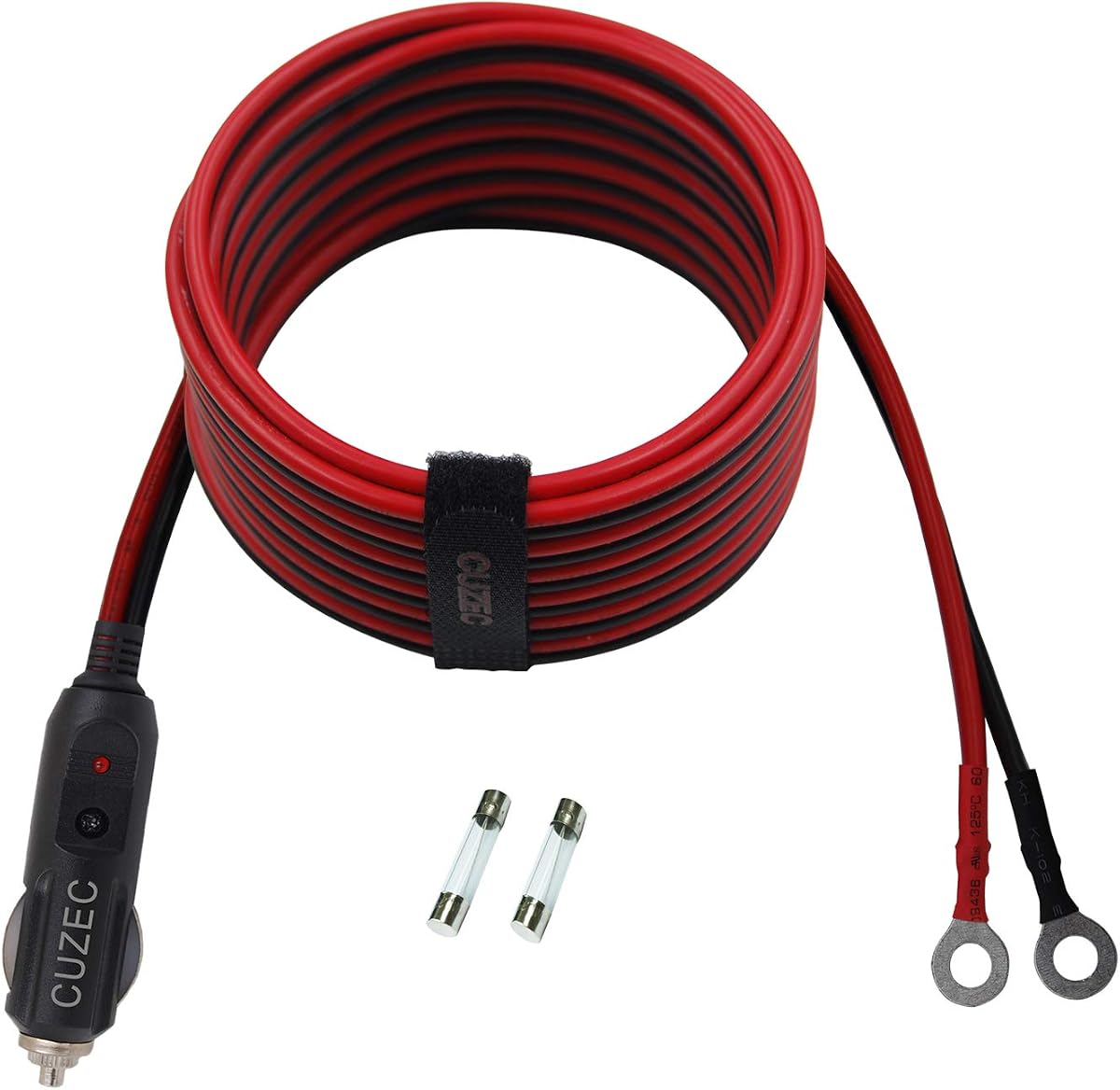
CUZEC 14AWG 20A Adapter
4.7Editor score
Twenty-amp plug rating
Twelve-foot cable length
Twelve- and twenty-four-volt support
Fuse and status LED
Power inverter cables connect vehicle power to inverters safely. This guide compares ten options by gauge, length, terminals, fuses, materials, and installation
Power inverter cables connect a vehicle battery, socket, or DC system to an inverter so household-style equipment can operate from stored energy. A suitable cable must fit the installation, handle expected current, provide secure polarity, and include suitable fault protection where appropriate.
This guide compares ten cable-related options across several installation styles, including cigarette-lighter adapters, direct battery leads, heavy-gauge battery sets, and cut-to-length wire kits. We considered conductor size, cable length, connector type, fuse protection, conductor material, terminal coverage, and stated uses.
The list shows where each product fits best: compact vehicle connections for modest loads, battery-direct runs for demanding equipment, and flexible wire kits for custom installations. Product ratings and availability can change, so verify the current listing and your inverter requirements before buying.
4.7Editor score
4.8Editor score

4.6Editor score
The table below compares the ten options by connection style, conductor size, approximate length, and notable protection or installation features. It helps distinguish quick socket leads from direct battery cables and custom-cut wiring kits.




This cigarette-lighter inverter cable provides a compact way to connect compatible 12V or 24V equipment through a standard vehicle socket. Its 4.6 rating reflects generally favorable buyer feedback, while the three-foot length, 16 AWG conductors, and 15A fuse make it most appropriate for compact, lower-to-moderate-load installations rather than a full high-output inverter installation.
We may earn a commission when you buy through this link, at no additional cost to you.
The lead uses heavy-duty red and black copper wire, with a bakelite plug shell and copper spring. A green LED indicates that the cable is receiving power, while the built-in glass fuse provides a visible and replaceable point of protection. Extra 20A and 15A glass fuses are included, adding practical value for owners who want a spare before traveling.
Its most important limitation is the relatively short lead. Three feet is useful for powering a small inverter close to the dashboard socket, but it can be restrictive when the inverter must sit farther away. The socket circuit, the plug fuse, and the inverter's own requirements all remain part of the overall electrical limit, so a larger cable cannot make an undersized vehicle circuit safe.
This is a good selection for portable air pumps, electric cups, compact electronics, or a smaller inverter used near a front socket. It is less attractive for high-current loads, long routing distances, or installations requiring a direct battery connection. For those needs, move up to a 14 AWG lead or a heavy-gauge battery cable.
The standard male plug is intended to work with most vehicle cigarette-lighter sockets. That makes installation quick because no battery terminal removal or permanent cable routing is required.
The green power LED, replaceable 15A glass fuse, and red-positive, black-negative conductors help make operation easier to understand and maintain.
We may earn a commission when you buy through this link, at no additional cost to you.
This 5 AWG battery cable pair offers a useful combination of length, terminal variety, and broad application support. The product has a 4.6 rating and includes one red positive lead and one black negative lead, each measuring ten feet. It is designed for automotive, marine, RV, solar, motorcycle, audio, and other direct-current wiring applications.
We may earn a commission when you buy through this link, at no additional cost to you.
Each cable has a 3/8-inch lug at one end and a 5/16-inch lug at the other. Those two sizes are helpful because battery posts, inverter studs, and distribution equipment do not always use the same hardware. Copper lugs receive a tinned coating for corrosion protection, while polyolefin heat-shrink tubing seals the cable-to-lug attachment points.
The main trade-off is that this is a fixed-length set without a listed inline fuse. Users must place appropriate overcurrent protection in the positive path if the inverter and its load require it. The supplied data also lists grounding, solar, and automotive uses broadly, so those applications still call for correct polarity, a suitable fuse, and an installation that follows electrical safety practices.
Choose this set when you need a ten-foot direct battery run and want flexibility between two common lug sizes. It is especially appealing for marine or outdoor inverter projects where corrosion-resistant lugs and sealed terminations are priorities. It is less suitable when a custom route needs exact cutting or when a preinstalled fuse holder is essential.
The different 3/8-inch and 5/16-inch ring lugs can match different battery posts and inverter studs without modifying the cable ends.
Tinned copper lugs and heat-shrink seals help protect connection points in humid, dusty, marine, and general outdoor environments.
We may earn a commission when you buy through this link, at no additional cost to you.
This heavy-duty 14 AWG adapter bridges the gap between a compact lighter plug and a more capable 20A lead. It carries a 4.6 rating, includes a six-foot cable, and offers a male cigarette-lighter plug with a 20A fuse. The lead also includes an eyelet terminal sized for 5 mm or 6 mm inverter studs.
We may earn a commission when you buy through this link, at no additional cost to you.
The stated conductor cross-section is 2.08 square millimeters, compared with 1.31 square millimeters for 16 AWG, giving it a lower resistance rating for comparable runs. It supports both 12V and 24V systems, with output voltage matching the vehicle supply, and the plug's LED indicates when power is present.
The adapter includes both a 20A fuse and a 25A spare fuse. That is useful for replacement planning, although the installed fuse should be selected according to the vehicle circuit, cable rating, inverter requirements, and applicable electrical guidance. A 25A spare should not be treated as permission to exceed the rating of the plug or upstream circuit.
This lead is a sensible middle ground for a portable inverter, air pump, or electric appliance that needs more reach and current capacity than a short 16 AWG lead. It remains dependent on the vehicle's socket and fuse, so it does not replace a properly sized direct battery cable for sustained high-output operation.
The six-foot length gives an inverter more placement freedom while retaining the convenience of a removable socket connection.
A plug fuse, LED status indicator, and included eyelet terminal provide useful installation and operating features in one lead.
We may earn a commission when you buy through this link, at no additional cost to you.
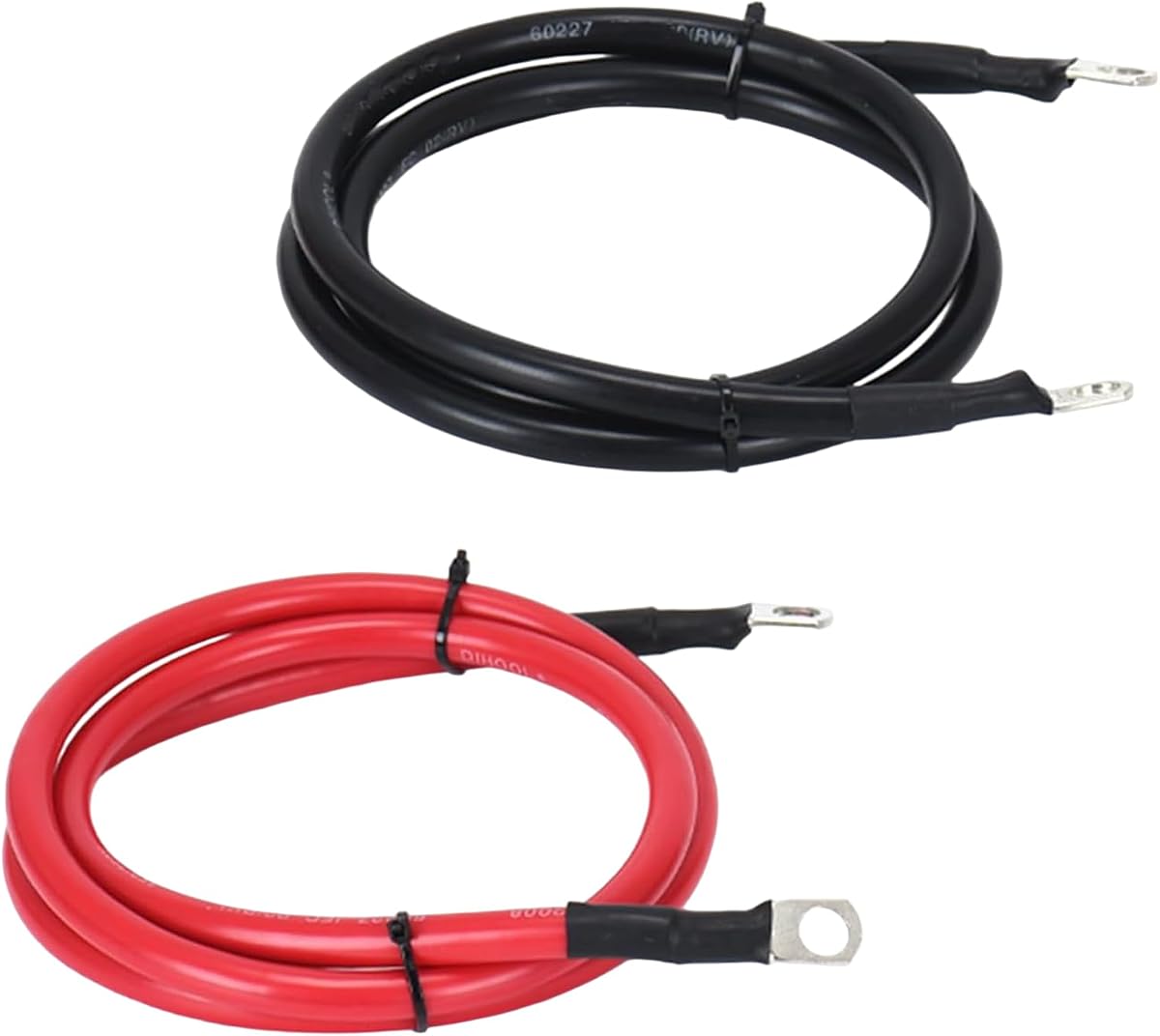
This four-foot 4 AWG battery cable pair is the strongest all-around direct-lead option in the group. It has the highest listed rating at 4.8 and uses pure copper conductors, tinned copper lugs, flexible PVC insulation, and heat-shrink tubing. The set includes red and black leads with 3/8-inch ring terminals at each end.
We may earn a commission when you buy through this link, at no additional cost to you.
Its copper construction is a notable strength for an inverter lead because lower conductor resistance can reduce voltage drop during demanding loads. The tinned lugs improve resistance to corrosion and oxidation, while the jacket is described as abrasion resistant, waterproof, moisture proof, flame retardant, and heat insulating.
This product does not include a fuse holder, so the installation must provide suitable protection on the positive side. Its four-foot length is also the central limitation: it works well for a battery-to-inverter layout with a short, direct route, but it offers little margin for larger vehicles, complex routing, or equipment positioned farther from the battery.
It is a strong recommendation for owners who want a compact, purpose-built battery-to-inverter set and can route the cables without extension. Compared with lighter CCA wire kits, its pure-copper construction is preferable when minimizing resistive loss matters. Confirm the inverter's current draw, cable length, terminal size, and fuse requirements before installation.
Pure copper offers a straightforward advantage over copper-clad aluminum in a connection where lower resistance and dependable high-current performance are priorities.
Tinned copper lugs and heat-shrink seals help protect the points where the cable is most vulnerable to moisture, abrasion, and corrosion.
We may earn a commission when you buy through this link, at no additional cost to you.
This CUZEC lead is designed for installations where the inverter sits farther from the battery than a short socket adapter allows. It includes a 13.1-foot 16 AWG extension, a battery clamp, and an eyelet terminal with a 0.25-inch or 6.3 mm ring opening. Its 4.5 rating is solid, though slightly lower than the leading products.
We may earn a commission when you buy through this link, at no additional cost to you.
The lead connects directly to a vehicle battery and supports 12V and 24V appliances. Red identifies positive and black identifies negative. An external 15A fuse is included for short-circuit and surge protection, along with an extra 15A fuse and a 25A backup fuse according to the product information.
Its 16 AWG conductor and 15A fuse are the important limitations. This is not the appropriate choice for a large inverter that continuously draws high current, even though the listing mentions high-power inverter use. The long lead can also increase voltage drop under substantial load, making correct sizing and secure routing particularly important.
This product makes sense for portable equipment that needs a long reach but stays within the limits of the wire and fuse. It is convenient because the battery clamps can be removed without dismantling a fixed terminal connection. For sustained heavy loads, a 4 AWG or 5 AWG battery cable with appropriately located overcurrent protection is the better direction.
The 13.1-foot lead and battery clamps let portable equipment connect directly to the battery while remaining farther from the vehicle's socket.
The external 15A fuse provides a replaceable protection point and can be inspected during routine setup and maintenance.
We may earn a commission when you buy through this link, at no additional cost to you.
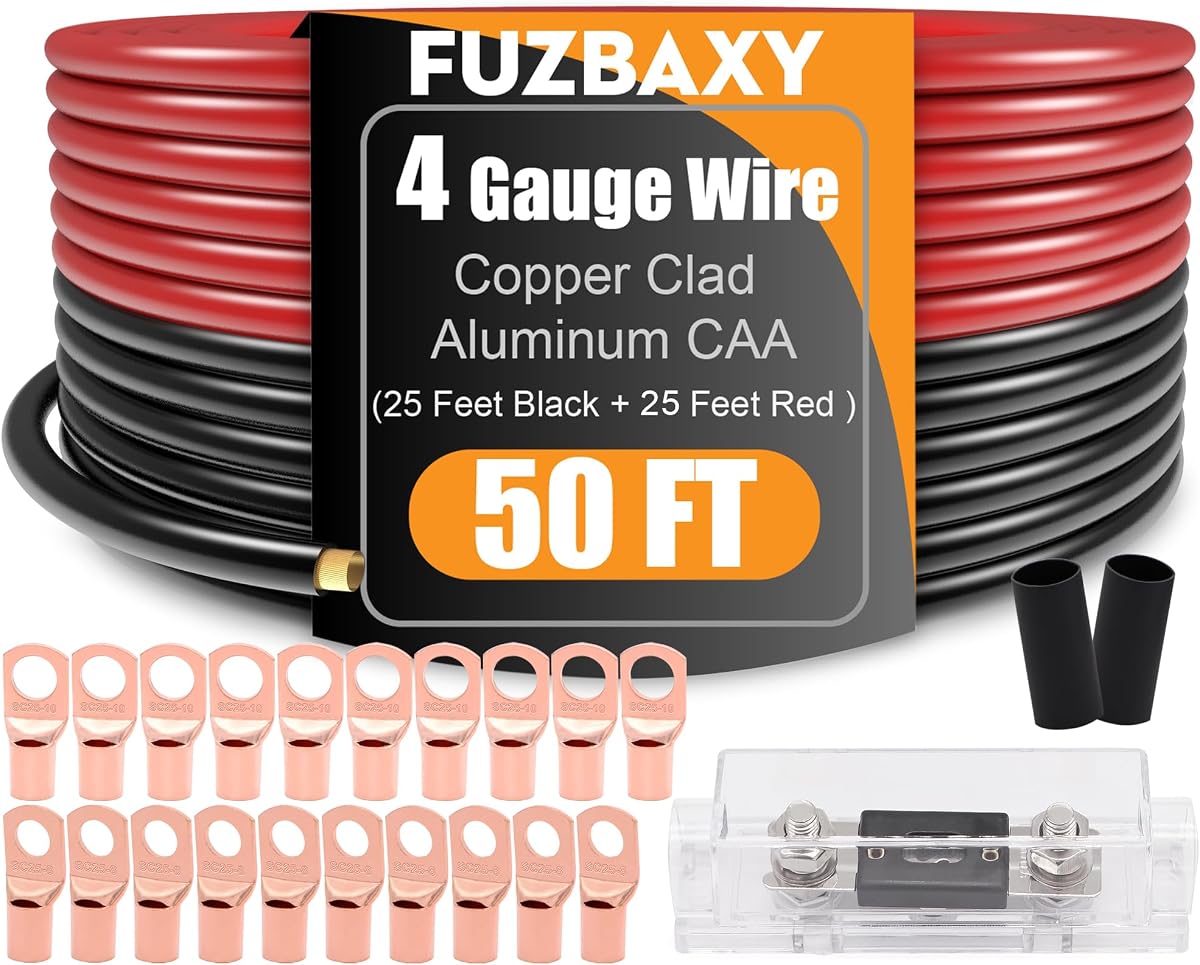
This kit is the most complete option for a custom power-inverter installation. It provides 25 feet of red and 25 feet of black 4 AWG copper-clad aluminum wire, a 100A ANL fuse holder and fuse, 20 ring terminals, and heat-shrink tubing. The 4.6 rating and broad automotive, marine, solar, and RV uses make it relevant to several power projects.
We may earn a commission when you buy through this link, at no additional cost to you.
The included fuse holder is a major advantage for installers who want a protected positive run rather than a simple pair of loose leads. The long wire can be cut to fit custom routes through vehicle compartments, boats, trailers, and solar installations. Fine-stranded CCA also offers flexible handling compared with many rigid conductors.
CCA requires careful consideration. The listing describes it as copper-clad aluminum and positions it as a more economical option than pure oxygen-free copper. It is not the same conductor as the pure-copper sets in this guide, and the correct size must be determined from the load, route length, acceptable voltage drop, and installation environment rather than by inverter wattage alone.
Choose this kit when a complete package, adjustable length, and integrated 100A fuse holder are more valuable than a ready-made lead. It suits experienced installers building a battery, inverter, or distribution-panel connection. The included 100A fuse rating does not automatically make every downstream load safe, so the entire circuit still needs appropriate design and protection.
Wire, ring terminals, heat-shrink tubing, and a fused holder reduce the need to source separate pieces before beginning a larger installation.
Custom cutting eliminates excess conductor in a compact installation and makes it easier to route each color along its intended path.
We may earn a commission when you buy through this link, at no additional cost to you.
This set shares the high 4.8 rating and pure-copper construction of the four-foot A ABIGAIL cable while offering a longer option for installations with additional routing distance. It includes red positive and black negative 4 AWG wires with 3/8-inch ring terminals at each end.
We may earn a commission when you buy through this link, at no additional cost to you.
The flexible PVC jacket is described as abrasion resistant, waterproof, moisture proof, flame retardant, and heat insulating. Heat-shrink tubing seals the cable ends, and tinned copper terminals add corrosion and oxidation resistance. Those qualities make the set relevant to automotive, solar, marine, RV, motorcycle, golf-cart, and general equipment wiring.
There is a notable listing discrepancy. The product title identifies the set as six feet, while one package-content bullet states 24-inch wire. The shared product image also appears with the four-foot listing. Buyers should confirm the actual cable length in the current listing and customer-provided information before ordering, especially where routing distance determines whether voltage drop will be acceptable.
If the listed six-foot length is correct, this is a strong lead for a battery-to-inverter run requiring more space than the four-foot set. Its pure-copper conductors and sealed terminals remain its chief attractions. It is not a complete protected circuit, so an appropriately rated fuse or breaker still needs to be installed according to the design.
The stated six-foot length is useful when a short battery lead cannot pass neatly around an engine bay, seat, storage compartment, or equipment panel.
Because the description contains conflicting measurements, checking the current package contents is important for avoiding an unsuitable cable length.
We may earn a commission when you buy through this link, at no additional cost to you.
The GEARit set provides 25 feet each of red and black 4 AWG copper-clad aluminum wire, giving installers fifty total feet for a custom route. Its 4.6 rating and stated uses include amplifiers, batteries, inverters, distribution panels, and automotive wiring, making it a flexible middle ground between a pre-terminated lead and a full fuse-and-terminal kit.
We may earn a commission when you buy through this link, at no additional cost to you.
Fine-stranded conductors and flexible jackets help with routing through trunks, panels, amplifier racks, and battery compartments. Red and black provide familiar color coding for positive and negative runs. Since the wire is supplied as continuous lengths, each conductor can be measured and cut to suit the installation instead of forcing a fixed-size cable into a complicated path.
Unlike the larger wire-and-fuse kit, this product does not list ring terminals, heat-shrink tubing, or a fuse holder. Those must be sourced separately and sized for the conductor and intended circuit. The CCA construction is also worth comparing against pure copper, particularly for a long run where resistive loss and heat under sustained load become important.
This wire set works well for an installer who values route flexibility and already has suitable termination and protection components. It can also serve car audio, battery, inverter, and panel projects when its electrical characteristics fit the planned load. Verify terminal bore size, crimp compatibility, and conductor size before finalizing the installation.
Continuous 25-foot conductors can be cut to the measured route, making the pair practical for installations with turns, panels, or separated connection points.
Fine-stranded wire and a flexible jacket are easier to maneuver around brackets, trim panels, racks, and battery compartments than stiff conductors.
We may earn a commission when you buy through this link, at no additional cost to you.
This CUZEC adapter is a capable socket lead for owners who want more length and current capacity than a short basic cable. It has a 4.7 rating, a 12-foot 14 AWG cable, a 20A fuse, a power-on LED, and compatibility with standard cigarette-lighter sockets and other suitable 6.3 mm terminal connections.
We may earn a commission when you buy through this link, at no additional cost to you.
The lead supports 12V and 24V systems, with output voltage matching the vehicle supply. Its stated 20A capacity makes it more ambitious than a 15A 16 AWG lead, while the extra two feet over the comparable six-foot adapter provides useful placement flexibility. Red and black conductors simplify positive and negative identification.
The package includes the lighter plug and cable, one 20A fuse, and one 25A spare fuse. A spare adds convenience, but the installed fuse and upstream vehicle circuit remain the limiting factors. Socket connections also introduce contact resistance and depend on the socket's construction, so they are not equivalent to a bolted direct-battery connection.
This is a good budget-oriented choice for car inverters, air pumps, electric cups, and DIY equipment that fit within the stated electrical limits. Choose it when quick plug-in operation and a long reach are priorities. For high-output continuous use, upgrade to heavy-gauge battery cable and fuse protection instead of relying on the vehicle socket.
The extended lead lets the inverter or appliance sit farther from the socket, which can improve access to cargo areas, rear seats, and camping equipment.
The LED shows when the plug is receiving power, while the replaceable fuse provides an accessible protection point in the lead.
We may earn a commission when you buy through this link, at no additional cost to you.
This entry is different from the cable-only products because it combines a 300W pure sine wave vehicle inverter with a detachable 3.2-foot XT60 cable. It has a 3.9 rating, the lowest in the group, and is best viewed as a compact all-in-one power solution rather than a universal replacement for heavy-gauge battery wiring.
We may earn a commission when you buy through this link, at no additional cost to you.
The inverter converts vehicle 12V DC into 110V AC at 60Hz. It offers two AC outlets, two USB-A ports, and a 60W USB-C port. The detachable XT60 connection may be convenient for portable placement, while the intelligent cooling fan remains inactive below 100W and produces a stated 28.6 dB when operating.
The short cable and complete inverter package do not make the lead appropriate for a permanent high-current installation. The detachable lead connects the inverter to the vehicle, but the product information does not establish that it is equivalent to a 4 AWG direct battery cable or that it is suitable for loads near the inverter's full rating. Load startup behavior and manufacturer limits should be checked.
Choose this product for a small, portable power station that supplies ordinary 110V appliances or charges devices from a vehicle. It is convenient for travel, but it does not replace heavy-gauge battery leads for a full-size inverter, winch, solar battery bank, or fixed installation. Verify the vehicle connection, load list, and cable limitations before use.
Bundling the inverter, AC outlets, USB ports, and detachable vehicle lead simplifies a portable travel power setup.
The stated pure sine wave output is designed to provide steadier AC power than square or modified sine wave alternatives for compatible electronics.
We may earn a commission when you buy through this link, at no additional cost to you.
The right power inverter cable depends on load current, cable run, connection method, vehicle electrical system, and environmental conditions. Match the lead to the installation rather than selecting solely by inverter wattage or cable length.
Start with the inverter's continuous output requirement and the connected load's actual draw. Because inverter input power is generally higher than its AC output power, the DC cable may need to carry substantially more current than the wattage label alone suggests. Check startup surges as well, especially for motors, compressors, heating devices, and other equipment that draws extra power when starting.
Longer cables increase resistance and can cause greater voltage drop under load. A lead that feels adequate in a short dashboard installation may perform differently across a long truck, trailer, boat, or battery-to-inverter run. Route length includes both the visible cable and any hidden travel through panels or around obstacles. When voltage stability matters, use a heavier conductor rather than simply adding extra length.
Pure copper and copper-clad aluminum offer different trade-offs. Pure copper is generally the straightforward choice when low resistance, heat control, and dependable high-current delivery are priorities. Copper-clad aluminum can provide lighter, flexible, and potentially more economical wire for suitable custom installations. The conductor material should be considered alongside gauge, length, temperature, and acceptable voltage drop.
Cigarette-lighter adapters are quick and removable, while battery clamps add reach without permanent terminal changes. Ring-terminal leads provide a more secure battery or inverter connection, and continuous wire supports custom routes. Inspect whether the battery, inverter stud, distribution block, or panel uses a 3/8-inch, 5/16-inch, 6.3 mm, eyelet, or other termination.
A fuse or breaker should be placed in the unprotected positive conductor close to the battery or power source. Its rating must coordinate with conductor size, the inverter's requirements, and the vehicle circuit without defeating either conductor or plug protection. Socket adapters in this list include replaceable fuses, while direct battery sets may require a separate holder. Never install a larger fuse without checking every current-carrying component.
Vehicle compartments, engine bays, marine locations, and solar installations can be hot, damp, salty, or exposed to abrasion. Flexible insulated jackets, tinned terminals, corrosion-resistant plating, and heat-shrink seals help protect termination points. Keep cable away from sharp edges, moving parts, exhaust heat, and chafing surfaces, and use appropriate fasteners to prevent terminals from loosening.
Correct polarity is essential: red should connect to positive and black to negative, while the inverter's DC input markings should also be followed. Verify whether the inverter accepts a cigarette-lighter input, direct battery connection, or an XT60-style lead. Portable plug leads are convenient, but not every vehicle socket is designed for sustained high-current operation.
The best cable is one that fits without being pinched, stretched, or routed through a hazardous path. Before ordering, identify where the cable will run, whether it must be removable, how it will be retained, and whether terminal tools or crimping equipment are needed. A complete kit can simplify sourcing, but installers should still verify that every included component matches the chosen cable and circuit.
Before installation, disconnect the vehicle battery or otherwise de-energize the circuit according to the vehicle manufacturer's guidance. Identify positive and negative terminals, inspect the cable for damaged insulation, and confirm that the terminal sizes, fuse rating, and conductor gauge match the inverter and battery. Secure tools, remove metal jewelry, and work in a dry, ventilated area.
For a socket adapter, push the male plug fully into the vehicle socket and connect the inverter with the engine running if the vehicle manufacturer recommends operating the charging system. For a direct battery lead, attach the correct ring terminals, install the appropriately rated fuse in the positive path near the battery, and tighten connections according to the equipment instructions. Observe polarity carefully and avoid routing the lead across sharp or hot components.
After installation, check for correct LED indication, stable inverter startup, and unexpected voltage drop under the intended load. Periodically inspect cable jackets, crimps, ring terminals, fuse holders, and routing points. Replace damaged or discolored components, keep terminals clean and tight, and never bypass a fuse to overcome a repeated blown-fuse condition.
A direct battery connection is generally preferable for high-output or continuous inverter use because it avoids limitations associated with the vehicle socket and its upstream fuse. Use appropriately sized conductors, a correctly rated fuse near the positive battery terminal, and secure terminals. A lighter adapter is more convenient for modest loads and portable use.
The correct gauge depends on DC input current, cable length, acceptable voltage drop, and the installation environment. Higher-wattage inverters generally require heavier cables, especially over longer runs. Do not select solely by the inverter's AC output label; verify its input current and startup requirements before choosing a conductor.
Only if the plug, cable, vehicle socket, and upstream fuse are all rated for the inverter's input current and duty cycle. Many vehicle sockets are intended primarily for lighter accessories rather than sustained high-current loads. For demanding equipment, a fused direct-battery connection is usually the more appropriate arrangement.
The fuse rating must match the conductor, inverter input, and any upstream protection while interrupting a fault safely. A common approach is to locate the fuse close to the positive battery terminal, but the exact rating requires the equipment requirements and applicable electrical guidance. Do not install a higher-rated fuse simply to stop a nuisance trip.
They are not identical. Pure copper generally offers lower resistance and is a straightforward choice for compact, high-current runs. Copper-clad aluminum can work for suitable custom installations and may provide easier handling or lower weight. When comparing them, consider gauge, length, temperature, terminal quality, and allowable voltage drop together.
Use a heavier conductor, shorten the route where practical, and ensure all connections are clean and tight. Very long runs can require substantially more copper than short battery leads. Measure voltage at the inverter under load and compare it with the inverter's acceptable input range rather than relying on an unloaded reading.
In a typical battery installation, the fuse belongs in the positive cable close to the battery or other DC source. This arrangement helps limit current during a short circuit before damage occurs along the unprotected section. Follow the inverter manufacturer's placement instructions and ensure the holder and wiring are rated for the intended current.
Inspect the cables before each substantial trip or installation change, and periodically during routine vehicle or system maintenance. Look for cracked insulation, loose terminals, corrosion, discoloration, damaged heat-shrink tubing, exposed conductor, and chafing. Replace compromised parts promptly and investigate why a fuse blew before changing its rating.
The A ABIGAIL four-foot 4 AWG set stands out for its high rating, pure-copper conductors, and protected terminals, while the CUZEC 14 AWG adapter offers an accessible socket-based option with generous reach. For comprehensive custom work, the four-gauge wire kit combines long conductors, ring terminals, heat-shrink tubing, and a 100A fuse holder.
Prioritize conductor capacity, total route length, correct protection, and a connection method that suits the load. Quick plug-in leads are useful for portable and lighter-duty systems, whereas sustained high-output installations benefit from direct, fused battery wiring. Terminal dimensions, polarity, environmental exposure, and inverter requirements deserve equal attention.
Ratings, included accessories, and product details can change, so check the current listing before purchasing. Compare the cable's limits with the inverter's input current and the vehicle's electrical system, and verify current product availability and pricing at the time of purchase.