
Sensi Smart Thermostat ST55
4.4Editor score
Often works without C-wire
Flexible schedules and remote access
Energy usage and maintenance reports
This Smart Home Thermostat guide compares 10 Wi-Fi thermostats for scheduling, comfort, energy insights, app control, installation, and smart-home compatibility
A smart home thermostat makes temperature control more convenient by adding remote access, flexible schedules, occupancy-based automation, and useful energy information. The right model depends on your HVAC system, wiring, preferred app, and need for sensors or voice features.
We compared ten leading thermostats on comfort controls, scheduling, remote access, energy-management tools, installation requirements, HVAC compatibility, and smart-home integration. The list includes models for straightforward installations, renters and older wiring, premium connected homes, and households seeking room-level control.
Each review explains the strongest reasons to consider a model, along with its important limitations. Ratings reflect the supplied customer feedback, while features and compatibility details are subject to manufacturer updates. Prices change frequently, so verify current listings and system requirements before buying.
4.4Editor score

4.4Editor score

4.3Editor score
The table below compares all ten thermostats across their most important distinctions, including connectivity, installation needs, occupancy features, and smart-home support. It is designed to make compatibility and feature trade-offs easier to assess before opening a product listing.


The Google Nest Thermostat is a straightforward connected thermostat for households that want remote control without a complicated equipment list. It carries a 4.1 rating and centers on scheduling, mobile access, automatic away behavior, and compatibility with Google Home, Google Assistant, Matter-certified voice assistants, and Alexa. Its restrained feature set makes it approachable, but less expansive than the premium ecobee models.
We may earn a commission when you buy through this link, at no additional cost to you.
The thermostat is designed to work without a C wire in many homes, which can simplify replacement of a conventional model. Installation still depends on the existing equipment: heating-only, cooling-only, zone-controlled, and heat-pump systems may require a C wire or another compatible power accessory. Buyers should use the Nest Compatibility Checker before ordering, particularly for older or unusual HVAC configurations.
The Google Home app supports schedule creation, remote temperature changes from a phone, laptop, or tablet, and family access. Nest can reduce heating or cooling when the home is empty, while Savings Finder looks for opportunities to refine the schedule. HVAC monitoring adds another layer by sending alerts when something appears abnormal and providing maintenance reminders. These features are useful without requiring a separate sensor or a premium display.
The honest limitation is that the Nest does not include built-in occupancy detection. It must rely on its automatic away feature and the schedule configured by the household. It also lacks some of the room-level controls found in the ecobee Premium, since compatible SmartSensors are not listed for this model. That makes Nest a sensible choice for straightforward comfort and energy scheduling, especially for Google Home users, but less suitable for people who want radar-based presence detection or sensor-guided room control.
Schedules can be created in the Google Home app for Android and iPhone, and household members can change the set temperature remotely from several types of devices. The automated away behavior can help avoid heating or cooling an empty home without requiring constant manual changes.
Savings Finder reviews the schedule and suggests possible improvements, while the energy provider can identify rebates or other programs. HVAC monitoring looks for signs of a problem and supplies maintenance reminders, giving the thermostat useful functions beyond basic temperature adjustment.
We may earn a commission when you buy through this link, at no additional cost to you.
The ecobee Smart Thermostat Essential combines a familiar thermostat format with Wi-Fi control, a color touchscreen, and a capable set of energy features. Its 4.2 rating reflects a balanced approach: households can adjust settings by tapping the screen or through the ecobee app, while the thermostat automatically follows a configured schedule when no one is home.
We may earn a commission when you buy through this link, at no additional cost to you.
Compatibility is broad, with the manufacturer stating support for 85% of systems. The model works with most 24 VAC gas, oil, electric, dual-fuel, forced-air, conventional, heat-pump, and boiler equipment. Homes without a C wire can use the optional ecobee Power Extender Kit, and an optional trim kit can improve the finished appearance. Because those accessories are sold separately, owners should account for them before installation.
The eco+ tools add meaningful value. Indoor humidity detection supports comfort decisions, the Schedule Assistant helps organize temperature changes, and Time of Use can preheat or precool when energy is less expensive. The app also lets users monitor energy consumption while away. Compatible SmartSensors can be added to measure temperature and movement in important rooms, although occupancy data is not built into the Essential itself.
This is a good middle ground for someone who wants a polished screen, app access, and optional room-level intelligence without moving to the top ecobee tier. The trade-offs are the lack of a built-in occupancy sensor and the extra cost of installation accessories when a home lacks a C wire. Buyers who want intelligent presence detection out of the box should compare the Enhanced, while those who mainly need a capable touchscreen and flexible schedule will find the Essential easy to justify.
The thermostat combines schedule assistance, indoor humidity detection, and Time of Use preheating or precooling. These tools are designed to coordinate comfort with energy conditions, although actual results depend on the household schedule, system, and local energy program.
Adding ecobee SmartSensors allows the system to consider the rooms people use most and detect movement. The two-pack is sold separately, so this is a gradual upgrade rather than a standard feature of the Essential package.
We may earn a commission when you buy through this link, at no additional cost to you.
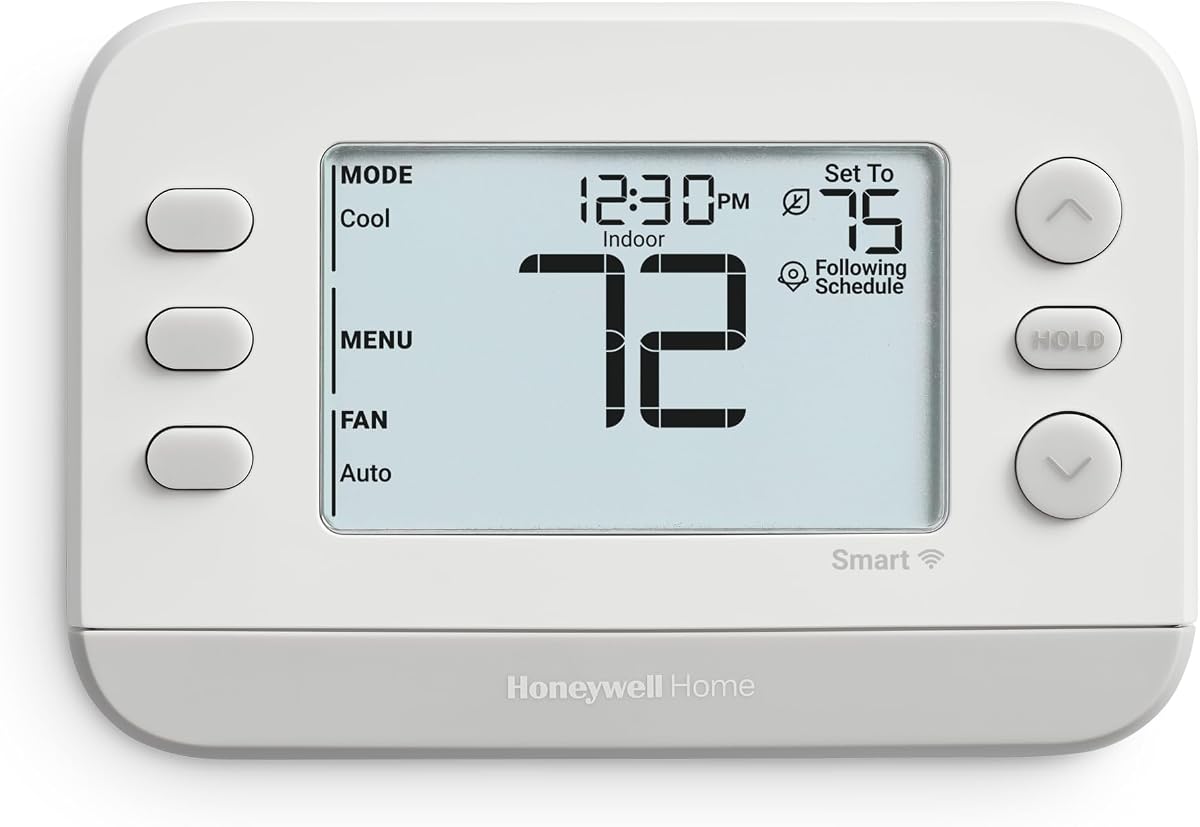
The Honeywell Home RTH9585WF1004 is a polished 4.3-rated option for homeowners who appreciate a color screen and a highly visible thermostat. It supports seven-day programming, mobile app control, Amazon Alexa, and Google Home. Its main distinction is the combination of aesthetic customization, detailed energy reports, and utility program support.
We may earn a commission when you buy through this link, at no additional cost to you.
The bright touchscreen is designed for simple operation, and the display color can be personalized to complement the room. Flexible programming accommodates a household schedule or a utility's peak-rate pricing. It is also ENERGY STAR certified and can provide monthly heating and cooling reports along with personalized suggestions intended to reduce energy use.
Compatibility is a critical consideration because a C wire is required. The model supports forced-air systems using gas, oil, or electricity, hot-water and steam heating, and heat pumps with electric backup. It does not work with 120–240V electric baseboard heat, and heating-only oil systems need a C wire. It works with most heating-and-cooling oil furnace systems, but compatibility should still be checked before purchase.
The model offers three fan-control options: always on, automatic, and a circulate setting that runs the fan randomly about 35% of the time. Those choices, monthly reports, and demand-response participation make it appealing for utility-conscious households. Its limitation is installation complexity compared with models that can operate without a C wire. It is best for a compatible conventional or heat-pump home that wants a colorful, information-rich display and established smart-home support.
The customizable color screen is more than a cosmetic distinction for buyers who want the thermostat to blend into a visible wall location. The bright touchscreen also prioritizes legibility during everyday scheduling and status checks.
Eligible households may be able to enroll in a local utility demand-response program that allows slight temperature adjustments during periods of high energy demand. Rebates and incentives vary, so the utility should be contacted before purchase.
We may earn a commission when you buy through this link, at no additional cost to you.
The Sensi Smart Thermostat ST55 is one of the most approachable connected options in this guide, combining a 4.4 rating with a familiar physical design. It provides Wi-Fi access, flexible scheduling, remote control, energy reports, and maintenance reminders without trying to recreate the appearance of a premium entertainment device.
We may earn a commission when you buy through this link, at no additional cost to you.
Installation is designed for common residential HVAC systems, and a C wire is generally unnecessary in most applications. A built-in level and step-by-step app instructions help position the thermostat accurately. Its traditional button-based layout, screen, and wall footprint also make it easier for some buyers to transition from a mechanical or digital model without patching or repainting the wall.
The ENERGY STAR-certified thermostat is advertised to help save about 23% on HVAC energy through flexible scheduling, remote access, and usage reports. Sensi also monitors HVAC performance and efficiency, provides equipment alerts, and reminds users when a filter replacement may be due. The manufacturer also states that Sensi will not sell personal information to third parties, which may appeal to privacy-conscious buyers.
Its main limitation is that it does not offer the sophisticated room sensing, large color display, or premium voice hardware found elsewhere in the list. It is a better fit for a household seeking straightforward control, simpler installation, and useful reports without a large feature premium. Confirm HVAC compatibility and C-wire status before purchase, and use the included installation resources to avoid unnecessary wall damage.
The ST55 retains the shape and familiar controls of a conventional thermostat while adding Wi-Fi scheduling and remote access. That makes it a practical option for first-time smart thermostat buyers who value an uncomplicated interface.
Beyond temperature changes, the thermostat can report equipment usage, flag possible system concerns, and remind the household about filter replacement. These functions help make the device useful even when a user is not actively changing the schedule.
We may earn a commission when you buy through this link, at no additional cost to you.
The ecobee Smart Thermostat Enhanced earns this guide's Editor's Choice for combining built-in occupancy sensing, automatic preheating, broad HVAC compatibility, and a complete installation package. Its 4.4 rating places it among the strongest customer-rated models here, and it offers enough automation and smart-home integration to suit a connected household without moving to the Premium tier.
We may earn a commission when you buy through this link, at no additional cost to you.
The built-in occupancy sensor detects when people are home, allowing the thermostat to begin preheating or precooling before arrival. It also learns temperature preferences and the household's routine and can adjust for humidity. According to the product information, the system can save up to 26% per year on heating and cooling compared with holding a constant 72°F.
The box includes a Power Extender Kit for homes without a C wire and a Trim Kit for a finished appearance, reducing the need for separate essentials. ecobee states compatibility with 90% of HVAC systems and provides an online checker. The thermostat also works with Alexa, Google Assistant, Apple HomeKit, and SmartThings, and the app supports remote changes, vacation settings, schedules, system activity, home monitoring, and energy-use views.
The primary trade-off is that additional SmartSensors are sold separately if a buyer wants room-by-room guidance. The Premium model adds a sensor, air-quality monitoring, and a built-in speaker, but those extras are not necessary for every household. The Enhanced is a strong all-around recommendation for people who value occupancy-based comfort, flexible voice control, and a generous included installation kit.
Built-in occupancy sensing allows the thermostat to recognize when the home is occupied and adjust the temperature automatically. Its ability to preheat or precool means the home can approach a comfortable setting before the household arrives.
The ecobee app presents schedules, system activity, home monitoring, and energy use in a single interface. Compatibility with four leading ecosystems also makes it easier to include temperature control in existing voice-assistant and automation routines.
We may earn a commission when you buy through this link, at no additional cost to you.
The Honeywell Home RTH9600WF is a feature-rich smart color thermostat with a 4.3 rating. Its strongest point is the amount of comfort information shown directly on the high-definition display, including indoor and outdoor temperatures, humidity, and a daily weather forecast. It also supports app control, programmable scheduling, and several major smart-home platforms.
We may earn a commission when you buy through this link, at no additional cost to you.
The display can be customized to any color, offering more visual flexibility than a conventional monochrome thermostat. As an ENERGY STAR-certified product, it is designed to track heating and cooling, provide monthly usage reports, and offer personalized energy-saving tips. The mobile app and compatible partners—including Amazon Alexa, Google Assistant, and Microsoft Cortana—allow users to manage the temperature from away.
The installation requirement is strict: a C wire is required, and a compatible power adapter may be needed. The model supports forced-air systems powered by gas, oil, or electricity, hot-water and steam systems, and heat pumps with electric backup. It does not support 120–240V electric baseboard heat. Most heating-and-cooling oil furnace systems are supported, but a heating-only oil system requires a C wire.
The package includes the thermostat, wall plate, screws, anchors, wire labels, a quick-start guide, thermostat ID card, and user guide. That completeness helps with installation, but the wiring requirement makes it less convenient than C-wire-free options. This Honeywell is most appropriate for a compatible home that wants a sophisticated color screen, convenient weather information, flexible programs, and broad voice control.
The home screen presents both indoor and outdoor temperature, humidity information, and the daily forecast. This makes the thermostat more than a control panel, allowing users to check conditions without opening the app.
Flexible scheduling supports users who prefer to configure the thermostat and let it run, while app and voice access provide immediate changes. Households can also check local utility rebate and incentive programs for potential savings.
We may earn a commission when you buy through this link, at no additional cost to you.
The ecobee Smart Thermostat Premium is the most feature-rich connected thermostat in this guide. It combines room-level sensing, a large display, built-in radar occupancy detection, air-quality monitoring, and a smart speaker. Its 4.3 rating reflects a capable premium package rather than a minimal thermostat with a few connected features.
We may earn a commission when you buy through this link, at no additional cost to you.
The included SmartSensor detects which rooms occupants are using and helps the thermostat prioritize comfort there instead of relying entirely on a hallway reading. The Premium's radar sensor learns the household's routine and can preheat or precool before arrival. The system can also save up to 26% on energy bills compared with a constant 72°F by adjusting automatically for occupancy.
A built-in air-quality monitor can alert the household when air quality declines, offer tips for improvement, and remind users to change the furnace filter. The thermostat also has a built-in smart speaker with Siri or Alexa. It can control compatible smart-home functions, play Spotify playlists or podcasts, and detect smoke-alarm sounds for an alert. Siri requires an Apple home hub, and some security-related functions require an ecobee Smart Security subscription.
The product also supports two-way talk and a live front-door view when paired with an ecobee Smart Doorbell Camera. ecobee states compatibility with 95% of HVAC systems, and the package includes a Power Extender Kit and Trim Kit. This is a strong premium option for a connected household that wants room-level control and a broad collection of functions in one device, though buyers should consider subscriptions, hub requirements, and whether they will use the added features.
The included SmartSensor adds a room-based perspective that a single thermostat location cannot provide. Combined with the built-in radar sensor, it can guide heating and cooling toward spaces where people are actually spending time.
Air-quality alerts, filter reminders, voice controls, media streaming, and smart-doorbell communication extend the device beyond temperature management. These features are most valuable to buyers who already use or intend to build a broader ecobee ecosystem.
We may earn a commission when you buy through this link, at no additional cost to you.
The Honeywell Home T5 is a 4.2-rated smart thermostat centered on flexible seven-day scheduling, geofencing, and automatic home-and-away control. It provides a middle path between a basic programmable thermostat and a more elaborate connected model, with energy reports and demand-response compatibility for households interested in utility programs.
We may earn a commission when you buy through this link, at no additional cost to you.
Geofence technology uses the household's smartphone location to recognize when someone leaves and returns. This allows the T5 to select an away setting during an absence and move toward the preferred home setting on return. Buyers who prefer a predictable program can instead use the seven-day schedule, making the thermostat adaptable to different routines.
As an ENERGY STAR-certified model, the T5 tracks heating and cooling, provides monthly reports, and suggests personalized ways to reduce energy use. The product information notes that customers using its scheduling feature saved between 8% and 16% on heating and cooling bills in the cited nationwide comparison, while emphasizing that actual savings vary with consumption.
A C-wire power adapter is required, and this may complicate installation. The thermostat works with most heating-and-cooling oil furnace systems but not heating-only oil systems unless a C wire is present. Eligible customers may also participate in a utility demand-response program that temporarily adjusts temperature during high-demand periods. Overall, the T5 is a practical choice for a compatible home that values location-based automation but does not need a large color display or room sensors.
The geofence feature can make away and home changes without requiring the resident to remember a thermostat adjustment. It supplements the conventional seven-day schedule, giving buyers both predictable and presence-aware control options.
ENERGY STAR features, monthly reports, and potential demand-response enrollment give the T5 value for utility-conscious households. Available rebates and incentives depend on location and eligibility, so they should be confirmed with the local provider.
We may earn a commission when you buy through this link, at no additional cost to you.
The Honeywell Home X2S in White is a 4.4-rated, Matter-certified thermostat that emphasizes practical connectivity. It can be controlled through the First Alert app and works with Amazon Alexa, Google Assistant, and Apple HomeKit. That combination of standards support and flexible programming makes it a strong option for buyers building or updating a mixed smart-home environment.
We may earn a commission when you buy through this link, at no additional cost to you.
Scheduling can be personalized using seven-day, 5-1-1-day, 5-2-day, or one-week increments. A non-programmable mode is also available, and automatic away behavior can reduce unnecessary conditioning when the home is empty. Display settings, indoor humidity monitoring, and filter reminders let users tailor the thermostat to the way they actually live.
The system supports conventional systems up to two heat and two cool stages and heat pumps with electric backup up to two heat and one cool. It also supports hot-water heat and forced-air equipment powered by gas, oil, or electricity. It does not work with 120–240V electric baseboard heat. A 24 VAC C wire is required, and the unit supports 2.4 or 5GHz 802.11 b/g/n Wi-Fi.
The White X2S also includes demand-response capability, energy program participation opportunities, an extended 32°F low-heat setpoint, and a two-year warranty. Its limitations are typical of a value-focused Honeywell model: a C wire is needed, and the stage limits may not suit unusually large or multi-zone equipment. It is a good match for a compatible home wanting Matter, broad voice-platform support, and multiple scheduling options without a premium touchscreen.
Matter certification supports control through compatible smart-home platforms, reducing the need to manage every device through a separate integration. The thermostat also works with Alexa, Google Assistant, and Apple HomeKit for familiar voice-control options.
Users can select several programming formats or use the thermostat without a fixed program. Auto-away behavior adds another layer of automation, while humidity display and filter reminders add practical everyday information.
We may earn a commission when you buy through this link, at no additional cost to you.
The Gray Honeywell Home X2S provides the same core smart-thermostat proposition as the White version in a neutral finish. It has a 4.2 rating, Matter certification, Wi-Fi app control, and compatibility with Amazon Alexa, Google Assistant, and Apple HomeKit. For buyers who prefer a subdued thermostat, the gray option is easy to consider.
We may earn a commission when you buy through this link, at no additional cost to you.
Its programming choices include 5-1-1-day, 5-2-day, seven-day, and one-week schedules, plus a non-programmable option. Auto-away functionality handles periods when the house is empty, while filter reminders, humidity monitoring, and customizable display settings add practical information. The thermostat is also demand-response capable and may support participation in local energy programs.
The RTH2CWF is described as a replacement for the RTH6580 and supports applications up to two heat and two cool stages with conventional systems or two heat and one cool with heat pumps. It is designed for 24 VAC C-wire power, so a compatible power adapter may be needed when the home lacks the required connection. The product includes a two-year warranty.
Matter certification is the major technical advantage, allowing the thermostat to participate in a broader smart-home setup with control from compatible platforms. However, buyers with heating-only oil systems or 120–240V electric baseboard heat need to check limitations carefully, and a C wire is not optional. This model is best for a compatible household wanting understated styling, flexible scheduling, and broad smart-home interoperability.
The gray finish is designed for buyers who want a thermostat that blends into a visible room rather than drawing attention with a bright display. Its functional focus stays on scheduling, automatic away control, and essential comfort information.
Matter certification and support for three major voice ecosystems make the X2S Gray easy to incorporate into a mixed-device home. Equipment-stage and wiring requirements remain important, so a compatibility check should come before installation.
We may earn a commission when you buy through this link, at no additional cost to you.
A useful smart thermostat should fit the home's wiring and HVAC equipment while making everyday temperature control easier. The right balance depends on whether comfort, automation, energy reporting, room sensing, or ecosystem compatibility matters most to the household.
Begin with the equipment the thermostat must control. Most products in this guide support common 24 VAC systems, but configuration limits differ: the Honeywell X2S models support up to 2 heat/2 cool for conventional systems and 2 heat/1 cool for heat pumps, while ecobee states compatibility with 90% or 95% of systems for its Enhanced and Premium models. Boiler, steam, forced-air, dual-fuel, and heat-pump households should confirm the exact equipment configuration rather than assuming every model is interchangeable.
Choose only a thermostat that explicitly supports the heating and cooling stages, fuel type, and voltage used in the home. Use the manufacturer's online compatibility checker, review the existing wiring, and consult a qualified HVAC professional when anything is unclear. A mismatch can prevent installation or limit heating and cooling stages even if the thermostat powers on.
A C wire provides continuous power, but its availability depends on the existing installation. The Google Nest is designed to work without a C wire in many homes, and the Sensi ST55 says a common wire is not required in most applications. ecobee includes a Power Extender Kit with the Enhanced and Premium models, while the Essential lists it as a separate accessory. The Honeywell T5, RTH9585WF1004, RTH9600WF, and both X2S variants require a C wire or appropriate adapter.
Check the thermostat location and wall condition before buying, especially if the replacement has a different size. Sensi includes a built-in level, ecobee's Premium package includes a trim kit, and the Essential trim kit is sold separately. Favor a model with a straightforward app-guided installation or an installation accessory bundle that matches the existing wall opening.
A fixed schedule is the foundation of nearly every model here, with Google Nest, Honeywell, Sensi, and ecobee all allowing programmed temperature changes. Occupancy detection adds a more adaptive layer. The ecobee Enhanced and Premium use built-in radar sensing to recognize when people are home and can preheat or precool. Honeywell's T5 adds geofencing, while its X2S models provide auto-away behavior.
Prioritize schedules if household routines are regular and predictable. Choose occupancy features if arriving home, sleeping, or leaving unexpectedly are common comfort concerns. Remember that the ecobee Essential does not include built-in occupancy sensing, and room-level SmartSensors on the Enhanced are sold separately. Verify how the model detects presence and whether optional accessories are required.
A thermostat mounted in one location can miss hot or cold spots elsewhere in the home. ecobee offers the most direct room-level solution in this group. SmartSensors measure temperature and movement in rooms that matter to the household, allowing the system to prioritize occupied areas. The Premium includes a SmartSensor, while the Essential supports a separate two-pack and the Enhanced can also use SmartSensors.
Consider how many rooms need monitoring and where the main thermostat is located. A hallway reading may not represent a bedroom, office, or sunroom. Multi-zone equipment can also complicate room control, so confirm whether the thermostat supports the desired zones. For basic whole-home comfort, a single sensor may be sufficient, but additional sensors can improve comfort in larger or unevenly heated homes.
A thermostat becomes more useful when it can join existing voice, automation, and energy-management routines. The Google Nest works with Google Home, Google Assistant, Matter-certified voice assistants, and Alexa. The ecobee Essential supports Apple HomeKit, Google Assistant, and Alexa; the Enhanced adds SmartThings; and the Premium includes Siri or Alexa hardware. Honeywell models generally support combinations of Alexa, Google Assistant, Apple HomeKit, and, depending on the model, Microsoft Cortana.
Matter certification is especially relevant for a mixed smart home because it provides a common communications standard for supported platforms. The Honeywell X2S models are Matter certified. Before purchasing, verify that the intended voice assistant, app, automation service, and HVAC equipment all support the model. A compatible thermostat can still be isolated if the surrounding smart-home platform does not offer a native integration.
ENERGY STAR certification is a useful starting point, but the reports and automated functions may matter more for a particular household. Google Nest's Savings Finder suggests schedule changes, Sensi provides usage reports and maintenance reminders, and the Honeywell models offer monthly reports and potential demand-response participation. ecobee includes eco+ features that use routine, preferences, local weather, and grid activity to improve efficiency.
Look for tools that match the user's behavior: a report-oriented household may value usage charts, while an always-mobile household may benefit from geofencing or automatic preheating. Local utilities may offer rebates or incentive programs for eligible connected thermostats, and these vary by address and system. Confirm current program requirements directly with the provider rather than assuming every ENERGY STAR device qualifies.
Most thermostats focus on temperature, schedules, and equipment status, but the ecobee Premium includes a built-in air-quality monitor. It can send alerts when air quality declines, suggest improvements, and provide furnace-filter reminders. The Premium also combines a smart speaker, radar occupancy detection, and a front-door video function when paired with an ecobee Smart Doorbell Camera.
Premium extras are worthwhile only when they solve a real household need. A built-in speaker may be convenient in a kitchen or living area, while air-quality alerts are helpful for households sensitive to indoor conditions. Check privacy preferences, subscription requirements, and hub needs before buying. The Premium's smoke-alarm sound detection requires an ecobee Smart Security subscription, and Siri requires an Apple home hub.
The best interface is the one household members will understand and use. The Honeywell RTH9585WF1004 and RTH9600WF offer color touchscreens, ecobee's Essential includes a color touchscreen, and the Premium uses a large vibrant display. The Sensi ST55 takes a more traditional approach with familiar buttons, a standard thermostat footprint, and app-based setup, which can be preferable for users who want minimal changes to their routine.
Consider readability, physical controls, app navigation, and whether status information is important. On-screen weather, humidity, energy reports, and filter alerts can make a thermostat more useful between schedule changes. Remote access should also be tested through the associated app before relying on it for daily control.
Start by confirming compatibility, identifying the thermostat's power source, and assembling every required accessory before disconnecting the existing unit. Photograph the original wiring, label each conductor, and follow the manufacturer's installation guide exactly. The setup process generally includes mounting the base, connecting and securing the wires, attaching the display, and completing configuration in the mobile app.
After power is restored, connect the thermostat to the home's 2.4GHz Wi-Fi network, create or sign into the appropriate account, and grant only the app permissions needed for the desired functions. Set a realistic weekly schedule, confirm heating and cooling setpoints, and test every operating mode. If the app offers away, geofencing, occupancy, or demand-response features, enable them only after the basic schedule works correctly.
Care for the thermostat by keeping the vents and nearby air moving freely, changing filters on the schedule recommended by the HVAC system or thermostat, and checking equipment alerts periodically. Clean the display with a soft dry cloth, avoid blocking sensors, and review software or firmware updates through the manufacturer's app. Revisit the schedule when work hours, travel, sleep patterns, or seasonal needs change, and verify compatibility or subscription details before adding optional equipment.
It depends on the model and the existing HVAC wiring. The Google Nest and Sensi ST55 can operate without a C wire in many homes, while the ecobee Enhanced and Premium include a Power Extender Kit. The Honeywell T5, RTH9585WF1004, RTH9600WF, and X2S models require a C wire or an appropriate adapter. Check the manufacturer's compatibility tool before purchase.
No. Heating stages, cooling stages, voltage, fuel type, heat pumps, boilers, steam systems, and zoning can all affect compatibility. Most products support common 24 VAC equipment, but they have different limitations. Enter the system details into the manufacturer's checker and review the installation guide, especially for oil furnaces, unusual stage configurations, or homes with multiple zones.
Geofencing uses a household member's phone location to estimate when someone is approaching or away, while built-in occupancy sensing uses sensors in the thermostat to detect presence directly. The Honeywell T5 offers geofencing, and the ecobee Enhanced and Premium include built-in occupancy sensing. Neither method is guaranteed to be perfectly accurate, so the schedule should remain a useful backup.
A SmartSensor is optional for basic ecobee operation, but it helps the system focus on rooms people actually use instead of relying only on the thermostat's location. The Premium includes one SmartSensor, while the Essential and Enhanced support separately sold sensors. A single added sensor can help in a home with persistent hot or cold rooms, particularly when the main thermostat is in a hallway.
No. ENERGY STAR certification indicates that a product meets specified energy-efficiency criteria, but savings vary with the home, equipment, climate, schedule, habits, and energy prices. Scheduling, remote access, occupancy automation, and maintenance features may improve efficiency, but actual results should not be treated as guaranteed. The stated savings figures for individual products are also based on particular comparison assumptions.
Many models in this guide support one or more of those platforms, but exact compatibility differs by product. Google Nest supports Google Home, Google Assistant, Matter-certified voice assistants, and Alexa. The ecobee models support combinations of HomeKit, Google Assistant, and Alexa, while Honeywell X2S models are Matter certified and support Alexa, Google Assistant, and Apple HomeKit. Confirm the model and smart-home service together.
First confirm that the phone is connected to the 2.4GHz network and that the thermostat is in pairing mode. Move the phone closer to the thermostat, check the network password, and restart the router if necessary. The Honeywell X2S supports 2.4 or 5GHz Wi-Fi, while other models may have different network requirements. If the issue continues, consult the manufacturer's setup support.
Review the schedule whenever work hours, sleep patterns, travel, or seasonal conditions change, and check filter reminders at least monthly. Smart thermostats can report equipment usage and possible issues, but alerts should not replace professional inspection or maintenance. Clear alerts, confirm the equipment's needs, and have a qualified HVAC professional address persistent warnings.
The Sensi Smart Thermostat ST55 is the best budget-oriented choice for households seeking simple controls, remote access, flexible scheduling, and installations that often do not need a C wire. The ecobee Smart Thermostat Enhanced is the Editor's Choice because it adds occupancy-based preheating, broad smart-home support, and included installation accessories. For the most comprehensive connected features, the ecobee Smart Thermostat Premium includes room sensing, air-quality monitoring, and built-in voice hardware.
Prioritize HVAC compatibility, wiring, and the controls your household will actually use before focusing on premium extras. Schedule flexibility and energy reports are broadly useful, while built-in occupancy sensors, SmartSensors, Matter, air-quality monitoring, and integrated speakers are more specialized. A model that fits the equipment and integrates cleanly with the apps already in use will usually deliver more value than one with a longer but less relevant feature list.
Finally, check the current listing, manufacturer specifications, utility programs, and any changes in app or subscription support before making a purchase. Customer ratings and product details can evolve, and the availability of accessories or optional sensors may vary. Taking a few minutes to verify the installation requirements can prevent delays and help ensure the selected smart home thermostat performs as expected.

