
Garmin HRM 600
4.5Editor score
Rechargeable two-month battery
Advanced running dynamics
On-device workout storage
Our guide compares the best heart rate monitor for Peloton options, covering accuracy, connectivity, comfort, battery life, compatibility, and training
A heart rate monitor for Peloton can add a useful stream of live performance data to rides that otherwise rely on cadence, resistance, and effort alone. The right model should deliver stable readings, pair without frustration, remain comfortable through long sessions, and support the workout metrics you use to judge intensity and progress.
This guide compares ten chest straps and armbands based on their stated heart rate capabilities, wireless protocols, battery design, fit, environmental resistance, and compatibility with Peloton equipment and popular fitness apps. It also distinguishes between chest-mounted sensors and optical armbands so riders can compare form, function, and practical trade-offs.
Each review explains the product's strongest features, limitations, and ideal user, from budget-friendly chest straps to premium Garmin sensors and rechargeable armbands. Ratings reflect the supplied customer feedback, while availability and prices can change, so check the current listing and recent reviews before making a final purchase.
4.5Editor score

4.1Editor score

4.2Editor score
The comparison covers sensor format, wireless connectivity, power design, and practical training features. Chest straps generally emphasize consistent electrical readings, while armbands offer easier dressing and broader placement options across the ten products listed.



The Polar H10 is a chest-mounted heart rate monitor with a 4.1 rating and a strong focus on measurement quality. It is described as Polar's most accurate sensor in the company's history, making it a compelling choice for riders who want a dependable signal during intervals, climbs, recovery work, and long endurance rides.
We may earn a commission when you buy through this link, at no additional cost to you.
Connectivity is a major strength. The sensor supports Bluetooth, ANT+, and 5 kHz, and Bluetooth and ANT+ can operate simultaneously, with support for two Bluetooth connections as well. That flexibility makes the H10 suitable for a Peloton bike, a cycling computer, a watch, or a training app without requiring a different sensor for each part of a setup.
The H10 is fully waterproof and includes internal memory for recording multiple hours of activity. Its improved electrodes, easy-to-use buckle, and silicone dots are designed to reduce interference and improve comfort. The trade-off is a replaceable CR2025 button-cell battery, which is simple to change but less convenient than a rechargeable model.
This is the strongest general recommendation for Peloton riders who value proven sensor performance, broad compatibility, and dependable construction. It is particularly suitable for people using more than one platform or recording offline workouts, while riders prioritizing rechargeable power and Garmin-specific features may prefer a different option.
The chest position places the sensor directly over the heart, and Polar's stated emphasis on top-level precision supports its use for training decisions based on live heart rate. Proper strap placement and good contact remain important for obtaining the most consistent results.
Bluetooth, ANT+, and 5 kHz support give the H10 unusual flexibility for cycling computers, smartwatches, fitness equipment, and apps. Simultaneous connections can also simplify setups that combine a Peloton session with an external training platform.
We may earn a commission when you buy through this link, at no additional cost to you.
The Garmin HRM 600 has the highest rating in this group at 4.5 and offers the most expansive feature set. It is designed to send real-time heart rate and heart rate variability data to compatible Garmin watches, cycling computers, fitness equipment, and apps, making it a premium option for an organized training setup.
We may earn a commission when you buy through this link, at no additional cost to you.
Its standout advantage is the rechargeable battery, which lasts up to two months according to the product information. The sensor can also record workouts without a watch and sync heart rate, calories, speed, distance, and other data to Garmin Connect. Additional capabilities include running dynamics, treadmill pace and distance, swim storage, daily steps, and estimated calories.
Those advanced features are not equally relevant to every Peloton rider. Running metrics and smartwatch features add value for cross-training users, but a rider who only needs live heart rate in a cycling app may not use them. The HRM 600 also falls into the premium category, making the Polar H10 or a budget chest strap more economical for simpler needs.
The HRM 600 is best for Garmin-oriented athletes who want detailed training data, long intervals between charges, and extensive offline storage. It is an excellent companion for Peloton workouts that are also recorded in Garmin Connect, provided the rider uses compatible equipment and wants the broader ecosystem features.
The sensor can record and sync detailed activity information when a watch is unavailable. It also supports advanced running metrics and indoor tracking, making it more versatile than a basic live heart-rate sensor.
A battery lasting up to two months removes much of the routine associated with replaceable sensors. It is particularly convenient for riders who exercise several times per week and want one device to support both live sessions and stored activities.
We may earn a commission when you buy through this link, at no additional cost to you.
The COOSPO H6 has a 4.2 rating and is one of the most straightforward ways to add heart rate data to a Peloton setup. It offers real-time chest-mounted sensing, Bluetooth and ANT+ transmission, and broad compatibility with bike computers, sports watches, gym equipment, and popular training apps.
We may earn a commission when you buy through this link, at no additional cost to you.
Peloton compatibility is stated directly rather than left as a general possibility. The product information also names Concept2, Nordic treadmill, Bowflex Max Trainer, Pro-Form treadmill, iFIT treadmill, and Echelon equipment, which gives it appeal for riders who split training between cycling and cardio machines.
Its replaceable CR2032 battery can support approximately 300 hours under the stated usage assumption. The sensor has an IP67 rating for sweat and rainy-day training but should not be soaked or used for swimming. Users should also moisten the plastic electrode areas and separate the sensor from the strap after exercise.
The H6 is the most sensible value recommendation for someone beginning a Peloton heart-rate setup, using multiple pieces of cardio equipment, or wanting a straightforward alternative to the cost of premium sensors. Its trade-offs relate primarily to care requirements and the absence of a rechargeable battery.
The H6 can connect directly to a Peloton bike and is also listed for several major cardio equipment brands. This makes it useful for people who want one sensor to cover indoor cycling, treadmill, and strength-training sessions.
The stated 300-hour battery life is generous for a frequently used chest strap. Routine CR2032 replacement is less convenient than recharging, but the long intervals between changes can keep maintenance minimal.
We may earn a commission when you buy through this link, at no additional cost to you.
The POWR LABS chest strap has a 4.0 rating and focuses on long battery life, broad device support, and an easy-to-wear fabric strap. It combines Bluetooth and ANT+ radios and is explicitly listed as compatible with Peloton, Garmin, Wahoo, Polar, cycling computers, smartwatches, and a wide selection of fitness apps.
We may earn a commission when you buy through this link, at no additional cost to you.
Its battery is the central selling point. The stated runtime exceeds 400 hours, meaning most users could train for many months before replacing the included cell. That eliminates charging cables from the routine, although this is not a rechargeable option and the sensor must eventually have its battery replaced.
The soft, seamless fabric is designed to reduce chafing and slipping, while an adjustment range of 24 to 61 inches supports a broad range of body sizes. The product also claims clinical-level plus or minus one BPM accuracy and can provide heart rate, heart rate variability, and calorie information to compatible apps.
This strap suits riders who want reliable Bluetooth and ANT+ pairing without frequent charging and who do not need the advanced recording or running features of a premium Garmin model. The requirement to wear the monitor while pairing is a minor setup consideration, but one worth remembering during the first use.
A stated battery life of more than 400 hours is especially useful for regular Peloton riders. The included replaceable battery keeps the sensor operating without a proprietary charging cable for extended periods.
The seamless fabric is intended to limit chafing and movement during long workouts. A broad adjustment range also makes it possible to position the sensor securely without relying on a single fixed size.
We may earn a commission when you buy through this link, at no additional cost to you.
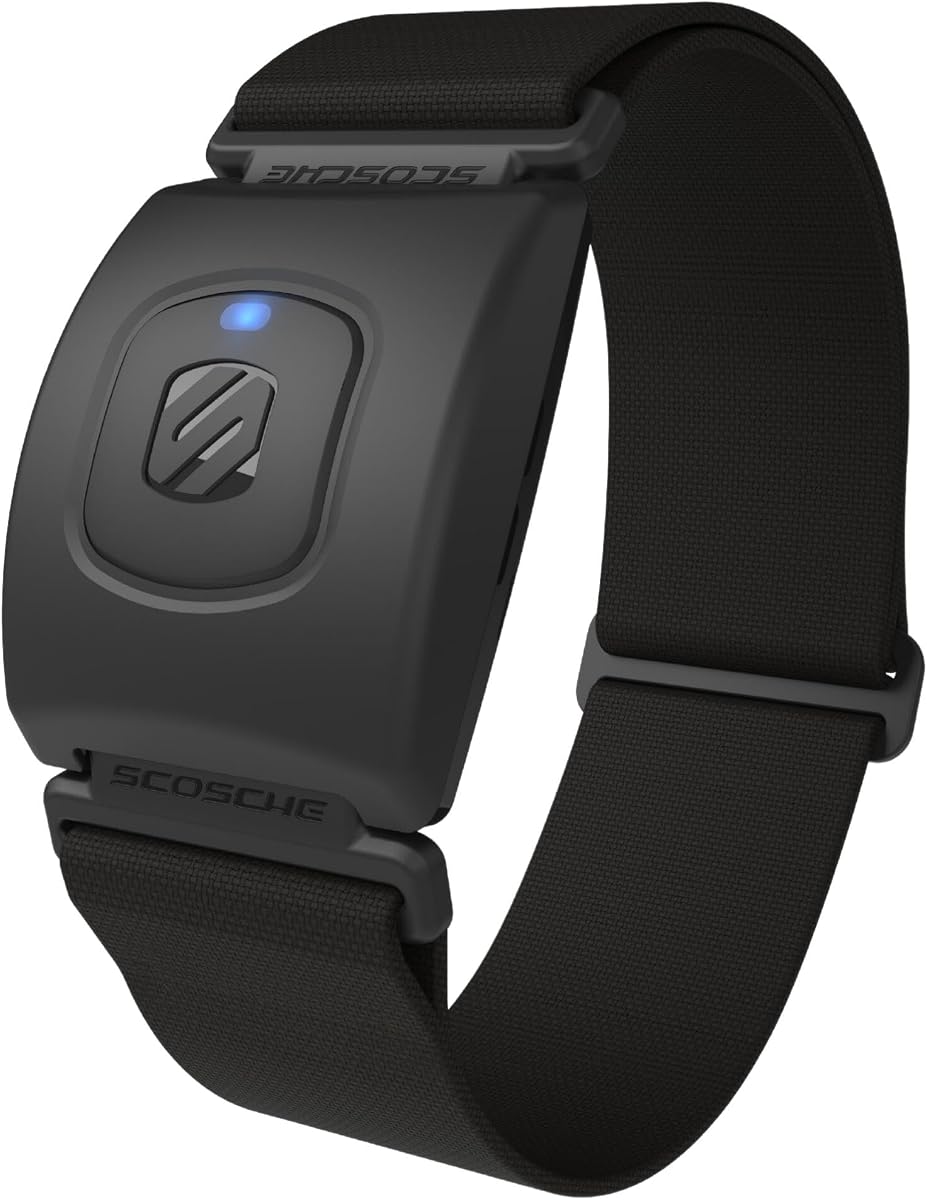
The Scosche Rhythm+ armband offers an appealing alternative to a chest strap for people who dislike the sensation of a belt under their shirt. It uses an optical sensor, a breathable adjustable band, and dual-band Bluetooth and ANT+ connectivity, with a 4.1 customer rating.
We may earn a commission when you buy through this link, at no additional cost to you.
Its strongest feature is the availability of RR interval data for HRV applications. The product information specifically names HRV4Training, Morpheus Training, and Welltory, while also stating compatibility with Peloton, STRAVA, Wahoo, and other platforms. The band can be worn on the forearm, bicep, or tricep to improve stability.
The IP68 construction supports sweat, rain, and demanding training conditions, and the stated battery provides up to 24 hours of continuous use. Optical accuracy depends on maintaining a secure, direct skin connection, so arm placement matters more than it would with a chest-mounted electrical sensor.
The Rhythm+ is well suited to riders who prioritize easy dressing, freedom of movement, and RR interval information. It is less compelling for someone specifically seeking the most established chest-sensor format or a multi-month rechargeable battery, but it provides a practical and well-supported alternative for Peloton use.
The armband avoids pressure and fabric around the torso, which can be more comfortable during frequent or long sessions. Multiple wearing positions allow riders to choose the location that feels most stable.
RR interval streaming provides detailed heartbeat timing information for supported HRV applications. This adds value for riders who use recovery and stress data to inform their training decisions.
We may earn a commission when you buy through this link, at no additional cost to you.
The COOSPO HW706 is a rechargeable optical armband with a 4.1 rating and explicit support for Peloton equipment. It combines Bluetooth 4.0 and ANT+ connections, tracks live heart rate, training zones, and calories, and can send data to compatible smartphones, tablets, watches, and bike computers.
We may earn a commission when you buy through this link, at no additional cost to you.
Its rechargeable battery supports more than 25 hours of use per charge. That is shorter than the Garmin HRM 600 but more convenient for many riders than managing a replaceable coin cell. The package includes two fabric straps, which helps with rotation, washing, and daily replacement.
The fabric band is designed to remain comfortable while riding, and the simple start-and-stop button operation helps keep setup straightforward. An LED flashes blue when the heart rate has been found, while vibration and a red flash confirm shutdown. The product should not be used for swimming even though it has an IP67 rating.
The HW706 works well for a Peloton rider who wants an uncomplicated armband and broad app support. It is a good middle ground between basic sensors and premium models, though riders wanting fewer charging cycles or more advanced offline features may need to spend more.
More than 25 hours of stated battery life covers many days of workouts between charges. The included charging system removes the need to buy and replace button cells during regular use.
A single-button interface and clear LED status feedback reduce operational complexity. Dual wireless support and compatibility with a wide list of training apps provide flexibility beyond Peloton equipment.
We may earn a commission when you buy through this link, at no additional cost to you.
The COOSPO HW9 is built around zone-based intensity feedback rather than simply displaying heart rate. It has a 4.0 rating, a five-color LED indicator, customizable maximum-heart-rate settings, and a vibration warning when a selected ceiling is exceeded.
We may earn a commission when you buy through this link, at no additional cost to you.
The optical sensor is stated to monitor heart rate within plus or minus one BPM and provides calorie data. It also supports heart rate variability, while Bluetooth 5.0 and ANT+ allow it to connect with bike computers, apps, fitness equipment, running watches, and Peloton equipment. Two simultaneous Bluetooth connections are also supported.
Its rechargeable battery lasts up to 35 hours and uses a magnetic charger. The adjustable, breathable band can be placed on the arm for more freedom than a chest strap, although a secure fit is important for consistent optical readings. Setup is simple, with a short press for power on and a long press for power off.
The HW9 is a strong choice for interval riders who want immediate visual or haptic intensity cues. It is less minimalist than a basic monitor because zone customization and heart rate limits require additional configuration, but that added feedback can make it more useful during structured Peloton sessions.
Five LED colors make the current training zone visible without opening the Peloton display. Riders can use the same feedback to confirm whether a sprint, climb, or recovery effort is moving into the target range.
The wearable app allows a custom maximum heart rate and a vibration warning when that threshold is crossed. This gives riders a quick physical cue, useful when they are following the bike or watching a class rather than a screen.
We may earn a commission when you buy through this link, at no additional cost to you.
The COOSPO HW807 is an entry-level optical armband with a 4.0 rating, multicolor heart-rate zone lights, and Bluetooth 5.0 plus ANT+ connectivity. It can connect directly with Peloton bikes and is also listed for treadmills, max trainers, sports watches, and bike computers.
We may earn a commission when you buy through this link, at no additional cost to you.
Heart rate is stated to remain within plus or minus one BPM during exercise, while the device also tracks calories, training zones, and heart rate variability. Compatibility extends to apps including Wahoo Fitness, STRAVA, Polar Beat, DDP Yoga, HR monitor, and CooSpoRide, along with a stated library of more than 200 supported apps.
The rechargeable battery provides up to 20 hours of operation, the shortest stated runtime among the rechargeable armbands in this comparison. Its IP67 rating handles sweat and rainy training, but swimming is not recommended. As with other optical designs, keeping the band tight and properly positioned helps maintain a steady signal.
The HW807 is best for a rider who wants basic live heart rate, convenient zone lights, and broad connectivity without moving to a premium device. Its value proposition is strong for regular indoor use, while the HW9 or Scosche Rhythm+ may be better if longer runtime or more detailed recovery functions are priorities.
Color-coded LEDs make workout intensity visible at a glance. The feature is useful during intervals when the rider wants quick feedback without stopping to examine a phone or watch.
Bluetooth 5.0 and ANT+ support covers Peloton equipment, bike computers, sports watches, and a broad app selection. The result is a sensor that can move between indoor and outdoor training setups.
We may earn a commission when you buy through this link, at no additional cost to you.
The Garmin HRM 200 combines a 4.3 rating with a conventional chest-strap format, dual wireless connectivity, and a user-replaceable battery rated for up to one year. It sends real-time heart rate and heart rate variability information to compatible Garmin devices, cycling computers, fitness equipment, and apps.
We may earn a commission when you buy through this link, at no additional cost to you.
The sensor's strengths are focused and practical. A 3 ATM water rating provides durability for everyday training, the strap is machine washable, and separate XS-S and M-XL sizes improve the chance of a secure fit. It is a natural choice for riders already invested in Garmin watches or cycling computers.
Compared with the Garmin HRM 600, the HRM 200 does not advertise the same advanced running dynamics, extensive on-device activity storage, or rechargeable power. Its replaceable battery, however, lasts up to one year, which is substantially longer between changes than most rechargeable armbands in this list.
The HRM 200 is a strong recommendation for Peloton users who want a dependable chest sensor and Garmin compatibility without moving to the premium HRM 600. It works particularly well for riders who want HRV data, simple care, and long battery life in a single-purpose heart rate monitor.
Real-time heart rate and HRV information can flow to compatible Garmin smartwatches, cycling computers, fitness equipment, and apps. This makes the sensor a natural fit for a Garmin-based training ecosystem.
The user-replaceable battery can run for up to one year, greatly reducing maintenance compared with a device that needs regular recharging. Riders should still keep a suitable replacement cell available for long-term use.
We may earn a commission when you buy through this link, at no additional cost to you.
The Rechargeable Peloton Armband is the most automatically operated option in this guide, with a 3.9 rating. It detects contact with skin, activates without a power-button routine, and uses dual Bluetooth and ANT+ radios to connect with up to three devices at once.
We may earn a commission when you buy through this link, at no additional cost to you.
Its optical sensor is designed to provide consistent readings during recovery, steady riding, and high-intensity intervals. The soft-touch silicone band is intended to sit flush against the arm without bouncing, pinching, or sliding, reducing the irritation that leads some riders away from chest straps.
Compatibility is broad, covering Peloton, Wahoo, STRAVA, Zwift, Garmin Connect, Apple Health, Google Fit, Polar Beat, and DDP Yoga. The product is rechargeable, although the supplied information does not state a specific runtime or charging duration, so prospective buyers should check those details on the current listing.
This armband is a good fit for someone who values effortless startup and simultaneous connections across several training services. Its lower rating warrants a closer look at recent customer feedback, but the automatic activation and three-device capability distinguish it from more conventional armbands.
Automatic wear detection allows the rider to put on the armband and begin training without manually powering it on. This may be particularly useful for spontaneous sessions or routines that are already crowded with other workout preparation.
Support for up to three simultaneous device connections can reduce the need to reconnect when training data is used across a bike, watch, and app. Dual-band radio support also offers flexibility across different equipment ecosystems.
We may earn a commission when you buy through this link, at no additional cost to you.
The most useful heart rate monitor is one that pairs reliably with your Peloton equipment, produces a stable signal in the position where you wear it, and records the data you actually use. Connection method, sensor format, battery behavior, fit, and training features should guide the decision.
Start by confirming that the monitor supports the wireless protocol used by your Peloton setup. Bluetooth is the most common requirement for direct bike communication, while ANT+ support can be useful when pairing with a separate bike computer, sports watch, or ANT+ cycling head unit. Compatibility with a fitness app is a separate consideration from hardware compatibility, so verify both the equipment and the app you intend to use.
Choose a monitor with explicit Peloton support and, ideally, both Bluetooth and ANT+. Dual-protocol devices offer more flexibility if your training setup includes external hardware.
A chest strap places electrodes close to the heart and generally provides a direct signal, making it a common choice for riders focused on live training data. An optical armband is easier to put on, can feel less restrictive, and may offer more flexible arm placement, but it is more sensitive to a loose fit, movement, and contact with the skin.
Choose a chest strap for direct chest-based sensing and armband freedom. Choose an optical armband for easier dressing, comfort, and flexible placement.
Accuracy claims should be considered alongside fit and connection quality. A sensor that is correctly positioned and produces a steady reading is more useful than one with an impressive specification on paper. Chest straps use electrical contact and can be affected by poor electrode moisture or an awkwardly adjusted belt, while optical armbands need firm, uninterrupted skin contact.
Prioritize stable readings during intense intervals, not just a plausible average. Follow preparation and placement instructions for the chosen sensor type.
Battery behavior determines how much maintenance the monitor creates. Replaceable coin cells can last for months or even a year, but they require a spare when depleted. Rechargeable models are more convenient for frequent use, yet they need access to a charger and may offer fewer hours between charges than long-life replaceable-battery designs.
Choose a replaceable battery for low maintenance frequency and rechargeable power for convenient everyday use. Check stated runtime carefully, and do not assume similar-sounding products have identical battery life.
A secure but comfortable fit matters because a loose chest strap can move, create gaps in electrode contact, or become distracting. Chest straps should be adjusted to sit firmly without restricting breathing or movement. Armbands should be positioned on a stable section of the upper arm or forearm, using the manufacturer's recommended location and tightness.
Try the device if possible, or examine the adjustment range and available sizes. A fit that stays secure during intervals is more valuable than a thinner or lighter design that shifts.
Some monitors go beyond displaying heart rate and calories. Zone LEDs, vibration warnings, customizable maximum-heart-rate limits, HRV, and RR interval streaming can make a sensor more useful for structured intervals and recovery monitoring. These functions vary widely by device and app, and some advanced metrics require compatible software.
Choose extra training features when you actively use zone guidance or recovery data. For basic ride tracking, prioritize reliable connectivity and battery life instead.
Peloton workouts commonly produce heavy sweat, and outdoor use can add rain and other exposure. A water-resistant rating adds useful protection, but it does not always mean the device is suitable for swimming. Several products in this comparison explicitly restrict swimming even when they carry an IP67 rating.
Prioritize sweat and rain resistance for indoor cycling. Read the specific restrictions before rinsing, soaking, or using a sensor in a pool.
The sensor's radio support and app compatibility should align with the software where you view workouts. A broad app list can be useful for switching among Peloton, Strava, Wahoo, Polar Beat, Zwift, and other services. Some premium chest sensors also store workouts without a watch and sync them later, which is valuable for riders who want a record even when live connectivity is interrupted.
Check app support before purchasing and choose offline storage only if it serves your routine. A broad compatibility claim is less useful than reliable support for the programs you actually use.
Begin with a clean, dry area of the chest and allow the monitor to dry fully after a workout. For chest straps, check that the electrodes are clean and lightly moisten them when the instructions call for it, while avoiding excessive water. Put on the strap before beginning the ride and position the sensor as directed by the manufacturer.
Pair the monitor through the relevant Peloton app or fitness application rather than assuming it will appear under the phone's standard Bluetooth menu. Wear the device during the initial pairing process when required, confirm that heart rate appears in the app, and make a brief test ride to verify that the reading remains stable through changing positions and intensities.
After the session, disconnect the sensor if the manufacturer recommends it, remove it from the body, and wipe away moisture with a soft cloth. Follow the stated waterproofing restrictions, avoid washing a non-washable unit, and let it dry fully before storage. Charge rechargeable models as directed or install the correct replacement battery type before the next ride.
No. A monitor must support the connection method used by the bike and the relevant Peloton software. Bluetooth is central to many current setups, while ANT+ may be relevant for external bike computers or watches. Check the product's explicit Peloton compatibility and the pairing instructions for the specific bike generation before purchasing.
A well-fitted chest strap is often preferred for live training because its electrodes sit close to the heart and are less affected by movement than an optical sensor. An armband can still provide useful and consistent readings when it is snug, correctly positioned, and in direct contact with skin. The best choice depends partly on comfort and consistency in real use.
Many chest-strap manufacturers recommend lightly moistening the conductive electrode areas because moisture improves electrical contact. The COOSPO H6 instructions specifically call for this step, while also advising users to keep the device from becoming soaked. Follow the manual for your exact sensor and use only enough moisture to improve contact.
Not always. An IP67 rating generally indicates protection from sweat, rain, and temporary immersion, but it does not automatically mean the device is safe for swimming. The COOSPO HW706, H6, and HW807 specifically state that swimming is not recommended, so users should follow the individual product restrictions.
Bluetooth and ANT+ are different wireless protocols used to send heart-rate data to equipment and apps. Bluetooth is commonly associated with phones and newer fitness devices, while ANT+ is widely used with sports watches and cycling computers. A sensor that supports both gives the rider more options when building a mixed training setup.
It depends on your goals. Peloton already provides class targets, output, resistance, and cadence information, but external heart-rate data can add independent intensity feedback and may be useful in free rides or training that relies on zones. It also allows the same sensor to serve outdoor rides, treadmill sessions, and supported fitness apps.
Adjust the strap so the sensor remains centered and secure without restricting breathing. For electrical chest sensors, ensure the electrodes are clean and lightly moistened when directed, since poor contact can cause both unstable readings and a feeling of inconsistent contact. For an armband, tighten it enough to prevent movement while keeping it comfortable.
That depends on the device. Replaceable-battery models may run for many months or as long as a stated year, while rechargeable models need charging according to their specified runtime. Do not wait for a sensor to fail completely, because unstable or intermittent readings can make a workout harder to interpret.
The Polar H10 is the strongest all-around recommendation because it combines a chest sensor, multiple wireless protocols, waterproof construction, and internal memory. The Garmin HRM 600 is the premium choice for riders who want rechargeable power, extensive activity storage, and advanced training data, while the COOSPO H6 provides a budget-friendly and direct route to adding heart rate data on a Peloton bike.
Prioritize the features you will actually use. Chest straps suit riders seeking a direct signal, armbands suit riders who value easy dressing and flexible placement, and dual-protocol devices offer the most freedom when connecting to watches, bike computers, and multiple training apps. Zone lights, HRV, vibration alerts, and offline recording can be useful additions but should not replace stable connectivity.
Before purchasing, verify current compatibility, fit guidance, battery specifications, and recent customer feedback. Prices and availability change over time, so checking the current listing can help ensure that the chosen monitor meets both your training needs and your current budget.