
ECO-WORTHY 5000W Solar Inverter Charger
4.1Editor score
100A MPPT solar controller
Six-unit parallel operation
Single or split-phase configurations
Our 5000 Watt Solar Inverter guide compares ten models for battery compatibility, charging modes, surge capacity, output quality, and installation needs.
A 5000 watt solar inverter is the central power-conversion device in many off-grid, backup, and hybrid renewable-energy systems. The best model must match the battery bank, solar array, household loads, transfer behavior, and required output voltage without exceeding any of those system limits.
This guide compares ten inverters with supplied specifications, customer ratings, charging options, surge ratings, phase support, and safety features. It covers both full 48-volt hybrid units with integrated MPPT controllers and simpler 12-volt power inverters intended for vehicles, RVs, camping, and smaller solar systems.
The selections show where each model fits: the strongest all-in-one options suit permanent 48-volt installations, while more portable designs emphasize multiple outlets, remotes, and straightforward battery hookups. Product configurations, availability, and prices can change, so readers should verify current specifications and seller information before purchasing.
4.1Editor score

5.0Editor score

4.6Editor score
The table below compares all ten products by architecture, power handling, battery support, and installation flexibility. It makes clear that the term covers both permanent 48-volt hybrid systems and simpler 12-volt inverters designed for mobile or compact off-grid use.


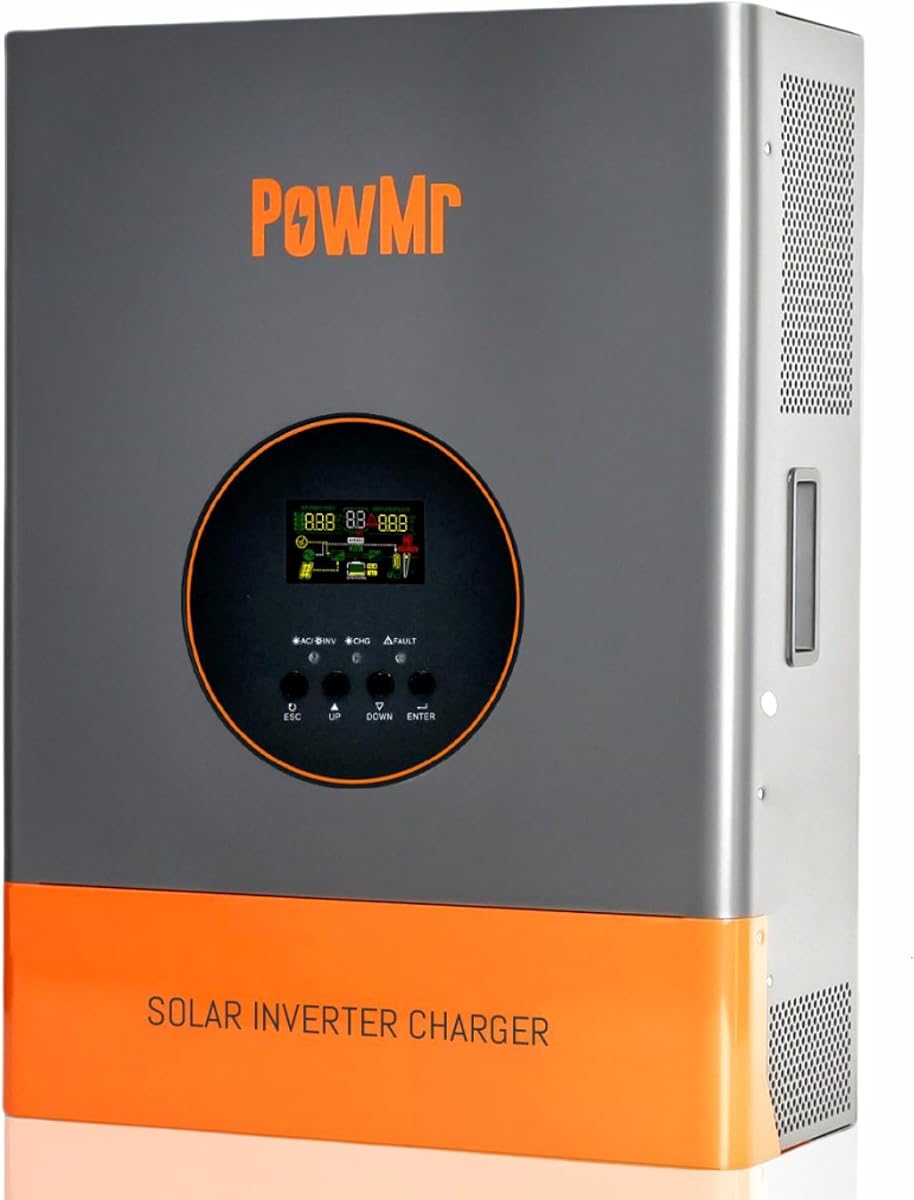

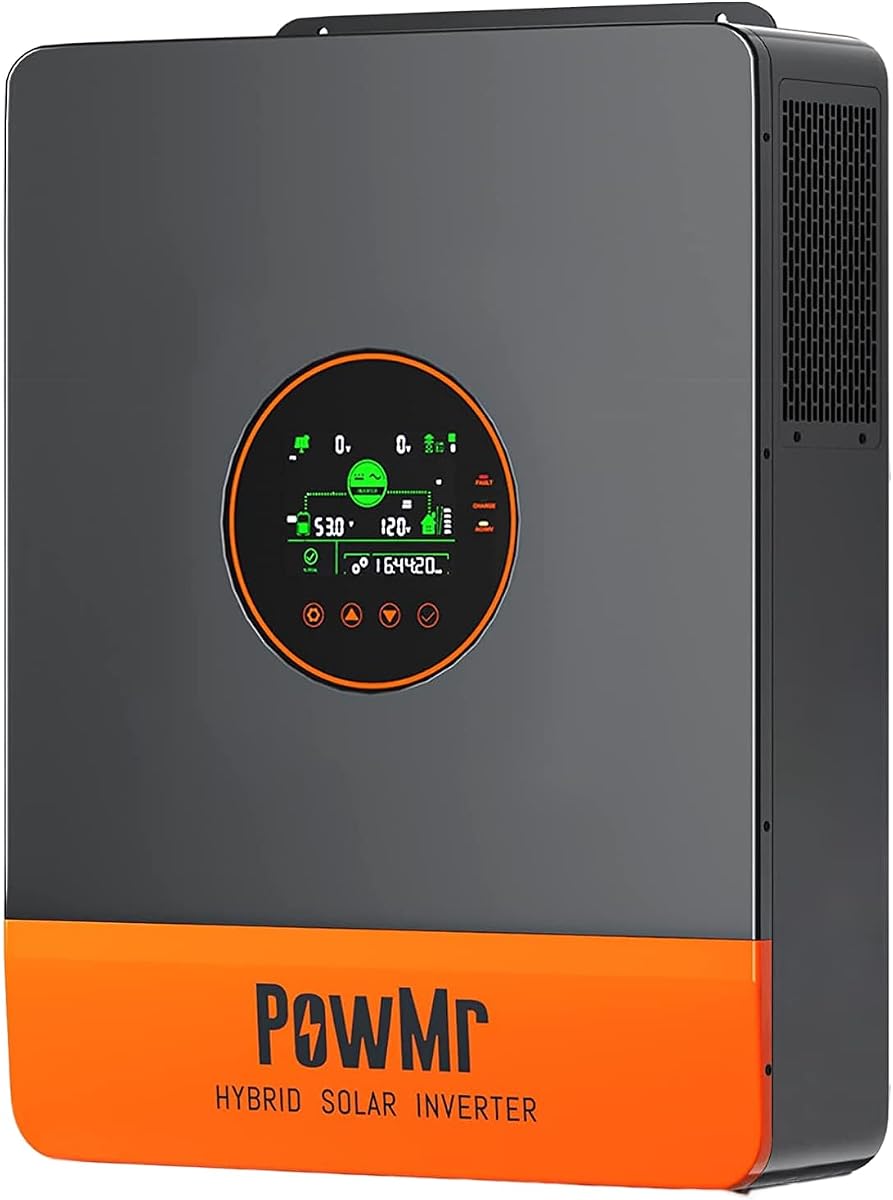


The PowMr 5000W Hybrid Solar Inverter is a full-featured 48-volt system with a 5.0 customer rating in the supplied data. Its strongest qualities are the combination of a 5000W continuous rating, 15000W peak capability, pure sine wave output, and a built-in 120A MPPT charge controller. That combination makes it a capable centerpiece for a permanently installed off-grid or hybrid power system.
We may earn a commission when you buy through this link, at no additional cost to you.
Output flexibility is another major strength. The inverter natively supports 110V and 220V, while its 60–105VDC MPPT range accepts a maximum PV input of 6400W and up to 120A of solar current. Users can select among solar-only, utility-priority, and solar-priority charging, along with utility-priority, solar-priority, and inverter-priority discharge behavior. The listed battery compatibility includes flooded, LiCoMnNiO2, LiFePO4, AGM, gel, and user-configured types.
The trade-offs are significant. The MPPT operating range is narrower than the high-voltage arrays accepted by several competing models, so panel layout matters. The manufacturer also warns against exceeding maximum open-circuit voltage, array power, or charging current because overvoltage or overcurrent could damage internal switching components. Its substantial power and broad wiring requirements make it less convenient than the compact 12-volt units in this list.
This is the strongest all-around choice for a builder who wants an integrated 48-volt hybrid inverter, substantial surge headroom, and flexible 110V/220V output. The right buyer is comfortable sizing the battery bank and PV array to the stated limits and should have the installation reviewed by a qualified electrical professional.
The built-in 120A MPPT controller reduces the number of separate system components, while three charging and three discharge modes provide useful control over the relationship among solar, utility power, batteries, and loads. The LCD and LED indicators also help users monitor operating status.
A 15000W peak rating gives the inverter more starting margin than the 10000W peaks common among several alternatives. That headroom is valuable for appliances with compressors, motors, or other components that draw extra power during startup, although the actual load must remain within all electrical and battery limits.
We may earn a commission when you buy through this link, at no additional cost to you.
The ECO-WORTHY UL1741 5000W Solar Inverter Charger combines a 5000W pure sine wave inverter, a 100A MPPT controller, and a battery charger with a maximum charging current of 100A. Its 4.1 rating is lower than those of the leaders, but the supplied specifications distinguish it through parallel-operation support and a 120V AC output designed for expandable home-backup systems.
We may earn a commission when you buy through this link, at no additional cost to you.
Its standout feature is scalability. Up to six units can operate in parallel, with the documentation describing single-phase operation and split-phase outputs of 120V/208V/240V when more than two inverters are used. The charging system supports solar-only, mains-priority, solar-priority, and combined mains-and-solar charging, giving users several ways to prioritize energy sources.
The product also accepts a broad PV operating range of 120–500VDC and offers timed charging and discharging. Its protections include PV input current and power limiting, PV overvoltage, night reverse-current prevention, and cooling designed to reduce overheating risk. These are meaningful safeguards for a permanent system with a high-voltage array.
Those features make it a premium option for users who may expand beyond a single 5000W unit. The trade-off is installation complexity: phase arrangements, parallel communications, high-voltage PV wiring, and battery charging require careful design. The supplier explicitly recommends professional installation for a 48-volt off-grid system.
The 120–500VDC PV operating range offers more collection flexibility than the lower-voltage MPPT design in the top-ranked PowMr. This can be helpful when designing a larger array, provided every module, string, and connection stays within the documented input ceilings.
Four charging modes and timed dispatch allow users to favor solar, protect battery capacity, or use utility power at selected times. These controls are most valuable when operating schedules and local utility conditions are understood before installation.
We may earn a commission when you buy through this link, at no additional cost to you.
The SUNGOLDPOWER 5000W DC 48V All in One Solar Inverter is a 5.0-rated option for users seeking a straightforward 48-volt hybrid unit. It combines a 5000W pure sine wave inverter, an 80A MPPT solar charger, and a 40A AC charger, reducing the number of separate charging components needed in a compact installation.
We may earn a commission when you buy through this link, at no additional cost to you.
The inverter accepts PV arrays up to 5500W and offers AC-priority, solar-priority, solar-only, and combined solar-and-mains charging. Its four output modes cover PV priority, utility priority, inverter priority, and hybrid output, including a grid-connection function. Battery support includes AGM, sealed, gel, flooded, lithium, and user-defined settings, with a 40–60V charging range and RS485 BMS communication.
The most important limitation appears directly in the product name: it cannot operate in parallel. Buyers who may later combine inverters for redundancy or higher capacity should rule it out now. The 120V output also makes it less versatile for systems requiring 220V or other multi-phase arrangements.
Despite that limitation, it is a good fit for a dedicated 120-volt home, cabin, or small commercial backup system that values an all-in-one design and broad operating modes. The 24-month warranty and stated lifetime technical support add reassurance, while the 5.0 rating makes it one of the strongest customer-rated options in the group.
Combining the inverter, MPPT tracker, and AC charger in one unit can simplify wiring and conserve installation space. It is especially appealing for projects that do not need the phase complexity or parallel capacity offered by higher-end alternatives.
Compatibility with common lead-acid, gel, AGM, sealed, and lithium batteries makes the unit adaptable to different storage choices. RS485 communication can also assist with integration where the connected battery management system supports that interface.
We may earn a commission when you buy through this link, at no additional cost to you.
The TOPBULL 5000W Power Inverter is a versatile 12-volt-to-120-volt converter with a 4.6 rating. It provides 5000W continuous output, 10000W peak capability, four 20A AC sockets, two 3.4A USB fast-charging ports, a 30W Type-C port, and three AC terminal blocks. That outlet selection makes it practical for vehicles, campsites, mobile offices, and temporary off-grid power.
We may earn a commission when you buy through this link, at no additional cost to you.
Its color display reports voltage, power, and operating status, while the included remote can operate the unit from up to 200 feet away. A metal enclosure, impact-resistant construction, temperature-controlled fans, and pure copper cables support use in mobile environments. The supplied specifications also list protections for low and high voltage, overload, short circuit, overheating, reverse connection, grounding, overcurrent, leakage, and battery faults.
This product is often called a solar inverter, but it is architecturally different from the 48-volt hybrid models. It converts power from a 12V or 12.8V battery and does not include an MPPT controller or battery charger. Users wanting a complete solar-charging system must add those components separately and size them to the inverter and array.
It is an attractive budget-oriented choice for RV and vehicle users who need numerous outlets, remote operation, and strong surge capability. For a permanently installed home system with automatic solar charging and grid interaction, a true hybrid inverter would be a more appropriate category match.
Four AC receptacles plus USB and Type-C ports reduce the need for several separate adapters. Terminal-block connections add flexibility for fixed projects, while the stated 20A rating for each AC socket should be considered when planning simultaneous loads.
The extended remote range is useful when the inverter sits in a cabinet, under a bench, or out of reach inside a vehicle. The display supplies real-time voltage, power, and status information without requiring direct access to the controls.
We may earn a commission when you buy through this link, at no additional cost to you.
The LVYUAN 5000W Power Inverter delivers 5000W continuous power and 10000W of surge capability from a 12-volt battery. Its 4.5 rating reflects a balanced design for RVs, trucks, solar systems, camping, and off-grid cabins. Four AC outlets, a hardwire terminal, an LCD display, and wireless remote control cover the main needs of a mobile power installation.
We may earn a commission when you buy through this link, at no additional cost to you.
The real-time display shows input voltage, battery level, load, and alerts, making it easier to identify overloads or changing battery conditions. Its intelligent cooling fan activates above 104°F or when the load exceeds 45%, helping manage heat without running continuously. Listed protections include overvoltage, undervoltage, overload, short circuit, reverse polarity, and overheating.
Like the TOPBULL, this is primarily a power inverter rather than a complete hybrid solar system. It can draw from a battery that is charged by a separate solar controller, but it does not include MPPT control or AC charging. The hardwire terminal is useful for permanent installations, while the four outlets serve temporary plug-in loads.
This model fits buyers who want a simple, accessible 12-volt inverter with both outlet-based and wired connection options. It is especially well suited to RV cabinets, mobile work vehicles, and compact solar projects where wireless remote access and basic status monitoring matter more than grid interaction or multi-phase output.
The wireless remote is valuable where the inverter is installed inside a cabinet, under a dashboard, or behind other equipment. The LCD adds a second layer of visibility by reporting key operating data and alerts.
Four AC outlets provide immediate flexibility, while the hardwire terminal supports a cleaner fixed installation. This mix makes the inverter useful both as a travel accessory and as a component in a small off-grid power setup.
We may earn a commission when you buy through this link, at no additional cost to you.
The PowMr 5000W 110/220V Hybrid offers a 4.8 rating and nearly the same core specification as the top-ranked PowMr model. It provides 5000W continuous output, 15000W peak power, pure sine wave AC output, and a built-in 120A MPPT charge controller for a 48-volt battery bank.
We may earn a commission when you buy through this link, at no additional cost to you.
Its 60–105VDC MPPT range permits up to 6400W of PV input and 120A of maximum PV current. The unit supports 110V and 220V output at 50Hz or 60Hz, along with solar-only, utility-priority, and solar-priority charging. Discharge behavior can prioritize PV, utility power, or the inverter. Flooded, LiCoMnNiO2, LiFePO4, AGM, gel, and user modes are listed as supported battery configurations.
Compared with the first PowMr listing, the notable differences are the dual cooling-fan arrangement and a more explicit description of its dust- and corrosion-resistant finish. It remains a substantial high-surge system, but the supplied data does not identify it as a parallel-capable model. Buyers needing multiple units for redundancy should confirm communications and phase requirements before proceeding.
It is a compelling alternative for 48-volt users who prioritize 110V/220V flexibility and very high peak handling. The 4.8 rating is strong, although not identical to the 5.0 rating of the first PowMr listing. Correct PV design, battery sizing, and professional installation remain essential.
The 15000W peak figure is the main attraction. It provides a large starting allowance for refrigerators, air conditioners, and other motor-assisted equipment, but users should confirm startup demand, sustained draw, and battery capability rather than relying on peak power alone.
Dual fans improve heat dissipation in a unit capable of sustained high output. The described corrosion- and dust-resistant enclosure is also relevant for garages, utility rooms, mobile installations, and other environments where air quality and ambient conditions vary.
We may earn a commission when you buy through this link, at no additional cost to you.
The 5000W 12V Solar Power Inverter is a 4.4-rated mobile inverter notable for a stated conversion efficiency above 90%. It converts a 12V or 12.8V battery into 110V/120V AC power, delivering 5000W continuously and 10000W during a surge. It is designed for vehicles, RVs, marine use, camping, emergency power, and compact off-grid systems.
We may earn a commission when you buy through this link, at no additional cost to you.
Its connection options include four AC sockets, one USB port, and a hardwire port, all supported by pure copper cables. The LCD reports input and output voltage, battery level, and load status. A 16.5-foot wired remote places basic controls within reach, although that is less convenient than the extended wireless remotes offered by some competing models.
Safety provisions cover undervoltage, overvoltage, overload, overheating, short circuit, reverse polarity, leakage, and overcurrent. The temperature-controlled fan is described as activating when temperature or load crosses specified thresholds. The package includes the inverter, battery cables, remote, manual, a 24-month warranty, and technical support.
It is a good value-oriented option for users who already have a suitably sized battery and separate solar charging equipment. Its advantage is efficient conversion and a generous set of connection options, while the lack of an integrated MPPT controller keeps it outside the full hybrid-system category.
A stated efficiency above 90% can reduce avoidable energy loss in a battery-limited installation. Actual results depend on battery condition, load level, wiring, temperature, and the quality of electrical connections, so system design remains as important as the headline efficiency.
Four AC outlets, a USB port, and a hardwire connection support both temporary and fixed equipment. The included cables and remote simplify initial setup, while the LCD helps users monitor the state of the battery and connected load.
We may earn a commission when you buy through this link, at no additional cost to you.
The PowMr 5000W Multi-Phase Hybrid is the most architecturally versatile model in the group, with a 3.9 customer rating. It supports single phase, 120V/240V split phase, and 208V configurations, and its supplied specifications state that up to six units can operate in parallel for larger residential, office, commercial, or industrial systems.
We may earn a commission when you buy through this link, at no additional cost to you.
Its MPPT controller operates over a 120–450VDC range within a broader 120–500VDC PV operating window, with maximum PV input of 5500W. The stated tracking efficiency reaches 99.9%. Rated output is 5000VA, peak output is 10000VA, and communication options include CAN, USB, and RS485. The unit can also operate in batteryless mode when powering loads from PV or grid power.
There is a specification issue worth noting. The product data refers to a total output of 30000kW in one place, but multiplying six 5000W units indicates 30000W, not 30000kW. That discrepancy should be verified with the manufacturer. The product also requires at least two inverters for split phase, so a single unit cannot deliver every advertised phase arrangement by itself.
This model makes the most sense for buyers planning a larger, phased installation who value communication ports, advanced PV tracking, and batteryless operation. Its lower rating and the need to carefully verify multi-unit configuration mean it is less suitable as an uncomplicated standalone purchase.
Supporting single, split, and three-phase arrangements gives the model a wider scope than single-output hybrid inverters. Parallel capacity also creates a path to redundancy and larger total output, although each multi-unit configuration must be installed exactly as documented.
CAN, USB, and RS485 communications can support integration with compatible control or battery-management equipment. Time-slot control lets operators define charging and discharging periods, which may be useful where utility service patterns influence operating strategy.
We may earn a commission when you buy through this link, at no additional cost to you.
The LiTime 5000W Hybrid Solar Inverter combines a 5000W inverter, a 100A MPPT controller, and a 40A battery charger in a 48-volt enclosure. It has a 4.2 rating and supports up to 10000W of surge output, making it a well-rounded choice for home backup and renewable-energy storage where components should be consolidated.
We may earn a commission when you buy through this link, at no additional cost to you.
The unit offers PV-only and hybrid charging, with hybrid mode adding mains support when solar energy is insufficient. Four output modes cover inverter priority, PV priority, utility priority, and mixed load. After utility power is interrupted, the battery or PV system can continue supplying loads, providing UPS-style continuity. Timed charging and discharging can be configured around local utility patterns.
It accepts both 48-volt lithium and lead-acid batteries, along with user mode. Its parallel support extends to six units and a stated maximum output of 30kW. The documentation specifies that single-phase and split-phase systems may be connected in parallel, while more than two units can produce 120V/240V. These features make expansion more practical than with a non-parallel all-in-one model.
The main drawback is a lower customer rating than several competing hybrid inverters, plus fewer charging choices than some rivals. Still, the combination of parallel support, split-phase capability, MPPT integration, and scheduled energy control is attractive for a carefully designed home-backup installation.
Six-unit support gives users a way to increase available output or build redundancy over time. Split-phase operation is also possible when the required inverter count is met, making the model more adaptable than many single-unit designs.
The four output priorities let users decide whether PV, batteries, or utility power should be favored. Automatic transfer to battery or PV after grid loss supports continuity for essential loads, subject to correct configuration and adequate stored energy.
We may earn a commission when you buy through this link, at no additional cost to you.
The 5000W Split-Phase Hybrid Solar Inverter is a 5.0-rated 48-volt unit with 5000W continuous output, 15000W peak power, and a built-in 120A MPPT controller. It supports 110V/240V output, making it relevant to systems that need both single- and split-phase household voltage arrangements.
We may earn a commission when you buy through this link, at no additional cost to you.
Its MPPT input range of 60–150VDC accepts up to 6400W of PV power. The inverter can charge from solar, utility power, or a generator, and it offers three charging modes plus three output priorities. Flooded, AGM, gel, LiFePO4, and user-defined 48-volt batteries are supported. BMS/RS485, RS232, and dry-contact interfaces offer several control options.
Its stated charging efficiency reaches 99%, while dual cooling fans, a corrosion- and dust-resistant enclosure, and an LCD with LED indicators support monitoring and thermal management. Protection includes short circuit, overvoltage, undervoltage, overload, and reverse-polarity safeguards. Installation must remain within the rated PV limits to preserve safety and warranty coverage.
This is an appealing high-surge split-phase model for a dedicated 48-volt installation, particularly where 240V equipment or a standard household split is desired. The product data does not confirm parallel operation, so buyers who need multi-unit redundancy should verify that capability. It should be installed strictly according to the manual.
A 15000W peak rating supports demanding startup loads, while the 120A MPPT controller can serve a substantial solar array. The 60–150VDC operating range is wider than that of the two featured PowMr models, offering additional string-layout flexibility within the stated limits.
BMS and RS485 communication, RS232, and dry contacts provide options for integrating the inverter with compatible equipment. A clear status interface and dual fans improve operation in installations where monitoring and heat management are especially important.
We may earn a commission when you buy through this link, at no additional cost to you.
Choosing a 5000 watt solar inverter requires matching the unit to the battery voltage, solar-array design, household output, surge requirements, and desired level of automatic control. The most important distinction is whether you need a standalone 12-volt power converter or a complete 48-volt hybrid inverter with integrated charging and transfer functions.
Start with the battery bank because it determines which inverter families are electrically compatible. The TOPBULL, LVYUAN, and 5000W 12V Solar Power Inverter accept 12V or 12.8V batteries and suit vehicles, RVs, marine use, and portable off-grid power. The PowMr, ECO-WORTHY, SUNGOLDPOWER, LiTime, and split-phase models operate from 48V batteries, where a larger storage bank helps support the inverter's 5000W output and reduces the current carried by battery cables.
Choose the architecture that matches an existing battery system and your installation plan. Never connect a 12-volt inverter directly to a nominal 48-volt bank or assume a 48-volt hybrid model is suitable for a small automotive battery.
A built-in maximum power point tracker extracts energy from the PV array and regulates charging for the connected battery bank. Hybrid options in this guide range from an 80A MPPT controller in the SUNGOLDPOWER model to 120A controllers in several PowMr units, while the ECO-WORTHY and LiTime models use 100A controllers. The 12-volt power inverters require a separate compatible solar charge controller.
Decide whether an integrated controller is worth the added complexity. It can reduce component count and simplify wiring, but the PV voltage, current, array power, and battery chemistry must all remain within the inverter's documented limits.
A 5000W continuous rating describes the sustained power level, while peak capacity covers brief startup or short-duration events. Several 48-volt hybrid models advertise 15000W peaks, while most 12-volt mobile inverters and other hybrids list 10000W. Compressors, pumps, and motor-driven tools can require considerably more power during startup than while running.
List the running watts and startup surge for every essential load, then add a reasonable margin. Do not use peak rating to justify continuously operating a load that exceeds the inverter's continuous output or its battery system's safe discharge current.
Most mobile inverters provide 110V or 120V outlets, while the stronger 48-volt hybrids include choices such as 220V, 240V, split-phase, or three-phase configurations. The PowMr Multi-Phase Hybrid supports the widest range, while the ECO-WORTHY and LiTime models also describe parallel split-phase arrangements. A single unit cannot always deliver every advertised phase configuration, so the required inverter count matters.
Match the output to the appliances and building wiring. A 120V-only installation may be sufficient for ordinary household outlets, while 240V equipment requires appropriately rated split-phase output and compatible wiring throughout the system.
Hybrid inverters let users decide when solar, utility power, or batteries should be used. Common choices include solar-only charging, utility priority, solar priority, and combined charging. Output priorities similarly determine whether loads draw from PV, the battery, utility power, or a mixed source. The SUNGOLDPOWER and ECO-WORTHY models offer especially broad mode selections.
Choose priorities that reflect how the system is actually used. A self-consumption household may favor PV first, while a backup system may keep batteries available for an outage. Programmable time slots can coordinate charging and discharging with local utility patterns.
Parallel support allows multiple inverters to increase total output or provide redundancy. The ECO-WORTHY, PowMr Multi-Phase, and LiTime models state support for as many as six units. The SUNGOLDPOWER model explicitly does not support parallel operation, while the supplied information does not confirm parallel capability for every other hybrid unit. Planning to add capacity later requires choosing a model that supports it from the beginning.
Verify the permitted phase combinations, communication requirements, and minimum unit count before purchasing. Parallel output is an engineered system configuration, not merely a matter of connecting several boxes together.
The hybrid models support combinations of flooded, gel, AGM, lead-acid, lithium-ion, LiFePO4, and user-defined battery settings. The correct charging profile matters because battery chemistry, capacity, and temperature affect safe charge voltage and current. Some models also offer RS485, RS232, CAN, USB, BMS, or dry-contact communication for monitoring and integration.
Use user-defined mode only when the charging values are known and properly configured. For lithium batteries, verify BMS communication compatibility and follow the battery manufacturer's recommendations rather than relying on a generic setting.
Look for protection against overvoltage, undervoltage, overload, short circuit, overheating, reverse polarity, leakage, and reverse current as applicable. Displays, LEDs, remotes, and status alerts make faults easier to identify. Cooling fans and dust- or corrosion-resistant enclosures are especially relevant in garages, vehicles, and other demanding environments.
Installation quality can determine system performance as much as the inverter itself. High-voltage PV, 48-volt battery, grid-tie, and split-phase connections should be handled by a qualified professional who can size breakers, cables, disconnects, grounding, and overcurrent protection correctly.
Begin by identifying every intended load and calculating both its continuous draw and startup surge. Size the battery bank, solar array, charge controller, wiring, disconnects, and overcurrent protection around that load profile. For a hybrid unit, confirm the nominal battery voltage, charging chemistry, PV open-circuit voltage, MPPT range, and AC output configuration before making any connections.
Install the inverter in a clean, dry, ventilated location protected from direct weather exposure and combustible materials. Keep the required clearances around the enclosure, secure all cable connections, and use correctly sized battery and PV cables. Follow the manual for fuse or breaker placement, grounding, torque, and terminal order; incorrect polarity or exposed live conductors can cause injury or equipment damage.
After installation, configure charging priorities, battery type, output mode, and any timers through the LCD or approved controls. Test normal utility operation, transfer during an outage, solar charging, and load behavior with smaller devices before adding heavy appliances. Periodically clean dust from vents, inspect connections for heat or corrosion, review warning indicators, and check battery condition and state of charge.
It may be enough for many essential or carefully selected household loads, but suitability depends on the inverter's surge rating, battery capacity, PV array size, and expected simultaneous demand. Motorized appliances can require substantial startup power, so calculate their running and starting requirements before connecting them. For an entire home, load management and a professionally sized system are often more important than the headline 5000W rating.
It depends on the model. Most 12-volt power inverters in this guide require a connected battery to provide stable AC output, while the PowMr Multi-Phase listing specifically supports a batteryless mode using PV or grid power. A battery-backed hybrid system also stores energy for nighttime use and outages, so the correct answer depends on whether continuous or emergency power is needed.
No. The panels must stay within the inverter's maximum PV power, open-circuit voltage, charging current, and MPPT voltage limits. String configuration also matters because series voltage can exceed the safe input range. Review the manual and have the array design checked before connecting modules, especially with the higher-voltage 48-volt hybrid models.
A 12V inverter is simpler and common in vehicles, RVs, camping, and smaller portable systems. A 48V inverter usually supports larger battery banks, continuous household-scale output, grid interaction, and integrated high-current MPPT charging. They are not interchangeable, and using the wrong battery voltage can permanently damage an inverter.
Peak power is a short-duration surge allowance above the inverter's 5000W continuous output. It helps start appliances with compressors or motors that briefly draw more power while operating. It does not mean the inverter can sustain that level indefinitely, and actual performance also depends on battery capability, wiring, and the load's startup characteristics.
Only if the model explicitly supports parallel operation and the installation follows its required configuration. The ECO-WORTHY, PowMr Multi-Phase, and LiTime products state support for up to six units, while the SUNGOLDPOWER model explicitly cannot operate in parallel. Parallel and phase arrangements also require compatible communication, wiring, and grid or load-balancing procedures.
Most of the 48-volt hybrid models list LiFePO4 compatibility, and the 12-volt models are designed for suitable 12V batteries. Compatibility does not mean every battery can use the default settings. The battery's charging voltage, current, temperature limits, and any BMS communication requirements must match the inverter configuration.
A prewired low-voltage setup may be approachable for someone with solid electrical experience, but 48-volt battery, high-voltage PV, grid-tie, and split-phase installations should be professionally installed. Incorrect overcurrent protection, cable sizing, grounding, terminal connections, or PV strings can create fire, shock, and equipment-damage risks.
The PowMr 5000W Hybrid Solar Inverter leads the guide because it combines a 5.0 rating, 5000W continuous output, 15000W peak capability, a 120A MPPT controller, and selectable 110V or 220V output. The ECO-WORTHY is a premium alternative for expandable and split-phase systems, while the TOPBULL provides the best budget-oriented mobile option with four outlets, USB and Type-C connections, and remote control.
Prioritize the category that matches your installation rather than choosing solely on wattage. Mobile users should select a 12-volt inverter with the required outlets and remote, while permanent 48-volt systems benefit from integrated MPPT charging, grid transfer, phase support, and automatic battery management. Verify battery chemistry, PV limits, surge requirements, output voltage, and parallel capability before buying.
Finally, check the current listing, manufacturer documentation, and seller details at the time of purchase, and remember that prices and configurations change. A safe, effective system depends as much on correct battery sizing, compatible wiring, suitable overcurrent protection, and professional installation as it does on the inverter itself.