
VEVOR 4.7-Inch Glass Suction Cups
4.4Editor score
Two 4.7-inch cups included
Aluminum-alloy handle construction
Natural nitrile rubber pads
Industrial suction cups for glass handling provide a secure, controlled way to move large panes, polished stone, ceramic tile, appliances, and other smooth, nonporous materials. The right lifter combines a dependable vacuum seal, comfortable handling, useful capacity, and clear release and pressure-monitoring features for installation and fabrication work.
This guide compares ten industrial suction cup options across cup diameter, claimed lifting capacity, handle material, pump mechanism, safety indicators, operating conditions, and compatible surfaces. It includes compact 4.7-inch models, larger 8-inch and 9-inch tools, metal-handled vacuum lifters, and a lightweight plastic-handled option for lighter-duty handling.
Each review explains where a product stands out, what limitations to consider, and the kinds of jobs it suits best. The first three recommendations cover different priorities, including a strong all-around professional tool, a practical high-capacity pair, and a value-focused choice. Product availability and prices can change, so confirm current details before purchasing.
4.4Editor score

4.8Editor score
4.8Editor score
As an Amazon Associate we earn from qualifying purchases.
The comparison below highlights cup diameter, stated load capacity, handle and pad construction, and the most important operating feature of each option, helping buyers match tool size and vacuum design to the material and job.


Wood's Powr-Grip 8-Inch Suction Cup with Metal Handle and Carrying Case (N4950) earns a 4.8 rating and stands out as a well-rounded professional lifting tool. Its defining combination is a large suction area, rugged metal handle, and supplied carrying case. It is designed for fast attachment to smooth, nonporous, flat surfaces, making it a logical choice for glass, polished stone, metal panels, and similar material.
We may earn a commission when you buy through this link, at no additional cost to you.
The eight-inch footprint is especially useful when a smaller cup would have limited contact with a large panel. A broad pad can create a more stable hold than a compact tool, while the metal handle offers a durable structure for repeated installation and handling tasks. The carrying case also addresses a practical issue often overlooked in job-site gear: protecting the tool during transport and storage.
The main trade-off is that this is a single-cup configuration. A two-cup setup generally gives the operator more control over a broad or heavy panel, particularly when the load is not centered. The supplied product information also does not describe the pump system or a visual vacuum indicator in detail, so buyers who prioritize those specific features should verify the product configuration before ordering.
This suction cup is best for contractors, fabricators, installers, and serious DIY users who want a durable, portable tool for lifting flat, smooth materials. It is an especially sensible option when a case is important and when one larger cup is preferable to two smaller cups. For most routine glass-handling assignments, it is a strong all-around recommendation.
The eight-inch pad gives the tool a useful contact area for large sheets of glass, tile, polished stone, and other flat materials. That broader footprint can improve stability compared with a much smaller cup when the surface is clean, smooth, and free of debris.
A protective carrying case makes this model more convenient for mobile work. It helps organize the suction cup during transport and reduces the chance of accidental damage to the tool or nearby equipment.
We may earn a commission when you buy through this link, at no additional cost to you.
Bluebow Suction Cups for Glass Tile Granite, 8 Inch 2 Pack 880lbs carries a 4.6 rating and offers an appealing mix of capacity, operating simplicity, and surface versatility. Each eight-inch cup has a stated maximum holding capacity of 440 pounds, with a theoretical combined figure of 880 pounds when the pair is used together. Those figures make the set appear especially substantial for large panels and slabs.
We may earn a commission when you buy through this link, at no additional cost to you.
The product uses a highly elastic, ultra-sealing rubber pad designed for smooth, nonporous materials such as glass, tile, marble, stainless steel, and polished metal. Its top exhaust valve allows the user to expel internal air by pressing firmly, avoiding a complicated pump assembly. A triple anti-slip and leak-resistant design is intended to improve stability and reduce unwanted air loss.
These claims should still be treated as rated limits rather than a promise that every panel can be lifted safely. Actual performance depends on proper placement, surface cleanliness, even load distribution, panel condition, and the angle of use. The absence of a stated carrying case may also be inconvenient for installers who regularly move between job sites.
The Bluebow pair is a compelling choice for users who want two large cups without moving to a more complex vacuum-lifting system. It suits glass installers, stone handlers, renovation crews, and workshop users dealing with large smooth panels. Its straightforward attachment method and broad material compatibility make it particularly useful when speed and flexibility matter.
Using two cups gives the operator a more balanced grip on broad materials than a single center-mounted cup. Spacing the cups appropriately also helps distribute the load and reduces rotation when a panel is lifted carefully.
The top exhaust valve is operated by pressing firmly on the cup. This uncomplicated method can be convenient when workers need quick attachment without operating a separate plunger.
We may earn a commission when you buy through this link, at no additional cost to you.
The 10" Vacuum Suction Cup for Granite and Glass Lifting, with Metal Handle and Brass Pump, 760-Pound Load Capacity, earns a 4.7 rating for its large contact area and professional vacuum controls. Each tool has a ten-inch diameter and an all-metal handle, while the pair is rated for a maximum combined load of 760 pounds under appropriate conditions.
We may earn a commission when you buy through this link, at no additional cost to you.
Its red-line indicator is a notable safety feature. If vacuum loss becomes visible during a lift, the operator can pump the plunger while keeping the cup attached to the surface. The product also includes a release lever for quick removal, brass rather than plastic or aluminum for the plunger, and handle holes designed to accommodate rope-assisted lifting with a team.
The listed working range is minus 20 to 60 degrees Celsius, and the manufacturer states that the vacuum can remain for up to six hours. Those specifications suggest a tool intended for demanding professional work, although users still need to inspect seals and monitor the indicator continuously. The maximum capacity should never be treated as a routine target or permission to ignore safe working practices.
This set is best suited to professional glass, granite, aquarium, appliance, and stone-handling work where large panels benefit from maximum contact area. Its size, weight, and specialized pump may be excessive for light household tasks, but for industrial-scale lifting, it offers a remarkably comprehensive feature set.
A ten-inch diameter creates a broad seal area on large sheets and slabs. That can be valuable when the goal is to stabilize a wide panel rather than lift a small, compact item.
The red-line indicator makes changes in vacuum easier to notice. It provides a practical cue to stop, restore pressure, or lower the material before a marginal hold becomes unsafe.
We may earn a commission when you buy through this link, at no additional cost to you.
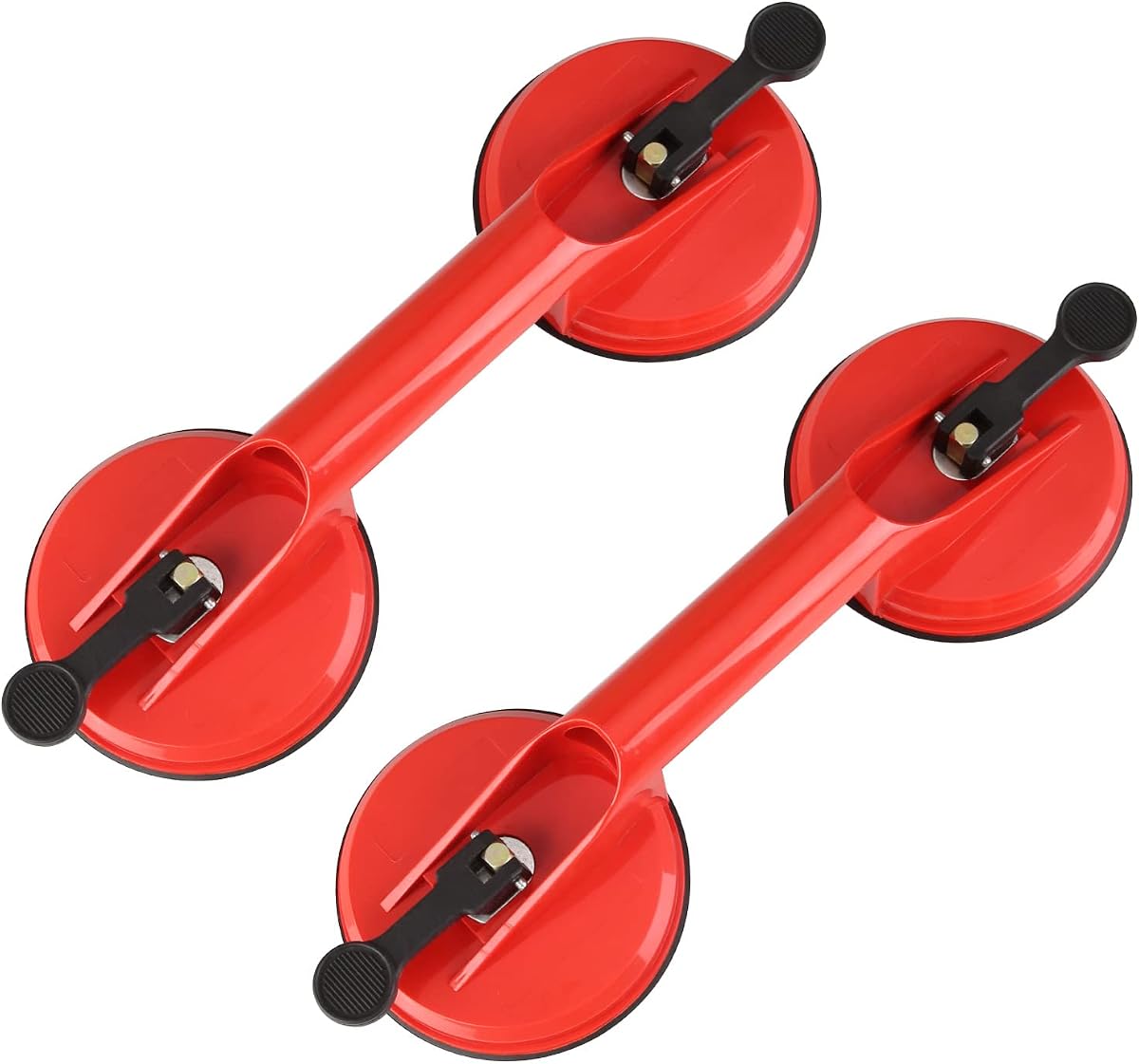
VEVOR Glass Suction Cup, 4.7-Inch Two-Pack, has a 4.4 rating and focuses on portability, practical dimensions, and a durable aluminum-alloy handle. The cups use natural nitrile rubber pads and have a stated thickness of 7 millimeters. Each pair is intended to provide a controlled way to handle glass, granite, tile, metal, and smooth wood panels.
We may earn a commission when you buy through this link, at no additional cost to you.
The manufacturer lists a recommended safe load of 187 pounds, a maximum vertical suction force of 297 pounds, and a maximum horizontal suction force of 330 pounds. These are different operating figures, emphasizing that orientation and use conditions matter. The smaller cup is easier to position where an eight- or ten-inch model would overlap neighboring surfaces or extend beyond the panel edge.
The clear limitation is that it is not suitable for rough surfaces, and a compact pad offers less contact area than the larger options in this guide. A lower rating than several leading picks may also reflect a more modest positioning in the category, though the product remains a versatile tool for installers and DIY users who need maneuverability more than maximum capacity.
VEVOR is a good fit for shower-door installation, aquarium handling, floor-gap work, and moving smaller smooth panels. Buyers should still use the two cups together for balanced handling and test the seal before lifting. It offers solid utility without the bulk of a large professional vacuum lifter.
The 4.7-inch diameter can reach areas where a broad industrial cup cannot fit. It is especially useful for localized lifting points and smaller sections of tile, glass, or metal.
Separate vertical and horizontal figures make it clear that the tool is not rated identically in every orientation. Users should select a safe working load that accounts for the intended movement and the condition of the material.
We may earn a commission when you buy through this link, at no additional cost to you.
GRENPRO Heavy Duty Glass Suction Cups for Lifting Windows and Tile has a 4.9 rating, the highest listed rating among these ten products. Its central selling point is balance: two cups, a stated 330-pound capacity per cup, aluminum-alloy bodies, and thick natural rubber pads in a package designed for one-person handling with one cup in each hand.
We may earn a commission when you buy through this link, at no additional cost to you.
The product is compatible with glass, ceramic tile, marble, painted wood, metal, and appliances. That range makes it relevant to movers, installers, automotive workers, aquarium handlers, and homeowners tackling renovation tasks. The solid metal body and reinforced rubber construction are designed to withstand regular handling, while the two-cup format offers better balance than a single center attachment.
Important exclusions apply. GRENPRO does not recommend the cups for curved or unfinished wood surfaces, and any dust, moisture, coating, or texture can compromise the seal. The stated one-person convenience should be understood as a handling aid rather than a guarantee that every person can safely control every load.
This set is one of the most approachable choices for users who need two capable cups and want a straightforward aluminum tool. It works especially well for windows, tile, smooth panels, and appliances. For professional use, it is worth combining the cups with sensible load limits, a spotter for large work, and routine inspection of the rubber pads.
Holding one cup in each hand lets the operator support opposite sides of a panel. This arrangement generally improves balance and makes it easier to keep the material level during short moves.
The product guidance recommends warming the cups to room temperature for 30 minutes when used below 32 degrees Fahrenheit. Flexible rubber can become less effective when cold, making this step important for consistent sealing.
We may earn a commission when you buy through this link, at no additional cost to you.
2 Pack 8-Inch Heavy Duty Suction Cups for Glass Lifting has a 4.4 rating and combines large cups with high stated capacity. Each eight-inch suction cup is rated for up to 440 pounds of holding force, while a pair is listed at up to 800 pounds. The design is aimed at large glass panels, glazed tile, polished stone, metal, windows, and smooth appliances.
We may earn a commission when you buy through this link, at no additional cost to you.
A red-line indicator provides visible feedback about vacuum pressure. According to the operating guidance, the plunger is pumped until the line disappears, and it can be pumped again without removing the cup if pressure drops. A release lever supports quick detachment, while thickened rubber pads and reinforced handles are intended to provide dependable everyday performance.
The product description appropriately states that actual capacity depends on cleanliness, surface smoothness, lifting angle, load distribution, and seal quality. It is not suitable for unfinished MDF, plywood, ordinary rough wood, concrete, rough stone, textured tile, or other porous surfaces. Users should avoid interpreting the maximum figures as a guarantee under poor conditions.
This pair is a good choice for glass installers, countertop workers, renovators, and anyone who wants a large cup with a clear pressure indicator. It is more specialized than compact models and more demanding to position. In exchange, the broad contact area and monitoring system are valuable for controlled handling of large, smooth materials.
A visible indicator can help workers notice the loss of vacuum before continuing a lift. It should be checked continuously rather than treated as a substitute for controlled movement and load testing.
The stated capacity is most relevant when the surface is clean, dry, smooth, and the load is balanced. A wide margin between the actual material weight and the product rating is a sensible safety practice.
We may earn a commission when you buy through this link, at no additional cost to you.
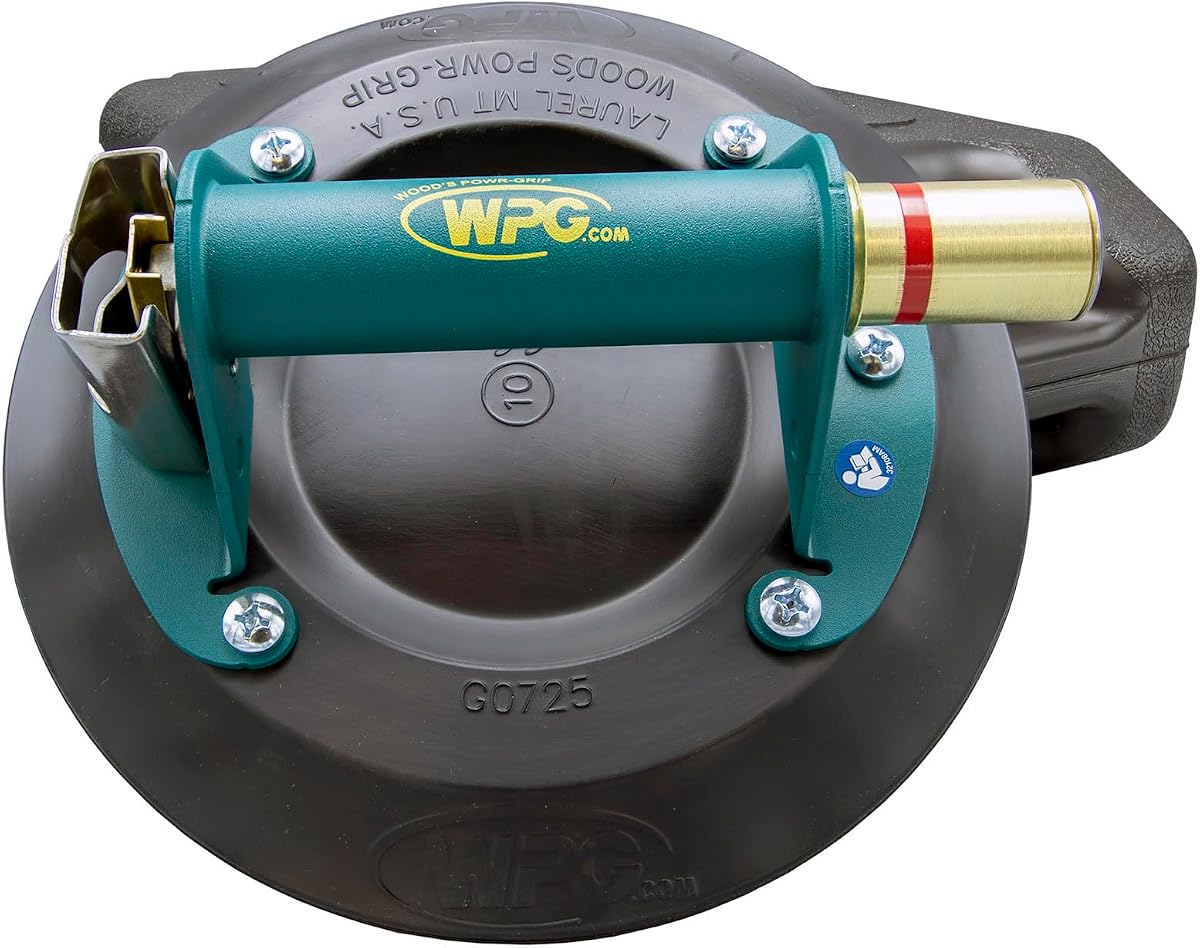
Wood's Powr-Grip 9-Inch Vacuum Suction Cup with Metal Handle and Carrying Case earns a 4.8 rating for a feature set tailored to professional work. It combines a large nine-inch cup, rugged metal construction, a manual hand pump, a red-line indicator, and a textured non-slip handle. The product is made in the USA and supported by the Wood's Powr-Grip Exchange Program.
We may earn a commission when you buy through this link, at no additional cost to you.
The visual red-line system is particularly useful because it gives immediate feedback about whether a proper vacuum has formed. The textured handle supports grip control, while the manual pump allows the operator to restore or create suction as needed. Compatibility with glass, metal, plastic, and other smooth nonporous materials makes the tool relevant to construction, manufacturing, and automotive environments.
The large cup can be awkward on small or tightly confined panels, and a single-cup configuration provides less balancing control than two smaller tools. Suction performance also depends on an airtight surface; coatings, dust, texture, and contaminants may prevent the cup from reaching its ideal hold.
This model is best for installers and fabrication teams that value professional construction, clear pressure feedback, and durable handling. The carrying case adds mobility, while the pump and indicator support controlled operation. It is a particularly complete choice for users who prefer a feature-rich vacuum lifter over a simpler top-valve design.
Combining a manual pump with a red-line indicator makes seal status more visible during operation. That visibility is valuable when a worker needs to confirm vacuum before moving a panel.
The textured handle is designed to resist slipping. A secure grip is especially important when the tool is wet, dusty, or being used with gloves in a demanding work environment.
We may earn a commission when you buy through this link, at no additional cost to you.
SEESII Glass Suction Cups with Aluminum Handle has a 4.6 rating and offers a compact pair with a stated holding power of 200 pounds. Each cup measures approximately 4.6 inches across and uses a 7-millimeter natural rubber pad. The reinforced aluminum-alloy handle offers a useful combination of strength and manageable size.
We may earn a commission when you buy through this link, at no additional cost to you.
The stated applications include lifting and positioning glass, tile, and stone, adjusting gapped laminate flooring, handling aquariums, supporting bathroom safety tasks, and moving large flat surfaces. Compatibility with glass, tile, granite, marble, and metal gives the pair broad relevance for renovation and installation work.
The cups have less contact area and a lower stated capacity than the large 8-, 9-, and 10-inch options. Their effectiveness can also decline in cold conditions, and the rubber pads require appropriate care to prevent moisture, sunlight, and debris from affecting performance. The stated 200-pound figure should not be treated as a recommended working load for every material.
SEESII is well suited to installers who want two compact cups rather than a single oversized lifter. It is also useful for home projects involving a single tile, aquarium, glass wall section, or manageable panel. The main reason to choose it is maneuverability combined with metal handles and a two-cup setup.
The cups are designed for glass, tile, granite, marble, and metal. That makes them useful across several common building and finishing materials as long as the surface is smooth, clean, and nonporous.
The 4.6-inch size is easier to position than a large industrial cup. Two units can be spaced according to the panel, giving the operator room to work around edges and obstacles.
We may earn a commission when you buy through this link, at no additional cost to you.
FCHO Glass Suction Cups Heavy Duty for Tile Glass Lifting, 2 Pack Blue, carries a 4.6 rating and provides a practical compact pair for installers and DIY users. Each cup has a 4.66-inch diameter, a 7-millimeter natural rubber suction pad, and an aluminum-alloy handle body. The listed maximum lifting weight is 200 pounds.
We may earn a commission when you buy through this link, at no additional cost to you.
The product's versatility is one of its strengths. Listed uses include fixing gapped laminate floors, assisting with bathroom safety, lifting tile, moving aquarium glass, positioning heavy glass walls, and handling other flat surfaces. Aluminum alloy gives the handles a rigid, relatively light construction that is easier to carry than a full-size metal vacuum lifter.
The compact diameter is beneficial for positioning, but it means the tool is not intended to span a very large panel in the same way as an 8- or 10-inch cup. The manufacturer also advises that cold cups should be kept at room temperature for at least 30 minutes before use below freezing to restore stronger suction performance.
FCHO is a good choice for glass shops, tile installers, aquarium handlers, and homeowners seeking a straightforward two-cup kit. It is particularly useful when a smaller lifting point is needed. Users should store the cups in a clean, dry place away from moisture and direct sunlight to preserve the rubber and metal components.
Aluminum-alloy bodies keep the tools relatively easy to carry while maintaining a rigid grip structure. This is helpful for repeat moves across a workshop, tile room, or installation site.
Rubber becomes less flexible in cold conditions. Warming the cups before use helps the pads conform to the material and supports a more consistent seal.
We may earn a commission when you buy through this link, at no additional cost to you.
Olympia Tools Glass Suction Cups Heavy Duty Plastic Vacuum Plate Handle, 2 Pack, has a 4.4 rating and offers a lightweight, uncomplicated option for smaller handling tasks. The handles are made from ABS, while the suction pads are PVC. Each cup measures 4.66 inches across with a pad thickness of 7 millimeters and a stated maximum lifting weight of 132 pounds.
We may earn a commission when you buy through this link, at no additional cost to you.
Potential applications include lifting tile, assisting with aquarium handling, moving smaller glass-wall sections, and closing gaps in laminate flooring. The two-cup configuration provides a more balanced way to hold a manageable item, and the plastic handle is easy to carry and less likely to add unnecessary weight to a toolbox.
Its stated capacity is the lowest among the products compared, and the plastic handle and PVC pad do not offer the same heavy-duty character as aluminum handles and reinforced natural or nitrile rubber. It is best for smaller objects, not large architectural glass, thick stone slabs, or demanding factory applications.
Olympia Tools is a sensible budget-oriented choice for light household projects, hobby handling, and occasional tile or aquarium work. It offers the basic benefits of paired suction cups in a portable format. Users should keep loads well below the stated maximum, confirm a secure seal, and store the pads away from heat, moisture, and direct sunlight.
ABS handles make these cups easy to place in a toolbox or carry between occasional jobs. Lower equipment weight can be valuable for users who do not need the rigidity of a metal-handled vacuum lifter.
With a 132-pound maximum stated capacity, these cups are most appropriate for smaller tiles and light glass items. The compact format can be more useful than a large industrial cup when access is limited.
We may earn a commission when you buy through this link, at no additional cost to you.
The right industrial suction cup depends on panel size, material, working environment, and the amount of control the operator needs. Capacity, seal design, pump style, handle construction, and surface restrictions should be evaluated together rather than in isolation.
Cup diameter determines how much surface area can participate in the vacuum seal. Large cups generally create broader contact and are better suited to full-size glass, polished stone, and appliance panels, while compact 4.6- and 4.7-inch models are easier to position on smaller sections or near edges. The broadest possible contact is desirable when the material is large, but a cup should never extend beyond the usable flat area if that would compromise the seal.
Rated capacity is an upper boundary under favorable conditions, not a target working load. Products in this guide list maximum vertical or horizontal figures, and those values can differ because pulling direction, surface condition, and seal quality affect performance. For example, a horizontal pull may be listed higher than a vertical lift, but the actual safe load should also account for panel weight, leverage, movement speed, and whether two cups are being used as a balanced pair.
Vacuum suction works best on smooth, clean, dry, nonporous surfaces. Glass, glazed ceramic tile, polished marble and granite, stainless steel, and smooth appliances are typical suitable materials. Rough stone, unfinished wood, concrete, textured tile, plywood, and MDF can leak or hold contaminants that prevent an airtight seal. Paint and coatings may also change the grip, so test any unfamiliar surface before relying on the tool.
The three main operating styles are a top exhaust valve, a manual hand pump, and a more elaborate pump-and-indicator arrangement. A top valve is simple and quick, while a hand pump gives the operator direct control over seal formation. Models with a red-line indicator are especially helpful because they provide a visible indication of vacuum status. Any system should have an easy release and should not require excessive force during normal operation.
Aluminum and other rugged metal handles are generally better suited to repeated professional use than lightweight ABS. Natural rubber, nitrile rubber, and PVC differ in flexibility, durability, and temperature behavior. Natural and nitrile pads are prominent among the stronger choices here, while the Olympia Tools set uses PVC with an ABS handle. Examine the pad for cuts, embedded debris, hardened edges, or deformation, because a damaged seal can leak even when the tool is correctly operated.
Two cups allow the operator to support opposite sides of a panel, distribute weight, and reduce unwanted rotation. They can also make a large item feel less awkward than a single central handle. Correct spacing matters: place the cups where both can form complete seals and where the panel's center of gravity remains manageable. A two-cup system is often more useful than maximum single-cup capacity for routine installation work.
Rubber pads can become stiff in cold conditions, reducing their ability to conform to a surface. Several products specifically recommend warming the cups to room temperature before use below freezing, while the 10-inch vacuum lifter lists a broader operating range of minus 20 to 60 degrees Celsius. Heat, direct sunlight, moisture, and dust can also shorten pad life. Store tools in a clean, dry location away from prolonged sunlight and protect them from damage during transport.
A red-line indicator helps workers notice a developing vacuum loss, and carrying cases make frequently transported equipment easier to organize. Pump accessibility, release visibility, handle texture, and the availability of replacement parts also affect daily usability. These secondary features do not determine whether a cup can seal, but they can make safe operation more consistent in a professional workflow where tools are moved, stored, and used repeatedly.
Before attaching a cup, inspect the rubber pad and confirm that the intended surface is clean, dry, smooth, and free of dust, oil, moisture, or loose particles. Check that the material's weight is within a conservative working limit and that the planned lifting path is clear. For a two-cup lift, position both cups before creating vacuum, spacing them evenly and ensuring that each pad lies completely against a flat section of the material.
Place the cup squarely against the surface and create the vacuum according to its design. Pump the plunger until the red line disappears on monitored models, or press the exhaust valve firmly on top-valve models. Confirm that the seal is stable, keep hands clear of pinch points, and begin with a small test lift. Move slowly, watch the indicator, and stop or lower the load immediately if the seal weakens, the panel shifts, or the indicator changes.
Release the vacuum before removing the tool, using the provided release lever or valve. Wipe the pads and metal components after use, but allow the rubber to dry fully before storage. Keep cups away from prolonged sunlight, high heat, moisture, and chemicals that may damage rubber. Inspect the seal regularly, replace damaged pads, and use a protective case when transporting the tool between job sites.
They can assist with lifting large glass when the surface is smooth, clean, dry, and nonporous and the load remains within a conservative working limit. Proper cup placement, balanced use of two tools, controlled movement, and continuous attention to the vacuum indicator are essential. Suction cups reduce strain and improve control, but they do not replace safe lifting practices, spotters, proper supports, or site-specific procedures.
The best surfaces are smooth, flat, clean, and nonporous, including glass, glazed ceramic tile, polished marble or granite, stainless steel, and smooth appliance panels. Dust, moisture, paint, texture, and roughness can weaken the seal. Avoid unfinished MDF, plywood, concrete, rough stone, textured tile, curved surfaces, and unfinished wood unless the manufacturer specifically approves them.
Two cups usually provide better balance and make a panel easier to control, especially when the load is broad or awkward. One large cup can offer greater contact on a single area and may be more convenient for localized lifting. The better choice depends on panel dimensions, access, weight, and whether both lifting points can maintain a complete, airtight seal.
A red-line indicator shows when the tool's vacuum is no longer at its intended level. On models where the line disappears when the seal is properly established, its reappearance signals possible pressure loss. The operator should stop moving the load, lower it safely, and restore the vacuum or reassess the surface before continuing.
Even materials that appear smooth can differ in porosity, coating, texture, and cleanliness. A porous or dusty surface lets air move under the pad, preventing the necessary vacuum from forming. Clean the surface and test the tool in a safe position, but do not force a poor seal or use the cup on a surface its manufacturer has excluded.
Yes. Cold temperatures can make rubber pads stiffer and less able to conform to a surface. Products in this guide recommend warming cups to room temperature for approximately 30 minutes when used below freezing. Even after warming, users should inspect the seal and confirm the indicator shows proper vacuum before handling a load.
Store the tools in a clean, dry environment away from direct sunlight, excessive heat, moisture, and chemicals that could damage the rubber pads. Keep release valves and pumps free of debris, and do not stack heavy objects against the suction surface. A carrying case is useful for models that include one because it protects the cup during transport.
Replace a pad if it is visibly cracked, torn, permanently deformed, hardened, or unable to hold a steady seal on a clean, approved surface. Inspect the edge carefully because small cuts can create slow leaks. If the handle, valve, pump, or indicator is damaged, stop using the tool until it is repaired or replaced.
The Wood's Powr-Grip 8-Inch is the strongest overall choice because it combines a large professional cup, metal-handle construction, and a protective carrying case. The Bluebow 8-Inch Two-Pack stands out for high stated capacity and simple operation, while the Wood's Powr-Grip 9-Inch offers the most complete premium package with a manual pump and visual vacuum monitoring.
Prioritize the material and working environment before focusing on the largest capacity number. A suitable tool must create an airtight seal on a clean, smooth, approved surface, and the actual load should be comfortably below the rating. Two cups often improve control, while a compact model may be more useful when access is limited or the panel is relatively small.
Product details, ratings, availability, and prices can change, so review the current listing before buying. Verify dimensions, handle material, operating temperature, included accessories, and surface restrictions. Inspect each cup, perform a controlled test lift, and follow the manufacturer's handling and storage instructions before moving glass or any other substantial material.