
RØDE Wireless PRO
4.5Editor score
Two transmitters and one receiver
32-bit float onboard recording
Built-in timecode synchronization
260-meter line-of-sight range
Works with cameras and phones
Recording a pickleball match involves more than pointing a camera toward the court. A useful system must follow changing rallies, capture clear audio, remain stable through long sessions, and fit the practical needs of players, coaches, families, or club organizers. Court layout and equipment stability are just as important as camera features.
This guide compares ten supplied products according to their relevance to court recording workflows, tracking capabilities, image resolution, audio support, setup requirements, portability, and suitability for different environments. The list includes dedicated AI sports cameras, a wireless audio system, portable and permanent nets, and temporary boundary systems that can support a complete recording setup.
Each pick reveals what its specifications contribute to a practical pickleball production, while also noting where it belongs within the larger court environment. Product configurations and availability can change, and prices fluctuate over time, so readers should verify the latest specifications and current cost before making a purchase.
4.5Editor score

3.9Editor score

3.9Editor score
As an Amazon Associate we earn from qualifying purchases.
The comparison includes dedicated recording and audio products as well as portable, semi-permanent, and permanent court systems. Their roles differ, so the table emphasizes the most useful characteristics for filming, sound capture, court framing, and dependable on-site setup.




The RØDE Wireless PRO is a complete wireless audio solution for the sound half of a pickleball recording setup. Its two transmitters, one receiver, two lavalier microphones, charging case, cables, and windshields give users a coordinated kit for interviews, commentary, sideline narration, and on-court conversations. The strongest feature is 32-bit float onboard recording, which creates a safety copy of each transmitter signal and preserves recoverable audio when a sudden loud sound would otherwise clip.
We may earn a commission when you buy through this link, at no additional cost to you.
Timecode support is especially useful for a multi-camera production. It allows picture and sound from separate cameras to be aligned without a clapper board or repeated manual synchronization, while the receiver can feed a camera, USB-C phone, or computer. A stated 260-meter line-of-sight range provides ample room for positioning transmitters around a regulation court, although walls, crowds, and other radio interference can reduce real-world separation.
This is not a standalone video camera, and the kit’s value depends on a separate camera and suitable placement. Users also need to monitor levels, manage transmitter assignments, and make sure each microphone is positioned properly. Even so, the onboard backup, multi-transmitter design, and timecode capability make the system a particularly thoughtful audio companion for AI tracking cameras that concentrate on visuals.
Pick this system when clear speech and synchronized production audio matter more than having one device record everything. It is especially effective for coaches creating instructional content, families recording player commentary, or production teams combining sideline and baseline cameras. For those needs, the Wireless PRO is the most versatile audio-focused option in this roundup.
Recording a copy directly on each transmitter reduces the risk that a distracting whistle, paddle impact, or sudden cheer will ruin the entire take. That backup is valuable when a referee calls a point in front of the camera or a player gives an immediate post-match reaction.
Built-in timecode gives editors a common reference for clips captured by different cameras. Synchronization is particularly helpful when one camera follows a player and another provides a wide view of the entire court.
We may earn a commission when you buy through this link, at no additional cost to you.
The XbotGo Chameleon is an AI sports camera built around automatic action tracking. It records in 4K at 60 frames per second through a 120-degree wide-angle lens and can stream to YouTube, Facebook, TikTok, or other RTMP-compatible services. Its FollowMe Mode is intended to keep an identified player centered, making it a practical option for parents and coaches who want a closer subject while remaining away from the playing area.
We may earn a commission when you buy through this link, at no additional cost to you.
The included app expands the system beyond basic capture. A Bluetooth remote and Apple Watch support can be used to capture key moments, while a live scoreboard and one-tap highlight reel creation help organize footage. The package also includes 20GB of free cloud storage without a subscription fee, which makes it easier to move recordings off a phone and share clips with players or teammates.
Pickleball differs from soccer and basketball because rallies are short, rapid, and often concentrated near the kitchen. That makes camera placement and tracking behavior important, and users may need to adjust the system based on how players change direction. The wide lens helps preserve context, but auto-tracking should be checked before a full match rather than trusted blindly. The eight-hour recording claim also makes the camera suitable for extended practices when power and storage are arranged appropriately.
Choose the Chameleon when a single device must combine 4K capture, player following, live streaming, and phone-based management. It is particularly attractive for families, recreational leagues, and coaches who want an approachable system without a recurring subscription. Dedicated production teams may still prefer the Falcon’s more advanced tracking hardware, while this model remains a strong all-in-one value.
FollowMe Mode shifts attention toward a selected athlete, allowing a parent or coach to watch the game rather than continuously monitor a tripod-mounted camera. The system is most useful when the subject stays within the camera’s usable tracking area.
Live streaming, remote triggering, score tracking, and automatic highlights are all managed from the mobile ecosystem. This reduces the need for separate editing and streaming tools during a busy match or practice.
We may earn a commission when you buy through this link, at no additional cost to you.
The XbotGo Falcon is the most technically advanced camera in this guide. It combines AI tracking, 4K recording, and live streaming in an all-in-one sports camera, using six TOPS of AI performance and an eight-core processor to recognize and center the main action. A dual-lens design assigns one lens to recording and another to tracking, which can help preserve a useful view of the court while the camera follows players.
We may earn a commission when you buy through this link, at no additional cost to you.
Its intended use extends from family highlights to coaching analysis, player development, and recruitment video. Built-in Wi-Fi supports live sharing, while microSD and cloud storage options provide flexibility for both immediate streaming and later review. A standard 1/4-inch tripod mount also makes it easier to pair the camera with the portable and semi-permanent net systems listed below.
The trade-off is complexity and cost. This is a substantial investment for a family that may only record a few short matches, and its tracking behavior still needs to be evaluated under real pickleball conditions. The two-camera sports examples in the supplied information do not guarantee identical results for every pickleball layout. Users should test framing at the kitchen, along the baseline, and during rapid doubles rotations before committing to a tournament-day layout.
The Falcon is the strongest choice for a serious club, coach, or athlete who wants a dedicated camera to handle both tracking and high-resolution capture. It combines much of the appeal of an automated broadcast system in a more flexible form, making it a compelling premium option for producing repeated analysis sessions and shareable game footage.
The specified AI performance and separate tracking lens are designed to keep the primary action centered without constant manual adjustment. That makes the system useful when a camera operator also needs to coach, officiate, or participate.
The Falcon can serve as a game recorder, live-stream source, analysis camera, or highlight generator. Local card and cloud options let users choose between immediate transfer and a self-contained recording workflow.
We may earn a commission when you buy through this link, at no additional cost to you.
This portable net is a supporting component for a court recording system rather than a camera. It creates a defined playing area with a 22-foot length, 34-inch center height, and 36-inch side height. Those dimensions help the camera operator establish a consistent court frame, while the stable center line and regulation geometry make recorded matches easier to compare across sessions.
We may earn a commission when you buy through this link, at no additional cost to you.
A built-in hand winch and reinforced tension rope allow users to tighten the net after moving it. Locking three-inch wheels simplify repositioning, and pre-attached quick-tie points reduce the need to thread rope through the frame. The included carry bag and manageable assembly process make the system useful for backyard sessions, community venues, and traveling coaches who film at different locations.
Portable equipment is less consistent than a permanent installation. Wheels can move on uneven surfaces, outdoor wind can affect lighter frames, and each setup may require a tension check. A recording camera should therefore be mounted independently or positioned so the net’s movement does not change the composition. Users must also confirm local venue rules and avoid implying that a portable court is approved for every sanctioned event.
This net is a strong match for the Chameleon or Falcon when a flexible, frequently changing location is required. It is not a complete recording system by itself, but it gives those cameras a recognizable and regulation-sized playing environment. Choose it when portability, quick setup, and straightforward court organization matter more than the permanence of an embedded installation.
A consistent center height and side height help the camera establish repeatable wide shots. This is useful when filming training drills, comparing player positioning, or producing a regular series of match videos.
Locking wheels and a carry bag make it possible to roll the net between nearby courts or pack it for travel. The setup should still be checked after every move, especially outdoors where the ground may be uneven.
We may earn a commission when you buy through this link, at no additional cost to you.
The Chemimoso system creates a temporary pickleball court using magnetic boundary lines rather than a regulation net. Its twelve accessories connect at corners and along line joints, allowing a user to establish a recognizable playing area for training or informal recording. Because the product is reusable and rolls into a compact package, it is useful when a fixed court is unavailable.
We may earn a commission when you buy through this link, at no additional cost to you.
Corner connections use double magnetic snap modules for additional pulling force, while the bottom edge uses textured particles to increase ground friction. Bright line color improves boundary visibility for players and viewers. These features are particularly useful when a recording camera is positioned high enough to include the full court and the player needs an unmistakable visual reference.
A boundary system cannot reproduce the ball response or consistent center height of a proper net, so it is not equivalent to a regulation playing environment. Wind can also disturb temporary lines despite the anti-slip design, and the stated setup time assumes the ground is clear and the modules are aligned correctly. A separate regulation net is still advisable for footage intended to resemble sanctioned play.
Choose the Chemimoso lines for temporary demonstrations, clinics, social content, or filming in a space where permanent court markings are impractical. They complement an AI camera or wireless audio kit by providing visual structure, but they do not replace a competition net. The compact format makes them particularly attractive for mobile coaches and users who want to build a court quickly wherever space allows.
Magnetic connections allow a court to be assembled without tools or fixed anchors. That makes the system useful when a coach wants to film a clinic on a driveway, parking area, or open indoor surface.
Bright lines make the playing area clear to athletes and viewers. The visual reference can also help a camera operator keep the entire action inside the frame.
We may earn a commission when you buy through this link, at no additional cost to you.
The ONCOURT OFFCOURT PickleNet Deluxe is a robust portable net with a 22-foot length and official 34-inch center height. Its oval tubing combines powder-coated steel with more than half aluminum by weight, balancing strength and portability. Larger four-inch locking wheels make it easier to move between courts, storage areas, and temporary filming locations.
We may earn a commission when you buy through this link, at no additional cost to you.
A center-strap design supports consistent height, while an elastic lower band speeds setup and reduces stress on the net. These details help the net maintain its shape through repeated use, which is valuable when the same court hosts practices, ranked games, and recorded sessions. The included heavy-duty zippered duffel has wheels and internal dividers for organized transport.
The system is physically substantial, so the frame and bag take up more room than a folding boundary kit or lightweight portable net. It also does not provide the hand-crank adjustment offered by two other products in this guide. Users may need to become familiar with the included strap and band system, and outdoor placement should be checked for base movement and surface level.
This PickleNet Deluxe is a good fit for a club or traveling coach that wants a stable, regulation-sized net without committing to a permanent concrete installation. It gives an AI tracking camera a familiar center of attention and gives viewers the visual structure of a real court. For users who value durability and easy movement over compact packing, it remains a strong option.
Keeping the middle of the net at a predictable height helps the court look level in wide shots. It also reduces the visual distraction of a sagging center line during player-development footage.
Four-inch wheels are useful across parking lots, gym floors, and outdoor approaches. Locking them before play helps the frame remain in position while athletes move around the court.
We may earn a commission when you buy through this link, at no additional cost to you.
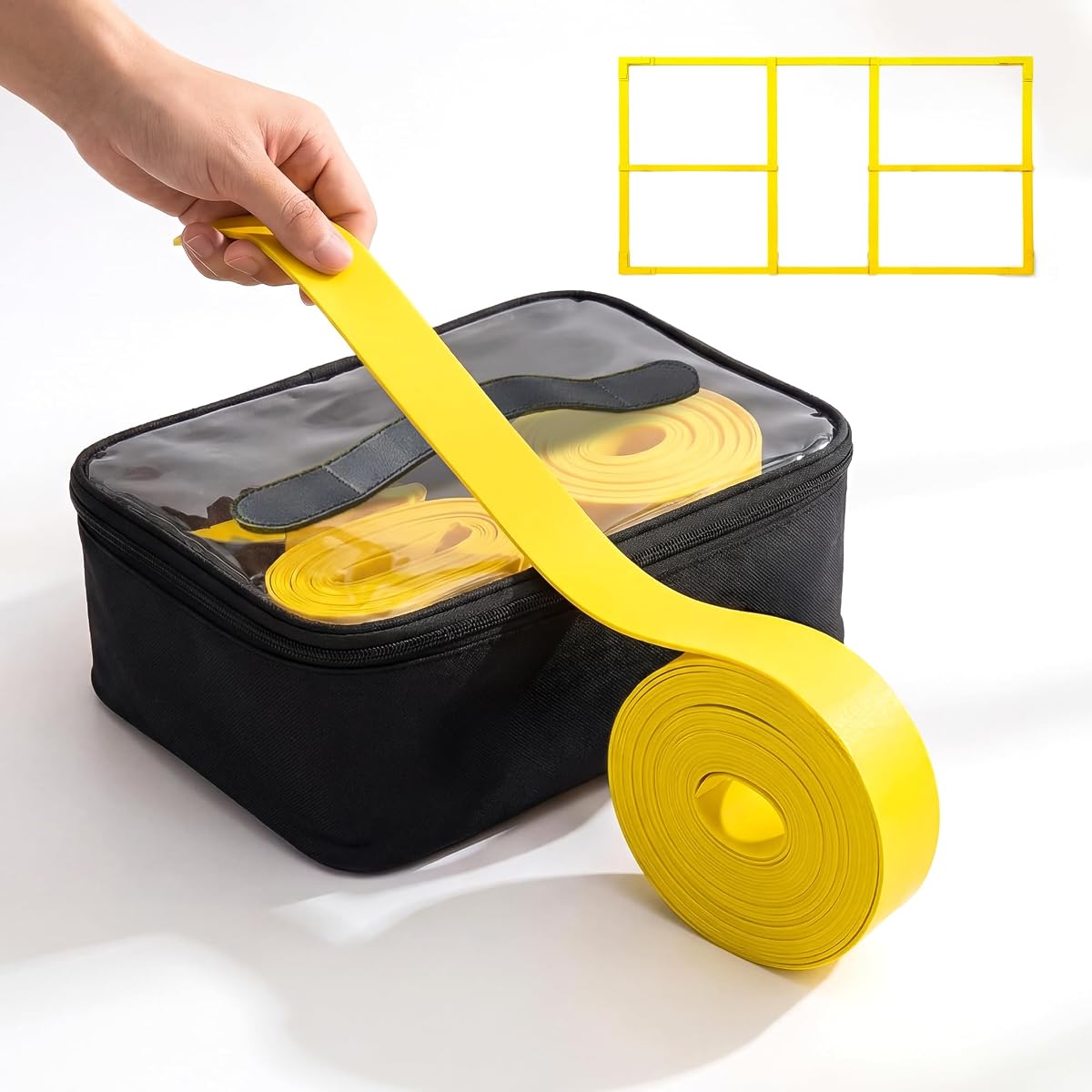
This portable line system offers a compact way to establish pickleball boundaries for recording. It uses magnetic cable connections, dual magnetic buckle modules at each corner, and textured ground contact to improve grip. The bright yellow color helps players identify the court quickly and can make the playing area easier for a camera operator to frame.
We may earn a commission when you buy through this link, at no additional cost to you.
The entire set rolls into a package roughly the size of a shoebox, making it easier to carry than a net assembly. It can be cleaned and reused for indoor or outdoor activities, which suits traveling coaches, pop clinics, and families creating a temporary filming area. Installation uses snap modules rather than conventional tools, so the system can become usable in a matter of minutes.
The main limitation is outdoor stability. The supplied information notes that weight blocks are sold separately to resist wind uplift, and a boundary system on an open surface can be vulnerable to gusts or accidental contact. The product’s low customer rating also suggests greater uncertainty than the higher-rated choices, although individual experiences can vary. Users should inspect the magnets and textured bases before every session.
This product makes the most sense when compact transport matters and the recording session is informal. It can support a camera demonstration, a training exercise, or a casual match, but it is not a substitute for a regulation net. Buyers who expect frequent outdoor use should budget for appropriate weights and regularly check that every connection remains seated.
The small rolled package fits easily into a vehicle or equipment bag. That portability is valuable for coaches who travel to different courts or film clinics in temporary spaces.
Additional weight blocks are available separately for locations exposed to wind. They should be placed according to the manufacturer’s guidance and checked before players enter the court.
We may earn a commission when you buy through this link, at no additional cost to you.
The Pro 22ft Pickleball Net combines regulation dimensions with an easy-to-adjust tension system. Its hand crank and reinforced tension rope help keep the center line straight and reduce sag, producing a more consistent court appearance in wide recordings. Lockable wheels add mobility, while the quick-tie points and metal frame buckles shorten setup compared with systems that require extensive rope threading.
We may earn a commission when you buy through this link, at no additional cost to you.
The 22-foot length gives a camera operator a predictable boundary for full-court compositions. It can also be moved to a new location without dismantling the whole system, which is helpful for a club hosting games in adjacent spaces. A 600D carry bag keeps the components organized and provides a convenient way to transport the net between a permanent venue and temporary outdoor court.
Hand-crank tension still needs attention after the net is moved or exposed to changing weather. Locking wheels cannot fully compensate for a sloping or uneven surface, and users should inspect the net before every session. Although the frame is described as heavy duty and suitable for indoor or outdoor use, long-term outdoor storage should keep components protected from moisture and direct weather exposure.
This net is a strong all-around companion for the Chameleon or Falcon, especially for coaches who want fast tension changes and frequent relocation. It is less appropriate for a facility seeking a permanently embedded solution, but it gives most users a practical balance of regulation size, mobility, and straightforward maintenance.
A hand crank makes it easy to respond to changes in the net after a move. Consistent tension reduces visual sag and helps the court maintain a predictable appearance during filming.
Pre-attached tie points and buckle-based base connections remove several time-consuming setup tasks. A club can therefore move the net more quickly between matches, practices, and recording sessions.
We may earn a commission when you buy through this link, at no additional cost to you.
The Seliyoo system is a permanent 22-foot net designed for courts that will be used repeatedly. Its carbon-steel posts have a three-millimeter wall, while the winder, crank, and top pulley are made from cast brass. The product information specifically emphasizes this hardware for installations that may be difficult to service later.
We may earn a commission when you buy through this link, at no additional cost to you.
The posts use galvanized sleeves embedded deeply into poured concrete. The stated installation combines 17.7-inch sleeves with a 15.7-inch post section, creating a structure intended to resist movement and avoid seasonal re-leveling. A steel-cable-core net, adjustable center strap, 36-inch side height, and 34-inch center height complete the regulation setup.
This is not a casual do-it-yourself purchase for someone who expects to move the court. Installation requires concrete work, accurate post alignment, and appropriate construction planning. The system also carries more financial commitment than a portable net, and local building or facility requirements should be reviewed before installation. A professional contractor may be preferable for clubs and public venues.
For a permanently installed club court, however, it provides the most stable foundation in the guide. A fixed net gives an AI tracking camera a consistent center line and removes the recurring task of locking wheels or checking portable tension. It is the best choice for facilities that want a tournament-style environment designed to support repeated play and recording.
A concrete-direct installation is designed not to drift during play. That stability gives camera operators repeatable framing and eliminates weekly wheel locking or net re-leveling.
Thick-wall carbon steel provides structural rigidity, while the specified brass hardware and galvanized embed components address common corrosion concerns. Site-specific drainage and protective maintenance still matter.
We may earn a commission when you buy through this link, at no additional cost to you.
The MOXOW Semi-Permanent system is designed for community courts, training spaces, recreation centers, and premium clubs that may need to change court layouts. It measures 22 feet by 36 inches, with an adjustable center strap that maintains the official 34-inch center height. The result is a regulation-sized visual reference for an AI camera and a clear net line for viewers.
We may earn a commission when you buy through this link, at no additional cost to you.
A steel cable and hand crank provide controlled tension adjustment, while integrated lockable wheels allow the system to be repositioned and secured. The rust-resistant aluminum frame and reinforced net are intended for outdoor use in changing weather. When the system is not in play, the manufacturer recommends storing it under cover to extend its service life.
Its semi-permanent format is a compromise between a lightweight portable net and a fully embedded installation. The wheels still need to be locked, the ground should be level, and the center strap may require periodic checks. Although assembly is tool-free, a large club moving the system frequently should assign the task to a trained staff member rather than expecting every player to handle it.
The included backpack provides convenient storage after the net is taken down, while the nested slide-in frame supports quick assembly. MOXOW is a strong choice for a multi-use venue that needs reliable court dimensions without committing to concrete work. It pairs especially well with the Falcon for clubs producing coaching video, live streams, and player-development highlights.
Integrated wheels allow staff to reconfigure a space without a full installation. Once locked in place, the system provides a stable regulation-sized court for games and recording.
A rust-resistant frame still benefits from being kept under cover when the net is not in use. Routine cleaning, dry storage, and regular tension checks support dependable long-term performance.
We may earn a commission when you buy through this link, at no additional cost to you.
A useful purchase should be evaluated as part of a connected workflow rather than as an isolated gadget. The right combination depends on whether you need autonomous video, reliable audio, a regulation court, temporary boundaries, or the mobility to film at several venues.
Pickleball rallies move quickly between the baseline, kitchen, and sidelines, so tracking behavior deserves careful attention. The Chameleon offers AI-powered tracking and FollowMe Mode, while the Falcon supplies more processing power and a dedicated tracking lens. Neither specification replaces a real-world trial: place the camera where it will actually operate, have players hit from different positions, and check whether the frame follows the intended athlete without losing essential court context.
Choose tracking that can follow players during exchanges near the net, not merely during isolated movement. The wider context can remain important for doubles, shot selection, and instructional analysis.
Both dedicated cameras record in 4K at 60FPS, which is well suited to fast ball movement and detailed court footage. High resolution allows viewers to inspect footwork and paddle positioning, while the higher frame rate makes slow-motion review more useful. Storage requirements, app support, and available recording time should be checked before committing to a long session.
Prioritize a camera that maintains stable output under the lighting and network conditions found at your regular venue. Resolution alone does not compensate for poor placement or an obstructed view.
Clear commentary can change the usefulness of a match video, especially for coaching or family highlights. The RØDE Wireless PRO provides two transmitters, a receiver, onboard float recording, timecode, and included lavalier microphones. Its receiver can connect to cameras, USB-C phones, and computers, making it a flexible addition to a visual camera system.
Place microphones close to the speaker, monitor for wind and clothing rub, and keep a backup recording available. The onboard float copy is valuable, but it does not replace careful microphone placement.
A recording camera needs a consistent visual reference at the center of the court. The ONCOURT OFFCOURT, Pro 22ft, MOXOW, and Seliyoo systems all use a 22-foot format, while their construction ranges from rolling aluminum frames to permanently embedded carbon-steel posts. Regulation center height helps create repeatable footage and a familiar game environment.
Choose a portable frame for mobility, a semi-permanent system for a flexible club, or an embedded net for a dedicated venue. Match the system to the surface and how often it will be moved.
Net sag can look distracting and may affect play. Hand cranks, reinforced ropes, center straps, and elastic lower bands all help maintain a consistent shape. The two Pro-style portable nets and MOXOW offer direct crank adjustment, while the ONCOURT OFFCOURT Deluxe uses a center-strap approach. Check tension after moving any portable system and inspect the net before players begin.
Consistent tension improves both gameplay and recorded presentation. A level, taut center line makes it easier for viewers to judge depth and player positioning.
Traveling coaches and families face a different problem from permanent clubs. The magnetic line systems roll into small packages, the Pro Pickleball Net includes a carry bag, the ONCOURT OFFCOURT Deluxe has a wheeled duffel, and MOXOW uses a backpack-style carrier. Larger steel and aluminum frames may be durable but occupy more vehicle and storage space.
Compare packed size, assembly time, wheel size, and carrying weight before purchase. A system that is difficult to move may remain unused, even when it offers strong specifications.
The Chameleon supports RTMP-compatible live streaming and includes 20GB of free cloud storage without a subscription fee. The Falcon adds built-in Wi-Fi live streaming and supports both microSD and cloud storage. Users must consider whether they need real-time sharing, later editing, remote access, or all three. Cloud workflows should be tested with the venue’s available network, while local card recording offers resilience when connectivity is poor.
Choose the camera that matches your distribution plan. A livestream is not essential for private analysis, and a locally stored 4K file may be more useful for highlights than an unreliable live feed.
Outdoor courts expose every component to sun, moisture, wind, and uneven ground. Magnetic lines may require separate weight blocks outdoors, portable nets require frequent wheel and tension checks, and the MOXOW system should be stored under cover when not in use. Seliyoo’s concrete-embedded construction is intended for permanent indoor or outdoor facilities, while the camera and audio equipment also need weather protection.
Plan the complete environment rather than only the camera. Shade, power access, storage, and safe cable management can determine whether a technically capable setup remains usable for a full match.
Begin by selecting the court location and confirming its dimensions before positioning equipment. For a permanent or semi-permanent net, lock the wheels, level the posts, and adjust the center strap. For temporary lines, inspect the magnetic connectors, place the weighted corners where needed, and check that the boundaries remain visible. Position the camera high enough to show the desired court area while avoiding blocked views from posts, fences, spectators, or direct sunlight.
Set up audio next. Connect the RØDE receiver to the camera, phone, or computer, confirm that the transmitters are recording, and assign each microphone to the correct speaker. A short sound check should include normal speech, a clap or sharp hand gesture for synchronization when appropriate, and a brief listen for wind or clothing noise. Keep the receiver within clear line of sight and start the main recording before the match so no early action is missed.
After the session, stop recording, confirm that the camera and transmitters created usable files, and copy essential footage before editing. Clean the camera lens, wipe down boundary lines, remove debris from net hardware, and dry any moisture on the equipment. Roll or fold temporary lines neatly, inspect magnetic pieces, lock portable net wheels during transport, and store outdoor systems under cover. Permanent installations should receive routine net, post, anchor, and tension inspections.
An AI tracking camera is useful when you want the frame to follow a particular player without constant manual adjustment. The Chameleon is a more accessible option with FollowMe Mode and 4K 60FPS recording, while the Falcon offers more advanced processing and a dedicated tracking lens. A fixed wide-angle camera can also work well for complete-court views. The best choice depends on whether you prioritize athlete close-ups, full-court instruction, live streaming, or manual framing.
A separate wireless microphone can materially improve commentary, interviews, and instructional videos because camera microphones often capture more court noise than close speech. The RØDE Wireless PRO provides two transmitters, a receiver, lavalier microphones, onboard recording, and timecode. It is not necessary for every casual highlight video, but it is valuable when the audio will be reviewed for coaching or shared in a polished production.
A quality portable net can provide regulation dimensions and stable footage, but it is not identical to a permanently embedded installation. Portable systems may need wheel locking, tension adjustment, and level checks after each move. A permanent net is generally more consistent over time. If footage is intended for sanctioned competition, always confirm that the court and equipment comply with the rules of the event organizer.
You can record many practices and informal games on a flat paved surface using temporary boundary lines. The Chemimoso and Magnetic Portable Court Lines systems are designed for reusable temporary layouts, and the magnetic units may need separate weights outdoors. A regulation net remains preferable for realistic ball response and consistent center height. Check the surface for debris, moisture, traffic, and safe camera-placement locations before recording.
Reliable framing, clear audio, stable court dimensions, and secure equipment placement matter more than any single specification. Start with the video view you want to preserve, then add audio and court equipment that supports that view. Test the full configuration with real players before an important event, because tracking, lighting, wireless reliability, and surface conditions can all affect the final result.
Local recording is dependable and works without a stable internet connection, making it suitable for practices and important match footage. Cloud storage is useful when the goal is immediate sharing, remote access, or transferring clips without filling a phone. The Chameleon and Falcon support connected workflows, but users should still retain local files when possible and verify that uploads finish before deleting the original footage.
Start with a wide view from a high, unobstructed position that includes the relevant court area. Check how the camera follows a player approaching the kitchen, rotating to cover a lob, and moving between the baseline and sideline. Avoid placing it where the net, fence, or nearby players can block the subject. A fixed wide shot can be used alongside a tracking camera when full context and close-up footage are both important.
Check net tension, wheel locks, frame connections, and the condition of the center strap before every session. Clean court lines after use and keep magnetic modules from collecting dirt. Cameras should have clean lenses, and audio transmitters should be charged and confirmed to be recording. Store outdoor equipment under cover when possible, and inspect permanent installations periodically for post movement, hardware wear, and net damage.
The strongest complete recording setup combines the XbotGo Chameleon or Falcon with reliable sound and a stable court. The Chameleon offers approachable tracking, 4K 60FPS capture, live streaming, and useful mobile features, while the Falcon provides more advanced AI hardware and a dedicated tracking lens. The RØDE Wireless PRO adds synchronized, recoverable audio for commentary and multi-camera work.
The net and line products determine the physical foundation of that recording. MOXOW suits flexible multi-use venues, the ONCOURT OFFCOURT Deluxe offers a sturdy rolling option, the Pro 22ft net provides straightforward crank tension, and Seliyoo serves permanent facilities. Chemimoso and the Magnetic Portable Court Lines are best viewed as flexible boundary tools for informal or temporary setups rather than regulation-net replacements.
Before purchasing, verify the current specifications, compatibility, storage requirements, venue rules, and latest cost, because product configurations and prices can change. The right choice is the combination that matches your court, athletes, and distribution plans—not simply the model with the longest feature list.