
LiNKFOR 192kHz DAC Converter
4.8Editor score
192kHz PCM conversion
Integrated RCA cable
Amplified stereo output
Discover the best Optical to RCA Adapter options by comparing DAC performance, surround decoding, cable design, connectivity, and setup ease.
An optical to RCA adapter connects a modern digital audio source to an older amplifier, stereo system, or pair of powered speakers. A worthwhile model should translate the signal cleanly, provide a stable connection, and fit the source's PCM or surround format without creating setup confusion.
We compared the ten featured converters by examining resolution support, input and output options, amplification, decoding capabilities, cable construction, power requirements, and compatibility guidance. The list covers compact integrated designs, detachable models, volume-controlled options, and converters that down-mix surround audio.
Each selection highlights a different practical advantage, from flexible RCA connectivity to support for Dolby AC-3 and DTS. Ratings and product details reflect the supplied information, while current prices and availability can change. Always verify the intended source format before making a final connection.
4.8Editor score

4.4Editor score

4.3Editor score
The comparison below highlights the important differences among ten optical-to-RCA converters, including supported formats, decoding, cable construction, amplification, power, and output flexibility.

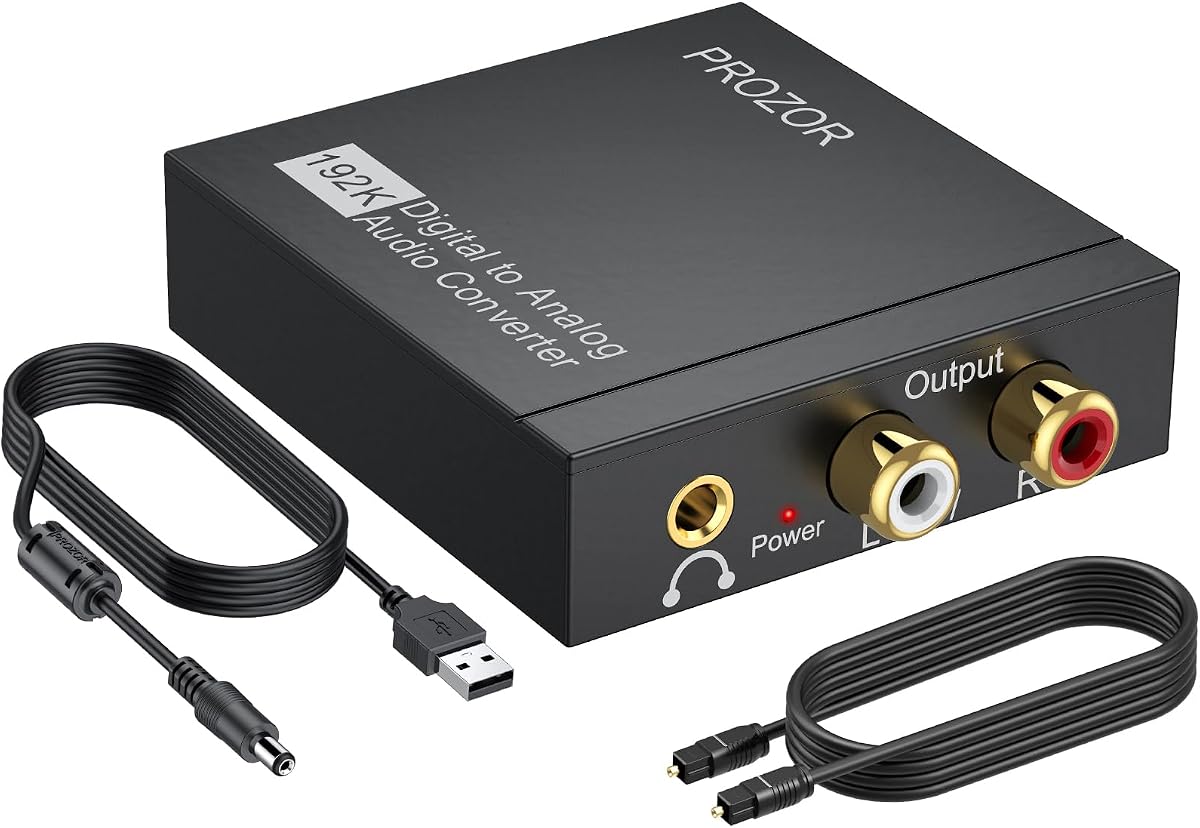


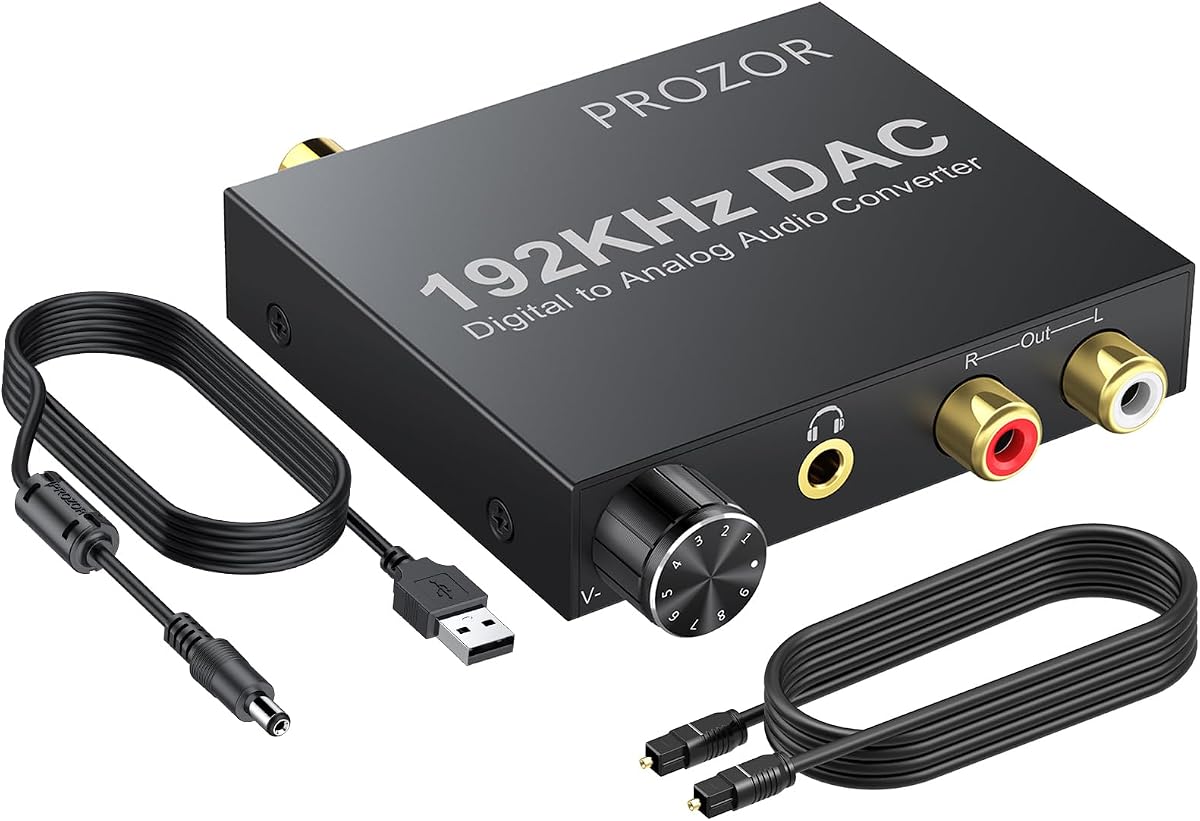


The PROZOR Detachable DAC earns a 4.4 rating and stands out as the most adaptable converter in this guide. It accepts both coaxial and optical digital input, then sends analog audio to left and right RCA jacks and a 3.5mm jack at the same time. That combination lets it serve an amplifier, powered speakers, and headphones without changing converters.
We may earn a commission when you buy through this link, at no additional cost to you.
Its detachable converter box is a particularly useful feature. The supplied three-foot optical cable and USB power cable support a straightforward installation, while removable RCA leads make it easier to replace a worn cable without replacing the entire unit. Gold-plated RCA connectors and an aluminum alloy housing complement the practical connector arrangement.
Audio specifications include support for 32, 44.1, 48, 96, and 192kHz sampling rates with a 24-bit S/PDIF incoming bitstream on both channels. The stated PCM and LPCM limitation means users should set the source to a compatible two-channel format. Since there is no physical volume knob, output level must be controlled through the source's settings or the connected amplifier.
This is the strongest general recommendation for someone who wants one converter to cover several source and output combinations. It is particularly useful when the optical source is more than a few feet from the stereo system or when headphones may be connected occasionally. Buyers should confirm that their source can output PCM or LPCM and obtain a suitable 5V 1A power adapter.
Optical, coaxial, RCA, and 3.5mm support removes several common compatibility barriers. The simultaneous analog outputs also allow a shared converter to feed an amplifier and headphones, provided the connected equipment does not fight over the output level.
The detachable cable arrangement makes replacement more convenient, while the aluminum housing is designed for heat dissipation and electromagnetic shielding. The result is especially appealing for permanent installations near entertainment equipment.
We may earn a commission when you buy through this link, at no additional cost to you.
The PROZOR 7ft Integrated DAC has a 4.4 rating and focuses on a clean, uncomplicated installation. Its built-in 7-foot RCA cable reaches from a wall-mounted television or media console to an amplifier or powered speaker without requiring a separate analog lead. This makes it a good fit for installations where cable routing matters.
We may earn a commission when you buy through this link, at no additional cost to you.
The converter uses an integrated amplifier chipset and dual-channel operational amplifier to address low RCA output levels. It supports sampling rates from 32 to 192kHz and a 24-bit S/PDIF incoming bitstream across the left and right channels. Its USB power lead includes a ferrite core intended to minimize electromagnetic and radio-frequency interference.
The principal limitation is format support. It is designed for uncompressed two-channel LPCM or PCM and is not compatible with 5.1-channel signals such as Dolby AC3. A source's automatic audio setting may therefore need to be changed to PCM. The fixed RCA cable also cannot be swapped independently if it becomes damaged.
This model suits users connecting an HDTV, set-top box, DVD or Blu-ray player, or game console to an RCA-equipped system while keeping the setup tidy. It offers less output flexibility than the detachable PROZOR model, but the integrated seven-foot lead and compact converter body may be more convenient for many living-room arrangements.
The integrated 7-foot lead reduces the number of components behind a television. It is particularly convenient when the source sits above or beside the amplifier and the stereo system is positioned along a nearby wall.
The built-in amplifier chip is intended to produce a stronger, clearer RCA signal. Source volume may still need adjustment through television menus because the converter itself has no volume control.
We may earn a commission when you buy through this link, at no additional cost to you.
The PROZOR Multi-Output DAC carries a 4.4 rating and combines broad input support with convenient analog outputs. Optical and coaxial digital signals can be converted simultaneously to left and right RCA and a 3.5mm jack. Like the first-ranked model, it is designed for PCM and LPCM rather than encoded surround formats.
We may earn a commission when you buy through this link, at no additional cost to you.
Its internal amplifier chip addresses low output volume, while gold-plated RCA connectors are intended to maintain reliable signal transmission. The converter supports 32, 44.1, 48, 96, and 192kHz sampling rates, plus 24-bit incoming S/PDIF streams on both channels. Its ferrite-core USB power cable is designed to reduce interference during operation.
The main compromise is that there is no built-in volume knob or surround decoder. Users who need to decode Dolby AC3 or DTS to stereo will need a different converter. A separate 5V 1A power supply is also required, and the instructions advise against using unsuitable plugs or relying on uncertain power sources.
This is a flexible option for a home audio setup in which one source might feed an amplifier, powered speakers, or headphones. It is especially appealing to users who want gold-plated RCA connections and do not need the detachable housing offered by the top-ranked PROZOR converter.
Feeding RCA and 3.5mm outputs at the same time gives the converter broad practical utility. It can connect to a stereo system while leaving a headphone connection available for quieter listening.
Support for sampling rates through 192kHz makes the converter suitable for modern digital sources that provide compatible PCM. The amplifier chip and ferrite-core power lead are intended to support clear, stable output.
We may earn a commission when you buy through this link, at no additional cost to you.
The Neoteck 7ft DAC has a 4.4 rating and is designed to link digital optical sources with traditional RCA audio equipment. Its integrated seven-foot RCA cable and compact converter body can simplify a home theater or living-room installation without taking up much space.
We may earn a commission when you buy through this link, at no additional cost to you.
A high-performance amplifier chipset is included to raise the RCA output level and improve interference resistance. The converter supports 32, 44.1, 48, 96, and 192kHz sampling rates, along with 24-bit S/PDIF incoming streams on the left and right channels. Compatibility is intended for HDTVs, set-top boxes, disc players, and game consoles.
This is a PCM-only model for uncompressed two-channel audio. Dolby AC3, DTS, and other 5.1-channel signals are not supported, so the source must be configured for PCM before use. The package does not include a wall adapter, and the supplied guidance emphasizes a separate 5V 1A power supply for stable operation.
Buyers who want a tidy, integrated cable arrangement will find the Neoteck appealing. It is less versatile than converters offering coaxial input or a 3.5mm output, but its 4.4 rating, amplification, and high-resolution capability make it a credible choice for connecting a modern source to older speakers.
The small converter and long integrated lead reduce cable clutter around wall-mounted displays. The fixed design also means there are fewer separate components to position and reconnect.
The strongest results depend on setting the television or disc player to PCM output. Using an encoded surround signal can prevent playback, so checking this setting before installation avoids unnecessary troubleshooting.
We may earn a commission when you buy through this link, at no additional cost to you.
The LiNKFOR 192kHz DAC Converter holds the highest listed rating in the group at 4.8. It converts an optical Toslink signal into analog left and right RCA audio, making it a straightforward solution for pairing a modern television with an older amplifier or powered stereo.
We may earn a commission when you buy through this link, at no additional cost to you.
Its built-in amplifier chip is designed to improve output level and clarity. The converter supports 32, 44.1, 48, 96, and 192kHz sampling rates, as well as 24-bit S/PDIF incoming streams on both channels. A built-in 1.1-meter RCA cable provides useful placement flexibility while keeping the installation compact.
Compatibility centers on digital PCM or LPCM. Encoded 5.1-channel signals such as Dolby AC3 and DTS are not supported, which means the source may need to be changed from automatic output to PCM. The converter is powered through a 5V 1A USB cable, and the fixed RCA lead cannot be replaced independently.
This is an appealing budget-oriented choice for a basic two-channel installation. Its 4.8 rating reflects strong customer reception, while the long cable and amplification cover the essential needs of most optical-to-RCA conversions. It is best for users who do not require surround decoding, physical volume control, or interchangeable output leads.
A 4.8 rating makes this one of the most positively reviewed products listed. Its simple conversion path and broad sampling-rate support cover the core needs of a modern source connected to legacy stereo equipment.
The 3.6-foot RCA lead makes the converter less dependent on the position of nearby furniture. It is useful behind televisions and near media consoles where a compact, single-piece arrangement is preferred.
We may earn a commission when you buy through this link, at no additional cost to you.
The LiNKFOR Compact DAC has a 4.3 rating and offers the basic function of converting optical Toslink audio into analog RCA stereo. It targets the common situation in which a television or game console has digital audio but an amplifier or speaker system only accepts RCA.
We may earn a commission when you buy through this link, at no additional cost to you.
The converter includes an amplifier chip intended to produce a stronger and clearer signal. Sampling rates from 32 to 192kHz are supported, along with 24-bit S/PDIF incoming streams on both channels. Its compact construction and integrated 1.1-meter RCA cable reduce the need for separate analog leads.
As with many PCM-only converters, Dolby AC3 and DTS 5.1-channel signals are not compatible. The television or other source must output PCM for reliable operation. The device draws power through a 5V 1A USB connection, and there is no built-in volume knob for matching the output to a particular amplifier.
This model is a sensible choice when preserving space matters more than having several inputs or outputs. It covers high-resolution PCM conversion and amplification in a small package. Users needing Dolby or DTS decoding should consider one of the surround-capable options in this guide instead.
The converter keeps the signal path uncomplicated: optical in, RCA left and right out. That makes it easy to understand and maintain in a permanent home audio installation.
Despite its small form, the stated specifications include support for sampling rates through 192kHz and a 24-bit incoming bitstream. The integrated amplifier chip helps provide a practical output level.
We may earn a commission when you buy through this link, at no additional cost to you.
The PROZOR Volume-Control DAC is the premium pick in this guide because it adds direct control over the output level. Its built-in knob lets the user match the converter to an amplifier or powered speakers without relying exclusively on television menus. It carries a 4.4 rating.
We may earn a commission when you buy through this link, at no additional cost to you.
The converter accepts optical Toslink and coaxial digital input and provides left and right RCA plus a 3.5mm headphone output. Sampling rates of 32, 44.1, 48, 96, and 192kHz are supported, with a 24-bit S/PDIF incoming bitstream on both channels. The aluminum housing is designed for heat resistance and durability.
A 5V 1A power adapter is required, but the unit supports gold-plated input and output interfaces intended to reduce signal loss. The audio format remains PCM-oriented rather than surround-capable. Automatic muting during non-audio input signals is also listed as a feature, which can be useful when the source changes modes.
This model makes the most sense for users who want manual level control at the converter rather than navigating source menus. It is also appropriate when one device needs to feed both an amplifier and headphones. Buyers should prioritize its physical volume knob, flexible ports, and metal construction over integrated-cable convenience.
The volume knob provides a direct way to reduce output or raise it for a particular amplifier. This is useful when the source's available digital output levels do not align well with the connected analog system.
An aluminum metal shell offers a more substantial enclosure than a basic plastic converter. Gold-plated interfaces complement the design and support dependable connections in a permanent setup.
We may earn a commission when you buy through this link, at no additional cost to you.
The PROZOR 5.1-Channel DAC has a 4.4 rating and differs from most models by accepting Dolby AC3, DTS, LPCM, and PCM sources. It down-mixes 5.1-channel audio into a 2.0-channel analog output, allowing a source with surround audio to feed a conventional stereo amplifier.
We may earn a commission when you buy through this link, at no additional cost to you.
Optical Toslink and coaxial digital inputs are both available. The analog side includes left and right RCA jacks and a 3.5mm connection, so the same unit can serve a stereo system, home cinema amplifier, or headphones. Sampling rates extend to 192kHz, and the converter accepts a 24-bit S/PDIF incoming bitstream across the channels.
Its adjustable amplifier chip and magnetic-ring power cord are intended to support stable, low-noise transmission. The limitation is that down-mixing cannot recreate the discrete channel separation of a true surround system. It provides a stereo presentation rather than preserving six separate analog outputs, and no physical volume control is included.
This model is a good choice for users who encounter automatic Dolby or DTS output and do not want to change the television setting each time. It is especially relevant for newer televisions, game consoles, and disc players feeding older stereo equipment. Those who only use PCM and prefer a simpler converter can find more compact alternatives.
Dolby AC3 and DTS decoding allows a television, console, or disc player to remain on its preferred output setting. The converter handles the conversion to stereo, though it cannot reproduce true spatial channel separation.
The magnetic-ring power cord and adjustable amplifier chip are intended to improve signal stability and reduce unwanted noise. These features suit installations where interference or unstable power could affect playback.
We may earn a commission when you buy through this link, at no additional cost to you.
The eSynic Extended DAC has a 4.2 rating and is built around a seven-foot fiber-optic cable for installations where the source and stereo equipment are separated. It bridges modern optical sources and vintage RCA amplifiers with a built-in DAC and gold-plated output ports.
We may earn a commission when you buy through this link, at no additional cost to you.
The converter is specified for PCM 2.0 and is not compatible with Dolby or DTS 5.1 or 7.1 signals. Its one-way design converts optical input to RCA output and cannot operate in the reverse direction. A status LED confirms operation, while the aluminum housing is designed to reduce interference and dissipate heat.
The supplied compatibility information is important because some descriptions of the product refer broadly to the absence of external power, while the listed requirements also call for a 5V 1A USB adapter that is not included. Following the specific power requirement and using a proper source is the safest setup approach.
This model is best for a PCM-focused home theater installation with a wall-mounted television or a long run to an amplifier. It is less suitable for users who need automatic surround decoding or bidirectional conversion. The extended cable, metal enclosure, and gold-plated RCA outputs remain its most attractive features.
The flexible seven-foot fiber-optic section can reach behind a television and continue to the analog stereo system. That reach reduces the need for an intermediate converter or additional digital cable.
The converter is intended for two-channel PCM, not encoded surround signals. Confirming the source's output setting and providing the specified USB power are essential for reliable operation.
We may earn a commission when you buy through this link, at no additional cost to you.
The eSynic Dolby DTS Decoder has a 4.3 rating and is designed to reduce menu changes when streaming or gaming systems output surround audio. It natively decodes Dolby AC3 and DTS 5.1 and converts the signal to 2.0-channel analog audio for an RCA amplifier or stereo speakers.
We may earn a commission when you buy through this link, at no additional cost to you.
The listed sampling-rate range extends from 32 to 192kHz with 16-24-bit resolution. The specifications also state a 105dB signal-to-noise ratio, -90dB THD+N, and a 20Hz-20kHz frequency response. A built-in amplifier chip is intended to provide a strong, clean output level, and the DAC and amplifier are integrated into the converter housing.
A 7-foot overall reach is provided through the optical and integrated RCA sections. The unit draws power through USB and can be connected to a TV USB port, computer, or suitable phone charger according to the product information. This reduces the need for a separate external power brick in many installations.
This converter is a strong option for users who want Dolby and DTS sources to work without forcing every app or device into PCM mode. Its trade-off is inherent to analog stereo output: surround effects are down-mixed, not reproduced as separate channels. It also lacks a physical volume control, so final level adjustment remains with the source or amplifier.
Dolby AC3, DTS, PCM, WAV, WMA, AAC, and FLAC are listed as compatible formats. This broad support is useful across streaming services, consoles, disc players, and television menus.
Combining the DAC, amplifier, and cables in one housing creates a compact installation. The stated noise and distortion figures make this model appealing to buyers seeking more specification than a basic PCM converter.
We may earn a commission when you buy through this link, at no additional cost to you.
The right optical to RCA adapter depends less on marketing language than on format support, signal direction, output flexibility, and the physical layout of the equipment. These factors determine whether the converter will work smoothly after installation.
Most basic converters accept only uncompressed two-channel PCM or LPCM. If a television, game console, disc player, or streaming device outputs Dolby AC3 or DTS by default, a PCM-only adapter may produce no sound until the source settings are changed. Surround-capable converters decode those signals and down-mix them to stereo, making them more convenient when the user wants consistent behavior across apps and devices.
Check the source's digital audio output menu before buying. Look for PCM, LPCM, or a supported surround format, and note that application behavior can vary. Choosing a decoder-capable model provides more flexibility when the source cannot be configured consistently.
These products are digital-to-analog converters: optical or coaxial digital audio enters the device, while RCA analog audio leaves it. They do not turn RCA audio into an optical signal. A few listings mention bidirectionality in general descriptions, but the detailed direction for every featured model is one-way.
Write down which side of the connection needs digital audio. If the amplifier has only RCA input and the source has optical output, the direction is correct. If the goal is to send music from an old amplifier to a soundbar or digital recorder, a completely different type of adapter is needed.
A basic converter provides left and right RCA outputs, which are enough for a stereo amplifier. Models with a 3.5mm jack can also feed headphones or compact powered speakers. Coaxial digital input can be useful if a source offers that connection but lacks optical output. Detachable RCA cables make cable replacement easier, while an integrated cable creates a tidier installation.
Choose based on the actual ports already present on the connected equipment. Avoid paying for extra flexibility that will not be used, but favor a converter with serviceable leads if the wiring will be moved frequently or routed through a tight entertainment center.
Many converters amplify the RCA signal but do not include a user-adjustable volume knob. In those designs, level adjustment takes place in the television's audio menu or on the connected amplifier. This is not inherently a problem, but some televisions expose digital output volume only in advanced settings, making initial setup less intuitive.
A physical volume control offers immediate, source-independent adjustment and is especially useful with different amplifiers or headphone levels. The PROZOR Volume-Control DAC is the featured option with this feature. Other buyers should verify how their source handles optical output volume before installation.
A stated maximum of 192kHz indicates support for high-resolution digital streams, but it does not mean every source will deliver that rate. Actual output depends on the television, console, player, and the format selected. Two-channel support is the common requirement for analog RCA conversion, and 24-bit S/PDIF input is listed for most featured models.
Do not treat a sampling-rate headline as a guarantee of superior sound in every setup. Correct format selection, clean cables, stable power, and an appropriate analog system remain more important to a successful conversion than the maximum number printed on the box.
An integrated RCA cable makes setup quick and reduces loose connections. It is useful when the converter can be positioned close to the source, with the analog cable extending toward the amplifier. A detachable converter box is preferable when cables need to be routed independently, replaced, or adapted to different connector lengths.
Consider reach and furniture placement together. A seven-foot lead may be unnecessary for a compact media console but valuable behind a wall-mounted television. Measure the likely route before choosing, and avoid creating a tight strain point around a permanently fixed cable.
An integrated amplifier chip can raise the converter's RCA output level, which may help when the connected amplifier has a modest input sensitivity. Aluminum housings are used in several featured products for heat dissipation and electromagnetic shielding, while gold-plated connectors are intended to support stable signal contact.
Build features are supporting details rather than substitutes for correct operation. A well-built converter still needs compatible source settings, secure cables, and suitable power. Reviews should focus on whether those elements work together in the intended installation.
Most models use a USB power lead and require a stable 5V 1A source. Some include a cable without including the wall adapter, and instructions may discourage powering the converter from a television's USB port. A separate certified adapter is generally more predictable when troubleshooting noise or intermittent operation.
Check the package contents before ordering an additional power supply. If the source equipment has a dependable USB port and the manufacturer's instructions explicitly permit it, that can be convenient. Otherwise, reserve a suitable 5V 1A adapter for the converter and keep the power connection secure.
Begin by identifying the source's optical or coaxial digital output and the destination's left and right RCA inputs. Disconnect power from the equipment, connect the digital cable to the converter, and route the analog output to the amplifier or powered speakers. Connect the USB power lead to the specified 5V source before turning on the system.
On the source device, open the sound, audio, or digital-output settings. Select PCM or LPCM for PCM-only converters, or select an encoded surround format when using a model with Dolby or DTS decoding. If the converter has a volume knob, begin at a low setting and raise it gradually after confirming that the source is producing audio.
Keep the optical connector properly seated and avoid sharp bends in the fiber-optic cable. Do not use the converter as a permanent volume controller unless it has a dedicated control. For noise or unstable output, reseat the cables, confirm the source format, use shielded RCA wiring where appropriate, and provide the converter with a stable compatible power source.
Its primary purpose is compatibility, not automatic sound enhancement. It lets a digital source feed an analog amplifier that lacks optical or HDMI audio input. A capable converter can provide a clean analog signal and adequate output level, but the final sound also depends on the source settings, cables, amplifier, and speakers.
The most common causes are an unsupported audio format, a loose cable, or insufficient power. Set the source to PCM or LPCM for a PCM-only converter, reconnect the optical and RCA leads, and verify that the converter's power light is active. For surround-capable models, confirm that the selected Dolby or DTS format is among the supported modes.
Sometimes, but it depends on the television. Many televisions adjust their optical output level through the sound settings rather than directly through the remote. Search the television menu for digital audio output volume, or adjust the level on the amplifier if it has its own volume control.
Only if the source regularly outputs Dolby AC3 or DTS and you want to avoid changing it to PCM. A decoder-capable converter can down-mix surround audio to two RCA channels, but the result is a stereo presentation and does not preserve six independent speaker channels.
No. Every featured product is a digital-to-analog converter with optical or coaxial input and RCA output. Sending audio in the opposite direction requires an analog-to-digital converter, also called an ADC, which is a different product category.
No. The converter must support the sample rate supplied by the source, and the source must actually provide it. Most programs and television services transmit at lower rates. The 192kHz figure describes the converter's supported capability rather than the rate every connected device will use.
Follow the specific manufacturer's instructions. Some products advise against television USB ports and recommend a separate certified 5V 1A adapter, which can provide more consistent operation and simplify troubleshooting. Other listed models explicitly permit suitable USB power sources such as a television, computer, or phone charger.
A PCM converter is usually sufficient if the television can be set to PCM and you need only left and right stereo audio. Choose a decoder-capable model if the television or its apps output Dolby or DTS and you want to avoid repeated menu changes. A detachable or longer-cable design may be better if the equipment is far apart.
The PROZOR Detachable DAC is the strongest all-around option because it combines optical and coaxial inputs, RCA and 3.5mm outputs, detachable wiring, and a useful aluminum housing. The LiNKFOR 192kHz DAC Converter represents the budget pick, while the PROZOR Volume-Control DAC offers the premium feature of direct manual level adjustment.
Prioritize format compatibility before any other feature. PCM-only models are appropriate when the source settings can be controlled consistently, while Dolby and DTS decoders are better for mixed entertainment systems and streaming applications. Cable reach, detachable construction, output options, and power should then be matched to the physical layout of the room.
Finally, check the current product details, package contents, source settings, and power requirements before purchasing. Ratings, specifications, and product availability can change, and the best adapter is the one that supports the source format, reaches the intended system, and connects without adding avoidable troubleshooting.