
Cable Matters Shielded Cat6A
4.4Editor score
600MHz performance bandwidth
Shielded S/FTP construction
23AWG solid copper
10Gb Ethernet support
Our 1000 Foot Ethernet Cable guide compares ten bulk options for speed, shielding, fire rating, copper quality, outdoor use, and installation ease.
A 1000-foot Ethernet cable is a substantial wiring investment for a home, office, surveillance system, or data center. The best roll balances usable performance, dependable construction, convenient installation, and compatibility with the equipment and building spaces where it will be used.
We compared the ten options by category, conductor material and gauge, supported bandwidth, fire rating, shielding, outdoor suitability, pull-box design, and included installation accessories. The list covers basic Cat5e runs through Cat6, Cat6A, and Cat8 bulk cable.
Each review identifies the environments where that cable makes the most sense, along with its limitations and ideal use. Ratings and product details reflect the supplied information, while prices and availability can change, so readers should verify current listings before purchasing.
4.4Editor score

4.8Editor score

4.7Editor score
The comparison below highlights each cable's category, construction, bandwidth target, and practical use so buyers can quickly identify the option that matches their network, installation environment, and termination plans.


The TRUE CABLE Cat6A Riser is the strongest all-around choice in this 1000-foot Ethernet cable roundup, earning a 4.8 rating. Its 23AWG solid bare copper, 750MHz bandwidth capability, and support for Gigabit and 10-Gigabit Ethernet give it useful performance headroom for modern homes, offices, servers, and high-bandwidth devices.
We may earn a commission when you buy through this link, at no additional cost to you.
A key advantage is the combination of solid copper conductors and a riser-rated PVC jacket. The cable supports PoE, PoE+, and PoE++ under the cited IEEE standards, including delivery up to 100W. That makes it relevant for power-heavy access points, network cameras, and other powered devices, subject to the requirements of the connected equipment.
Installation details are unusually practical. The reel is designed for smooth pulling, while sequential two-foot markings help installers estimate the amount needed for each run. The product information also states that the cable was tested with a Fluke DSX-8000 and meets ANSI/TIA 568.2-E standards, with ETL, cETLus, and RoHS-3 compliance. Those are useful confidence signals for professional buyers.
The principal trade-off is that this is an unshielded U/UTP cable. It is well suited to conventional structured-cabling spaces, but it may be less ideal beside unusually strong sources of electromagnetic interference. It also requires field termination rather than arriving with standard RJ45 plugs. Overall, the performance, PoE capability, markings, and certification make it the most versatile premium-quality option here.
Supporting 10-Gigabit Ethernet over runs of up to 328 feet, as stated in the supplied information, gives this cable room for demanding applications. The 750MHz rating also positions it well for servers, gaming, 4K streaming, and business networking.
The CMR jacket, marked reel, and pull-friendly packaging align with professional installation practices. These details make the cable easier to inventory and deploy across multiple floors or wall pathways.
We may earn a commission when you buy through this link, at no additional cost to you.
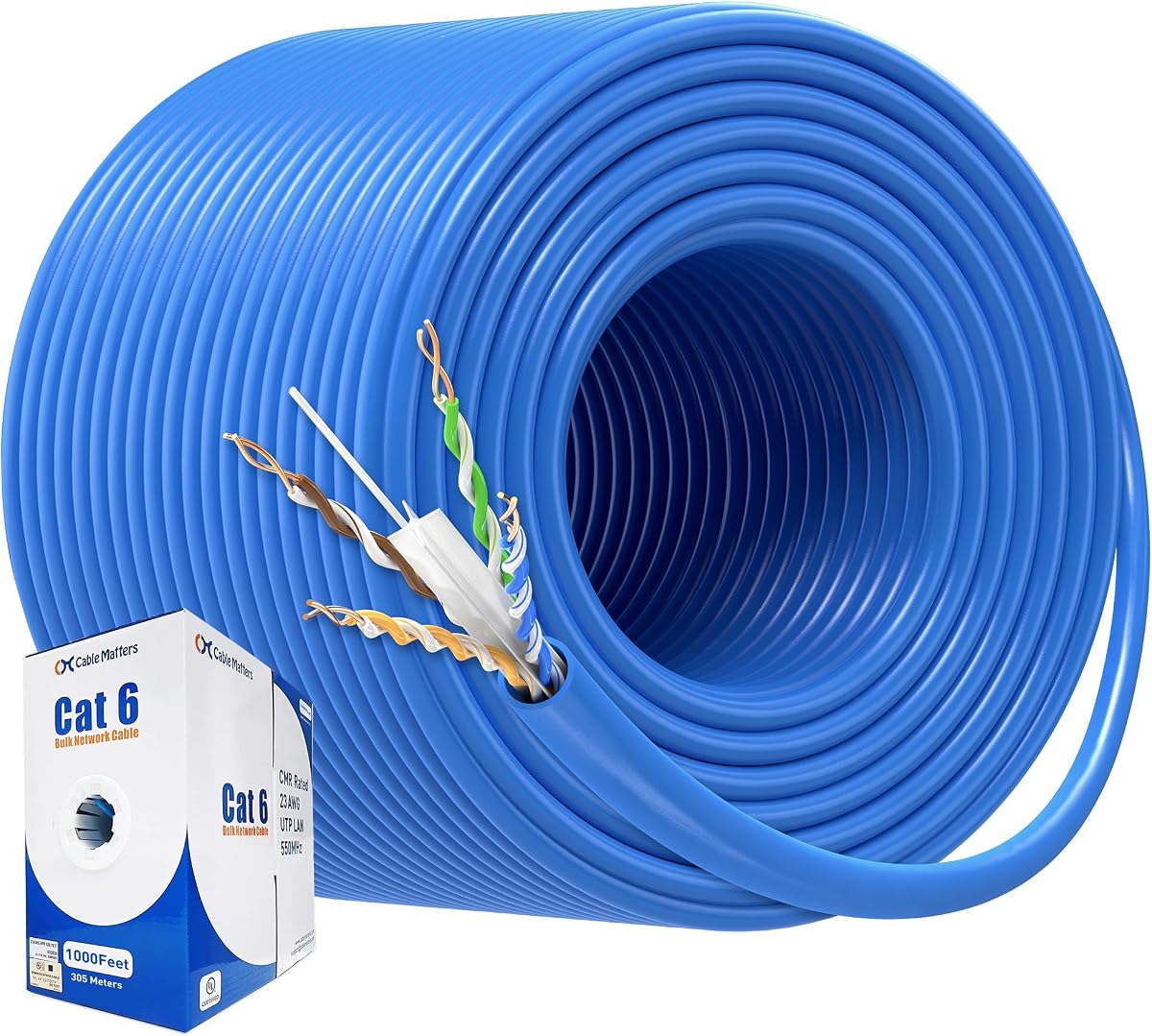
This Cable Matters Cat6 bulk cable earns a 4.7 rating and offers a balanced combination of solid copper, 550MHz bandwidth, and 10-Gigabit Ethernet support. It is a logical choice for structured cabling where Cat6 provides enough performance without moving to the larger diameter of Cat6A.
We may earn a commission when you buy through this link, at no additional cost to you.
The 23AWG solid bare copper construction is designed for conductivity and reliable signal transfer. The stated compliance with TIA/EIA 568-C.2 and support for PoE, PoE+, and PoE++ make the cable suitable for a broad mix of network devices, including security cameras, access points, and VoIP equipment.
The foot-marked jacket improves installation efficiency by helping installers see how much cable remains in the easy-pull box. A UL listing and CM jacket provide documented construction standards, although buyers installing it between floors should verify whether a riser-rated CMR cable is required by local codes.
This cable is best for buyers who want Cat6 performance and pure copper without the diameter and termination demands of shielded Cat6A. It is less suitable for electrically noisy locations because it is unshielded. For standard residential, office, and server-room structured wiring, however, it remains a capable and flexible choice.
The cable's solid bare copper conductors provide a strong foundation for stable data and power delivery. It retains the simpler construction associated with ordinary Cat6 while supporting modern high-speed applications.
Printed foot markings and an easy-pull box reduce avoidable waste during deployment. This is particularly helpful when a single 1000-foot reel must serve several outlets, rooms, or access points.
We may earn a commission when you buy through this link, at no additional cost to you.
The 1000-foot Cat5e UTP cable has a 4.6 rating and focuses on the fundamentals of reliable twisted-pair networking. It is a basic option for homes, businesses, file sharing, internet access, video streaming, and IP camera connections that do not require the additional headroom of Cat6 or Cat6A.
We may earn a commission when you buy through this link, at no additional cost to you.
Its four twisted pairs support Gigabit Ethernet-oriented applications, while the white jacket makes the cable easy to identify in otherwise visually busy wiring spaces. The product is supplied on a 1000-foot, or 305-meter, pull box, allowing installers to cut the exact length needed for each route.
The limitation is the category itself. Cat5e has less bandwidth and future capacity than the Cat6, Cat6A, and Cat8 options in this guide. It is unshielded, so it is not the strongest answer for high-interference areas, and buyers planning unusually bandwidth-intensive future equipment should consider a higher category instead.
For a straightforward Gigabit network, especially surveillance wiring or an existing Cat5e-compatible building, this cable can fulfill the core requirement. The trade-off is that it prioritizes basic function over long-term performance headroom, so it is most attractive where equipment and cabling standards are already established.
Cat5e remains relevant for internet access, shared files, streaming, and conventional IP surveillance. Its straightforward design is sufficient for many networks that do not plan frequent category upgrades.
The pull-box format lets installers measure only the amount required. This minimizes excess cable while providing a practical way to build several point-to-point runs from one reel.
We may earn a commission when you buy through this link, at no additional cost to you.
The Cable Matters CMR Cat6 has a 4.8 rating and is particularly well suited to vertical or between-floor structured cabling. Its 23AWG solid bare copper and 550MHz bandwidth provide 10-Gigabit Ethernet capability, while the riser-rated jacket addresses installations where cable passes vertically through building spaces.
We may earn a commission when you buy through this link, at no additional cost to you.
Compared with a general CM cable, the CMR designation is a meaningful construction distinction for multi-story routing. The product information specifically identifies suitability for residential and commercial installations between floors. Backward compatibility with Gigabit and Fast Ethernet also makes it a sensible option for mixed networks.
This cable is unshielded, and its product information does not identify it as a plenum cable. Buyers whose pathways require plenum-rated material should not treat CMR as a substitute. As with other bulk Ethernet products, installation requires compatible jacks, patch panels, and proper termination.
For contractors and advanced home installers who need Cat6 speed in a vertical pathway, this is a more purposeful choice than a general-purpose CM roll. The pure copper conductors, marked reel, and claimed 10-Gigabit support make it a strong middle ground between ordinary Cat6 and the higher-bandwidth Cat6A options.
The CMR jacket is intended for vertical runs and between-floor applications. That focus makes this cable more suitable for multi-story buildings than a roll marketed only for general indoor CM use.
Solid bare copper and 550MHz bandwidth support demanding server, cloud, surveillance, and streaming applications. The stated PoE compatibility further broadens its usefulness across modern connected devices.
We may earn a commission when you buy through this link, at no additional cost to you.
The Cable Matters Shielded Cat6A is the premium option in the group, holding a 4.4 rating while providing the most specialized construction for demanding networks. It combines 23AWG solid copper, 600MHz bandwidth, 10-Gigabit Ethernet support, and shielded S/FTP construction.
We may earn a commission when you buy through this link, at no additional cost to you.
The shielding is the defining feature. Foil around each twisted pair and a braided screen beneath the jacket are designed to reduce EMI/RFI interference and alien crosstalk. This makes the cable attractive for data centers, warehouses, enterprise networks, or installations passing near electrical equipment.
Its physical size creates an important installation constraint. The supplied information specifically warns that this 23AWG cable is thicker than standard Ethernet patch cable and is not recommended for ordinary RJ45 modular plugs. Shielded Cat6A keystone jacks and compatible patch panels are the appropriate termination route.
Buyers should also note that the jacket is CM-rated rather than identified as CMR or plenum. For a premium installation, shielded hardware must be used consistently from cable to outlets and patch panels. Where those requirements are met, this cable offers strong noise protection and substantial bandwidth headroom for future equipment.
The double-layer shielding strategy is especially useful in busy commercial and industrial settings. It helps maintain signal quality around power infrastructure, machinery, and other potential interference sources.
The 600MHz rating and 10-Gigabit capability provide meaningful headroom over Cat6. This supports high-bandwidth applications such as UHD video, IP surveillance, cloud access, and enterprise networking.
We may earn a commission when you buy through this link, at no additional cost to you.
The fast Cat. Cat5e FastReel earns a 4.7 rating and stands out as the budget-minded selection with solid bare copper, a 350MHz bandwidth claim, and Gigabit Ethernet support. Its FastReel package is designed to reduce snags while a long cable is being pulled through a project.
We may earn a commission when you buy through this link, at no additional cost to you.
The conductor quality helps distinguish this model from copper-clad aluminum alternatives. Its four twisted pairs use multiple pitches to reduce crosstalk, while polyethylene insulation provides durability. The product information also states that the cable is CMR flame resistant, ETL and CSA certified, TAA and RoHS compliant, and traceable by lot.
There is a ceiling on what Cat5e can offer. It is appropriate for Gigabit networks, gaming, mainstream office connectivity, and ordinary structured cabling, but buyers anticipating substantial future bandwidth gains may prefer Cat6 or Cat6A. It is also unshielded, which is not ideal in severe interference environments.
For someone who needs a dependable copper-based Gigabit run without paying for a higher category, this is a practical recommendation. The combination of certification, solid copper, useful pulling design, and strong rating makes it more compelling than a basic entry-level Cat5e spool.
Solid bare copper offers better conductivity and tensile characteristics than copper-clad aluminum. It is a meaningful choice for long bulk runs and installations where dependable signal transfer is the priority.
The FastReel design focuses on smooth deployment, while barcode lot tracking supports product traceability. Certification and CMR flame resistance add useful documentation for professional installations.
We may earn a commission when you buy through this link, at no additional cost to you.
The MEIPEK Outdoor Cat6 has a 4.4 rating and targets outdoor, direct-burial, and long-distance wiring. Its shielded Cat6 construction, waterproof and temperature-resistant PVC shell, and stated direct-burial capability distinguish it from ordinary indoor bulk cable.
We may earn a commission when you buy through this link, at no additional cost to you.
The four 23AWG pairs use copper-clad aluminum rather than solid bare copper. The listed 250MHz bandwidth and Gigabit-oriented transmission target make the cable appropriate for many standard outdoor network links, including routers, laptops, adapters, and game consoles.
One of the package's most useful features is the inclusion of 60 RJ45 connectors. Because bulk cable can be cut into arbitrary lengths, this allows installers to create custom runs without immediately sourcing separate plugs. Buyers should still confirm connector compatibility with the cable diameter and construction before terminating.
This is a specialized alternative rather than a universal best. Copper-clad aluminum and the lower bandwidth target make it less attractive than solid-copper Cat6 or Cat6A for sensitive or future-oriented networks. It is most compelling when the primary requirement is outdoor or direct-burial coverage over a long distance.
The stated direct-burial rating allows installation without routing every section through conduit. The protective jacket is also described as waterproof and resistant to high temperatures and twisting.
Sixty supplied RJ45 connectors support custom termination at multiple points. This is helpful for outdoor links connecting buildings, garages, cameras, and other distributed network equipment.
We may earn a commission when you buy through this link, at no additional cost to you.
The Outdoor Cat6 Tool Kit earns a 4.6 rating and is built for do-it-yourself installers who want cable and termination equipment in one package. The 1000-foot reel is accompanied by a crimp tool, network tester, wire stripper, 50 shielded RJ45 connectors, 50 snagless boots, and 30 labels.
We may earn a commission when you buy through this link, at no additional cost to you.
Its physical design is a major strength. A UV-resistant LLDPE weather jacket and PVC inner jacket provide two layers of protection against sunlight, moisture, temperature extremes, and general wear. The product information identifies use in walls, ground, underground areas, garages, and direct-burial installations.
The conductors are 24AWG copper-clad aluminum in four unshielded twisted pairs, with cross-isolation splines intended to reduce interference. Although the listing mentions speeds up to 10Gbps depending on length and a 550MHz bandwidth, actual performance depends on the full channel, equipment, and installation. The stated 10Gb claim should therefore be considered carefully rather than treated as a blanket guarantee.
This package is a strong match for homeowners installing exterior links, cameras, or connections between buildings. Its convenience is excellent, but professionals with strict solid-copper or shielded-channel requirements may prefer another option. For a self-contained DIY project, the included tools make it considerably easier to finish the job.
The included crimp tool, tester, stripper, connectors, boots, and labels cover the basic process of cutting and terminating custom runs. It reduces the need to assemble a separate tool inventory.
A UV-resistant outer jacket and protective inner layer help the cable tolerate sunlight, moisture, and seasonal temperature changes. The stated applications include garages and underground routes.
We may earn a commission when you buy through this link, at no additional cost to you.
This 1000-foot Cat5e cable earns a 4.6 rating and offers an economical route to basic structured wiring. Its 24AWG solid copper-clad aluminum conductors, unshielded twisted-pair construction, and white jacket are designed for routine home and office Ethernet connections.
We may earn a commission when you buy through this link, at no additional cost to you.
The product information identifies uses including data and voice transmission, streaming, gaming, VoIP, server rooms, and surveillance systems. Printed running-foot markings make measuring easier, while the spool format supports smooth dispensing and reduces the need to search for cable buried in a tangled coil.
The central trade-off is conductor material. Copper-clad aluminum can work for ordinary links, but it does not offer the same conductivity or installation characteristics as solid bare copper. Combined with the lower bandwidth ceiling of Cat5e, it is a better fit for basic existing networks than for new installations intended to remain unchanged for many years.
Buyers should consider this cable when the goal is economical coverage for multiple basic endpoints. It is less compelling where future upgrades, long-term reliability, high current for PoE, or interference resilience are priorities. Proper compatible RJ45 termination remains necessary, and the purchase should be matched to the equipment being connected.
A 1000-foot spool is useful when covering several rooms or wall locations. Printed footage and a pull-friendly spool help installers keep the remaining supply organized.
Copper-clad aluminum is the key specification to understand before buying. It can serve standard Ethernet needs, while solid copper offers a stronger option for performance-sensitive or future-facing installations.
We may earn a commission when you buy through this link, at no additional cost to you.
The Cat8 bulk Ethernet cable receives a 4.7 rating and offers the highest stated performance target in the group: up to 40Gbps across a 2000MHz bandwidth. Its 26AWG conductors and F/FTP shielding position it for specialized high-speed, short-distance data center and enterprise links.
We may earn a commission when you buy through this link, at no additional cost to you.
Four foil-shielded twisted pairs help reduce EMI/RFI interference, while the UV-resistant PVC jacket is designed for both indoor and outdoor use. The supplied information lists compatibility with routers, switches, servers, NAS devices, printers, cameras, gaming systems, smart TVs, and RJ45-based networking equipment.
Higher category numbers do not automatically make a cable appropriate for every installation. Cat8 is physically substantial, less flexible, and more demanding to terminate than common Cat5e or Cat6. Users also need matching equipment and a full installation that meets relevant channel requirements rather than relying on the nominal maximum alone.
The cable is most compelling for data center switch-to-server interconnections, small or medium enterprise LANs, and installers seeking a high-end option with strong shielding. For an ordinary home run, a Cat6 or Cat6A cable is usually more proportionate, easier to work with, and less likely to expose incompatibility with jacks or patch panels.
The 40Gbps and 2000MHz claims reflect the Cat8 category's emphasis on demanding data center and enterprise connections. It is designed to provide substantial performance margin where short, controlled links carry intense traffic.
Foil shielding reduces interference in demanding environments, and the UV-resistant jacket supports indoor or outdoor use. Matching shielded components remains important to preserve the intended installation performance.
We may earn a commission when you buy through this link, at no additional cost to you.
The right 1000-foot Ethernet cable depends on network speed, conductor construction, fire-rating requirements, interference levels, installation route, and compatible termination hardware. Use the following factors to narrow the field before buying a bulk reel.
Category determines the performance target and the amount of installation headroom a project needs. Cat5e is designed around conventional Gigabit Ethernet, Cat6 supports higher bandwidth and 10-Gigabit use, Cat6A adds more margin and 600MHz-class performance, and Cat8 targets specialized high-speed environments. Do not select solely by label: also consider the equipment, channel length, and whether the network will be upgraded.
In short, match the cable class to the network rather than buying the highest category without a reason.
Solid bare copper is generally the preferred construction for dependable signal transfer, tensile strength, and installation quality. Copper-clad aluminum can reduce material cost, but buyers should recognize that it behaves differently from solid copper. Wire gauge also matters: 23AWG and 24AWG are common bulk choices, while 26AWG indicates a larger conductor and a bulkier installation.
For most professional work, solid copper is the safer priority, especially when PoE, long-term reliability, or future upgrades matter.
Bulk Ethernet cable may pass through walls, plenums, riser shafts, and other regulated building pathways, and the jacket rating must satisfy local code. A CM cable is intended for general indoor use, while CMR is designed for riser applications such as vertical runs and between-floor pathways. Plenum cable has separate requirements and should not be inferred from a general or riser rating.
Always verify the jacket marking and local installation requirements before pulling cable through a building.
Shielded cable is valuable near heavy electrical equipment, motors, industrial machinery, or other high-interference sources, but it requires compatible shielded connectors and patch panels. U/UTP, UTP, and similar unshielded designs are simpler and often easier to terminate. They are appropriate for ordinary residential and commercial spaces where interference is limited.
Add shielding when the environment warrants it and budget for matched hardware; do not mix shielded and unshielded components without understanding the connection.
PoE devices include cameras, access points, VoIP phones, and some lighting or IoT equipment. The cable should support the relevant PoE standard and sufficient conductor performance. The TRUE CABLE Cat6A is specifically described as supporting PoE, PoE+, and PoE++ up to 100W, while several Cat5e and Cat6 options also list PoE compatibility.
Confirm both the cable's stated PoE support and the power requirements of the connected devices before installation.
Indoor structured cabling, outdoor building-to-building links, garages, and direct-burial routes have different physical requirements. Outdoor cable should have a weather-resistant and UV-resistant jacket, and direct-burial products should be explicitly rated for that use. Flexible installation paths also matter because large shielded or high-category cables have a greater bend radius and can be harder to pull.
Select the jacket for the actual route, not merely for the type of network the cable will carry.
A 1000-foot reel is long enough to create significant waste if it is pulled without a plan. Foot-marked jackets, sequential markings, and easy-pull boxes make length tracking easier. Buyers should estimate route lengths, include service loops where appropriate, and account for the space needed behind outlets or patch panels.
Choose packaging that makes the remaining cable visible and easy to redeploy after the first cut.
Bulk Ethernet cable usually arrives without installed plugs and must be terminated with compatible jacks, connectors, and tools. Cable diameter, category, shielding, and conductor construction all influence the correct hardware. The shielded Cat6A option specifically requires shielded Cat6A keystone jacks or patch panels and is not recommended for standard RJ45 modular plugs.
Buy the matching termination hardware at the same time so the completed channel uses a consistent, appropriate construction.
Plan the entire route before opening the reel. Mark endpoints, estimate cable requirements, and identify whether the pathway requires CM, CMR, plenum, shielded, outdoor, or direct-burial construction. Pull a small test length first when the route includes tight bends, old hardware, or unfamiliar wall cavities.
Unspool the cable carefully from the marked box rather than dragging it around a sharp corner. Keep the cable away from nails, sharp conduit edges, moving parts, and concentrated heat. Avoid twisting or excessively bending bulk Ethernet cable, especially shielded Cat6A and Cat8, because those constructions are already relatively stiff.
Terminate with category-appropriate, conductor-compatible connectors and test each completed run. Keep bends within the termination system's recommended radius, secure the cable without crushing its jacket, and label both ends. For outdoor or direct-burial routes, follow all stated environmental ratings and inspect exposed installation points periodically for physical damage.
It may be more than a small home needs, but it can be useful for structured wiring across several rooms or for an outdoor run between buildings. A 1000-foot box is most efficient when a single reel can serve multiple outlets, access points, or cameras. Measure the planned routes and include a reasonable service loop before deciding.
Cat5e can support conventional Gigabit Ethernet, while Cat6 provides more bandwidth headroom and Cat6A offers still greater performance margin. For a new structured-cabling project intended to support future equipment, Cat6 or Cat6A is generally the more forward-looking choice. Choose according to the relevant standards, equipment, pathway, and expected upgrade timeline.
Solid bare copper generally provides better conductivity, tensile strength, and a more predictable installation experience than copper-clad aluminum. Copper-clad aluminum can still be suitable for ordinary networking, but it is especially important to account for the material when purchasing long runs, high-power PoE, or future-facing installations.
CM is intended for general indoor communications wiring, while CMR has a jacket designed for riser applications such as vertical pathways and between-floor cable routes. CMR is not automatically approved for plenum spaces. Building officials, codes, and local requirements should determine which rating the installation path requires.
The shielded Cat6A product in this guide is thicker than standard patch cable and specifically warns against standard RJ45 modular plugs. Shielded Cat6A keystone jacks or compatible shielded patch panels are recommended instead. Using the wrong hardware can compromise fit, shielding continuity, or installation quality.
Most of the listed cables are supplied as bulk reels without a full set of plugs, while the MEIPEK outdoor cable includes 60 RJ45 connectors and the Outdoor Cat6 Tool Kit includes 50 shielded connectors plus tools. Confirm the package contents and buy suitable jacks, connectors, and termination equipment for any option that does not include them.
Only use cable that is explicitly listed as outdoor or direct-burial rated for the planned route. The MEIPEK and Outdoor Cat6 options describe suitable exterior, underground, garage, or direct-burial applications. General indoor CM, CMR, or unshielded cable should not be assumed to withstand moisture, sunlight, or soil conditions.
Add the measured length of every route, including wall paths and service loops, then round up with a reasonable allowance for bends and future repair. A marked jacket makes this calculation easier. Keeping one reel for several destinations can reduce waste and installation time compared with buying many pre-terminated patch leads.
The TRUE CABLE Cat6A Riser is the best overall selection because it combines solid copper, 750MHz bandwidth, substantial PoE support, riser-rated construction, and installation-friendly markings. Cable Matters Shielded Cat6A is the premium choice for high-interference environments, while fast Cat. Cat5e FastReel delivers a practical copper-based Gigabit solution on a more modest budget.
Prioritize the construction that matches the route: solid copper and an appropriate category for modern networks, the correct fire rating for the building, shielding for noisy locations, and an outdoor or direct-burial jacket for exposed runs. Confirm that compatible jacks, patch panels, connectors, and tools are available before beginning the installation.
Product availability, ratings, and prices can change over time, so check the current listing and all manufacturer specifications before ordering. The right 1000-foot Ethernet cable is the one that fits the complete channel, not merely the device at one end of it.