
HiLetgo A4988 5-Pack
4.4Editor score
Adjustable onboard current control
Five selectable microstep modes
Up to 35-volt output capacity
Protections against common faults
Our guide compares the best Stepper Motor Driver for 3D Printer options, covering noise, current, voltage, compatibility, microstepping, and ease of setup.
A stepper motor driver is the electronic bridge between a 3D printer controller and the motors that move its axes. A good module provides stable current, accurate positioning, manageable heat, and compatibility with the printer’s board. The right choice depends heavily on motor ratings, firmware, electrical limits, and how much noise matters to you.
This guide compares ten A4988, DRV8825, TMC2208, and TMC2209 driver modules using the specifications and customer ratings supplied for each product. It examines current handling, voltage range, microstepping, protection features, communication modes, sensorless homing, thermal performance, and common 3D-printer board compatibility.
Each review explains the strongest use case, practical trade-offs, and installation considerations for the featured module. The list includes basic driver boards, multi-packs, quiet TMC options, and choices for builders who want UART configuration or sensorless homing. Product availability and pricing can change, so confirm the current listing and your printer’s requirements before purchasing.
4.4Editor score

4.7Editor score

4.6Editor score
The table below provides a direct specification overview of all ten modules, making it easier to compare driver type, current, voltage, microstepping, communication features, and the number of boards included.
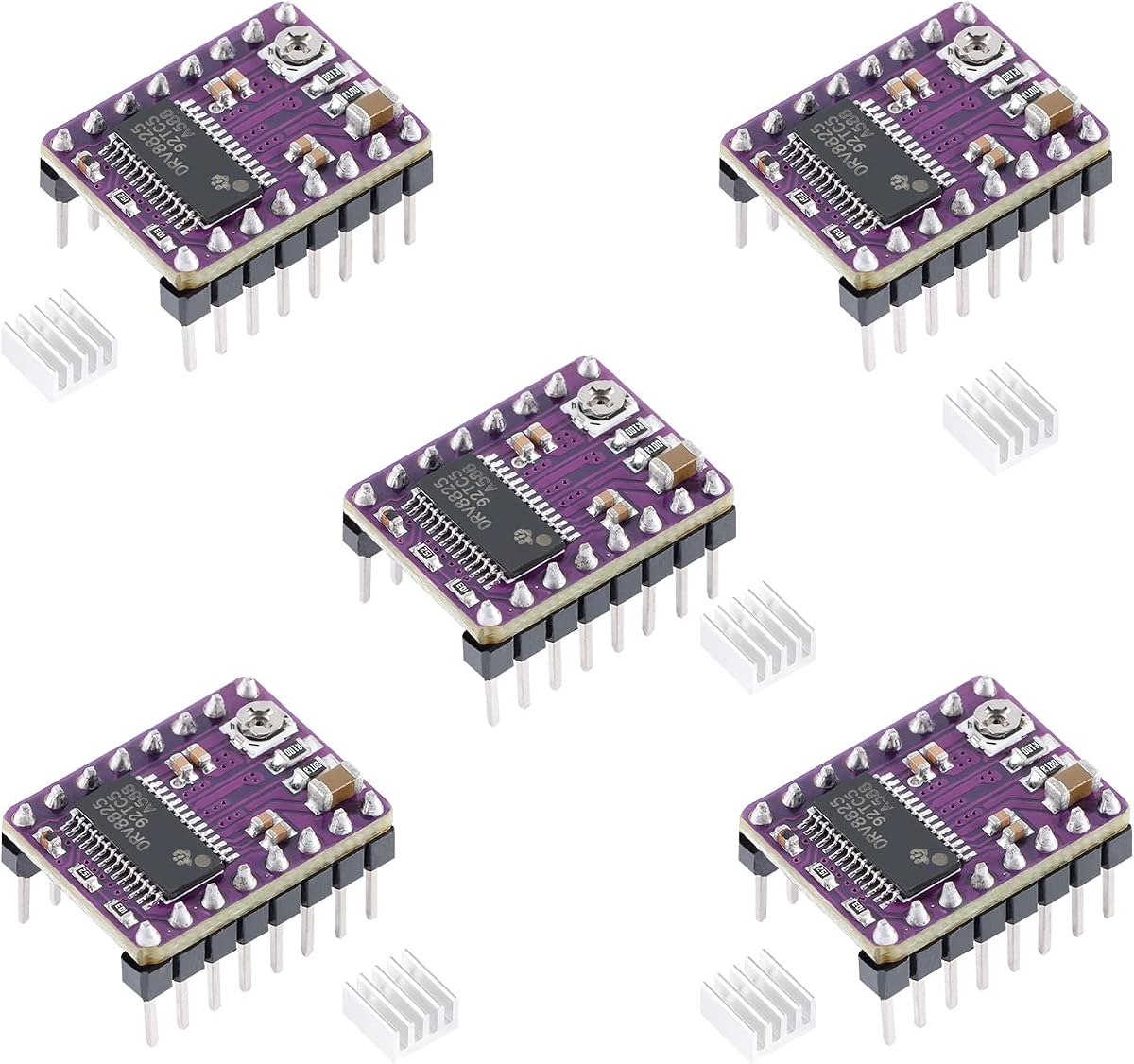


The HiLetgo A4988 5-Pack is a practical entry point for builders replacing the original stepstick modules in a DIY 3D printer. It carries a 4.4 customer rating and stands apart from costlier premium options by combining a straightforward step-and-direction interface with a useful bundle of five modules and heat sinks. That makes it particularly attractive to builders maintaining more than one axis or stocking spare driver boards.
We may earn a commission when you buy through this link, at no additional cost to you.
Its main strengths are versatility and protective circuitry. The module supports full-step through sixteenth-step operation, giving users five resolution options, while the onboard potentiometer makes it possible to match maximum output current to a particular motor. Its output drive capacity reaches 35V and ±1.2A, and intelligent chopping automatically chooses fast or slow current decay as operating conditions change. Over-temperature shutdown, under-voltage lockout, and crossover-current protection add useful safeguards for a compact machine.
The trade-off is acoustic and configurational rather than functional. Compared with TMC2208 and TMC2209 modules, the A4988 generally offers less refined low-noise motion, and it does not provide the extensive microstep interpolation or configurable communication options found on newer drivers. Its five microstep choices are also limited by modern standards. A4988 designs are not inherently problematic, however, and remain well suited to simple printers, CNC projects, and motion systems where straightforward operation matters more than near-silence.
Choose this package when you need a dependable, widely understood driver, want five matching modules, and prefer basic STEP/DIR control over UART configuration. It is a particularly good match for common RAMPS-style builds using motors whose rated current stays comfortably within the module’s capability. Before installation, check motor coil ratings, set current conservatively, confirm the voltage supplied to the driver board, and use the supplied heat sinks with adequate airflow.
The simple step-and-direction interface makes this module easy to introduce to new builders. It can support five microstep resolutions through the usual jumper selections, allowing a useful balance between print speed, positioning detail, and motor activity without requiring software-level driver configuration.
An onboard potentiometer provides a practical way to tune output current, while thermal shutdown, under-voltage lockout, and crossover-current protection help guard against common electrical faults. Current should still be set with reference to both the motor’s rating and the driver’s thermal limits.
We may earn a commission when you buy through this link, at no additional cost to you.
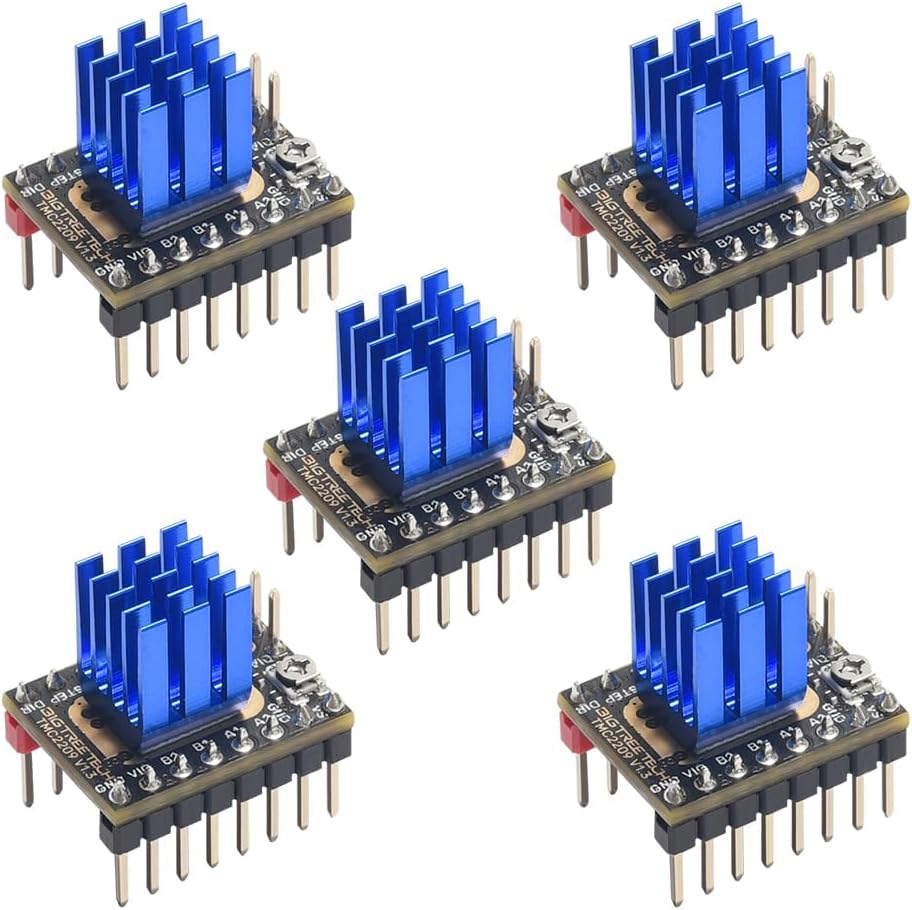
The BIGTREETECH TMC2209 V1.3 4-Pack combines a 4.7 rating with the features most sought after by modern 3D-printer builders. It uses StealthChop2 to reduce motor noise, supports both UART and STEP/DIR operation, and provides enough current capability for many common bipolar stepper motors. The four-module format is well suited to a three-axis printer with one spare module.
We may earn a commission when you buy through this link, at no additional cost to you.
Its standout benefit is quiet movement without abandoning sophisticated motor control. The driver supports continuous current up to 2.0A and peaks of 2.8A across a 4.75V to 28V voltage range. CoolStep dynamically manages current to reduce energy use and heat, while Stallguard4 can detect changes in motor current and support sensorless homing on compatible machines. Firmware support for UART mode allows current, microstepping, and other parameters to be configured more precisely than a simple onboard dial permits.
Compatibility is broad but not entirely automatic. The supplied information identifies support for BTT Octopus v1.1, Octopus Pro, SKR V1.4 Turbo, SKR 3, Manta M4P, M5P, and M8P boards, as well as MKS Gen L. Other boards may work, but the builder should verify the driver-socket layout, configuration pins, firmware driver selection, and required jumpers. UART operation also requires the appropriate firmware modification, so it is less convenient than the plug-and-play path offered by a basic STEP/DIR module.
This four-pack is the strongest general recommendation for a builder who wants markedly quieter operation and has a compatible modern controller. It also suits advanced users interested in sensorless homing, SpreadCycle, or detailed UART tuning. Confirm the printer’s board and firmware before ordering, use conservative current settings initially, and verify that the board provides any configuration interface required by the chosen operating mode.
StealthChop2 is the defining advantage of this package, reducing the characteristic mechanical buzz associated with basic stepstick drivers. The result is a calmer machine that is particularly noticeable during long prints, office use, and recordings made near the printer.
UART mode exposes useful configuration options through compatible firmware, while Stallguard4 can support sensorless homing. These features can be valuable on modern boards, but they also make this a better choice for builders who understand basic firmware and wiring than for first-time users seeking the simplest possible upgrade.
We may earn a commission when you buy through this link, at no additional cost to you.
The DRV8825 Driver 5-Pack offers a substantial increase in voltage, current, and microstepping capability over the classic A4988 format. Its 4.2 rating reflects a generally capable module with a 45V maximum output and drive current up to 2.5A. It is a logical option for CNC, robotics, automation, and 3D-printer projects that need more electrical headroom or finer available step resolution.
We may earn a commission when you buy through this link, at no additional cost to you.
Six microstep configurations are supported, ranging from full-step to 1/32 step, giving users more control than a standard A4988. The four-layer PCB is designed to reduce heat generation and improve dissipation, and the module’s small footprint is comparable to an A4988, which can simplify physical replacement. The package includes five boards and heat sinks, covering multiple axes and common spare-part needs.
The main concern is heat. A driver advertised for higher current still has to be operated within safe thermal limits, and the heat sink needs direct contact and adequate airflow. Current settings should be based on the motor’s rated phase current rather than the driver’s headline maximum. Like other conventional step-direction modules, the DRV8825 is not designed to provide the especially quiet chopping behavior associated with TMC devices, so a mechanically resonant system may remain audible.
Buy this pack when you need a familiar driver with stronger current and finer microstepping options, especially for a mixed set of printer, CNC, or robotics projects. It is less attractive for a builder whose main priority is whisper-quiet printing, and it may be unnecessary if the motors are lightly loaded and an A4988 is already adequate. Verify the board’s pinout, jumper configuration, motor voltage, and thermal conditions before final installation.
The stated 2.5A drive capability offers more room than the typical A4988, making the module relevant to projects using higher-current motors or operating under greater load. Headline current is not an instruction to run continuously at that limit; motor ratings, board traces, and heat dissipation still govern safe settings.
Up to 1/32-step operation gives users finer resolution choices while retaining the familiar simplicity of a step-direction driver. It can be an attractive middle ground for builders who want more control than an A4988 but do not need UART configuration or advanced quiet-current algorithms.
We may earn a commission when you buy through this link, at no additional cost to you.
The BIGTREETECH TMC2209 V1.3 is a feature-rich premium option with a 4.7 customer rating. It brings together StealthChop2 quiet operation, microstep interpolation up to 256 subdivisions, sensorless homing through Stallguard4, and support for UART and STEP/DIR modes. That combination makes it especially suitable for advanced 3D-printer builds where noise, motion quality, and diagnostic capabilities all matter.
We may earn a commission when you buy through this link, at no additional cost to you.
The electrical specifications support continuous current up to 2.0A and peak current of 2.8A over a 4.75V to 28V range. Its PWM chopper operation is designed to reduce jitter, running deviation, and lost steps, while the flexible microPlyer unit provides smoother sinusoidal control even when pulse frequency is limited. The module can replace common TMC2100, A4988, DRV8825, and LV8729 installations in suitable sockets, although physical and firmware compatibility still need confirmation.
Its sophistication introduces a learning curve. UART mode requires firmware changes, and the appropriate configuration must be selected carefully to avoid using the interface incorrectly. A direct STEP/DIR installation is more approachable, but it provides fewer software-adjustable parameters. Current is also not a concern to treat casually: even with advanced thermal behavior, the motor and module should remain below their stated operating limits, with heat sinks fitted correctly.
This is an excellent choice for an enthusiast willing to configure the driver, particularly if the controller is one of the listed BTT or MKS platforms. It is less suitable for a first build where the priority is a completely basic replacement module. If your firmware supports the driver and you want a refined balance of quiet operation, high resolution, and sensorless features, this TMC2209 provides one of the most capable options in the list.
The flexible microPlyer interpolation unit supports up to 256 subdivisions and aims for smooth sinusoidal movement even under limited pulse frequency. This can improve the perceived motion quality of the axes, while StealthChop2 reduces the high-frequency noise associated with many basic drivers.
The product information specifically calls out BTT Octopus v1.1, Octopus Pro, SKR V1.4 Turbo, SKR 3, Manta M4P, M5P, M8P, and MKS Gen L platforms. Because controller revisions and firmware builds can change, check the manufacturer’s current guidance before modifying an existing board.
We may earn a commission when you buy through this link, at no additional cost to you.
The DORHEA TMC2208 5-Pack is aimed at builders who want a significant noise reduction over older A4988, TMC2100, DRV8825, or LV8729 modules. Its 4.5 rating reflects a well-regarded quiet driver with a 4.75V to 36V operating range, 1.4A continuous current, and up to 256-step interpolation. Five modules make it practical to equip an entire three-axis machine while retaining spares.
We may earn a commission when you buy through this link, at no additional cost to you.
Quietness comes from StealthChop2, while the microPlyer interpolation unit helps create smooth motion even when the controller cannot provide a high pulse frequency. The package also includes a heat sink, screwdriver, and an adapter intended for testing or flashing a SilentStepStick with a USB-to-serial converter. Stackable headers are supplied so the modules can sit directly on compatible printer boards, including the board families named in the product information.
The main limitation is the 1.4A continuous-current rating, which is lower than the 2.0A continuous-current figure associated with the TMC2209 options in this guide. Motors must remain within safe limits, and the module’s VIO-VM jumper arrangement needs attention when the adapter is used. While the module can fit a familiar stepstick footprint, users should confirm whether their board expects standalone operation, UART configuration, or another pin arrangement.
This five-pack is a sensible choice for RAMPS 1.4, MKS, Prusa i3, Ender-3 Pro, and similar builds that benefit from quieter operation without moving to the highest-current TMC2209 platform. It is a particularly good fit for modest NEMA 17 motors and owners who value a mature, quiet module. Verify the board layout, motor ratings, and firmware driver selection, and begin with conservative current settings.
StealthChop2 addresses the high-pitched buzz that can make an otherwise successful print unpleasant to hear. Combined with up to 256 subdivisions, it offers a quieter and smoother driving approach for common RepRap-style controllers.
Stackable headers support direct placement on a compatible board, and the included adapter can assist with standalone testing or firmware flashing through a USB-to-serial converter. The VIO-VM jumper is preconfigured for standalone operation, so users should understand the jumper settings before testing.
We may earn a commission when you buy through this link, at no additional cost to you.
The 5-Pack A4988 Stepper Motor Driver Module with Heat Sink is a familiar, accessible option for DIY 3D printers, CNC upgrades, and automation projects. Its 4.5 rating and uncomplicated step-direction control make it well suited to builders who want an easy electrical upgrade without navigating advanced UART parameters or firmware-specific driver settings.
We may earn a commission when you buy through this link, at no additional cost to you.
This module provides full-step, half-step, quarter-step, eighth-step, and sixteenth-step modes. An onboard potentiometer adjusts maximum current, while intelligent chopping automatically selects fast or slow decay. The driver supports motor power up to 35V and a continuous current of ±1.2A per phase. Over-temperature shutdown, under-voltage lockout, and crossover-current protection help reduce the consequences of thermal or electrical faults.
The trade-off is that the A4988 design is not optimized for the lowest possible sound level. Its microstepping choices are also fewer than those available from the DRV8825 and TMC products in this comparison. That does not make it unsuitable for printing; it makes it most appropriate when reliability, familiarity, and simple installation take priority over refined acoustics. The documented compatibility includes popular RAMPS-style boards and printers based on Prusa Mendel, Ultimaker, Printbot, and Makerbot platforms.
This pack is a good selection for a new build, a repair involving several axes, or an owner who wants spare modules on hand. The included heat sinks are important, particularly near the stated current ceiling, and the motor’s rated current should determine the final potentiometer setting. Verify the socket orientation, power rails, stepper configuration pins, and local controller documentation before powering the system.
A step-and-direction interface and familiar jumper-based microstepping make this module approachable for first-time builders. It can be used without the configuration complexity associated with UART drivers, allowing a builder to focus on motor wiring and board compatibility.
Thermal shutdown, under-voltage lockout, and crossover-current protection provide useful layers of defense. The supplied aluminum heat sinks improve heat dissipation, though they still need clean airflow and correct mounting to transfer heat away from the driver chip.
We may earn a commission when you buy through this link, at no additional cost to you.
The A4988 High-Current 5-Pack stands out with a perfect 5.0 customer rating, making it the most positively reviewed module in the supplied data. It retains the familiar A4988 architecture but explicitly emphasizes output capacity, with a 35V maximum and a listed maximum current of 2A when the included heat sink is used. The package contains five driver modules, pins, and five matching heat sinks.
We may earn a commission when you buy through this link, at no additional cost to you.
Motion control uses the standard step-and-direction interface and offers full-step through sixteenth-step selections. The onboard potentiometer allows the maximum output current to be matched to the motor, while intelligent chopping automatically chooses between fast and slow decay. Thermal shutdown, under-voltage lockout, and crossover-current protection help manage foreseeable operating faults. These characteristics make the pack useful for DIY printers, automated machines, and other systems that value a proven control style.
A key point is that the 2A figure is tied to use with the supplied heat sink, while the continuous phase-current specification is ±1.2A. Users should avoid interpreting the headline figure as permission to run every motor continuously at 2A. Heat, board traces, motor rating, and supply capability must all support the selected setting. As with other A4988 modules, noise is likely to be more noticeable than with TMC2208 or TMC2209 hardware.
This is a compelling choice for a builder who values the simplicity of A4988 control but wants a complete multi-board set with clearly matched cooling hardware. It is especially suitable for a new three-axis printer with spares, or for multiple maintenance projects. Use conservative initial current settings, fit the heat sinks firmly, and verify the printer board’s driver configuration before connecting the motors.
Five modules, pins, and five heat sinks provide everything needed for multiple axes and sensible spares. That organization is useful for builders assembling a new machine or maintaining several printers without searching for matching components separately.
The onboard potentiometer allows output current to be tuned to the motor, and adaptive chopping helps manage current decay. Integrated thermal, voltage, and crossover-current protections add resilience, but the correct current limit and proper cooling remain essential.
We may earn a commission when you buy through this link, at no additional cost to you.
The BIGTREETECH TMC2209 V1.3 6-Pack is a generous upgrade package for builders who want quiet operation across several axes or extra modules for future projects. Its 4.6 rating reflects a well-regarded product, while the six-board format provides more coverage than a typical three-axis printer strictly needs. Heat sinks are included for the full set.
We may earn a commission when you buy through this link, at no additional cost to you.
StealthChop2 and a high-precision chopping algorithm are central to the package’s appeal, reducing motor noise while maintaining torque. The flexible microPlyer unit supports up to 256 subdivisions and smooth sinusoidal control even with limited pulse frequency. SpreadCycle provides precise cycle-by-cycle current regulation for dynamic movement, and the listed RDSon value of 0.2A is associated with a lower-resistance output stage intended to reduce dissipation and support higher current delivery.
The electrical envelope includes 2.0A continuous current, 2.8A peaks, and a 4.75V to 28V voltage range. Those figures exceed many common lightweight NEMA 17 applications, but they do not remove the need to match current to the motor and monitor heat. The driver can replace common TMC2100, A4988, DRV8825, and LV8729 modules when the socket and firmware are suitable, so compatibility verification is still required.
Choose this pack for a three-axis build that prioritizes silence, a dual-extruder or additional-axis machine, or a workshop maintaining multiple printers. It provides a strong feature set and a convenient inventory of matching modules. Before installation, confirm the controller’s driver configuration, set appropriate current and thermal limits, and check that the heat sinks make full contact with the driver chips.
StealthChop2 reduces audible motor buzz, while the microPlyer unit supplies interpolation up to 256 steps. Together they can create smoother and quieter movement, especially in printers that previously used basic A4988-style modules.
SpreadCycle’s cycle-by-cycle current control is intended to support consistent dynamic movement. It is particularly relevant to builders who care about stable axis behavior and want more control than a basic potentiometer-only driver can provide.
We may earn a commission when you buy through this link, at no additional cost to you.
This BIGTREETECH TMC2209 V1.3 module combines a 4.2 rating with a feature set aimed at modern printer electronics. It supports StealthChop2, CoolStep current management, Stallguard4 sensorless homing, and both UART and STEP/DIR operation. The result is a flexible driver for builders who want quiet motors, efficient current use, and advanced configuration capabilities.
We may earn a commission when you buy through this link, at no additional cost to you.
Continuous current is listed at 2.0A with peaks of 2.8A, and the operating voltage spans 4.75V to 28V. CoolStep is described as reducing energy use by as much as 75% while helping lower heat and cooling requirements. PWM chopper control is also intended to reduce jitter and avoid running deviation or lost steps. The module supports up to 256 microsteps through its flexible interpolation unit.
The supplied compatibility list includes BTT Octopus v1.1, Octopus Pro, SKR V1.4 Turbo, SKR 3, Manta M4P, M5P, M8P, SKR Pro V2, and MKS Gen L boards. Firmware must support the selected operating mode, and UART requires appropriate configuration changes. Sensorless homing also requires careful Stallguard tuning and a mechanical setup that produces a reliable current-change signal at the end of travel.
This module is a strong option for an advanced, modern 3D printer and a sensible alternative to noisier conventional drivers. It is less attractive for someone seeking a completely automatic replacement, because the benefits of UART and sensorless homing require deliberate configuration. Match the module to the motor, inspect the socket, select the correct firmware driver, and begin with low current settings before tuning performance.
CoolStep adjusts current dynamically as operating conditions change, helping reduce energy consumption and motor heat. This can lessen cooling demands and supports quieter operation, although motor and driver current limits still need to be observed.
Stallguard4 monitors motor-current changes to identify an abnormal or stopped motor condition, potentially allowing end-of-axis detection without physical limit switches. Reliable use depends on the motor, mechanics, travel speed, and correct sensitivity tuning, so it should not replace a sound homing strategy without testing.
We may earn a commission when you buy through this link, at no additional cost to you.
The TMC2208 V1.2 2-Pack provides a focused upgrade for a printer that needs quiet drivers on selected axes rather than a complete multi-board set. It has a 4.5 rating and uses the TMC2208 platform, with 1.4A continuous current, 2A peak current, a 4.75V to 36V range, and up to 256 subdivisions.
We may earn a commission when you buy through this link, at no additional cost to you.
StealthChop2 and the flexible microPlyer interpolation unit are the main reasons to consider this module. Together, they support quiet motor movement and smooth control even with limited pulse frequency. The package includes heat sinks, a screwdriver, stackable headers, and an adapter that can be used to test a SilentStepStick or flash it using a USB-to-serial converter. That testing support makes the two-pack useful for diagnosing firmware or motor behavior before committing to a larger installation.
Its limits are the lower continuous-current rating compared with TMC2209 modules and the two-module quantity. A three-axis printer will still need another board unless one axis is left unchanged, while a dual-extruder configuration may use the pair effectively. The adapter is preconfigured for standalone operation with the VIO-VM jumper closed, so users should understand its settings and avoid changing them while the board is energized.
This pack is best for a targeted upgrade, a spare-axis replacement, or a builder who wants to test TMC2208 behavior on a compatible machine. It suits Reprap, MKS, Prusa i3, and Ender-3 Pro-style systems named in the product information. Check the controller’s driver socket, confirm the motor’s current rating, and ensure the firmware supports the TMC2208 before installation.
Two modules are enough to upgrade the two axes that contribute most to perceived noise in some printers. This focused approach can be more practical than buying a larger pack for a machine that only needs a partial replacement.
The included adapter supports testing or flashing a SilentStepStick through a USB-to-serial converter. Stackable headers and a screwdriver simplify board installation, while the preconfigured VIO-VM jumper provides a defined starting point for standalone operation.
We may earn a commission when you buy through this link, at no additional cost to you.
The right stepper motor driver depends on electrical limits, controller firmware, motor characteristics, noise expectations, and the number of axes being upgraded. Use the following factors to narrow the field before buying.
Start with the stepper motor’s rated phase current and voltage rather than choosing a driver by headline output alone. A driver’s maximum current rating is not the same as a safe continuous operating point for every motor or board. Very small NEMA 8 and NEMA 11 motors may run comfortably with a 1.2A-class A4988, while larger NEMA 17 models or high-torque printers may justify a 1.4A TMC2208 or a 2.0A-class TMC2209. A 2.5A DRV8825 offers additional headroom, but its heat requirements and motor limits still need careful attention. Always compare rated current with the driver’s electrical and thermal specifications.
The best match is a motor that can operate below the driver’s limits while still providing the torque the printer requires. Excessive current can overheat both the motor and module, while insufficient current can cause missed steps under load.
Driver voltage ranges differ considerably. The A4988 products listed support up to 35V, the DRV8825 reaches 45V, TMC2208 modules support 4.75V to 36V, and the listed TMC2209 modules cover 4.75V to 28V. The printer’s power supply, controller designators, connector pinout, and stepper configuration pins must all align with the module. A driver that fits physically may still require jumpers, firmware settings, or UART wiring before it functions correctly.
Check the controller model and revision before ordering. Compatibility claims are most reliable when the exact board and firmware are identified, not merely when the printer uses a similar board family.
A4988 and DRV8825 modules are conventional step-direction drivers and are usually more audible than TMC-based alternatives. TMC2208 and TMC2209 modules use chopping techniques such as StealthChop2 to reduce motor noise, making them preferable for home offices, bedrooms, or long unattended prints. Quietness is not the same as eliminating every sound: belt tension, frame resonance, motor mounts, stepper ringing, and unbalanced mechanics can still produce significant noise.
If silence is the priority, choose a TMC module and also plan to improve the printer’s mechanical setup. Lowering speed or acceleration can help, but properly tensioned belts and well-secured stepper assemblies usually have a greater effect.
STEP/DIR control is the traditional driver interface. The controller sends step pulses and a direction signal, while the driver determines how those signals translate into motor coil currents. Most modules offer this familiar mode, and it is often the simplest way to test a new driver. UART mode adds a serial configuration channel, allowing firmware or configuration software to set current, microstepping, and other parameters more precisely. TMC2208 and TMC2209 modules can use UART, but the board and firmware must support it.
Choose STEP/DIR for simplicity or a first installation. Choose UART when you want repeatable software settings, easier adjustment across multiple axes, or access to advanced driver functions.
The A4988 modules in this guide offer five microstep resolutions, the DRV8825 offers up to 32, and the TMC2208 and TMC2209 products support up to 256 subdivisions. Higher microstepping can make movement appear smoother and may reduce audible stepping artifacts, but the actual benefit depends on the controller, mechanical system, speed, and motor. More microsteps do not automatically guarantee a better print, and extremely high settings can increase processing demands on some firmware platforms.
Treat microstepping as one part of a complete motion system. It works best alongside appropriate current settings, balanced mechanics, sufficient axis rigidity, and sensible acceleration limits.
The TMC2209 products use Stallguard4 to detect changes in motor current, potentially allowing a printer to identify the end of an axis without physical limit switches. This can reduce wiring and simplify some builds, but it is not a universal drop-in replacement for proven homing behavior. Reliable detection depends on motor characteristics, load, speed, mechanics, and sensitivity tuning. A jam or an unusually smooth axis can produce different current patterns, which may affect repeatability.
Keep conventional limit switches if dependable physical end detection is essential, or test sensorless homing carefully in both directions before relying on it for production printing.
Every stepper driver produces heat during operation, and the amount depends on current, voltage, switching behavior, enclosure temperature, and airflow. The included heat sinks on most of these products are important rather than optional. A current setting that appears acceptable in an open frame can become problematic inside a tightly packed electronics enclosure. Larger current capability also requires a board and power system able to deliver it without excessive wiring losses or voltage drop.
Start at conservative current, monitor temperatures during a representative print, and improve airflow if the heat sink becomes too hot to maintain comfortable contact. Never treat a peak-current specification as a recommended long-term setting.
Most Cartesian 3D printers use one module per driven axis, so three drivers form the core set, while dual-extruder machines and multi-axis systems may need more. A five-pack covers a standard three-axis printer with two spares, and six- or four-driver packages are useful for specialized configurations. Two-module packs are best for a targeted replacement or testing a quieter driver on selected axes. Buying only what is needed can simplify setup, while keeping one spare is useful because driver modules are inexpensive components that can be damaged by wiring mistakes.
Plan the quantity around axes, planned expansion, and whether a spare module should remain on hand. A mixed inventory is often more useful than a large batch of identical boards.
Before installation, disconnect the printer’s power and confirm the replacement module matches the controller socket, stepper configuration method, and intended operating mode. Compare the board’s pin labels with the module layout, and make sure the driver is oriented correctly. Remove the old module if necessary, inspect the socket for bent pins, and install the replacement firmly without forcing it. Connect motor cables only after the driver board is seated and the required jumpers have been selected.
Set the driver current conservatively before the first powered test. For a potentiometer-controlled A4988 or DRV8825, use the board’s documented measurement procedure and adjust the limit according to the motor’s rated phase current. For TMC2208 or TMC2209 modules in UART mode, use compatible firmware or configuration software and save the settings where the controller expects them. Check that the microstep settings in hardware and firmware agree so the motor receives the intended pulse pattern.
Fit the heat sink squarely on the driver chip, confirm good airflow, and perform a short low-speed test before a long print. Listen for unusual noise, watch for missed steps or axis drift, and check the heat sink and surrounding components after the machine warms. Remove power immediately if a module smells overheated, the motor stalls unpredictably, or the heat sink becomes too hot for safe contact. Keep the electronics dry, clean dust from cooling paths, and inspect connectors periodically.
For most users prioritizing quiet operation, a TMC2208 or TMC2209 is the better choice because it offers smoother current control and significantly reduced motor noise. An A4988 remains useful for basic builds because it is straightforward, widely understood, and adequate for many low-load applications. The best option still depends on motor current, board compatibility, firmware, and whether UART configuration is desired.
A TMC2209 can replace an A4988 in many printers with compatible stepstick sockets, but physical fit is only the first requirement. The controller must support the selected STEP/DIR or UART mode, and the appropriate jumpers and firmware configuration must be used. Check the board model and revision, confirm the current limit for the motors, and test each axis before relying on the upgrade.
No, a TMC2209 can operate in STEP/DIR mode, which is usually the simpler starting point. UART mode is valuable when firmware supports it because it exposes detailed settings for current, microstepping, and other parameters. It does require compatible hardware and firmware configuration, so the simpler mode is often preferable for an initial installation.
Set the driver near the motor’s rated phase current without exceeding the motor, driver, board, or power-supply limits. A4988 and DRV8825 boards normally require a measurement-based potentiometer adjustment, while TMC2208 and TMC2209 modules can be configured in UART mode. Begin conservatively, monitor heat and missed steps, and increase only within the documented limits.
A TMC driver reduces electrical and stepping noise, but it cannot eliminate mechanical resonance from belts, frames, pulleys, or loose motor mounts. Check belt tension, secure every motor and pulley, inspect bent shafts, and make sure the correct microstep and current settings are active. A rigid frame and balanced axis can make a larger difference than the driver alone.
Not always. Stallguard4 can detect motor-current changes and support sensorless homing, but its accuracy depends on motor characteristics, mechanics, speed, load, and tuning. Limit switches provide a direct physical reference and are generally easier to trust in critical applications. If using sensorless homing, test repeated moves in both directions and keep a way to recover the machine if detection fails.
A basic Cartesian printer with one motor on each of the X, Y, and Z axes needs three stepper drivers. An extruder that uses a stepper may require another, while dual-extruder or multi-axis systems need still more. The five-, six-, and four-driver packs in this guide provide useful coverage and spares for common configurations.
Stepper drivers dissipate energy as heat, particularly when current is set high or the motor is moving continuously under load. Confirm the heat sink is attached correctly, the current does not exceed the motor and module ratings, and the driver has adequate airflow. Persistent overheating can also indicate unsuitable wiring, an undersized board, or a problem with the motor or power supply.
The BIGTREETECH TMC2209 V1.3 4-Pack is the strongest all-around recommendation for builders who want quiet operation, 256-step interpolation, UART support, and sensorless homing capabilities. The HiLetgo A4988 5-Pack represents the best budget path for straightforward replacements, while the BIGTREETECH TMC2209 6-Pack offers a complete premium set for multiple axes, supported controllers, and future projects. Each suits a different level of configuration and printer complexity.
Prioritize motor-current compatibility, board layout, and firmware support before focusing on the largest advertised specifications. TMC modules are ideal when noise is important; A4988 modules remain dependable for simple builds; and the DRV8825 is attractive when greater current and finer step settings are needed. Proper current adjustment, reliable heat sinks, and adequate airflow are essential regardless of which module you select.
Before buying, check the current listing to confirm the included quantity, package contents, board compatibility, and any updated instructions. Prices and availability can change, and controller revisions may affect compatibility. With the correct driver, conservative configuration, and attention to cooling, a printer can achieve quieter motion, dependable positioning, and better overall operation.