
SG90 9G Micro Servo 4-Pack
4.2Editor score
Four micro servos included
1.6 kg-cm stall torque
4.2-6V operating range
180-degree rotation
Compact 9G housing
Our expert guide compares 10 servo motors for robotics across torque, speed, control, durability, application fit, and ease of integration for every project.
Servo motors for robotics must combine accurate positioning, dependable torque, responsive speed, and control that suits the mechanical design. A strong robot arm, miniature rover, articulated gripper, and educational mechanism each place different demands on the actuator, so motor size alone rarely determines the best choice.
This guide compares ten individual servos and complete robotic systems using the supplied specifications, including stall torque, operating speed, voltage range, control angle, feedback method, gear construction, and intended application. It covers lightweight micro servos, heavy-duty digital models, testing equipment, and ready-built arms without implying that every product serves the same purpose.
The recommendations show why the 25KG digital servo works well for serious mechanisms, why SG90 models suit compact prototypes, and where a complete arm kit offers a faster path to experimentation. Each pick also identifies practical trade-offs, and readers should confirm dimensions, connector standards, and current availability before purchasing because prices and configurations can change.
4.2Editor score

4.8Editor score

4.9Editor score
The table compares torque, motion, electrical requirements, construction, and practical role across all ten options, revealing clear differences between compact classroom servos, high-torque robot actuators, testing equipment, and integrated robotic arms.




This 25KG full-metal-gear digital servo holds a 4.5 rating and stands out as a capable general-purpose actuator for robotic arms, humanoid projects, and other mechanisms that need more force than a lightweight hobby servo. Its listed maximum torque reaches 34.5 kg-cm, while the stated speed is 0.17 seconds per 60 degrees at 6.8V.
We may earn a commission when you buy through this link, at no additional cost to you.
The mechanical construction is the central attraction. A high-precision steel gear, potentiometers, a high-resolution digital chip, and a CNC aluminum center shell support consistent positioning and useful heat dissipation. The product also provides free U-brackets and accessories, reducing the need to design a mounting solution from scratch.
This servo also offers more positioning flexibility than many competing models. Its output range is stated as 0 to 270 degrees, and the output can be repositioned through a full rotation while powered off. That range is useful when a joint needs a mechanical limit outside the typical 180-degree control interval, although the control electronics must still be configured safely.
The tradeoff is that this is a substantial actuator rather than a lightweight mechanism component. Robot builders should account for its physical dimensions, current draw, heat, and the structural strength of the joint. It is most appropriate for users who need strong torque and fast movement without moving to the premium 45KG class.
The listed 34.5 kg-cm maximum torque gives this servo an advantage on articulated arms, gripper linkages, and human-inspired robots. Actual performance depends on the lever arm, load, voltage, and duty cycle, so it should be sized with a reasonable safety margin rather than selected solely by its headline rating.
The 270-degree output range and included brackets make installation more versatile than a basic micro-servo package. These features are particularly valuable when a builder is refining joint geometry or adapting an existing chassis rather than starting with a standardized kit.
We may earn a commission when you buy through this link, at no additional cost to you.
This four-pack of SG90 9G micro digital servos provides an accessible starting point for small robots, pan mechanisms, model aircraft, boats, and simple articulated projects. Its 4.2 rating reflects a useful combination of familiar form, broad voltage compatibility, and adequate performance for lightweight mechanisms.
We may earn a commission when you buy through this link, at no additional cost to you.
The listed operating range is 4.2-6V, with a stall torque of 1.6 kg-cm and a response time of 0.3 seconds per 60 degrees. Its small, lightweight housing makes it much easier to fit into compact platforms than the larger high-torque servos in this guide. The four-unit quantity also allows several joints to be populated without purchasing separate motors.
The primary limitation is its low pulling power relative to heavy-duty options. The product uses a plastic geared construction, making it better suited to pan-tilt units, small arms, aircraft controls, and educational mechanisms than to heavy loads or industrial lifting tasks. Fast, smooth motion is possible, but the motor can lose effective control when a mechanism approaches its torque limit.
For students, hobbyists, and first-time robot builders, this pack is a sensible way to prototype a complete multi-axis mechanism. Its value is strongest when the goal is learning PWM control, linkage geometry, and servo programming rather than maximum payload. A higher-torque digital servo is the better choice once the project moves beyond light duty.
Four servos are enough to create a basic pan-tilt head, four-axis arm, gripper arrangement, or small walking mechanism. Buying them together also simplifies matching control signals and power planning across the same project.
The listed 1.6 kg-cm torque supports the product's suitability for small electronics projects and model-scale mechanisms. Builders should keep linkages short and avoid adding heavy payloads that could cause stalling or inconsistent positioning.
We may earn a commission when you buy through this link, at no additional cost to you.
Hosyond's blue 10-pack is a well-matched option for builders creating micro robots, small arms, boats, helicopters, or other projects that need numerous inexpensive actuators. It carries a 4.5 rating, and the bundle makes it convenient to complete multi-joint mechanisms with matching motors.
We may earn a commission when you buy through this link, at no additional cost to you.
Its listed no-load speed is especially brisk at 0.12 seconds per 60 degrees at 4.8V and 0.1 second per 60 degrees at 6V. The working voltage range is 4.8-6V, and the maximum rotation is 180 degrees. Compatibility with JR and Futaba interface systems broadens its usefulness with common radio-control equipment.
This is an analog servo with a listed stall torque of 1 kg-cm and a 7-microsecond dead band. The supplied guidance stresses that it needs a continuous pulse-width modulation signal and a starting current above 1A. Those requirements make controller and power-supply selection especially important when all ten motors operate together.
The package is ideal for educational fleets, prototypes, and hobby mechanisms where component quantity matters more than payload capacity. It is not the right actuator for a gripper lifting a sizable object or a joint exposed to substantial mechanical resistance. For those jobs, a metal-geared 25KG model offers a much more appropriate margin.
A ten-pack removes the inconvenience of sourcing individually equivalent servos for a complex robot. Matching components can simplify calibration and make it easier to replace a failed unit later without introducing different speed or voltage behavior.
The quick no-load movement gives small mechanisms a responsive feel, especially when linkages are light. Torque falls substantially under load, so the motor is best used with well-balanced arms and low-friction mechanisms.
We may earn a commission when you buy through this link, at no additional cost to you.
The RDS3225 pack earns a 4.8 rating through a combination of high torque, rapid movement, sturdy gearing, and installation hardware. It is a particularly versatile choice for robot arms, RC crawlers, and other articulated systems where a standard-size high-performance servo is needed.
We may earn a commission when you buy through this link, at no additional cost to you.
Stall torque is listed at 24 kg-cm at 5V and 28 kg-cm at 6.8V, while speed reaches 0.17 seconds per 60 degrees at 6.8V. The digital control system accepts a 500-2500-microsecond pulse range for 180-degree positioning, and the specified dead band is 3 microseconds. These details make it suitable for common hobby control systems.
The construction details distinguish it from ordinary steering servos. It uses strong copper and aluminum gears, high-precision potentiometers, a CNC aluminum middle shell, waterproof rubber seals, and screws. The dual-shaft arrangement provides added strength and stability, while long and short U-brackets support different installation needs.
The pack includes two servos, four mounting brackets, four round metal disks, and two sets of screws. It is a strong pick for a two-joint mechanism or a pair of high-torque steering actuators. Buyers needing a large number of joints can choose it for critical joints and use lighter servos elsewhere, but the main limitation is that it is not a broad bulk pack.
The 28 kg-cm listed stall torque gives robot builders substantially more reserve than micro servos. It is particularly suitable for steering links, robotic-arm joints, and gripping mechanisms that must overcome friction or move a moderate load.
The dual shafts, metal mounting disks, and paired bracket lengths allow a builder to create rigid connections without separately sourcing every piece. This completeness is a major advantage over buying a bare premium servo.
We may earn a commission when you buy through this link, at no additional cost to you.
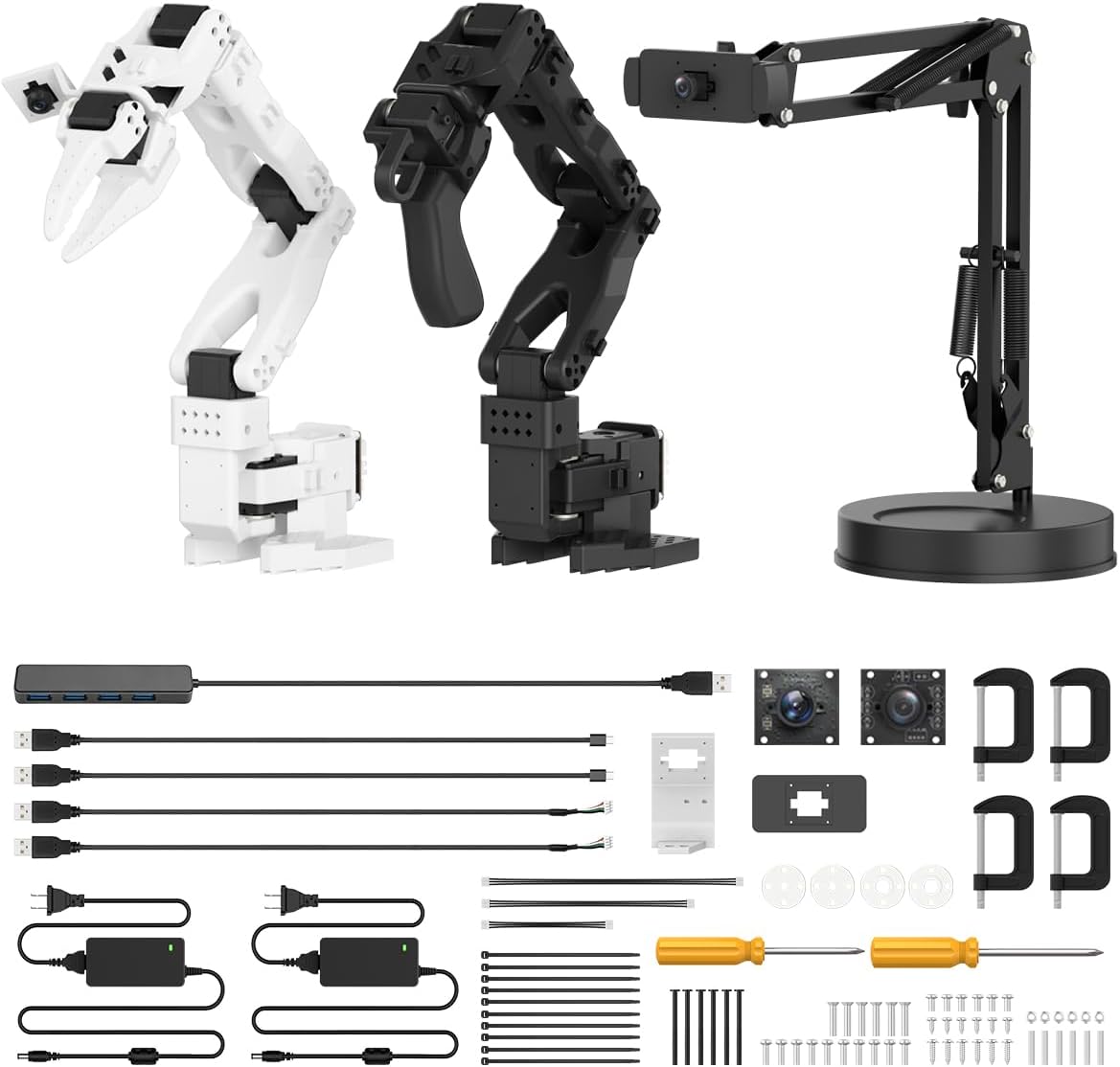
The Hiwonder SO-ARM101 is not merely a pack of replaceable motors; it is a complete robotic-arm research platform with 12 high-torque bus servos, two cameras, mechanical parts, and integrated controls. Its 4.3 rating reflects a product aimed at users exploring imitation learning, embodied AI, manipulation, and open-source robotics.
We may earn a commission when you buy through this link, at no additional cost to you.
The servos use magnetic feedback and are integrated to provide smooth, stable movement while avoiding power deficiency and jitter. A camera mounted on the gripper supports precise manipulation views, while an external camera adds environmental awareness. Together, the two viewpoints are designed to support more capable imitation-learning experiments.
Control and diagnostics are handled through the Hiwonder BusLinker V3 debugging board. The listed software capabilities include servo scanning, real-time status monitoring, trajectory control, calibration, and debugging. Compatibility with the LeRobot open-source framework and access to shared code, templates, and pretrained models make this a more research-oriented platform.
The main tradeoff is complexity. Users interested only in replacing a servo in a small hobby robot will find this system unnecessarily elaborate. Conversely, developers who want a ready-built AI manipulation arm will benefit from the assembled structure, coordinated actuator network, vision hardware, and control software. It is best viewed as a specialized robotics platform rather than a general motor recommendation.
The gripper-mounted camera offers a close view of the working area, while the external camera supplies broader context. This dual-view arrangement supports tasks where the robot must recognize objects and monitor its surroundings while manipulating them.
Twelve magnetic-feedback servos form the arm's coordinated motion system. The integrated debugging board and real-time monitoring functions make it easier to inspect servo behavior and tune a trajectory than troubleshooting twelve independently wired PWM motors.
We may earn a commission when you buy through this link, at no additional cost to you.
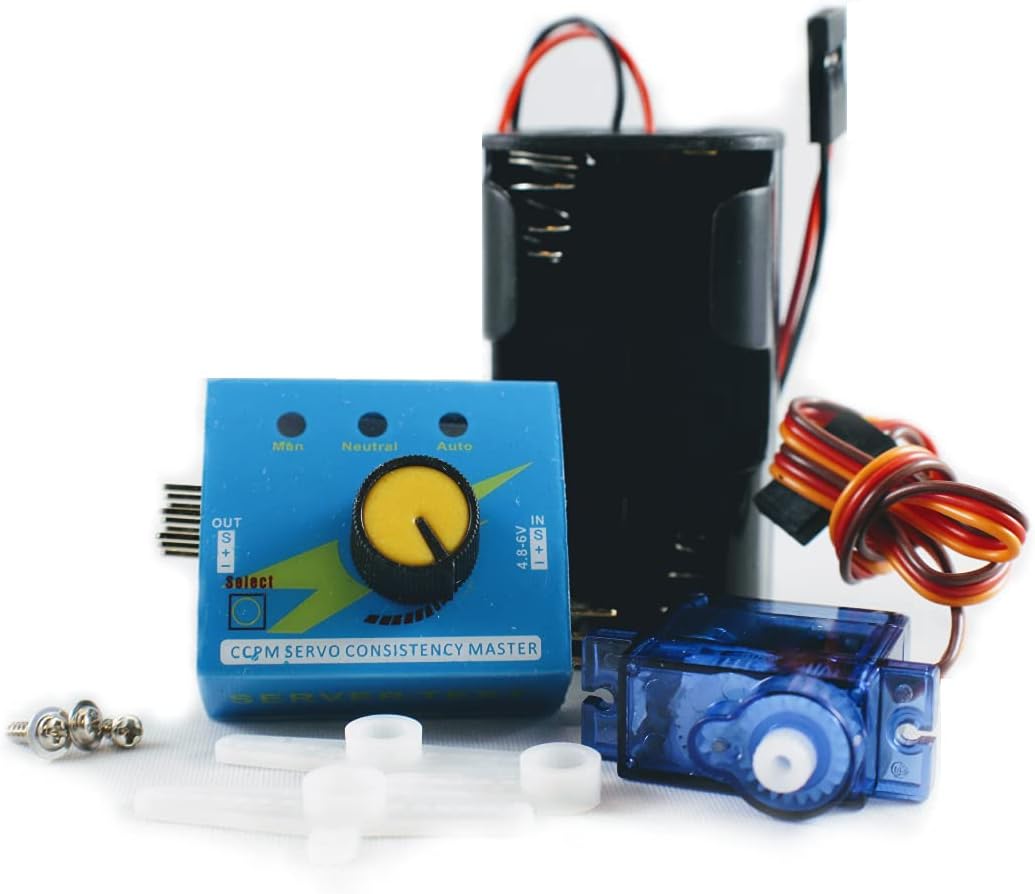
This tester kit pairs a 180-degree 9G servo with an RC servo tester controller and a holder for four AA batteries, producing 6V. It provides a straightforward way to check a servo, confirm its neutral position, and center a mechanism before connecting the component to the final robot controller.
We may earn a commission when you buy through this link, at no additional cost to you.
The tester offers manual dial, neutral, and automatic modes. Its stated movement range is approximately 45-135 degrees, making it useful for checking basic movement and setting a centered starting point. The included servo also comes with three types of servo horns, allowing the attachment style to be changed to suit a particular linkage.
For a robotics builder, one of the most useful tools is not another motor but a way to verify that a servo actually moves as expected. This package can isolate basic issues before the actuator is installed, helping identify reversed wiring, incorrect signal behavior, or a badly balanced horn. The supplied battery holder also reduces the need for a bench power supply during a simple check.
The limitation is its specialized role. It does not replace a high-torque actuator, and the tester's restricted range may not reproduce the full travel required by a robot joint. It is most valuable as an addition to a workbench alongside the main motor selection, particularly for first-time builders and anyone frequently changing servo horns.
Testing the motor away from the chassis makes it easier to observe its direction, travel, and neutral point. It also prevents a mechanically unbalanced servo from immediately straining linkages or colliding with nearby components.
Manual, neutral, and automatic modes cover quick manual checks, repeatable centering, and broader automatic sweeps. The three horn styles add another layer of flexibility when adapting the included 9G servo to a small robot mechanism.
We may earn a commission when you buy through this link, at no additional cost to you.
The Smraza 10-pack upgrades the familiar SG90 format with a metal motor pinion and shaft, addressing a common weakness of plastic-geared micro servos. With a 4.4 rating, it is a strong choice for small robots, robotic arms, aircraft, boats, and compact maker projects.
We may earn a commission when you buy through this link, at no additional cost to you.
The listed specifications include 1.9 kg-cm stall torque, a 0.08-second 60-degree running speed, a 4.8-6V operating range, and full 180-degree movement. The 5-microsecond dead band provides relatively fine control around the commanded position, while the metal pinion and shaft are intended to resist tooth breakage and heat deformation.
Each motor uses a familiar three-pin PWM arrangement compatible with JR and Futaba receivers. The package includes servo arms and 24.5 mm leads, which helps with wiring in tight builds. These details make the set approachable for Arduino and Raspberry Pi experiments as well as conventional radio-controlled models.
The 10-pack remains a micro-servo option, so it should not be mistaken for a heavy-duty robot joint actuator. Its specified operating range is 4.8-6V, and the instructions call for continuous PWM and a supply capable of more than 1A during startup. It is best for low-payload mechanisms where speed and a more durable gear train matter more than lifting capacity.
Replacing the vulnerable pinion with metal helps the servo tolerate compact mechanisms more effectively than a basic plastic-geared version. It does not create heavy-duty torque, but it improves durability within the micro-servo category.
The stated 0.08-second speed per 60 degrees is suited to small mechanisms that need crisp movement. Low mass, short linkages, and balanced loads will allow the servo to deliver its fastest and most consistent response.
We may earn a commission when you buy through this link, at no additional cost to you.
This 45KG waterproof coreless servo pack carries a 4.9 rating and represents the strongest performance tier in the guide. The listed stall torque reaches 51 kg-cm at 8.4V, while speed reaches 0.11 seconds per 60 degrees, creating an exceptional combination of force and rapid response.
We may earn a commission when you buy through this link, at no additional cost to you.
The coreless motor is designed to deliver smoother and more efficient operation than a standard motor, while a high-resolution digital chip and high-precision potentiometer support accurate positioning, low noise, and reduced vibration. High-precision stainless-steel and aluminum gears use hard anodizing to resist wear and stripping under load.
Its IP67 rating and CNC aluminum center shell add environmental durability and heat dissipation. These properties suit animatronics, large robotic arms, off-road vehicles, crawlers, monster trucks, boats, and other demanding projects. The standard dimensions are listed as 40 by 20 by 38.5 millimeters, allowing easier comparison with other 40-millimeter-class servos.
The pack includes two servos, adjustable 25T metal horns, and mounting accessories. Its 8.4V performance figures imply a greater power budget than standard 5- or 6V hobby systems, so the supply, wiring, and controller must be designed accordingly. For a demanding high-torque joint, that electrical requirement is an acceptable trade for the listed torque and environmental protection.
The 51 kg-cm stall figure and 0.11-second speed make this servo appropriate for joints that face substantial resistance and still need to reposition quickly. Designers should still account for acceleration, gearbox stress, and the structure attached to the output shaft.
The IP67 enclosure adds confidence for outdoor robots, boats, and wet-weather installations where an ordinary servo would be vulnerable to dust or moisture. The aluminum shell also supports heat dissipation during sustained high-load operation.
We may earn a commission when you buy through this link, at no additional cost to you.
The Hanaive 16-pack is designed for makers who need many small servos in one coordinated build. It has a 4.5 rating and supplies multi-arms and fixing screws, making it a convenient option for several micro robots, multiple pan-tilt units, or a larger collection of lightweight joints.
We may earn a commission when you buy through this link, at no additional cost to you.
Each SG90 measures 3.2 by 3.09 by 1.24 centimeters, with a listed stall torque of 1.6 kg-cm at 4.8V. No-load speed is stated at 0.1 second per 60 degrees at 4.8V and 0.08 second at 6V. Maximum travel is 180 degrees, and the dead-band width is listed as 5 microseconds.
The standard three-wire arrangement uses red for power, brown for ground, and yellow for signal. That familiar layout makes wiring straightforward in Arduino projects, RC toys, helicopters, boats, and small robotic arms. The included quantity is particularly useful for teaching environments where several identical mechanisms must be assembled quickly.
The product explicitly notes that its reduced pulling force makes it appropriate for ordinary small electric aircraft rather than large fixed-wing models or electric helicopters. It is best treated as a high-volume micro-servo supply, not a heavy-duty actuator set. Its strongest advantage is availability and consistency across many small joints.
A 16-unit bundle can populate a complex robot, several separate builds, or a replacement inventory for education. It also reduces the need to mix motors with uncertain specifications in one coordinated system.
The small dimensions are valuable when every gram and millimeter affects the design. These servos fit naturally into small robotic arms, aircraft, boats, and compact pan mechanisms where full-size high-torque actuators would be impractical.
We may earn a commission when you buy through this link, at no additional cost to you.
This 6DOF robot arm kit provides a complete mechanical platform with six MG996 analog servos, a metal claw, aluminum brackets, fasteners, extension cords, and mounting components. It is aimed at college teaching, creator education, and demonstration projects where a working manipulator is more important than industrial-grade performance.
We may earn a commission when you buy through this link, at no additional cost to you.
The six servo-driven degrees support forward, backward, upward, downward, lateral, and gripping movements. Imported cup bearings support smoother joint alignment, while the disc-shaped chassis helps the arm turn left and right. The bracket set uses 2mm aluminum plate to improve structural stability compared with thin sheet-metal frames.
The main weakness is reflected in its 2.8 rating: it uses analog MG996 servos rather than the digital, high-resolution actuators found in more advanced systems. The six servos also create a meaningful power and control burden. Calibration, mechanical play, noise, and behavior under sustained load may require extra attention compared with a purpose-built robotic arm.
The kit remains compelling for learning because it provides the arm, claw, brackets, and mechanical pieces in one package. A buyer can focus on programming and inverse kinematics rather than sourcing every component. It is best suited to education and controlled demonstrations, while research or payload-intensive work should favor a more refined servo platform.
The included chassis, claw, shafts, bearings, brackets, wiring, and six actuators remove much of the initial mechanical work. That makes the kit useful for students who need to concentrate on control algorithms and motion sequencing.
The 2mm aluminum brackets and metal claw provide a more durable frame than lightweight sheet constructions. Rigidity remains important because any flex in the arm can translate into position errors or inconsistent behavior at the gripper.
We may earn a commission when you buy through this link, at no additional cost to you.
Selecting a robot servo requires balancing mechanical load, required speed, control electronics, power budget, physical dimensions, and environmental exposure. The best actuator is not automatically the one with the highest torque; it must fit the mechanism and work reliably within the complete system.
Torque should be selected after calculating the load at the joint and the length of the lever arm. A long gripper or extended arm creates greater mechanical advantage than a short, close-mounted lever, while friction, acceleration, and the servo's own housing can add demand. The listed stall torque is a peak value rather than a continuous safe operating load, so a practical margin is important.
Choose enough torque for smooth starting and positioning without relying on the motor operating close to stall. Micro servos around 1 to 2 kg-cm suit lightweight models, while 25KG and 45KG-class models support heavier arms, steering systems, and animatronics.
Speed determines how quickly a joint can complete a movement, but published figures are often measured under no-load conditions. A servo that looks fast on a specification sheet may slow considerably when carrying a load or operating near a mechanical limit. The control system must also generate a stable pulse signal, or the motor may move erratically.
For fast miniature mechanisms, SG90 options listed around 0.08 to 0.12 seconds per 60 degrees offer a lively response. Heavy-duty digital servos around 0.11 to 0.19 seconds per 60 degrees combine speed with greater load capacity. Match speed to the task rather than selecting the fastest number available.
Operating voltage affects torque, speed, and the servo's ability to start under load. A 4.8-6V micro servo may work from a common hobby supply, while an 8.4V high-performance servo requires a more capable arrangement. The supply must also handle the aggregate current of every actuator, especially when several joints move simultaneously.
Use a regulator or power distribution board with enough current headroom and use appropriately sized wiring. Do not power a cluster of servos through a controller board's small signal pin. Check whether the motor requires continuous PWM, and confirm that the controller's signal level is compatible with the servo input.
Basic hobby servos commonly use a three-wire PWM interface, while bus servos communicate through a dedicated data network. PWM is familiar and inexpensive, but individual signal wires and pulse timing can become harder to manage as the number of joints grows. Bus systems can simplify status monitoring and coordinated motion when the complete control ecosystem is supported.
Check connector style, signal protocol, pulse width, dead band, and control angle before buying. Also consider whether the controller library supports the exact servo model. A mechanically compatible plug does not guarantee that software will identify or control the actuator correctly.
Plastic gears are adequate for light, low-impact tasks but are more vulnerable to tooth wear and heat deformation. Metal pinions, steel gears, and aluminum gearing add durability for mechanisms that experience frequent starts, reversals, or moderate shock loads. Bearings and the rigidity of attached brackets also influence whether the output holds position accurately.
For small robots, a metal-pinion micro servo can be a useful middle ground. High-torque arms and steering systems benefit from full metal gearing, while cost-sensitive projects may still accept plastic gears when loads are consistently light and maintenance is possible.
Servo size must match the robot's structure, not just its weight rating. In addition to the motor body, consider the output spline, horn width, shaft length, wire clearance, and space needed to rotate. A powerful servo can be impossible to install if its housing collides with the arm or lacks a suitable mounting pattern.
Dual-shaft servos can provide more installation options, while included U-brackets, metal disks, and multiple horn styles save design time. Measure the available area and compare it with the manufacturer's stated dimensions before ordering. Also check that the horn will not collide with the chassis at full travel.
Waterproofing, sealing, and temperature tolerance matter for robots that operate outdoors, near water, in dusty spaces, or in changing temperatures. The 45KG servo in this guide carries an IP67 rating, while the RDS3225 includes waterproof rubber seals. These features should not be interpreted as permission to submerge the actuator unless the documentation explicitly allows it.
For indoor prototypes, environmental sealing may be less important than torque or cost. For field robots, consider both the motor and its connector, since exposed wiring can undermine an otherwise sealed servo. Shield cables and route them away from moving joints to reduce mechanical damage.
Buying servos individually gives control over joint sizing and makes it easy to mix actuator classes. A multipack simplifies matching components and provides immediate inventory for several joints. Complete robot-arm kits go further by including the chassis, claw, brackets, bearings, and often a controller, making them convenient for education.
Choose a multipack for uniform micro mechanisms, individual motors for mixed-load robots, and a complete arm when the goal is to learn programming and kinematics quickly. A preassembled AI platform may be preferable for imitation learning and vision-based research, but it introduces a specific ecosystem and greater complexity.
Begin by confirming the servo's voltage, current requirement, pulse range, connector, and mechanical dimensions. Connect the power and ground leads to a supply with suitable current capacity, then connect the signal lead to the controller. Keep servo power separate from sensitive sensor circuits where possible, and confirm the signal level before powering the motor.
Test each actuator without a payload. Use a tester or a simple control program to check direction, travel, neutral position, and smooth movement. Install the horn only after identifying the correct zero point. If the mechanism approaches a hard stop, shorten the control range, reposition the horn, or add a physical limit to reduce strain on the gearbox.
For maintenance, inspect horns, screws, spline engagement, and wiring for looseness or wear. Keep the case dry, avoid blocking ventilation openings, and do not operate a high-torque servo beyond its safe load. After a stall or impact, power down and check for damaged gears, a slipped spline, or a bent output shaft before testing again.
Use the voltage range stated for the exact servo model. Many SG90 micro servos operate around 4.8-6V, while some high-performance servos support voltages as high as 8.4V. Exceeding the rated range can damage the motor or control electronics, and using a supply below the intended voltage can reduce torque and speed. The power source must also provide enough current for the number of servos in the robot.
Micro servos are suitable for lightweight arms, small grippers, pan-tilt mechanisms, and educational models. Their listed torque commonly falls around 1 to 2 kg-cm, so long linkages and heavy objects can cause stalling. A 25KG or 45KG-class servo is more appropriate when the arm must carry meaningful payload or operate against substantial friction.
Many analog hobby servos, including several SG90 models, require a continuous pulse-width modulation signal to remain in position. If the signal stops, the servo can stop responding or behave unexpectedly, depending on the model and controller. Digital and bus servos may use different protocols, so their documentation and signal requirements should be checked before connection.
Digital servos use an internal digital signal processor to interpret control pulses, which can improve response, holding behavior, and dead-band performance. Analog servos traditionally use a simpler analog control circuit and are widely supported by inexpensive hobby controllers. The choice should be based on the robot's load, required precision, control system, and power budget rather than terminology alone.
The supply should support the combined current of all actuators, with extra headroom for startup and simultaneous movement. Servo data sheets often describe current under no load or stall conditions, and startup demand can be significantly higher than steady movement. A controller board should not supply actuator power through its logic or signal connections; use a suitably rated regulator or distribution system.
A servo with an IP rating is better suited to outdoor or wet environments, but its documentation still governs safe use. Protect the connector and wiring because exposed plugs can admit moisture even when the motor housing is sealed. The 45KG option in this guide carries an IP67 rating, while the RDS3225 includes waterproof seals for added environmental protection.
Individual servos offer more control over actuator sizing and are ideal for an existing robot design. A complete arm kit includes the structure, claw, brackets, and often the necessary servos, saving time and making it easier to begin programming. A preassembled AI arm adds cameras, bus servos, and open-source tooling, but it is best for users who want that specific research ecosystem.
Common causes include inadequate supply current, a weak ground connection, an unstable or incorrect PWM signal, and mechanical interference near the output limits. Confirm the wiring, connector, voltage, and pulse range before replacing the motor. If the servo buzzes while stalled, disconnect it immediately and reduce the load or improve the mechanical balance.
The RDS3225 25KG dual-shaft servo stands out as the strongest all-around standalone choice, combining high torque, fast movement, metal gearing, and complete mounting hardware. The 45KG waterproof coreless pack delivers the highest performance for demanding or exposed mechanisms, while the four-pack of SG90 micro servos offers the most accessible way to prototype a lightweight robot.
Prioritize the joint's actual load before focusing on headline torque. Match the actuator's dimensions to the mechanism, verify voltage and current requirements, and ensure the control system supports its signal protocol. Complete arm platforms are valuable for education and research, but bare servos provide more freedom when designing a custom robotic system.
Prices, availability, and package contents can change, so check the current listing and technical details before purchasing. Verify dimensions, connector type, voltage, pulse range, and included hardware, and compare those specifications with the mechanical demands of your project.