
Ecarke 220W Portable Power Inverter
4.2Editor score
Compact 0.68-pound inverter
220W continuous AC output
Adjustable LED work light
Requires compatible DeWALT battery
Our expert guide compares the best Power Bank with AC Outlet options for capacity, portability, charging speed, safety, outlets, and everyday use.
A power bank with AC outlet combines the convenience of portable battery charging with the ability to power small laptops, lights, tools, and household electronics. The right model depends on more than capacity: inverter output, port selection, recharge speed, weight, safety protections, and intended use all influence which unit is genuinely practical.
This guide compares ten portable power stations and inverter-style battery packs using the specifications and features listed for each product. It covers compact battery-powered options, tool-battery inverters, solar bundles, and larger systems for camping, travel, emergency preparation, or limited home backup, without overlooking important limitations.
Each review highlights the most suitable use for the product and explains the compromises that shoppers should understand before buying. The top picks offer distinct advantages for portability, overall capability, and higher-end capacity, while prices and availability can change, so readers should confirm current listing details before making a purchase.
4.2Editor score

4.8Editor score

4.7Editor score
The comparison below shows the defining trade-offs among all ten products, including energy capacity, AC output, portability, charging speed, and major configuration details.


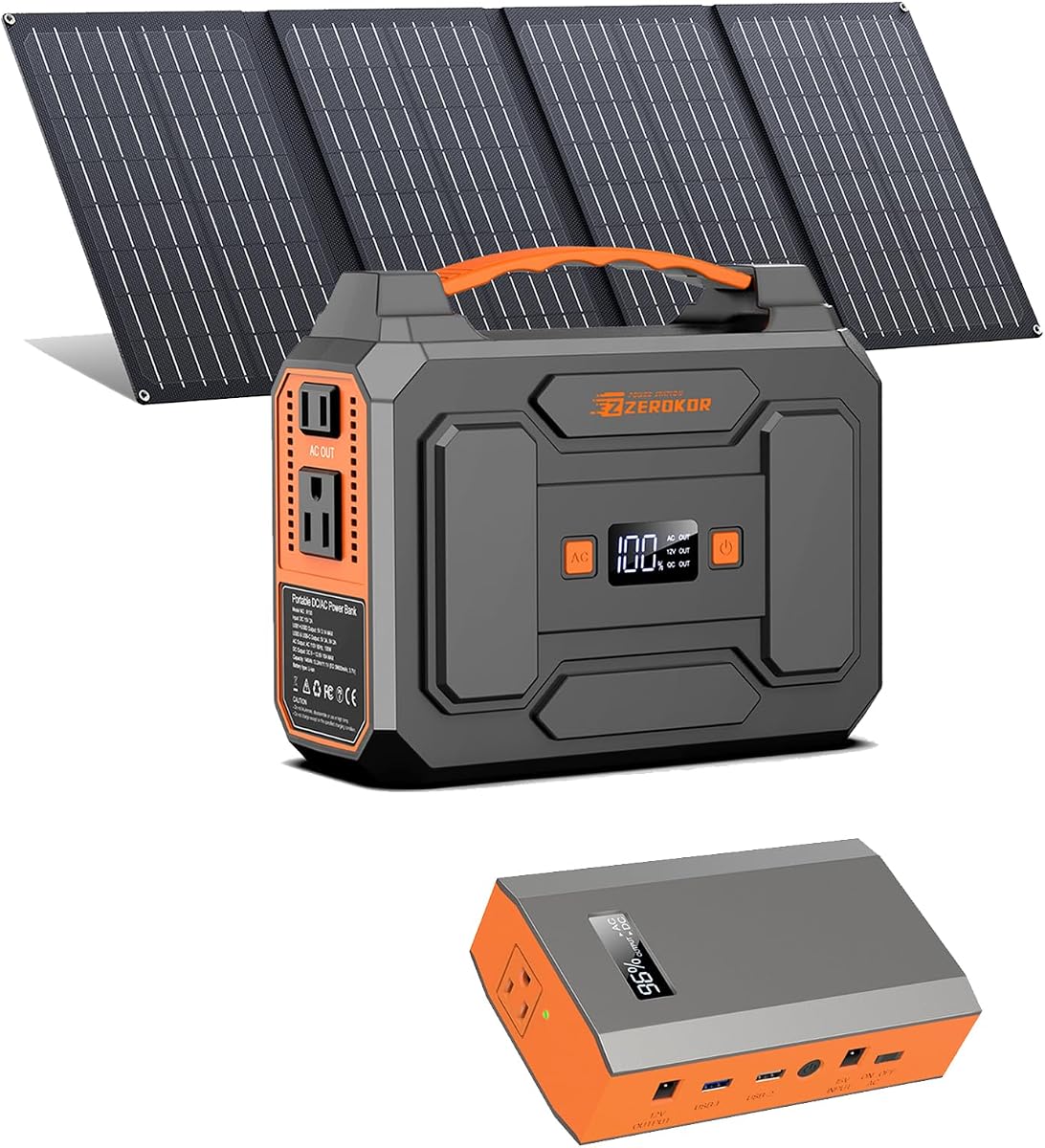



This ZeroKor bundle combines a 300W portable power station, a smaller 100W power bank with AC outlets, and a 40W foldable solar panel. With a 4.8 rating, it stands out for offering several backup-power formats in one package. The main unit contains a 280Wh lithium-ion battery, while the included panel provides a convenient way to replenish it during extended outdoor use.
We may earn a commission when you buy through this link, at no additional cost to you.
The main station has two 110V pure sine wave AC outlets rated to 300W, a DC output, three standard USB ports, a QC 3.0 port, and a flashlight with reading and SOS modes. A 100W unit adds AC, DC, USB, USB-C, and QC connectivity. This broad port selection makes the bundle useful for phones, tablets, laptops, headphones, cameras, and suitable camping electronics without requiring separate adapters for every category of device.
The largest limitation is appliance compatibility. The product information specifically warns against using high-wattage equipment, heat-producing appliances, coffee makers, hair dryers, and water pumps. The 40W panel is also an entry-level charging source, so it should be treated as supplementary rather than a rapid way to restore substantial energy. Buyers who need to run demanding appliances should instead consider one of the higher-capacity stations in this guide.
This kit makes the most sense for campers, travelers, and households wanting multiple battery options with solar replenishment. It offers good flexibility for electronics and light camping loads, provided the shopper carefully observes the wattage limits. It is a broad bundle for the category, but not a substitute for a full-sized emergency power system.
Including both a 300W station and a 100W unit gives buyers more placement options than a conventional power bank. The smaller unit is particularly useful inside a tent, vehicle, or travel kit, while the main station can remain with a group or serve as the primary charging hub.
The foldable 40W panel makes unattended solar charging practical for phones, lights, cameras, and other low-demand devices. Because solar collection varies with light and weather, it is best viewed as a useful supplement rather than the sole means of recharging.
We may earn a commission when you buy through this link, at no additional cost to you.
The Ecarke 220W Portable Power Inverter is a compact battery-to-AC adapter rather than a conventional self-contained power bank. It weighs only 0.68 pounds, making it easy to carry in a tool bag, glove box, or camping pack. Its 4.2 rating reflects a simple design centered on portability, useful lighting, and access to standard household-style power when a compatible battery is available.
We may earn a commission when you buy through this link, at no additional cost to you.
The inverter delivers 200W continuously and can reach a 250W peak, with 110-120V AC output. It includes two USB-A ports and a 20W USB-C port, allowing several compatible devices to charge at the same time. The built-in 200-lumen work light has three brightness levels, an 85-degree adjustment, and an SOS strobe mode, making the unit more practical during roadside, campsite, or job-site emergencies.
The essential caveat is that no battery or charger comes with the inverter. Buyers must already own a compatible DeWALT 20V battery and a compatible charger. That makes the product especially attractive to existing DeWALT users, but less economical or convenient for someone buying a portable power solution from scratch. Low-voltage, over-current, overload, overheat, and short-circuit protections help manage safe operation.
Among budget options, this is ideal for users who want an AC outlet without carrying a full power station. It works especially well for phones, tablets, laptops, LED lights, projectors, camera chargers, and compatible soldering irons. Those who already have the required battery gain a remarkably light and useful tool; everyone else should account for the additional battery and charger before deciding.
The main benefit is simple: it converts a compatible slide-on battery into a conventional AC source without requiring a large generator. Its low weight makes it considerably easier to carry than a self-contained 200W-class station, particularly for mobile work or travel.
A separate work light can be inconvenient to remember in a vehicle or toolbox. The built-in adjustable lamp gives this inverter a useful role during flat-tire changes, campsite setup, map reading, and low-light repairs, with an additional emergency strobe.
We may earn a commission when you buy through this link, at no additional cost to you.
The EcoFlow Delta 3 is a premium portable power station with 1,024Wh of internal capacity and 1,800W of rated output. Its 4.7 rating and advanced charging system place it among the strongest options for users who want rapid recharging, modern battery chemistry, and room to expand. It is designed for emergencies, camping, and a broad collection of household and electronic devices.
We may earn a commission when you buy through this link, at no additional cost to you.
EcoFlow states that a full charge can be completed in 56 minutes using 500W solar input and up to 1,500W of AC input, while 80% can be reached in 30 minutes. The station can power up to 13 appliances simultaneously, and X-Boost supports resistive loads above 2,600W continuously. Its LiFePO4 cells are rated for 4,000 cycles to 80% capacity, and the battery pack carries IP65 protection against splashes, dust, and oil.
Expansion is another major strength. The Delta 3 Series can work with Delta 3, Delta Pro 3, and Delta 2 Max batteries, expanding the system to as much as 5kWh. That makes the base unit a credible starting point for a system that may need to grow. The trade-off is bulk and expense when extra batteries are added, and buyers must decide whether a 1,024Wh base configuration is sufficient.
This is a strong recommendation for a shopper who values fast turnaround, broad appliance support, and future expansion more than minimal weight. It also works well as a capable travel or campsite station. Those seeking a smaller emergency pack may prefer the Jackery Explorer 1000 v2, but buyers wanting premium charging speed and ecosystem flexibility will find the Delta 3 particularly compelling.
The ability to reach 80% in 30 minutes or a full charge in 56 minutes is particularly valuable before a trip, storm, or period of expected use. Rapid input also makes topping up from multiple sources more practical than on systems that require lengthy charging windows.
Compatible expansion batteries can take the platform toward 5kWh, allowing the same basic station to support longer runtime and more demanding loads. Expansion should be planned around actual power needs, because additional energy and portability do not come without added size.
We may earn a commission when you buy through this link, at no additional cost to you.
This 99.9Wh outdoor power bank is positioned as a travel and emergency battery with more connection options than an ordinary phone power bank. It carries a 4.3 rating and offers seven outputs, three inputs, a 22.5W USB-C port, an LCD display, and a multi-mode flashlight. Its energy capacity is conveniently below 100Wh, which many travelers view as a more manageable category.
We may earn a commission when you buy through this link, at no additional cost to you.
The stated capacity can charge most phones seven to eight times or laptops three to four times, although actual results depend on device requirements and operating conditions. USB-C fast charging can take a phone to 60% in 30 minutes. Built-in Type-C and Lightning cables reduce the need to carry separate leads, and the unit is compatible with iPhone and Android devices through its other connections.
The most important limitation is that the listing does not identify a standard AC outlet. Despite using “generator” and “power station” language, this appears primarily suited to USB and DC charging rather than powering conventional AC appliances. Also, the built-in cables are only for charging connected devices; they cannot be used to recharge the power bank itself. Buyers who require an AC socket should not select it on the basis of the general product label.
The 99.9Wh Outdoor Power Bank is a good match for travel, hiking, camping, and family emergency kits where phone and laptop endurance matter most. Its LCD display, integrated flashlight, and multiple outputs make it more versatile than a basic power bank. For users searching specifically for an AC outlet, however, the absence of a specified AC output makes it a less direct answer to the core requirement.
Keeping internal energy below 100Wh helps preserve a travel-oriented balance between useful runtime and manageable size. It can serve as a central charging point for several family members without taking on the bulk of a large portable power station.
The built-in Type-C and Lightning leads are useful when a conventional cable is missing or damaged. They are designed only for output, however, so the unit still requires an appropriate charging cable or input method to restore its own charge.
We may earn a commission when you buy through this link, at no additional cost to you.
The ZeroKor 100W Solar Kit includes a 100W portable power station, a 65W power bank with an AC outlet, and a 40W foldable solar panel. Its 5.0 rating reflects a versatile package aimed at phones, tablets, laptops, cameras, drones, and camping electronics. The two-unit format gives buyers more flexibility than a single compact bank without moving into the weight class of a full-size home station.
We may earn a commission when you buy through this link, at no additional cost to you.
The main station has two 110V AC outlets rated to 100W, AC pass-through charging, one DC output, two standard USB ports, one QC USB port, and one USB-C port. The smaller 65W unit adds its own AC outlet, DC output, two USB connections, and a QC 3.0 port. Both include flashlights with SOS functionality, while the larger unit also offers a reading mode. A built-in BMS supplies short-circuit, over-current, over-voltage, and overload protection.
Its 100W ceiling keeps it realistic for light and moderate electronics rather than household appliances. The listing explicitly warns that devices above 100W may damage the generator, so shoppers should not approach it as a mini home backup system. Similarly, the 40W panel is most effective for maintaining smaller loads or adding limited energy during prolonged daylight. It cannot rapidly restore the larger battery under all conditions.
This bundle is well suited to tent camping, road trips, outdoor work, and travel kits where two different power sizes are convenient. The larger station can serve as a group hub, while the 65W unit can accompany a smaller group or travel separately. Buyers wanting more raw AC power and larger capacity should move to a 1,000Wh-class system, while lighter users may appreciate its compact orientation.
AC pass-through charging allows the main station to remain connected to an input while it supplies power to connected devices. This can simplify a campsite or travel setup where a continuously available charging hub is more convenient than alternating between charging and use.
The 100W station provides more AC capability, while the 65W bank is smaller and easier to carry. That separation lets one buyer build a flexible collection for both a central camp and a secondary vehicle or activity area.
We may earn a commission when you buy through this link, at no additional cost to you.
The Jackery Explorer 1000 v2 combines 1,070Wh of capacity with 1,500W of AC output, placing it in the sweet spot for many camping, travel, and emergency needs. Its 4.8 rating reflects a well-rounded package, and the 23.8-pound weight plus foldable handle make it more manageable than larger home-oriented stations. It can also support 3,000W of surge power for compatible startup loads.
We may earn a commission when you buy through this link, at no additional cost to you.
Jackery provides two USB-C ports, one USB-A port, one DC car port, and three pure sine wave AC outlets. The USB-C port supports 100W fast charging, allowing many laptops and tablets to charge directly without a separate wall adapter. The app can activate a one-hour emergency charging mode, a 30dB quiet charging mode, and an energy-efficiency mode, giving the owner meaningful control over charging speed and noise.
The LFP battery is designed to retain more than 70% of its original capacity after 4,000 cycles, supporting the stated lifespan of more than ten years. That makes it a practical long-term purchase for frequent travelers or households keeping it ready for outages. Its trade-off is that the fastest charging mode must be enabled in the app before use; the unit otherwise defaults to a 1.7-hour full-charge cycle to protect battery health.
This is the strongest general recommendation for most buyers because it handles more device types than a basic power bank without approaching the size of the largest systems. It is appropriate for road trips, camping, and emergency essentials. The solar panel is not included, and only compatible Jackery panels are supported, but the station is otherwise a balanced, portable choice with generous output and modern charging features.
The 1,070Wh capacity is large enough for many common electronics and moderate travel loads, while the 23.8-pound weight remains manageable for vehicle-based camping. Its mix of AC, USB-C, USB-A, and car outputs also reduces the need to carry multiple charger types.
Emergency charging offers maximum replenishment speed when time is short, quiet charging is useful overnight, and energy-efficiency mode can reduce unnecessary consumption. Understanding these settings allows the owner to balance urgency, noise, and long-term battery care.
We may earn a commission when you buy through this link, at no additional cost to you.
The Anker SOLIX C2000 Gen 2 delivers 2,048Wh of capacity with 2,400W rated output and a 4,000W peak, placing it in the middle of the guide's higher-capacity options. Its 4.7 rating is supported by flexible recharging, expansion capability, and a listed ability to handle several appliances at once, including many window and RV air conditioners.
We may earn a commission when you buy through this link, at no additional cost to you.
One of its strongest features is recharging flexibility. The station can reach a full charge in 58 minutes using AC or solar, while the 800W UltraFast alternator charging option can restore it from a vehicle in three hours. An expansion battery can increase capacity to 4kWh, extending the stated fridge runtime from up to 32 hours to as much as 64 hours. Low standby consumption of 9W also helps preserve stored energy.
At 41.7 pounds, the unit is not as easy to carry as a 1,000Wh station, though it is described as 25% lighter and 29% smaller than comparable products. Its dimensions are 18.1 by 9.8 by 10.1 inches, and a handle-style design supports vehicle transport. The trade-off is that even with careful space optimization, this remains a substantial system rather than a lightweight phone battery.
The C2000 Gen 2 is well matched to RV travel, longer camping trips, mobile projects, and households seeking substantial runtime without moving to a dedicated 3.6kWh system. Its combination of high output, rapid charging, and expandable capacity makes it particularly versatile. Shoppers should consider the weight and likely need for vehicle transport, but for serious mobile energy needs, this model offers an excellent balance.
Adding a compatible expansion battery can double the usable energy to 4kWh, which is meaningful for refrigerators, electronics, and extended outages. The choice should be based on realistic runtime needs because a larger battery adds both carrying effort and storage space.
The 800W alternator charging method is useful for road trips where charging from a conventional socket is too slow. It turns the station into a more practical mobile energy asset that can replenish while the vehicle is in use, subject to compatible installation and operating conditions.
We may earn a commission when you buy through this link, at no additional cost to you.
The Jackery HomePower 3600 Plus is designed as home backup rather than a pocketable travel battery. It combines 3,584Wh of internal capacity with 3,600W of output, and parallel configurations can raise output to 7,200W. Its 4.6 rating reflects serious capability for users who need to run pumps, heaters, dryers, or other substantial loads during an outage.
We may earn a commission when you buy through this link, at no additional cost to you.
The system supports 120V and 240V in parallel, which expands its usefulness for suitable appliances. One unit can be expanded to 21kWh, while multiple units can reach 43kWh. The listed claim of supporting a three-person household for more than two weeks illustrates the potential for carefully managed essential loads, although actual duration depends on appliance demand and available stored energy.
Safety and longevity are central to the design. High-temperature-resistant ceramic membrane cells are tested at 302 degrees Fahrenheit, and the product offers 6,000 cycles with a stated 10-year lifespan. It is also described as reliable in negative 4-degree Fahrenheit blizzards. Four charging methods include hybrid AC and DC replenishment in two hours, AC in 2.5 hours, solar in four hours, and gas-generator charging in 2.5 hours.
This is the strongest choice for homeowners seeking a plug-and-play alternative to a permanently installed backup system. Its wheeled, telescopic-handle design makes it more manageable around a home than a conventional generator. The clear trade-off is size and weight: this is not intended for camping in a small tent or carrying in a backpack. Buyers should assess whether their essential loads justify a system of this scale.
Unlike compact power banks, the HomePower 3600 Plus is engineered to support appliances that draw hundreds or thousands of watts. That makes it relevant for keeping refrigeration, heating, water systems, or selected tools operating when a normal battery pack would be inadequate.
Expansion to 21kWh per unit and higher totals with multiple units allows owners to scale the installation as their backup requirements change. Modular planning also makes it possible to start with a smaller configuration and add energy only when necessary.
We may earn a commission when you buy through this link, at no additional cost to you.
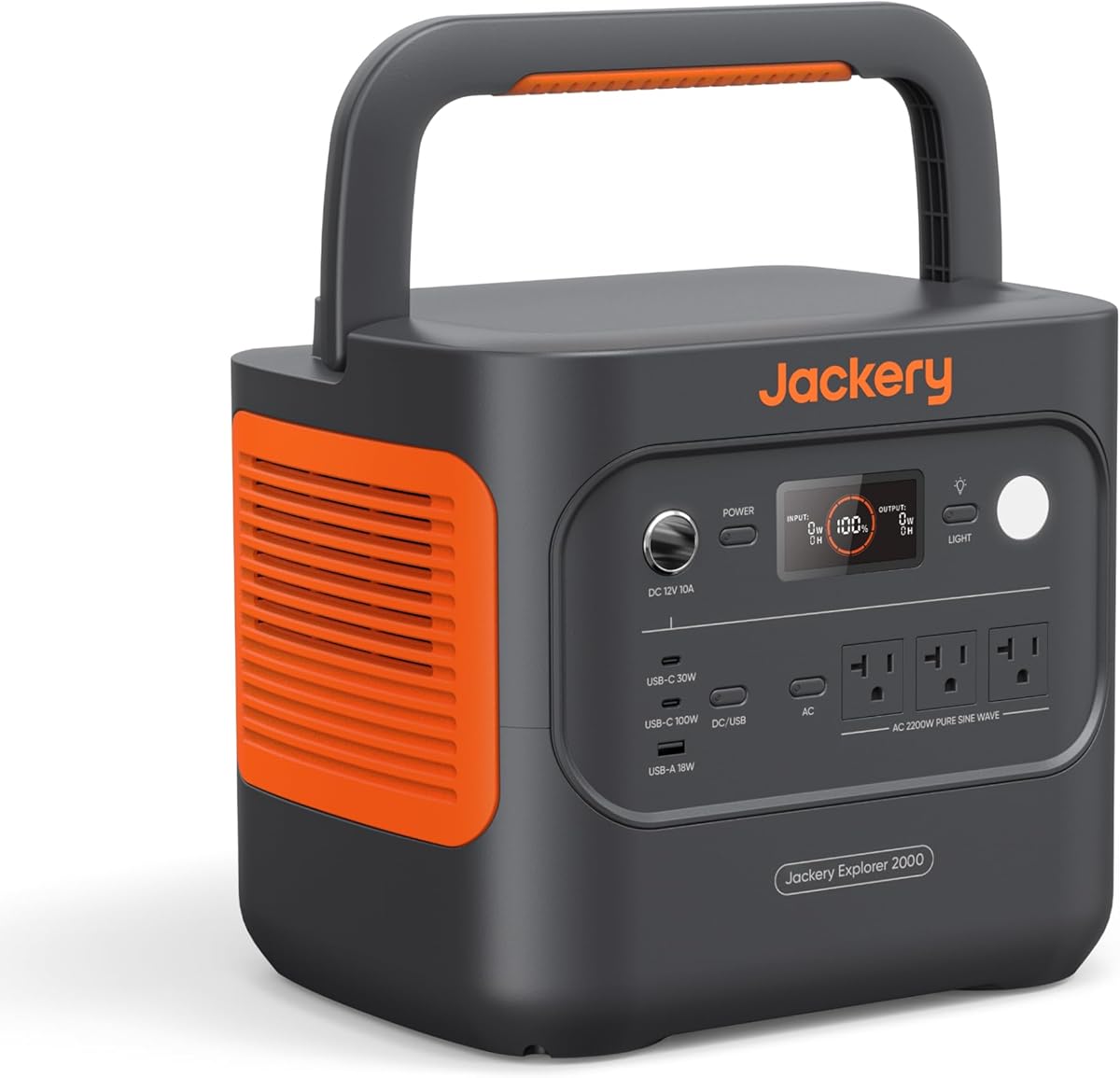
The Jackery Explorer 2000 v2 delivers 2,042Wh of capacity and a total 2,200W across three AC ports, placing it between the Explorer 1000 v2 and the much larger HomePower model. Its 4.4 rating reflects a capable middle ground for home backup, camping, and small-business use. At 39.5 pounds, it is positioned as a relatively compact and light 2kWh LiFePO4 station.
We may earn a commission when you buy through this link, at no additional cost to you.
A 100W USB-C PD port provides direct fast charging for compatible laptops and devices without an extra wall adapter. The station can reach 80% charge in 66 minutes with AC fast charging, and the app-activated Emergency Super Charging mode can complete a full charge in 102 minutes. A Silent Charging mode reaches a full charge in five hours at less than 30dB, making it suitable for use while sleeping or working.
The built-in LiFePO4 battery is stated to last up to ten years, and the Cell-to-Body design is intended to improve structural security and use of space. Its 20ms UPS switching helps maintain power to connected devices during outages. The trade-off is that the unit is substantially heavier than a 1,000Wh model, so it remains best suited to vehicle transport, campsite bases, or homes rather than backpacking.
The Explorer 2000 v2 is a strong choice for users who need roughly twice the capacity of a compact station without stepping up to a 3.6kWh home system. It can support a broad mix of electronics and moderate appliances, while USB-C and AC outputs simplify connections. Emergency charging should be selected deliberately because the default charging mode prioritizes battery health and the app provides additional control.
The capacity is large enough for multi-day support of a varied collection of essentials, yet the 39.5-pound weight is more manageable than many similarly powerful systems. It suits buyers who need more endurance without the footprint of a dedicated home installation.
The advertised 20ms switching is designed for compatible devices that remain online during a grid interruption. It creates a useful bridge between an ordinary power bank and a larger generator, though every connected appliance must still fall within the output limit.
We may earn a commission when you buy through this link, at no additional cost to you.
The BLUETTI AC200PL is a 2,304Wh portable power station with 2,400W of rated output, designed with RV users and technically prepared campers in mind. Its 4.5 rating reflects a broad port selection, flexible expansion, and rapid charging. The standout RV feature is a dedicated 48V port for replenishing a compatible RV battery using solar or other supported inputs.
We may earn a commission when you buy through this link, at no additional cost to you.
Recharging is flexible and quick. With up to 2,400W of AC input, the unit can go from zero to 80% in 60 minutes. Solar input of up to 1,200W is stated to provide a full charge in roughly 1.9 to 3.8 hours depending on conditions. The station supports several charging paths, including solar and car charging through the included cables, making it suitable for extended travel beyond ordinary electrical outlets.
Connectivity is unusually broad. There are four AC outlets, a 30A TT30 port, a 48V 8A DC port, a car port, two 100W PD ports, and two 15W USB-A ports, for eleven total. Capacity can expand with compatible B300, B210P, or B230 batteries to as much as 8,448Wh. The LiFePO4 cells are rated for more than 3,000 cycles, while the battery management system provides overcharge and short-circuit protection.
This model is best for RV owners, van-life travelers, and households that want one high-output system for both vehicle and general electronics. Its many ports reduce the need for separate adapters, and expansion makes long-term runtime possible. The trade-off is its larger physical footprint and the additional bulk of expansion batteries, so buyers should consider whether they genuinely need that scale before adding modules.
The 48V RV port creates a more convenient path for solar replenishment of a compatible RV battery. That makes the station particularly relevant to travelers who need to maintain vehicle electrical support while away from ordinary hookups.
Multiple AC, USB, USB-C, DC, car, and TT30 connections let the station serve a broad collection of equipment. Buyers can run supported devices simultaneously while preserving the high-wattage RV and AC connections for equipment that benefits from them.
We may earn a commission when you buy through this link, at no additional cost to you.
The best power bank with AC outlet depends on the devices you intend to run, how long they must remain powered, and how much the unit can be moved. Capacity, inverter output, charging options, safety, and included accessories should be evaluated together rather than as isolated specifications.
Begin with the wattage of the devices that must operate on AC power. A unit rated below the combined load may shut down, trip its overload protection, or fail to start equipment with a high surge demand. The output rating also needs to cover adapters and power-hungry electronics such as laptops, projectors, cooking equipment, pumps, and small appliances. Peak output is relevant for brief startup surges, but it should not be confused with safe continuous capacity.
Choose an inverter with continuous output comfortably above your expected draw. The Ecarke provides 200W continuously and 250W at peak, the ZeroKor systems reach 100W or 300W, and the larger EcoFlow, Jackery, Anker, and BLUETTI stations support substantially higher loads. Confirm the specific wattage of each intended device before choosing.
Battery capacity determines how long a unit can run after accounting for conversion losses, device efficiency, and the power draw of the equipment itself. Sub-100Wh models emphasize travel convenience, 1,000Wh models offer a useful middle ground for electronics and moderate loads, and systems above 2,000Wh are better suited to extended outages, RV travel, and household essentials. Larger capacity normally means more bulk and weight.
Consider the most likely storage and transport location before buying. A 23.8-pound station can be reasonable for a vehicle or campsite, while a 3,584Wh home system belongs on a floor or in a garage. Select enough runtime for realistic use rather than paying for capacity that will remain unused and difficult to move.
A product named as a solar generator may include a panel, while another may require separate solar equipment. Some inverter-style products do not contain their own battery at all and instead need a compatible slide-on battery. Bundles can include a panel, charging leads, car cables, or multiple power banks, but terminology alone does not guarantee a complete setup.
Read the box contents carefully. The Ecarke specifically excludes its battery and charger, while several ZeroKor and BLUETTI bundles include solar or vehicle accessories. The Jackery Explorer 1000 v2 does not include a solar panel, and the EcoFlow Delta 3 listing includes an AC charging cable rather than a panel. A complete listing review prevents expensive disappointments.
An AC outlet is only one part of a useful power system. USB-C is valuable for modern phones, tablets, and laptops, while USB-A supports legacy accessories, DC outputs can serve compatible equipment, and a car socket may assist with road-trip charging. Some models also include built-in cables, though these may be restricted to output and cannot recharge the unit itself.
Match the ports to your device collection rather than relying on a high total port count. Pay attention to supported protocols, voltage ranges, and shared power limits when several outputs are used simultaneously. Also verify physical connector types: a USB-C port without sufficient output may charge a phone slowly, and an AC outlet may not support the startup surge of a particular appliance.
The fastest initial charge is only one part of long-term usefulness. A useful system should support the charging methods available where it will be used, such as household AC, solar, vehicle power, or a compatible tool battery. High AC input can restore capacity quickly, while a modest panel is more appropriate for maintaining low-draw devices over several days.
Some models support pass-through charging, allowing the power station to operate while it is being recharged. Others provide app modes for emergency charging, quiet charging, and energy efficiency. Jackery, for example, requires its one-hour emergency charging mode to be enabled in the app, while EcoFlow and Anker advertise rapid replenishment through several inputs.
Portable power stations store substantial energy, so battery chemistry, cycle life, temperature management, and electronic protection deserve careful attention. LiFePO4 chemistry is used by EcoFlow, Jackery's larger models, and BLUETTI, with listed cycle ratings and lifespan expectations that generally suit frequent use better than an unspecified basic battery. The ZeroKor products include BMS protection for short circuits, over-current, over-voltage, and overload.
Look for thermal controls, low-voltage cutoffs, over-temperature safeguards, and clear guidance on unsupported appliances. Claims about operating in cold or warm conditions are useful only within their stated limits. Proper charging, ventilation, storage, and adherence to the manufacturer's instructions remain essential regardless of the protection system.
A power bank for air travel, a portable station for a campsite, and a home backup system face different environmental demands. Smaller units benefit from portability and airline-relevant capacity considerations, while camping equipment may need AC outlets, lights, solar charging, and weather resistance. Home users may prioritize high continuous output, UPS behavior, expansion, and the ability to run essential appliances.
The 99.9Wh model is particularly travel-oriented, the ZeroKor bundles target outdoor users, and the BLUETTI AC200PL includes an RV-focused port. The Jackery HomePower 3600 Plus is built around home mobility and substantial loads. Choose the design whose form factor matches the location where the unit will actually be used.
Manufacturer runtime claims provide useful direction but should not be treated as guaranteed results. Runtime varies with appliance efficiency, battery age, temperature, inverter conversion loss, and whether several devices are active at once. A larger battery can run a refrigerator longer, but only if its compressor cycles and ambient conditions match the stated test conditions.
Similarly, full-charge times depend on the input source, available solar light, and whether the battery begins empty. Treat published figures as best-case or defined scenarios and build in a margin for real-world conditions. For outage planning, list essential loads, estimate their combined demand, and confirm that both the inverter and energy capacity can support them for the required duration.
Before using a new unit, inspect it for shipping damage and read the included manual, particularly the requirements for compatible batteries, supported appliances, charging inputs, ventilation, and expansion accessories. Confirm the AC output rating and the power requirements of every device. Charge the unit fully through a supported method before relying on it for travel or an outage, and install any required app while the device is connected to power.
Distribute loads sensibly rather than automatically connecting every output at once. Stay below continuous and surge limits, use quality cables and undamaged adapters, and avoid plugging in heat-producing appliances unless the manufacturer explicitly permits them. Do not exceed the input rating with an incompatible charger or solar source. If a breaker, shutdown message, unusual heat, odor, or irregular behavior occurs, disconnect the affected load and consult the manual rather than repeatedly resetting the unit.
For longevity, use the manufacturer's recommended charging modes, keep the power station within its stated temperature limits, and avoid leaving it in a hot vehicle, damp location, or area without ventilation. Recharge it periodically according to the guidance provided, store it partially charged for long periods when advised, and use compatible expansion batteries and panels only. Cleaning should involve a soft dry cloth, with ports checked for dust and debris before use.
A regular power bank mainly charges USB devices, while a power bank with an AC outlet includes an inverter that produces household-style power. That extra capability lets it charge compatible laptops, lights, projectors, tools, and small appliances. The larger inverter and battery also generally make the unit heavier and more expensive to carry.
It depends on both the refrigerator's running and startup wattage and the power bank's continuous and surge ratings. Larger systems such as the EcoFlow Delta 3, Anker SOLIX C2000 Gen 2, or BLUETTI AC200PL are more likely to handle such loads. Always compare the appliance label with the station's specifications and follow the power bank's guidance.
It depends on the panel size and the station's solar input limit. The included 40W panels in the ZeroKor bundles are best treated as supplementary charging for smaller loads rather than rapid restoration of a large battery. Larger solar input systems can refill capacity much faster when sunlight, panel angle, and weather are favorable.
Yes. The Ecarke 220W Portable Power Inverter is an adapter that requires a compatible DeWALT 20V battery, and neither the battery nor charger is included. It is most economical for people who already own those items. Other shoppers should choose a self-contained station with a built-in battery.
The Ecarke 220W inverter is the most compact option in this guide at 0.68 pounds, but it relies on a separate compatible battery. Among self-contained products, the 99.9Wh outdoor power bank is notably travel-friendly, although it does not list a standard AC outlet. The ZeroKor 65W unit combines an AC socket with a smaller secondary format, while the 100W main station offers more output.
The right amount depends on the devices and the required runtime. A 1,000Wh station is useful for phones, laptops, lights, and moderate electronics, while 2,000Wh to 3,600Wh systems are better for more appliances and longer outages. Calculate the combined wattage and multiply by the hours of operation, then allow extra headroom for conversion losses and varying appliance demand.
Battery-powered stations operate without combustion fumes, which makes indoor use during an outage more practical than a gas generator. They should still be operated according to the manual, with adequate ventilation and without overloading the AC outputs. Keep the unit away from combustible materials and maintain clearance around cooling areas.
Pass-through charging allows a power station to recharge while it simultaneously supplies power to connected devices. It can be convenient in a campsite, workshop, or vehicle where a continuously available power source is needed. The station must explicitly support the function, and the connected loads must remain within all relevant output and input limits.
The Ecarke 220W inverter is the most budget-oriented and portable choice for someone who already owns a compatible DeWALT 20V battery. The Jackery Explorer 1000 v2 is the strongest overall option for a balanced mix of capacity, manageable weight, pure sine wave AC output, fast USB-C charging, and app-controlled operating modes. For buyers seeking premium charging speed and expansion flexibility, the EcoFlow Delta 3 is the most advanced top pick.
Prioritize continuous AC output first, followed by the capacity needed for your actual loads. Portable electronics may be served by a 100W unit, while camping, RV travel, or outages often justify 1,000Wh or more. Expansion, USB-C charging, solar inputs, UPS behavior, work lights, and vehicle charging can add value, but they should support rather than distract from the core power requirement.
Finally, check the current listing, package contents, warranty information, and product specifications before ordering, because prices, bundles, and availability can change. Verify whether a battery, charger, panel, or expansion accessory is included, and follow the manufacturer's charging, ventilation, and compatibility instructions. The right power bank with AC outlet is the one whose output, runtime, and portability align with how you actually plan to use it.