
Fermion C4002
5.0Editor score
Native ESPHome integration
Static presence up to 10 meters
Configurable noise filtering
Explore the best Mmwave Human Presence Sensor options, comparing radar range, wireless connectivity, occupancy detection, light sensing, installation, and
Mmwave human presence sensors use high-frequency radar to determine whether a person is occupying a room, even when they are sitting, sleeping, reading, or otherwise remaining still. Unlike a conventional passive infrared motion sensor, this technology can distinguish persistent presence from simple movement, making it especially useful for lighting, climate, security, and energy-saving automations.
The ten products in this guide cover Wi-Fi, Zigbee, Matter over Thread, and developer-oriented approaches to mmwave presence detection. We compared the supplied specifications for radar frequency, detection range, stationary-person detection, ambient light measurement, power options, smart-home compatibility, installation requirements, and environmental learning features.
Each review explains where a sensor is strongest and where its ecosystem or installation demands deserve attention. The shortlist includes finished products for common users, flexible modules for builders, and combined radar and PIR designs. Product listings and prices can change, so confirm the current specifications, hub compatibility, and available offers before purchasing.
5.0Editor score

4.4Editor score

4.3Editor score
This side-by-side comparison highlights the radar frequency, stationary-presence capability, connectivity, power arrangement, and standout features of each mmwave human presence sensor.



The Akamatis Litos v3 is a compact 24GHz mmWave presence and light sensor with a 4.4 rating. It is designed for users who want occupancy-aware lighting without investing in a full mains-powered radar system. Its ability to identify both moving and stationary people makes it a meaningful upgrade from a basic passive infrared sensor, particularly in a reading room, bedroom, home office, or bathroom.
We may earn a commission when you buy through this link, at no additional cost to you.
The standout feature is the combination of presence detection and an integrated VEML7700 ambient light sensor. This allows an automation to distinguish between an occupied room and a room that is both occupied and dark, helping prevent unnecessary lighting activation during daylight hours. The sensor uses the HLK-LD2401 radar module and a Seeed XIAO ESP32-C3 controller, while the external antenna is intended to support dependable Wi-Fi range and stability.
Setup is streamlined for the target audience because the unit arrives with ESPHome firmware already installed. There is no need for manual flashing, and the light-permeable 3D-printed front allows ambient light to reach the VEML7700 sensor. The trade-off is clear: the product works exclusively with Home Assistant, and an existing installation plus some familiarity with the platform are required. Buyers outside that ecosystem should look toward Zigbee or Matter options instead.
The Litos v3 is the strongest all-around choice for a Home Assistant household that wants true stationary-presence awareness, local automation, and light-level context in a ready-to-use device. It is especially appropriate for a single room or a focused pilot project. Buyers should confirm that their router provides a compatible 2.4GHz network and plan the mounting position carefully to cover the intended occupied zone.
Combining radar occupancy data with illuminance readings makes the Litos v3 useful for rules that depend on both human activity and room brightness. Its front design allows the ambient light sensor to gather measurements without requiring a separate light sensor.
Pre-flashed ESPHome firmware removes the most technical part of installing a bare radar module. The remaining setup centers on joining the device to Wi-Fi and adding its entities to an existing Home Assistant installation.
We may earn a commission when you buy through this link, at no additional cost to you.
The SONOFF SNZB-06P24 is a 3.8-rated Zigbee presence sensor aimed at users who want detailed control over where radar detection operates. It combines 24GHz mmWave radar with ambient light sensing, allowing it to detect subtle human micro-movements and support occupancy-aware lighting. Unlike a basic room sensor, it can divide its monitored area into as many as seven configurable zones.
We may earn a commission when you buy through this link, at no additional cost to you.
Zone positioning is the defining feature. Within a four-meter range and approximately 110-degree field of view, users can disable areas such as a hallway or window while concentrating detection around a sofa, desk, or bed. The supplied information also highlights detection calibration and historical light data, both of which can make automations more context-aware and less prone to unnecessary activations.
The main compromise is its requirement for a Zigbee hub or controller. It is compatible with Home Assistant, SmartThings, and Alexa-oriented systems, and advanced third-party configuration can be performed through Bluetooth in the eWeLink app. The 3.8 rating suggests some variability in real-world satisfaction, so buyers should verify that their preferred platform exposes the functions they need before installation.
This sensor is a compelling choice for a homeowner who values precise coverage zones and calibration more than simple battery placement. USB-C power favors a permanent mounting point, while the seven-zone feature is especially helpful in open-plan rooms where an unrestricted radar field could produce unwanted triggers. It is less suitable for anyone wanting a completely standalone Wi-Fi device.
Seven independently configurable zones give the SNZB-06P24 more granular coverage than many compact presence sensors. This can reduce unwanted activation caused by traffic outside the primary seating or working area.
The self-learning calibration feature is intended to account for recurring environmental movement such as airflow, pipes, and appliance activity. It cannot guarantee a perfect result, but it offers useful tools for stabilizing a real household installation.
We may earn a commission when you buy through this link, at no additional cost to you.
The Generic Zigbee MmWave Sensor has a 4.0 rating and provides a 24GHz radar solution for people who want stationary-presence detection through a Zigbee connection. It can detect movement as well as a still occupant, making it useful for scenes in which a traditional motion sensor would switch lights off while someone is reading, working, or resting.
We may earn a commission when you buy through this link, at no additional cost to you.
The recommended Home Assistant route is Zigbee2MQTT rather than ZHA. According to the supplied product information, that route exposes the full set of functions, including presence distance, illuminance, detection distance, and presence sensitivity. The unit also supports a Tuya Zigbee gateway, making it potentially useful for people maintaining devices in the Tuya ecosystem as well as a more specialized Home Assistant configuration.
Installation is straightforward in concept but not completely flexible. It is a wired device that must remain connected to USB 5V1A power, and the mounting hardware can be attached to a wall, ceiling, or another suitable location. This dependence on a power outlet may be inconvenient in closets, bathrooms, and other locations without a convenient outlet, but it also avoids battery maintenance.
This product suits builders who value granular Zigbee2MQTT control and already operate a compatible gateway. Its 4.0 rating is moderate, and the generic branding may leave buyers wanting more structured documentation than a well-known platform product. The combination of illuminance, sensitivity, distance, and presence data makes it a practical starting point for detailed occupancy automations.
Using Zigbee2MQTT can expose a broad set of measurements that a basic binary occupancy entity would omit. This makes the sensor useful for people building nuanced distance, light, and sensitivity automations.
Constant USB power is appropriate for a permanently installed room sensor and removes the need to monitor battery capacity. A nearby outlet or suitable low-voltage cable route should be planned before mounting.
We may earn a commission when you buy through this link, at no additional cost to you.
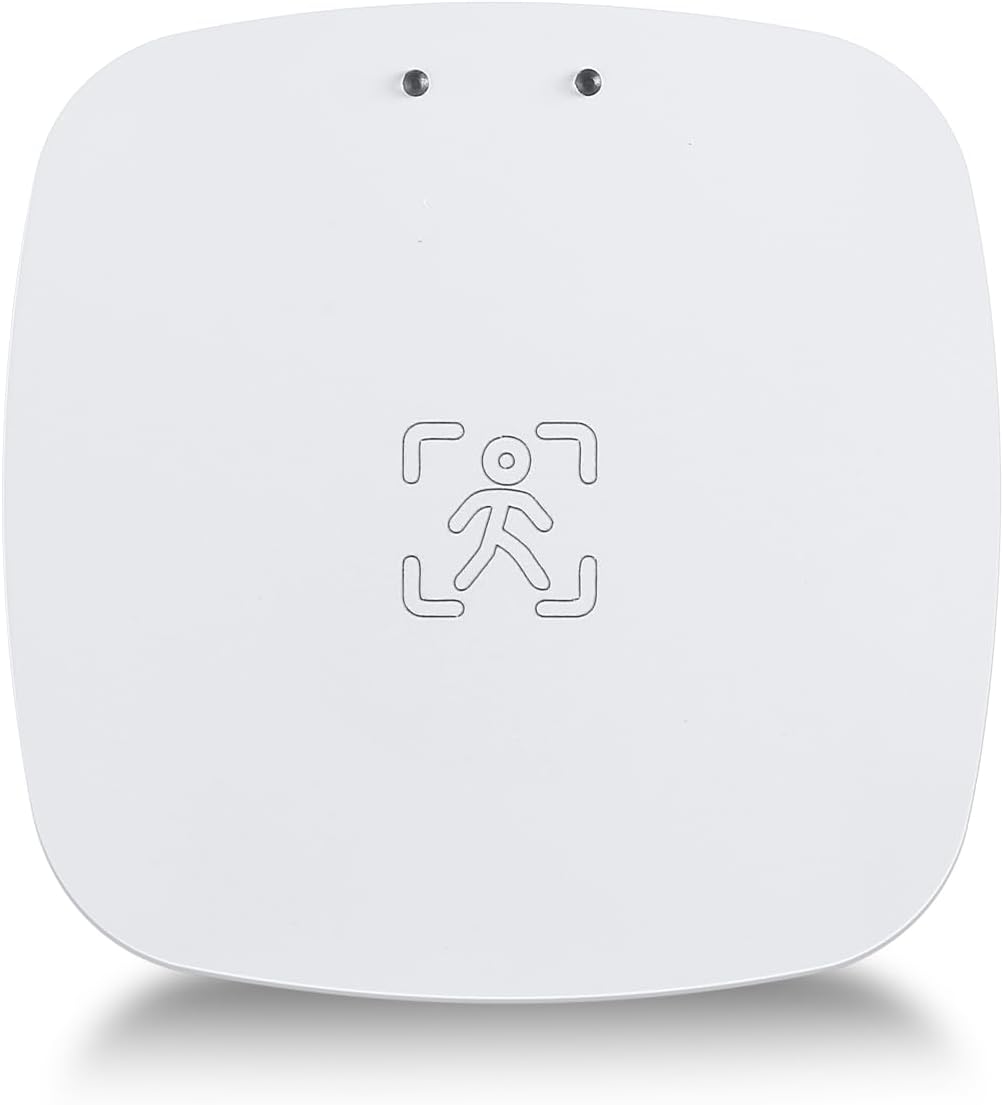
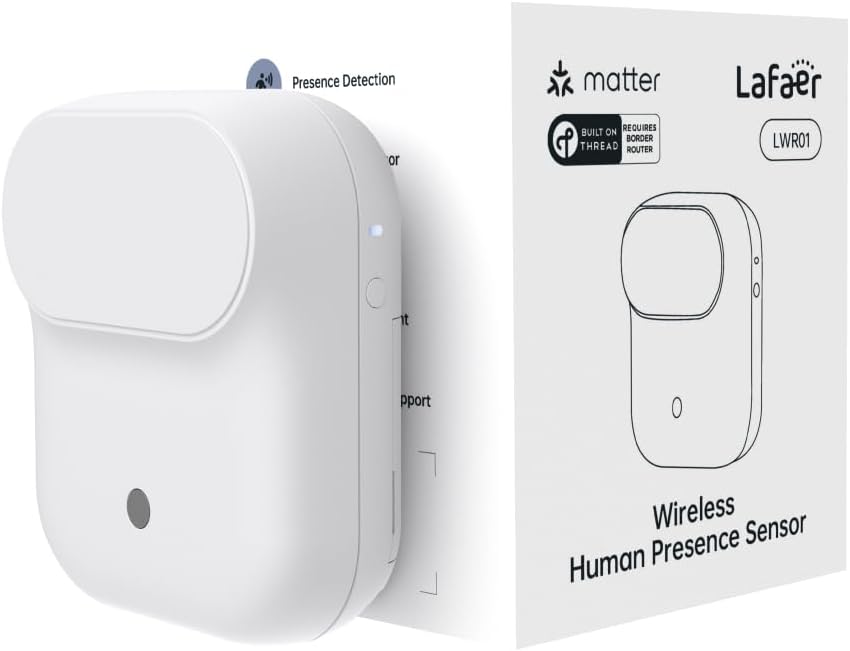
The LWR01 is a wireless mmWave presence sensor designed around Matter over Thread. Its 3.3 rating is the lowest among the reviewed products, but its feature set is attractive for users who want flexible placement and access to Apple Home, Amazon Alexa, Google Home, SmartThings, Home Assistant, Homey, or other compatible platforms.
We may earn a commission when you buy through this link, at no additional cost to you.
The radar is advertised as detecting stillness up to 3.5 meters and movement up to six meters. This separation between occupied and active ranges can support nuanced automations, while the built-in ambient light sensor can prevent lights from turning on when daylight is sufficient. IPX3 water resistance also makes the LWR01 a candidate for bathrooms and other splash-prone spaces, subject to the stated rating and manufacturer guidance.
The product supports a battery life of more than one year and can alternatively be powered through a Type-C connection. That flexibility is valuable when an outlet is inconvenient, although sustained high-performance use may be better served by wired power. The product also requires compatible infrastructure: the supplied information lists several qualified Apple, Amazon, Google, Homey, and Samsung hubs or routers.
The LWR01 is best for a multi-ecosystem household that values wireless placement and Matter over Thread more than the highest customer rating. Users should confirm that their chosen hub or router supports Thread, and that the current mobile app and automation platform expose the desired presence and illuminance entities. Verified compatibility before mounting can prevent a frustrating setup.
The ability to use batteries or Type-C power lets the sensor cover both retrofit locations and continuously powered installations. A wired arrangement may be preferable where frequent occupancy reporting or the highest stated performance is important.
Its IPX3 rating expands the potential use of radar presence sensing to bathrooms, laundry rooms, and similar areas. The rating addresses splash exposure rather than direct submersion, so installation position still matters.
We may earn a commission when you buy through this link, at no additional cost to you.
The LWR02 is the most comprehensive room sensor in the list, with a 4.3 rating and a 5-in-1 design. It tracks presence, motion, temperature, humidity, and ambient light, reducing the need to install several separate devices when a single room needs broader environmental context. Its support for Matter over Thread places it among the more ecosystem-flexible options here.
We may earn a commission when you buy through this link, at no additional cost to you.
Its dual-sensing design pairs 24GHz mmWave radar with a passive infrared sensor. Radar can maintain an occupied state when someone is sitting still, breathing, or sleeping, while PIR responds to larger movements such as walking. The supplied information says this division helps reduce false triggers from fans, curtains, and small pets. The device offers a four-meter presence range, an eight-meter motion range, and an approximately 120-degree field of view.
Two included AAA batteries can provide up to two years of operation, and rechargeable cells are supported. The magnetic hemispherical base, adhesive option, and shelf placement offer flexible mounting, while IPX3 protection suits bathrooms and kitchens. One consideration is the need for an existing Thread border router and compatible ecosystem, even though the product supports Apple Home, Alexa, Google Home, SmartThings, Home Assistant, and Homey.
The LWR02 is the premium pick for anyone who wants a versatile room sensor rather than a single-purpose radar detector. It is particularly attractive when temperature, humidity, and light data can all contribute to automations. Buyers should focus on correct orientation, because radar and PIR coverage patterns differ, and should verify local Matter implementation before buying.
The radar channel maintains occupancy during stillness, while PIR provides a complementary response to larger movement. This hybrid approach offers a broader and potentially more stable picture of room activity than either sensing method alone.
Temperature, humidity, illuminance, motion, and presence in one housing can support richer automations and reduce visual clutter. It also gives users a unified way to review conditions in dashboards that support the exposed entities.
We may earn a commission when you buy through this link, at no additional cost to you.
The THIRDREALITY Presence Sensor R2 combines 24GHz radar with adjustable sensitivity and battery-powered placement. It is intended to detect through nonmetallic materials such as wood and glass, with consistent operation regardless of ambient light, temperature, or humidity. A 3.5 rating reflects moderate customer satisfaction, but the sensor's five sensitivity levels offer meaningful control.
We may earn a commission when you buy through this link, at no additional cost to you.
That sensitivity control can be especially useful in a multi-purpose household. High sensitivity can respond to posture changes and small gestures, while a lower level can focus on more significant movement in a hallway or busy passage. AI-enhanced environment learning is also included to reduce effects from air-conditioning airflow and sheer curtain movement, although the product information correctly notes that strong repetitive motion can still trigger detection.
Three AA batteries eliminate the need for a nearby outlet and permit placement in cabinets, bathrooms, hallways, and storage rooms. Compatibility is broad across Home Assistant through ZHA or Zigbee2MQTT, SmartThings, Aeotec, Homey systems, and several Echo models with built-in Zigbee hubs. The device nevertheless requires Zigbee infrastructure rather than functioning as a standalone Wi-Fi product.
The R2 is best for users who want to tune radar behavior instead of relying entirely on automatic calibration. Its battery design makes it particularly useful in retrofit locations. The main caution is the need to establish a stable Zigbee mesh and to test sensitivity in the actual room, since airflow and repetitive movement can influence the results.
Manual sensitivity selection lets users balance awareness against false activation. Fine-tuning after installation is especially helpful in rooms where one automatic profile cannot handle both subtle occupancy and background movement.
AA battery power makes the R2 convenient for closets, storage rooms, and other spaces where running a cable would be inconvenient. The hub requirement is the principal installation trade-off.
We may earn a commission when you buy through this link, at no additional cost to you.
The Fermion C4002 is a developer-oriented mmWave module with a 5.0 rating, the highest among the ten products. It combines a 10-meter static-presence range, an 11-meter motion range, micro-motion detection, and an ambient light sensor. Rather than arriving as a sealed consumer product, it is designed for ESP32, Arduino, Raspberry Pi, and other compatible projects.
We may earn a commission when you buy through this link, at no additional cost to you.
Its biggest advantage is the supplied ESPHome YAML configuration and clear Home Assistant pathway. Once the module is connected through standard UART and the firmware is flashed, Occupancy, Distance, Energy, and Illuminance entities become available. This removes much of the reverse engineering normally associated with raw radar modules and makes the C4002 accessible to ambitious Home Assistant users.
The module accepts a 3.6-to-5.5-volt supply and can work with both 3.3-volt and 5-volt logic systems without a level shifter. It also offers adaptive noise filtering and software-configurable distance gates, allowing users to exclude adjacent rooms and reduce unwanted detection. These are meaningful benefits, but the product demands more technical confidence than a preconfigured sensor.
The C4002 is the budget pick for builders who want exceptional range, documentation, and integration flexibility at a lower entry point than a finished multi-function system. It is not the easiest choice for a nontechnical buyer, but it may offer the best value for an ESPHome or Arduino enthusiast willing to handle the connection and enclosure.
Verified ESPHome files and documented entities reduce the work required to turn a raw radar module into a usable smart-home sensor. Builders still need to connect UART, provide power, and integrate the setup with their existing configuration.
The 10-meter static and 11-meter motion specifications are among the most generous in the list. Configurable distance gates help turn that reach into focused room monitoring rather than allowing unrelated adjacent-space activity to influence automations.
We may earn a commission when you buy through this link, at no additional cost to you.
The Akamatis Presence Sensor v2.2 is a 4.4-rated Wi-Fi mmWave sensor for Home Assistant users. It uses the HLK-LD2410B radar module and Seeed C3 controller to detect both moving and stationary objects up to 20 feet indoors. Its core purpose is precise, flexible occupancy automation without the need for a camera-based system.
We may earn a commission when you buy through this link, at no additional cost to you.
The sensor arrives with ready-to-use ESPHome firmware, so setup does not require manual flashing. After connecting through the device hotspot and entering Wi-Fi credentials, it can be added to Home Assistant. An external antenna supports connection range and stability, while adjustable sensitivity lets users refine how aggressively the radar reacts to subtle movement in different environments.
Compared with the Litos v3, this version does not include the supplied information's integrated ambient light sensor. It is powered through USB-C, eliminating batteries, and its main components are described as FCC-certified. As with the Litos v3, it works only with Home Assistant, and a running installation plus basic familiarity is expected.
The v2.2 is a good choice for users who want a focused presence-only sensor and already operate Home Assistant. It may be preferable when a smaller feature set and lower technical complexity are desired. If ambient light data is central to the intended automations, however, the Litos v3 offers a more direct fit.
Pre-installed ESPHome firmware makes the v2.2 substantially easier to deploy than a raw radar module. Users still need to provide the sensor with power, connect it to a 2.4GHz network, and complete its configuration within Home Assistant.
The external antenna and certified radar and controller components support a more dependable installation than a basic Wi-Fi module. Placement away from metal obstructions and large electronic equipment can further improve results.
We may earn a commission when you buy through this link, at no additional cost to you.
The THIRDREALITY Presence Sensor R3 is a 3.3-rated Zigbee presence sensor distinguished by 60GHz mmWave radar, an RGB status light, illuminance sensing, and TVOC monitoring. The higher radar frequency is used to identify subtle micro-movements such as breathing, helping the device maintain occupancy status when a person is sitting or sleeping still.
We may earn a commission when you buy through this link, at no additional cost to you.
The RGB illumination serves two roles. It can provide an ambient visual effect and indicate presence, automation, or system status through different colors and brightness levels. This makes the R3 useful where a visible room-state cue is helpful, although buyers who only need invisible sensing may find the feature unnecessary.
Powered by USB-C at 5V1A, the sensor operates continuously and functions as a Zigbee 3.0 repeater to strengthen mesh coverage. It supports Home Assistant through both ZHA and Zigbee2MQTT, along with SmartThings, Aeotec, Homey, and compatible Echo devices. Lux and TVOC availability depends on the selected platform, and the indicator flashes red when the sensor determines that TVOC levels are dangerous.
The R3 is best for someone who wants a visual status indicator and a multifunction environmental sensor in a continuously powered location. Its moderate rating and platform-dependent data should encourage buyers to verify integration details first. The Zigbee repeater function is particularly useful in a larger home where extending mesh reach can improve reliability.
The RGB light can indicate occupancy or automation state at a glance, offering feedback that a conventional hidden sensor cannot. It also allows color and brightness to be tailored to different household routines.
Illuminance and TVOC readings can enrich presence-based automations, but their availability depends on the selected controller. Buyers should confirm support rather than assuming every environmental measurement will appear in their dashboard.
We may earn a commission when you buy through this link, at no additional cost to you.
The Zigbee Human Presence Sensor is a battery-powered 24GHz radar detector with a 3.2 rating. Its primary attraction is straightforward stationary-person detection across a stated range of up to 20 feet, allowing lighting to remain active while someone reads, sleeps, or sits without making a visible movement.
We may earn a commission when you buy through this link, at no additional cost to you.
The device is designed for the common problem of lights turning off in an occupied room. It works with Home Assistant, SmartThings, Hubitat, Tuya, and compatible Echo devices that include a Zigbee hub. Its 24GHz radar provides a practical alternative to camera-based occupancy detection and does not depend on ambient light for person detection.
Two AAA batteries are stated to last up to two years in typical use, making wireless placement possible without a nearby outlet. The trade-offs are the lowest rating in this group and the absence of more advanced zone, illuminance, or calibration features in the supplied specifications. It remains dependent on Zigbee infrastructure and compatible automation templates.
This sensor is most appropriate for a user who wants a simple battery-powered presence trigger across a mainstream Zigbee platform. It can be particularly effective in a bedroom or living room where lights should remain on during stillness. Buyers should confirm compatibility with their controller and compare the available automation parameters before committing to a larger multi-room deployment.
The sensor focuses on the essential distinction between motion and continued presence. That simplicity makes it approachable for lighting routines and removes the need for manual gestures to keep lights on.
The stated two-year battery estimate enables installation away from wall outlets, which is valuable in existing homes. Actual runtime depends on activity, signal conditions, and the automation frequency of occupancy reports.
We may earn a commission when you buy through this link, at no additional cost to you.
The most important choices are the detection method, supported ecosystem, power source, mounting location, and level of control needed. A sensor that excels technically can still be a poor fit if its hub, network, or automation platform does not match your home.
Prioritize a model explicitly designed to detect stationary occupants, not merely a product described as a radar motion detector. Check whether the stated range applies to static presence, movement, or both.
Choose a detection range that matches the room. A compact sensor may be preferable for focused coverage, while a long-range module offers flexibility for larger spaces.
Match the sensor to an ecosystem you already operate. Verify required hubs, firmware, mobile-app versions, and available measurement entities rather than relying only on a broad compatibility label.
Choose battery power for outlet-free placement or continuous power for permanent installations. Confirm cable length, mounting clearance, and the sensor's environmental suitability before ordering.
Choose a light sensor when daylight-aware automation matters. Confirm the reported range, supported entities, and platform support before expecting environmental data to control routines.
Look for calibration, zone selection, and sensitivity controls. Expect to test and fine-tune the sensor in its final placement rather than relying entirely on factory defaults.
Check the enclosure rating and manufacturer guidance for damp locations. Place wired sensors away from standing water and follow all local electrical requirements.
Choose a ready-made sensor for straightforward deployment. Choose a developer module when you need custom entities, local control, or integration with an existing embedded project.
Begin by choosing a target automation rather than installing the sensor without a plan. Decide whether it should maintain desk lighting, activate bathroom lights after dark, control a thermostat, trigger a security scene, or send a phone notification. Write down the desired occupied and unoccupied behaviors, including any timeouts, so the configuration can be tested against a clear goal.
Mount the unit at a suitable height and angle, keeping the radar field directed toward the area that should count as occupied. Avoid placing it immediately beside a fan, curtain, heat source, mirror, or large metal object. For wired models, route the power cable safely and confirm that the connection meets the manufacturer guidance. For battery models, note the battery specification and install fresh cells when beginning a new automation period.
After pairing, allow the sensor to learn the room if its platform provides an automatic or guided calibration process. Test by entering, leaving, sitting still, walking, and making a small gesture. Adjust sensitivity, zones, distance gates, and detection timeouts gradually rather than changing several settings at once. Periodically check battery level, light readings, connection reliability, and whether the automations still reflect real occupancy patterns.
Yes, that is the primary advantage of a true mmwave presence sensor over a basic PIR motion detector. Radar can detect subtle micro-movements such as breathing and maintain an occupied state while someone sits, reads, works, or sleeps. Performance can vary with mounting, distance, and environmental interference, so testing in the intended room is important.
No, but the requirement depends on the radio and platform. Wi-Fi products in this list require Home Assistant, Zigbee sensors require compatible Zigbee infrastructure, and Matter over Thread products need a Thread border router and supported controller. A builder-oriented module may connect to an ESP32 or Raspberry Pi instead of a conventional consumer hub.
It is better for occupancy-aware automations because it can distinguish a still person from an empty room. PIR remains effective for straightforward movement-triggered lighting and may use less power in some applications. A hybrid model that combines mmWave radar and PIR can offer complementary strengths in complex rooms.
A fan can create moving-air or repetitive interference, depending on the sensor and installation. Models with environmental learning, adjustable sensitivity, zone controls, or distance gates can reduce those false activations. Strong or repetitive movement may still trigger detection, so placement and calibration remain important.
Yes, particularly when the automation should keep a light on while someone is washing, shaving, or using the toilet. Choose a model with suitable splash resistance, such as the IPX3-rated LWR01 or LWR02, and follow the installation instructions. Do not treat a splash-resistance rating as permission for direct water exposure.
It is optional, but it allows a more useful rule: turn the light on only when someone is present and the room is dark. Without illuminance data, a presence sensor may activate lighting even when daylight is already sufficient. Models such as the Litos v3, SNZB-06P24, LWR01, and LWR02 include ambient light measurement.
Start by adjusting its mounting angle and distance from walls. If the model supports zones, detection gates, or configurable ranges, exclude the adjacent area explicitly. A shorter sensitivity setting may also help in a busy hallway. Because radar can pass through some nonmetallic materials, physical placement and software limits should be used together.
Radar does not produce a visual image, which can make it attractive for people avoiding camera-based monitoring. Some products, notably the LWR02, explicitly describe local-first processing. Home Assistant-based systems can also support local control, but privacy still depends on the chosen platform, integrations, cloud services, and the data settings selected by the user.
The Akamatis Litos v3 is the best overall option for a Home Assistant household because it combines stationary-presence detection, ambient light sensing, and pre-flashed ESPHome firmware. The Fermion C4002 is the best budget choice for builders, offering long detection ranges and detailed entity access, while the LWR02 5-in-1 sensor is the premium option for users who want radar, PIR, and broader room measurements in one device.
Prioritize compatibility before every other feature. The best sensor on paper will disappoint if it requires a different hub, platform, mounting arrangement, or power arrangement than the room allows. For straightforward installations, select a finished sensor with the required radio and ecosystem. For maximum control, choose a module with ESPHome, Zigbee2MQTT, or other advanced configuration options.
Before ordering, confirm the current product listing, supported hubs, mobile-app requirements, measurement entities, and installation guidance. Prices, firmware, and platform compatibility can change, so the latest listing is the best final source for current availability. Match the sensor to the room, automate a simple rule first, and then refine sensitivity and coverage.
