
WWZMDiB SG90 3-Pack
4.2Editor score
Three servos per kit
Arduino and Raspberry Pi support
Standard three-wire connections
This Micro Servo Motor Kit guide compares torque, speed, gear type, pack size, and control compatibility for DIY robotics projects.
Micro servo motor kits provide the small, precisely controlled movement needed for compact robots, model aircraft, boats, robotic arms, and other hobby projects. A worthwhile kit should combine dependable gearing, responsive positioning, suitable power requirements, and clear wiring information with enough servos for the intended build.
This guide compares ten popular SG90-related kits using their published specifications, pack quantities, ratings, construction details, and stated applications. It covers metal- and standard-gear options, individual-servo and multi-servo sets, as well as a bundled tester setup, so readers can compare capability without conflating quantity with performance.
Each pick highlights the strongest reason to consider that particular kit, along with practical limitations. The top selections favor strong overall versatility, economical project building, and upgraded metal-gear capability. Product listings and prices can change, so confirm the current specifications, connector type, and available accessories before ordering.
4.2Editor score

4.4Editor score

4.5Editor score
The comparison below organizes all ten kits by their most useful differences: pack quantity, gearing, speed, torque, power requirements, and included equipment. It makes it easier to distinguish a simple three-project bundle from a larger robotics fleet or a standalone testing setup.

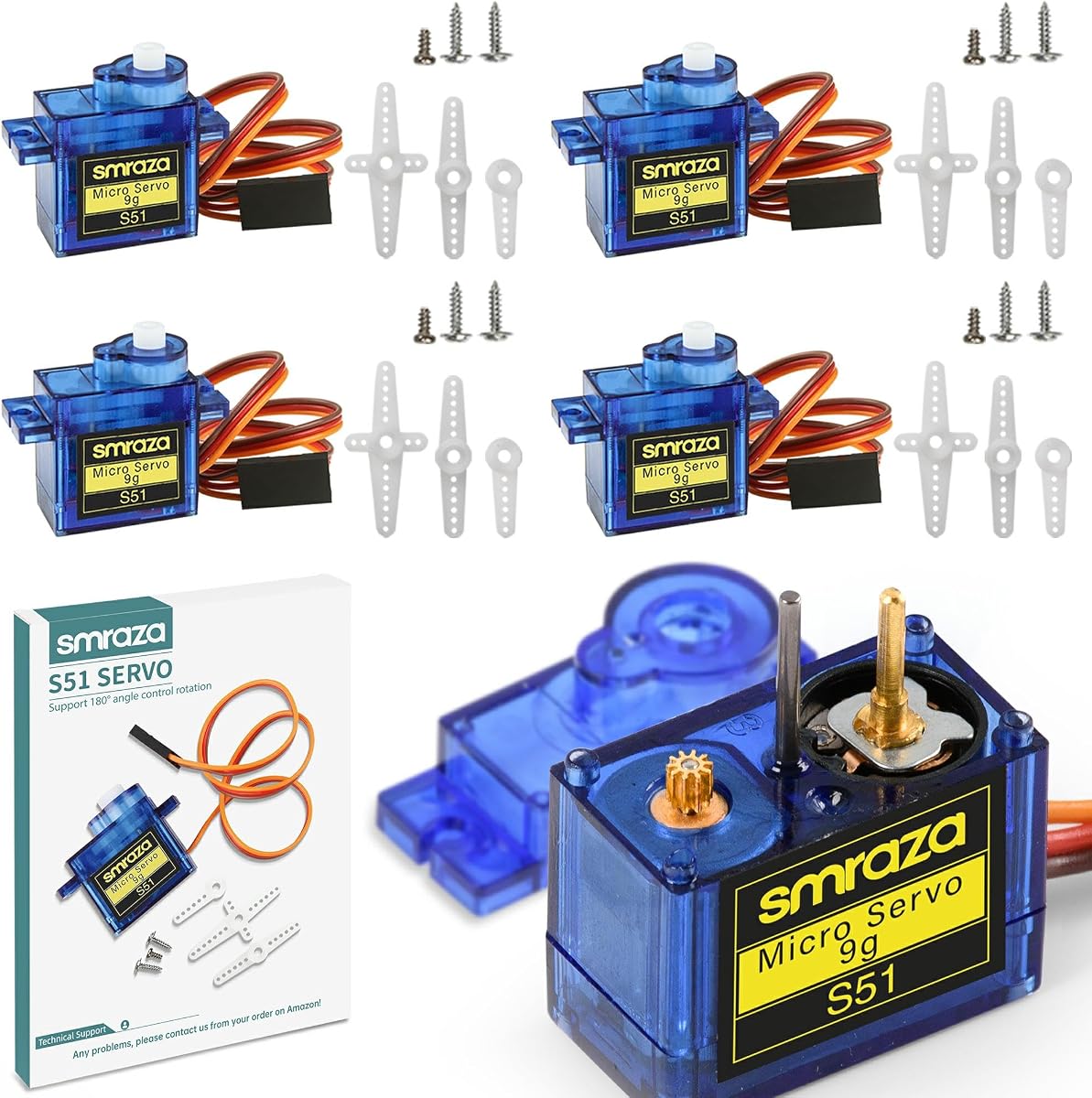


The Smraza SG90 10-Pack Metal Gear earns the Editor's Choice designation because it balances upgraded internal gearing with enough quantity for substantial builds. Its 4.4 rating reflects a generally well-received option, while the published metal pinion gear and shaft address common weaknesses associated with inexpensive plastic-gear micro servos.
We may earn a commission when you buy through this link, at no additional cost to you.
The kit's strongest feature is its 1.9 kg-cm stall torque combined with a stated speed of 0.08 seconds per 60 degrees across a 180-degree range. That combination is useful for robotic arms, micro robots, small boats, gliders, fixed-wing models, and compact radio-controlled mechanisms. The improved five-microsecond dead band also suits projects where consistent response to small control changes matters.
The included servo arms and 24.5 mm leads make the package more convenient for compact builds, and the three-pin PWM connection is compatible with Arduino, Raspberry Pi, and JR or FUTABA receivers. The important trade-off is electrical: the product requires a continuous PWM signal and a supply capable of more than 1A of starting current. Driving several units from a weak controller supply could produce resets, erratic movement, or stalling.
This is the strongest general-purpose choice for a maker who wants metal-gear durability without purchasing many separate servos. It suits multi-axis mechanisms, classroom activities, RC models, and compact robotic projects, provided the builder uses a suitable external supply and common-ground wiring. The ten-unit format offers more flexibility than small two- or three-piece bundles while remaining easier to manage than a very large inventory.
The upgraded metal pinion gear and shaft are intended to resist tooth breakage and heat deformation that can occur with plastic-gear units. That makes this kit more appropriate for articulated mechanisms and repeated motion than a basic hobby servo, although the load must still remain within the stated torque limit.
Ten servos are enough to prototype a walking robot, build a multi-jointed arm, or equip several RC models without mixing in different servo specifications. Keeping the same motor model across a project also simplifies library settings, power planning, and replacement procedures.
We may earn a commission when you buy through this link, at no additional cost to you.
The WWZMDiB SG90 3-Pack is a practical entry point for learners, hobbyists, and anyone who needs a small number of functioning micro servos. Its 4.2 rating indicates a solid general-purpose option, and the three-unit format is especially useful for a robot arm, a pan-tilt arrangement, a small walking robot, or an introductory electronics experiment.
We may earn a commission when you buy through this link, at no additional cost to you.
The servos operate across a 4.8–6.0V range and rotate 180 degrees within a 500–2500 microsecond control range. Their counterclockwise movement and standard three-wire interface make them familiar to Arduino and Raspberry Pi users. Red is identified as the 5V connection, brown as ground, and yellow as the digital control connection, which simplifies initial setup for first-time builders.
The main limitation is that three servos may not support a larger multi-axis build, and the supplied information does not identify the internal gear material. As a result, buyers with unusually heavy loads should not assume it has the same mechanical strength as the explicitly metal-gear alternatives in this guide. The stated 180-degree range also should not be treated as a guarantee of exact positioning under every load or supply condition.
This kit is best for controlled learning and compact DIY projects rather than a production fleet of actuators. It is a sensible choice when three matching servos are enough, when straightforward wiring matters, and when the project does not require the stronger construction or higher torque highlighted by the upgraded kits. It also provides a practical way to test whether a 9G servo is appropriate before buying larger quantities.
The clearly identified power, ground, and signal leads reduce ambiguity during assembly. Even so, users should verify their controller's logic-level compatibility and avoid powering several moving servos directly from a controller pin that cannot supply the required current.
A three-pack covers common learning projects without requiring a large inventory. It can be split between separate demonstrations or used together in a compact mechanism where synchronized movement and consistent control settings are useful.
We may earn a commission when you buy through this link, at no additional cost to you.
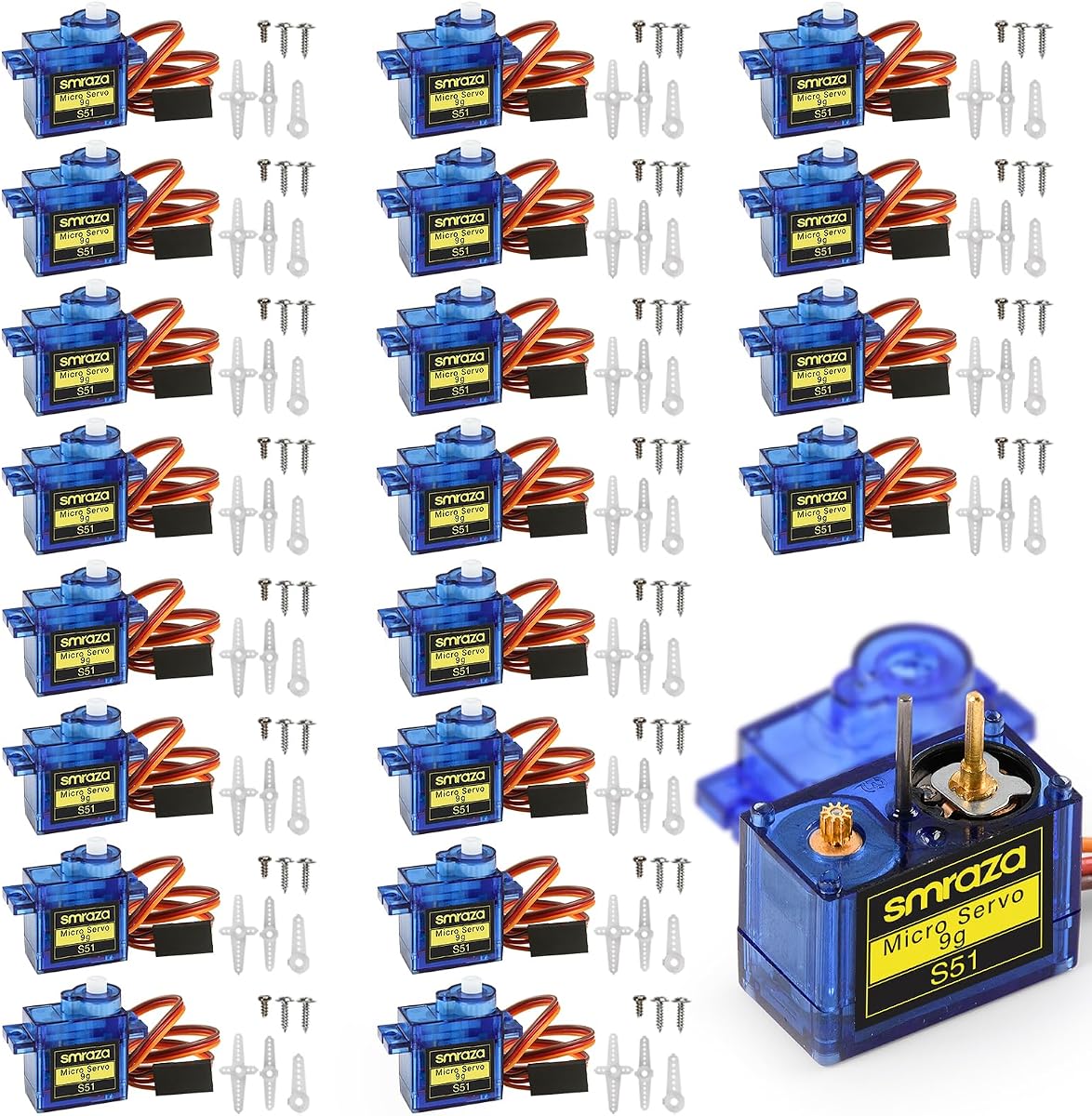
The Smraza SG90 20-Pack Metal Gear is built for projects that need many matching actuators. It carries a 4.4 rating and shares the same published 1.9 kg-cm stall torque, 0.08-second speed, metal pinion gear, and five-microsecond dead band found in the smaller Smraza kits. That consistency is valuable when designing a robot with numerous articulated limbs.
We may earn a commission when you buy through this link, at no additional cost to you.
Twenty servos provide ample inventory for a walking robot, several robotic arms, multiple RC aircraft, or a classroom set. The wide stated compatibility includes fixed-wing and KT planes, gliders, micro robots, robotic arms, small boats, and compact RC mechanisms. Servo arms and 24.5 mm leads are included, helping users assemble the motors without sourcing basic mounting pieces separately.
The tradeoff is electrical and logistical complexity. A system using many servos can draw enough current to overload a small power source, reset a controller, or create voltage drops that affect performance. The stated requirement for a continuous PWM signal and more than 1A of starting current applies to each SG90, so a multi-servo build needs a larger, stable supply and careful distribution.
This kit is most appropriate for established builders who know they need substantial quantity. It may be unnecessary for a single steering mechanism or basic arm, but it reduces the need to mix brands or motor models later. For large robotic fleets, the combination of uniform specifications and metal-gear upgrades makes this a strong foundation, provided the electrical system is designed before assembly.
Using one servo model throughout a robot can simplify programming because the same speed, range, and dead-band values can be applied. It also makes a failed unit easier to identify and replace without recalibrating a mixed collection of motors.
A twenty-servo system should use a dedicated supply sized for the expected load rather than a single controller output. Staggering motor starts and testing movement without load can also help reveal inadequate power delivery before the complete mechanism is assembled.
We may earn a commission when you buy through this link, at no additional cost to you.
The Smraza SG90 6-Pack Metal Gear occupies a useful middle ground between a small starter bundle and a large robotics inventory. Its 4.4 rating matches the other Smraza sets, and the six servos are enough for a small hexapod-style concept, a robotic gripper with multiple joints, or several independent demonstrations.
We may earn a commission when you buy through this link, at no additional cost to you.
Its upgraded metal pinion gear and shaft are intended to improve resistance to tooth breakage and heat deformation. With a stated 1.9 kg-cm stall torque, 0.08-second speed per 60 degrees, and full 180-degree range, the set offers the same core performance as the larger Smraza configurations. The five-microsecond dead band supports relatively responsive control behavior.
The package includes servo arms and 24.5 mm leads, while the three-pin PWM hookup works with Arduino, Raspberry Pi, and JR or FUTABA receiver arrangements. As with other Smraza kits, the servos need continuous PWM signals and a supply capable of more than 1A of starting current. Six moving motors can create larger current spikes than a single servo, making supply selection particularly important.
This set is a strong choice for builders who want metal-gear durability without maintaining a very large collection. It is less economical for one joint and less complete for an elaborate robot than the 10- or 20-pack versions, but the six-unit quantity maps neatly to compact, multi-axis projects and classroom activities where spare units are valuable.
Six motors offer enough articulation for many small mechanisms while keeping wiring manageable. They are also a practical quantity for a kit intended to expand gradually, with room to replace a failed servo as a project develops.
Matching servos generally simplify software configuration and calibration because each unit uses the same operating range and response characteristics. Builders can create a reusable control routine instead of adjusting separate parameters for every joint.
We may earn a commission when you buy through this link, at no additional cost to you.
The Smraza SG90 4-Pack Metal Gear is a compact starter option for a four-joint mechanism, a small pan-tilt unit, or a class set of basic micro servo projects. Its 4.4 rating places it alongside the brand's larger packs, while the quantity keeps the initial build focused rather than encouraging excess inventory.
We may earn a commission when you buy through this link, at no additional cost to you.
The motor pinion gear and shaft are upgraded to metal, a meaningful distinction for users concerned about the fragility of plastic micro servos. The kit also publishes a 1.9 kg-cm stall torque, 0.08-second speed over 60 degrees, a full 180-degree range, and a five-microsecond dead band. These figures make it suitable for light robotic arms, micro robots, model aircraft, and small boats.
Compatibility extends to Arduino and Raspberry Pi setups, and the three-pin PWM connection supports JR and FUTABA receiver use. Servo arms and 24.5 mm leads are included. The main practical limitation is the same one found in the larger Smraza sets: continuous PWM and a source capable of more than 1A starting current are required, so users should not depend on a fragile controller supply.
The four-pack is ideal when a project needs a small number of coordinated actuators but would benefit from upgraded gearing. It provides a reasonable middle ground between the three-piece standard set and the six-piece metal-gear alternative. For a simple mechanism, it is easier to manage; for a large walking machine, it may require acquiring additional matching units later.
Four servos can control a claw, a small pan-tilt camera mount, a basic robotic arm, or several separated joints. The compact quantity makes troubleshooting more approachable because each actuator has a clear role in the mechanism.
The upgraded gearing provides the mechanical benefit of the larger Smraza collections without requiring the same number of motors. It is a sensible approach when four units meet the design requirement exactly and additional spares are not essential.
We may earn a commission when you buy through this link, at no additional cost to you.
The Miuzei MG90S Two-Pack stands out as the premium-oriented selection, combining the highest listed rating in the group with upgraded MG90S construction. Its 4.5 rating and aluminum metal gear teeth make it appealing for users who value mechanical strength and precise response in a compact actuator.
We may earn a commission when you buy through this link, at no additional cost to you.
The servos are described as upgraded SG90-style units with a 2.0 kg-cm stall torque at 6.0V and a stated operating speed of 0.08 seconds per 60 degrees. The operating range is 4.8–6.0V, with a stable 5V supply recommended for smooth performance. A coreless motor, 180-degree rotation, and reduced operating noise complete the published feature set.
Two servos are enough for a steering mechanism, pan-tilt arrangement, two-joint gripper, or a pair of matching prototypes. However, the limited quantity makes this less suitable for a large robot unless additional units are added. The supplied information also recommends an external stable supply for multi-servo setups, because several moving loads can cause controller voltage instability.
This kit is best for selective, quality-conscious projects where two strong metal-gear actuators are enough. The higher stated torque and upgraded construction distinguish it from standard SG90 packages, while the high rating supports its premium placement. Builders should still respect the load limit, use a dependable supply, and confirm connector and control compatibility with the rest of their electronics.
Aluminum teeth and the higher stated torque make this set more compelling when a compact mechanism needs dependable positioning. The coreless motor and 180-degree range also suit fine-control tasks such as camera positioning, steering, and small articulated grippers.
The two-pack is economical in scope while still supporting paired movement. It works particularly well when both axes need to be calibrated similarly, and it can serve as a test pair before a builder commits to a larger purchase.
We may earn a commission when you buy through this link, at no additional cost to you.
The Dorhea SG90 5-Pack is a versatile basic kit for education, experimentation, and light hobby mechanisms. Its 4.2 rating is supported by a five-servo quantity and a broad list of possible uses, including robot arms, robot hands, walking machines, door-lock demonstrations, and small RC models.
We may earn a commission when you buy through this link, at no additional cost to you.
The published stall torque is 1 kg/cm at 4.8V, with an operating voltage range of 3.0–6.0V and a seven-microsecond dead band. These figures differ from the stronger metal-gear options, so the kit is better matched to light loads than mechanically demanding articulated systems. Its small, lightweight format is useful where component weight and footprint matter.
Wiring follows the familiar three-wire arrangement: red for 5V, brown for ground, and yellow for a digital controller pin. The listing specifically mentions compatibility with remote-control helicopters, micro robots, robot arms, and boats. Users still need to ensure that their power source can handle the number of servos in motion and that the signal arrangement matches the controller.
This is a useful selection for learners, teachers, or hobbyists who want several matching servos for demonstrations and prototypes. It is less attractive for a heavy claw or a robot that places continuous stress on its gearbox. The five-unit quantity is the main advantage, allowing a compact mechanism to use several axes while retaining one spare for experimentation or replacement.
Five servos support several common teaching exercises involving control signals, joint coordination, and basic mechatronics. Students can reuse the units across different mechanisms, which makes the pack more flexible than a single-servo purchase.
Because the stated stall torque is lower than that of the upgraded kits, these servos are best for lighter linkages and intermittent motion. Keeping mechanisms balanced and avoiding unnecessary mechanical resistance will help them operate more effectively.
We may earn a commission when you buy through this link, at no additional cost to you.
The SG90 5-Pack with Cables is a straightforward option for builders who need a small fleet of 9G micro servos. The supplied data does not provide a customer rating, so this selection should be evaluated primarily from its specifications and stated compatibility. Its five included units provide more flexibility than a small pair while remaining manageable for a compact project.
We may earn a commission when you buy through this link, at no additional cost to you.
The listed speed is 0.09 ± 0.01 seconds per 60 degrees at 4.8V and 0.08 ± 0.01 seconds at 6.0V. Stall torque is stated as 1 kg/cm at 4.8V, the operating voltage range is 4.8–6.0V, and dead-band width is five microseconds. The servos have three-wire interfaces compatible with JR and FUTABA arrangements, with red, brown, and yellow serving as power, ground, and signal.
The included cables are a notable convenience, reducing the need to source compatible leads separately. Intended applications include remote-control helicopters, micro robots, robot arms, boats, and other RC toys. The lack of a gear-material specification and a lower stated torque make it important to use the motors for appropriately light mechanisms rather than assuming the same durability as the explicitly upgraded kits.
This product is most appropriate for hobby experimentation and standard small RC or robotic projects where a known 9G configuration and five matching actuators are needed. Because no rating is available, buyers should read current customer feedback when listing data is accessible, verify the connector arrangement, and provide a stable supply before operating multiple servos simultaneously.
Cabled servos can shorten assembly time and make it easier to route wiring in a compact robot. The three-color lead arrangement also provides a familiar reference when connecting power, ground, and PWM control.
The published speed is suitable for small arms, steering parts, and compact model mechanisms that need quick response. As with any 9G servo, the load should remain light enough to avoid prolonged stall conditions.
We may earn a commission when you buy through this link, at no additional cost to you.
The SG90 Servo Tester Kit is unique in this comparison because it includes a standalone tester controller and battery holder instead of offering only a group of servos. Its 4.2 rating makes it a practical option for checking a micro servo, learning its response range, or troubleshooting a model before integrating it into a larger robot.
We may earn a commission when you buy through this link, at no additional cost to you.
The package contains one 180-degree SG90 9G servo, a tester controller, and a holder for four AA batteries. The tester supports manual, automatic, and neutral modes, allowing users to command movement in different ways and return the servo to a center position. A JR connector simplifies the connection between the battery box, tester, and servo.
This format is especially useful because it can operate without a computer, microcontroller, or programming setup. That lowers the barrier to entry for students and hobbyists who want to inspect motor behavior immediately. The trade-off is that one servo and a tester do not replace the quantity found in the multi-packs, and the included battery holder is the power source rather than a conventional project wiring harness.
Choose this kit if your priority is testing, demonstration, or a first functional servo setup. It is less appropriate for a walking robot, multi-joint arm, or collection of matching actuators. For those needs, one of the larger packs offers better value and project capacity, whereas this bundle wins on the inclusion of dedicated diagnostic equipment.
The included controller and battery holder allow a user to exercise a servo immediately. This makes the bundle useful for checking basic movement, determining a safe starting angle, and spotting a motor that does not respond correctly.
Manual mode supports direct control, automatic mode demonstrates repeated movement, and neutral mode provides a center reference. These functions make the kit useful for teaching or troubleshooting without writing a control program.
We may earn a commission when you buy through this link, at no additional cost to you.
The Hanaive SG90 16-Pack is a large basic collection for hobbyists who want numerous matching 9G servos in one order. Its 4.5 rating is among the strongest in the guide, and the package includes multi-arms and fixing screws in addition to the servos, which helps reduce time spent gathering basic mounting hardware.
We may earn a commission when you buy through this link, at no additional cost to you.
Each servo measures 3.2 by 3.09 by 1.24 centimeters and has a stated stall torque of 1.6 kg/cm at 4.8V. The operating voltage is 4.8V, dead-band width is five microseconds, and maximum running angle is 180 degrees. Listed speeds are 0.1 second per 60 degrees at 4.8V and 0.08 seconds per 60 degrees at 6.0V.
The stated uses include RC helicopters, micro robots, robotic arms, boats, and most kinds of RC toys. The product information specifically warns that reduced pulling force makes these servos more appropriate for ordinary small electric aircraft than for large fixed-wing models or electric helicopters. The 16-unit quantity is therefore best matched to distributed small mechanisms rather than a single heavy control surface.
This kit is a good choice for a large classroom, a fleet of small robot arms, or multiple compact RC builds. Its generous quantity and included hardware reduce the need for repeated purchases. However, operating many servos at once requires careful power distribution, and the load limitation should be respected to avoid prolonged strain on the motor and gearing.
A large matching set is useful when many students or several mechanisms need the same type of actuator. Identical specifications also make it easier to share control code, replacement procedures, and calibration settings.
Including multi-arms and fixing screws means builders can connect the output spline to different linkage styles without immediately searching for basic hardware. These accessories are particularly helpful when designing a multi-joint arm or replacing a damaged mounting horn.
We may earn a commission when you buy through this link, at no additional cost to you.
Choosing a micro servo motor kit requires balancing mechanical strength, electrical demand, movement range, project quantity, and control compatibility. The most important rule is to match each servo to the actual load and use the power system as carefully as the actuator itself.
Stall torque indicates the maximum twisting force the servo can produce at the specified voltage. The choices range from 1 kg/cm for the Dorhea set to 1.6 kg/cm for Hanaive, 1.9 kg-cm for Smraza, and 2.0 kg-cm for Miuzei. Higher figures provide more margin for articulated arms, clutches, steering linkages, and other mechanisms that resist movement. Stall torque is not a continuous operating limit, however, so a heavily loaded servo can still overheat or wear quickly.
Choose based on measured or estimated load, not on the largest published number. Balanced linkages and direct drives require less force than long arms with large paddles or gripping claws.
The Smraza kits and Miuzei MG90S explicitly advertise upgraded metal gearing, while some standard SG90 packages do not identify their internal gear material. Metal pinion gears and aluminum teeth are intended to resist the tooth breakage and heat deformation associated with basic plastic gears. That distinction matters for high-cycle joints and mechanisms that experience occasional stalls, although correct alignment and load control remain necessary.
For light demonstrations, a conventional gear set may be sufficient. For repeated articulated movement, favor a kit with clearly documented metal gearing and consider buying a matching spare.
Kits range from the Miuzei two-pack to the Smraza 20-pack, with three-, four-, five-, six-, ten-, and sixteen-unit options available. A pan-tilt mechanism might need only two servos, a compact robotic arm may need several, and a walking robot or classroom activity can require a much larger inventory. Count the joints, allow for calibration and testing, and decide whether a spare motor is worthwhile before choosing a bundle.
More servos are not automatically better if they will remain unused. Match the pack closely to the project while considering the convenience of standardized replacements.
Most kits specify a 4.8–6.0V operating range, while the Dorhea set is listed from 3.0–6.0V and the Hanaive package is specifically described at 4.8V. The Smraza products call for a supply capable of more than 1A of starting current, and Miuzei recommends a stable 5V supply. A controller pin that can send a signal may still be unable to power one or several servos safely.
Use a suitably sized external supply for multi-servo builds, connect the controller and servo supply grounds, and avoid relying on undersized board regulators. A stable supply reduces resets, erratic travel, and poor positioning.
The listed 9G-class speeds range from 0.1 second per 60 degrees at 4.8V to approximately 0.08 seconds per 60 degrees at 6.0V. Faster movement can make aircraft controls and quick robotic gestures feel more responsive, but speed alone does not guarantee accuracy. Dead band, gearing quality, mechanical play, and power stability also influence how precisely a mechanism holds position.
For aircraft, compare the stated speed with the response of the receiver and controller. For robots, prioritize smooth movement, adequate torque, and repeatability over a small difference in speed.
Most of the kits use a three-wire interface with a red power lead, brown ground, and yellow signal. Several listings explicitly reference Arduino, Raspberry Pi, JR, and FUTABA compatibility. The pin arrangement may vary, so check the product's instructions and the controller library or receiver connector before assembling the project. PWM is required for the Smraza servos, which must receive a continuous control signal.
Compatibility is more than a matching plug. The control voltage, signal pattern, common ground, and power capacity must all align with the system driving the servo.
Most of the listed motors provide a maximum or operating angle around 180 degrees, although the exact control range and tolerances differ. Dead-band width also varies from five to seven microseconds. A narrower dead band can improve the ability to distinguish small control inputs, while mechanical play and the quality of the control signal influence actual repeatability.
Check the product's specification table and the limits of your control software before commanding extreme positions. Restrict motion if a mechanism could bind at the end of its travel.
Mounting arms, screws, leads, and controller-specific hardware can make a kit much more convenient. The Smraza sets include servo arms and 24.5 mm leads, while the Hanaive pack includes multi-arms and fixing screws. The dedicated tester kit goes further by adding a controller, battery holder, and JR connector, making it especially useful for initial testing and demonstrations.
Consider the accessories only after confirming the motors meet the mechanical and electrical requirements. Extra equipment is valuable when it serves the build rather than adding features the project will never use.
Begin by identifying the control platform, power arrangement, and mechanical load. Connect the controller ground to the servo supply ground, verify the red, brown, and yellow lead functions, and test one servo at a modest starting position. Use a dedicated supply when several servos may move together, and avoid attaching a moving horn while the motor is receiving a command.
Program conservative travel limits and move the mechanism slowly through its intended range. Calibrate neutral position before attaching linkages, then check for binding, excessive play, or cables pulling against moving parts. For a multi-servo arm, use coordinated motion rather than commanding all joints at maximum speed simultaneously, which can place a large short-term demand on the supply.
Care for the servos by keeping the gearbox free of dust, debris, and moisture, securing the mounting hardware, and preserving a small amount of mechanical slack where appropriate. Do not use stall torque as a working specification; if a servo strains, heats, buzzes, or loses position, reduce the load or improve the linkage. Periodically inspect connectors and leads, especially after moving a completed project.
A micro servo motor kit is a collection of compact, electronically controlled rotary actuators. The motors use a three-wire arrangement for power, ground, and a pulse-width-modulated control signal, allowing a microcontroller or receiver to position an output horn over a defined range. These kits are common in small robots, model aircraft, boats, and articulated mechanisms.
Metal-gear servos are generally better suited to repeated articulated movement and loads that may strain a gearbox. Kits such as the Smraza and Miuzei options explicitly advertise upgraded metal gearing, while several standard SG90 packages do not specify their material. Metal gears do not eliminate the need for proper load control, alignment, and current protection.
Yes, most of the listed kits are designed for PWM-controlled use with Arduino, Raspberry Pi, and compatible radio-control equipment. The signal usually connects to a PWM-capable pin, while power and ground connect to the servo supply and controller ground. Because Raspberry Pi and Arduino boards have limited power output, an external supply is advisable for multiple servos.
The number depends on the number of controlled joints. A simple pan-tilt unit may use two servos, while a basic articulated arm may need three to six, and more complex designs can require additional actuators. A four-, five-, or six-pack is convenient for small experimental arms because it provides enough joints plus a possible spare.
The most common cause is inadequate or unstable power delivery. A servo can draw a substantial current when it starts or stalls, causing controller voltage to fall and the system to reset. Use a suitable supply, share a common ground, keep wiring short, and reduce mechanical resistance. Incorrect PWM settings or a loose signal connection can also produce inconsistent movement.
It indicates the servo's maximum usable travel under its specified operating conditions. The control signal defines the intended position, but real movement can be affected by load, voltage, mechanical play, and the quality of the PWM signal. Start with reduced limits and avoid forcing a linkage against the end of its travel.
A tester is helpful when you are new to micro servos or want to verify the motor, connector, and movement before building a larger mechanism. The dedicated SG90 tester kit includes a controller and four-AA battery holder for standalone checks. Experienced builders can instead test one servo with their planned controller and power supply.
Most of the listed 9G servos are better suited to ordinary small models and compact mechanisms. The Hanaive listing specifically warns against using its reduced-pull-force servos on large fixed-wing models or electric helicopters. Larger aircraft generally need servos with greater torque, better bearings or gearing, and power requirements matched to the model's size.
The Smraza 10-Pack Metal Gear is the strongest all-around selection because it combines a useful quantity, upgraded gearing, published torque, fast response, and broad project compatibility. The WWZMDiB three-pack serves budget-conscious builders who need a few standard servos, while the Miuzei MG90S two-pack offers the most premium-focused construction and the highest listed rating.
Prioritize torque and gear construction for articulated mechanisms, pack quantity for multi-joint robots, and testing equipment for beginners. Standard five-packs and the large Hanaive or Smraza collections can be sensible for classes and repeated builds, but every multi-servo system needs a stable supply and careful common-ground wiring.
Before purchasing, verify the current listing details, operating voltage, connector style, included accessories, and mechanical limits. Prices and product availability change, so compare the latest information and choose the kit that matches the actual number and type of joints your project requires.


