
12V RV Air Conditioner with PTC Heating
5.0Editor score
Direct 12V battery power
PTC heating and cooling
Remote control and display
Adjustable airflow outlets
Low-power quiet operation
Our guide compares the best low wattage 12V air conditioner for RV options, evaluating cooling, power efficiency, noise, controls, fit, and off-grid use.
A low wattage 12V air conditioner for an RV can bring dependable cooling to campers, vans, trailers, and trucks without requiring shore power. The right unit balances cooling capacity with battery consumption, while also considering roof clearance, operating noise, controls, heating, and installation requirements.
We compared ten 12V rooftop and direct-powered units using their stated specifications, including cooling output, electrical draw, battery compatibility, sound levels, housing dimensions, supported modes, and user controls. The list includes cooling-only models, heat-and-cool systems, and units designed for different roof openings and vehicle types.
Each review explains the strongest reasons to consider a particular model and the compromises that may affect your setup. Ratings reflect the information available for each listing, while actual results can vary with battery capacity, solar input, ambient temperature, insulation, and installation. Prices and availability change frequently.
5.0Editor score

5.0Editor score

4.7Editor score
The table below compares all ten units by their stated cooling capacity, electrical design, noise level, physical fit, and major control features. It is designed to help RV owners identify the most suitable option for their roof opening, battery setup, climate, and preferred operating modes.



This 10,000 BTU rooftop unit combines a particularly slim 5.5-inch body with direct 12V DC operation and PTC heating. It carries a 4.2 rating, and its most distinguishing attribute is physical efficiency: the low-profile housing is intended to fit many RV roofs while reducing wind resistance. The listing also highlights a standard 14.1-inch-square opening.
We may earn a commission when you buy through this link, at no additional cost to you.
Its electrical design avoids the inefficiency associated with powering a conventional rooftop air conditioner through an inverter. The manufacturer states that the system can retain 80 percent of standard performance when outdoor temperatures exceed 113°F. In eco mode, a suitably sized 400Ah lithium battery is claimed to provide more than 12 hours of operation, making the unit relevant to campers with substantial battery and solar capacity.
Noise is another strength. The claimed 39-decibel eco-mode output is appropriate for travelers who expect to sleep with the system running. A reinforced ABS enclosure, IPX6-rated fan design, sealing materials, and an installation kit support outdoor durability. The trade-off is that a 400Ah battery bank and effective solar replenishment are substantial components of the stated off-grid runtime.
This is a good match for RV owners who prioritize a thin rooftop profile, direct 12V power, and strong hot-weather cooling. People seeking the lowest possible power draw for a small battery should examine the unit's actual operating specifications more closely, since the cooling performance claims and runtime depend on conditions. For standard roof openings and long off-grid stays, it remains one of the more complete selections.
The 5.5-inch thickness is the centerpiece of this design. It helps the unit fit beneath height-restricted structures and reduces the aerodynamic penalty associated with a tall rooftop box, while the claimed standard opening simplifies replacement planning.
Running directly from a 12V battery avoids conversion losses from an inverter. Its eco mode, low-voltage-conscious off-grid design, and stated high-heat retention make it appealing to campers relying on solar charging.
We may earn a commission when you buy through this link, at no additional cost to you.
This 12V rooftop air conditioner offers 10,000 BTU of cooling and a 4,500 BTU PTC heater, earning it a 4.6 rating among the products in this guide. It is designed for a broad range of vehicles, including RVs, trucks, vans, campers, and tractors, with a low-profile format intended to keep wind resistance under control.
We may earn a commission when you buy through this link, at no additional cost to you.
The manufacturer claims that cooling can begin making a noticeable difference within 15 minutes. Brushless copper motor fans, spring-supported mounts, and a directional duct are included to reduce noise and vibration. Remote control, temperature monitoring, and eco, sleep, and turbo modes provide a more versatile operating experience than a basic cooling-only unit.
Weather resistance comes from UV-stabilized ABS materials, an EPDM foam gasket, and a zinc-coated condenser. The heater, however, is explicitly intended for mild temperatures and smaller spaces rather than serving as a primary source of warmth in extreme cold or a very large RV. That limitation keeps the design focused on summer cooling and transitional weather.
This unit is well suited to travelers who want both cooling and a modest heating function without moving beyond 12V power. Its 4.6 rating and quiet fan design make it a balanced all-season choice for spring, summer, and fall trips. It is less attractive for winter-focused campers or owners who require documented compatibility with a specific roof cutout.
The 4,500 BTU PTC heater adds value during cool mornings and evenings. It is best viewed as supplemental comfort rather than a replacement for a furnace in severe cold.
Brushless fans and vibration-isolating mounts support smoother operation. Eco, sleep, and turbo modes let users balance cooling speed, noise, and energy use throughout the day.
We may earn a commission when you buy through this link, at no additional cost to you.
This 12,000 BTU 12V DC rooftop unit is the strongest all-around performer in the list, combining the highest stated cooling output with a 5.0 rating. Its inverter technology is designed to adjust output efficiently, and the listing claims rapid cooling within three minutes with steady temperature maintenance afterward.
We may earn a commission when you buy through this link, at no additional cost to you.
The power story is central to its appeal. Average nighttime consumption is stated at about 360 watts under 30°C ambient conditions, representing approximately 60 percent less energy use than traditional air conditioners according to the manufacturer. It operates directly on a 12V battery, and all-night use is claimed when paired with a 400Ah battery. Turbo, eco, and sleep modes provide practical choices for changing power demands.
Controls are unusually flexible for this category. The unit supports a Bluetooth smartphone app, an infrared remote, and a physical panel. Users can adjust temperature, create timers, switch between Celsius and Fahrenheit, and enable automatic power changes based on temperature differences. The brushless fan and sound insulation produce a claimed 40-decibel sleep-mode level.
At 54 pounds, it is also among the lighter rooftop options here. The included hardware, 19.7-foot cable, and compatibility with a common 14-inch-square opening simplify installation, while roof thicknesses from 1.5 to 3.5 inches cover many configurations. Its main limitation is that it cools only. It is best for hot-weather campers who value capacity, control, and battery-conscious inverter operation over built-in heat.
Twelve thousand BTU gives this unit the highest cooling capacity in the comparison. Inverter-based adjustment helps it avoid running at full output continuously once the cabin reaches the selected temperature.
The app, infrared remote, and local panel make the unit convenient for different travelers and campgrounds. Timers and automatic output adjustment are particularly useful when managing limited battery reserves.
We may earn a commission when you buy through this link, at no additional cost to you.
This universal cooling-only unit provides 11,000 BTU of capacity and one of the clearest sets of technical specifications in the comparison. It has no listed customer rating, so buyers must judge it primarily by its detailed electrical, dimensional, refrigerant, and protection information rather than by review history.
We may earn a commission when you buy through this link, at no additional cost to you.
Its professional-grade electric scroll compressor is claimed to cool in three to five minutes while intelligently adjusting compressor frequency. The listed power range is 200 to 700 watts, with a maximum figure of 750 watts. An LED indoor display, adjustable vents, and a remote control provide straightforward operation and airflow management.
The outdoor unit is only six inches thick and the dimensions are clearly listed for installation planning. It uses R134a refrigerant and includes short-circuit, anti-leakage, overvoltage, and low-voltage protection. The manufacturer states that eco mode can run for eight to ten hours at night and approximately five hours during the day, though actual runtime depends on battery capacity and operating conditions.
This model is a compelling choice for owners of unusual vehicles, including food trucks, excavators, agricultural vehicles, buses, and semi-trucks. The cooling-only design and absence of a customer rating may make it less reassuring than the top-rated alternatives, but the detailed installation steps, included hardware, and broad compatibility set provide useful guidance for informed buyers.
Rated voltage, current, power, refrigerant, compressor type, and protective features are all listed. This transparency makes it easier to compare the model with an existing RV electrical system before installation.
The stated applications extend beyond conventional RVs to vans, trailers, trucks, buses, excavators, and agricultural equipment. A universal format may appeal to owners building or converting specialized vehicles.
We may earn a commission when you buy through this link, at no additional cost to you.
This 12V rooftop unit stands out for its connected controls and refined noise management, earning a 4.7 rating. Bluetooth app support and hands-free voice commands allow travelers to manage climate settings without using a physical control while driving or resting at a campsite.
We may earn a commission when you buy through this link, at no additional cost to you.
Its dual-rotor compressor delivers 10,000 BTU of cooling, with a claimed ability to bring the interior to 75°F to 79°F within three minutes and continue cooling in ambient heat up to 122°F. The unit runs directly on 12V power, and the manufacturer states that it can provide more than 11 hours of overnight cooling with a 315Ah lithium battery.
An intelligent low-voltage cutoff is designed to prevent unexpected shutdowns and excessive battery discharge. The sound figures are also impressive: indoor noise is stated as low as 32 decibels, while outdoor noise is listed at 40 decibels. These characteristics make the system attractive for light sleepers and travelers seeking comfortable, low-interruption operation.
The six-inch housing fits an industry-standard 14-by-14-inch roof cutout without requiring extra cutting. Reinforced anti-vibration construction is intended to withstand rough roads. The main qualification is that voice functionality depends on a compatible phone, app, and connected-control setup, while serious off-grid use still requires a properly sized battery and charging system.
Bluetooth app and voice control reduce the need to reach the rooftop panel. Timers and remote adjustments are particularly helpful for owners who split their time between the cab, passenger area, and exterior campsite.
The stated 32-decibel indoor level is among the lowest figures in the comparison. Battery protection and an 11-hour runtime claim support extended use where shore power is unavailable.
We may earn a commission when you buy through this link, at no additional cost to you.
This compact 12V rooftop unit combines 11,000 BTU of cooling with 4,500 BTU of PTC heating. It has a 3.9 rating, the lowest numerical customer score among the rated products, but its installation-focused design and soft-start feature offer concrete advantages for battery-powered setups.
We may earn a commission when you buy through this link, at no additional cost to you.
The integrated soft start is claimed to reduce startup surge by 70 percent, which can reduce abrupt electrical demand and is useful when powering the unit from a battery or generator. The manufacturer states that eco mode can deliver 12 hours of cooling with a 400Ah battery. This figure remains dependent on ambient conditions, battery health, and the chosen output level.
At 43 pounds and 6.1 inches tall, the unit is designed to be manageable during installation. It fits a standard 14-by-14-inch roof opening and accommodates roof thicknesses from 1.5 to 3.9 inches. A complete hardware kit supports either ducted or non-ducted setups, while 360-degree adjustable vents offer softer airflow distribution.
Its 35-decibel operating claim, digital LED display, reading light, remote, sleep mode, and six fan speeds make it appealing for compact campers. The trade-offs are its lower customer rating and supplemental heating capacity. It is best for a smaller RV or van where low weight, simple installation, and a complete mode selection matter more than having the highest cooling figure.
A soft-start function is intended to reduce the initial power surge. That can make the unit easier to manage alongside other 12V loads and reduces stress on battery connections during startup.
The low weight and modest height simplify lifting onto an RV roof. Compatibility with common roof thicknesses and both ducted and non-ducted layouts broadens installation options.
We may earn a commission when you buy through this link, at no additional cost to you.
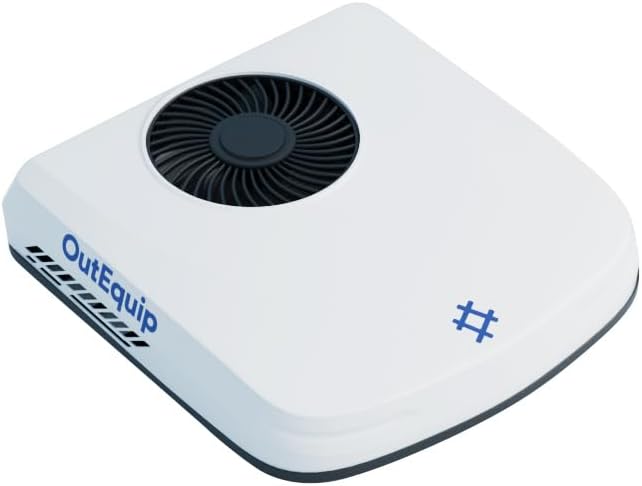
This straightforward 12V unit offers cooling, PTC heating, remote control, and adjustable airflow without a complex list of operating modes. It carries a 5.0 rating, making it one of the highest-rated products in the comparison, although the listing does not state a specific BTU cooling capacity.
We may earn a commission when you buy through this link, at no additional cost to you.
Direct connection to a vehicle's 12V battery allows operation while parked or driving without idling the engine. A clear display and remote control provide access to temperature, fan speed, and mode settings, while adjustable outlets allow air to be directed toward different parts of a cab or compartment.
The stated low-power design focuses on reducing the burden on a 12V system. A seven-blade fan and larger condenser are intended to dissipate heat efficiently and maintain cooling performance during extended operation. Construction combines ABS with aluminum alloy for resistance to deformation and aging.
This product is a good choice for buyers who prioritize straightforward controls, a strong customer rating, and basic year-round functions over published cooling output. The absence of a BTU figure means it is harder to compare its capacity directly with the other models. Confirm the dimensions, electrical requirements, and intended installation location before making a final choice.
Direct 12V power makes the unit practical for campers who do not want to carry a large inverter. The result depends on battery capacity and current, so it is best paired with a solid charging system.
PTC heating adds useful warmth during cool conditions, while the scroll compressor handles cooling. Adjustable outlets help distribute either conditioned stream without blowing directly onto occupants.
We may earn a commission when you buy through this link, at no additional cost to you.
This 9000 BTU rooftop unit provides cooling and 1500-watt PTC heating with a 5.0 customer rating. It is aimed at smaller motorhomes, trucks, campers, excavators, cranes, and commercial vehicles, offering enough stated output for many common RV interiors without the footprint of a larger system.
We may earn a commission when you buy through this link, at no additional cost to you.
An energy-efficient scroll compressor handles cooling, while PTC heating supplies steady warmth. The stated controllable indoor temperature range is 60.8°F to 78.8°F. A smart chip regulates voltage and protects against fluctuations, which is a useful feature for mobile electrical systems exposed to changing loads.
The unit operates at a stated 50 decibels, making it quieter than many conventional rooftop appliances but not as quiet as the 32-, 35-, or 39-decibel eco and sleep claims elsewhere in this list. Rotatable outlets, a remote, and an onboard panel allow users to control cooling, heating, fan speed, and temperature.
For owners seeking a proven customer rating, simple remote operation, and both heating and cooling, this is a practical contender. Its less powerful heating element and 9000 BTU cooling figure make it better suited to smaller cabins than large RVs. Exact fit should be verified because the listing emphasizes universal use without providing a clear roof-cutout measurement.
The integrated smart chip is intended to stabilize supply fluctuations and reduce electrical risk. This is especially relevant when compressors share a battery with pumps, lighting, refrigeration, or other vehicle systems.
The 1500-watt PTC element adds supplemental warmth without presenting itself as a cold-weather heating system. It works best for smaller interiors during transitional seasons.
We may earn a commission when you buy through this link, at no additional cost to you.
This 9000 BTU model shares a clear cooling-and-heating feature set with other compact rooftop units and has a 5.0 rating. It uses a scroll compressor for cooling and a 1500-watt PTC heater for warmth, with the listing indicating a 50-decibel operating level.
We may earn a commission when you buy through this link, at no additional cost to you.
High-grade ABS and aluminum alloy are used to resist deformation and aging. That construction is appropriate for mobile use, where rooftop units face vibration, changing temperatures, rain exposure, and repeated handling. The internal electronics include intelligent voltage regulation designed to keep operation stable during fluctuations.
Remote and onboard-panel controls provide access to temperature, heating, cooling, and fan speed. Rotatable outlets let occupants redirect airflow away from direct blowing, an important comfort detail in a compact cab or sleeper compartment.
The listing positions the unit for RVs, campers, trucks, cranes, excavators, and commercial vehicles. Its 9000 BTU capacity and 50-decibel sound level make it most appropriate for smaller spaces or travelers who value heating as much as cooling. Buyers should verify the physical footprint and roof opening before ordering, as those measurements are not clearly presented.
ABS and aluminum alloy combine low weight with structural rigidity. The materials are specifically described as resistant to deformation and aging under demanding travel conditions.
The remote and local panel make it easy to adjust the unit before bed or during a break. Directional outlets help maintain a more even cabin temperature without creating an intense draft.
We may earn a commission when you buy through this link, at no additional cost to you.
The Treeligo 10,000 BTU unit combines cooling and heating with a stated eight-minute comfort time and a 4.0 rating. Its most useful differentiator is the inclusion of FCC and UL certifications, giving buyers documented safety and electromagnetic-compatibility information that is not consistently presented for every listed product.
We may earn a commission when you buy through this link, at no additional cost to you.
The compact rooftop housing measures 28.35 by 25.98 by 7.09 inches. Installation requires a minimum opening of 12.59 by 9.45 inches, while the indoor panel measures 23.62 by 19.69 inches. These clear dimensions help owners determine whether their existing cutout can be used.
Frequency-adjusting technology is designed to support efficient operation, and the unit is stated to remain below 50 decibels during daily use. It can operate from a vehicle battery or an external power source, allowing cooling and heating whether the RV is moving or parked.
This model is a solid option for buyers who prioritize recognized certification and precise dimensions. Its 4.0 rating is lower than those of most alternatives, and its nonstandard opening may require more adaptation than a unit designed around a 14-inch-square cutout. It is best for owners willing to verify fit carefully and value compact size with both climate functions.
FCC and UL certification provides a useful layer of assurance concerning electromagnetic compatibility and electrical safety. These standards matter in vehicles where air conditioning operates alongside radios, navigation, and other electronics.
The stated opening is smaller than the common 14-inch-square format used by several competitors. Accurate roof measurements are essential to avoid unexpected cutting or additional installation work.
We may earn a commission when you buy through this link, at no additional cost to you.
Selecting a 12V RV air conditioner requires balancing cabin size, battery architecture, available roof space, climate needs, and acceptable noise. The most efficient-looking unit on paper may not be the right choice if its opening, electrical requirements, or controls do not suit your RV.
Cooling capacity is commonly expressed in BTU, but the number alone does not reveal real-world performance. Larger, poorly insulated RVs and vehicles exposed to direct sun can require more capacity than a small camper with curtains, reflective roofing, and limited windows. Compare the stated cooling output with the interior volume and note whether the product also provides heating, because some units divide their overall electrical design between comfort functions.
Choose enough capacity for the space without assuming that a higher number automatically means lower energy consumption. Look for inverter or adjustable-frequency operation, automatic output control, and distinct turbo and eco modes. Those features can improve efficiency more than a modest increase in maximum BTU.
Low-wattage operation is most meaningful in an off-grid electrical system. Examine the listed power draw, input current, and battery size used for the manufacturer's runtime claim. A unit may run for several hours from a small battery but deliver less cooling, while a larger battery bank can support stronger output for an entire evening.
Direct 12V DC connection is generally more efficient than routing power through an inverter. Low-voltage cutoff, soft-start, and short-circuit protection can also improve system reliability. Match the unit to your battery chemistry, charging method, and reserve requirements, and use solar or generator support when the cabin and ambient temperature require sustained high output.
Measure both the roof opening and the space above the roof before choosing a unit. Many products target a common 14-by-14-inch cutout, while others specify a more compact or elongated opening. The exterior height also affects clearance around roof accessories, awnings, vents, racks, and nearby structures.
Low-profile housings can reduce wind resistance, but installation still requires a level, reinforced mounting surface and an unobstructed path for expelled heat. Check whether the product supports the roof thickness of your RV, and verify the indoor panel dimensions as well as the outdoor footprint. A good fit should avoid the need for unnecessary structural modification.
Cooling-only units concentrate their electrical design on removing heat, which can be attractive for summer-focused campers. Heat-and-cool models add PTC heating and may include a fan-only mode, providing useful comfort in cool mornings, evenings, and shoulder seasons. PTC heating is usually supplemental and should not be treated as a substitute for a propane furnace in extreme cold.
Choose based on the climates you travel and the seasons you use the RV. Mixed-use travelers may accept a slightly smaller cooling system to gain heating. Dedicated summer travelers should compare the cooling-focused models for their battery efficiency, controls, and noise ratings instead of paying attention to heating elements they will rarely operate.
Noise matters most at night, when compressor hum and airflow can disrupt sleep. Published figures may refer to indoor sound, outdoor sound, eco mode, or sleep mode, so compare like with like. A unit advertised below 40 decibels may be better suited to a sleeper cabin than one operating around 50 decibels.
Brushless fans, sound insulation, vibration-isolating mounts, and soft-start systems can reduce the rumble commonly associated with rooftop compressors. Also consider control convenience: a remote, local panel, sleep timer, and quiet auto mode let you change output without repeatedly walking to the indoor unit.
Basic panels and remotes are dependable and straightforward, while app-enabled units add timers, remote monitoring, and programmable operation. Voice control can be convenient, but it depends on a compatible smartphone, application, and connected environment. A physical panel remains useful when the phone has no signal or the app cannot connect.
Look for temperature display, Celsius and Fahrenheit selection, adjustable fan speed, sleep timers, and clear mode indicators. Automatic power adjustment based on temperature difference is particularly valuable for low-wattage operation because it can reduce output once the cabin reaches its target.
Rooftop air conditioners are exposed to rain, ultraviolet radiation, vibration, road debris, and large temperature swings. UV-resistant ABS housings, sealed electrical components, corrosion-resistant condensers, foam gaskets, and waterproof fan designs support longer service. Look for recognized safety and electromagnetic-compatibility certifications where available.
Installation quality is just as important as the enclosure. Use the supplied mounting hardware, seal gaps carefully, support wiring properly, and keep the condenser area clear. If a unit lacks explicit certifications or protection details, confirm its compatibility with your RV's electrical and communication systems before installation.
A complete installation kit can prevent delays and missing components. Look for a mounting bracket, sealing sponge or gasket, screw set, power cable, interior panel, remote, and manual. Detailed wiring diagrams and explicit roof-opening measurements are valuable, especially for first-time installers or owners with a nonstandard cutout.
A unit that supports both ducted and non-ducted layouts offers flexibility for different RV designs. Even when installation is described as DIY, professional work may be appropriate if the roof needs reinforcement, the cutout must be modified, or the electrical load is substantial. Plan the full installation before buying.
Before operating the unit, confirm that the roof opening, mounting surface, wiring, fuse, and battery connection match the installation instructions. Start with the fan or a moderate cooling setting, check that the indoor and outdoor units are secure, and verify that no tools or packaging remain near the vents. Allow the selected temperature to stabilize before deciding whether the system needs more capacity.
Choose eco or sleep mode when conserving battery is more important than rapid cooling, and use turbo mode for short periods when the cabin begins heating quickly. Set timers before sleeping or leaving the vehicle, and avoid leaving the air conditioner running with the battery disconnected. Monitor battery state and charging input so the unit does not consume the reserve needed for essential systems.
Clean accessible vents and filters as directed, remove leaves or debris from the exterior condenser area, and inspect seals and mounting hardware periodically. Before travel, verify that roof-mounted hardware is secure and that no object obstructs airflow. Follow the manual's instructions for defrosting, storage, service, and seasonal shutdown rather than using methods that could damage refrigerant lines or electrical components.
Yes, if the unit is designed for direct 12V DC input and its current, cable, and connector requirements are compatible with the battery system. Direct operation avoids the losses associated with an inverter. A battery bank, appropriate fusing, and a reliable charging method are still needed, especially for extended cooling or high-output modes.
Runtime depends on battery capacity, the unit's average power draw, ambient temperature, cabin insulation, and selected mode. Listings in this guide cite overnight ranges from several models, but those claims use particular battery sizes and conditions. Calculate expected consumption from the rated wattage and monitor actual battery state for reliable results.
A 9000 BTU unit may be suitable for a small camper van, truck cab, or compact RV, particularly with good insulation and shade. Larger motorhomes, parked vehicles in direct sun, or cabins with large glass areas may benefit from 10,000 to 12,000 BTU. Matching capacity to the actual interior is more important than assuming one figure works for every vehicle.
PTC heaters are generally intended for supplemental warmth in mild conditions and small spaces. They can be useful during spring, fall, and cool desert nights, but they usually are not designed to replace a high-output furnace in severe cold. RV owners traveling into freezing conditions should consider a dedicated heating system.
Units expressly designed for 12V DC rooftop power do not require an inverter for normal operation. They connect directly to a compatible 12V source, which generally improves efficiency. Conventional 120V rooftop air conditioners still need an inverter or shore power and should not be connected directly to standard house batteries.
It is essential because the outdoor unit and interior panel must fit without crowding vents or other roof equipment. Measure the opening, roof thickness, and available clearance before purchasing. Some models fit a common 14-by-14-inch cutout, while others require a different rectangular opening or additional adaptation.
Among the stated figures, the Voice and App 12V RV AC lists an indoor level as low as 32 decibels. The Ultra-Slim 12V RV AC states 39 decibels in eco mode, and the Mini 12V unit states 35 decibels. These measurements may use different conditions, so noise should be evaluated together with mode and cooling output.
Some kits are explicitly designed for DIY installation and include mounting hardware, seals, cables, and instructions. The roof must be structurally sound, the opening must match, and wiring must be protected correctly. Modification, unusual roof structures, or heavy electrical work are good reasons to consult a qualified RV installer.
The 12,000 BTU Inverter RV AC is the strongest overall option for buyers who prioritize cooling capacity, efficient adjustment, flexible controls, and a strong customer rating. The Voice and App 12V AC is the most sophisticated premium choice, while the PTC Heating 12V RV AC offers a practical direct-12V alternative with a 5.0 rating and straightforward controls.
Before choosing, prioritize the constraints that cannot be changed easily: roof opening, roof thickness, battery capacity, wiring, and cabin size. Then compare cooling output, stated power draw, noise in the mode you will use, and whether supplemental heating is useful. A lower maximum output can be more appropriate if it better matches your battery and improves the likelihood of comfortable overnight operation.
Current listings can change their specifications, ratings, included accessories, and commercial terms, so verify the seller, model, fit dimensions, warranty, and installation requirements before ordering. Current pricing and availability should also be checked directly. Those final checks help ensure that the selected 12V rooftop air conditioner works with your RV rather than merely matching its headline output.