
ASRock Intel Arc A580 Challenger 8GB OC
4.6Editor score
8GB GDDR6 memory
256-bit memory interface
Dual-fan 0dB cooling
Four-display support
DirectX 12 Ultimate ready
This Intel Arc GPU guide compares 10 models for gaming, AI, creative work, compact builds, and professional multi-display use.
Intel Arc GPUs give gamers and creators an alternative to the most familiar graphics-card brands, with models ranging from efficient low-profile cards to dual-GPU professional accelerators. A good choice depends on memory capacity, cooling, physical clearance, display needs, and whether your priorities are gaming, AI inference, rendering, or media production.
The ten products in this guide are compared using their supplied specifications, including GPU architecture, GDDR6 capacity, memory interface, clock speed, power requirements, cooling, display outputs, and intended workloads. The list covers gaming models, workstation cards, compact systems, multi-monitor configurations, and combined dual-GPU solutions rather than limiting the category to one use case.
Each review explains the strongest reason to consider its Intel Arc GPU, along with practical trade-offs involving fit, power, memory, cooling, and platform requirements. Product ratings are shown where available from the supplied listings, while prices and availability can change, so confirm current listings and system compatibility before making a purchase.
4.6Editor score

4.7Editor score

3.9Editor score
The comparison below highlights memory, architecture, cooling, and connectivity across the full range of Intel Arc options, from compact 50W models to dual-GPU professional cards.



The ASRock Intel Arc Pro B60 Creator 24GB is a workstation-oriented Intel Arc GPU built around 24GB of GDDR6 memory, 456 GB/s of bandwidth, and the Xe2-HPG architecture. Its supplied rating is 3.9, but the specifications reveal a highly specialized card aimed at users who prioritize memory capacity, AI throughput, and professional display support over conventional gaming value.
We may earn a commission when you buy through this link, at no additional cost to you.
The card's most important advantage is its 24GB frame buffer. That capacity gives local AI models, complex 3D scenes, and professional applications substantially more room than the 8GB and 10GB configurations found in many gaming models. Twenty Xe cores and 160 XMX engines provide 197 INT8 TOPS, while dual media transcoders support AV1, H.264, and HEVC workflows. Four DisplayPort 2.1 outputs are also supplied, enabling expansive multi-monitor arrangements.
The trade-offs are physical and platform-related. This is a 200W TDP card with a 200W thermal design target, a single 8-pin power connection, and a 2-slot form factor measuring 271 by 112 by 39mm. The blower-style cooler is sensible for pushing heat out of dense workstation cases, and the listed 0dB behavior stops the fan under light loads, but buyers still need to confirm PSU capacity and physical clearance.
This is the strongest recommendation for a professional who needs substantial local memory and acceleration, particularly for AI inference, generative design, rendering, or high-resolution multi-display work. It is not the natural choice for a gaming-only system, but for compatible professional workloads, its 24GB allocation and workstation features can outweigh its more demanding power and cooling requirements.
The 24GB GDDR6 allocation is the defining feature of this model. It can accommodate larger AI models and detailed graphics projects that may strain the smaller memory pools of conventional gaming cards, while the 456 GB/s bandwidth supports demanding data movement.
Four DisplayPort 2.1 outputs support expansive desk arrangements without requiring a separate collection of adapters. This is particularly useful for design, engineering, media, and financial-analysis workflows that depend on several high-resolution displays.
We may earn a commission when you buy through this link, at no additional cost to you.
The ASRock Intel Arc B570 Challenger 10GB OC combines a 2600MHz GPU clock, 19 Gbps GDDR6 memory, and a 10GB allocation in a design expressly positioned for 1440p gaming and content creation. It carries a supplied rating of 4.7 and appears in this guide as the best-balanced general-purpose option for shoppers who want modern gaming features without moving into specialized professional hardware.
We may earn a commission when you buy through this link, at no additional cost to you.
Intel's Xe2-HPG architecture brings Xe Matrix Extensions for AI acceleration and Intel Xe Super Sampling 2 for supported upscaling workflows. The card's 10GB of memory is more useful than many entry-level alternatives for high-detail textures and modern content creation. Connectivity is also strong, with three DisplayPort 2.1 outputs and one HDMI 2.1a connector, allowing a flexible mix of high-resolution and high-refresh-rate displays.
Thermal management uses two striped axial fans and a 0dB silent mode intended to keep the card quiet at low loads. A metal backplate adds rigidity and helps resist GPU sag, while a single 8-pin connector keeps the power arrangement straightforward. The main limitation is that 10GB may eventually be restrictive for very large AI models, elaborate professional scenes, or future games with unusually demanding texture requirements.
The B570 Challenger is recommended for mainstream enthusiasts, 1440p gamers, and content creators seeking a single card that handles both. Its higher clock, stronger media capabilities, 10GB memory pool, and modern display support make it a particularly coherent package. It is the option to choose when overall balance matters more than the extreme memory capacity of a workstation card.
The combination of a 2600MHz clock and 19 Gbps memory speed provides a more convincing basis for smooth 1440p play than an entry card. The 10GB pool also gives modern games and creative applications more breathing room at higher texture settings.
Dual axial fans provide active cooling during heavier workloads, while 0dB Silent Cooling prevents unnecessary fan noise at lower activity. The included metal backplate supports the PCB and adds a more substantial feel than a bare entry-level design.
We may earn a commission when you buy through this link, at no additional cost to you.
The ASRock Intel Arc A580 Challenger 8GB OC is a value-focused 1440p card with 8GB of GDDR6 memory spread across a 256-bit interface. Its supplied rating is 4.6, and the combination of memory width, factory overclocking, dual-fan cooling, and four display outputs makes it a sensible alternative when the B570's additional capacity is not essential to the build.
We may earn a commission when you buy through this link, at no additional cost to you.
Running 16 Gbps memory over 256 bits gives this card a substantial bandwidth foundation for gaming and creative work. The factory clock reaches 2000MHz, while 384 XMX engines support AI-assisted features. Three DisplayPort 2.0 outputs and one HDMI 2.0b connector can drive as many as four displays, including resolutions up to 7680 by 4320. DirectX 12 Ultimate, OpenGL 4.6, and Intel Xe Super Sampling support broaden its appeal for modern games.
The construction is robust, with striped axial fans, an ultra-fit heatpipe, 0dB Silent Cooling, a metal backplate, and ASRock Super Alloy components. However, it is a physically substantial 2.4-slot card measuring 271 by 132 by 48mm, and it asks for two 8-pin PCIe power connectors. The supplied compatibility guidance also recommends a 650W power supply, making case size and PSU quality important checks.
Choose the A580 Challenger when you want a capable 1440p gaming card and four-display flexibility without paying for a professional accelerator or a larger memory allocation. It is less attractive for memory-heavy AI work, and its power connector requirements are demanding for the class, but its 256-bit interface and cooling design make it a strong value-oriented recommendation.
The 256-bit bus and 16 Gbps memory speed are especially relevant for a value-oriented card because they support higher-resolution gaming more convincingly than narrow-bus designs. The 8GB pool remains the principal limit for future-heavy content.
Three DisplayPort 2.0 ports and one HDMI 2.0b output support as many as four displays, making this card practical for a mixed productivity and gaming desk. UHD support broadens its usefulness beyond a single high-refresh-rate screen.
We may earn a commission when you buy through this link, at no additional cost to you.
The Sparkle Intel Arc B580 Titan OC stands out in this list because it combines 12GB of GDDR6 memory with a 2760MHz boost clock. Its supplied rating is 4.5, and those headline specifications appeal to gamers who want more memory headroom than a standard 10GB B570 while retaining a conventional, actively cooled graphics-card format.
We may earn a commission when you buy through this link, at no additional cost to you.
The 12GB allocation is the most compelling feature. It provides extra space for detailed textures, content creation, and more demanding future applications than the 10GB and 8GB gaming models in this roundup. The high boost clock also suggests strong raster performance, although exact gaming results depend on the rest of the computer, game settings, cooling, and the workload being run.
Thermal management is handled by an axial fan and TORN Cooling 2.0. A metal backplate supports the card structurally, and a graphics-card sag bracket is included, reducing concern about the weight of larger components pulling on the PCIe slot. Blue breathing light adds a visual accent, although buyers who prefer a restrained build may see that as optional rather than essential.
This model is best for a 1440p gaming system where memory capacity is the deciding factor. The supplied listing does not detail every architectural or connector specification, so buyers should verify the final power, dimensions, and display configuration in the product listing. Subject to that check, the Titan OC offers an appealing combination of 12GB memory, a high clock, and a complete physical design.
The move to 12GB gives the Titan OC more room for texture-heavy games, layered creative applications, and workloads that would quickly approach the limit of an 8GB card. It is a meaningful advantage without moving to a much larger professional design.
TORN Cooling 2.0, an axial fan, and a metal backplate form a practical thermal and structural package. The included sag bracket further improves confidence in builds using a long, heavier card.
We may earn a commission when you buy through this link, at no additional cost to you.
The WEELIAO MAXSUN Intel Arc Pro B60 48G Turbo is a highly specialized workstation solution built around two Arc Pro B60 GPUs and 48GB of combined GDDR6 memory. No rating was supplied for the listing, but the architecture makes the intended use clear: local AI inference, machine learning, and other parallel-computing jobs that benefit from a very large memory pool.
We may earn a commission when you buy through this link, at no additional cost to you.
The card is advertised as capable of hosting 70B-class quantized models such as DeepSeek-R1:70B and QwQ-32B on a single card. Each GPU operates at 2400MHz with 20 Xe cores and contributes 197 INT8 TOPS, for a combined 394 TOPS. Native support is listed for PyTorch, IPEX-LLM, and vLLM, along with compatibility for Qwen3-32B, Qwen3-VL, and DeepSeek model families.
The unusual PCIe 5.0 x8 plus PCIe 5.0 x8 interface needs attention. It can use full x16 bandwidth when paired with a motherboard that supports x16 lane bifurcation, allowing the card to function on more approachable consumer platforms. Cooling includes a blower fan, large vapor chamber, and metal backplate, while SR-IOV support is listed for flexible virtualization and resource allocation.
This is the recommendation for a technically informed AI developer who wants substantial local model capacity in one workstation card. It is not a gaming product, and buying it without understanding lane bifurcation, motherboard support, software compatibility, and sustained thermal requirements could lead to disappointment. For the right system, though, the 48GB aggregate allocation is a major differentiator.
The dual-GPU arrangement allows the operating system to recognize the two Arc Pro B60 components separately, supporting flexible task assignment and combined parallel throughput. This is more useful for sustained professional workloads than for ordinary game rendering.
Support for PyTorch, IPEX-LLM, and vLLM gives the product a clearer path into local AI development. Compatibility with prominent open-source model families is an advantage, provided the planned workload and software stack have been checked in advance.
We may earn a commission when you buy through this link, at no additional cost to you.
The MAXSUN Intel Arc Pro B60 Dual 48G Turbo combines two Arc Pro B60 GPUs into a 48GB workstation graphics card designed for AI, machine learning, rendering, and complex visual-computing tasks. The listing does not supply a rating, so its value rests on the stated hardware configuration rather than a measurable customer score.
We may earn a commission when you buy through this link, at no additional cost to you.
Two B60 GPUs provide dedicated GDDR6 memory and parallel processing capacity in one package. The 48GB aggregate pool creates ample headroom for large-scale inference, detailed 3D scenes, and datasets that exceed the capacity of a single conventional gaming card. Unlike a basic multi-card desktop arrangement, this is a coordinated dual-GPU product intended to operate as one workstation accelerator.
One of its most important practical features is the compact dual-slot format. It is designed to fit standard expansion areas without monopolizing a motherboard's available space. A single large-diameter turbo fan exhausts heat from the chassis, which can be effective in workstation cases with directed airflow. As with any dual-GPU board, buyers should still confirm available clearance and the exact display-routing requirements of their application.
The MAXSUN card is most appropriate for professional users who specifically value 48GB in a comparatively compact workstation design. It is not intended to compete with gaming cards on fan noise, general upgrade value, or ease of installation. Users should confirm board support, power delivery, application behavior, and whether a software stack benefits from the dual-GPU configuration before finalizing the purchase.
The 48GB combined memory capacity is paired with a dual-slot design, reducing the space penalty often associated with large professional accelerators. That balance makes the product interesting for workstations where memory headroom matters but every expansion slot also does.
A large turbo fan moves heat out of the chassis rather than relying only on circulation within it. This approach can suit tightly packed professional systems when the case and ambient environment are appropriate for sustained heavy workloads.
We may earn a commission when you buy through this link, at no additional cost to you.
The ASRock Intel Arc B570 bundle combines the Arc B570 Challenger 10GB OC with the PRO-650G 650W 80 PLUS Gold power supply. Its supplied rating is 5.0, making it a convenient choice for a new 1440p gaming system or a major graphics upgrade where the buyer also wants a compatible, efficiency-focused PSU.
We may earn a commission when you buy through this link, at no additional cost to you.
The graphics card supplies a 2600MHz clock and 10GB of GDDR6 memory on the Xe2-HPG architecture. Intel Xe Super Sampling 2 and XMX provide AI-powered upscaling and frame-generation features in supported games. The included PSU is 80 PLUS Gold certified and ATX3.1 ready, while the GPU uses dual striped axial fans and 0dB Silent Cooling to remain quiet during lighter activity.
The bundle's strength is convenience, not exclusivity. Users who already own a modern, adequately sized PSU may find more freedom with a standalone card, while builders starting from a bare system can reduce the number of separate components to source. A 650W rating and ATX3.1 support are useful for modern gaming platforms, although the exact connector and cable arrangement should be confirmed before assembly.
This bundle is recommended for buyers who value a coordinated upgrade and want to avoid uncertainty around PSU selection. It is also a logical choice for a first Arc gaming build focused on 1440p play. Those with a reliable existing power supply should compare the standalone B570, while new builders can treat this as a straightforward graphics-and-power package.
Pairing the graphics card with a capable PSU simplifies the build for someone assembling a new gaming system. It also provides a clear route to modern power standards without requiring buyers to compare a separate list of supplies.
The 80 PLUS Gold PSU is designed to reduce energy loss, while XeSS 2 and XMX support modern upscaling features in compatible games. Together they target a practical balance of efficient operation and visual performance.
We may earn a commission when you buy through this link, at no additional cost to you.
The GUNNIR Intel Arc Pro B50 LP 16GB is a compact professional graphics card designed for small-form-factor PCs, mini towers, and edge workstations. Its single-slot low-profile body, 70W power draw, and lack of an external PCIe power connector distinguish it from every larger gaming and dual-GPU option in this guide.
We may earn a commission when you buy through this link, at no additional cost to you.
Despite its small dimensions of 167 by 69 by 18.4mm, the card includes 16GB of GDDR6 memory on a 128-bit bus with 224 GB/s of bandwidth. Intel's Xe2 architecture provides 16 Xe cores and 128 XMX engines for up to 170 INT8 TOPS. That combination makes the card interesting for AI inference, deep learning, 3D rendering, and large datasets where an 8GB gaming card would be too constrained.
The metal shroud and turbo fan protect the components in a dense chassis, and the 70W power requirement simplifies installation in systems with limited power capacity. Because it is a single-slot design, airflow and the host system's cooling arrangement deserve particular attention. The low-profile format also requires a case with appropriate clearance and a suitable mounting arrangement.
The B50 LP is recommended for integrators and compact-workstation builders who need meaningful AI or visualization capacity without a full-size, externally powered accelerator. It is not the right choice for a high-end gaming build, but for its intended niche, 16GB of memory in such a restrained package is a compelling combination.
A 16GB memory pool and 170 INT8 TOPS give the card considerably more capability than a basic display adapter. That makes it possible to use the GPU for genuine inference, rendering, and dataset work in a compact professional enclosure.
Drawing only 70W and requiring no external PCIe power connector simplifies integration. The main installation concern is physical space and case airflow rather than PSU capacity, although the host still needs to meet the card's platform requirements.
We may earn a commission when you buy through this link, at no additional cost to you.
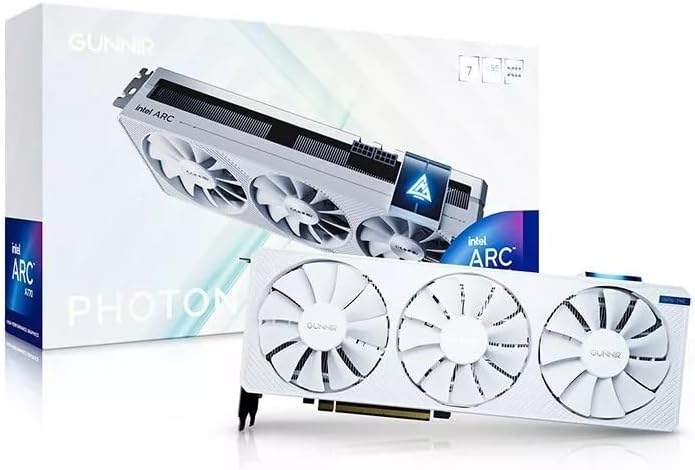
The GUNNIR Intel Arc A770 Photon 8GB OC combines a factory clock of 2400MHz with a 256-bit memory interface in a white triple-fan design. Its supplied rating is 4.5, and the card remains an attractive option for builders who want a distinctive high-airflow graphics card for gaming, content creation, and 4K display setups.
We may earn a commission when you buy through this link, at no additional cost to you.
The 256-bit bus is one of its strongest technical details, providing a broad memory channel for a gaming-focused card. A triple-fan cooler offers ample surface area and airflow for sustained gaming sessions, while the white exterior and illuminated style make the Photon particularly suited to visually coordinated light-colored systems. Its listing confirms support for HDMI and DisplayPort connections as well as 4K displays.
The architecture is tied to PCIe 4.0 rather than the newer PCIe 5.0 interface found on the latest professional options. That distinction is largely irrelevant for many current gaming systems, where the card's bandwidth needs are met by the platform, but buyers should still confirm motherboard and CPU compatibility. The more noticeable limitation is the 8GB memory pool, which is increasingly modest for texture-heavy games and ambitious creative projects.
The Photon is best for a 1440p gaming build where cooling capacity, appearance, and a wide memory interface matter. It is a less forward-looking choice for users who need large local models or professional memory, but it remains a well-rounded option for conventional gaming and display use.
Three fans spread cooling capacity across a larger heatsink area than a typical dual-fan card. That design can be appealing in a warm room or during long sessions, provided the card has adequate case clearance and intake airflow.
The white finish and triple-fan styling make the Photon a natural match for a coordinated gaming interior. Buyers should also compare card length and connector placement against their case and motherboard layout.
We may earn a commission when you buy through this link, at no additional cost to you.
The Sparkle Intel Arc A310 Omni View is built around a simple proposition: provide a compact, power-efficient card with four HDMI outputs for multi-display work. With 4GB of GDDR6, a 50W total board power target, and a single-fan, single-slot configuration, it is better viewed as a focused display and light-compute solution than a high-performance gaming card.
We may earn a commission when you buy through this link, at no additional cost to you.
Four HDMI outputs allow a desk to run several screens without requiring multiple adapters or display cards. The single-slot body and low 50W power target make the card attractive for compact office and workstation systems where space and energy use matter. Its simple cooling arrangement should also avoid adding significant bulk to a chassis with limited expansion room.
The 4GB memory allocation and low power target are the primary boundaries. The card should not be expected to handle texture-heavy modern gaming, large AI models, or demanding professional rendering. Its more appropriate roles include extended desktop productivity, digital displays, visualization, and light graphics tasks where multiple video outputs matter more than raw 3D throughput.
The Omni View is recommended for a four-screen productivity setup, a compact multi-monitor workstation, or a system that needs a straightforward low-power display card. It is a specialized but practical option, and the four-HDMI configuration is the feature that should drive the buying decision.
Four native HDMI outputs are the reason this card exists. They simplify a four-monitor desk and reduce dependence on adapters, making the A310 Omni View useful for control rooms, offices, and productivity systems.
The 50W TBP and single-slot format minimize power and physical demands. A single fan keeps the cooler simple, making this an unobtrusive option when gaming performance is not the goal.
We may earn a commission when you buy through this link, at no additional cost to you.
The right Intel Arc GPU depends first on your workload, then on fit, memory, cooling, display requirements, and platform support. Reviewing those factors before comparing models prevents a powerful card from becoming a poor investment because it does not fit, draw enough power, or provide the memory your applications require.
Start with the resolution and frame-rate target you expect to maintain. The ASRock B570 Challenger is positioned for 1440p gaming and combines a 2600MHz clock with 10GB of memory, while the A580 Challenger also emphasizes 1440p through its 256-bit interface and factory-overclocked 2000MHz engine. Higher resolutions, ray tracing, heavy texture packs, and uncapped high-refresh-rate displays can increase memory and graphics-processing demands, so the more demanding the scene, the more valuable additional VRAM becomes.
VRAM determines how much data a GPU can hold without relying on slower system memory. The 4GB A310 and 8GB gaming models suit display-heavy or mainstream tasks, while the 12GB Titan OC provides more room for texture-rich games. For professional work, the 16GB B50 LP, 24GB Arc Pro B60 Creator, and 48GB dual-GPU products offer progressively larger pools for AI models, detailed scenes, and large datasets.
Intel's newer Xe2-HPG models add XMX engines for AI-oriented acceleration, and compatible games can use XeSS 2 for upscaling. The Arc Pro B60 Creator lists 197 INT8 TOPS, while the dual-GPU products combine two B60 processors. These figures are relevant when your software can use Intel acceleration, but they are not interchangeable with gaming frame rate. Check framework, driver, and application support before selecting a professional card solely for its advertised TOPS value.
Measure before ordering. The A580 is a 2.4-slot card measuring 271 by 132 by 48mm, the Arc Pro B60 Creator is 271 by 112 by 39mm, and the B50 LP measures only 167 by 69 by 18.4mm. A low-profile card is not automatically compatible with every compact case, and a full-length dual-slot card can conflict with large CPU coolers. Blower, axial-fan, and triple-fan designs also need enough case airflow to release heat properly.
Power requirements range from 50W for the A310 Omni View and 70W for the B50 LP to 200W for the Arc Pro B60 Creator. The A580 Challenger uses two 8-pin PCIe connectors and is supplied with a recommendation for a 650W PSU, while the B570 Challenger uses one 8-pin connector. The B570 bundle includes a 650W 80 PLUS Gold ATX3.1 PSU, which can simplify a new build, but current owners of a suitable PSU can choose a standalone card instead.
Output configuration can be more important than raw graphics performance. The A310 Omni View provides four HDMI outputs, the Arc Pro B60 Creator provides four DisplayPort 2.1 outputs, and the B570 and A580 Challenger cards mix DisplayPort with HDMI. Check monitor resolution, refresh rate, adaptive-sync requirements, and whether your application supports multi-display configurations. HDR, high-resolution color work, and large desks can make output count and interface generation more important than gaming performance.
Professional users should verify ISV certification, driver support, and the exact application version they intend to run. The Arc Pro B60 Creator is listed as validated for AI, design, engineering, and manufacturing software with workstation-optimized drivers. The dual-GPU B60 products add support for frameworks such as PyTorch, IPEX-LLM, and vLLM, but they may also require PCIe lane bifurcation, particular motherboard layouts, and workload-specific configuration.
A complete upgrade may involve more than the graphics card. The B570 bundle includes a power supply for buyers who need both components, while the B50 LP and A310 Omni View reduce space and power requirements. Professional dual-GPU cards demand careful case planning, and larger gaming models may need extra room for airflow. Consider whether the system needs a PSU upgrade, motherboard features, additional cables, or a case with more intake capacity.
Before installation, power down the computer completely, disconnect the power cable, and wait for internal components to discharge. Confirm that the case has the required slot clearance, the motherboard supports the card's PCIe interface, and the PSU provides the correct connectors. For the dual-GPU professional cards, verify lane-bifurcation support and the recommended board layout before attempting installation.
Install the card using the appropriate PCIe retention mechanism, attach only the power connectors specified for that model, and route cables without blocking fans. Connect the displays to the intended outputs, boot the system, install the current Intel graphics driver, and then update the workstation application or AI framework required by your project. Allow the operating system to recognize each GPU independently and confirm the expected memory and compute allocation.
For routine care, keep intake and exhaust paths clear of dust and ensure that the case receives cool air. Monitor temperatures and behavior during sustained rendering, compilation, or AI inference rather than judging performance from a short game test. Update drivers when an application requires it, avoid abrupt shutdowns during long writes, and never assume a workstation card can be installed without checking physical and platform compatibility.
The ASRock Arc B570 Challenger 10GB OC is the most balanced recommendation in this guide for 1440p gaming. It combines a 2600MHz clock, 19 Gbps GDDR6 memory, 10GB of VRAM, dual-fan cooling, and modern display outputs. The A580 Challenger is a value-oriented alternative with a wide 256-bit bus, while the Sparkle B580 Titan OC offers 12GB for buyers who prioritize extra memory.
An 8GB card is suitable for many mainstream games and general content-creation tasks, while 10GB or 12GB provides more comfortable headroom for high-detail textures. Professional rendering, larger AI models, and demanding datasets benefit from 16GB, 24GB, or even 48GB. Choose based on the largest projects you expect to run rather than on gaming performance alone.
Several models in this list are explicitly oriented toward local AI. The Arc Pro B60 Creator provides 24GB and 197 INT8 TOPS, while the dual-GPU B60 products combine 48GB and 394 TOPS. The GUNNIR B50 LP also offers 16GB and 170 INT8 TOPS in a compact low-power design. Actual performance depends on model quantization, software support, system memory, and the selected inference framework.
That depends on the card and the PSU already in the system. The A310 Omni View draws 50W, the B50 LP has a 70W power target, and the Arc Pro B60 Creator has a 200W TDP. The A580 Challenger requires two 8-pin connectors, while the B570 bundle includes a 650W 80 PLUS Gold PSU. Check both wattage and connector availability rather than relying on wattage alone.
Intel Xe Super Sampling 2 is an AI-powered upscaling technology supported by compatible Intel Arc hardware and games. It can improve frame rates by rendering at a lower internal resolution and reconstructing the final image at a higher output resolution. Benefits vary by game and settings, so it should be treated as a useful supported feature rather than a guaranteed fixed performance increase.
They can be, especially when the application and driver stack are supported. The Arc Pro B60 Creator includes professional drivers, ISV validation, four DisplayPort 2.1 outputs, and 24GB of memory. Dual-GPU B60 cards target larger AI and rendering workloads. Before purchasing, verify the specific engineering, design, manufacturing, media, or AI software you intend to use.
The dual-GPU B60 design uses a PCIe 5.0 x8 plus PCIe 5.0 x8 configuration and can achieve full x16 bandwidth when the motherboard supports x16 lane bifurcation. Exact physical slot arrangements and platform support may vary, so check the motherboard manual, case dimensions, power provisions, and application requirements before ordering this specialized hardware.
A low-profile design is only better if it fits the case and offers the performance the system needs. The GUNNIR B50 LP is particularly compelling for compact workstations because it combines 16GB of memory, a 70W power target, and no external PCIe power connector. By contrast, the A310 Omni View emphasizes four HDMI outputs and display use rather than heavy graphics or AI workloads.
The ASRock Arc B570 Challenger 10GB OC is the strongest all-around pick, combining modern Xe2-HPG features, 10GB of memory, a high clock, and a well-rounded cooling and display design. The ASRock A580 Challenger 8GB OC serves value-focused 1440p builders, while the ASRock Arc Pro B60 Creator 24GB stands out for professional memory, AI throughput, and four DisplayPort 2.1 outputs.
Prioritize the workload before the model name. Conventional gamers should balance VRAM, clock speed, and fit; compact-system builders should look for low-profile dimensions and modest power; and AI or rendering users should evaluate memory, framework support, lane configuration, and sustained cooling. The 12GB Sparkle B580 Titan OC, 16GB GUNNIR B50 LP, and dual 48GB B60 products serve those more specialized needs.
Finally, verify current product details, connector requirements, case clearance, motherboard support, and driver compatibility before purchasing. Intel Arc GPU availability and pricing can change over time, and a card that is ideal for one workstation may be unsuitable for another. The most dependable choice is the one that meets your memory, power, physical, software, and display requirements without paying for features you will never use.