
BN-LINK 24-Hour Mechanical Timer
4.5Editor score
Fifteen-minute scheduling intervals
Single grounded three-prong outlet
ETL-listed heavy-duty construction
Grow light timers compared across programming, outlets, safety features, and cycle control to help you choose the right model for indoor and outdoor grow
Grow light timers make it easier to keep indoor plants, propagation areas, and outdoor growing spaces on a consistent lighting schedule. A useful timer balances accurate programming, safe electrical construction, flexible cycle settings, and enough outlet capacity for the equipment connected to it.
We compared the ten models in this guide by examining their scheduling options, mechanical or digital controls, outlet configurations, electrical ratings, safety features, and suitability for grow lights and related equipment. The list includes indoor timers, an outdoor model, and a specialized short-cycle timer.
Each pick highlights a different practical advantage, from straightforward 24-hour scheduling to detailed weekly programs and precise on-off cycling. Ratings reflect the supplied customer feedback, while current prices and availability can change, so confirm the latest listing details before purchasing.
4.5Editor score

4.2Editor score

4.5Editor score
The following comparison covers every timer in the guide, emphasizing control type, scheduling flexibility, outlet capacity, electrical limits, and the environments each model is best suited to manage.




The BN-LINK Indoor 7-Day Programmable Digital Timer Outlet is a well-rounded option for grow rooms that need more than a simple daily cycle. It has a 4.3 rating and combines eight on-off programs with two grounded outlets, giving users a practical combination of scheduling flexibility and plug capacity.
We may earn a commission when you buy through this link, at no additional cost to you.
Its strongest feature is the ability to program individual days or choose convenient preset combinations. Settings can be adjusted down to one minute, which is useful when plants require a short changeover between lighting and other equipment. Both outlets are controlled simultaneously, and a daylight-saving mode simplifies clock changes. The long-lasting backup battery also helps preserve programming during a power interruption.
The main limitation is that the two outlets are not independently programmable. If one fixture needs a different schedule from another, this model cannot provide separate controls for each connected device. A random vacation mode adds security value, but it is not a substitute for a genuinely different daily lighting plan. It is also a digital product, so it takes slightly more setup than a mechanical dial.
This is a strong choice for a compact indoor setup where multiple fixtures follow one shared schedule. The combination of weekly programming, one-minute precision, and two outlets makes it particularly versatile, while buyers needing independent per-outlet timing should favor a more specialized dual-outlet model.
Eight daily programs can be assigned across the week, allowing lights to follow different patterns on different days. The timer is best suited to a room with one consistent photoperiod shared by all connected fixtures.
The backup battery helps retain the programmed schedule if power is interrupted. Random mode varies the apparent lighting pattern while the home is occupied, adding a useful security layer during vacations.
We may earn a commission when you buy through this link, at no additional cost to you.
The VIVOSUN Digital Timer Outlet stands out as the most flexible programmable model in this roundup. Its 4.2 rating reflects solid customer reception, while 20 on-off program groups, independent outlet control, and a countdown function give it considerable flexibility for indoor grow setups.
We may earn a commission when you buy through this link, at no additional cost to you.
Each of the two grounded outlets can be controlled separately, solving a common limitation encountered with shared two-outlet timers. Intervals can be configured from one minute to as long as seven days, and eight preset working-day combinations simplify recurring schedules. A large LCD makes the menu easier to read, while the side-entry layout can make the unit more practical in hard-to-reach locations.
Its rechargeable battery preserves presets and programs after an outage. Random mode offers variable lighting behavior for security, and a child lock reduces accidental changes. The stated 125-volt, 15-amp rating and maximum load of 1,875 watts are suitable for many lights, fans, pumps, and other indoor devices, though the combined load still needs to remain within the rating.
This timer is best for growers who want two devices on different schedules without buying two separate controllers. It is more elaborate than a mechanical timer, but the independent outlets, generous program capacity, and readable display make it an excellent all-around choice for a dedicated indoor grow room.
The independent outlets allow a light and a fan, pump, or other accessory to follow separate schedules. That control is valuable when ventilation should continue after the lights switch off.
A large LCD presents the current time and programmed settings more clearly than many compact digital timers. Twenty program groups and preset day combinations reduce the need to rebuild a schedule manually.
We may earn a commission when you buy through this link, at no additional cost to you.
The BN-LINK 24-Hour Heavy Duty Mechanical Timer Outlet delivers dependable daily scheduling without digital menus or batteries. It carries a 4.5 rating, and its clear pin-based operation makes it approachable for anyone setting up a first automated lighting schedule.
We may earn a commission when you buy through this link, at no additional cost to you.
The built-in dial represents the full day in 15-minute increments. Users can set numerous on and off periods, and the schedule repeats every 24 hours. Its three-prong grounded format suits modern indoor grow lights, while the stated 125-volt, 15-amp, 1,875-watt maximum load accommodates many lamps and related devices.
This model does not offer different schedules for different days of the week, nor does it independently control multiple outlets. Those limitations are reasonable for a single grow light with a steady daily photoperiod, but they may frustrate users managing several devices on different schedules. An indicator light also helps show the timer's operating state at a glance.
The timer is a sensible choice for a straightforward indoor grow space that repeats one lighting plan every day. Its simple controls, broad load rating, and 15-minute precision make it a strong budget-oriented option without the complexity of a digital controller.
The integrated pin dial avoids loose, easily misplaced components. Quarter-hour settings still provide useful precision for coordinating a standard light and fan schedule.
The listed 15-amp, 1,875-watt capacity is suitable for many indoor grow-light arrangements. Users should still verify the combined draw of connected equipment and follow the manufacturer's load guidance.
We may earn a commission when you buy through this link, at no additional cost to you.
The G-Homa Timers for Electrical Outlets four-pack is designed for setups that need several independent daily timers without buying them separately. It has a 4.5 rating, an ETL approval, and four individually usable plug-in timers that can automate plant lights, lamps, fans, and other indoor equipment.
We may earn a commission when you buy through this link, at no additional cost to you.
Each timer uses 30-minute intervals across a 24-hour cycle, providing 48 available on-off positions. Setup is mechanical: turn the dial to the current time, move the pins into the desired positions, and place the manual switch in timer mode. A main on-off switch gives users an easy way to bypass the programmed cycle.
The trade-off is precision. A 30-minute step is usually adequate for a consistent daily light cycle, but it is less useful when a ventilation fan needs to run for only a few minutes after the fixtures switch off. The four timers also do not create independent weekly programs; each one simply repeats its own daily arrangement.
This multipack is most valuable for growers with several areas, propagation zones, or fixtures that need different start and stop times. Its multiple timers make equipment organization easier, while the simple interface and stated 15-amp general-purpose rating suit many standard indoor loads.
Four separate timers let growers assign different daily schedules to multiple rooms or fixture groups. Each unit follows its own pin pattern rather than forcing every device onto one shared program.
The main on-off switch provides a convenient override when a grower needs continuous power. That makes it easier to check equipment or move from a programmed schedule to an always-on setting.
We may earn a commission when you buy through this link, at no additional cost to you.
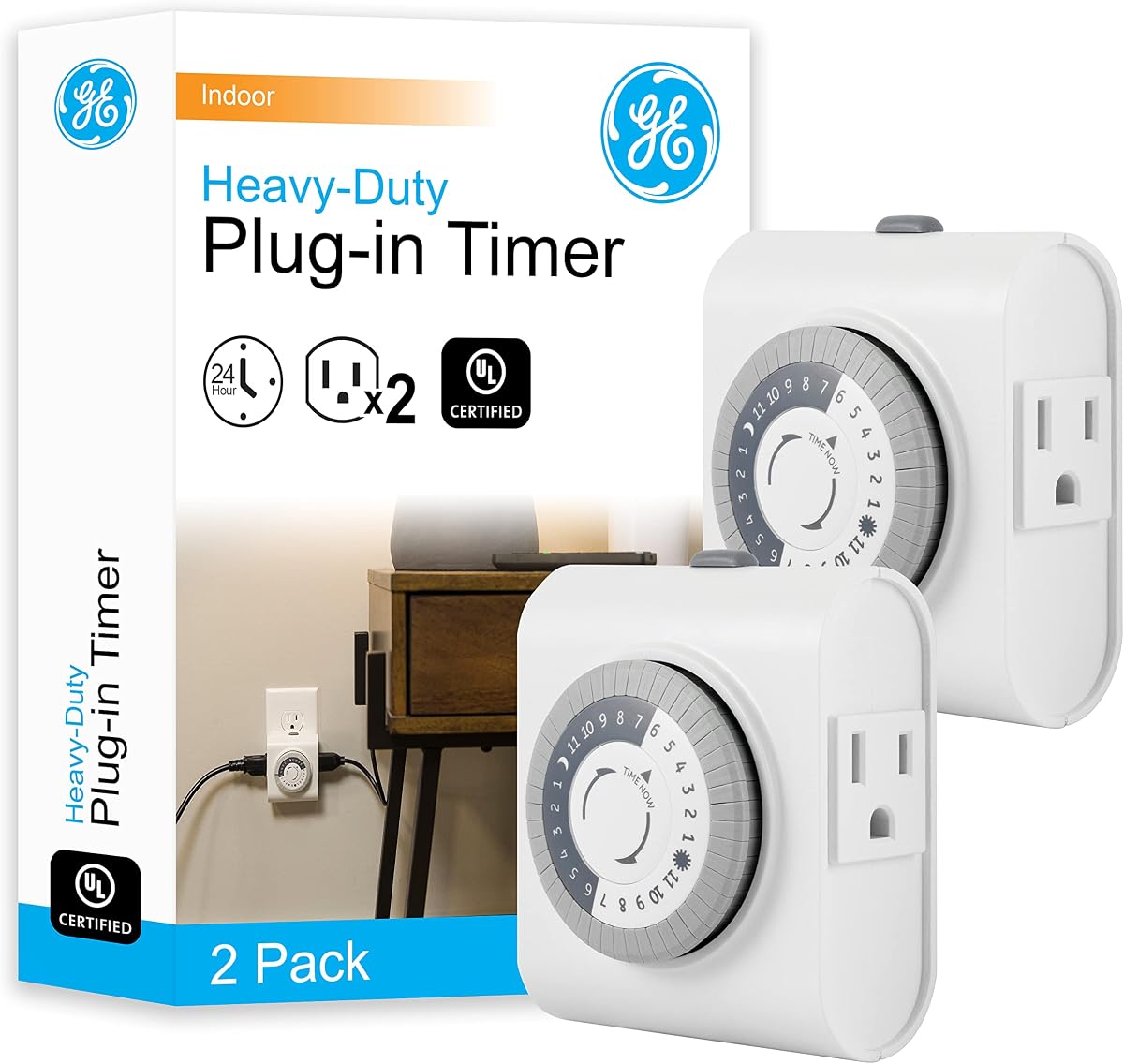
The GE 24-Hour Plug-in Mechanical Timer Outlet is one of the strongest all-around choices for a basic indoor grow setup. It has the highest customer rating in this group at 4.6 and includes two grounded outlets on each timer, with two timers supplied in the pack.
We may earn a commission when you buy through this link, at no additional cost to you.
Push-pin programming creates a straightforward daily cycle in 30-minute steps. Both outlets operate from the same schedule, which is convenient when multiple fixtures need identical on and off times. The override switch pauses the programmed cycle whenever continuous operation is more practical.
Its limitations are the same ones shared by most mechanical two-outlet timers. Neither outlet can have an independent program, and 30-minute increments are not precise enough for very short equipment run times. The product also lacks features such as countdown operation, random patterns, and outage memory.
For a grower with a steady daily photoperiod, the GE pair offers convenient plug capacity and straightforward operation. The two-pack provides useful redundancy or allows two separate locations to be automated, making this a versatile choice for indoor lights, fans, and seasonal equipment.
Two grounded outlets can power compatible three-prong equipment on the same daily schedule. This reduces the need for additional receptacles in a compact grow area.
There is no app, network connection, or battery to maintain. The push-pin interface makes the schedule easy to understand and adjust when lighting requirements change.
We may earn a commission when you buy through this link, at no additional cost to you.
The DEWENWILS Indoor 24 Hour Programmable Digital Timer Outlet emphasizes compact design, readable controls, and dependable schedule retention. It has a 4.5 rating and includes two timers, each with a single three-prong outlet and three daily repeat-program groups.
We may earn a commission when you buy through this link, at no additional cost to you.
Users can configure always-on, automatic, and always-off behavior, while the digital screen displays the programmed state clearly. The timer supports precise minute-level adjustment and operates silently, making it a reasonable option for bedrooms or other indoor spaces where mechanical clicking would be distracting.
Its memory function preserves programmed settings for up to three months if power is removed or disconnected. The compact shape is designed not to block other sockets, and the listed 125-volt, 15-amp, 1,000-watt rating supports plant lights, holiday decorations, indoor lights, and electronics within that limit.
This timer is best for a small indoor grow area that follows a daily schedule and values a compact profile. It cannot vary programs by day of the week, and its one-outlet layout is less accommodating for multiple devices, but the included two-pack helps manage separate fixtures or rooms.
The slim enclosure is intended to leave neighboring receptacles accessible. That makes it useful where a bulky controller could interfere with another plug or where a grow room has limited wall space.
Silent operation is helpful in occupied rooms, while extended setting retention reduces the chance of losing a schedule during an extended outage. The display provides quick confirmation of the current mode.
We may earn a commission when you buy through this link, at no additional cost to you.
The BN-LINK Heavy Duty Dual Outlet Mechanical Timer combines two grounded outlets with quarter-hour scheduling. It has a 4.4 rating and is built for growers who want simple daily automation without losing access to continuous power.
We may earn a commission when you buy through this link, at no additional cost to you.
Users press the integrated pins down for scheduled on periods and leave them up for off periods. The cycle repeats every 24 hours, and the switch can be placed in the on position to bypass the timer and keep connected devices operating continuously. The 15-minute intervals provide better adjustment than many competing mechanical models.
Both outlets follow the same schedule, so separate lighting and fan programs are not possible. The unit also lacks digital memory, random operation, and different daily programs, although those features are usually unnecessary for a simple photoperiod. Its stated 125-volt, 15-amp, 1,875-watt capacity and UL listing support heavy-duty indoor use.
This timer suits growers who value precise mechanical timing, two outlets, and a dependable bypass. It is a practical alternative to digital models when a straightforward repeating schedule is preferable to complicated programming.
Fifteen-minute pin positions allow a grow light and fan to be coordinated more closely than a half-hour timer permits. The schedule remains visible directly on the dial.
The always-on position bypasses the programmed cycle without requiring the pins to be reset. This is useful for maintenance, testing, or temporary changes.
We may earn a commission when you buy through this link, at no additional cost to you.
The BN-LINK Outdoor 24-Hour Mechanical Timer Outlet is the clear choice in this group for an outdoor growing area. It has a 4.5 rating, a rainproof casing, and two grounded outlets for controlling outdoor lighting and other compatible equipment.
We may earn a commission when you buy through this link, at no additional cost to you.
A 48-pin dial provides 30-minute scheduling intervals, and the daily cycle repeats automatically after one setup. The mechanical pin settings are retained even if the power fails, reducing the chance of losing the schedule. The unit should be mounted upright and at least two feet above the ground as described in its product information.
Both outlets share one program, and its 15-amp, one-half-horsepower rating should be checked against connected equipment. The weather-resistant construction is a meaningful distinction from indoor models, but it does not remove the need for careful placement, secure mounting, and appropriate outdoor-rated connections.
For patio lights, landscape lighting, or an outdoor grow installation, this model provides a practical and durable daily schedule. It is less appropriate for indoor users who need weekly variation or independent outlet programming.
The rainproof casing is built for outdoor use, unlike the indoor-focused models in this guide. Proper upright placement and elevation help protect the timer from water and other environmental exposure.
Mechanical pin settings remain in place if power is interrupted. That repeatability is useful for unattended outdoor lighting that should resume the same daily program.
We may earn a commission when you buy through this link, at no additional cost to you.
The Techbee Indoor Digital Infinite Repeat Cycle Intermittent Outlet Timer is a feature-rich option for growers who need more than standard daily on-off timing. It has a 4.4 rating and combines a 24-hour clock, three daily programs, countdown operation, manual on-off control, and a customizable repeating cycle.
We may earn a commission when you buy through this link, at no additional cost to you.
Its most notable function is the ability to establish an on-off repeat pattern that can continue through the day. That can be useful for pumps, irrigation components, ventilation, or other equipment that needs intermittent operation rather than one long lighting block. The large screen makes the selected mode and programmed values easier to read.
A built-in battery retains programs during outages, and silent switching suits indoor spaces. The fireproof V0 housing and child lock add practical safeguards, while the two-pack provides two programmable outlets for different tasks. Its weakness is complexity: a simple mechanical timer would be faster for a single fixed daily schedule.
This model is best for technically minded growers who want multiple timing formats and intermittent cycles in one unit. It is a better fit for sophisticated indoor routines than for a basic one-light setup or an exposed outdoor installation.
Clock mode, three daily programs, countdown operation, and a repeating cycle cover several different control needs. This variety is useful for coordinating lights with pumps or other intermittently operated equipment.
Battery-backed memory helps preserve settings during a power interruption, while silent switching reduces distractions in indoor rooms. The child lock helps reduce accidental changes after setup.
We may earn a commission when you buy through this link, at no additional cost to you.
The BN-LINK Short Period Repeat Cycle Intermittent Timer is the most specialized model in this guide and the best fit for short, repeating equipment cycles. It has a 4.5 rating and supports on durations from five seconds to 30 minutes, with off durations from five seconds to 60 minutes.
We may earn a commission when you buy through this link, at no additional cost to you.
Unlike ordinary lamp timers, it is designed to cycle equipment repeatedly rather than simply switch it on for one long daily period. Day Only, Night Only, and 24-Hour modes let users restrict operation according to ambient light or run continuously through the day. A built-in photocell supports dusk-to-dawn behavior without requiring a separate light sensor.
The straightforward dials make the operating pattern easy to set, although the very short ranges require care to avoid a continuous-on or continuous-off condition. The stated 125-volt, 15-amp, 1,875-watt capacity and ETL listing suit many pumps, fans, humidifiers, and grow-system accessories. It does not provide separate weekly programs.
This is the premium choice for hydroponics, aquaponics, aeroponics, irrigation, ventilation, or other intermittent accessories. Growers who merely need a standard daily light schedule may find a dedicated digital or mechanical timer easier to operate.
Five-second increments make it possible to run brief operational cycles rather than only long scheduled blocks. This precision is particularly useful for pumps, irrigation routines, and ventilation accessories.
The integrated photocell can trigger the appropriate day or night behavior. Choosing the 24-hour mode removes that distinction for equipment that must cycle continuously.
We may earn a commission when you buy through this link, at no additional cost to you.
The right grow light timer depends on your lighting pattern, number of connected devices, required precision, and installation environment. Reviewing these factors before buying helps prevent a schedule that is too basic, too complex, or unsuitable for outdoor use.
Mechanical timers use physical pins or dials to define when connected devices should run. They are straightforward, dependable, and often useful for a fixed daily schedule, but their intervals are usually 15 or 30 minutes and they rarely support different programs for each day of the week. Digital timers provide minute-level or even second-level control, more memory, and multiple operating modes, but they require menu navigation and may need battery-backed programming to retain settings through an outage.
A 24-hour timer repeats one pattern every day, which is appropriate when a grow light follows a constant photoperiod throughout the week. A seven-day timer can assign different programs to individual days, making it useful for seedlings, flowering stages, propagation rooms, or variable environmental routines. Before choosing, write down the required on and off times and identify whether they ever differ by weekday. Paying for weekly programming without a real need can add unnecessary complexity.
A single-outlet timer may be sufficient for one light, while a dual-outlet model can support more equipment from one receptacle. Independent control is the more important distinction: two outlets that follow one shared program cannot operate a light and fan on separate schedules. If your equipment needs different start and stop times, choose a digital model with independently programmable outlets or purchase separate timers. Otherwise, a shared schedule can keep wiring and setup simpler.
Standard mechanical models commonly use 15- or 30-minute intervals. That is usually sufficient for consistent grow lights, but it may not be precise enough for a fan that should run only a short period after the lights switch off. Digital models can schedule down to one minute, while specialized intermittent timers may support cycles lasting only five seconds. Match the timer's smallest interval to the shortest equipment run time you genuinely need rather than paying for finer control that the setup will never use.
Every timer has a maximum voltage, amperage, wattage, and sometimes motor-horsepower rating. Compare those limits with the combined requirements of every connected grow light, fan, pump, heater, or other device. A wattage rating may include resistive and tungsten limits, and adding multiple high-output fixtures can exceed a product's capacity even when each light seems acceptable by itself. Do not use a power strip to expand beyond the timer's stated rating, and follow the instructions supplied with all connected equipment.
Most plug-in timers in this guide are intended for indoor use. An outdoor model needs a weather-resistant enclosure and should be mounted upright and at least two feet above the ground according to its supplied instructions. Indoor models should not be placed in wet locations or exposed to irrigation spray. Outdoor-rated lights and extension cords should be used as appropriate, with the timer still protected from standing water and physical damage. Never assume a splash-resistant or waterproof-sounding feature means the entire connected setup is weatherproof.
A timer that loses its schedule after a brief power interruption can leave lights off or on unexpectedly. Digital models with built-in or rechargeable batteries are best for setups where the program must survive outages, and mechanical pin models naturally retain their visible settings. An always-on or manual override is also useful for testing, maintenance, and temporary changes. Check how the override behaves so it does not accidentally cancel or alter the programmed schedule.
Some grow environments need intermittent operation rather than a standard photoperiod. Short-cycle timers can run pumps, humidifiers, or ventilation on and off at precise intervals, while day, night, and 24-hour modes can respond to ambient light through a built-in photocell. These features are valuable for hydroponics, aquaponics, aeroponics, and irrigation systems. They are not automatically better for ordinary grow lights, so consider them only when the connected equipment truly needs repeating cycles.
Begin by identifying every device that will be connected and confirming that its combined electrical load remains within the timer's listed limits. For a mechanical timer, set the dial to the current time before moving the pins, then place the manual switch in timer mode. For a digital timer, set the correct current time, select the appropriate program or operating mode, and confirm the first on and off times before leaving the unit unattended.
Install the timer in a dry, accessible location where you can reach its controls. A digital unit should be aligned with its display, while a mechanical dial should remain visible for inspection. Outdoor models need careful upright mounting and adequate clearance from the ground. Do not use a timer to exceed its voltage, wattage, amperage, or horsepower rating, and avoid connecting equipment through an unapproved power strip.
Check the schedule after installation and whenever daylight-saving time changes, seasons change, or a fixture is moved. Test the override so you know how to provide continuous power during maintenance. Keep indoor timers free of dust, moisture, and stacked objects, and never open or modify a timer while it is connected to power. Replace a damaged unit rather than attempting repairs, and use only compatible grounded plugs and properly rated equipment.
A properly rated and correctly programmed timer is designed for scheduled unattended operation, but the connected equipment must remain within its electrical limits. Follow the manufacturer's instructions, use grounded outlets, and avoid extension arrangements that create overload or connection problems. Inspect the timer and wiring periodically, especially in outdoor locations exposed to moisture.
A mechanical timer is usually easier and more appropriate for one fixed daily lighting schedule. A digital timer is better when you need different times for individual days, precise minute-level changes, countdown functions, or independent outlet control. The best choice depends on your schedule complexity rather than simply which style appears more advanced.
It can if the timer has enough outlets and the combined electrical load falls within its rating. A dual-outlet timer can control two compatible devices on the same schedule, while a model with independently programmable outlets can run them differently. Never assume every two-outlet timer supports separate timing for each outlet.
Choose a model specifically rated for outdoor use and install it upright with the required clearance from the ground. The outdoor timer in this guide has a rainproof housing, two grounded outlets, and a daily 30-minute pin schedule. The connected light, plug, extension cord, and other exposed components must also be suitable for outdoor conditions.
Battery backup is valuable when a power interruption would disrupt a critical lighting schedule or restart a digital timer from its factory settings. It is less critical for a mechanical model because the visible pin settings remain in place. Even with backup memory, the connected equipment may remain off until power returns, so plants still need to be checked during extended outages.
Yes, provided the timer's electrical and motor ratings cover those devices. A standard daily timer can control a fan or pump on a fixed schedule, while a short-cycle interval timer offers finer on-off control for irrigation, humidification, ventilation, and aeroponic systems. Verify both wattage and horsepower requirements before connecting motor-driven equipment.
Fifteen- or 30-minute intervals are generally sufficient for a steady light photoperiod and a related fan schedule. Minute-level precision helps when lights, ventilation, and pumps need closely coordinated switching. Very short intervals are primarily useful for specialized equipment cycles rather than ordinary lighting blocks.
Digital timer support varies. The VIVOSUN, DEWENWILS, and Techbee models include memory functions that help preserve programmed settings, while mechanical timers retain their pin positions. Verify the specific model's claims and keep a note of the intended schedule as a backup for critical growing systems.
The VIVOSUN Digital Timer is the most versatile overall choice because it combines 20 program groups with two independently controlled outlets, countdown operation, random mode, and battery-backed memory. The BN-LINK 24-Hour Mechanical Timer is a practical budget option when one daily schedule and simple controls are enough, while the BN-LINK Short Period Repeat Cycle Timer serves specialized systems that need precise intermittent operation and automatic day-night behavior.
Prioritize the schedule your grow space actually requires. Choose daily mechanical control for a constant photoperiod, weekly or independent digital programming for mixed equipment, and a short-cycle timer for pumps, irrigation, or aeroponics. Outlet count, timing precision, load capacity, and indoor-versus-outdoor construction matter more than extra menu features that will remain unused.
Before purchasing, verify the current listing, electrical ratings, included components, warranty or support information, and availability. Product prices and seller conditions can change over time, and the most suitable timer is ultimately the one that safely delivers the lighting pattern your plants require.


