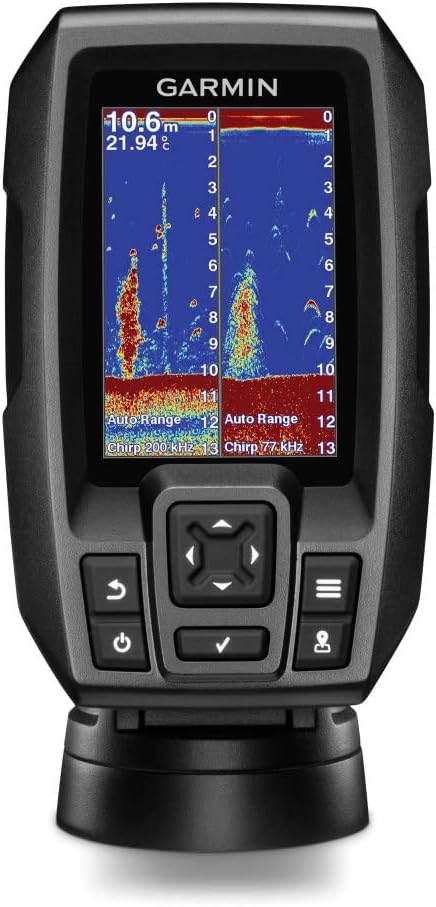
Garmin Striker 4
4.6Editor score
Compact three-and-a-half-inch display
ClearVu scanning sonar
Waypoint navigation included
Fish finders for small boats combine sonar, display, mounting, and navigation features in packages designed to fit limited deck space. A good unit should reveal fish and underwater structure clearly while remaining simple to operate from a compact fishing boat, kayak, or pontoon.
We compared ten options using the supplied specifications, focusing on sonar technology, screen size, GPS capabilities, included transducers, mounting hardware, portability, and ease of use. The list covers traditional boat-mounted units, portable systems, compact color displays, and larger models with expanded navigation features.
Each review identifies the most useful strengths and the practical trade-offs of its product, helping you match equipment to your available space and fishing style. Product availability, feature bundles, and prices can change, so verify the current listing before making a purchase.
4.6Editor score

4.7Editor score
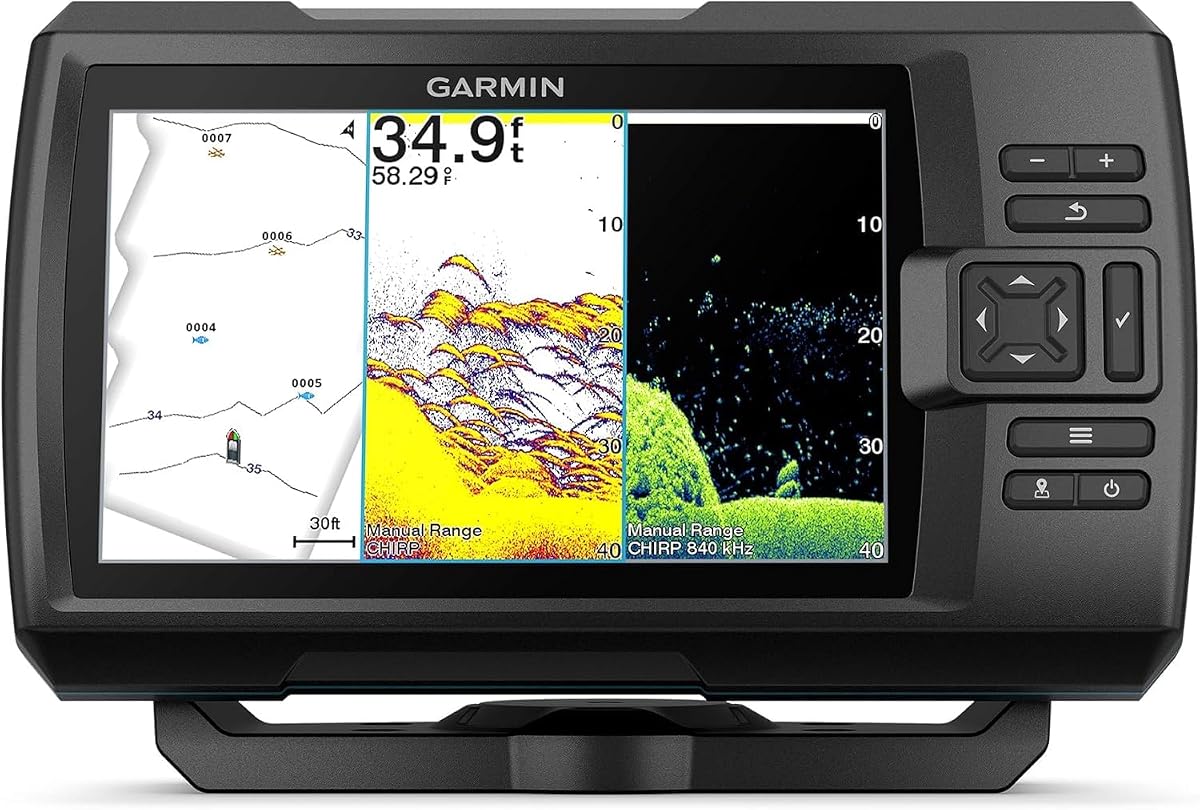
4.5Editor score
As an Amazon Associate we earn from qualifying purchases.
The comparison below highlights the display, sonar, navigation, and installation features that matter most when selecting a fish finder for a compact boat. Use the chart to compare conventional mounted units with portable and feature-rich alternatives.


The Garmin Striker 4 combines a compact three-and-a-half-inch display with ClearVu scanning sonar and built-in GPS, earning a 4.6 rating among users. Its most impressive quality is the balance of useful fish-finding features in a unit designed to fit where larger chartplotters may feel intrusive.
We may earn a commission when you buy through this link, at no additional cost to you.
ClearVu sonar is intended to produce detailed representations of fish, objects, and submerged structure. CHIRP sonar sends a continuous sweep of frequencies, helping produce crisper arches and stronger target separation. Dedicated buttons make menu navigation straightforward, while the waypoint map lets anglers save brush piles, stumps, docks, and other productive locations.
The main limitation is display size. A three-and-a-half-inch screen is ideal for a compact console but offers less room for detailed readings than the larger Garmin and Humminbird models in this guide. The supplied specifications also list no wireless connectivity or premium chart support, so it is better suited to straightforward sonar and GPS use.
Choose the Striker 4 when space, straightforward operation, and essential sonar performance matter more than large-screen mapping. It is a particularly sensible option for small fishing boats, kayaks with limited mounting areas, and anglers who want more fish information than a basic depth finder without moving to a full chartplotter.
ClearVu scanning sonar gives the compact unit a level of visual detail that can help reveal structure and separate fish from the bottom. CHIRP frequencies improve arch clarity and target separation, while the keyed interface remains easy to operate while the boat is moving.
The integrated GPS and waypoint map let anglers mark and revisit promising areas. Maximum depth is listed at 1,600 feet in freshwater and 750 feet in saltwater, providing useful context for different fishing environments.
We may earn a commission when you buy through this link, at no additional cost to you.
The Humminbird PiranhaMAX 4 is a focused entry-level fish finder with a 4.6 rating, Dual Beam sonar, and a straightforward control approach. It is designed for anglers who want a useful combination of fish arches, structural detail, and broad bottom coverage without a complicated navigation package.
We may earn a commission when you buy through this link, at no additional cost to you.
Its dual-beam system lets users choose between a narrow beam for detail and a wide beam for broader coverage. That flexibility helps when moving between a steep drop-off, a submerged ridge, or a shallow area. The included tilt-and-swivel mount makes it easy to change the viewing angle, an important consideration when glare, weather, or different seating positions affect visibility.
Compared with the more advanced Garmin and Humminbird units in this roundup, this model lacks listed GPS mapping, connectivity, and scanning sonar technologies. It also does not include the Down Imaging capability found in the other PiranhaMAX 4 model included here. As a result, its appeal rests on traditional sonar utility rather than advanced imaging or cartography.
The PiranhaMAX 4 is best for small-boat anglers prioritizing simple controls, flexible sonar coverage, and a complete transducer-and-mount package. It also makes sense for new fish-finder users who want an approachable unit that can help identify fish, contours, and structure.
A narrow beam concentrates the sonar view for detail, while a wide beam covers more water beneath the boat. Switching between them can make the unit more useful across changing terrain without requiring a more complicated interface.
The included tilt-and-swivel bracket allows anglers to reposition the screen as light or viewing needs change. It is a practical feature in small boats where every bit of console space and mounting flexibility matters.
We may earn a commission when you buy through this link, at no additional cost to you.
The Humminbird Helix 5 Chirp GPS G3 combines a five-inch display, Dual Spectrum CHIRP sonar, built-in mapping, and AutoChart Live technology. Its 4.4 rating reflects a feature-rich option for small-boat anglers who want more than fish arches and basic bottom contours.
We may earn a commission when you buy through this link, at no additional cost to you.
Dual Spectrum sonar supports two search approaches. Wide Mode covers more water, while Narrow Mode emphasizes detailed scanning and precise two-dimensional target separation. The built-in Humminbird Basemap covers more than 10,000 lakes and the continental United States coastline, and compatibility with LakeMaster, CoastMaster, and Navionics charts expands navigation options.
AutoChart Live can create maps of depth contours, bottom hardness, and vegetation while the boat is underway. It includes eight hours of built-in recording time and supports AutoChart Zero Line SD cards for additional mapping capacity. These features are impressive, but they are more involved than the straightforward sonar functions offered by smaller entry-level units.
The Helix 5 Chirp suits anglers who need meaningful mapping alongside advanced sonar and can reserve a reasonable amount of console space for the display. Choose it when creating your own lake contours and navigating unfamiliar water matter more than selecting the smallest possible unit.
Wide Mode is useful when scanning broad areas beneath the boat, while Narrow Mode helps separate nearby targets and examine fish-holding structure. The Low-Q transducer supports more precise two-dimensional target separation.
AutoChart Live records depth, bottom hardness, and vegetation information during a trip. The built-in recording capacity and SD card support make it possible to build maps gradually across multiple outings.
We may earn a commission when you buy through this link, at no additional cost to you.
The Garmin STRIKER Vivid 4cv pairs a four-inch color screen with CHIRP traditional sonar, CHIRP ClearVu scanning sonar, GPS, and Quickdraw Contours. Its 4.7 rating is the highest among the ten products, making it a strong all-around choice for small boats that need more display room than a basic unit without moving to a full-size chartplotter.
We may earn a commission when you buy through this link, at no additional cost to you.
The GT20 transducer provides both traditional CHIRP and ClearVu scanning data. Vivid sonar color palettes help distinguish fish from structure, while the color display provides more visual definition than a monochrome unit. The tilt-and-swivel bail mount makes screen positioning straightforward, and the included transducer avoids the need to purchase it separately.
High-sensitivity GPS supports waypoint marking, route creation, and boat-speed viewing. Built-in Quickdraw Contours adds mapping depth without turning the unit into a complex network device. However, unlike the larger Striker Vivid 7cv, this four-inch version does not list Wi-Fi connectivity or ActiveCaptain app support.
This is a versatile recommendation for an angler who values ClearVu detail, color interpretation, GPS convenience, and a complete installation package. It is particularly well matched to a small fishing boat with a limited but usable console area and an angler who wants to record personal contours without needing a large screen.
The Vivid color palettes help separate fish arches, terrain, and submerged structure at a glance. This can make a four-inch screen more informative than its compact dimensions might initially suggest.
High-sensitivity GPS supports waypoints, routes, and speed readings, while Quickdraw Contours records depth information. Together, they add useful context without the learning demands of a fully networked multi-function display.
We may earn a commission when you buy through this link, at no additional cost to you.
The Garmin Striker Vivid 7cv brings a large seven-inch color display, advanced sonar, GPS, Quickdraw Contours, and Wi-Fi connectivity. With a 4.5 rating, it stands out as the most feature-rich premium-style option in this collection, provided the boat has enough room for a larger screen.
We may earn a commission when you buy through this link, at no additional cost to you.
The included GT20-TM transducer supports Garmin CHIRP traditional sonar and CHIRP ClearVu scanning sonar. Vivid color palettes improve visual separation, and the larger screen offers room to inspect contours, fish arches, and route information more comfortably. The tilt-and-swivel bail mount helps maintain a suitable viewing angle.
Wi-Fi connects the unit with the ActiveCaptain app on a compatible smartphone. This enables waypoint transfers, smart notifications, software update notices, and access to the Garmin Quickdraw Community. The U.S. version also includes built-in Quickdraw Contours, although users remain responsible for obtaining chart data through supported workflows.
The 7cv is best for a small but modern boat with a broad enough console or transom area to accommodate a seven-inch display. It is ideal for anglers who want excellent visual detail and phone connectivity but do not need the broader chartplotter functionality of a dedicated marine display.
The seven-inch color display gives fish arches, contours, and structure more room to become distinct. It is particularly useful for anglers comparing multiple sonar layers or checking detailed navigation information at a glance.
ActiveCaptain compatibility supports waypoint transfers, notifications, update notices, and community contour access. The connection adds useful convenience while keeping the core fish-finding functions local to the unit.
We may earn a commission when you buy through this link, at no additional cost to you.
The Lowrance Eagle offers a range of four-to-nine-inch configurations, a bright IPS portrait screen, Auto-Tuning sonar, and a broad 44-degree beam. Its 4.3 rating reflects an approachable and flexible option for anglers who want an easy setup with more visual information than a basic depth display.
We may earn a commission when you buy through this link, at no additional cost to you.
The IPS screen is designed to remain clear in bright sunlight, at wide viewing angles, and through polarized sunglasses. Auto-Tuning Sonar optimizes settings automatically, reducing the need to adjust multiple controls every time you launch. Fish icons with depth readings and zoom offer a straightforward way to interpret underwater returns.
The included 200 kHz Bullet Skimmer transducer provides broad coverage beneath kayaks and small boats. A twist-lock connector simplifies attaching or removing the display, while the portrait format supports limited-space installations. C-MAP options are available in the range, but the exact navigation capability depends on the selected configuration.
Choose the Eagle when you want a bright screen, minimal setup, and automatic sonar operation. It is a practical match for kayaks, jon boats, and compact fishing boats where quick installation and readable information matter more than the very largest screen available.
The IPS portrait display is designed for sunlight, broad viewing angles, and polarized eyewear. These qualities help maintain clear information in open water and across different positions within a compact boat.
Auto-Tuning reduces manual setup, while the 44-degree beam covers substantial water below the boat. The twist-lock connection simplifies installation and removal without the complexity of a permanently wired installation.
We may earn a commission when you buy through this link, at no additional cost to you.
The LUCKY MT-202 is a portable wireless fish finder designed for anglers who do not want to drill, wire, or permanently mount a display. It combines a three-and-a-half-inch handheld LCD with a castable floating sonar sensor and earns a 4.5 rating for its flexible approach.
We may earn a commission when you buy through this link, at no additional cost to you.
The floating sensor can be tied to a fishing line or safety tether and cast toward weed beds, structure, channels, or other promising areas. A stated 853-foot operation distance separates the sensor from the handheld display, while the 90-degree beam scans a broad area and covers a listed depth range of three to 147 feet.
The screen scrolls from right to left to provide a continuous history of what passes beneath the sensor. Fish icons display depth values, helping anglers track fish movement and relate targets to structure. The design supports boat, kayak, canoe, pontoon, shore, and ice fishing, but it does not list GPS, mapping, or detailed chart functions.
The MT-202 is best for mobile anglers, small craft without a console, and fishing situations where exploring an area away from the boat matters. Choose it for flexibility and minimal installation rather than for advanced navigation or comprehensive navigation-chart support.
The castable sensor lets anglers send sonar toward locations that a hull-mounted transducer cannot reach. This is useful around banks, weed edges, channels, submerged timber, and other structural targets.
There is no drilling, bracket, or complex wiring requirement. The handheld display and floating sensor are designed for quick deployment, making the system attractive for portable and spontaneous fishing trips.
We may earn a commission when you buy through this link, at no additional cost to you.
The Garmin Striker Plus 4 combines a 4.3-inch sunlight-readable touchscreen, dual-beam CHIRP sonar, built-in GPS, and Quickdraw Contours. Its 4.6 rating makes it a strong compact choice for anglers who want modern touch controls and mapping in a relatively small display.
We may earn a commission when you buy through this link, at no additional cost to you.
The included dual-beam transducer supports Garmin CHIRP traditional sonar at 50, 77, 83, and 200 kHz frequencies. Listed transmit power is 200 watts RMS, while dual-beam operation helps balance target detail against coverage. The interface includes conventional touchscreen navigation and built-in GPS for waypoints, routes, and boat speed.
Quickdraw Contours can store maps with one-foot contours for up to two million acres. That is a substantial storage figure for a compact unit, although creating the contours still requires recording depth data in suitable areas. Compared with the Garmin Striker 4, this model offers a larger screen and touch interface rather than dedicated physical buttons.
Choose the Striker Plus 4 if you prefer a touchscreen and want a generous mapping allowance without moving to a seven-inch display. It is well suited to a small fishing boat with a modern console, particularly for anglers who frequently mark locations and build personal depth maps.
The dual-beam transducer provides options for detailed and broader sonar views, while supported frequencies cover several common scanning needs. A listed 200-watt RMS transmit output supplies the system with substantial sonar capability.
The bright 4.3-inch display is designed for outdoor readability, while Quickdraw Contours stores one-foot depth contours across up to two million acres. This combination supports both immediate fish finding and longer-term location management.
We may earn a commission when you buy through this link, at no additional cost to you.
The Humminbird PiranhaMAX 4 DI adds Down Imaging to the familiar PiranhaMAX platform, combining it with a 4.3-inch color LCD and Dual Beam sonar. Its 4.6 rating makes it an attractive option for anglers who want to inspect timber, brush, rocks, and bridge pilings as distinct structural forms.
We may earn a commission when you buy through this link, at no additional cost to you.
Down Imaging provides a clear below-boat view that can help distinguish objects and fish-holding structure. Dual Beam sonar adds a choice between narrow detail and wider coverage, while Fish ID+, fish alarms, depth alarms, and zoom support faster interpretation. The included tilt-and-swivel mount allows the display to be adjusted for changing light and seating positions.
The package includes the PiranhaMAX 4 DI unit and an XNT 9 DI T transom-mount transducer, providing the core installation components. As with the standard PiranhaMAX 4, the supplied specifications do not list GPS navigation, charting, or wireless connectivity. This keeps the focus on underwater imaging rather than route management.
Buy this model when structural clarity is more important than mapping. It is a good match for small boats fishing near timber, brush, rock, pilings, and drop-offs, especially for anglers who appreciate color information and alerts but do not need a chartplotter.
Down Imaging gives structural objects a clearer visual form than conventional sonar alone. Timber, brush, rocks, and pilings can become easier to distinguish, helping anglers interpret where fish are likely to hold.
Fish ID+, fish and depth alarms, and zoom reduce the need to interpret every return manually. Dual Beam sonar still allows the angler to adjust the coverage-versus-detail balance for different underwater conditions.
We may earn a commission when you buy through this link, at no additional cost to you.
The Garmin STRIKER 5CV combines a five-inch color display, CHIRP traditional sonar, CHIRP ClearVu scanning sonar, GPS, and Quickdraw Contours. Its 4.5 rating reflects a capable middle ground for small boats that can accommodate a medium-sized screen.
We may earn a commission when you buy through this link, at no additional cost to you.
Supporting both CHIRP sonar types lets anglers compare conventional frequency-based information with detailed ClearVu scanning returns. The larger color display provides more room to interpret fish arches, structure, and bottom contours than the three-and-a-half-inch or four-inch alternatives in this guide.
Built-in GPS supports marking waypoints, creating routes, and viewing boat speed. Quickdraw Contours records maps with one-foot intervals and can store up to two million acres. The included transducer and rugged design make it a well-rounded installation package, although the supplied information does not list Wi-Fi connectivity.
Choose the STRIKER 5CV when you want ClearVu detail and mapping without the footprint of the seven-inch Striker Vivid 7cv. It is well suited to small fishing boats with a reasonably wide console and for anglers who value physical screen size more than smartphone connectivity.
CHIRP traditional sonar and CHIRP ClearVu scanning sonar provide complementary ways to examine the water below the boat. Traditional returns are useful for familiar scanning, while ClearVu adds detailed structural imagery.
GPS waypoints, route creation, speed display, and Quickdraw Contours make the unit more useful over repeated trips. The five-inch screen offers enough room to check this information without moving to a full chartplotter.
We may earn a commission when you buy through this link, at no additional cost to you.
The right fish finder depends on boat size, available mounting space, preferred sonar information, navigation needs, and how often the unit will move between craft. Use these factors to narrow the field before comparing final features.
Begin by measuring the intended mounting area rather than comparing screen sizes alone. A compact three-and-a-half-inch or four-inch unit may be the only practical choice on a narrow console, while a five-inch or seven-inch display can work well across a broader dash. Consider the bracket, cable routing, viewing distance, and whether the screen needs to fold or tilt out of the way. Thick mounting hardware and large housings also need clearance behind the display.
Choose the largest screen that fits without obstructing controls, visibility, or movement. A cramped installation is more likely to be frustrating than a slightly smaller screen used from a comfortable position.
Traditional CHIRP sends a continuous sweep of frequencies, which can improve fish-arch clarity and target separation. ClearVu and other scanning sonar methods produce more detailed representations of fish, objects, and submerged terrain. Dual Spectrum options in the Humminbird Helix offer both broad coverage and a narrower detailed view. Down Imaging systems emphasize recognizable structure below the boat.
Look for the sonar types that match the information you need. CHIRP is a strong all-around choice, scanning sonar adds visual detail, and Down Imaging is particularly useful for locating brush, timber, rocks, and other structure.
A fish finder is only as useful as its transducer and mounting position. Confirm whether a transom-mount transducer, portable skimmer, or another mounting style is included. Transom mounts are convenient for installation on small boats, while portable systems are easier to move between kayaks, canoes, and shore-fishing locations. For portable models, consider whether the floating sensor can be cast and retrieved safely.
Match the transducer to the hull and intended use. Also verify that required cables, connectors, mounting hardware, and power connections are included before installation.
Basic GPS functions can mark waypoints, display speed, and create routes, while advanced chartplotter features add detailed maps and compatibility with specialized chart offerings. The Humminbird Helix includes a broad built-in basemap and supports premium charts, while several Garmin models include Quickdraw Contours for building personal maps. The LUCKY portable unit focuses on sonar and does not list navigation mapping.
Choose basic GPS for repeatable trips to local spots. Consider mapped or chart-compatible systems when traveling across lakes, coastlines, or unfamiliar water where structure and depth context are especially valuable.
A bright screen can make a major difference in direct sunlight, glare, or rough water. Color models and vivid palettes may help distinguish fish from structure, while larger displays provide more room for readings and menus. The Lowrance Eagle emphasizes an IPS display designed to remain visible from wide angles and through polarized sunglasses. Consider your typical viewing distance and whether you wear polarized eyewear.
Evaluate readability together with controls. Physical buttons are easy to use in rough conditions, while touchscreens offer intuitive menu interaction but may require more deliberate input.
Fixed fish finders require a reliable power connection, appropriate cable routing, and a secure mount. Check the device's stated power requirements and the space needed behind the console. Portable systems remove much of this installation burden but may need their batteries charged between outings. Lowrance's twist-lock connector is designed for rapid display removal, while the LUCKY MT-202 uses a wireless handheld and floating sensor.
For a permanently installed unit, prioritize a clean layout and protected connections. For a boat shared among users or used from shore, portability may be worth more than permanent integration.
Fixed units provide continuous forward-looking information, stable mounting, and more room for larger screens. Portable units are better when the craft has no console, when you fish from multiple locations, or when you want to cast sonar toward targets beyond the boat. The LUCKY MT-202 supports shore, kayak, canoe, boat, pontoon, and ice fishing, while mounted models are designed around a permanent display location.
Choose portability for flexibility and minimal modifications. Choose a fixed unit for consistent real-time coverage, familiar controls, and better integration with your fishing station.
A low purchase price can be misleading if a transducer or mounting bracket must be added separately. Several products in this guide include a transducer, while the Garmin STRIKER Vivid 7cv specifically includes the GT20-TM unit and a bail mount. The Humminbird PiranhaMAX models also list mounting hardware and compatible transducers. Review the package contents carefully and identify any accessories that remain optional.
Confirm that the included parts fit your boat and match your intended installation. A complete package generally reduces compatibility concerns and makes setup more straightforward.
Start by reading the unit's installation instructions and identifying the correct power source, mounting location, and transducer arrangement. Fixed systems should be mounted where the screen remains visible without blocking steering or other controls. Clean the hull area before attaching a transom mount, route cables away from sharp edges, and make sure the transducer remains fully submerged during operation.
For a portable system, charge the display and sensor as directed, pair them according to the manual, and test the wireless connection before leaving shore. Check that the sonar beam can cover the intended area, learn how to switch between wide and narrow views, and mark several familiar reference locations to become familiar with the screen's colors and symbols.
After every outing, remove portable components from moisture, inspect connectors and mounts, and rinse exposed hardware with fresh water when appropriate. Recheck fixed brackets, tighten loose hardware, and keep the display protected from excessive sun and impact. Store the unit in a dry area, keep the transducer lead free of sharp bends, and update compatible software when instructed.
A three-and-a-half-inch to four-and-a-half-inch display usually works well where console space is tight. A five-inch screen offers easier reading without taking up excessive room, while a seven-inch model is best on a boat with a broad mounting area. Measure the console, check the bracket dimensions, and consider viewing distance before choosing.
CHIRP can provide clearer fish arches and better target separation because it sweeps across a range of frequencies. Traditional sonar remains useful and can be more familiar to operate. Several models in this guide support both traditional CHIRP and scanning sonar, giving anglers useful information in different forms.
Portable systems generally include a sonar sensor as part of the package, but it is important to verify the included components before ordering. The LUCKY MT-202 includes a floating, castable sensor with a handheld display. Fixed models also need a compatible transducer, and the products listed here generally include one.
Yes, provided the display can be mounted safely and the transducer can operate without damaging the hull. Portable units such as the LUCKY MT-202 are particularly convenient because they need no drilling or permanent wiring. Lowrance's Eagle line also emphasizes quick installation and a broad beam for kayaks and small boats.
It is not essential for every angler, but it can be valuable near timber, brush, rocks, pilings, and steep structure. Down Imaging makes these objects easier to recognize, while traditional sonar remains useful for arches, depth, and bottom contours. The PiranhaMAX 4 DI is a practical choice when structure visualization is a priority.
Wi-Fi is helpful for transferring waypoints, receiving notifications, accessing software updates, and interacting with compatible smartphone apps, but it is not required for core sonar operation. Fixed units without networking can still provide fish finding, speed, waypoint, route, and contour features. Choose connectivity only when its convenience fits your normal routine.
Mount it where it will remain submerged and operate at the intended depth without interfering with the motor, hull, or drain plug. Use the supplied hardware, observe cable-routing cautions, and confirm that the boat will maintain enough water over the sensor while underway. Recheck the mount periodically because vibration and movement can loosen fittings.
Choose a fixed unit for continuous real-time scanning, stable mounting, and a potentially larger display. Choose a portable unit for minimal boat modification, moving between craft, fishing from shore, or casting sonar toward targets beyond the hull. The best choice depends on how and where you fish rather than on a single universal specification.
The Garmin STRIKER Vivid 4cv offers the strongest overall balance for many small boats, combining a four-inch color screen, ClearVu scanning sonar, GPS, Quickdraw Contours, and an included transducer. The Garmin Striker 4 is the value-focused alternative for very limited spaces, while the Striker Vivid 7cv takes visibility and phone connectivity further for boats with room.
Prioritize transducer coverage, screen readability, mounting fit, and the sonar style that matches your target habitat. Portable systems can be ideal for anglers without a console, while Down Imaging and advanced mapping deserve consideration when structure recognition and repeated navigation are central to your fishing strategy.
Before purchasing, confirm the current product bundle, transducer type, mounting hardware, power requirements, and compatibility with your boat and charts. Features and prices can change, so check the latest listing and your local installation needs before ordering.