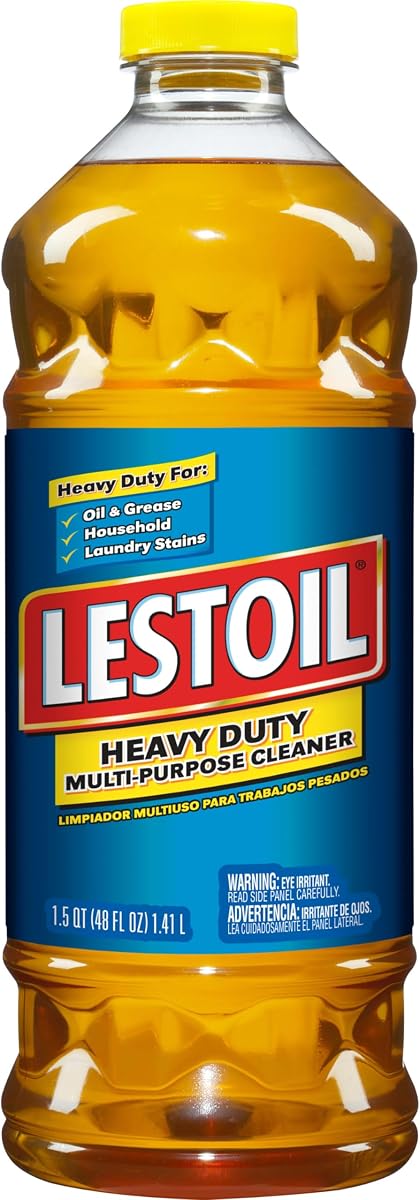
Lestoil Heavy Duty Multi-Purpose Cleaner
4.7Editor score
Highest listed customer rating
Indoor and outdoor cleaning
Suitable for garage floors
Removes tar and fresh paint
Our Concrete Oil Stain Remover guide compares 10 formulas for grease, petroleum stains, driveways, pavers, patios, and garage floors with ease.
Concrete can absorb oil deep into its porous surface, leaving dark, stubborn marks that ordinary sweeping or pressure washing may not remove. An effective concrete oil stain remover combines penetrating cleaning power with a method suited to driveways, garage floors, pavers, patios, stone, asphalt, and other hard surfaces.
We compared ten options by examining their stated cleaning mechanisms, compatible surfaces, ease of use, drying time, rinse requirements, and suitability for fresh or aged oil and grease. The list covers pour-and-dry treatments, pressure-washer concentrates, enzymatic cleaners, powders, and broad-purpose degreasers with different levels of specialization.
Each review explains what distinguishes the product, where it fits best, and which trade-offs matter before purchase. Ratings reflect the supplied customer feedback, while product specifications and use directions come from the listed descriptions. Availability and prices can change, so confirm the current listing and label instructions before buying.
4.7Editor score

4.1Editor score
4.1Editor score
The comparison below shows each product's core cleaning method, strongest application fit, and practical handling features. The award labels identify the top three selections, while the remaining products offer distinct approaches for specialized routines, larger jobs, or different oil-cleaning needs.


CHOMP! Pull It Out is a dedicated concrete oil stain remover built around a deep-penetrating poultice formula. It earns a 4.1 customer rating and stands out for its specific focus on oil and petroleum-based contamination in porous flooring. The 32-ounce container is practical for targeted household jobs rather than maximum-volume commercial work.
We may earn a commission when you buy through this link, at no additional cost to you.
Its central benefit is a low-effort application method. The instructions call for pouring enough formula to cover the stain, allowing it to dry, and then brushing away the chalk-like residue. As it dries, the formula is intended to draw contamination out of the surface, making the cleanup process less dependent on vigorous scrubbing. It is also stated to contain no bleach, acid, or other potentially hazardous materials.
Compatibility is another strength. The product is described for concrete, brick, paver driveways, garage floors, parking lots, and drive-through lanes, including stains from transmission fluid and brake fluid. Concrete composition varies, so no oil-stain product can guarantee identical results on every pour, but the product is explicitly positioned as versatile across different concrete conditions.
This is the most balanced recommendation for a homeowner who wants a dedicated treatment and a straightforward pour-dry-brush process. Its limitations are the need to plan around drying time and the possibility that deeply aged or severe stains require more than one treatment. For those seeking an established, stain-specific option rather than a general household cleaner, it is the leading choice in this guide.
The drying powder is the key part of the workflow: it is intended to pull the oil away from porous material and leave a residue that can be brushed off. This approach is particularly helpful when the goal is to avoid rinsing a large driveway or working a stiff brush repeatedly across the entire area.
The product description specifically highlights transmission fluid, brake fluid, oil, and grease. Those are common sources of marks around driveways and garage work areas, making the formula most relevant where vehicles regularly park, turn, or leak.
We may earn a commission when you buy through this link, at no additional cost to you.
This overnight stain remover uses oil-eating microbes to clean beneath the surface of hard and porous materials. Its 3.8 rating places it among the more moderately rated choices, but its stated mechanism is distinct from ordinary solvent degreasers: the formula is presented as working at a molecular level to separate contamination from concrete and other materials.
We may earn a commission when you buy through this link, at no additional cost to you.
The application is refreshingly simple. Pour a small amount over the stain, allow it to remain until it dries to a powder overnight, and sweep away the residue. No scrubbing or rinsing is required, which is a major convenience for patios, driveways, paver areas, and garage floors where a wet cleanup would add unnecessary work.
The product is described as biodegradable and free of harsh acids, bleaches, and hazardous materials. It is also compatible with concrete, asphalt, brick, stone, patios, and decks. Although oil-eating microbes offer a distinctive approach, actual performance will vary with the age and depth of the mark, and the description appropriately notes that multiple applications may be necessary for severe or older stains.
Choose this option when convenience and an overnight, no-scrub workflow matter more than immediate results. The planning requirement is substantial: the surface must remain undisturbed long enough for drying. It is a practical alternative for homeowners willing to treat stains in a staged process rather than seek same-session cleanup.
The stated microbe-based formula is designed to work below the visible mark, where oil can settle into pores. That makes it worth considering for old garage-floor spots that remain after ordinary surface cleaning.
Once the dried material is ready, cleanup consists of sweeping rather than scrubbing or rinsing. This keeps the process simple, although any loose powder should be collected so it is not tracked back onto the cleaned area.
We may earn a commission when you buy through this link, at no additional cost to you.
Oil Eater Original is a professional-strength, ultra-concentrated cleaner and degreaser with a 4.3 rating. Unlike products dedicated to dry stain treatment, it takes a conventional cleaner approach: dissolving grease, oil, and dirt from washable surfaces. Its one-gallon format and broad application list make it more useful as part of a complete garage or workshop cleaning system.
We may earn a commission when you buy through this link, at no additional cost to you.
The formula is biodegradable, contains no harsh solvents, and is noncorrosive. It is also USDA approved for use at food-service facilities under the stated categories. That combination makes it suitable for users who need a strong degreaser across varied cleanup tasks rather than a product narrowly limited to a single concrete-stain method.
Its listed uses extend across floors, walls, driveways, grills, exhausts, patios, outdoor furniture, tile, boats, automotive wheels, laundry prewash, parts, tools, and carpet stains. This versatility is the main appeal, although concrete oil-stain performance should be considered in the context of ordinary cleaner use rather than the specialized subsurface action claimed by poultice or powdered products.
This is a strong pick for a user who values one product for many cleaning jobs. Follow dilution instructions for the surface and level of soil, and confirm that the concrete can be rinsed after application. It is less convenient for someone who wants to cover a stain, leave it overnight, and sweep away a dry residue without wet cleanup.
The extensive use list lets owners address driveways, floors, grills, tools, parts, and outdoor surfaces with one concentrated product. That makes it easier to stock a utility area than to maintain separate cleaners for every household task.
The ultra-concentrated format can be diluted for different jobs. Using it correctly is important: overly strong dilution may not be necessary, while insufficient dilution may not provide the intended cleaning performance.
We may earn a commission when you buy through this link, at no additional cost to you.
This 128-ounce version of CHOMP! Pull It Out provides the same stain-specific pour-and-dry approach as the smaller model but in a larger container. It is intended for broader jobs on garage floors, driveways, parking areas, and other porous concrete or brick surfaces where a greater quantity of powder may be needed.
We may earn a commission when you buy through this link, at no additional cost to you.
The formula is described as deeply penetrating and effective against oil and petroleum-based stains, including transmission and brake fluid. It uses poultice technology to accommodate different concrete compositions, and its application does not depend on scrubbing. The working sequence is to cover the stain, let the formula dry, and brush away the residue.
A major advantage is convenience for users covering several marks or working over a sizable section of flooring. Repeatedly buying a smaller container would be less convenient, while this format keeps the dedicated formula on hand for future vehicle leaks and maintenance. It also contains no bleach or acid, according to the product description.
The larger size is a poor fit for a small, one-time spot, but it makes sense for garages, driveways, and properties with recurring automotive stains. Buyers should still consider how much of the surface is actually affected, since the powder is applied in targeted patches rather than as a general floor coating.
The 128-ounce container is intended to reduce restocking during repeated or extensive treatments. It gives owners of busy garages and long driveways a practical supply for multiple stains and future maintenance.
The larger size does not change the core process. Pour over the contaminated area, allow the powder to dry, and brush it away, taking care not to disturb surrounding clean concrete unnecessarily.
We may earn a commission when you buy through this link, at no additional cost to you.
This two-pack combines two 32-ounce bottles of CHOMP! Pull It Out, offering a middle ground between a single household container and the much larger 128-ounce format. It carries the same 4.1 rating and uses the same deep-penetrating poultice approach aimed specifically at oil and grease in porous flooring.
We may earn a commission when you buy through this link, at no additional cost to you.
Users pour the formula over a stain, let it dry, and brush the powder away as the contamination is drawn out. The description highlights suitability for driveways, garage floors, parking lots, pavers, brick, and other concrete conditions. It does not contain bleach or acid, and its pour-dry-brush method avoids a separate rinsing stage.
Two separate containers can be useful when one bottle is kept in the garage and another near a driveway, or when the owner wants to manage the risk of carrying a large, heavy container. Conversely, someone dealing with a single compact mark may not need the combined quantity.
This pack is best for households with recurring leaks, several vehicles, or multiple small stain areas that benefit from separate storage locations. It preserves the convenience of a dedicated concrete treatment while offering more flexibility than one standard bottle. Results still depend on the stain's age, depth, and the porosity of the concrete.
Two containers can be divided between an indoor garage and an exterior driveway. That flexibility is especially useful when the exterior product could be exposed to weather before it is ready to be applied.
The pack retains the principal benefits of the original CHOMP! treatment: deep penetration, compatibility with oil and petroleum stains, and cleanup by brushing dried material away rather than scrubbing the surface.
We may earn a commission when you buy through this link, at no additional cost to you.
Krud Kutter Concrete & Driveway Pressure Washer Concentrate is designed for owners who already have a pressure washer or prefer a wet-cleaning workflow. Its 3.8 rating is moderate, but the application method and stated coverage make it a strong option for large residential and commercial hardscape projects.
We may earn a commission when you buy through this link, at no additional cost to you.
The product is advertised as a commercial-strength, fast-acting formula for tough oil and grease stains. Its surface list is extensive, covering concrete, brick, masonry, asphalt, driveways, patios, sidewalks, garage floors, and basement floors. That makes it particularly relevant for property managers, contractors, and homeowners cleaning multiple exterior surfaces rather than one isolated mark.
Instead of requiring mechanical scrubbing, the product is applied and left for three to five minutes so it can penetrate before the area is rinsed clean. A pressure washer can provide the final removal step, although the title also identifies manual use as an option. The formula is described as bleach-free and biodegradable, which can be important when runoff and surrounding landscaping are considerations.
This is the pick for a whole-surface cleaning strategy rather than a dry powder treatment. It requires planning around a three-to-five-minute dwell period and a rinse, but in return it can be integrated with equipment suited to broad concrete, asphalt, stone, and masonry cleanup.
The stated dilution makes one gallon up to 20 gallons of solution, with coverage listed at up to 5,800 square feet. Those figures make the concentrate appealing for large driveways, parking areas, and commercial hardscapes when diluted as directed.
The cleaner is given time to penetrate and then rinsed. A pressure washer can remove residue and surface soil efficiently, making this more suitable for users with suitable equipment than for a completely hands-off cleanup.
We may earn a commission when you buy through this link, at no additional cost to you.
Goof Off FG820 takes a direct approach to embedded oil in concrete. The 32-ounce two-pack has a 4.0 customer rating and distinguishes itself through a simple sequence: pour the liquid onto the stain, let it dry, and sweep away the resulting powder. The listing states that no scrubbing or rinsing is needed.
We may earn a commission when you buy through this link, at no additional cost to you.
The product is aimed particularly at oil spills and drips, making it relevant to garage floors, driveways, parking areas, and similar places where automotive fluids accumulate. Its dry-to-powder format is convenient because cleanup does not require bringing a hose into the treatment area or dealing with a slurry of cleaner and contaminated water.
The two-pack provides a useful amount for repeated maintenance while avoiding the bulk of a gallon container. It may still be more than a shopper needs for one small spot, but having two bottles can be convenient if separate work areas are common or if another mark appears later.
Goof Off FG820 is best for people who value a short, understandable routine and already know the concrete can tolerate the product. Unlike a general-purpose cleaner, it is explicitly marketed for embedded oil and emphasizes a no-scrub, no-rinse dry process. Check the full label for surface guidance and ventilation precautions before application.
The method is immediately understandable: apply, allow the liquid to dry, then sweep. That simplicity makes it easier to treat several small spots consistently and avoid unnecessary scrubbing of the surrounding concrete.
Oil drips and spills are the product's stated targets. It is therefore a natural fit for parking spots, garage work areas, and other locations where fresh or recurring leaks are the main maintenance concern.
We may earn a commission when you buy through this link, at no additional cost to you.
Krud Kutter Original Cleaner Degreaser Spray is a compact, ready-to-use option with a 4.4 rating. Unlike the stain-specific powders and dry treatments in this roundup, its appeal comes from straightforward spraying and a general degreaser format that can fit many household cleaning routines.
We may earn a commission when you buy through this link, at no additional cost to you.
The product description emphasizes an environmentally friendly, water-based formula that is non-toxic, biodegradable, nonflammable, and xylene-free. Those characteristics can make it attractive for users who want a degreaser without the more concerning solvent attributes associated with some traditional cleaning products.
A spray bottle offers good control over application around workbenches, tools, engines, garage floors, and localized oily patches. However, the supplied listing does not describe it as a dedicated concrete-stain treatment, so buyers should follow the product label regarding dilution, dwell time, and surface rinsing. It is best understood as a compact degreaser that can support broader garage maintenance.
This pick suits a homeowner who wants a manageable bottle for routine spot cleaning and values a water-based formula. It may be less suitable than dedicated poultice products for deeply embedded stains that are expected to dry and brush away without rinsing, and its 32-ounce capacity is modest for large concrete areas.
The spray format helps users place cleaner precisely where it is needed. It is especially useful around tools, machine parts, bins, and confined garage corners where a broad pour could spread cleaner over unnecessary surfaces.
The stated water-based, non-toxic, biodegradable, nonflammable, and xylene-free attributes distinguish the formula. Always read the current label for exact use and compatibility instructions before applying it to a driveway or garage floor.
We may earn a commission when you buy through this link, at no additional cost to you.
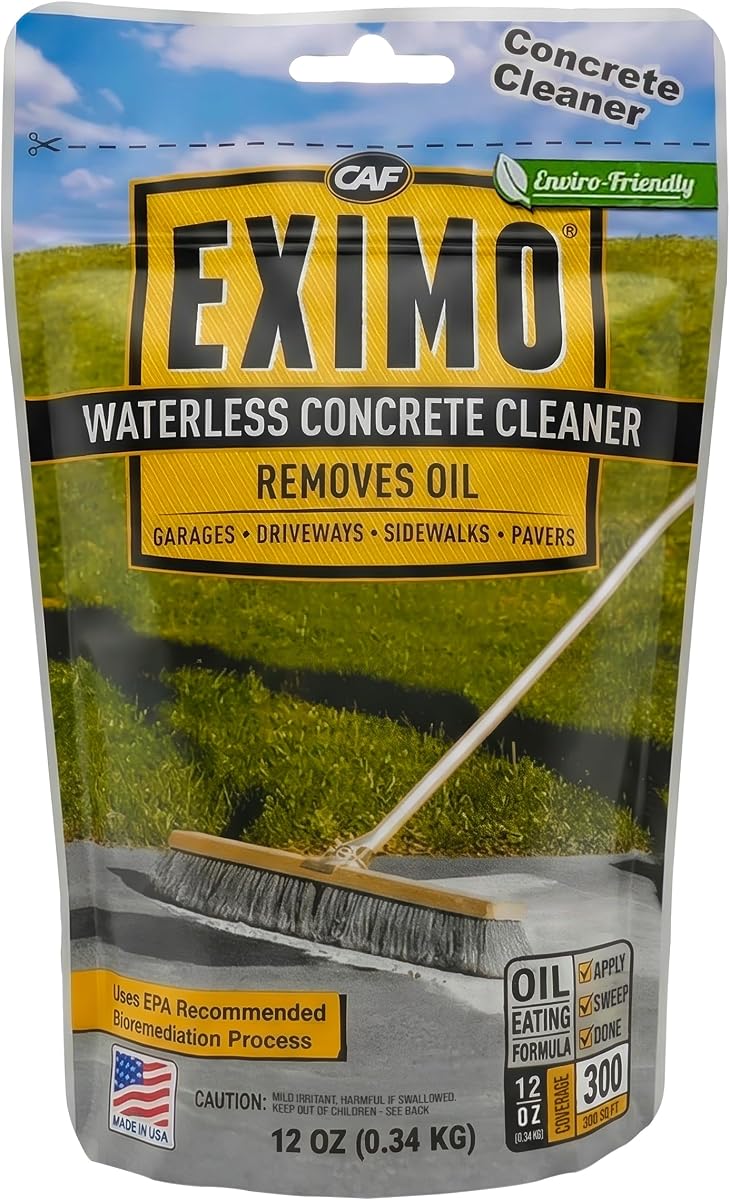
CAF EXIMO is a compact concrete cleaner powder designed to address oil stains and hydrocarbon residue within porous concrete. It has a 4.1 rating and distinguishes itself through a natural breakdown process intended to convert contamination into water and carbon dioxide over time.
We may earn a commission when you buy through this link, at no additional cost to you.
The treatment is explicitly designed for concrete surfaces such as driveways, garage floors, basements, sidewalks, and walkways. Unlike a general degreaser, it focuses on oil contamination that has settled below the surface. This makes it especially relevant to porous concrete where a mark is more than a thin film sitting on top.
Application is exceptionally convenient: the powder is applied directly without mixing or rinsing. Its waterless nature is useful in locations where bringing water to the surface is inconvenient or where runoff needs to be minimized. The compact 0.75-pound container is intended for targeted areas and smaller concrete-cleaning jobs.
CAF EXIMO is a compelling premium choice for a precise, specialized treatment rather than a broad household cleaner. Its natural process requires patience, and the compact package is not intended to blanket an enormous property. For a concentrated patch of embedded oil, however, it offers a clean application method and a clear concrete-specific purpose.
The powder is designed to target oil and hydrocarbon residue within porous concrete. That subsurface focus makes it a logical option for older marks that have become embedded rather than remaining on the top layer.
The product is applied directly in powder form, simplifying both storage and use. No liquid mixing is required, and the stated application does not call for a rinse after treatment.
We may earn a commission when you buy through this link, at no additional cost to you.
Lestoil Heavy Duty Multi-Purpose Cleaner is a 48-ounce amber bottle with a 4.7 rating, the highest customer rating among the products in this guide. It is not marketed as a specialized concrete poultice, but its stated ability to remove stains inside and outside the home makes it a compelling option for routine garage-floor cleanup.
We may earn a commission when you buy through this link, at no additional cost to you.
The product is listed for counters, garage floors, and patios, as well as a variety of stains on clothing when used in the laundry. It also removes tar and fresh paint. This broad range means one bottle can serve several cleaning tasks rather than being reserved for one type of concrete stain.
Its strongest advantage is accessibility and utility. A homeowner can use it for a spill on a garage floor without committing to a dedicated dry treatment that needs to remain undisturbed overnight. It also has the highest rating here, although customer ratings should be considered alongside the product's broader purpose and the instructions for the exact surface.
Lestoil is best for everyday, multi-surface cleaning and localized messes, particularly for buyers who want one useful cleaner around the house. It is less specialized than CHOMP!, CAF EXIMO, or the overnight microbial formula for oil that has penetrated deeply into concrete, but it is a practical choice for common surface maintenance.
Garage floors and patios sit alongside counters and laundry stains in the product's stated uses. This flexibility makes it easy to justify keeping on hand for routine cleanup throughout the home.
Its 4.7 rating is the strongest listed score in the roundup. While it does not replace stain-specific products for every deep concrete mark, the rating supports its value as a broadly useful cleaner for frequent messes.
We may earn a commission when you buy through this link, at no additional cost to you.
The right product depends on the stain's depth, the size of the affected area, the tools available, and how much cleanup you are willing to perform. These factors distinguish dry poultices, microbial treatments, concentrates, powders, and general-purpose degreasers.
Choose a stain-specific formula for stubborn oil, and a versatile degreaser for routine maintenance and surrounding cleanup tasks.
Verify compatibility with the concrete and surrounding materials before selecting a treatment, and follow the product label for sealed or specialty surfaces.
Choose dry cleanup for convenience without water; choose wet cleaning when you already have the equipment and need broad, rinse-based cleaning.
Choose a treatment schedule that fits the site: quick dwell for active cleanup, or overnight drying when patience produces a simpler finish.
Estimate the number and size of marks before choosing a format, then favor a container that fits recurring maintenance without creating unnecessary storage bulk.
Compare the complete safety information, not just a bleach-free or biodegradable claim, and follow the label exactly during application.
Choose a broad cleaner for household utility or a concrete-specific treatment when removing embedded oil is the primary objective.
Select a method you can manage safely with your available equipment, including drying space, runoff control, and cleanup of removed residue.
Begin by identifying the surface, the type of stain, and the product's stated compatibility. Move vehicles, tools, furniture, and loose materials away from the area. Sweep away ordinary dirt and debris so the cleaner is directed at the oil rather than mixed with unrelated soil. Read the full label before opening the container, and wear the protective equipment it specifies.
For pour-and-dry treatments, apply enough formula to cover the mark as directed, keeping the treatment focused on the contaminated area. Block access from foot and vehicle traffic, then allow the required drying period. For overnight products, wait until the formula has become a dry powder; for short-dwell concentrates, follow the stated contact time before rinsing. Do not shorten the wait merely because the visible mark begins to fade.
Remove the residue using the method described by the manufacturer. Brush or sweep dry powder carefully and collect it for appropriate disposal. For wet or pressure-washer methods, direct runoff safely and rinse until the surface is clean. Afterward, keep vehicles and equipment off the area until the surface is fully dry, and inspect periodically because recurring leaks may require another treatment.
For many homeowners, the easiest dedicated treatment is a pour-and-dry formula such as CHOMP! Pull It Out or Goof Off FG820. You cover the stain, allow it to dry, and brush or sweep away the residue without scrubbing or rinsing. Products like Lestoil and Oil Eater are easier to find in a general household cleaning routine, but they use wet cleaning and are not limited exclusively to concrete.
No. Several options in this guide are designed for waterless or dry cleanup, including CHOMP! Pull It Out, Goof Off FG820, and CAF EXIMO. The Krud Kutter pressure-washer concentrate is intended for use with a washer and can be useful for large areas, but pressure washing is optional when a non-equipment method is preferred.
Several products state that they can address both fresh and older stains, but the amount of treatment may vary. The overnight microbial remover notes that severe or older marks may need multiple applications. Older oil that has penetrated deeply may also require more than one product or method, so realistic expectations matter.
No. Bleach is not a requirement, and several listed products are specifically described as bleach-free. CHOMP! Pull It Out also contains no acid according to its description, while the overnight remover uses no harsh acids or bleaches. The correct choice should be based on the product's stated cleaning action and surface compatibility rather than assuming harsher ingredients are automatically better.
The best match depends on the mark and the garage owner's preferred cleanup. A pour-and-dry treatment is convenient where rinsing is difficult, while a pressure-washer concentrate suits larger floors and owners with suitable equipment. A general cleaner such as Lestoil or Oil Eater can also handle routine garage-floor grease along with other household tasks.
Sealing can be considered for ongoing surface protection, but it should not be applied over a stain or damp cleaning residue unless the sealer and cleaner instructions allow it. Allow the concrete to dry fully, remove all powder or rinse residue, and follow the sealer's own preparation requirements. Concrete condition and the desired maintenance routine should guide the decision.
Several products list pavers, brick, stone, asphalt, or masonry among compatible surfaces. However, sealed pavers and mixed materials may behave differently from unsealed concrete. Check the label for each material and confirm whether the area is sealed, and test a small inconspicuous area when the instructions recommend it.
There is no fixed number because stain age, depth, concrete porosity, and product choice all matter. The overnight remover explicitly says multiple applications may be necessary for severe or older stains. Allow the full recommended contact or drying period each time and reassess between applications rather than applying extra product immediately.
CHOMP! Pull It Out is the most balanced overall choice because it targets oil and petroleum stains with a dedicated pour-dry-brush process. Lestoil earns the budget distinction as a versatile cleaner with the highest listed customer rating, while CAF EXIMO stands out for its specialized, waterless powder treatment and focus on contamination within porous concrete.
Prioritize the cleaning mechanism that matches the stain, the compatibility of the formula with your surface, and the cleanup process you can realistically manage. Dry treatments offer convenient residue collection, microbial products suit a patient overnight routine, pressure-washer concentrates serve larger wet-cleaning jobs, and multi-purpose degreasers are useful when one bottle must cover several tasks.
Before ordering, check the current product listing, label directions, package size, customer feedback, and current price. Formulas, packaging, and availability can change, and the right choice also depends on whether you need a small spot treatment, a two-bottle maintenance supply, or enough cleaner for a broad hardscape project.