
MEYULMOL 12V 300Ah LiFePO4 Battery
4.4Editor score
3840Wh rated energy
200A intelligent BMS
App-based status monitoring
4S4P system expansion
5000+ stated deep cycles
Our 12V 300Ah LiFePO4 Battery guide compares capacity, cycle life, BMS protection, monitoring, expansion, and cold-weather performance for every model.
A 12V 300Ah LiFePO4 battery is a substantial deep-cycle energy-storage solution for RVs, boats, solar systems, off-grid projects, and home backup power. The right unit should provide dependable capacity, manageable weight, effective battery management, and protection for the operating environment rather than relying on headline specifications alone.
We compared all ten options by examining usable capacity, rated energy, battery-management protection, cycle-life claims, charging options, low-temperature behavior, physical dimensions, app monitoring, expansion limits, and intended applications. The guide also separates energy-storage batteries from models designed to handle engine-starting surges, an important distinction for mobile installations.
Each review identifies the strongest reason to consider that battery and the compromises a buyer should understand. Rankings reflect the supplied product information and customer ratings, not hands-on testing. Specifications, configurations, availability, and prices can change, so verify the current listing and your system requirements before purchasing.
4.4Editor score

4.8Editor score

4.9Editor score
This side-by-side comparison highlights each battery's rated capacity, protection hardware, monitoring functions, expansion capability, and most relevant use case so buyers can quickly narrow down the right fit for mobile, marine, solar, or backup installations.




The MEYULMOL 12V 300Ah LiFePO4 battery combines a 3840Wh energy rating, a 200A intelligent BMS, and app-based monitoring in a broadly capable deep-cycle package. Its 4.4 rating places it among the stronger customer-rated options in this group. The most attractive element is not one isolated specification but the combination of monitoring, protection, expansion, and installation flexibility at a comparatively accessible tier.
We may earn a commission when you buy through this link, at no additional cost to you.
The supplied information describes a battery built with automotive-grade A-class cells and a rated capacity of 300Ah. Its BMS protects against overcharge, over-discharge, overcurrent, and short circuits, while a 0°C charging cutoff helps reduce the risk of lithium plating in freezing conditions. The mobile app is said to report real-time capacity, voltage, current, and operating temperature for both Android and iOS users.
Expansion is another major strength. Each unit supports a 4S4P arrangement, allowing a single-battery installation to grow toward 48V and 1200Ah when properly configured and supported by the rest of the system. The listing also cites a commitment of more than 5000 deep cycles and a lifespan of up to 10 years, although the product title uses a different cycle figure. Buyers should therefore rely on the manual and current listing for the precise rating rather than treating the headline as a guaranteed test result.
This is a compelling option for an RV, solar project, off-grid cabin, or home backup installation that values remote telemetry and room to scale. The main caution is that users still need a compatible charger, correct wiring, ventilation, and secure mounting. With those requirements met, it is our Best Budget selection and a well-balanced recommendation for serious deep-cycle use.
The app can expose capacity, voltage, current, and temperature without requiring additional monitoring hardware. That visibility makes it easier to identify charging problems, abnormal draw, and changing battery condition in an RV or stationary storage system.
Four-series and four-parallel support gives owners a practical migration path. A smaller array can begin as a 12V installation and later become a higher-voltage, higher-capacity system, provided wiring, fusing, balancing, and charger selection are upgraded accordingly.
We may earn a commission when you buy through this link, at no additional cost to you.
This 12V 300Ah lithium LiFePO4 battery earned a 4.9 rating, the highest in the supplied group, and differentiates itself with a dual-mode BMS. One mode treats it as a deep-cycle energy-storage battery, while another delivers high-rate starting current. That versatility makes it particularly interesting for RVs, boats, and mobile systems that want one battery to serve both energy storage and engine-starting duties.
We may earn a commission when you buy through this link, at no additional cost to you.
The listed instant current of 1500A is the headline feature, but it should be understood within the context of a properly designed electrical system. A high surge rating does not eliminate the need for correctly sized cables, a compatible starter circuit, fusing, and careful battery placement. The battery also includes a 200A BMS with protection against overcharging, over-discharge, overcurrent, short circuits, and temperature extremes.
Real-time app monitoring covers voltage, current, power, state of charge, and cycle count. That is a more detailed telemetry set than many competing listings describe. The battery also supports expansion from one unit to sixteen matching batteries in a 4P4S arrangement, with a stated maximum of 61.44kWh and 40.96kW. It accepts solar, generator, or a specified 14.6V 70A LiFePO4 charger, providing useful flexibility across off-grid installations.
We recommend this model for buyers who specifically value a combined starting and storage solution and are prepared to configure the electrical system professionally. It is our Best Premium pick because the combination of surge power, monitoring, protection, and scaling is unusually complete. It should not be selected solely for starting without confirming starter load, cable length, and manufacturer requirements.
The dual-mode control can simplify installations that otherwise need separate starting and house-power batteries. That consolidation is useful when space and weight are limited, although each mode should still be evaluated against the vehicle or vessel's actual electrical load.
Voltage, current, power, state of charge, and cycle-count data provide a useful operational picture. This makes the app more than a convenience feature, particularly for owners who need to track consumption, charging behavior, and battery usage over time.
We may earn a commission when you buy through this link, at no additional cost to you.
The SUPER EMPOWER 12V 300Ah LiFePO4 battery is a 4.7-rated model built around 3840Wh of energy, a 200A BMS, and a five-year warranty. It targets RV, camper, boat, solar, marine, trolling-motor, off-grid, and emergency-backup users who want one high-capacity battery without an extensive list of optional integrations.
We may earn a commission when you buy through this link, at no additional cost to you.
Its integrated BMS monitors voltage, current, and temperature while providing protection against overcharge, over-discharge, overcurrent, short circuits, and temperature-related conditions. Cold-weather operation receives particular attention: charging pauses below 0°C, discharge stops at -20°C, and operation resumes above 5°C. These are important controls for RVs, marine systems, and other installations exposed to seasonal temperature changes.
The stated dimensions are 15.35 by 7.59 by 9.84 inches, and the listed weight is 58.4 pounds. Those figures are helpful when planning a battery compartment, but the manufacturer explicitly advises checking compartment size and system compatibility first. A battery can have suitable electrical ratings and still be difficult to secure, ventilate, or connect safely in a crowded installation.
SUPER EMPOWER is a strong choice for buyers who prioritize a clear warranty, mainstream deep-cycle use cases, and thoughtful cold-weather controls without needing app telemetry. The absence of listed phone monitoring is the clearest trade-off against several competitors. If your installation is mobile or exposed to changing conditions, this model offers a balanced and practical feature set.
Automatically pausing charge below 0°C reduces exposure to one of the most common LiFePO4 installation risks. The separate discharge and resume thresholds also show attention to preserving usable capacity while allowing the battery to recover in warmer conditions.
The published size and weight help buyers eliminate obviously unsuitable setups, but a successful installation also needs clearance, secure retention, cable bend space, and proper ventilation. Measure the compartment and compare it with the manual before ordering.
We may earn a commission when you buy through this link, at no additional cost to you.
The PUPVWMHB 12V 300Ah battery combines a 200A BMS, app monitoring, and an unusually high stated system ceiling of 61.44kWh. Its 4.5 rating and broad range of RV, solar, boat, camper, and off-grid uses make it a credible choice for buyers planning substantial energy storage rather than a single portable battery.
We may earn a commission when you buy through this link, at no additional cost to you.
App connectivity is used to report current, voltage, temperature, and cycle information, allowing remote observation of operating status. The battery also includes a cold-temperature cutoff, while the 200A BMS is described as guarding against overcharge, over-discharge, overcurrent, and short circuit. The supplied information also discusses cell-level safety and the stable chemistry of lithium iron phosphate, but buyers should distinguish general chemistry benefits from specific certification or testing claims.
The standout feature is expansion. Matching batteries can be connected in series and parallel to reach 1200Ah, 51.2V, 61.44kWh, and a stated maximum load of 40.96kW. A system of this scale requires carefully engineered cables, bus bars, fusing, disconnects, charge controllers, inverter compatibility, and ventilation. Capacity expansion alone does not guarantee a safe or balanced installation.
This model is best for a planned solar or stationary storage project that can grow over time and whose owner values app visibility and a five-year warranty. It is less compelling for a simple installation where the full expansion potential will never be used. Ensure that all interconnected units are compatible and configured according to the manufacturer's current instructions.
The stated 61.44kWh ceiling is meaningful for owners building a dedicated solar or backup system. It should be treated as a configuration target rather than a blanket guarantee, because the complete system must also support the voltage, current, charge profile, and safety requirements of that scale.
Built-in communication lets a phone display current, voltage, temperature, and cycle information. This reduces the need to add a separate battery monitor, although app compatibility and connection procedures should be confirmed before installation.
We may earn a commission when you buy through this link, at no additional cost to you.
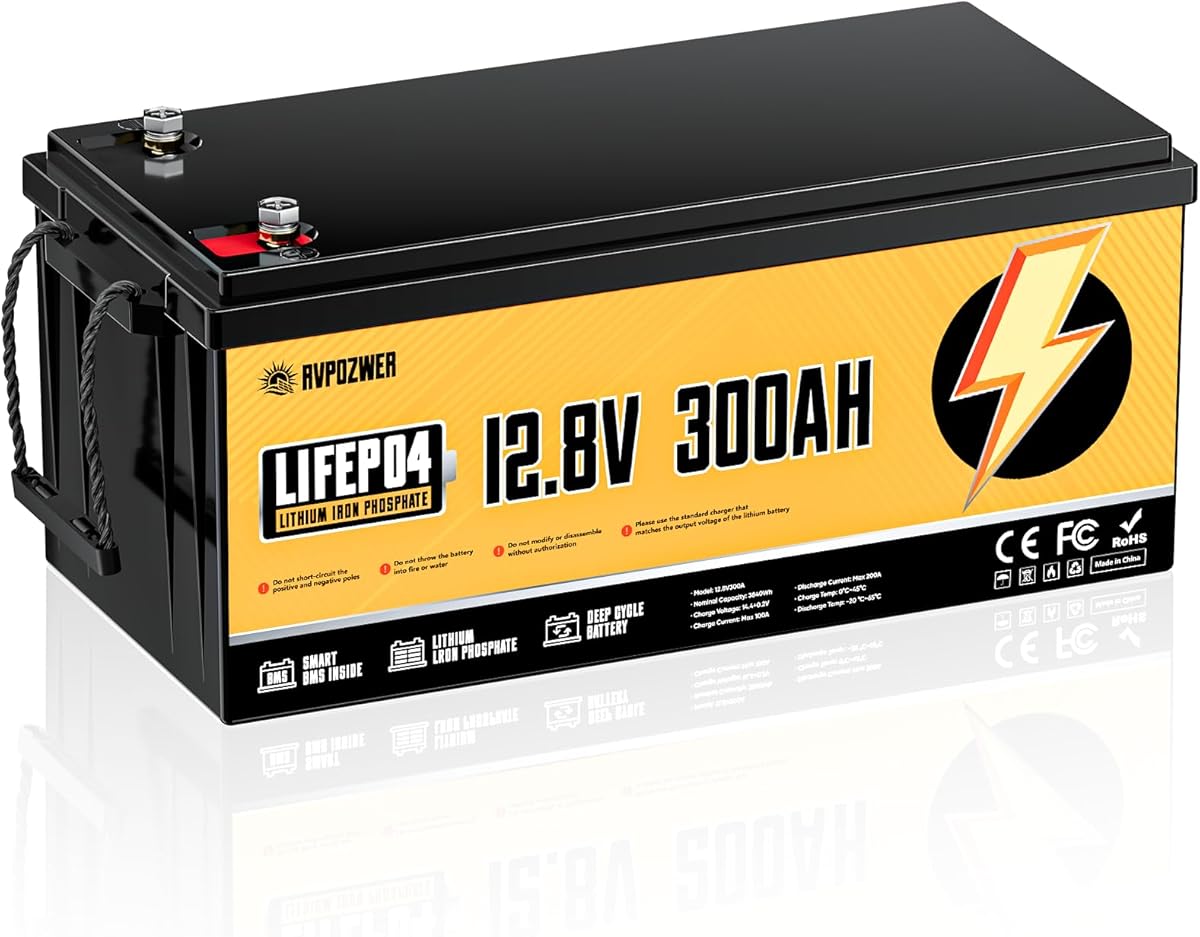
The Rvpozwer 12V 300Ah LiFePO4 battery is rated 4.0 by customers and distinguishes itself with detailed cycle-life figures tied to different depth-of-discharge levels. It offers 4000 cycles at 100% DOD, 6000 at 80% DOD, and as many as 15000 at 60% DOD, giving buyers a more nuanced view of expected longevity than a single headline number.
We may earn a commission when you buy through this link, at no additional cost to you.
Its 3840Wh energy capacity and 200A Smart BMS make it suitable for RV appliances, trolling motors, solar systems, boats, campers, and off-grid storage. Protection includes overcharge, over-discharge, overcurrent, overvoltage, and short-circuit management. The battery is also described as meeting Group 31 dimensions, a useful clue for replacement planning, though buyers should still compare the complete case and terminal layout.
The product information lists a 15-year lifespan, while the cycle claims vary with discharge depth. These claims should be understood as manufacturer specifications rather than independently verified test results. Actual longevity depends heavily on charge discipline, temperature, depth of discharge, current, cell matching, and whether the battery is operated within its recommended parameters.
This is a good option for users who plan moderate-depth daily cycling and want a large expansion ceiling. The 4.0 rating is the lowest in this list, so paying close attention to current customer feedback is advisable. It remains attractive for off-grid and mobile systems because of the smart BMS, broad operating range, ergonomic handle, and stated 4S4P flexibility.
The different figures for 100%, 80%, and 60% DOD illustrate why cycle specifications need context. Running only part of the advertised capacity is presented as extending cycle life, so buyers should align their expected daily use with the operating pattern described in the manual.
Group 31 dimensions can simplify replacement planning in many installations. Terminal positions, cable clearance, weight, and battery-box fit still need confirmation, because a dimensional standard does not guarantee identical layouts across every product.
We may earn a commission when you buy through this link, at no additional cost to you.
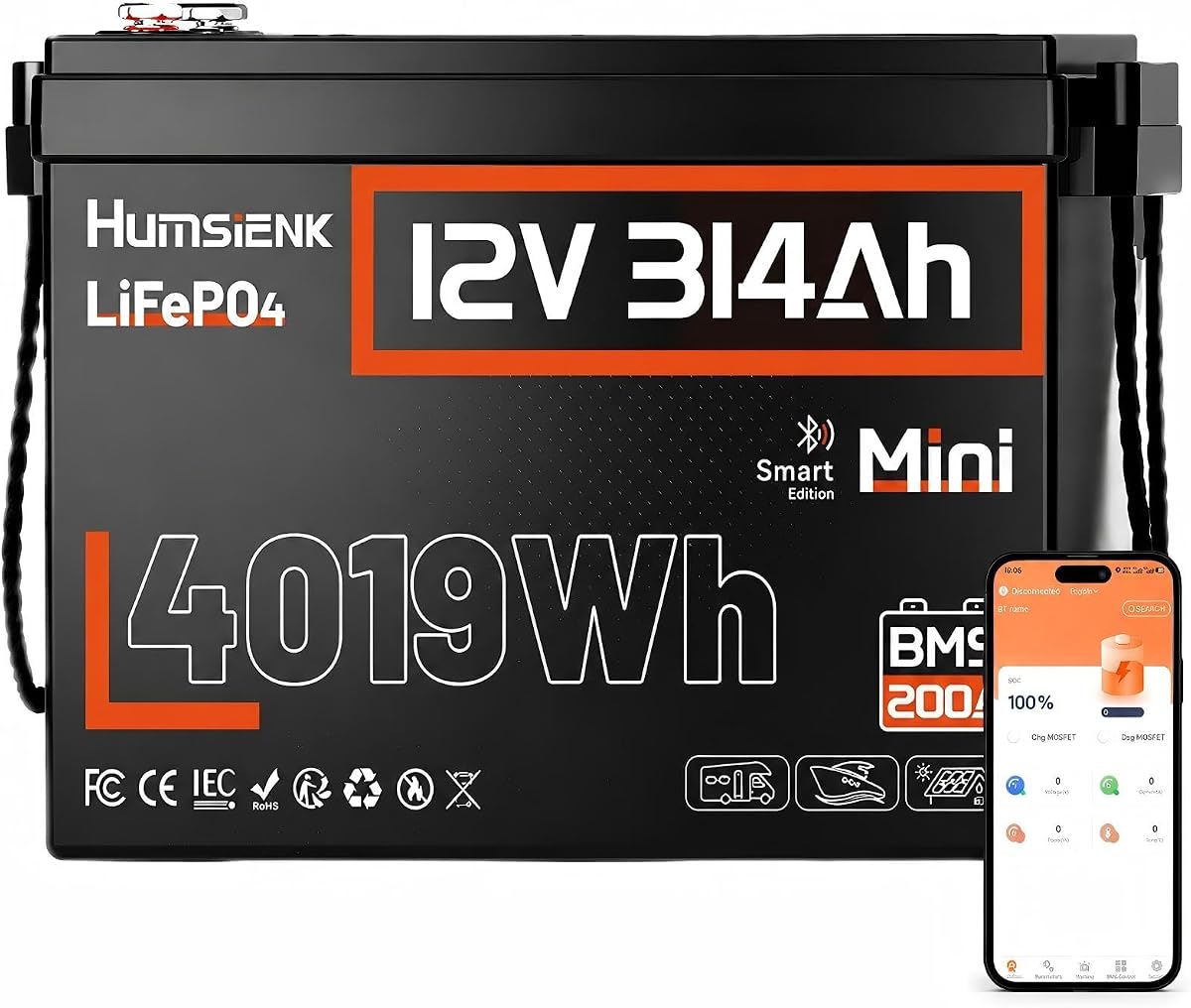
The HumsiENK 12V 300Ah, marketed as 314Ah, is designed around a high energy rating, a 200A BMS, and a compact 59.5-pound format. It receives a 4.4 customer rating and offers app-based monitoring, making it a strong candidate for RVs, boats, solar systems, and tight off-grid installations where space matters.
We may earn a commission when you buy through this link, at no additional cost to you.
The listing describes 4.01kWh of usable energy in one place and 4.19kWh in another, while the product title identifies the battery as 4019Wh. Those differences may reflect nominal and usable-capacity conventions, but the figures should be confirmed in the technical manual. The stated 15,000-plus-cycle claim at 60% DOD also depends on the same operating assumptions discussed in the buying guide.
Its full-aluminum internal frame is intended to add structural strength and resist swelling, while an ABS case provides the outer enclosure. The 200A BMS includes low-temperature charging cutoff, high-temperature cutoff, and standard electrical protections. Bluetooth monitoring reports voltage, current, capacity, and temperature from a stated range of 15 meters, although the supplied information describes app availability differently for iOS and Android.
HumsiENK is best for space-conscious owners who want high capacity, monitoring, and a five-year coverage period. The battery can be expanded to four in series and four in parallel, with a listed maximum of 51.2V, 1256Ah, and 64.3kWh. It is also suitable for marine use, UPS backup, trolling motors, golf carts, and houseboats, subject to equipment and charging compatibility.
The 15.1 by 9.7 by 7.6-inch listed dimensions may help owners replace multiple smaller batteries with one enclosure. The benefit is strongest when the compartment can accommodate the stated footprint and weight without restricting terminals, airflow, or access to connections.
Phone-based visibility is useful for quick checks near the battery, including during installation and routine maintenance. The stated 15-meter range is not intended to replace remote cloud monitoring over substantial distances.
We may earn a commission when you buy through this link, at no additional cost to you.
The Vatrer Power 12V 300Ah LiFePO4 battery carries a 4.6 rating and offers a useful combination of deep-cycle storage and starting capability. Its 200A BMS protects against overcharge, over-discharge, overcurrent, and short circuits, while a high-temperature cutoff prevents charging above 167°F and low-temperature protection reduces charging in cold conditions.
We may earn a commission when you buy through this link, at no additional cost to you.
Automotive-grade LiFePO4 cells are used to provide high energy density, rapid charging and discharging, and strong cycle performance. The listing states more than 5000 cycles and says the service life is eight to ten times that of standard lead-acid batteries. It also states that the unit weighs 30% less than an equivalent lead-acid battery, a major practical benefit in RVs, boats, and camper installations.
The ability to mount the battery in different positions is useful because lithium iron phosphate chemistry contains no acid. Nevertheless, orientation does not remove the need to follow terminal, ventilation, retention, and charging instructions. The battery can also be expanded to four in series and four in parallel, which supports larger solar and off-grid systems.
This is an attractive all-in-one option for owners who want fewer batteries in a mobile installation and value the combined storage-and-starting role. Confirm that starter current, cable sizing, and the manufacturer's mode instructions suit the vehicle or vessel. It earns a place in the roundup as a flexible, well-rated choice without app-based monitoring.
Combining house-energy storage and starting support can reduce installation space and simplify some RV or marine layouts. The electrical design must still preserve appropriate conductor sizing and protection for the higher starting load.
A stated 30% weight advantage over comparable lead-acid capacity can improve handling and reduce the burden on vehicle or trailer capacity. It does not make the battery light, so secure mounting and safe lifting procedures remain necessary.
We may earn a commission when you buy through this link, at no additional cost to you.
The 12V 300Ah, 314Ah deep-cycle LiFePO4 battery is rated 4.6 and is especially notable for its stated IP65 water resistance. That makes it a logical option for fishing, boating, marine electronics, ice-fishing setups, RVs, solar storage, residential systems, and other outdoor installations where moisture resistance is valuable.
We may earn a commission when you buy through this link, at no additional cost to you.
Its enhanced BMS manages overcharging, over-discharging, low-temperature charging, overcurrent, and short circuits. It also activates automatic balancing when voltage exceeds 14.1V, intended to help connected batteries remain at a similar state of charge. The listing states a cycle life often exceeding 6000 cycles at 80% depth of discharge, which makes it a strong option for regularly cycled off-grid systems.
At the same nominal capacity, the battery is described as having roughly one-third the weight of lead-acid. It can power small trolling motors when the stated power does not exceed 2kW, but the product information explicitly says it is not suitable for starting gasoline engines, golf carts, or jacks. That clear limitation makes it a dedicated energy-storage product rather than a universal replacement for every lead-acid battery.
Buyers should also follow the stated maintenance guidance of charging and discharging the battery once every six months to prevent damage from disuse. The reading-variation note is normal for batteries measured under different conditions. This is a strong choice for moisture-prone outdoor storage, especially for owners who do not need a starting function.
The IP65 rating gives this model a notable advantage in wet or exposed environments. It should still be protected from prolonged submersion and installed with terminals, ventilation, and wiring arranged according to the manual.
This battery is expressly not designed to start gasoline engines, golf carts, or jacks. That restriction reduces ambiguity and makes it easier to select for applications centered on deep discharge rather than surge-heavy starting.
We may earn a commission when you buy through this link, at no additional cost to you.
The TEMGO 12V 300Ah LiFePO4 battery combines a 4.8 customer rating, a 200A BMS, and Bluetooth app monitoring. It is particularly compelling for marine, RV, camper, travel-trailer, and off-grid users who want meaningful capacity without the substantial weight associated with many lead-acid banks.
We may earn a commission when you buy through this link, at no additional cost to you.
At 54.67 pounds, it is listed at roughly one-third the weight of a same-capacity lead-acid battery. That makes handling and placement easier in mobile installations. The battery can be mounted in any position according to the listing and can be expanded to ten units in parallel or four in series within a 4P4S arrangement, allowing it to serve either a larger 12V bank or 24V, 36V, and 48V systems.
The BMS provides protection against overcharge, over-discharge, overcurrent, overheating, and short circuits, while a low-temperature cutoff helps prevent charging damage in cold conditions. Bluetooth gives the owner quick access to battery information through the app. The listed shell material is recycled post-consumer ABS, and the product information notes that measurements can vary by 1% to 5% due to temperature, instruments, and operating conditions.
TEMGO is our Editor's Choice because it balances customer feedback, weight, monitoring, protection, and expansion in an especially useful mobile-oriented package. The main weakness is the stated one-year service period, shorter than the five-year coverage offered by several competitors. It is still a highly appealing option for buyers who prioritize portability and everyday visibility.
The listed 54.67-pound weight is meaningful in an RV, boat, or camper where a group of lead-acid batteries can become difficult to handle. A proper rated strap or tray is still required to prevent movement during travel.
Built-in Bluetooth lets users consult the app for operating information without adding a separate monitor. It is particularly handy for checking a battery during setup, troubleshooting a circuit, or monitoring a system before a trip.
We may earn a commission when you buy through this link, at no additional cost to you.
The Paoweric 12V 300Ah/330Ah LiFePO4 battery is a 4.4-rated model with a notable 6S6P expansion ceiling. This makes it a candidate for larger solar, RV, emergency-lighting, UPS, marine, fire-safety, and home-storage systems where owners may eventually want a 72V-class array rather than being limited to 48V.
We may earn a commission when you buy through this link, at no additional cost to you.
Its 200A BMS provides five listed protections: overcharge, overvoltage, over-discharge, overcurrent, and short circuits. The listing states more than 10,000 cycles and a lifespan of more than 10 years when properly charged and stored according to the manufacturer's recommendations. It also describes automotive-grade LiFePO4 cells, high energy density, and a size of roughly one-third that of a same-capacity lead-acid battery.
The wide 6S6P range offers considerable design flexibility but also raises the bar for installation quality. A high-voltage battery bank requires compatible charge controllers or chargers, correctly rated series cables, fusing at appropriate points, isolation where needed, and a system designed to handle high fault currents. The manufacturer also advises against connecting batteries from other brands, which is sensible because unmatched units can create imbalance.
Paoweric is a good fit for a planned system in which future expansion matters more than app-based convenience. Its capacity choices and long stated service life reinforce that positioning. The absence of listed phone monitoring and the complexity of a six-series installation mean it is better suited to technically confident buyers than to a simple one-battery setup.
Six-series support distinguishes this model from the more common four-series alternatives. It can support larger high-voltage architectures, provided every connected device, charger, conductor, and protection device is rated for the resulting system.
Using the same brand and model as the manufacturer recommends reduces the risk of capacity and state-of-charge mismatch. Even matched batteries need correct series wiring, parallel distribution, and a suitable charging profile.
We may earn a commission when you buy through this link, at no additional cost to you.
The best 12V 300Ah LiFePO4 battery is not determined by capacity alone. Match the battery's starting, storage, monitoring, temperature, physical, and expansion characteristics to the electrical demands of your RV, boat, solar system, or backup installation.
Most 300Ah LiFePO4 batteries are deep-cycle energy-storage units, but a few listings also advertise a starting mode or integrated starting capability. Engine starting produces a brief, very high current demand, while household and solar use emphasizes repeated, deeper discharge over many hours. The battery that advertises a 1500A surge or dual-mode BMS may suit a combined installation, while products expressly restricted to energy storage should not be used to start gasoline engines, golf carts, or similar equipment. Match the battery to the load rather than assuming every 12V battery is interchangeable.
A 300Ah battery at a nominal 12.8V corresponds to approximately 3.84kWh before accounting for usable energy, losses, temperature, and cutoff behavior. Some listings advertise 314Ah or 330Ah alternatives, while others quote 4.01kWh or 4.19kWh. These variations may reflect different measurement conventions, so compare the manufacturer's nominal voltage, rated amp-hour capacity, recommended operating range, and usable energy rather than relying on the most dramatic number. The battery must also be large enough for the load's daily consumption and the inverter or charger's continuous rating.
A quality BMS is essential because it manages cell balance, charging, and abnormal conditions. All ten options advertise 200A or enhanced protection systems, but the listed functions differ. Look for overcharge, over-discharge, overcurrent, short-circuit, overvoltage, and temperature protection. Some models also describe automatic balancing or low/high-temperature charging cutoffs. The 200A label is a protection or discharge-related rating rather than permission to pull 200A continuously without checking the inverter, wiring, cooling, and manufacturer recommendations.
Low-temperature charging protection is especially important for RV, marine, and outdoor systems. Many models pause charging below 0°C, and some allow discharge to a lower threshold, often around -20°C, before stopping. The thresholds and resume points vary. A battery that is safe to discharge in cold weather may still not be safe to charge while its cells are below the permitted temperature. Confirm whether a built-in heater exists, whether charging requires an external heated environment, and how the BMS resumes operation after temperatures recover.
App monitoring can provide real-time voltage, current, capacity, power, temperature, state of charge, and cycle information. Bluetooth is convenient for nearby setup and troubleshooting, while cellular or remote access may be preferable for a remote cabin or stationary solar site. App convenience should remain secondary to electrical compatibility and safe operation. Confirm phone-platform support, connection range, whether additional hardware is required, and how the app presents alerts before relying on it as a central management tool.
Most products support four units in series and four in parallel, producing a potential 48V-class system. One model advertises 6S6P support, allowing a higher 72V-class architecture. Expansion limits matter if your energy requirements are likely to grow, but a larger ceiling also increases system complexity. Use matching batteries, maintain equal cable lengths, install suitable fusing and disconnects, and confirm that the inverter, charge controller, and wiring are rated for the final voltage and power. Never mix different models merely to fill an open slot.
Published weights range from 54.67 to 59.5 pounds in the supplied information, while dimensions vary by model. A lighter battery can be much easier to install in an RV, boat, or camper, yet weight alone does not guarantee a secure fit. Measure the compartment, terminal spacing, cable bend radius, ventilation, and access to disconnects. Confirm the battery can be restrained against movement and installed in the permitted orientation while preserving the manufacturer's safety clearances.
Cycle claims range from more than 5000 to 15000 or more, often tied to different depth-of-discharge levels. A deeper daily discharge generally reduces cycle life, so compare equivalent test conditions rather than the largest headline number. Warranty coverage also varies, with several products offering five years and one citing a one-year service period. Technical support and a clear manual are useful because setup, firmware, BMS behavior, and cell balancing can all affect long-term performance.
Before installation, read the current manual, identify the battery's positive and negative terminals, and verify that your charger, inverter, solar controller, and load devices support a 12V LiFePO4 charging profile. Use cables, breakers, disconnects, and terminal hardware rated for the expected current and wire length. Mount the battery securely, protect the terminals from accidental contact, and provide ventilation and service access consistent with the manufacturer's instructions.
Charge the battery with a compatible LiFePO4 charger and observe its temperature restrictions. Never charge below the stated low-temperature cutoff unless the manufacturer provides an approved heating solution. Avoid leaving the battery deeply discharged for long periods, and establish a regular inspection routine that checks terminal condition, state of charge, voltage, temperature, physical damage, and the readings reported by the app or meter.
For long storage, follow the manual's recommended state of charge and maintenance schedule. One included product guidance recommends charging and discharging at least once every six months to prevent damage from disuse, while other products may provide slightly different instructions. When connecting multiple units, use the same brand and model, maintain symmetrical wiring, follow the required series and parallel order, and recheck every connection before energizing the system.
A nominal 12V 300Ah battery stores approximately 3.84kWh of nameplate energy. Actual usable energy is lower because of conversion losses, temperature, inverter draw, wiring losses, and the BMS cutoff. The amount available to a load also depends on whether the battery is configured as one 12V unit or part of a larger series-parallel bank.
No. Some models in this roundup explicitly support a starting function, while others are intended only for energy storage. Check the product manual and listing for engine-starting approval, surge current, BMS mode, and required cable sizes. Using an energy-storage-only battery as a starter can create unsafe electrical conditions or trigger protection.
Most support a 4S4P arrangement, while one listed model supports 6S6P. Expansion requires identical batteries, correct equal-length cabling, suitable fusing, compatible chargers, and an inverter or controller rated for the final voltage and power. Mixing brands, capacities, or ages can create imbalance and cause the BMS to disconnect the bank.
Charging a cold LiFePO4 cell can cause lithium plating, which may permanently damage the battery. Most models in this list include a low-temperature charging cutoff around 0°C, so charging pauses until conditions are safe. The manual should be checked for exact cut-off and resume temperatures, and an approved heated-storage solution may be required in cold climates.
The 200A figure describes a major component of the battery's current-management and protection capability. It does not automatically mean every installation should continuously draw 200A. Inverter output, cable size, fusing, temperature, and manufacturer guidance must all support the actual load you intend to place on the battery.
The listed claims vary considerably, and many are tied to a particular depth of discharge. A 15000-cycle claim at 60% depth of discharge does not mean the same battery will deliver 15000 full-depth cycles. Compare equivalent conditions, use a compatible charge profile, and avoid treating a manufacturer cycle claim as an independently guaranteed result.
App monitoring is helpful but not essential for safe operation. It can simplify state-of-charge checks, reveal abnormal current, and help with troubleshooting. A properly wired system with a trustworthy voltmeter or battery monitor can still function effectively, so buyers should prioritize electrical compatibility, BMS quality, and protection before considering connectivity features.
Use a charger designed for a 12V LiFePO4 battery and confirm its charge voltage, current, temperature rules, and operating mode against the battery manual. Lead-acid chargers may use an inappropriate absorption stage, and oversized charging current can stress the internal cells or wiring. A compatible solar controller or generator charging arrangement is also necessary for off-grid systems.
The MEYULMOL model stands out as the Best Budget option because it combines 3840Wh of energy, a 200A BMS, app monitoring, and 4S4P expansion in a balanced package. The TEMGO battery earns the Editor's Choice designation for its strong customer rating, light listed weight, Bluetooth controls, and mobile-friendly design, while the dual-mode battery takes Best Premium thanks to its starting capability, detailed telemetry, and extensive expansion ceiling.
The remaining models are compelling when particular details matter. SUPER EMPOWER emphasizes warranty coverage and cold-weather charging behavior, PUPVWMHB targets larger planned systems, Rvpozwer provides detailed depth-of-discharge cycle figures, HumsiENK emphasizes compact high-capacity packaging, Vatrer Power supports combined starting and storage roles, the 314Ah model offers IP65 water resistance, and Paoweric provides the broadest listed series expansion.
Before ordering, verify current specifications, charger compatibility, physical clearance, temperature limits, warranty terms, and the intended starting or storage role. Prices and product configurations can change, so check the live listing at the time of purchase. The right choice is the battery whose electrical design, protection, dimensions, and operating requirements fully match your installation rather than simply the model with the largest headline number.