
ANYCUBIC Photon Mono 4
4.4Editor score
7-inch 10K monochrome display
17×17-micron XY resolution
6.04×3.42×6.49-inch build
Resin printers for dental and jewelry detail are specialized tools for producing accurate models, patterns, guides, and masters from light-sensitive liquid materials. The right machine must balance fine pixel resolution, reliable curing, adequate build space, and workflows that suit professional models, prototypes, castable patterns, and small-batch production.
This guide compares ten relevant resin printers and materials using the specifications supplied by each manufacturer, including resolution, build volume, speed features, material compatibility, and intended dental or jewelry applications. It covers both complete printers and purpose-formulated resins, because equipment alone cannot deliver a successful result without a suitable material and compatible post-processing workflow.
The selections show how a high-resolution desktop printer, a production-oriented large-format system, and specialized dental or castable materials serve different needs. Ratings and specifications reflect the supplied product information, while availability and pricing can change. Readers should confirm current resin settings, safety requirements, and compatibility before purchasing.
4.4Editor score

4.0Editor score
4.0Editor score
As an Amazon Associate we earn from qualifying purchases.
The following comparison places the three printers and seven complementary dental, castable, and jewelry resins side by side. It highlights the differences in resolution, working volume, cure characteristics, precision, and intended use so readers can distinguish a complete production system from a specialized material solution.


The ANYCUBIC Photon Mono 4 is a desktop MSLA-style resin printer built around a 7-inch 10K monochrome display. Its supplied rating is 4.4, and the headline 9024×5120 resolution translates to 17×17-micron pixels on the X and Y axes. That combination makes it a compelling general-purpose option for jewelry masters, dental study models, character models, and other work where small features and clean edges matter.
We may earn a commission when you buy through this link, at no additional cost to you.
Its LighTurbo matrix light source is intended to provide stable, balanced, and uniform illumination across the LCD area. Uniform exposure is important for dental and jewelry work because uneven curing can exaggerate layer lines, obscure fine ornamentation, or leave a model with inconsistent surfaces. The print platform uses a laser-engraved texture to improve adhesion, which is particularly useful when printing multiple small parts on one plate.
The build volume of 153.4×87×165 mm provides enough room for a tall jewelry tree, a dental arch model, or several small pieces without moving into a much larger machine. Four-point leveling reduces early setup work, and the resume function can help preserve a long job after a power interruption. The trade-off is that the Photon Mono 4 does not include the remote monitoring, advanced automation, or large-batch features found on higher-end production systems.
This is the most balanced selection for a new buyer, independent jewelry designer, dental technician, or educator who wants meaningful resolution in a manageable desktop format. It is particularly appropriate for users who will pair the printer with a separately acquired castable, dental, or high-detail model resin. For high-volume laboratories or organizations requiring centralized printer management, a more advanced system would be a better fit.
The 17×17-micron pixel size and uniform matrix lighting target the type of small geometry seen in jewelry settings, ornamental textures, and dental model surfaces. Stable exposure across the screen also supports repeatability when producing related parts that must look and fit consistently.
Four-point leveling, a textured platform, and power-restoration resume reduce common sources of early frustration. The machine is therefore a practical entry point for users who want a streamlined setup without paying for a production-oriented platform.
We may earn a commission when you buy through this link, at no additional cost to you.
Siraya Tech Cast True Blue is not a printer but a 500g castable resin for use with compatible LCD DLP SLA machines. It carries a 4.5 rating and is especially relevant to jewelry makers and dental users who need printable patterns for later casting. The product’s defining advantage is its wax content, which is intended to make burning and cleanup easier than with many non-wax-based casting resins.
We may earn a commission when you buy through this link, at no additional cost to you.
According to the supplied information, the resin burns more easily and cleanly than Siraya Tech Cast Purple and leaves less ash. That characteristic is valuable for bracelets, medals, coins, large pendants, metal components, and other thicker designs where a conventional casting resin may be more difficult to eliminate completely. True Blue also produces a bright, smooth surface that helps reveal fine details before the model enters the casting process.
The material is described as softer than Cast Purple, easier to print, capable of quick curing, and effective at maintaining plate adhesion. Its compatibility with most LCD DLP SLA printers makes it accessible to owners of different equipment brands, although users should verify their specific printer, wavelength, and resin settings before beginning a production job.
This resin is best suited to makers who already own a compatible printer and want a smoother, easier-to-burn alternative for jewelry patterns or dental metal parts. It does not solve the cost or complexity of selecting and maintaining a printer, and castable work still demands careful cleanup, burnout, and casting procedures. Within that specialized category, however, it offers a clear benefit through cleaner burn-out behavior and high surface quality.
Wax content helps the printed pattern burn out more readily and leave less residue. This is especially useful when a design contains thick sections that would otherwise retain material longer and complicate the casting process.
The blue color and high-resolution formulation help operators inspect fine textures and sharp features. A smooth green model can also reveal printing or preparation problems before the pattern is committed to a casting workflow.
We may earn a commission when you buy through this link, at no additional cost to you.
The Phrozen Sonic Mighty Revo is a high-resolution resin printer with a 16K LCD, a 10.1-inch display, and a listed XY pixel size of 14×19 microns. Its supplied rating is 4.0, and the central advantage is a combination of fine detail, a relatively tall build area, and workflow tools intended for professional environments.
We may earn a commission when you buy through this link, at no additional cost to you.
Dual linear rails and an aluminum frame help minimize vibration and maintain alignment during longer jobs. The 211.68×118.37×235 mm build volume is large enough to accommodate a tall jewelry tree, larger dental models, or several parts in a batch. This gives it more flexibility than a compact hobby platform without expanding to the footprint of a large industrial machine.
Integrated calibration assistance, resin feeding, failure detection, and Phrozen GO app support add value for users who need to monitor jobs or coordinate multiple machines. The manufacturer notes that minor manual adjustment may still be required depending on setup conditions and experience. That caveat is reasonable for a precision system, because a guided workflow should support rather than replace careful leveling, material preparation, and test prints.
The Mighty Revo is our Editor’s Choice for users who want a complete printer designed around professional detail and manageable remote operation. It suits jewelry studios, dental laboratories, and advanced hobbyists who will use several specialized resins and produce repeatable batches. Those who only need occasional models and want the simplest possible setup may find a more basic desktop printer easier to justify.
The Phrozen GO app supports progress monitoring, real-time updates, and control of multiple printers. These features are particularly useful for studios that need to coordinate several jobs, maintain consistent schedules, or reduce the chance that a failed print goes unnoticed.
Dual linear rails and the aluminum frame help limit movement and vibration. In practical terms, that supports repeatable placement of fine features and gives tall batches a more stable mechanical foundation.
We may earn a commission when you buy through this link, at no additional cost to you.
JAMG HE Temporary Dental Resin is a 500g, 405nm material designed for temporary crowns, bridges, and related dental models. No customer rating was supplied for this product, so its evaluation here rests on the stated formulation and application data. Its primary attractions are tooth-like color, high hardness, low stated shrinkage, and compatibility with most 405nm DLP LCD printers.
We may earn a commission when you buy through this link, at no additional cost to you.
The resin is formulated to reproduce fine details and maintain dimensional stability, with the supplied information listing shrinkage as low as 0.2%. After curing, the material has a stated stiffness of 80–90D. These characteristics are relevant when a printed model needs to hold delicate details, fit closely, and survive polishing, capping, or other finishing work without excessive deformation.
The material also allows for printing at nearly three seconds per layer, according to its description. This is a material-specific claim rather than a universal printer-speed guarantee, so users should still follow the manufacturer’s profile and validate results on their own equipment. The natural tooth-like appearance makes the printed form easier to evaluate during fitting and finishing.
This resin is a strong choice for dental technicians and clinics that need temporary restorations or detailed demonstration models, particularly when low shrinkage and fast curing are priorities. It is not a printer and cannot be evaluated as a complete production system. It should be selected after confirming the printer’s wavelength, build area, and recommended exposure parameters.
The low stated shrinkage helps printed features remain close to the intended dimensions. That is important for crowns, bridges, diaphragms, and other structures where a change in fit can affect the usefulness of the finished model.
A fast intended cure can improve throughput, while the 80–90D hardness and smooth finish support polishing and capping. Users should still complete the recommended secondary curing and surface treatment before clinical evaluation.
We may earn a commission when you buy through this link, at no additional cost to you.
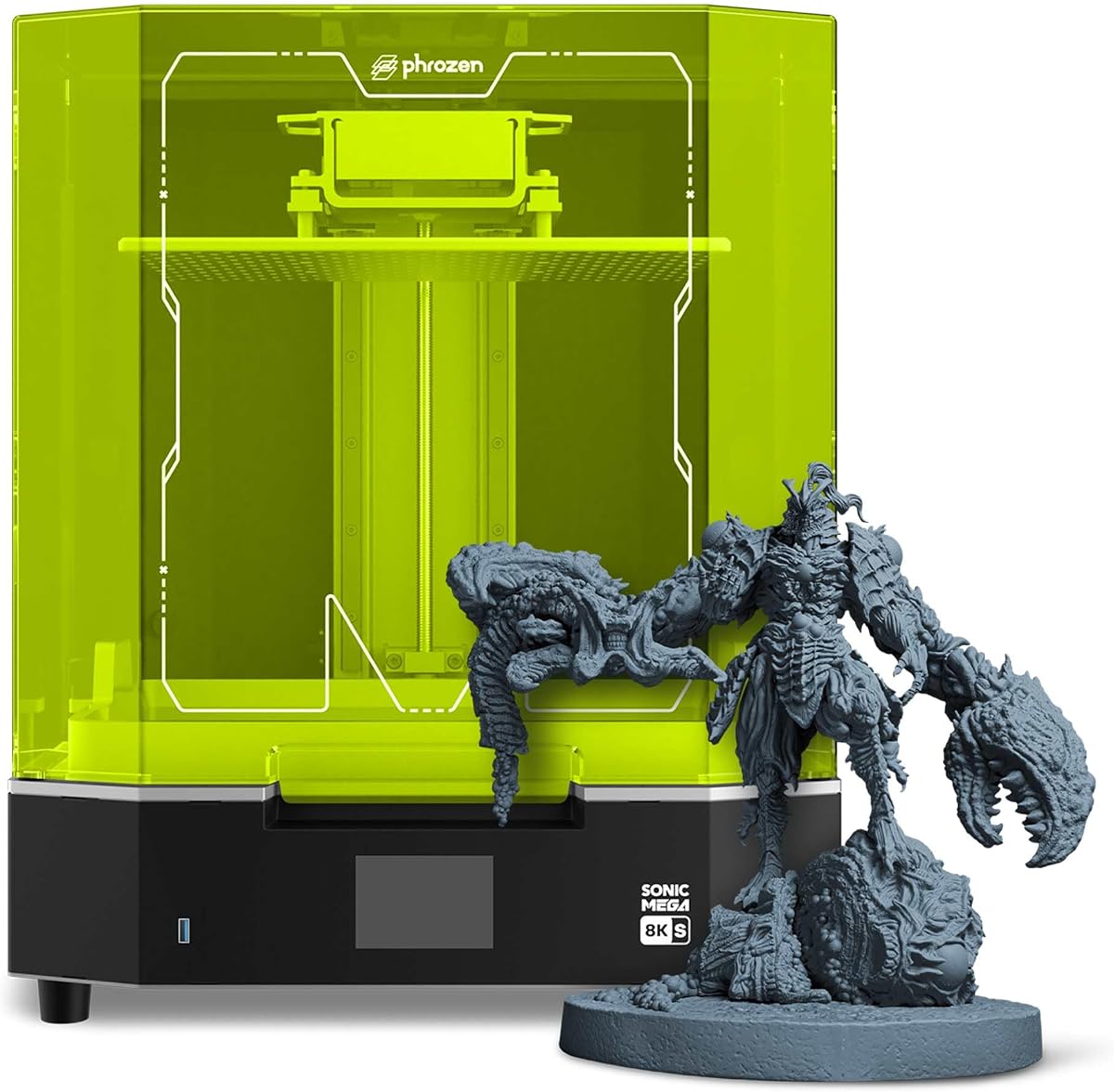
The phrozen Sonic Mega 8K S is a large-format MSLA resin printer with a 15-inch 8K monochrome LCD, a 43-micron XY resolution, and a build platform measuring 12.99×7.28×11.81 inches. Its supplied rating is 4.0, while its distinguishing strengths are production throughput, access around the machine, and the ability to print sizable batches of dental prototypes or jewelry masters.
We may earn a commission when you buy through this link, at no additional cost to you.
The supplied information states that the printer can produce 80 detailed one-thirty-second-scale miniatures in under 90 minutes when used with TR300 resin. It also describes speeds up to ten times faster than standard mid-size printers with the advanced All-Cutter Fluoropolymer film and TR300 high-speed resin. While real output depends on geometry and settings, the platform is clearly designed for repeated cycles rather than isolated hobby prints.
A lift-up lid reduces the vertical and lateral clearance required for loading and unloading, which can make the system more practical in a compact production area. The integrated metal drip hanger allows the build plate to be hung after printing so excess resin can drain back into the vat. That feature can simplify cleanup, reduce mess, and support material recovery during busy production schedules.
The Sonic Mega 8K S is the premium choice for professional studios, larger dental laboratories, and jewelry operations that need batch capacity and fast turnaround. Its physical size and specialized high-speed workflow may be excessive for occasional small jobs, but the 8K display and broad platform offer a clear production advantage when the equipment is used consistently.
The large build platform makes it possible to place many related components in a single job. For dental labs or jewelry studios, fewer platform changes and shorter production cycles can simplify scheduling compared with repeatedly using a small desktop printer.
The built-in metal drip hanger provides a convenient place to drain the build plate after a job. This supports a cleaner workspace and can recover uncured resin before post-processing begins.
We may earn a commission when you buy through this link, at no additional cost to you.
JAMG HE Dental Castable Resin is a 500g casting material for dental crowns, frames, implant restorations, and related metal patterns. The product has a supplied rating of 4.5 and distinguishes itself through a stated low shrinkage rate of 0.85–1%, an ash-free casting process, and compatibility with most brands of 405nm LCD DLP printer.
We may earn a commission when you buy through this link, at no additional cost to you.
Low shrinkage is important because a casting pattern that changes dimensions during curing can create a poor fit in the final restoration. The material is positioned for professional dental work, where accuracy and repeatability are more consequential than creating a visually attractive raw print. Its UV photopolymer formulation is described as suitable for LCD RGB, monochrome, and DLP systems operating at 405 nanometers.
The ash-free casting claim is another important benefit. A cleaner burnout can reduce impurities in the cast result and simplify the transition from a printed pattern to a finished restoration. That advantage only materializes when the user follows a suitable curing, cleanup, burnout, and casting process, so laboratory protocols remain essential.
This resin is best for dental technicians and labs already equipped with a compatible printer and casting workflow. It is a targeted material rather than a general-purpose model resin, making it more relevant to restorative applications than to decorative models. Teams should validate the printed pattern against their own equipment and casting process before using it for critical clinical work.
The low stated shrinkage helps preserve dimensions through curing and casting. This makes the resin a practical choice for crowns, frames, and implant patterns where fit is a central requirement.
Support for common 405nm LCD and DLP systems means many existing resin printers can be used. Users should still confirm the manufacturer’s profile, exposure settings, and material-handling requirements before production use.
We may earn a commission when you buy through this link, at no additional cost to you.
JAMG HE Dental Guide Resin is a clear, 500g material designed for surgical guides, crown and bridge models, orthodontic models, and implant models. It carries a supplied rating of 4.5. Its most distinctive feature is transparency, which allows a dentist or surgeon to see the underlying anatomy and the position of the guide while working.
We may earn a commission when you buy through this link, at no additional cost to you.
The material is formulated to resist cracking and withstand drilling and tapping. After UV curing, its stated hardness reaches up to 83D, giving the finished guide enough rigidity to retain functional geometry while remaining workable during preparation. The transparent formula also improves visibility, which is valuable when a clinician needs to inspect alignment or make adjustments during a procedure.
The supplied information states that the cured resin can withstand high-temperature sterilization and disinfection without compromising its integrity. It also emphasizes low shrinkage, sharp detail, and dimensional stability. These qualities make the material more focused than a standard model resin: it is intended for functional guides and prosthetic applications rather than only visual models.
This resin is a strong choice for dental practices and laboratories already using compatible resin equipment and experienced with guide preparation and sterilization. It should be considered as part of a clinical workflow that includes proper design, printing, curing, cleaning, and sterilization. The material can improve visibility and handling, but it does not replace careful case planning or technical judgment.
The transparent resin allows the user to observe the guide and underlying structures rather than working around an opaque shell. That visibility can support positioning, inspection, and adjustment during dental procedures.
A stated cured hardness of up to 83D supports drilling, tapping, and polishing without easy cracking. The material therefore balances the visibility of a clear resin with the rigidity needed for a functional guide.
We may earn a commission when you buy through this link, at no additional cost to you.
The ELEGOO Mars 4 Ultra is a 7-inch 9K monochrome MSLA printer with a supplied rating of 3.7. Its 8520×4320 display produces 18-micron XY pixels, placing it firmly in the detail-oriented desktop category used for jewelry models, dental masters, and small precision parts.
We may earn a commission when you buy through this link, at no additional cost to you.
Built-in Wi-Fi is one of its most useful workflow features. It supports 2.4GHz and 5GHz networks with stated transfer speeds of 6–10Mbps, allowing files to be moved without a cable. A Linux operating system, 4GB of memory, and a 4-inch HD IPS touch screen further support a self-contained setup and easier file navigation.
The printer includes four-point leveling, a laser-carved build surface, and a new ACF release liner with lower release tension. Together, these features aim to make adhesion and layer separation more reliable, including at faster printing speeds. The monochrome LCD is protected by 9H hardness tempered glass, which is important for a surface exposed to repeated cleaning and maintenance.
The Mars 4 Ultra is most appealing to users who prioritize file convenience, clean presentation, and solid fine-pixel resolution without moving to a large production system. Its relatively narrow build width limits oversized parts and extensive batches, and its lower supplied rating suggests a less proven customer history than some alternatives. Even so, it remains a capable option for detail-oriented learning, prototyping, and small professional workflows.
Dual-band Wi-Fi reduces cable management and can simplify the transfer of print files from a computer. The included screen and operating system make it easier to manage files directly on the machine.
The ACF film is designed to reduce release tension and improve separation at higher speeds. Combined with the textured platform, it supports more dependable printing of small jewelry components and delicate dental details.
We may earn a commission when you buy through this link, at no additional cost to you.
Antinsky Standard Dental Model Resin is a 1kg beige material for crown and bridge models, orthodontic models, implant models, and other dental print applications. Its supplied rating of 4.6 is the second-highest among the materials in this guide, making it one of the strongest choices for users seeking established customer feedback.
We may earn a commission when you buy through this link, at no additional cost to you.
The cured resin has a stated hardness of 88D, a smooth surface, and resistance to heat up to 100°C. It is also described as supporting long-term storage, corrosion resistance, tapping, and polishing. These physical properties make it relevant for models that will be handled repeatedly, inspected from different angles, or exposed to processes beyond initial printing.
Low volume shrinkage is another stated benefit, helping preserve dimensional stability and close fits. The material can capture subtle features and is suitable for removable tooth models. It is compatible with most 405nm DLP LCD printers and has a stated printing target of two to three seconds per layer, although actual performance depends on geometry and the selected profile.
This resin is a practical everyday choice for dental labs that repeatedly print study models, implant models, orthodontic pieces, and other working forms. It is not a castable material, so users seeking metal-restoration patterns should choose a dedicated casting resin instead. For non-metal dental modeling, however, its heat resistance, rigidity, and surface finish make it a versatile option.
An 88D cured hardness and smooth surface help the model withstand tapping, polishing, and routine use. The stated 100°C thermal resistance is useful for workflows that involve heat beyond standard room-temperature model inspection.
The one-kilogram package and rapid layer target suit labs printing multiple models over time. Low shrinkage supports dimensional consistency across common crown, bridge, orthodontic, and implant-model designs.
We may earn a commission when you buy through this link, at no additional cost to you.
Antinsky Castable Dental Smart Resin is a one-kilogram green resin for dental implant restorations, frames, and crowns. With a supplied rating of 4.8, it has the highest customer rating among the ten products included. It is designed for 395–405nm LCD and DLP equipment and is reported to have been tested on the Saturn 3 Ultra.
We may earn a commission when you buy through this link, at no additional cost to you.
Its stated linear shrinkage rate of 0.85–1.05% is intended to preserve accuracy through the printing and casting stages. The formulation contains 30–40% wax and is claimed to leave less than 0.5% ash after high-temperature burnout. A low-residue pattern is desirable because trapped ash or impurities can interfere with the quality of the final casting.
Low viscosity of 50–170 cps at 25°C supports fast infiltration and curing, while reduced adhesion and release forces can help separate the printed pattern from the build surface. The green model has a stated Shore D hardness of 85–88 and high tensile, bending, and impact strength, allowing it to be cleaned and handled before casting.
This is the strongest specialist choice for dental labs that already have a mature burnout and casting process. The supplied standard exposure range of 2.5–3.5 seconds, with 25–30 seconds for bottom layers, provides a useful starting point, but users should validate those values with their specific printer, geometry, and test patterns. The material’s rating and low-ash claim make it an attractive option for consistent, high-quality casting workflows.
A stated ash residue below 0.5% reduces the amount of nonmetal material expected to remain after burnout. This supports smoother casting outcomes and is particularly valuable for detailed implant and frame patterns.
A Shore D hardness of 85–88 gives the green pattern enough strength for cleaning and handling. The low-viscosity formulation also supports quick infiltration and can reduce force at the build plate during separation.
We may earn a commission when you buy through this link, at no additional cost to you.
Choosing the right resin printing system involves balancing physical resolution, usable build space, material behavior, workflow needs, and post-processing requirements. The following factors are especially important for dental and jewelry work, where fine details, dimensional stability, and repeatable results affect the usefulness of the finished part.
Pixel size is one of the most visible specifications, but it should not be treated as the only measure of detail. The Photon Mono 4 uses 17×17-micron pixels, the Sonic Mighty Revo uses 14×19-micron pixels, the Mars 4 Ultra offers 18-micron resolution, and the Sonic Mega 8K S uses 43-micron pixels. Optical performance, light uniformity, motion, layer height, and resin formulation also influence whether tiny features actually appear in the finished print.
Build volume determines whether a project can be produced as designed and how many parts can share a platform. The Mono 4 provides 153.4×87×165 mm, while the Sonic Mighty Revo reaches 211.68×118.37×235 mm. The Sonic Mega 8K S offers a much larger 12.99×7.28×11.81-inch platform for substantial batches. Height is also important because tall jewelry trees need room above the base layer, while dental arches need sufficient width and depth.
A printer and resin must work together. Most materials listed here support 405nm systems, while the Antinsky castable resin specifies 395–405nm compatibility and reports testing on the Saturn 3 Ultra. Standard model resin, temporary dental resin, surgical guide resin, and castable resin have fundamentally different functions and should not be treated as interchangeable. Check the printer wavelength, software profiles, and resin instructions before ordering.
Shrinkage is especially important in dentistry because printed structures must reproduce anatomy, fit, and drill paths accurately. The listed materials range from the JAMG HE temporary resin’s stated 0.2% shrinkage to castable formulas at approximately 0.85–1.05%. A lower percentage can reduce dimensional error, but geometry, orientation, exposure, cure conditions, and the user’s calibration also influence the result. Validate shrinkage using representative prints rather than relying on a single specification.
Dental and jewelry workflows often require washing, curing, removing supports, inspecting, and finishing. Castable materials add burnout and casting stages, while guide resin may need cleaning and sterilization. A machine with easy plate access, manageable draining, and a comfortable working area can make these steps safer and more repeatable. The Sonic Mega 8K S includes a metal drip hanger, and the build platforms across the printer selections use textured or laser-engraved surfaces to aid adhesion.
Automation matters most when several machines or long jobs are involved. The Sonic Mighty Revo offers assisted calibration, failure detection, resin feeding, and remote monitoring through Phrozen GO. The Mars 4 Ultra includes Wi-Fi transfer, a Linux operating system, and a touch interface. The Mono 4 emphasizes four-point leveling and power-restoration resume. These features differ in sophistication, so buyers should distinguish simple convenience from genuine multi-printer management.
Small features can be lost when vibration, loose leveling, or an unstable frame moves the platform. The Sonic Mighty Revo uses dual linear rails and an aluminum frame to minimize vibration and maintain alignment. Other systems rely on four-point leveling, textured platforms, and release films to improve repeatability. Reliable performance also depends on correct exposure, stable room conditions, clean resin, and regular maintenance, so no machine should be expected to compensate for poor preparation.
All resin workflows involve uncured liquid, fumes, UV exposure, and post-processing chemicals. Dental and jewelry professionals should work in a suitable ventilated area, use gloves and eye protection, and follow the safety guidance for the printer, resin, cleaner, and waste disposal. Printed dental objects and guides should be validated against the relevant clinical and laboratory requirements. A high customer rating or precise specification does not replace material testing, quality control, or professional judgment.
Begin with a clean, level work area and install the printer on a stable surface with adequate ventilation. Confirm that the build platform and vat are clean, the film is free of scratches or trapped particles, and the resin is the correct formulation for the machine. Level the platform according to the manufacturer’s procedure, load a correctly oriented and supported model, and perform a test print before producing dental or jewelry-critical parts.
After curing, remove the part without forcing it from the platform, wash it with a compatible cleaner, and complete the recommended UV or thermal post-curing. Inspect the model under magnification for layer lines, incomplete features, trapped supports, and dimensional problems. Use gloves and eye protection during handling, and dispose of waste resin and contaminated cleaning materials in accordance with local requirements rather than ordinary household waste.
For castable patterns, follow the resin manufacturer’s curing, draining, burnout, and casting schedule, using a test pattern to validate the cycle before processing valuable work. For dental guides, use the prescribed cleaning and sterilization method and retain the guides only if they pass visual and functional inspection. Keep the LCD, vat, film, platform, and vat window clean, and routinely check leveling, exposure, resin temperature, and build-plate alignment to maintain consistent results.
Fine XY pixel specifications are generally preferable for small jewelry details, although light uniformity, layer height, and the chosen resin also matter. The 14–19-micron options in this guide offer a strong starting point for intricate work. Print a representative test model and inspect it under magnification before relying on a particular machine for production.
Resin printers can be used to print dental models, temporary restorations, guides, and castable patterns when the material is specifically formulated for that application. The JAMG HE temporary resin, guide resin, and Antinsky castable resin target different parts of the workflow. Clinicians should follow validated laboratory procedures, applicable regulations, and the material manufacturer’s instructions.
No. Compatibility depends on wavelength, printer architecture, resin profile, and manufacturer recommendations. Most products here mention 405nm support, while the Antinsky castable resin specifies 395–405nm compatibility and reports testing on a Saturn 3 Ultra. Always check the printer manual and resin instructions before using a new material.
Model resin is generally used for accurate, durable study models, prototypes, and appearance models. Castable resin is engineered to burn out cleanly and leave minimal ash before molten metal replaces the printed pattern. The castable product also needs a suitable burnout and casting process, so it is not a drop-in substitute for standard model resin.
No. Build volume affects the size and quantity of parts, while resolution, alignment, light uniformity, calibration, and material behavior determine quality. A large printer can be valuable for batches, but a smaller high-resolution unit may produce more detailed individual parts. Choose the machine that matches both your part size and workload.
Print a geometry that can be measured accurately, cure it under the recommended conditions, and compare it with the source design. Repeat the test across several samples and settings because orientation, exposure, and printer calibration can affect results. The listed shrinkage figures are useful comparisons, but they should be validated in the actual production environment.
Yes. Uncured resin and some cleaning or post-processing materials can irritate skin and eyes, while certain workflows produce fumes. Use a properly ventilated work area, gloves, eye protection, and suitable containers for waste material. Follow the safety data sheets supplied with the printer, resin, cleaner, and other chemicals.
The printers can create detailed printed jewelry models or masters, but direct final-use suitability depends on the specific resin, regulations, and application. Many jewelry workflows use a castable resin and then create a metal piece through casting. A professional should confirm material safety, durability, and customer requirements before offering printed pieces for direct wear.
The ANYCUBIC Photon Mono 4 stands out as the best balanced desktop choice, combining a 10K display, fine pixel dimensions, a useful build volume, and straightforward setup. The Phrozen Sonic Mighty Revo is the strongest all-around professional system for users who value fine detail, remote workflow control, and a roomier platform. The phrozen Sonic Mega 8K S takes the lead for large batches and production throughput.
The specialized materials complete the equipment picture. Siraya Tech Cast True Blue emphasizes smooth jewelry surfaces and cleaner burn-out, while the JAMG HE range covers temporary models, surgical guides, and dental casting. Antinsky provides both a heat-resistant standard model resin and a highly rated castable option for implant, frame, and crown patterns. Choose based on the final part, required accuracy, and post-processing process rather than display resolution alone.
Before ordering, verify the current printer specifications, resin compatibility, build dimensions, safety provisions, and application-specific requirements. Ratings and prices can change, and current availability should also be checked. A well-chosen printer paired with a proven material and a controlled workflow will usually deliver more consistent results than an expensive machine used with an unsuitable resin or poorly validated settings.