
PRV Audio 6MB200-4 v2
4.6Editor score
4 ohm impedance
200 watts power handling
Designed for small enclosures
A 6.5 inch mid bass speaker fills the important space between conventional full-range drivers and dedicated subwoofers. The best models reproduce warm upper bass, vocal fundamentals, drums, and instrument detail with enough impact for a satisfying upgrade without taking over the lowest frequencies.
The products in this guide were compared using their published specifications and supplied product details. We examine power handling, impedance, sensitivity, voice-coil design, frequency range, mounting requirements, and the environments each speaker is designed to serve, covering options for cars, professional systems, and compact custom installations.
Each review identifies the strongest use case for the driver while also noting practical trade-offs. Ratings and technical details reflect the information available for this November 2026 guide, but product availability, configurations, and prices can change, so confirm the current listing and your amplifier requirements before buying.
4.6Editor score

4.7Editor score

4.3Editor score
As an Amazon Associate we earn from qualifying purchases.
This side-by-side comparison highlights each driver's power rating, impedance, sensitivity, and intended installation environment, making it easier to identify a model that matches your enclosure, amplifier, and listening priorities.



The Skar Audio FSX65-4 is a 6.5-inch, 4-ohm midrange loudspeaker with a 4.6 rating and a clear 300-watt maximum and 150-watt RMS power specification. It is aimed at builders seeking a conventional pro-audio midrange driver that can handle more output than an entry-level full-range replacement while remaining straightforward to match to common amplifiers.
We may earn a commission when you buy through this link, at no additional cost to you.
Its most appealing feature is the balance between the listed power handling and 92.5 dB sensitivity. The 1.5-inch ferrite-magnet voice coil provides a substantial motor structure, while the solid-composition paper dust cap gives the driver a traditional pro-audio character. A single-speaker package also gives installers flexibility when odd quantities are needed for a custom layout.
The main limitation is that the FSX65-4 is sold individually, so a conventional stereo installation requires two purchases. Its supplied information does not provide a specific frequency-response range or detailed enclosure dimensions, so installers should verify those points against their design. Those omissions do not undermine its value, but they make careful planning more important.
This is a strong choice for a straightforward pro-audio midrange build, a custom cabinet, or a car-audio upgrade where a 4-ohm driver and moderate power rating are desired. It is especially suitable for buyers who want a recognized pro-audio format without moving immediately to the most specialized high-excursion designs in the list.
The 150-watt RMS figure gives installers a useful baseline for amplifier selection, while 4-ohm impedance works with many common multi-channel amplifiers. An amplifier should still be matched to the full planned load and enclosure requirements rather than selected from peak-power marketing alone.
The paper dust cap and ferrite-magnet motor place the FSX65-4 firmly in the traditional pro-audio category. That design direction is appropriate for vocals, upper bass, and punchy midrange reinforcement in a carefully planned system.
We may earn a commission when you buy through this link, at no additional cost to you.
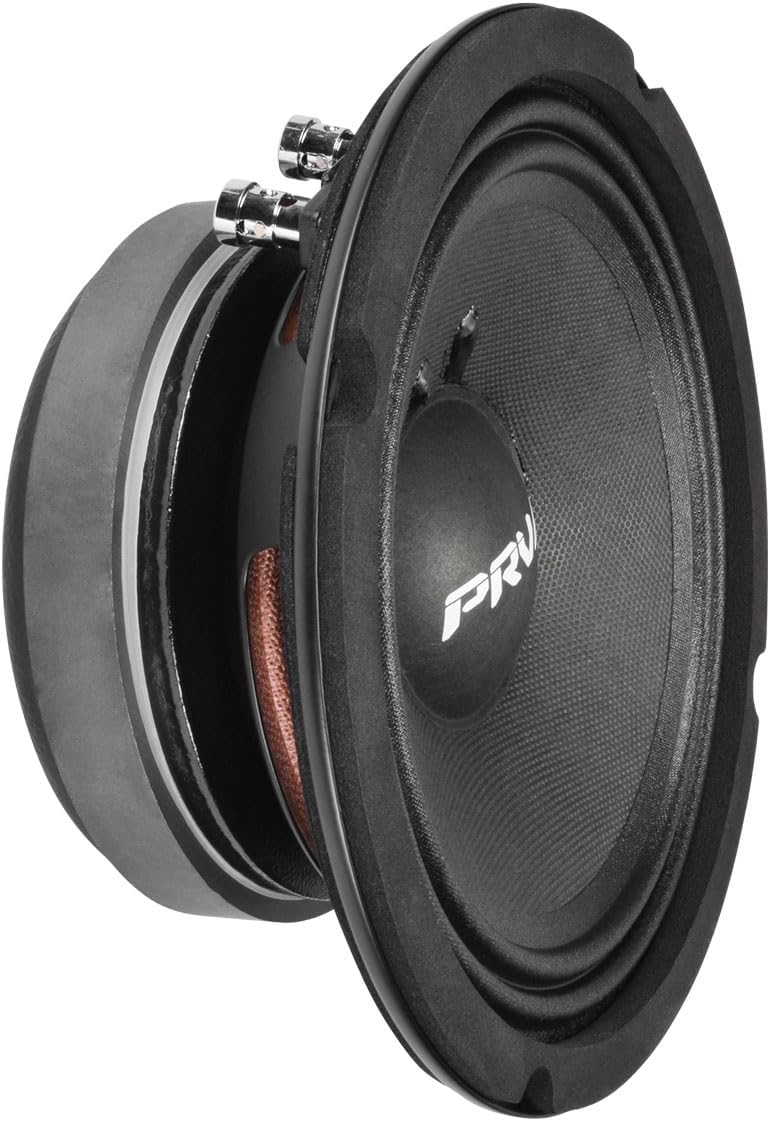
The PRV Audio 6MB200-4 v2 combines a 4.6 rating with a 200-watt power-handling figure, 93.5 dB sensitivity, and a 1.5-inch voice coil. It is a focused midbass driver designed to add depth, vocal presence, and controlled punch to car-audio systems, particularly when enclosure space is limited.
We may earn a commission when you buy through this link, at no additional cost to you.
The natural paper cone and double-roll surround are central to the product's character. Rather than being designed solely as a conventional full-range replacement, the 6MB200-4 v2 is optimized for midbass impact and strong vocals. Its stated suitability for small custom enclosures makes it a practical option for door panels, rear-deck builds, and compact demonstration systems.
As a single-speaker package, it may not be the most convenient choice for a simple left-right upgrade, and 200 watts of stated handling is lower than several more specialized competitors. Users should also avoid interpreting the rating as permission to drive the driver beyond the amplifier and thermal conditions supported by the manufacturer.
For cost-conscious builders, this is one of the most compelling choices in the guide. It combines a credible pro-audio specification with a practical focus on compact car installations, making it especially appropriate for buyers who want stronger midbass and vocal definition without moving to a complex high-excursion design.
The stated emphasis on rich midbass and strong vocal presence makes this driver useful when a system needs more weight between a conventional door speaker and a subwoofer. A dedicated crossover plan can preserve the midbass role without asking the driver to cover extreme low frequencies.
Small custom enclosures are an explicit design target. That makes the 6MB200-4 v2 relevant to installers who need strong performance from a constrained door or rear-deck location, subject to confirming physical dimensions before fabrication.
We may earn a commission when you buy through this link, at no additional cost to you.
The PRV Audio 6MB400 is a high-output 6.5-inch midbass driver rated 4.5, with an 8-ohm impedance and a 400-watt handling specification. It is intended for custom door applications, home or professional systems, and other installations where substantial midbass output is needed from a relatively compact driver.
We may earn a commission when you buy through this link, at no additional cost to you.
The supplied specification gives it a useful frequency range of 95 Hz to 7,500 Hz in a three-way arrangement. A naturally damped paper cone and double-roll surround are designed to maintain linear cone travel, while push terminals and silver tinsel leads simplify the electrical connection. These details make it appealing to experienced installers designing around performance rather than simply replacing a factory speaker.
Its 8-ohm impedance is the central trade-off. Some amplifiers work best with lower-impedance loads, while others can support 8-ohm speakers without difficulty. The driver is also sold as a single unit, and a compact profile does not automatically mean unlimited enclosure flexibility, so physical fitment and amplifier compatibility need verification.
The 6MB400 is best for builders who want more output and a broader stated operating range than the entry-level midbass models. It suits dedicated custom installations, three-way systems, and experienced users who can select an appropriate crossover and carefully design the enclosure.
The 400-watt handling specification and compact format position the 6MB400 for high-output custom work. Its capability becomes most useful when paired with a properly matched amplifier, a sensible crossover, and an enclosure that supports the driver's excursion.
A stated range up to 7.5 kHz gives the driver useful reach within a three-way system. Dedicated tweeters can take over the highest frequencies, allowing this midbass model to concentrate on vocal and upper-bass performance.
We may earn a commission when you buy through this link, at no additional cost to you.
The DS18 6PRO300MB-4 PRO has the highest customer rating among the ten products, at 4.7, and combines it with 96 dB sensitivity, 4-ohm impedance, and 300 watts maximum power. Its balance of output, efficiency, and frequency coverage makes it the most versatile all-around recommendation in this guide.
We may earn a commission when you buy through this link, at no additional cost to you.
The 80 Hz to 6 kHz specified response allows the driver to reproduce bass fundamentals and vocal information across a useful band. Its 5-inch voice coil handles 150 watts RMS and 300 watts maximum, while the stated 96 dB sensitivity provides a useful foundation for efficient amplifier operation. That combination is particularly attractive in vehicle systems where electrical efficiency matters.
One trade-off is that the product is sold as one speaker, so a matched left-right installation requires two units. The supplied details do not include exact mounting depth, cutout diameter, or a recommended enclosure design. Those details should be verified before cutting panels, even though the core electrical specifications are clearly stated.
This driver fits the widest range of sensible buyer profiles. It is a good match for a high-output car build, a professional three-way system, or a custom installation needing both midbass authority and vocal clarity. For most shoppers who do not require a specialist high-excursion design, it offers the most convincing balance of the available specifications.
The 96 dB sensitivity is especially notable because good efficiency gives an amplifier more headroom at a given output level. Paired with the 150-watt RMS rating, it forms a useful balance for professional and high-performance car systems.
The listed 80 Hz to 6 kHz range covers much of the driver’s most important territory. It can support kick drums, bass guitar weight, and clear vocal fundamentals when the crossover and enclosure are properly configured.
We may earn a commission when you buy through this link, at no additional cost to you.
The ORION Cobalt CM654 is a matched pair of 6.5-inch midrange bullet speakers with a 4.6 rating, 250 watts RMS power, and 96.67 dB efficiency. It combines a relatively compact mounting depth with a bullet-style design intended to extend high-frequency reach without giving up lower midrange output.
We may earn a commission when you buy through this link, at no additional cost to you.
One of its clearest advantages is the supplied dimensional detail. An overall diameter of 6.54 inches, mounting diameter of 5.67 inches, and mounting depth of 2.63 inches give installers valuable guidance before modifying a door or custom panel. The 2.75-inch stated depth can also help when internal clearance is limited.
The headline 1000-watt maximum figure should be interpreted separately from the 250-watt RMS rating. RMS power is the more relevant reference for amplifier matching, while efficiency and distortion behavior determine how much output the driver can produce cleanly. This distinction is important in a product category where peak and maximum ratings can be emphasized heavily.
The CM654 is a good choice for a matched stereo upgrade, especially when installers want efficient midrange output and already understand bullet-driver design. Its pair packaging simplifies symmetrical installations, though buyers needing an unusual single-speaker configuration may find the one-driver format less flexible.
Published cutout, mounting, and depth measurements reduce uncertainty during a door-panel upgrade. Measuring the intended location against these dimensions can prevent costly fabrication errors.
The bullet center helps the speaker reach higher frequencies while preserving its low-to-midrange role. That makes the CM654 useful when one driver must cover more range than a conventional midbass-only model.
We may earn a commission when you buy through this link, at no additional cost to you.
The Pyle PLG64 is a 4-ohm, 6.5-inch mid-bass woofer with a 4.0 rating. It is positioned as an accessible car-audio upgrade offering 300 watts of peak power, a 60 Hz to 5 kHz frequency response, and a one-inch high-temperature aluminum voice coil.
We may earn a commission when you buy through this link, at no additional cost to you.
Its one-inch voice coil and butyl rubber surround offer a familiar combination for users replacing a basic factory speaker. A 30-ounce magnet, polypropylene cone, and edge suspension support the traditional woofer design, while the published mounting depth and cutout diameter make installation planning more manageable.
The specifications are less specialized than those of the dedicated midbass models in this list. The stated response begins at a useful low 60 Hz, but it is not the same as a detailed crossover specification, and the product's 4.0 rating is the lowest here. Buyers seeking complex enclosure data, extensive output claims, or a highly specialized pro driver may find better fits elsewhere.
The PLG64 remains a practical option for a straightforward daily-driver upgrade where a familiar 4-ohm woofer and manageable dimensions matter most. It is best suited to listeners who want stronger low-midrange presence without the complexity of a fully engineered high-output installation.
The 4-ohm impedance and standard 6.5-inch format make the PLG64 familiar to many installers. It can suit a simple replacement or upgrade when crossover design and enclosure tuning are not especially specialized.
The listed response beginning at 60 Hz gives the driver a chance to reproduce bass fundamentals. In a balanced system, it should still be crossed over rather than asked to handle the lowest sub-bass range.
We may earn a commission when you buy through this link, at no additional cost to you.
The PRV Audio 6MB200 v2 is the 8-ohm counterpart to the 4-ohm 6MB200-4 v2. It carries a 4.6 rating, 200-watt handling figure, 93.5 dB sensitivity, and a 1.5-inch voice coil, with an emphasis on vocals, punch, and compact custom enclosures.
We may earn a commission when you buy through this link, at no additional cost to you.
Its paper cone and double-roll surround are intended to produce smooth, natural midbass with a strong vocal presence. The 8-ohm load is especially useful for systems in which amplifier stability or minimum-impedance requirements make a lower-impedance driver unsuitable. The product is also described for both car-audio and home-studio applications.
The 200-watt rating makes it less suited to extremely high-output builds than several other options here. It is also sold as one speaker, and no detailed mounting or enclosure dimensions appear in the supplied information. Those limitations matter most for installers working with tight dimensional constraints or substantial amplification.
Choose the 6MB200 v2 when your amplifier or system design specifically favors 8 ohms and you want a dedicated midbass voice over a more conventional full-range replacement. It is a sensible option for compact custom work where punch and vocal clarity are priorities.
An 8-ohm speaker can simplify amplifier compatibility in some systems because it presents a lighter load. It may also make parallel wiring plans more practical when several drivers are involved.
The natural paper cone and double-roll surround support a smooth, controlled presentation. That makes this model relevant to builds where vocal intelligibility and upper-bass detail matter as much as raw low-frequency impact.
We may earn a commission when you buy through this link, at no additional cost to you.
The ORION XTRPRO XPM654MBF is a matched pair of premium 6.5-inch mid-bass bullet speakers with a 4.3 rating, 400 watts RMS, and an exceptional stated efficiency of 99.3 dB. Its 1600-watt pair maximum and two-inch high-temperature voice coil place it among the most substantial drivers in this guide.
We may earn a commission when you buy through this link, at no additional cost to you.
The 54-ounce magnet structure and bullet design are engineered for powerful, efficient midrange output. Bullet-style drivers can project higher frequencies while preserving low-to-midbass force, making the model useful in a well-designed professional or car system. The pair format also provides a convenient starting point for a balanced left-right installation.
Physical fit is the main consideration. The supplied measurements show an overall diameter of 7.01 inches, overall depth of 3.74 inches, mounting diameter of 5.75 inches, and mounting depth of 3.28 inches. Those figures demand more clearance than many compact midbass options. Its 4.3 rating is also lower than the leaders, although ratings do not capture every aspect of a technical design.
The XPM654MBF is the premium choice for high-output systems where efficiency, scale, and substantial power handling are priorities. It is best suited to installers with adequate mounting depth, a properly designed enclosure, and an amplifier capable of driving the load cleanly.
At 99.3 dB, the XPM654MBF offers very high stated efficiency. When paired correctly, that efficiency can reduce the amplifier demand required to produce a given sound-pressure level and create additional operating headroom.
The two-inch voice coil and 54-ounce magnet provide a high-output-oriented motor package. These features align with the model’s premium positioning and its suitability for demanding custom installations.
We may earn a commission when you buy through this link, at no additional cost to you.
The PRV Audio 6MB550FT is a specialist 8-ohm midbass driver with a 4.5 rating and 550 watts RMS handling. It is designed for high-excursion applications, using a rigid cast-aluminum frame, large ferrite magnet, forced backplate vent, and carefully controlled suspension to deliver substantial movement.
We may earn a commission when you buy through this link, at no additional cost to you.
Its 14.8 mm CCAW voice coil uses 5.40 mm of winding wire, producing 5.40 mm of Xmax and allowing the cone to travel more than 0.55 inch. The special spider and double-roll surround are designed to reduce distortion and maintain linearity at high excursion, while copper tinsel leads support high-current transfer.
This is a more specialized driver than a general midrange replacement. The 550-watt RMS rating demands an appropriately powerful, clean amplifier and a well-engineered enclosure. Its 8-ohm load can complicate some amplifier arrangements, and a system that pushes it near its limits must account for heat, excursion, and distortion rather than relying only on the headline rating.
The 6MB550FT is a compelling choice for advanced builders seeking genuine high-excursion midbass rather than a conventional woofer with a 6.5-inch frame. It is suited to competition-leaning vehicles, stage systems, and custom projects where enclosure design expertise and substantial amplification are available.
The stated Xmax, special spider, and double-roll surround show that the design is intended to move through substantial distance while controlling distortion. This is valuable when low-frequency impact is a primary system goal.
The forced backplate vent and copper tinsel lead wire support power handling and current transfer. The rigid frame is also designed to minimize reflections back into the cone, preserving clarity during demanding operation.
We may earn a commission when you buy through this link, at no additional cost to you.
The Rockville RM64PRO is a 4-ohm, two-speaker set with a 4.4 rating, 103 dB sensitivity, and CEA ratings of 200 watts peak and 100 watts RMS per speaker. Its stated 85 Hz to 7 kHz range and high efficiency make it compelling for high-output car-audio installations.
We may earn a commission when you buy through this link, at no additional cost to you.
The black pulp cone and dust cap are Kevlar-reinforced for stiffness without excessive weight. A treated cloth accordion surround, progressive Conex spider, and 1.5-inch high-temperature CCAR voice coil are intended to support controlled excursion and fast response. The 90-ounce magnet is the mechanical foundation for the driver's high sensitivity.
Installation requires attention to depth. The supplied specifications list a 3.07-inch mounting depth, 5.79-inch cutout, and 6.16-inch mounting diameter, along with a four-hole pattern. The stereo package is convenient, although larger installations may need additional pairs. As with every highly efficient car driver, a quality external amplifier and proper crossover remain important.
The RM64PRO is an attractive choice for builders who prioritize high sensitivity and strong vocal projection. It fits daily drivers, demonstrations, and competition-leaning systems where efficient midbass and vocal presence are central goals, particularly when the available mounting space can accommodate its depth.
The stated 103 dB sensitivity is the highest in the guide and supports efficient, high-output operation. It can be especially useful where strong vocals and fundamentals are needed without driving the speaker at an unnecessarily high amplifier level.
The 100-watt RMS and 200-watt peak ratings make power comparisons more grounded. Using these values, along with the 4-ohm load, gives installers a clearer starting point for amplifier selection.
We may earn a commission when you buy through this link, at no additional cost to you.
Choosing a 6.5-inch midbass speaker requires balancing output, efficiency, bandwidth, enclosure demands, and amplifier compatibility. The most important rule is to design the system around the driver rather than selecting a driver only by headline wattage.
Maximum or peak power indicates a short-term limit, while RMS power better reflects continuous handling. Compare the two separately and size the amplifier so it can supply clean power to the driver's impedance without forcing the speaker far beyond its thermal and mechanical limits. A 150-watt RMS driver may pair well with an amplifier of roughly comparable continuous output, subject to the manufacturer's guidance.
The products in this guide include 4-ohm and 8-ohm drivers. Your amplifier must support the intended load, including the load created by wiring multiple speakers in series or parallel. An 8-ohm model can ease amplifier loading, while a 4-ohm model may be useful where the amplifier is designed for low-impedance loads and greater output.
Sensitivity indicates how efficiently a speaker converts amplifier power into output. Higher-sensitivity models such as the Rockville RM64PRO, ORION XTRPRO XPM654MBF, and DS18 6PRO300MB-4 PRO can produce substantial level with less amplifier power. This matters in vehicles where electrical capacity is limited and in professional systems where clean headroom is valuable.
A midbass speaker should reproduce the region between full-range vocals and a subwoofer's deepest output. Some listed models reach from roughly 80 to 95 Hz upward, while the Pyle PLG64 is described from 60 Hz to 5 kHz. These ranges provide a starting point, but crossover slopes, cabinet response, and installation position determine the real in-vehicle result.
Compact midbass drivers may still require meaningful internal depth, and high-excursion models often need carefully braced, volume-controlled cabinets. Review cutout diameter, mounting depth, overall diameter, and any enclosure guidance before cutting a door or fabricating a box. A speaker that performs well on paper can still be unsuitable if it lacks clearance behind the mounting surface.
Paper cones, polypropylene cones, Kevlar-reinforced pulp, and treated surrounds serve different priorities. The listed PRV models emphasize natural paper-cone character, the Rockville uses a reinforced pulp design, and the Pyle uses a polypropylene cone. Rather than assuming one material is universally better, consider the sound character you prefer and the system's tuning priorities.
Single-speaker products offer flexibility for unusual channel counts, custom layouts, and staged purchases. Packed pairs simplify a balanced left-right installation and make it easier to maintain matching configurations. If your design requires four or more identical drivers, buying the correct quantity and impedance at the outset can reduce compatibility and consistency concerns.
A bullet-style center can improve dispersion toward higher frequencies while retaining the force needed for lower midrange output. The ORION CM654 and XPM654MBF use this approach. They can be useful in three-way or compact multi-driver arrangements, but they still need an appropriate crossover and should not be expected to replace a dedicated tweeter in every system.
Install the driver in a rigid, properly braced enclosure, and use an amplifier with stable operation at the selected impedance. Confirm that the cutout and mounting depth fit before applying force, and connect the driver according to the amplifier or system's polarity instructions. A passive crossover or active processing can keep the midbass driver focused on its intended frequency band.
Start with moderate amplifier settings and allow the speaker to acclimate, especially if it has a stiff suspension or powerful motor. Increase level gradually while listening for clean vocals, controlled bass, and signs of strain. If the output sounds harsh, the amplifier may be clipping or the crossover may be asking the driver to handle frequencies it was not designed to reproduce efficiently.
Protect the cone and suspension from impact, moisture, and excessive heat. Keep the terminals secure, inspect the surround for tears or distortion, and avoid overdriving the voice coil. For a pair, both drivers should receive the same signal and crossover settings. Periodically checking the enclosure seals and wiring helps preserve consistent, reliable performance.
A 6.5-inch midbass speaker reproduces the frequencies between conventional full-range drivers and deep sub-bass. It can add impact to kick drums and bass guitar while keeping vocals clear. Most systems use it as part of a two-way or three-way setup rather than relying on one driver to cover the entire spectrum.
Yes, and many of the listed models are explicitly designed for car audio. Check the mounting dimensions, impedance, enclosure recommendations, and available depth before installation. Door and rear-deck locations also affect bass response because cabin reflections and panel structure can significantly change the perceived low-frequency output.
No. A higher rating can permit more output, but sensitivity, enclosure design, crossover behavior, and amplifier quality also affect performance. A lower-power driver used within its limits may sound better than an overdriven higher-power model. Match the amplifier to the driver's impedance and RMS rating instead of assuming maximum power is the only measure of quality.
Choose the impedance that your amplifier safely supports and that suits the planned wiring arrangement. Four-ohm drivers are common in car and multi-channel systems, while eight-ohm drivers can offer more amplifier compatibility in some configurations. With multiple speakers, calculate the final series or parallel load before connecting them.
It depends on the driver's bandwidth and system design. A bullet-style model may cover more high-midrange frequencies, while a dedicated midbass model often benefits from tweeters and a proper three-way crossover. A subwoofer can handle the lowest bass, tweeters can handle the highest frequencies, and the midbass driver anchors the vocal and upper-bass region between them.
The ideal enclosure depends on the driver's excursion, power handling, sensitivity, and intended crossover point. Some models are specifically intended for small custom enclosures, while high-excursion drivers may need more carefully engineered volume and bracing. Follow any manufacturer enclosure recommendation and confirm physical fit before beginning fabrication.
The correct amount depends on the driver's RMS rating, impedance, sensitivity, and the loudness and distortion you need. A good starting point is an amplifier capable of supplying the driver's RMS rating cleanly, rather than one based only on the maximum-wattage headline. Proper gain settings and adequate voltage or current capability matter as much as the nominal wattage.
It can serve as the main midrange driver in a well-designed system, but it may not reproduce the highest frequencies or the deepest bass as naturally as a dedicated multi-driver setup. The best results come from assigning each driver a clear role and using a suitable crossover to protect it from unsuitable frequencies.
The DS18 6PRO300MB-4 PRO stands out as the most balanced overall choice, combining a 4.7 rating, 96 dB sensitivity, and useful 80 Hz to 6 kHz coverage. The PRV Audio 6MB200-4 v2 is the budget-focused pick for compact car systems, while the ORION XTRPRO XPM654MBF is the premium option for installers who want exceptional efficiency and substantial high-output capability.
Prioritize impedance compatibility, enclosure design, crossover placement, and the role each driver must perform. A lower-wattage model can be the better choice for a modest daily-driver system, while high-excursion designs are most valuable in ambitious custom builds with appropriate amplification. Always verify physical dimensions and manufacturer guidance before modifying a vehicle or enclosure.
Ratings, configurations, and prices can change, so check the current product listing and technical details before ordering. If a listing differs from the information reviewed here, use the manufacturer's latest specifications as the basis for amplifier and enclosure decisions.