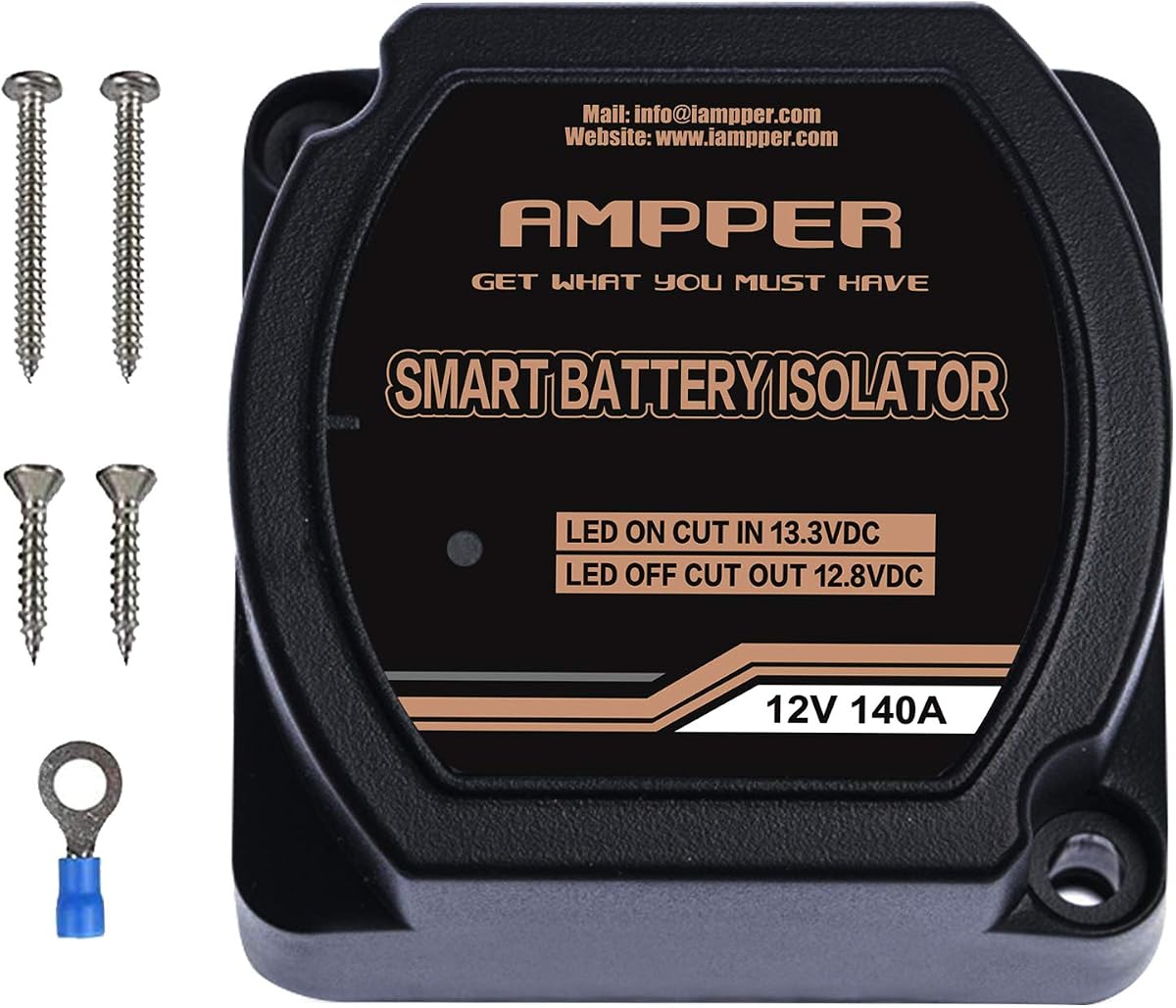
Ampper 140A Dual Battery Isolator
4.5Editor score
Automatic voltage sensing
Dual-battery isolation
Mounting hardware included
Our 12V DC dual battery isolator guide compares voltage-sensitive relays, current ratings, waterproofing, wiring kits, and compatibility for 10 leading models.
A 12V DC dual battery isolator keeps a vehicle’s starting battery separate from its auxiliary battery while allowing the alternator to charge both when appropriate. A quality voltage-sensitive relay is especially important in camper vans, boats, trucks, trailers, and off-road vehicles where accessories may remain connected for extended periods.
The products in this guide were compared using their documented voltage thresholds, current ratings, included installation hardware, environmental resistance, control methods, and battery compatibility. The list covers compact relay-only designs, complete wiring kits, manual and automatic units, marine-focused models, and higher-current options for demanding dual-battery systems.
Each review explains the most useful strengths and the practical limitations visible in the available product information. Ratings and specifications can change, availability varies by market, and current prices should be checked before buying, but the functional details provide a solid basis for comparing these isolators.
4.5Editor score

4.6Editor score
4.6Editor score
This side-by-side comparison highlights each relay’s rated current, operating approach, environmental protection, battery compatibility, and installation package so buyers can find a model suited to their vehicle and wiring plan.



The VEVOR Split Charge Relay Kit combines a 140-amp voltage-sensitive relay with a broad collection of installation accessories, making it a practical all-in-one option for establishing a second battery system. Its 4.4 rating reflects a generally favorable reception, while the compact 2.66-by-2.11-by-2.66-inch housing makes it easier to position in crowded engine compartments, under seats, or aboard a boat.
We may earn a commission when you buy through this link, at no additional cost to you.
The relay uses familiar charging logic, cutting in at 13.3 volts and cutting out at 12.8 volts. In that automatic mode, the primary starting battery receives charging priority before the auxiliary battery is connected. This arrangement helps prevent accessories from draining the starter battery when the engine is off, while still allowing one alternator to service both batteries under the appropriate conditions.
Environmental protection is another meaningful strength. The IP65-rated housing is described as waterproof, shockproof, and dustproof, making the relay suitable for off-road vehicles, camper vans, RVs, caravans, 4x4s, ships, yachts, and other marine applications. The supplied instructions and accessories reduce the number of separate items needed for a basic installation, although users should still verify cable lengths and connector sizes against their particular battery layout.
The main limitation is that the product information does not clearly confirm compatibility with lithium battery chemistries. It also does not mention a manual emergency mode for reverse charging. Those omissions make it a stronger match for conventional dual-battery installations than for buyers who require advanced lithium support or a clearly documented emergency recovery workflow.
The 13.3-volt cut-in and 12.8-volt cut-out sequence keeps the relay from linking the battery banks too early. This preserves the starting battery’s priority while allowing the auxiliary bank to charge once the charging system reaches the appropriate voltage.
Its IP65 enclosure and compact body suit installations exposed to dust, moisture, and vibration. Marine and off-road users should nevertheless secure wiring away from moving parts and follow the included instructions carefully.
We may earn a commission when you buy through this link, at no additional cost to you.
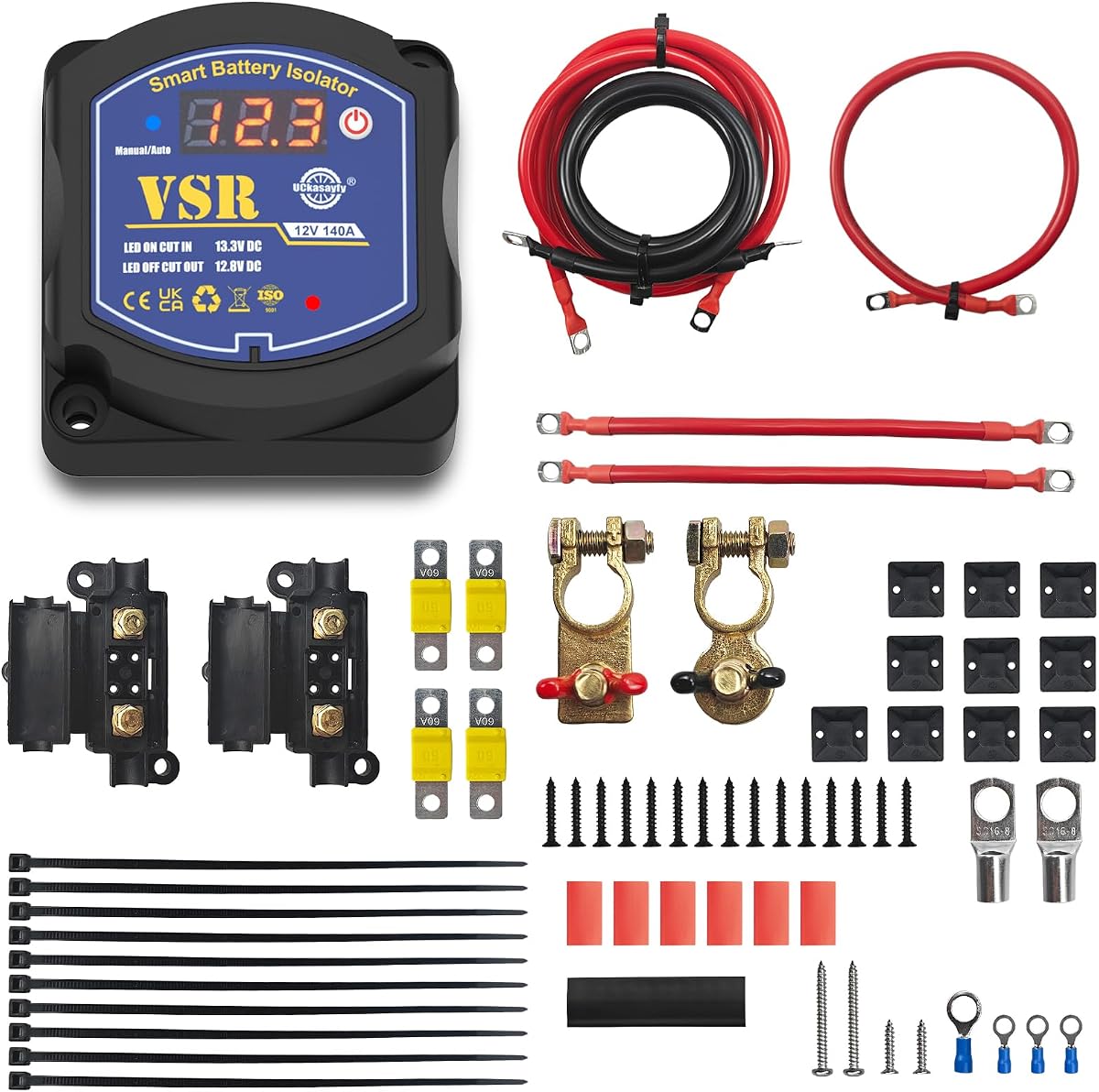
The Nilight 12V 140A Dual Battery Setup is one of the most comprehensively equipped options in this guide, pairing the relay with heavy-gauge cables, marine-style terminals, hardware, heat-shrink tubing, ring terminals, and cable ties. Its 4.6 rating is among the highest in the group, and the extensive package reduces the chance that a basic installation will stall because of a missing cable or connector.
We may earn a commission when you buy through this link, at no additional cost to you.
Its voltage-sensitive control cuts in at 13.3 volts and cuts out at 12.8 volts. Once the engine is running and the starting battery has reached the correct charging condition, the auxiliary battery can be charged by the same alternator. This creates the functional separation buyers want: deep-cycle accessories can draw from a second bank without routinely placing the starting battery at risk of discharge.
The casing, silicone seal, and IP66 waterproof rating provide useful protection in dusty, wet, and vibration-prone environments. That makes the package relevant to camper vans, trucks, caravans, RVs, ATVs, UTVs, boats, and other 12-volt applications. The included red and black 6AWG cables and selection of battery terminals also make the kit more accommodating for a complete installation than a relay-only purchase.
Two restrictions deserve attention. The manufacturer explicitly states that the isolator is not compatible with lithium batteries, and it is intended for dual-battery setups rather than single-battery vehicles. Buyers using lithium chemistry should choose a relay specifically approved for that battery type, while those with two conventional batteries can benefit from the unusually complete hardware selection.
The package includes power cables, grounding cable, marine terminals, battery clamps, screws, nuts, washers, heat-shrink tubing, ring terminals, and ties. This broad inventory is especially helpful when building a dual-battery system from components the owner has not already purchased.
The explicit lithium-battery exclusion prevents accidental use with an unsupported chemistry. Confirm the type of every battery in the system before installation and treat the documented restriction as an important safety and compatibility boundary.
We may earn a commission when you buy through this link, at no additional cost to you.
This 140-amp smart battery isolator stands out for offering both automatic voltage-sensitive operation and a manual mode. Its 4.3 rating is solid, and the additional control option provides a practical path for emergency recovery when the starting battery is depleted and the auxiliary battery still has a suitable charge.
We may earn a commission when you buy through this link, at no additional cost to you.
The relay cuts in at 13.3 volts and cuts out at 12.8 volts, allowing the primary battery to be prioritized during charging. A voltage display helps the user check the battery system in real time, while automatic disconnection below 11 volts or above 17 volts adds protection against unusually low or high input conditions.
Its IP67 rating is appropriate for marine, ATV, UTV, RV, truck, trailer, boat, and caravan environments where the unit may encounter dust, water, and vibration. The emergency function is especially valuable for stored sports cars and trailers because it can permit reverse charging from a sufficiently charged auxiliary battery into a depleted primary battery.
The product is explicitly not intended for lithium batteries, so it should only be considered for compatible conventional battery systems. The listing also contains a spelling error in its title, which does not affect the core function but makes the model less memorable. Overall, the automatic and manual combination is compelling for users who value recovery flexibility in addition to routine isolation.
Manual mode gives the owner a way to join the battery banks when the starting battery is low. This is particularly helpful after extended storage, provided the auxiliary battery has sufficient charge and the user follows safe jump-starting procedures.
The voltage display provides a quick way to assess battery condition, while the 11-volt lower cutoff and 17-volt upper cutoff help isolate the circuit during abnormal voltage conditions. These safeguards add useful diagnostic context to a standard dual-battery installation.
We may earn a commission when you buy through this link, at no additional cost to you.
The Ampper 12V 140A Dual Battery Isolator offers a focused approach to separating two conventional battery banks while charging both from one alternator. It carries a 4.5 rating and is designed specifically for acid-lead batteries, making it a sensible choice for classic automotive, marine, RV, and powersports installations that use compatible conventional chemistry.
We may earn a commission when you buy through this link, at no additional cost to you.
Its core behavior is easy to understand. The voltage-sensitive relay cuts in at 13.3 volts and cuts out at 12.8 volts, so the starting battery is charged first and the secondary battery joins the circuit later. That sequence helps ensure the primary battery remains ready to start the engine while accessories can draw from the auxiliary bank during periods when the vehicle is not operating.
The unit is described as heavy-built and resistant to water, shock, dust, and extreme weather. Its mounting plate and four bolts are included, which simplifies attachment to a suitable surface. The product can be used with cars, vehicles, RVs, ATVs, UTVs, boats, and two-battery electrical equipment, giving it broader relevance than a relay designed for one specific use case.
The clearest limitation is the explicit exclusion of lithium batteries. Also, although the mounting hardware is provided, the listed package does not promise power cables, ring terminals, or battery clamps, so a complete installation may require additional parts. For buyers seeking essential voltage-sensitive isolation without paying for a more elaborate kit, the Ampper remains a practical recommendation.
The familiar 13.3-volt and 12.8-volt thresholds provide predictable behavior for most conventional dual-battery systems. The primary battery is protected, and the auxiliary battery is charged only after the starter bank reaches the appropriate operating voltage.
Including the mounting plate and four bolts keeps the mechanical installation straightforward. Since the relay is the essential component rather than a full cable kit, installers should inventory their existing cables and terminals before purchase.
We may earn a commission when you buy through this link, at no additional cost to you.
The Compact 140A Dual Battery Isolator combines a relatively small body with automatic voltage sensing, manual override, and a visible voltage indication. Its 4.2 rating places it slightly below the group average, but the feature set is still attractive for buyers who need a flexible relay in a space-constrained installation.
We may earn a commission when you buy through this link, at no additional cost to you.
Under normal operation, the relay cuts in at 13.3 volts and cuts out at 12.8 volts. The primary battery is therefore favored for starting, while the auxiliary battery receives charging from the same alternator. Manual mode provides an emergency path for reverse charging when the main battery is depleted, and the voltage display helps the installer or owner monitor the state of the system.
Protective cutoffs are specified below 11 volts and above 17 volts. These limits can disconnect the circuit when input voltage moves into a less desirable range. The IP67 enclosure also adds confidence for use in ATVs, UTVs, boats, RVs, trucks, trailers, caravans, and marine environments where vibration, water, and dust are likely concerns.
The model is explicitly not intended for lithium batteries, which rules it out for many newer dual-battery builds. Its 4.2 rating also suggests that while the core functionality appears competitive, it may not offer the same level of customer satisfaction as the most highly rated options. Nevertheless, buyers who prioritize compactness, voltage visibility, and manual recovery may find it well matched to their needs.
Combining a display, automatic operation, and manual override in a compact enclosure makes this model useful in restricted installations. The enclosure should still be mounted in a protected area with secure strain relief and away from moving components.
The manual setting can allow a charged auxiliary battery to support an exhausted starting battery. Because manually joining batteries carries risk, users should check polarity and battery condition and follow safe vehicle-battery procedures.
We may earn a commission when you buy through this link, at no additional cost to you.
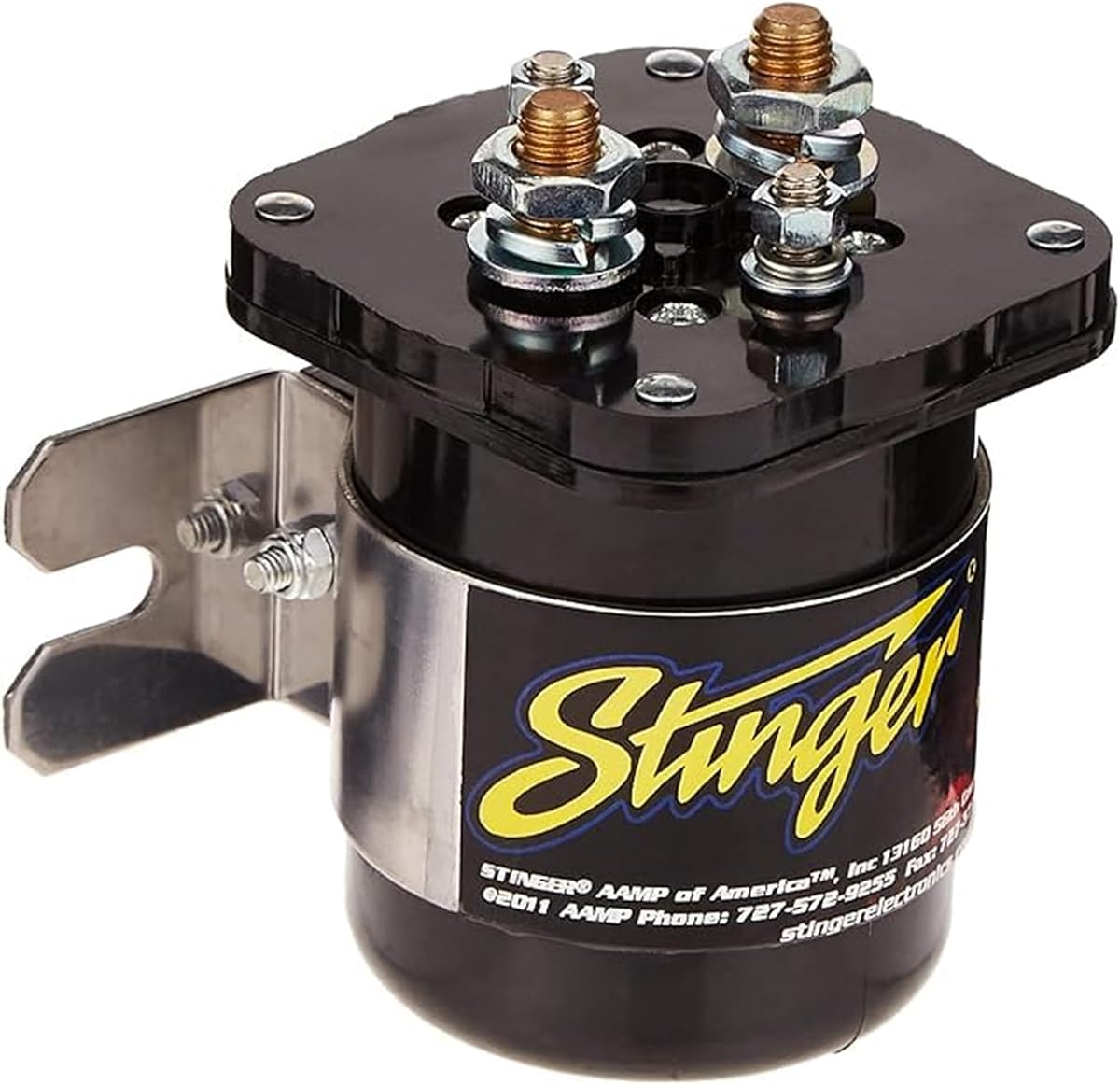
The Stinger SGP32 is the high-current specialist in this roundup, offering 200 amps of continuous current and surges up to 500 amps. Its 4.6 rating and focus on car-audio auxiliary power make it a premium option for installations where the second battery must feed substantial electronics rather than only a few low-draw accessories.
We may earn a commission when you buy through this link, at no additional cost to you.
Unlike a typical voltage-sensitive dual-battery relay, the SGP32 is described as a dual battery isolator and relay designed to provide access to secondary-battery power while preventing the primary battery from discharging. It works with any type of vehicle alternator or charging system, giving it broad potential across marine, powersports, and off-road applications.
Moisture resistance is built into the phenolic plastic body, which is valuable in environments where condensation and water are unavoidable. The relay can support up to 200 amps continuously, and the stated 100,000-mechanical-cycle service life indicates a design intended to endure repeated operation over a long service life.
This is a specialty unit rather than a universal plug-and-play kit. The product information does not specify automatic voltage-sensing cut-in and cut-out thresholds, and it does not list a full set of installation cables and terminals. Buyers needing conventional VSR behavior for battery-to-battery charging should choose one of the voltage-sensitive models instead. For a powerful, dedicated auxiliary-power isolator, however, the SGP32 has a clear technical advantage.
A 200-amp continuous rating provides substantial headroom for amplifiers, compressors, inverters, and other demanding accessories. The 500-amp surge specification also makes the unit more relevant to loads with brief high inrush demand.
The documented 100,000-cycle mechanical life supports long-term use in a frequently switched system. The phenolic body adds moisture resistance, although it is not described with a formal IP rating.
We may earn a commission when you buy through this link, at no additional cost to you.
The KeyLine Chargers 140A VSR uses a solid-state design to handle automatic isolation between primary and auxiliary batteries. Its 4.5 rating, compact 2.6-by-2.6-by-2-inch body, and IP65 rating make it a strong general-purpose option for automotive, marine, RV, and off-road electrical systems.
We may earn a commission when you buy through this link, at no additional cost to you.
The relay activates at 13.3 volts and disengages at 12.8 volts, allowing the starting battery to reach a suitable state before the auxiliary bank is connected. The manufacturer says this avoids the power loss associated with traditional isolator diodes while maintaining an effective connection during charging, making it useful for systems where voltage efficiency matters.
The solid-state construction removes the mechanical relay contacts found in some older isolators, which can support consistent switching and durability. Water, dust, and vibration resistance add confidence for exposed installations, and the small enclosure is easy to position under a hood, inside a camper conversion, or near a marine battery compartment.
Two practical caveats apply. Installation wires are not included, so cable length, gauge, and terminal selection remain with the installer. The available information also does not explicitly approve lithium chemistry, meaning the product should be used with compatible conventional batteries unless the manufacturer confirms otherwise. The included mounting hardware and straightforward thresholds make it a well-rounded relay-only choice.
A solid-state relay can provide clean automatic connection and disconnection without the mechanical contacts of a conventional relay. That design is well matched to applications where dependable operation and compact packaging are priorities.
Because the unit is a relay kit rather than a complete cable package, it can work with an existing battery-relocation setup. Ensure the selected cables are adequately rated, properly terminated, and protected from abrasion, heat, and moving parts.
We may earn a commission when you buy through this link, at no additional cost to you.
The Smart 140A Auto Manual VSR combines automatic isolation, manual control, and a digital voltmeter in a compact relay. Its 4.5 rating indicates a well-received product, while the IP68 waterproof rating gives it a notable environmental advantage for marine and off-road installations.
We may earn a commission when you buy through this link, at no additional cost to you.
The relay connects or disconnects the auxiliary battery according to the main battery’s voltage, allowing both batteries to charge from the engine alternator under the appropriate conditions. Automatic disconnection below 11 volts or above 17 volts provides protection against extreme input levels, and the display lets the user observe voltage without relying on a separate meter at the battery.
Its stated compatibility covers RVs, cars, ATVs, UTVs, Polaris and Can-Am vehicles, boats, 12-volt marine systems, four-wheel-drive applications, and caravans. The compact housing can be placed in many locations, although physical protection from heat, direct water ingress beyond its rating, and mechanical impacts remains important.
The product explicitly excludes ternary lithium batteries, so users with lithium systems must seek a chemistry-compatible unit. The product information also does not promise marine ring terminals or a complete cable set. Its strongest attraction is the combination of visual voltage information, selectable operating modes, and a high waterproof rating in a single enclosure.
A digital voltmeter display makes routine voltage checks more convenient and can help identify a depleted or charging-system problem. It is particularly useful in a dual-battery installation where understanding both charging and isolation behavior is important.
The IP68 rating supports use in wet, dusty, and vibration-heavy environments. Even with a high ingress-protection rating, correct cable sealing, mounting, and strain relief remain essential to the performance of the overall installation.
We may earn a commission when you buy through this link, at no additional cost to you.
The 12V 500AMP Dual Battery Isolator Kit is built for buyers who want considerable current capacity and prioritize copper connections. Its 4.4 rating and five-hundred-amp rating distinguish it from the many 140-amp relays in this guide, while the pure-copper terminals target conductivity and corrosion resistance.
We may earn a commission when you buy through this link, at no additional cost to you.
Its automatic operation connects the batteries during charging and disconnects them when the engine is off. This allows RV accessories such as refrigerators and lighting to use a separate battery while protecting the primary starting battery from excess discharge. The documentation emphasizes stable accessory power and reduced vulnerability to problems associated with corroded brass connections.
The stated 500-amp rating is useful as a headline capacity figure, but actual performance depends on the complete electrical path. Cable gauge, contact surface, alternator output, and installation quality all influence what the system can deliver. The included copper lugs and mounting screws support a DIY installation, but the package information does not identify complete cable lengths or battery cables.
The product is described as IP67 waterproof and comes with a compact form suited to RV and camper installations. It does not mention automatic voltage thresholds in the supplied data, and lithium compatibility is not stated, so those details should be confirmed before purchase. Overall, it is most compelling for high-current dual-battery builds that value copper terminals over a fully specified voltage-display package.
Pure copper is valued for strong conductivity and favorable corrosion resistance. Those qualities can be especially helpful in battery compartments where heat, moisture, and electrochemical reactions are persistent concerns.
A 500-amp rating gives the relay substantial theoretical headroom for demanding accessories. The installed wiring and charging system must also support the intended load, since the relay rating alone cannot increase alternator output.
We may earn a commission when you buy through this link, at no additional cost to you.
The MaySpare Dual Battery Isolator Kit combines a 140-amp voltage-sensitive relay with a wiring cable kit and the other pieces needed for a complete installation. Its 4.4 rating reflects a solid overall reception, and the all-in-one format is attractive for owners creating a second battery system without assembling every component separately.
We may earn a commission when you buy through this link, at no additional cost to you.
The relay cuts in at 13.3 volts and cuts out at 12.8 volts. This prioritizes the primary battery during charging and allows the auxiliary battery to join the circuit later. When the engine is off, accessories can operate from the second bank while the starting battery remains protected, giving users two separate power sources in a familiar arrangement.
Its small size makes it suitable for confined installations in ATVs, UTVs, boats, RVs, marine vehicles, trucks, and caravans. The included hardware is especially useful for a first-time dual-battery project because it reduces the need for separate terminal, cable, and fastening purchases. Users should still verify that the supplied cable lengths suit the vehicle and that the battery clamps match terminal dimensions.
Unlike several competitors, the supplied information does not state a formal IP waterproof rating, so caution is warranted in exposed marine or trail environments. Lithium compatibility is also not specified. Those points deserve verification before installation. For conventional 12-volt systems seeking a compact relay and complete wiring bundle, however, the MaySpare provides a straightforward and useful package.
Including the necessary installation pieces makes this kit practical for a first dual-battery build. Buyers should inspect cable condition, terminal compatibility, and fuse placement before connecting it to a vehicle.
The relay allows one alternator to serve both batteries while keeping them isolated when the engine is not charging. This balances the convenience of shared charging with the protection of a dedicated auxiliary power source.
We may earn a commission when you buy through this link, at no additional cost to you.
Choosing a dual battery isolator requires balancing battery chemistry, load demand, environmental exposure, control features, and installation completeness. The most important decision is whether the relay’s charging logic and electrical rating match the batteries and accessories in the intended system.
Choose a relay that explicitly approves the battery type in use, and do not assume that a general 12-volt label covers every lithium chemistry. Compatibility is a hard requirement, not a minor preference.
Match the relay to realistic normal and surge loads, then verify that the rest of the system is equally capable. A larger relay cannot compensate for an undersized cable or weak alternator.
Automatic voltage sensing is the most convenient everyday arrangement. Manual override is valuable when a planned emergency connection or recovery procedure is needed.
Choose an ingress rating appropriate for the installation, then protect the wiring and enclosure from impact and abrasion. Environmental resistance begins with sound installation practices.
Inventory the existing wiring before choosing between a bare relay and a complete kit. Buy only the missing pieces, and make sure cable length and terminal type match the battery layout.
Use automatic control for routine operation and consider manual override only when its recovery workflow fits the battery chemistry and the owner’s level of experience.
A built-in display is useful for routine awareness, while dedicated diagnostic tools remain better for determining battery age, internal condition, and alternator performance.
Measure the compartment and plan the complete cable route before ordering. Physical fit, service access, and strain relief matter as much as the relay’s headline specifications.
Begin by identifying every battery, cable, fuse, and accessory in the system. Disconnect the negative battery terminal before work, confirm the voltage-sensitive relay is approved for the battery chemistry, and use a properly rated cable gauge and terminal size. The primary battery connection should be fused near the source, while the auxiliary circuit should also have appropriately placed circuit protection. Route heavy cables away from hot exhaust parts, sharp sheet-metal edges, and moving drivetrain components.
Mount the relay where it remains accessible for inspection and where its terminals, display, and controls will not be obstructed. Keep the enclosure away from direct impact and follow its stated environmental limits. Connect the primary charging lead, auxiliary charging lead, ground, and accessory feed according to the product instructions, then check polarity and tightness before reconnecting the battery. If the relay supports both automatic and manual modes, leave automatic operation selected for normal use and understand the correct manual procedure before relying on it.
For routine care, periodically inspect the wiring for chafing, corrosion, loose terminals, heat discoloration, and damaged insulation. Clean corrosion from battery terminals with suitable equipment, keep the relay casing dry, and confirm that its display shows a normal system voltage when the engine is running. Test automatic isolation by turning the engine off and observing that the auxiliary bank no longer drains the starting bank. If the relay provides a manual emergency function, use it only with sound battery condition, correct polarity, and a safe connection procedure.
A dual battery isolator allows one alternator to charge two batteries while preventing the auxiliary bank from discharging the starting battery when the engine is off. A voltage-sensitive model normally connects the batteries only when the charging voltage reaches its specified cut-in threshold. This creates separate power sources while retaining a practical charging path.
No. Several products in this guide explicitly exclude lithium batteries, and one specifically states that it is not compatible with ternary lithium chemistry. Lithium charging systems can have different voltage behavior and may require a relay designed for that chemistry. Always verify compatibility with the exact battery type before installation rather than relying on the shared 12-volt label.
Many of the reviewed units cut in at 13.3 volts and cut out at 12.8 volts. These thresholds allow the starter battery to reach a suitable charging level before the auxiliary battery is connected, and they disconnect the banks when charging voltage falls. Because thresholds and protections vary, use the values documented for the specific relay rather than assuming every 12-volt model behaves identically.
It depends on the components already in the vehicle. A relay-only option is sufficient when you have appropriately rated cables, terminals, fasteners, and circuit protection available. A complete kit can simplify a first installation, but buyers should still verify cable length, terminal compatibility, fuse placement, and grounding quality.
Choose a location that protects the relay from impact, excessive heat, standing water, and moving parts while keeping the enclosure and connections accessible for inspection. Marine, camper, and off-road installations require especially careful strain relief and corrosion protection. The enclosure’s IP rating is helpful, but proper mounting and cable routing determine much of the real-world durability.
A correctly operating voltage-sensitive relay should disconnect the auxiliary battery once charging voltage drops below its cut-out threshold, preventing normal accessory drain from reaching the starter battery. Persistent discharge can still occur through a manual override, a connected accessory, poor switching, or a faulty relay. Inspect the display and connections if the starting battery remains low after the engine is turned off.
For many typical RV accessory loads, a 140-amp relay can be suitable, especially when the alternator and wiring are also appropriately rated. The actual decision depends on the combined current draw of refrigeration, lighting, electronics, inverters, and other loads, including startup surges. High-demand systems should calculate their load and select both the relay and the complete power path accordingly.
First, confirm that the auxiliary bank charges when the engine is running and that the starter battery remains at a healthy voltage. Then turn the engine off and check that the relay disconnects the auxiliary bank rather than allowing the two batteries to remain linked. For manual-control models, test emergency operation only after verifying polarity and the condition of both batteries.
The Nilight 140A kit is the strongest all-round choice for buyers who want a complete package, automatic voltage control, and extensive environmental protection. The Ampper provides a more economical relay-only option with straightforward starter-priority charging, while the Stinger SGP32 stands apart with high continuous and surge current ratings for demanding auxiliary systems.
Prioritize battery chemistry first, then match current capacity to the loads and alternator. Consider the voltage thresholds, automatic or manual controls, ingress protection, package contents, mounting space, and quality of the required cables. A higher current rating is useful only when the entire electrical system is designed to support it, and a waterproof enclosure cannot compensate for poor cable routing or loose connections.
Ratings, product details, availability, and prices can change over time, so check the current listing and manufacturer instructions before making a final decision. For a typical conventional 12-volt dual-battery build, the complete Nilight package is especially convenient, while specialized high-current or recovery-focused needs may point toward one of the other reviewed options.