
Upgraded Watt Meter Power Meter Plug
4.6Editor score
Eight display modes
No permanent wiring required
Overload warning display
Automatic data memory
This Electricity Meter for RV guide compares ten digital, plug-in, and hardwired meters for energy tracking, surge protection, solar monitoring, and RV
An electricity meter for RV helps RV owners understand power use, balance connected loads, inspect generator or pedestal performance, and track energy over time. The right meter should match the RV electrical system, provide readable measurements, and suit either a permanent panel installation or a temporary plug-in setup.
The products in this guide were compared by electrical configuration, installation method, metering functions, communication options, display features, environmental resistance, and suitability for common RV applications. The list includes digital sub-meters, socket-mounted kWh meters, appliance-level watt meters, a surge protector with energy monitoring, and a hardwired split-core monitor.
Each pick highlights the product's strongest use case while also identifying limitations related to wiring, compatibility, or measurement scope. Ratings reflect the supplied customer feedback, and specifications are based on the available product information. As with any electrical accessory, current prices, availability, and installation requirements should be checked before purchase.
4.6Editor score

4.8Editor score

4.8Editor score
The table below compares all ten electricity meters for RV by installation style, electrical rating, monitoring capabilities, and best-suited use, making it easier to distinguish permanent sub-meters from portable watt meters and surge-protection devices.
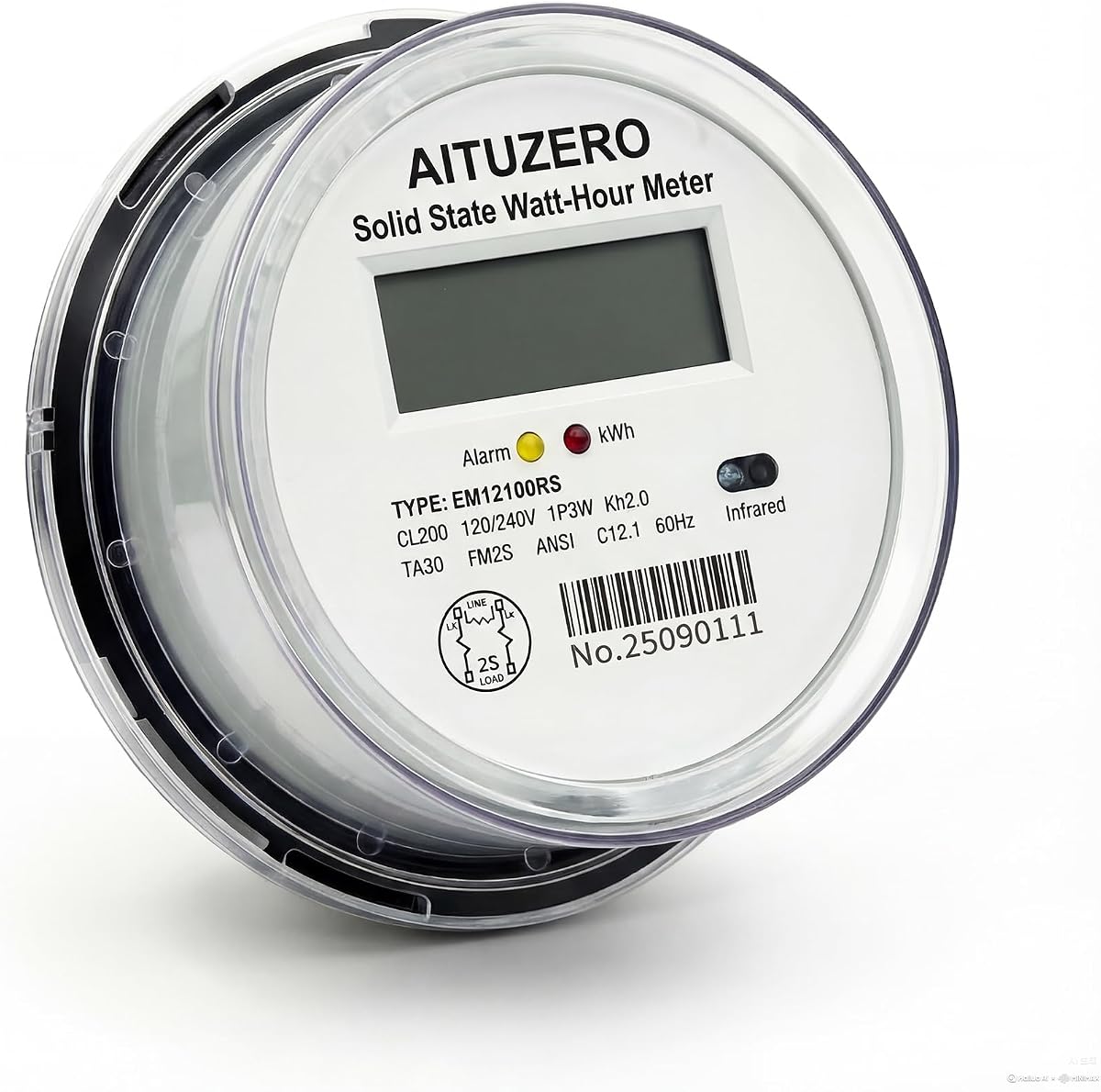


This digital electric sub meter combines 120/240-volt single-phase metering with an ANSI Form 2S four-jaw design, making it a broad option for RV power upgrades, rental spaces, workshops, and sub-panel monitoring. Its 4.5 rating reflects a useful feature set, though the connection options and installation requirements make it more involved than a simple plug-in watt meter.
We may earn a commission when you buy through this link, at no additional cost to you.
The LCD cycles through voltage, current, power, and other system information, while the bright backlight improves readability in dim utility areas. EEPROM memory preserves usage data during power interruptions, and pulse and reverse-flow LEDs provide quick visual confirmation of operation and energy direction. Modbus communication and pulse output expand its usefulness for connected monitoring systems.
The main drawback is that this is not a casual plug-in accessory. It is intended for installation in a compatible Form 2S socket, meter box, breaker panel, or sub-panel, and its labeling and communication features may be unnecessary for someone simply checking one appliance. Buyers without a suitable socket or basic electrical installation knowledge should consider a simpler design.
Despite that complexity, it is a strong match for RV owners who want more than a total kWh figure. It suits users comparing generator or pedestal use, evaluating solar backfeed, or separating an RV space from other loads. For a broadly equipped permanent RV energy monitor, this is one of the most versatile selections in the guide.
The meter can display real-time flow and track import or export behavior when placed in an appropriate energy path. That makes it useful for RV conversions, cabins, backup systems, and solar-assisted setups where conventional utility bills do not explain the complete direction of energy flow.
Modbus and pulse output provide routes to external controllers, counters, or data logging equipment. These features distinguish it from basic displays and suit users who want the measured consumption to feed a broader monitoring system.
We may earn a commission when you buy through this link, at no additional cost to you.
This 240-volt digital kWh meter is designed for single-phase, three-wire service and standard four-jaw ANSI Form 2S sockets. Its 4.7 rating and focused specification set make it an attractive option for an RV pedestal, garage, workshop, or residential sub-meter where users want clear consumption data without a complicated interface.
We may earn a commission when you buy through this link, at no additional cost to you.
The backlit LCD reports voltage, current, real-time power flow, accumulated kilowatt-hours, and total system use. An LED status indicator provides a quick confirmation that the meter is operating, while retained energy data helps preserve consumption records during an outage. The stated monitoring capacity extends to 200 amps, making it relevant to higher-load RV configurations.
Its simplicity is an advantage, but it also means fewer advanced features than some competing digital sub-meters. There is no documented RS485, Modbus, or pulse-output capability in the supplied information. It is also a three-wire model, so it should not be assumed to fit a two-wire RV pedestal or system without first confirming the configuration.
This meter is best for owners who want a straightforward digital replacement for a mechanical utility-style meter and need reliable kWh tracking in a compatible Form 2S socket. It is particularly appropriate for permanent RV park, workshop, or rental installations where indoor or outdoor enclosure requirements can be met safely.
Showing voltage, current, power flow, and accumulated energy together helps users determine whether a high bill stems from sustained demand, unusually high wattage, or simply more hours of use. The backlight also makes the meter practical in garages, basements, and outdoor compartments.
The four-jaw Form 2S layout and 200-amp capacity suit compatible RV pedestals and sub-panels. Users should still verify socket geometry, conductor configuration, enclosure requirements, and local electrical rules before installation.
We may earn a commission when you buy through this link, at no additional cost to you.
This plug-in watt meter is designed for detailed appliance-level analysis rather than permanent RV pedestal metering. It offers seven display modes covering watts, kilowatt-hours, voltage, current, frequency, power factor, cost, and operating duration, and it carries a 4.6 rating for its broad readout and convenience.
We may earn a commission when you buy through this link, at no additional cost to you.
Its 2.36-by-1.85-inch backlit screen is designed for easy reading from multiple angles, and five backlight-duration settings let the user choose between timed illumination and an always-on mode. The overload threshold is adjustable from zero to 3,680 watts, with an OVERLOAD message appearing when the connected load exceeds the selected limit.
The main limitation is scope. It measures a connected appliance or circuit through a standard wall receptacle rather than serving as a permanent meter for an entire RV. The product description also suggests configuring the overload limit appropriately, and that setup is important because an inappropriate threshold can produce warnings that do not reflect actual pedestal capacity.
This is a strong choice for an RV owner investigating the consumption of a refrigerator, inverter, air conditioner, heater, or other 120-volt device. It is especially useful for balancing loads before a trip, comparing appliances, and learning how much each one contributes without opening a panel or modifying the RV's wiring.
Minimum and maximum power, cumulative operating time, power factor, and cost information offer a more nuanced view than a simple watt readout. This helps RV travelers understand not only how much an appliance draws, but also when it draws that amount and how usage accumulates.
The data-memory function retains the last consumption information when the meter or appliance is disconnected and can automatically save data after a sudden power failure. That makes it easier to compare readings before and after travel or diagnose why consumption changed.
We may earn a commission when you buy through this link, at no additional cost to you.
This digital electric meter is purpose-built for RV pedestals and residential energy monitoring, combining a 240-volt operating voltage, CL200 kWh monitoring, and TA30 current measurement. Its 4.8 rating and RV-specific design make it the most balanced overall option for users who want a digital meter rather than an appliance-level plug accessory.
We may earn a commission when you buy through this link, at no additional cost to you.
A precision LCD provides a clear readout of energy consumption and real-time power data, while the stated 0.5-level measurement accuracy supports dependable tracking. The C1S configuration is compatible with four-jaw meter sockets, allowing the unit to work with compatible RV pedestal and residential meter-base arrangements.
The product also emphasizes resistance to dust, water, and pressure, which is relevant to RV storage areas, outdoor pedestals, and other environments where humidity, dust, or voltage fluctuations may occur. That said, environmental resistance does not remove the need for a suitable enclosure and correct installation, and the supplied information does not identify advanced communication outputs.
This is the most straightforward recommendation for an RV owner seeking a dedicated kWh meter with a 4.8 rating and strong pedestal compatibility. It is less convenient than a plug-in watt meter and less connected than the RS485 model, but it offers an effective balance of measurement capability, display clarity, and RV-specific design.
Rather than treating the RV as an ordinary household outlet, the meter emphasizes 240-volt service, CL200 kWh measurement, and compatibility with four-jaw sockets. That focus makes it easier to compare against an RV pedestal or permanent sub-panel when those electrical details match.
The high-definition LCD presents real-time consumption clearly, while the stated protective characteristics help address dusty, humid, and fluctuating environments. The result is a practical display for an RV utility area, garage, or compatible outdoor installation.
We may earn a commission when you buy through this link, at no additional cost to you.
This 50-amp RV surge protector adds energy monitoring to a familiar NEMA 14-50 connection, making it relevant for Class A motorhomes and fifth wheels. Its 3.5 rating is the lowest among the products reviewed, but the device serves a broader role than a standard electricity meter by combining protection, diagnostics, and kWh tracking.
We may earn a commission when you buy through this link, at no additional cost to you.
The LCD displays accumulated energy, voltage, current, active power, power factor, and frequency. Users can compare live amperage while operating appliances, and the 16,000-joule surge rating provides protection against lightning-related and grid-spike events. LEDs indicate that the surge-protection module is active.
A particularly notable feature is the internal temperature sensor. It monitors heat generated at the connection and alerts the user if abnormal conditions occur, adding awareness beyond the usual voltage and wattage display. Nevertheless, the product's 3.5 rating indicates comparatively mixed customer feedback, so prospective buyers should consider the complete specification and compatibility before choosing it.
The best candidate for this device is a 50-amp RV owner who wants one plug-in product to handle surge protection and basic energy monitoring at the same time. It should not be treated as a universal replacement for a dedicated sub-meter, particularly where higher-accuracy whole-system analysis or permanent energy allocation is required.
A meter-only product can reveal consumption but cannot provide the listed surge-defense function. Combining both in one enclosure may simplify RV hookups for travelers who want immediate feedback on voltage, current, power, and cumulative kWh.
Live amperage helps users decide whether to operate a heater, microwave, and other major loads together. The temperature watch adds a second layer of protection by flagging abnormal heat at the connection rather than relying only on breaker behavior.
We may earn a commission when you buy through this link, at no additional cost to you.
This upgraded plug-in energy monitor offers an approachable way to measure RV appliances without installing a sub-meter. It tracks watts, kilowatt-hours, voltage, frequency, current, power factor, unit cost, and total cost across eight display modes, earning a 4.6 rating for versatility and ease of use.
We may earn a commission when you buy through this link, at no additional cost to you.
The ABS housing is described as durable, fireproof, and resistant to drops, while the backlit LCD uses dark characters against a white illuminated field. An OVERLOAD warning flashes when the connected load exceeds the default 1,800-watt threshold, giving users immediate feedback about demand.
This meter only reveals the load connected through its receptacle, so it cannot substitute for a whole-RV meter. Its total-cost mode also depends on the utility rate entered by the user, meaning the displayed cost is only as accurate as that configuration. The product is better suited to appliances and portable test equipment than pedestal-level sub-metering.
For budget-conscious RV travelers, it offers an unusually broad set of measurements in a simple package. It is a good choice for learning how individual devices affect consumption, checking whether a load may overload a circuit, or keeping a record while testing an inverter, refrigerator, or air conditioner.
The separate modes let a user move from immediate power draw to accumulated energy or total cost. That makes the same compact device useful for a quick appliance check, a longer energy audit, or a record of operating behavior over time.
Because it operates through a standard US receptacle and plug, the meter requires no panel alteration. The automatic memory and easy reset make it practical for travelers who repeatedly connect different appliances and want to retain recent consumption information.
We may earn a commission when you buy through this link, at no additional cost to you.
This CL200 digital sub meter is the most connected option in the guide, combining 120/240-volt single-phase measurement with RS485 Modbus communication. Its 4.8 rating, import and export tracking, pulse output, and professional integration features make it a premium choice for RV parks, solar systems, and advanced energy projects.
We may earn a commission when you buy through this link, at no additional cost to you.
The large backlit LCD reports voltage, L1 and L2 current, active, reactive, and apparent power, power factor, frequency, and accumulated kWh. This on-device depth makes it useful even without external equipment, while the automatic display cycle lets users review parameters quickly.
For connected applications, RS485 supports Modbus RTU communication with compatible gateways, data loggers, and energy-management systems. Multiple meters can be placed on an RS485 network, and pulse output provides another route to external counters or programmable logic equipment. Nonvolatile EEPROM storage preserves important records through power interruptions.
This meter is best for technically confident users who need more than a local display. The communication capability can justify the extra complexity in a multi-space RV park or solar installation, but it would be unnecessary for someone who only wants to view a single RV's basic consumption. Confirm the device network, socket, and wiring requirements before purchasing.
RS485 networking allows multiple meters to feed compatible monitoring equipment. For an RV park operator or a complex RV installation, this can centralize consumption data instead of requiring each user to visit a separate display.
Import and export measurement helps users understand the balance between consumption and generation. A reverse-current indicator adds quick visual feedback when energy direction changes, which is particularly relevant to solar-assisted systems and backup configurations.
We may earn a commission when you buy through this link, at no additional cost to you.
This digital kWh meter is specifically designed for 240-volt two-wire systems, a distinction that matters when selecting a meter for an RV pedestal, camper, trailer, garage, or residence. Its 5.0 rating is the highest supplied customer score in the group, while the focused configuration keeps the product relevant to a distinct installation need.
We may earn a commission when you buy through this link, at no additional cost to you.
The LCD presents accumulated electricity use in a clear format, and CL200 kWh monitoring with TA30 current measurement supports routine RV and residential energy tracking. Its Type C1S and Form 2S-style structure fits standard four-jaw sockets, providing a practical alternative to conventional mechanical readings without requiring a separate external display.
The main caveat is electrical compatibility. A two-wire meter is not interchangeable with every three-wire installation, and the stated 30-amp test capability should be considered against the actual RV service and load. The product also does not document Modbus, pulse, or import and export features, so it is more of a dedicated kWh display than an integrated data platform.
This is the best dedicated choice for someone who has confirmed a 240-volt two-wire RV configuration and wants a simple digital meter in a compatible Form 2S socket. Its top rating and uncluttered purpose make it compelling, but accurate identification of the RV pedestal wiring remains the essential first step.
The digital LCD removes the need to interpret a spinning mechanical register. For renters, park operators, and RV owners trying to verify accumulated use, the straightforward kWh display offers an easier way to check consumption.
The defining strength is the dedicated 240-volt two-wire design. It gives owners of that configuration a meter tailored to their setup without implying that every RV pedestal will accept the same hardware.
We may earn a commission when you buy through this link, at no additional cost to you.
This 240-volt three-wire digital kWh meter combines a precision LCD, CL200 energy monitoring, and TA30 current measurement for RV and residential use. Its 4.8 rating places it among the strongest customer-feedback options, while the three-wire format targets systems that differ from the two-wire model elsewhere in the guide.
We may earn a commission when you buy through this link, at no additional cost to you.
The stated 0.5-level measurement accuracy and clear real-time readout make it useful for tracking consumption and power demand. ANSI C12.1 industry specifications are cited, giving the design a stated standard basis for safety and metering performance in RV and residential environments.
The product also describes dust, water, and pressure resistance, which is valuable in dusty, humid, or exposed areas. As with the other dedicated socket meters, that protection works best when the product is installed in an appropriate enclosure and connected correctly. No Modbus, pulse, or import and export capability is documented in the supplied information.
This meter is well suited to RV owners with a confirmed 240-volt three-wire system who want precise kWh tracking and a simple display. It is less suitable for two-wire pedestals and offers fewer advanced integration options than the premium RS485 sub-meter, but it balances capability with a compact, focused design.
The stated accuracy and real-time power display help users distinguish present demand from accumulated energy. That makes the meter useful for checking generator performance, understanding an RV's consumption pattern, or reviewing usage over a long stay.
Resistance to dust, water, and pressure supports use in demanding RV storage and outdoor conditions. The housing and display are designed for practical monitoring where visibility and stable readings both matter.
We may earn a commission when you buy through this link, at no additional cost to you.
This hardwired power meter offers a different approach to RV energy monitoring, using a split-core current transformer around one live conductor instead of occupying a Form 2S meter socket. Its 4.4 rating reflects a practical retrofit option for generators, panels, workshops, and RV circuits that need a live load display.
We may earn a commission when you buy through this link, at no additional cost to you.
The compact LCD reports voltage, current, wattage, kilowatt-hours, frequency, and power factor. With an 80–260-volt AC range, 0–100-amp current measurement, and up to 22,000 watts of rated power, it covers many common household, generator, and light-commercial monitoring applications.
For a 120/240-volt split-phase system, the clamp monitors one leg per meter, or the user can deploy separate meters as needed. That arrangement does not automatically combine both legs into a single total, so users should understand the wiring implications before installation. The need for proper electrical safety precautions is also significant compared with a plug-in meter.
This product is best for an RV owner seeking a retrofit-style panel display or generator load monitor without replacing a utility socket. Its split-core design simplifies conductor installation, while retained data and a flashing overload indicator support ongoing troubleshooting. It is less convenient than a plug-in watt meter but more adaptable to an existing conductor.
The current transformer clamps around one live conductor, avoiding the need to cut the wire being measured. This makes the meter useful in existing panels where replacing the full meter base would be inconvenient.
Voltage, current, wattage, energy, frequency, and power factor provide a broad operational view. The visual overload alarm helps users recognize when demand passes the configured threshold, helping with generator sizing and load balancing.
We may earn a commission when you buy through this link, at no additional cost to you.
The right electricity meter for RV depends on whether you want a permanent sub-meter, a plug-in appliance analyzer, a surge-protected connection, or a retrofit panel display. Electrical configuration, installation method, measurement needs, and RV compatibility should be evaluated before choosing.
Begin by identifying whether the RV uses a 120-volt receptacle, a 240-volt two-wire pedestal, or a 240-volt three-wire system. The dedicated digital sub-meters in this guide are not interchangeable: some are expressly built for two-wire service, while others specify three-wire, single-phase configurations. A meter that appears similar may still have incompatible terminals, load assumptions, or socket requirements.
A plug-in watt meter is the least invasive option and is best for checking individual appliances. A Form 2S digital meter is intended for a compatible meter socket, pedestal, or permanent sub-panel arrangement. A hardwired split-core model offers a different retrofit method but requires panel access and correct conductor placement. Choosing based on convenience rather than electrical design can lead to an unsuitable product.
Basic kWh tracking answers how much energy has been used, while real-time watts, amperage, voltage, and power factor help with load balancing. A meter that displays cumulative energy is useful for billing or comparing stays; an appliance analyzer with minimum and maximum power is better for diagnosing a refrigerator, inverter, heater, or air conditioner. More parameters are useful only when they answer a specific question.
A plug-in monitor attached to one receptacle cannot reveal the complete consumption of an RV. A dedicated sub-meter is more appropriate for pedestal, generator, or shared-space tracking. Appliance-level monitoring remains valuable for identifying which device causes a spike, so the best choice may depend on whether the goal is a complete bill estimate or a focused energy audit.
Look beyond the voltage figure and examine the supported current range, watt capacity, and stated accuracy. A meter with a 30-amp test capability may be suitable for a particular RV pedestal, while a 100-amp split-core model covers larger branch circuits. The RV's connected load, breaker rating, and pedestal capacity should all be considered before relying on overload warnings or accumulated readings.
RS485 Modbus, pulse output, import and export measurement, and nonvolatile memory are important when data must move to another system or survive interruptions. Modbus is valuable for centralized RV park or solar monitoring, while pulse output can connect external counters. A simple LCD is more appropriate when the goal is occasional manual reading rather than automated data collection.
An energy meter does not automatically protect the RV from power spikes. A combined surge protector and monitor can add a 16,000-joule protection layer, live electrical readings, and an internal temperature alert in a single 50-amp plug-in device. That convenience may be valuable, but it should complement—not replace—carefully selected surge protection and sound RV electrical practices.
RV utility areas can be dark, dusty, humid, and subject to changing temperatures. A backlit LCD, wide viewing angle, and housing with stated dust, water, and pressure resistance improve practical use. Also consider whether the meter will be mounted where it can be seen comfortably and whether the necessary socket or enclosure is available.
Before installation, identify the RV's exact electrical system, inspect the receptacle or meter socket, and compare voltage, wire count, current capacity, and connector geometry with the product specifications. Never assume a visually similar pedestal is electrically compatible. Record the starting kWh reading if the meter is being used to compare two RV sites or two stays.
For a plug-in watt meter, connect the meter to a correctly rated receptacle and then attach the appliance to the meter. Set the overload threshold and utility rate before relying on warnings or cost calculations. Give large loads time to stabilize, record watts, current, and accumulated kWh, and avoid resetting accumulated data until the relevant comparison or billing period is complete.
For socket-mounted or hardwired meters, installation should follow the product instructions and applicable electrical rules. Use appropriate wiring methods, secure terminations, suitable enclosures, and required safety equipment. Periodically inspect the display, connections, and surge status, and disconnect or service a suspect installation promptly. A qualified electrician is advisable when the wiring, pedestal, or panel configuration is uncertain.
A dedicated sub-meter is useful when you want whole-system kWh tracking, need to compare energy use between locations, or want to monitor a pedestal rather than one appliance. A plug-in watt meter is usually more practical for checking an individual refrigerator, inverter, air conditioner, or other device. The right choice depends on whether the goal is system-level or appliance-level measurement.
Only if the appliance and receptacle are genuinely 120-volt devices and the meter's plug, load rating, and overload configuration are suitable. Many RV appliances, including electric heating, water heaters, and some air conditioners, use 240-volt power and require an appropriately rated 240-volt connection. Using the wrong meter can produce incorrect results, overheating, or damage.
A two-wire model is intended for a specific 240-volt configuration, while a three-wire model is designed for a 240-volt single-phase system with three conductors. They should not be assumed to be interchangeable even when both use a similar Form 2S body. Confirm the RV pedestal wiring and terminal arrangement before purchasing or installing either type.
No. An ordinary energy meter measures voltage, current, power, or energy but does not provide surge protection. A combined surge protector with an energy monitor is different because it includes a stated surge-energy rating. Even then, protection should be part of a broader electrical-safety plan that includes suitable conductors, breakers, grounding, and proper maintenance.
Several of the digital sub-meters can measure real-time power flow, and models with import and export tracking can show energy moving in either direction. Placement is critical: the meter must be installed in an electrically appropriate location, such as between the inverter and load or between a charger and battery. Compatibility with the system's voltage, wiring, and communication controls must be confirmed first.
The label usually states maximum or rated consumption, while a meter shows real-time power draw, which can vary with compressor cycles, fan speed, temperature, and operating state. The difference does not automatically indicate a fault. Check the meter over several minutes, note minimum and maximum readings, and compare them with the manufacturer's expected operating range.
Modbus allows a compatible meter to send measurements to a gateway, data logger, or energy-management system instead of requiring someone to read the LCD. It is especially useful for an RV park with multiple spaces, a complex solar installation, or a custom monitoring project. Buyers without compatible receiving equipment will gain little practical value from this capability.
A plug-in meter can generally be used by an RV owner according to its instructions, provided the receptacle and load are compatible. Socket-mounted and hardwired products involve exposed conductors, panel work, and code-sensitive decisions, making professional installation the safer choice when the user lacks electrical experience or the pedestal configuration is uncertain.
The Digital Electric Meter for RV & Home stands out as the best overall choice for a dedicated 240-volt RV and residential installation, combining a 4.8 rating, CL200 kWh monitoring, a clear display, and four-jaw socket compatibility. The Upgraded Watt Meter Plug is the best budget option for portable appliance analysis, while the Digital Electric Sub Meter CL200 is the premium selection for Modbus-connected monitoring.
Prioritize the electrical configuration before considering extra features. Confirm voltage, wire count, current capacity, socket type, and the intended location of the meter. Then choose a permanent sub-meter for system-level kWh tracking, a plug-in analyzer for individual loads, a surge-protected monitor for a 50-amp hookup, or a split-core display for an existing circuit.
Regardless of the model selected, use the meter to support—not replace—sound electrical maintenance and safe installation practices. Current prices, stock, product details, and compatibility can change, so check the latest listing and manufacturer instructions before purchasing or connecting any electricity meter for RV use.