
TABYIK 35 OZ
3.9Editor score
Thermoelectric low-energy design
Compact 35-ounce tank
28 dB sleep-friendly operation
Discover the best low energy dehumidifiers for basements, bedrooms, bathrooms, and RVs, with key features, performance details, and comparisons.
Low energy dehumidifiers offer a practical way to reduce excess moisture without making comfort a major source of household energy use. The most useful models balance moisture removal, quiet operation, compact construction, and sensible controls, whether you need help with a damp basement or a small bathroom.
We compared ten products using the supplied specifications, certifications, rated capacities, noise claims, drainage options, and feature sets. The guide covers thermoelectric units for small spaces and compressor models for larger homes, emphasizing the factors that most directly affect efficiency and everyday convenience.
Each entry explains where a model makes the most sense, along with its strongest benefits and practical limitations. The selections are organized by overall usefulness, space, capacity, and energy credentials, while current prices and availability should be checked on the linked product pages because they can change.
3.9Editor score

4.3Editor score

4.5Editor score
The comparison below places all ten models side by side, highlighting the differences in technology, rated moisture-removal capacity, coverage, and drainage methods that matter when selecting an energy-conscious dehumidifier.


The Waykar 34 Pint combines substantial compressor-based moisture removal with a stated 2025 ENERGY STAR Most Efficient designation. Its 4.3 rating reflects a favorable balance of capacity, operating features, and energy credentials, making it the strongest all-around recommendation in this guide.
We may earn a commission when you buy through this link, at no additional cost to you.
Rated moisture removal reaches up to 34 pints per day under the stated 95°F and 90% relative-humidity test conditions, while the adjustable target range spans 30% to 80% humidity. The rotary compressor design supports relatively compact dimensions, and a minimum noise claim of 38 dB makes the unit more suitable for bedrooms and offices than many higher-capacity alternatives.
The model also includes a washable filter, two fan speeds, overload protection, power-outage memory, automatic tank shutoff, automatic defrosting, and a child lock. Its included 3.3-foot drain hose supports continuous drainage, although the 0.62-gallon tank must be emptied when used by itself and the drain-pipe switch tightened to prevent leaks.
This is a strong choice for basements, living rooms, and bedrooms up to the stated 2,000-square-foot coverage. Buyers wanting a straightforward balance of efficiency, capacity, and control should give it priority over smaller thermoelectric units, while those in very cold environments should carefully consider compressor operating limits.
The combination of a 34-pint rated capacity and ENERGY STAR Most Efficient certification gives this model a useful balance for larger rooms. It is more appropriate than a compact thermoelectric unit when moisture is substantial, while remaining more manageable than the highest-capacity models in the roundup.
Users can rely on the removable 0.62-gallon tank for intermittent operation or connect the included hose for continuous drainage. The choice makes the appliance well suited to basements where regularly emptying a small tank would be inconvenient.
We may earn a commission when you buy through this link, at no additional cost to you.
The AEOCKY 80 Pint is the option for buyers who need broad coverage and high moisture removal without settling for an ordinary energy-certified compressor unit. It carries a 4.5 rating and is presented as one of the relatively few models in the ENERGY STAR Most Efficient 2025 category.
We may earn a commission when you buy through this link, at no additional cost to you.
Its stated extraction rate reaches 80 pints per day at 95°F and 95% relative humidity, with another listed condition producing 56 pints per day. The claimed 5,500-square-foot coverage is the largest in the group, making it relevant for large basements, expansive homes, garages, and other seriously damp environments.
Efficiency is the defining theme, with the listing claiming efficiency improvements of up to 50% versus inefficient non-ENERGY STAR products. It also highlights 7mm pure-copper heat-exchange tubing, hydrophilic aluminum foil, millisecond-level humidity detection, a humidity-compensation algorithm, power-off memory, and low-temperature defrost sensors.
The tradeoff is size and weight: the unit measures 14.45 by 8.66 by 24.09 inches and weighs 31 pounds. That makes it less convenient for frequent room changes, but the capacity, advanced defrost behavior, and three-year coverage justify it for demanding installations where efficiency and performance are the main priorities.
An 80-pint rated capacity is designed for spaces with substantial seasonal or structural moisture. The 56-pint basement condition and broad coverage claim make this model a better match for whole-home or large-basement use than the compact alternatives.
The listed defrost sensors and 65°F low-temperature emphasis distinguish this model from basic compressor units. Low-temperature capability remains one of the most important factors for garages and basements in colder climates.
We may earn a commission when you buy through this link, at no additional cost to you.
The Kesnos 30 Pint combines a 4.5 rating with a generous stated 2,500-square-foot coverage area, making it an appealing value for medium-size basements and homes. Its ENERGY STAR certification and 35% lower claimed power consumption versus non-certified models directly support the low-energy focus.
We may earn a commission when you buy through this link, at no additional cost to you.
Rated removal reaches 30 pints per day at 95°F and 90% relative humidity, and the humidity target can be lowered to 30%. Four preset modes—Comfort, Dry, Continuous, and Turbo—provide flexibility for everyday humidity control, clothing drying, and sustained operation.
Drainage can be handled through the 0.39-gallon tank or the included 3.3-foot hose. Automatic shutoff and a tank-full indicator reduce overflow risk, while 360-degree casters and a hidden handle make the 11.02-by-7.68-by-15.20-inch body easier to reposition.
This model is especially attractive for buyers who want more capacity and portability than a thermoelectric appliance without moving into the largest premium category. The small tank requires frequent attention when not connected to continuous drainage, and the product is ENERGY STAR certified rather than identified as Most Efficient.
The 30-pint capacity and 2,500-square-foot claim make this a versatile middle ground between compact bedroom units and very large commercial-style models. It can address meaningful household humidity while remaining easier to move than the AEOCKY.
Comfort, Dry, Continuous, and Turbo settings make it easy to tailor operation to the room and task. The low 36 dB claim also supports use in bedrooms and offices when lower fan settings are appropriate.
We may earn a commission when you buy through this link, at no additional cost to you.
This 4,500-square-foot dehumidifier offers a broad 45-to-80-pint capacity range and a 4.4 rating, positioning it as a flexible high-capacity option. It is especially relevant to basements, garages, large homes, gyms, and laundry rooms where moisture can affect multiple occupied spaces.
We may earn a commission when you buy through this link, at no additional cost to you.
A 90-degree adjustable outlet lets users direct air toward corners, upward, or toward wet laundry. The unit also provides a 40 dB operating claim, sleep mode, automatic defrost, overload protection, ENERGY STAR certification, and a washable filter.
For drainage, buyers can choose between the 1.72-gallon self-shutoff tank and the included hose for continuous operation. Four swivel wheels, a hidden cord wrap, and a washable filter support routine use and movement, although the less-specific product naming makes it harder to compare every detail with clearly branded alternatives.
It is worth considering when the required coverage lies between the Waykar and AEOCKY options. Buyers should verify the unit's current warranty terms and confirm that its capacity and energy claims align with their installation, especially in spaces with severe moisture or changing temperatures.
The adjustable outlet is especially useful for laundry rooms and enclosed corners. It allows airflow to be aimed where moisture collects without directing the strongest stream directly at people.
Automatic defrost, overload protection, and ENERGY STAR certification support use in demanding locations. The 45-to-80-pint range allows buyers to consider a single machine for several large-area moisture problems.
We may earn a commission when you buy through this link, at no additional cost to you.
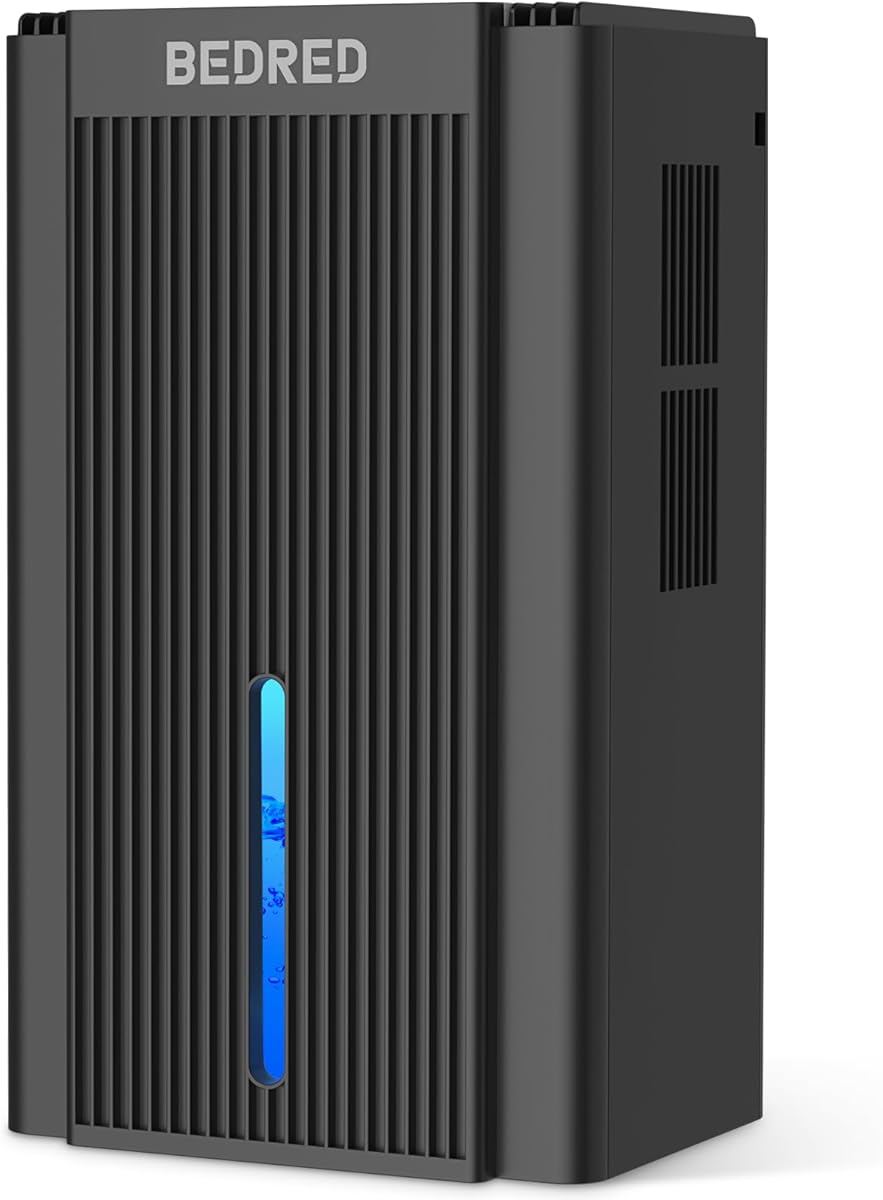
The BEDRED 95 Oz is a compact thermoelectric unit designed for moderate household moisture, with a 4.3 rating and coverage stated for spaces up to 1,000 square feet. Its modern styling and ambient lighting make it more visually suited to living areas than many utilitarian basement models.
We may earn a commission when you buy through this link, at no additional cost to you.
Thermoelectric condensation makes the operating concept simple and appropriate for low-energy use. A 95-ounce tank offers a comparatively generous collection capacity for a compact product, while automatic shutoff stops operation when the reservoir is full.
Sleep mode disables the ambient lights and reduces operating noise, and the unit includes seven selectable colors. It can also be moved among living rooms, bedrooms, bathrooms, basements, and recreational vehicles because of its compact, space-saving form.
The main limitation is capacity. A thermoelectric model is best suited to localized or moderate humidity, not the sustained moisture load of a wet basement. Buyers who need stronger extraction or continuous drainage will find one of the compressor-based models more appropriate.
The compact footprint lets the unit sit discreetly in a bedroom, bathroom, or RV. Its seven-color lighting can serve as a gentle night light while the sleep mode reduces visual and audible distraction.
Automatic shutoff protects against overflow when the tank reaches capacity. This is particularly useful in rooms where the device may run while occupants are away or asleep.
We may earn a commission when you buy through this link, at no additional cost to you.
The OWAAE 1000 Sq Ft is a compact home dehumidifier that prioritizes quiet operation and convenient placement. It holds a 4.3 rating, with a sleep mode operating below 30 dB for bedrooms, nurseries, offices, and other spaces where background noise would be disruptive.
We may earn a commission when you buy through this link, at no additional cost to you.
Its lightweight portable design and built-in handle make it easy to move into bathrooms, closets, and recreational vehicles. Integrated seven-color LED lighting provides soft ambient illumination, while the unit is designed for moderate-to-high humidity in enclosed environments.
Automatic shutoff activates when the water tank is full or improperly positioned. This is a simple but essential safeguard, especially because the listing does not identify a continuous drain-hose connection.
The appliance is best for users seeking a discreet small-space solution and exceptionally quiet nighttime operation. It lacks the stated daily extraction rate and capacity range offered by larger compressor models, so buyers should choose it for localized conditions rather than whole-home moisture control.
The under-30 dB sleep mode is the standout feature for bedrooms and nurseries. Turning off or reducing unnecessary noise helps preserve a restful environment while moisture control continues.
A lightweight body, compact dimensions, and integrated handle simplify moving the unit between a bathroom, closet, and RV. This flexibility is valuable when humidity changes with the season or daily activity.
We may earn a commission when you buy through this link, at no additional cost to you.
The ToLife 95 Oz combines semiconductor condensation with a 1,000-square-foot coverage claim, giving it a useful balance of portability and tank capacity. Its 4.3 rating places it alongside several other well-reviewed compact units in this roundup.
We may earn a commission when you buy through this link, at no additional cost to you.
Two operating modes include a more powerful setting for moisture reduction and a low-speed sleep mode operating below 30 dB. Seven ambient colors can be selected or locked, and the lights can function as a night light in a bedroom or other relaxed setting.
Automatic shutoff protects against overflow when the tank is full or installed incorrectly. The unit measures approximately 8.27 by 5.55 by 13.78 inches and includes handles for easier movement among bedrooms, bathrooms, basements, rooms, and closets.
It is best for consumers who want a quiet, compact appliance with a sizable visible tank and restrained energy demand. The absence of a stated extraction rate and continuous-drain option makes it less suitable for severe basement moisture, where a compressor model offers greater capacity and practical drainage.
The 95-ounce tank provides a useful visual indication of collected moisture without making the unit excessively large. Its moderate footprint can fit in closets and smaller rooms where a full-size compressor unit would be inconvenient.
The sleep mode lowers operating sound below 30 dB, while lockable lighting allows users to choose a preferred appearance. Together, these controls reduce distraction in restful spaces.
We may earn a commission when you buy through this link, at no additional cost to you.
The TABYIK 35 OZ is a budget-oriented thermoelectric dehumidifier for bedrooms, bathrooms, closets, offices, and RVs. Its 3.9 rating is the lowest among the selected products, but the unit remains a straightforward option for small spaces and moderate humidity.
We may earn a commission when you buy through this link, at no additional cost to you.
In the stated closed-room test at 86°F and 80% relative humidity, it can collect as much as 16 ounces in 24 hours. The specification also states that daily energy consumption does not exceed one kilowatt-hour, making low power demand a central part of its appeal.
It operates at a stated 28 dB, has a separate control for seven-color ambient lighting, and uses a transparent 35-ounce tank that makes the collected water visible. Automatic shutoff activates at approximately 700 to 800 milliliters and flashes a red indicator to alert the user.
The compact 5.9-by-5.9-by-10.1-inch body and rear handle make it highly portable. Its limitations are the modest extraction rate and relatively low review rating, so it should be viewed as a targeted solution for smaller spaces rather than a whole-home basement machine.
The stated maximum of one kilowatt-hour per day reflects the low-demand nature of thermoelectric operation. This makes the model suitable for users who want moisture control in a specific small area without operating a large compressor.
A transparent tank makes the water level easy to see, while the grooved base helps users remove it for emptying and cleaning. Red flashing and automatic shutoff provide clear notification when service is needed.
We may earn a commission when you buy through this link, at no additional cost to you.
The Small 44 Oz Dehumidifier stands out for its unusually broad set of controls despite its compact size. It has a 4.2 rating and targets spaces such as dorm rooms, apartments, closets, bathrooms, campers, offices, and small bedrooms.
We may earn a commission when you buy through this link, at no additional cost to you.
Users can select Sleep, Normal, or Performance modes and choose 24-, 48-, 72-, or 96-hour automatic shutoff timers, with continuous operation also available. Sleep mode operates below 28 dB, making it one of the quietest options identified in the guide.
Lighting includes ten colors and three brightness levels, while automatic shutoff and a flashing red alert activate when the tank is full. Automatic defrost is intended to reduce frost buildup in lower temperatures, and the listed FCC, CE, UKCA, and RoHS approvals support its suitability for varied installations.
Its 6.56-by-4.94-by-9.29-inch size fits easily into tight areas, but the 260-square-foot coverage claim limits its role. It is a good fit for targeted moisture in closets, RVs, and small rooms, rather than a damp basement or broad living area.
Five timer choices give users more control than a simple on-off device. Scheduled operation is useful for bathrooms after showers or rooms that need attention while occupants are away.
Ten colors and three brightness levels provide unusually detailed lighting control. Users can create a softer nursery, meditation, or bedroom atmosphere without adding a separate fixture.
We may earn a commission when you buy through this link, at no additional cost to you.
The Tenergy Sorbi differentiates itself by combining Peltier dehumidification with true HEPA filtration. Its 4.4 rating makes it a strong compact choice for closets, bathrooms, and other small spaces where both moisture and airborne particulates are concerns.
We may earn a commission when you buy through this link, at no additional cost to you.
The removable one-liter tank can collect up to 750 milliliters per day under the stated 86°F and 80% relative-humidity conditions. A water-level sensor, LED indicator, and automatic shutoff simplify monitoring, while adjustable fan speed and touch controls provide straightforward operation.
Its true HEPA filter is described as capturing 99.97% of particulates, allowing the appliance to function as both a dehumidifier and an air cleaner. It operates at a stated 35 to 42 dB and is ETL and CARB certified, with one year of coverage and registration-based extended coverage mentioned.
The Sorbi is best for focused small-space use rather than large basements. Tenergy recommends its branded Sorbi filters for best performance, so replacement-filter availability and ongoing maintenance should be considered before purchase.
The combination of Peltier moisture removal and true HEPA filtration is the Sorbi's defining advantage. It can address two aspects of indoor air quality in a compact appliance designed for spaces as small as closets and bathrooms.
The removable one-liter tank, visible water-level sensor, and automatic shutoff make emptying straightforward. Touch controls and adjustable speed allow users to select a setting appropriate for the space and activity level.
We may earn a commission when you buy through this link, at no additional cost to you.
The right low energy dehumidifier depends on the amount of moisture, room size, operating temperature, and preferred drainage method. Comparing technology, efficiency credentials, and maintenance needs is more useful than focusing on a single headline specification.
Thermoelectric and semiconductor units use cooling to condense moisture and generally suit compact spaces with moderate humidity. They tend to be simple, portable, and low in power demand, but their extraction capacity is usually lower than that of compressor models. Compressor dehumidifiers are better suited to basements, large rooms, clothing drying, and sustained moisture control because they can remove substantially more water per day.
Daily extraction capacity is one of the clearest indicators of how much water a unit can handle under specified test conditions. Capacity figures are directly comparable only when temperature and relative humidity are similar. The roundup ranges from 750 milliliters per day for the Tenergy Sorbi to an 80-pint claim for the AEOCKY, illustrating the difference between localized and large-area treatment.
Coverage claims provide a convenient starting point, but they should not be treated as guarantees. Building construction, ventilation, season, temperature, and the source of moisture all affect performance. A unit advertised for 1,000 square feet may be appropriate in one well-ventilated room yet inadequate for a damp basement with the same floor area.
ENERGY STAR certification provides a useful baseline for assessing operating efficiency. The ENERGY STAR Most Efficient designation used by the Waykar and AEOCKY represents a more demanding efficiency tier, while the Kesnos and 4,500-square-foot model are described as ENERGY STAR certified. Certification should be considered alongside capacity, because a highly efficient machine that cannot handle the moisture load may need to run longer and use more energy overall.
Small tanks are simple to remove and clean, yet they require frequent emptying. Continuous drainage through a hose is much more convenient for basements, laundry rooms, and other locations where the unit may operate for long periods. The Waykar, Kesnos, 4,500-square-foot model, and AEOCKY are better aligned with uninterrupted basement operation, while compact thermoelectric units are generally designed around removable tanks.
Noise matters most in bedrooms, nurseries, offices, and other quiet spaces. The compact models in this guide advertise operating levels as low as 28 to 30 dB, and the Waykar lists a 38 dB minimum. Sleep mode may also disable or dim lighting, making the unit less disruptive during the night.
Compressor coils can frost in cool conditions, making defrost performance important for basements and garages. The AEOCKY highlights defrost sensors and operation down to 65°F, while the Kesnos, 4,500-square-foot model, and Small 44 Oz model all list automatic defrost. Thermoelectric units may be attractive for cool enclosed spaces, but their overall extraction rate still limits their use in seriously damp conditions.
Consider handles, caster wheels, dimensions, filter access, and cord storage before selecting a unit. Larger compressor models are best placed where they will remain, while small thermoelectric appliances are easier to move among closets, bathrooms, bedrooms, and RVs. Removable tanks and washable filters make routine cleaning more manageable and help preserve efficient operation.
Begin by positioning the unit on a level surface with enough clearance around its air intake and outlet. Place it in the area where moisture is most noticeable, close doors and windows when practical to improve efficiency, and avoid obstructing vents. For continuous-drainage models, secure the hose, confirm that it slopes toward the drain, and test the connection before relying on unattended operation.
Set the desired humidity and operating mode according to the room's use. Allow the unit to stabilize, empty the tank before it becomes full, and respond to tank-full, defrost, or overload indicators. Do not place the tank or collection container on an uneven surface, and never operate a unit that has been tipped unless the manufacturer specifically permits it.
Clean the removable tank on a regular schedule and dry the collection surfaces before reinstalling them. Inspect or clean the filter according to the manual, because restricted airflow raises energy use and can reduce performance. For compressor models, keep the surrounding area clear and use automatic defrost as intended; for thermoelectric models, allow the device to move collected water away from the cooling surfaces as described in the manual.
ENERGY STAR certification indicates that a model meets established energy-efficiency requirements, while ENERGY STAR Most Efficient represents a more demanding tier. Actual energy use still depends on capacity, humidity, temperature, and run time. A smaller certified unit may use less electricity in a small room, while a larger certified model may still be the most efficient way to treat severe basement moisture.
Thermoelectric models are usually better for small spaces with moderate humidity and typically have lower power demands. Compressor models provide much greater extraction capacity and are better suited to basements, large rooms, and clothing drying. The best choice depends on the moisture load rather than technology alone.
Many households find a relative-humidity level around 30% to 50% comfortable. The appropriate target can vary with temperature, season, building materials, and health needs. Several models in this guide allow settings as low as 30%, while others focus on automatic control or dedicated sleep and drying modes.
Continuous drainage is convenient when a dehumidifier will operate for long periods or when someone cannot regularly empty the tank. It is especially useful in basements, laundry rooms, and other damp spaces. A removable tank can still work well if the unit runs intermittently and the water level is monitored.
Several compact models in this guide are specifically suitable for RVs, including the BEDRED, OWAAE, TABYIK, ToLife, Tenergy Sorbi, and Small 44 Oz model. The RV should have sufficient clearance for airflow, and the unit must be secured or placed on a stable, level surface. Continuous operating conditions and temperature limits should always be checked in the manual.
Cold coils can cause condensation to freeze when ambient temperatures fall below the unit's comfortable operating range. Automatic defrost can help, but a model with clearly stated low-temperature capability may be preferable for cold garages. Keep the air intake unobstructed and avoid setting the humidity target very low in a cold environment.
The Tenergy Sorbi combines dehumidification with true HEPA particle filtration, making it more versatile than a moisture-only unit. However, it is designed for spaces up to 200 square feet and has a limited 750-milliliter daily extraction rate. Large rooms and serious basement moisture still require a higher-capacity model.
The interval depends on humidity, temperature, capacity, and the unit's rated extraction rate. Small thermoelectric tanks may fill quickly in humid conditions, while larger compressor tanks can remain empty longer. Emptying before the automatic shutoff activates and cleaning the tank regularly helps prevent odors and mineral buildup.
The Waykar 34 Pint is the strongest all-around choice because it pairs meaningful compressor capacity with ENERGY STAR Most Efficient credentials, flexible drainage, and quiet operation. The AEOCKY 80 Pint is the premium option for large areas and demanding moisture conditions, while the Kesnos 30 Pint offers an appealing balance of capacity, portability, and efficiency certification.
For smaller rooms, prioritize the space and power demands of the installation. The Tenergy Sorbi is ideal when HEPA filtration matters, while the BEDRED, OWAAE, ToLife, TABYIK, and Small 44 Oz model suit targeted moisture control with compact, portable designs. Match daily capacity, room coverage, drainage needs, and low-temperature performance before choosing a model.
Energy certification is only one part of an efficient setup. Correct placement, unobstructed airflow, regular tank and filter maintenance, and sensible humidity settings can all influence results. Review the current listing, warranty, dimensions, operating conditions, and current price on the product page before making a final purchase, as availability and terms can change.