
Focusrite Scarlett 2i2 4th Gen 2×2 USB Audio Interface Bundle
4.7Editor score
Two Focusrite mic preamps
Hi-Z and line inputs
Auto Gain and Clip Safe
Dynamic Gain Halos
Loopback computer recording
Explore the Focusrite USB Audio Interface, comparing Scarlett models for recording quality, connectivity, software, inputs, monitoring, and musician needs.
A Focusrite USB Audio Interface serves as the bridge between instruments, microphones, and a recording computer. A useful model should provide clean preamps, low-latency monitoring, intuitive gain control, compatible software, and enough connectivity for the way you create music. These factors matter whether you record vocals at home, track a guitar, produce electronic music, or build a small project studio.
This guide compares ten Focusrite Scarlett interfaces and bundles across their input configurations, converter performance, monitoring features, software bundles, and intended recording applications. It covers current fourth-generation models, earlier Scarlett generations, and packages that add headphones, cables, or a pop filter. Each selection is evaluated from the supplied specifications, feature descriptions, and customer ratings rather than personal testing claims.
The list reveals three clear purchasing paths: the Scarlett Solo for compact solo recording, the Scarlett 2i2 for flexible stereo work, and the larger 16i16 or 18i16 for expanded production systems. Every product appears in the comparison, while the top recommendations highlight particular strengths. Product availability and pricing can change, so confirm the current listing, included accessories, and software terms before purchasing.
4.7Editor score

4.6Editor score

5.0Editor score
This side-by-side comparison covers every Focusrite option in the guide, emphasizing the practical differences between solo, dual-channel, and expandable production interfaces.




The Focusrite Scarlett Solo 4th Gen is a compact two-input, two-output interface built for songwriters who want a capable recording chain without a large control surface. Its supplied rating of 4.6 reflects a strong customer reception, while the fourth-generation design brings a 120dB dynamic range, improved converters, a re-engineered Air Mode, and features intended to make both recording and monitoring more approachable.
We may earn a commission when you buy through this link, at no additional cost to you.
The central selling point is the balance between studio-oriented signal quality and a remarkably manageable footprint. It accepts one microphone through the Scarlett mic preamp and offers a separate Hi-Z input for an electric guitar or another instrument. That arrangement suits a songwriter recording lead vocals, layering acoustic instruments, or tracking guitar through amplifier simulation software without requiring a second physical input at the same time.
Air Mode can add presence and harmonic character to vocals and instruments, giving recordings a more finished starting point when used thoughtfully. The interface also supports independent headphone-level control, and the stated 120dB dynamic range provides generous headroom for many recording situations. Pro Tools Intro+, Ableton Live Lite, Cubase LE, and the Hitmaker Expansion provide several paths for arranging, editing, mixing, and mastering.
Its limitations are intentional and easy to understand. You cannot record two microphones or a microphone and instrument simultaneously, and it lacks the larger input count, digital expansion, and MIDI connectivity found in the 16i16 and 18i16. For a solo artist working from a laptop, however, those omissions rarely matter. This is the most versatile general-purpose choice here for focused home recording, and it earns the Editor's Choice recommendation for its balanced design.
It is particularly well suited to anyone starting a home studio around vocals and guitar, particularly if the user values polished preamps, convenient monitoring, and a broad software package. The Scarlett Solo 4th Gen delivers a capable studio-style workflow without asking the user to manage unnecessary complexity.
Because the supplied information does not confirm personal testing, this evaluation is based on the documented specifications, feature descriptions, included software, and customer rating rather than subjective impressions from a hands-on session.
The Solo provides the essential path for recording a vocal, reamping guitar, or adding an instrument layer in a compact project studio. Its combination of a dedicated mic preamp, Hi-Z instrument input, headphone monitoring, and included production software gives a new user several ways to begin without assembling a large collection of separate components.
The fourth-generation converters and 120dB dynamic range support clean capture, while Dynamic Gain Halos and related level features make input gain easier to judge. Air Mode offers an additional tonal option for vocals and instruments, although it should be treated as a creative choice rather than a requirement for every recording.
Pro Tools Intro+, Ableton Live Lite, and Cubase LE cover several major production environments, while Hitmaker Expansion supplies instruments, effects, and mastering tools. This makes the package useful for learning and for completing a song without immediately searching for a separate bundle of starter applications.
We may earn a commission when you buy through this link, at no additional cost to you.
The Scarlett 2i2 4th Gen Bundle is a strong value-oriented choice for singers, songwriters, podcasters, and small ensembles that need more than one recording input. The supplied rating of 4.7 is among the strongest in this list, and the bundle includes two 6-foot H&A XLR cables alongside the interface, reducing the need to buy those basic connection items separately.
We may earn a commission when you buy through this link, at no additional cost to you.
Its two Focusrite microphone preamps offer a stated 69dB gain range, while the 120dB dynamic range and use of converters found in higher-end Focusrite hardware provide a clear technical foundation. Both Hi-Z instrument inputs and professional-quality line inputs make the interface adaptable to guitars, keys, synths, grooveboxes, and stereo equipment. The important distinction from the Solo is that the 2i2 can capture two sources at once.
Dynamic Gain Halos provide visual feedback at the hardware level, while Auto Gain and Clip Safe reduce the need for manual trial-and-error when setting recording levels. The custom headphone amplifier includes independent volume control, and Loopback allows computer audio to be routed through virtual inputs. These are meaningful workflow features for a small interface, particularly for creators who want to spend less time navigating menus and more time recording.
The main limitation is that the stated configuration does not advertise the digital expansion or extensive I/O of the 16i16 and 18i16. The included cables also need to be considered if you already own suitable XLR leads or require a different length. Even so, the core combination of dual preamps, flexible inputs, automation, and bundled cables makes this a particularly complete package for its intended class.
Choose this 2i2 bundle if your main goal is recording vocals, stereo instrument performances, guitar-and-vocal combinations, or spoken content with more than one source. It balances simplicity, recording flexibility, and useful accessories better than a barebones entry-level interface.
This recommendation is based on the supplied features, included components, specifications, and customer rating. It does not represent a personal hands-on test.
Two microphone preamps make it possible to record a vocalist and acoustic player at the same time, capture stereo microphones, or combine a microphone with a line-level source. That flexibility is the central advantage over the Solo for anyone whose sessions routinely involve more than one performer or instrument.
Auto Gain can analyze a short performance and establish a starting level, while Clip Safe is designed to reduce clipping risk if the source changes unexpectedly. The illuminated Dynamic Gain Halos remain valuable because they let the operator confirm signal behavior directly on the hardware.
Loopback captures computer audio through the interface's virtual inputs, supporting tasks such as recording software output, sampling, streaming demonstrations, and adding system sound to a production. It broadens the interface's role beyond conventional microphone recording without requiring a second conversion box.
We may earn a commission when you buy through this link, at no additional cost to you.
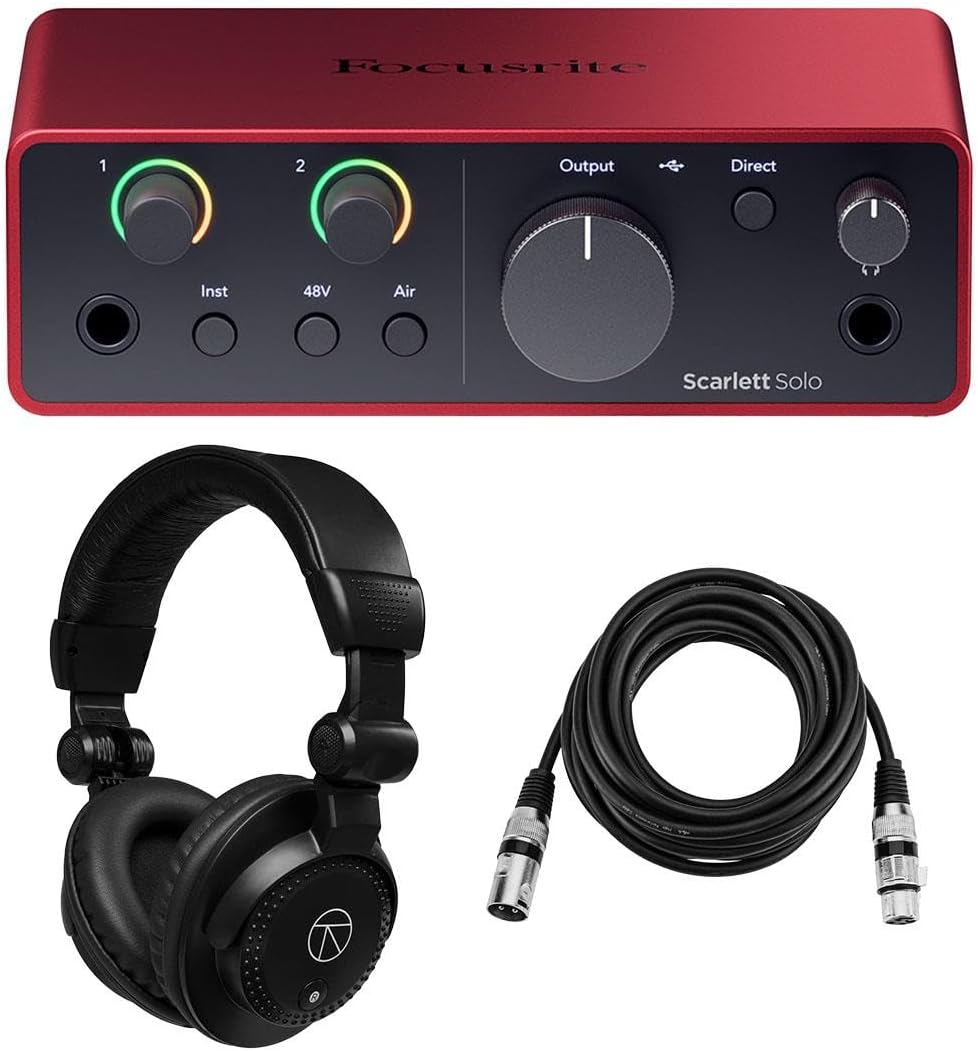
This Scarlett Solo 4th Gen bundle is a straightforward starting point for a singer, songwriter, or online creator who wants a microphone, a properly sized XLR cable, and a capable USB interface in one coordinated setup. Its supplied rating of 4.7 indicates strong customer approval, and the long cable makes it easier to position a microphone away from a desk without immediately adding another accessory.
We may earn a commission when you buy through this link, at no additional cost to you.
The interface provides one microphone preamp with phantom power, one instrument input, two line outputs, and one headphone output. Its stated 24-bit/192kHz A/D resolution and ultra-low-latency monitoring make it suitable for high-resolution capture and immediate vocal performance. USB Type-C connectivity and class-compliant operation also support modern Mac, Windows, and USB-C iPad workflows.
The included 10-foot H&A XLR microphone cable is perhaps the bundle's most obvious practical advantage. It provides enough room for a desk-mounted microphone arm or a nearby vocal booth, while the Solo itself remains small enough for mobile or temporary recording arrangements. Real-time monitoring helps performers hear themselves with minimal delay, which is especially valuable for singers and spoken-word recording.
Because the interface has only one microphone preamp and one instrument input, it cannot handle a two-person live recording or a microphone and guitar simultaneously. The user should also verify that the computer and recording application are configured for the USB Audio Class workflow described by the manufacturer. Within those limits, it remains a compact and approachable package.
This bundle is well suited to first-time home recordists and anyone who values a complete connection setup more than extensive I/O. The combination of high-resolution conversion, low-latency monitoring, broad computer compatibility, and a usable XLR cable makes it an uncomplicated path into serious recording.
The assessment uses the documented 4.7 rating, connectivity details, resolution information, and bundle contents supplied for the product. It does not imply a personal listening test.
The 10-foot XLR lead provides more placement flexibility than a short desktop cable, making it practical for microphone arms, vocal booths, and small recording rooms. It can also reduce visible cable clutter along the back of a desk when routed thoughtfully.
USB Type-C connectivity and class-compliant operation allow the Solo to work across modern Mac, Windows, and USB-C iPad systems. That portability makes the bundle suitable for a bedroom studio, rehearsal room, or a temporary recording setup away from a permanent workspace.
Real-time monitoring gives singers and instrumentalists immediate headphone feedback while recording. The stated low-latency design helps preserve the natural feel of a performance, while the dedicated headphone output provides a straightforward connection to the monitoring system.
We may earn a commission when you buy through this link, at no additional cost to you.
The Scarlett 2i2 3rd Gen remains a compelling option for musicians who already recognize the third-generation Scarlett workflow or can obtain it as part of a broader package. Its 4.6 rating reflects a well-established product with a large user base. The interface offers two microphone preamps, two high-headroom instrument inputs, and conversion up to 192kHz.
We may earn a commission when you buy through this link, at no additional cost to you.
Focusrite's third-generation mic preamps are designed to capture vocals and instruments with a natural character, while Air adds a familiar high-frequency emphasis and harmonic texture to lead sources. The 111dB dynamic range and 24-bit/192kHz converter specification provide a capable recording foundation. Supported sample rates extend from standard 44.1kHz and 48kHz options to 88.2kHz, 96kHz, 176.4kHz, and 192kHz.
Dynamic Gain Halos make it easier to see input levels on the hardware, and the Easy Start utility helps new users reach recording and playback quickly. The combination of microphone and instrument connectivity supports common home-studio tasks such as recording a singer and acoustic guitar together, capturing a stereo pair, or tracking bass and percussion through line-level paths.
The principal trade-off is age. Compared with the fourth-generation 2i2, this interface has a lower listed dynamic range and does not have the newer model's Auto Gain, Clip Safe, redesigned Air Mode, or expanded workflow features. It may therefore appeal most to buyers who prioritize a proven configuration, a suitable included software package, or a favorable bundle arrangement rather than the newest hardware generation.
For a creator comfortable with third-generation Scarlett behavior, the 2i2 remains a capable dual-channel recorder. New projects that specifically require the latest 4th Gen automation should compare the alternatives carefully, but this model still provides a practical and well-regarded foundation for everyday recording.
This analysis is based on the supplied specifications and established feature description rather than a claim of personal testing.
Support for 44.1kHz through 192kHz provides flexibility for standard music production, video-related workflows, and high-resolution projects. Creators can choose a practical working rate without being limited to a small number of fixed options.
The third-generation preamps and high-headroom instrument inputs cover both microphone and electric-instrument recording. Air can add brightness and harmonic density to a lead vocal or guitar when a more polished, console-inspired sound is desired.
Easy Start walks users through the initial recording and playback process, reducing the barrier between connecting the interface and capturing a first take. The hardware's familiar layout also makes it approachable for users who have encountered Scarlett interfaces previously.
We may earn a commission when you buy through this link, at no additional cost to you.
The Scarlett 2i2 4th Gen accessory bundle is designed for musicians who want a complete two-channel recording setup rather than only the interface itself. Its 4.6 rating indicates a favorable reception, and the package includes Turnstile Audio Studio Monitor Headphones, a pop filter, a 10-foot H&A XLR microphone cable, a USB-A to USB-C cable, and the software suite.
We may earn a commission when you buy through this link, at no additional cost to you.
The underlying interface carries the key strengths of the fourth-generation 2i2: two Focusrite mic preamps, Hi-Z connections for guitars, professional-quality line inputs for instruments such as keyboards and synths, and a 120dB dynamic range. It supports the modern Scarlett workflow associated with Dynamic Gain Halos, Air Mode, and other fourth-generation refinements, although the supplied description for this bundle focuses more heavily on the included components.
The headphones are particularly valuable because they remove the need to source a separate monitoring solution before the first recording session. The 10-foot XLR cable provides useful placement flexibility, and the included pop filter helps reduce plosive bursts when recording vocals. Together, these accessories cover several common setup requirements that would otherwise be purchased separately.
One consideration is that the bundle may offer less value to someone who already owns reliable headphones, a pop filter, and a suitable XLR cable. Also, the supplied details do not highlight digital expansion, so users who expect a larger or future-expandable system should examine the 16i16 or 18i16 instead. The core 2i2 remains a strong choice for dual-person and stereo recording.
This package is best for a new home-studio owner who wants to begin recording quickly with headphones, a microphone cable, and vocal accessories in hand. It is also a logical gift for a singer or songwriter who is moving from consumer equipment to a dedicated USB audio interface.
The recommendation reflects the supplied product information, included accessories, features, and rating. No personal trial or subjective listening test is claimed.
Bundled studio monitor headphones provide a ready-made path to low-latency headphone monitoring. They make the package convenient for a new user, although headphone preferences vary and experienced producers may eventually prefer a different pair.
A pop filter and 10-foot XLR cable address two practical needs associated with vocal recording. The filter helps manage plosive energy, while the longer cable allows the microphone to sit farther from the performer and the interface.
Two preamps and a mix of Hi-Z and line inputs support simultaneous recording, stereo capture, and connection to a range of instruments. This gives the bundle a wider creative scope than a single-microphone interface without moving into a large production console.
We may earn a commission when you buy through this link, at no additional cost to you.
The Scarlett Solo 4th Gen Headphone Bundle is a polished desktop recording package built around a single microphone and one instrument channel. It combines the interface with Turnstile Audio headphones and a 10-foot XLR cable, creating a setup that can move quickly from unboxing to recording. Its supplied rating of 4.6 reflects steady user approval.
We may earn a commission when you buy through this link, at no additional cost to you.
The Solo uses a detailed ultra-low-noise mic preamp, studio-grade converters, and a 120dB dynamic range. The separate Hi-Z input lets a guitarist connect directly, while the improved Air Mode can bring vocals and instruments forward with added presence and harmonic drive. Dynamic Gain Halos simplify level setting, and the headphone output has independent volume control for comfortable monitoring.
The software package is another meaningful part of the proposition. It includes Pro Tools Artist, Ableton Live Lite, and the Hitmaker Expansion, with tools such as Auto-Tune Access for Vocals, Softube Marshall Silver Jubilee 2555, and Native Instruments MASSIVE. This allows a new user to explore serious production software without treating the interface as an isolated hardware purchase.
The limitation is straightforward: only one source can be recorded at a time. That rules out live stereo microphone pairs, drummer and guitar tracking, and microphone-plus-instrument combinations. It is less suitable for podcasting with multiple guests, small ensembles, or users who want room to expand without changing interfaces later.
This bundle makes the most sense for a singer-songwriter, solo instrumentalist, or beginner who wants a refined and complete one-person studio. Its strong signal quality, included accessories, useful creative effects, and simple control layout reduce both the cost and complexity of assembling an initial recording setup.
The evaluation is based on the documented product features, package contents, and customer rating rather than claims of personal hands-on use.
The re-engineered Air Mode adds presence and harmonic character to vocals and instruments, giving tracks a more prominent, console-like quality. It can be useful for a lead vocal or an exposed guitar part, although many recordings will sound better with it applied selectively.
Pro Tools Artist and Ableton Live Lite cover major DAW workflows, while the Hitmaker Expansion adds vocal tuning, a guitar amplifier simulation, and a large synth. These applications make the Solo useful for arranging and finishing tracks as well as capturing them.
The Solo's compact form leaves room on a desk or shelf and keeps the signal path understandable. Dynamic Gain Halos bring level information into the hardware view, reducing the need to open monitoring software during setup.
We may earn a commission when you buy through this link, at no additional cost to you.
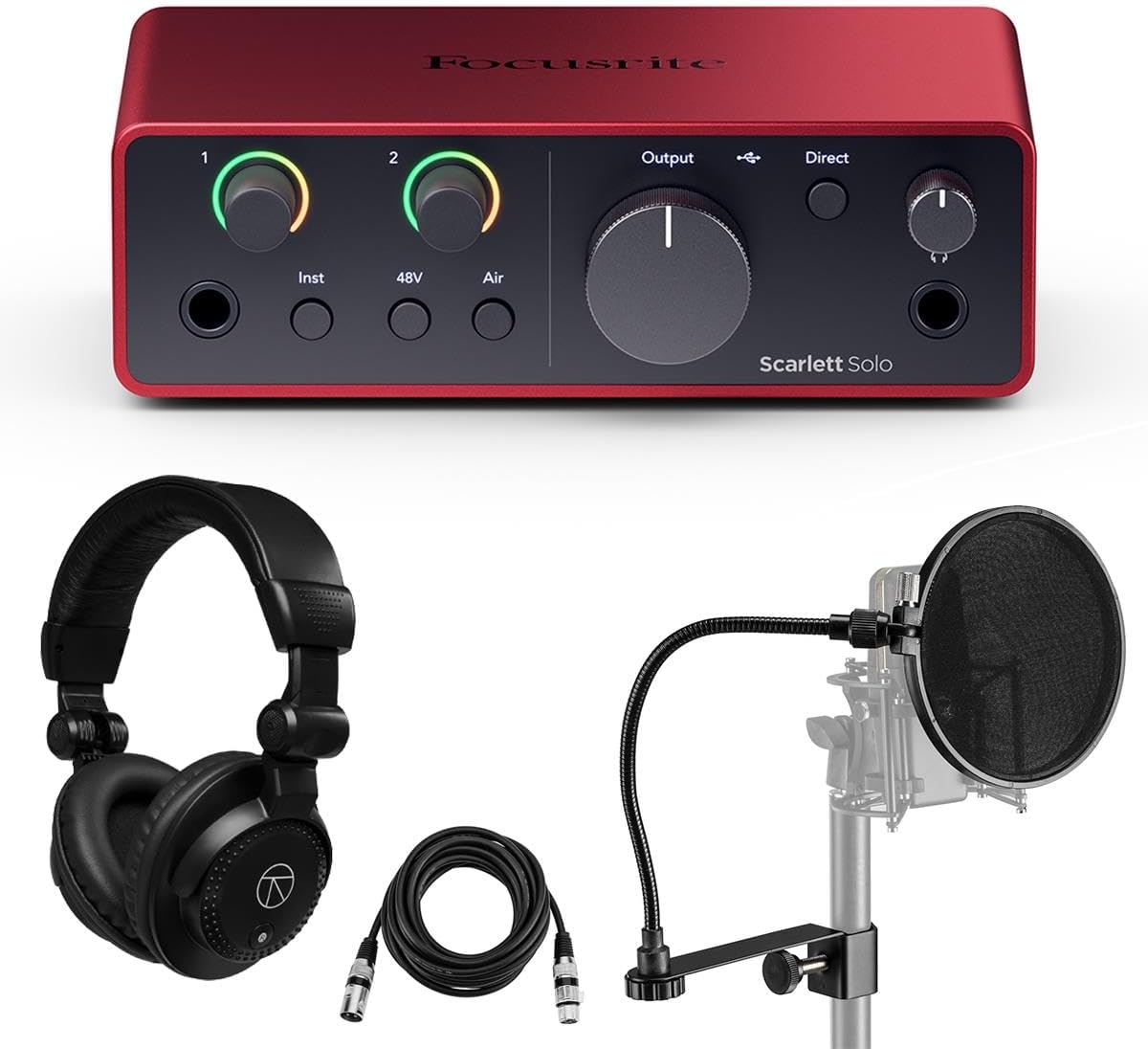
The Scarlett Solo 4th Gen Complete Bundle is one of the most accessorized options for a solo creator. It includes the Scarlett Solo 4th Gen, Turnstile Audio Studio Monitor Headphones, a pop filter, and a 6-foot XLR microphone cable. The supplied 4.7 rating places it among the most favorably reviewed products in this guide and supports its appeal as a ready-to-record package.
We may earn a commission when you buy through this link, at no additional cost to you.
The interface provides a detailed ultra-low-noise mic preamp, one Hi-Z instrument input, 120dB dynamic range, and an independent headphone amplifier. Dynamic Gain Halos help the user set levels efficiently, while Air Mode adds presence and harmonic drive to vocals and instruments. For a single performer, the same hardware can capture a vocal, an amplified guitar, bass, keyboards, or another line-level source.
Loopback allows computer audio to be captured through virtual inputs, expanding the Solo beyond standard microphone recording. Easy Start supports rapid setup, and Focusrite Control 2 permits session control from a Mac or PC. Ableton Live Lite, Pro Tools Artist, and the Hitmaker Expansion provide a wide collection of production and mastering resources.
Its constraints are the same as those of the standard Solo. One microphone preamp and one instrument input prevent simultaneous two-source recording, so the bundle is best for one-person sessions rather than ensembles. The included 6-foot XLR cable is shorter than the 10-foot lead offered by another Solo bundle, so buyers with a large vocal booth should measure the required distance first.
The package is especially attractive for a new singer who wants headphones, a cable, and a pop filter without researching each item separately. For a current Solo owner, it is less compelling unless the accessories are useful, but for a first-time home recordist it delivers a practical and inviting route into the Scarlett ecosystem.
The assessment relies on the supplied specifications, accessory list, software description, and rating, without representing a personal product trial.
The included headphones, pop filter, and XLR cable cover the most common needs for a first vocal recording session. It reduces setup friction while still allowing users to replace individual accessories later if their room or preferences change.
Loopback routing can capture system or application audio through the Scarlett's virtual inputs. This is useful for sampling, recording software demonstrations, producing reference parts, and including computer sounds in a larger composition.
Focusrite Control 2 brings interface control to a Mac or PC, which can be useful when the hardware is not within easy reach. Combined with Easy Start and Dynamic Gain Halos, it creates a workflow that remains approachable for a first-time interface user.
We may earn a commission when you buy through this link, at no additional cost to you.
The Scarlett 16i16 4th Gen Bundle is the most advanced conventional Scarlett configuration in this guide, offering a professional combination of analog inputs, digital expansion, and MIDI connectivity. Its supplied 5.0 rating is the highest listed among the ten products. The package includes the interface, power supply, USB cable, TAPH100 headphones, pop filter, two 10-foot XLR cables, and a three-year warranty.
We may earn a commission when you buy through this link, at no additional cost to you.
The interface has two mic preamps, two instrument inputs, and six line inputs, plus ADAT, SPDIF, and MIDI I/O. This creates a much wider routing canvas than the Solo or 2i2. Musicians can record microphones, electric instruments, synths, grooveboxes, external line-level sources, digital equipment, and MIDI controllers without continually changing the interface.
Its 24-bit/192kHz converters and near-zero-latency monitoring are intended to support both high-resolution capture and responsive performance. The class-compliant design is listed as compatible with Mac, Windows, Chromebook, and USB-C iPad systems. Loopback and the larger input count make it suitable for producers who record software instruments, external hardware, and live instruments within one project.
The tradeoff is size and setup complexity. A 16i16-style interface naturally occupies more desk space than a Solo, and the included power supply adds another connection to manage. It may also be more than a beginner needs if the intended work consists of one vocalist and one guitar. Even so, the extra I/O creates room for a project studio to grow without immediately moving to another interface family.
This bundle is an excellent choice for producers, small ensembles, podcasters, and home-studio builders who want substantial connectivity in a single desktop unit. Its high rating, extensive I/O, digital expansion, MIDI support, and complete accessory list justify the premium recommendation for expandable systems.
The conclusion is based on the supplied 5.0 rating, connectivity, converter information, accessory list, and compatibility details. It does not assert that the product was personally tested.
ADAT and SPDIF connections allow compatible digital gear to add channels beyond the analog front end. For a producer building a permanent room, this creates a practical path toward a larger system without requiring a rack-mounted interface immediately.
MIDI input and output make it possible to control software instruments with a keyboard or pad controller. Loopback adds another way to route computer audio into the recording environment, making the interface useful for hybrid electronic and acoustic sessions.
The package includes headphones, a pop filter, two XLR cables, a USB cable, and the power supply. Those components cover the essentials of a new recording setup and give the buyer a coordinated starting point rather than a collection of mismatched accessories.
We may earn a commission when you buy through this link, at no additional cost to you.
The Scarlett 18i16 4th Gen Bundle is the broadest interface in the guide, designed for producers who need more simultaneous recording capacity than a compact Scarlett can offer. Its supplied 5.0 rating indicates exceptionally strong customer approval. The bundle includes the interface, power supply, USB cable, TAPH100 headphones, a pop filter, two 15-foot XLR cables, and a three-year warranty.
We may earn a commission when you buy through this link, at no additional cost to you.
Four microphone preamps, two instrument inputs, and eight line inputs form a large analog front end. ADAT, SPDIF, and MIDI I/O extend the routing options even further. The result is a USB interface that can support a fuller project studio, including multi-microphone recording, external line-level gear, digital expansion, and hardware MIDI control without requiring several separate boxes.
The 24-bit/192kHz resolution and near-zero-latency design support high-resolution capture and responsive monitoring. USB 2.0 connectivity provides a direct computer path, while Auto Gain and Clip Safe simplify initial level selection and help manage changing source levels. Loopback adds the ability to record computer audio through the interface's virtual inputs.
The obvious trade-off is that this configuration can be excessive for a beginner or a single-songwriter workflow. Its larger hardware footprint, external power supply, extensive connections, and need to plan input routing make it more involved than a Solo or 2i2. Digital and MIDI features also matter only when the rest of the studio is equipped to use them.
For a serious home project room, band rehearsal studio, or production desk, the 18i16 delivers the greatest room for future growth in this list. The included long XLR cables are especially useful for placing several microphones around a room, while the headphones and pop filter help complete a vocal-monitoring setup.
This assessment is based on the supplied 5.0 rating, documented I/O, software compatibility, and included equipment rather than personal testing.
Four mic preamps allow multi-microphone recording without immediately relying on digital expansion. That supports a vocalist plus instruments, stereo microphone techniques, drum overheads, room captures, and other arrangements that exceed a two-channel interface.
Eight line inputs provide capacity for synthesizers, drum machines, grooveboxes, stereo players, and other line-level sources. The two instrument inputs support direct guitar or bass connections, while the digital and MIDI sections add even more routing flexibility.
The two 15-foot XLR cables offer more placement freedom than shorter leads, which is useful when microphones are positioned around performers or instruments. The included pop filter and TAPH100 headphones support a ready-to-record vocal workflow.
We may earn a commission when you buy through this link, at no additional cost to you.
The Scarlett Solo 2nd Gen is a lightweight, straightforward USB interface that continues to represent the compact end of Focusrite's Scarlett range. Its 4.6 rating shows that the design has remained well regarded, particularly for users who value a simple recording path and a small footprint. It provides two audio inputs and two audio outputs around a single Scarlett microphone preamp.
We may earn a commission when you buy through this link, at no additional cost to you.
The microphone pre includes 48V phantom power, low noise, and enough gain to handle a typical studio condenser microphone. A separate instrument connection supports electric guitar and other pickups, while the compact enclosure is described as tough enough to move between a home studio, rehearsal space, and other locations. That portability remains a meaningful part of the model's appeal.
The package includes the Focusrite Red 2 and Red 3 Plug-In Suite and a Softube Time and Tone plug-in bundle. These tools can complement the interface with channel-strip-style processing and utility effects. While not the same as the extensive fourth-generation software packages, they add value for basic recording, mixing, and mastering tasks.
The central limitation is age. This model lacks the 120dB dynamic range specification, fourth-generation converters, Air Mode, Dynamic Gain Halos, Auto Gain, Clip Safe, Loopback, and modern expansion options associated with newer Solo models. It also lacks a class-compliant feature set and broader high-resolution details emphasized for current-generation products, so compatibility should be checked carefully with the intended computer and operating system.
This interface makes sense for a budget-conscious beginner, a traveler who records simple ideas, or someone who already owns compatible software and wants a dedicated Focusrite unit. For a new desktop studio, however, a fourth-generation Solo provides a more modern feature set and a clearer long-term path.
The review is based on the supplied legacy specifications, feature summary, package contents, and customer rating, with no assertion of personal hands-on testing.
The lightweight Solo 2nd Gen is easy to place in a backpack or small project case and connect to a laptop. Its uncomplicated signal path suits capturing a spontaneous vocal, guitar idea, or voice note in a rehearsal room or temporary space.
The dedicated Scarlett mic pre supports a studio condenser with 48V phantom power, while the second input handles an instrument-level source. This covers the central needs of a solo creator without requiring a larger interface or external preamp.
The included Focusrite Red plug-in suite and Softube Time and Tone bundle provide familiar processing tools for shaping tracks and preparing mixes. They help add value to the package while keeping the hardware itself simple.
We may earn a commission when you buy through this link, at no additional cost to you.
The right Scarlett depends on how many sources you record, what instruments you use, how the interface will expand, and which monitoring and software features matter most. Input count, converter performance, and workflow convenience deserve more attention than bundled accessories alone.
Begin with the number of sources you expect to record at the same time. The Scarlett Solo has one microphone preamp and one instrument input, making it ideal for a single performer. The 2i2 provides two microphone preamps plus Hi-Z and line inputs, which supports two-person recording and stereo capture. The 16i16 and 18i16 move into project-studio territory with substantially more analog, digital, and MIDI connectivity.
Choose the smallest interface that reliably supports your normal workflow, but do not underestimate future needs. If you expect to add a room microphone, stereo pair, keyboard, external synth, or MIDI controller, the 18i16 may prevent an early upgrade. In short, match simultaneous input capacity to your most ambitious realistic session.
Focusrite lists 120dB dynamic range for the fourth-generation Solo, 2i2, 16i16, and 18i16, while the 2i2 3rd Gen is listed at 111dB. The Solo 3rd Gen product entry also specifies 24-bit/192kHz converters, and several fourth-generation bundle descriptions repeat that resolution. Higher dynamic range can provide more usable headroom before noise becomes intrusive, while high-resolution conversion preserves detail for demanding projects.
Do not judge a recording solely by one numerical specification. Actual results also depend on the source, room, gain setting, software, and monitoring chain. Nevertheless, a newer Scarlett with a stated 120dB range is a sensible choice when clean, low-noise capture is the priority and the operating system supports it fully.
Most musicians need XLR microphone inputs, a Hi-Z connection for electric guitar or bass, line-level inputs for instruments, and a headphone output. The Solo covers a microphone and one electric instrument. The 2i2 adds a second microphone channel and line input. The 16i16 and 18i16 also include ADAT, SPDIF, and MIDI I/O for more advanced routing.
Check every piece of equipment you already own before deciding. A guitar amplifier with a line output may connect differently from one with only an instrument-level output, while external preamps and digital recorders may require specific cables. The correct connection type prevents noise, distortion, and unnecessary adapters.
A USB interface must deliver headphone monitoring quickly enough for live vocal and instrument performance. The fourth-generation products in this guide advertise low or near-zero latency, and the Solo 3rd Gen emphasizes real-time monitoring through USB 2.0. The software buffer size also influences delay, so a low-latency claim does not replace sensible recording settings.
For singers, guitarists, and live musicians, reliable monitoring should be near the top of the decision list. A producer recording software instruments may care more about stable clocking and routing, but latency still affects timing during overdubs. Use the interface with a stable USB connection and avoid unnecessary hubs when smooth monitoring matters.
Dynamic Gain Halos make input levels visible directly on the hardware, while fourth-generation models add Auto Gain and Clip Safe. These tools are especially helpful for inexperienced users because they reduce the repeated guesswork involved in finding a safe level. The underlying preamp still matters, but easier level management can improve takes and shorten setup time.
Do not rely on automatic gain for every source. Loud and quiet performances within the same take may still need attention, and some instruments benefit from manual optimization. Treat these features as a helpful starting point and a safety net rather than a replacement for basic gain-staging knowledge.
Air Mode is a defining Scarlett feature intended to add presence and harmonic richness to vocals and instruments. It is available across the Scarlett generations represented here, though the 4th Gen description calls out a re-engineered implementation. This can help a thin vocal sound more present or make a clean guitar part fit a polished mix more easily.
Use Air as an effect, not as a compulsory starting point. A/B it against the unprocessed signal, listen at realistic volume, and save alternate versions when possible. The tool is most useful when a source lacks presence, while overly using it can make an entire mix bright or dense.
Modern Scarlett bundles include varying combinations of Ableton Live Lite, Pro Tools editions, Cubase LE, and Hitmaker Expansion. These programs can be substantial value because they cover recording, editing, instruments, effects, and mastering. However, compare the exact software version included in the chosen listing, since bundle contents can differ between Solo and 2i2 packages.
Also examine Loopback, MIDI I/O, ADAT, SPDIF, and computer compatibility. Loopback is useful for capturing software audio, while digital and MIDI connections matter to electronic producers and larger project rooms. The 18i16's broader feature set has more value when the rest of the studio can use those routes.
Several listings include headphones, XLR cables, a pop filter, software, and even a power supply. A complete bundle can be convenient and potentially better aligned with your needs, but accessories are useful only if their type and length suit the recording room. A long XLR cable is valuable in a large vocal space but may create unnecessary clutter on a small desk.
Review the included components rather than assuming every bundle is superior. Existing headphones, cables, and filters may make the core interface the more valuable part. Conversely, a first-time buyer without a microphone cable or monitoring headphones may get a more usable package from a coordinated bundle.
Begin by placing the interface on a stable, ventilated surface and connecting it directly to the computer with the supplied USB cable. Install the current Focusrite software and the production applications included with the selected bundle. Choose the Scarlett model as the recording device in the audio application, confirm the input and output assignments, and use the Easy Start utility if the setup process is unfamiliar. Before recording, perform a brief sound check with the microphone gain, headphone level, and monitoring source set appropriately.
Set gain conservatively by raising the input level until the source reaches a strong but non-clipping level. Dynamic Gain Halos provide a quick visual reference, and fourth-generation Auto Gain and Clip Safe can help establish a safe starting point, although neither eliminates the need to listen. Keep the instrument or microphone connection short, use shielded cables where appropriate, and avoid placing the interface directly beside a noisy power supply or motor-driven device. For a large Scarlett with its own power supply, verify that the unit is fully powered before changing inputs.
Care for the interface by keeping the enclosure dry, avoiding loose cables that can pull on connectors, and cleaning the surface with a soft, dry or lightly damp cloth. Do not move the unit while a recording is active, and avoid repeated unplugging during a session. Back up important recordings, document the interface model and settings, and revisit the current Focusrite compatibility information when updating the computer operating system or recording software.
Yes, the Solo is designed for a single-performer workflow and can record either a microphone or an instrument at one time. It is a strong choice for a singer-songwriter who records one source per take and uses editing to combine them. If you need to capture a microphone and guitar simultaneously, the 2i2 provides a more appropriate two-channel configuration.
The principal difference is simultaneous input capacity. The Solo has one microphone preamp and one instrument input, while the 2i2 has two microphone preamps plus Hi-Z and line-level connections. The 2i2 therefore suits duo recording, stereo microphones, keyboard capture, and simultaneous vocal and instrument tracking more effectively.
A home studio does not automatically need a large interface, but it may benefit from one as its recording scope expands. The 16i16 and 18i16 support multiple analog sources, digital expansion, and MIDI, making them attractive for producers, bands, and electronic setups. A Solo or 2i2 remains sufficient for many focused songwriting sessions.
Air Mode is intended to add high-end presence and harmonic character to vocals and instruments. It can help a source cut through a mix or give a clean recording a more polished, console-inspired character. Because it changes the sound, it should be compared carefully with the original and used selectively.
Fourth-generation models in this guide include Loopback functionality, which routes computer audio through virtual inputs for recording. This can be useful for capturing software output, creating samples, recording demonstrations, or including system sound in a project. A small interface might also need suitable routing software for these tasks.
The product descriptions identify included software editions and expansions, but the exact licensing terms can depend on the package and current redemption process. Buyers should review the software list and redemption instructions on the listing before purchase. This is particularly important if a DAW edition has only limited functionality compared with a full commercial release.
A Scarlett Solo is primarily a host interface for microphones and instruments connected through its own analog inputs. Its computer connection carries the audio the interface records, so it is not generally chosen to operate a separate USB microphone. Check device-routing requirements if a USB microphone must be used alongside another source.
Confirm that the interface is supported by your computer's operating system, that your DAW recognizes its class-compliant USB connection, and that you have an appropriate USB port. For larger Scarlett models, also check available space, power requirements, digital devices, and MIDI compatibility. Current manufacturer guidance is the best source for OS-specific support.
The Scarlett Solo 4th Gen is the strongest overall recommendation for focused home recording because it combines a quality microphone preamp, Hi-Z input, 120dB dynamic range, Air Mode, and generous software in a compact enclosure. The Scarlett 2i2 4th Gen Bundle is the best value choice for users who need two recording channels, automatic level assistance, and two XLR cables. The Scarlett 16i16 4th Gen Bundle is the premium selection for a more expandable studio.
Prioritize simultaneous input needs first, because they determine whether a Solo, 2i2, 16i16, or 18i16 fits your workflow. Then consider converter quality, monitoring, input types, software, digital expansion, MIDI, and the accessories you actually need. A smaller interface is usually easier to use, while a larger one provides more room to grow when your sessions involve multiple sources and external equipment.
Product listings, bundle contents, ratings, and prices can change over time, so verify the current offer and included software before ordering. Checking the interface's computer compatibility, power requirements, and accessory list can prevent avoidable surprises. With those details confirmed, the right Scarlett becomes a dependable centerpiece for recording, arranging, mixing, and releasing music.