
EZ AD Digital Signage Display Player
4.1Editor score
Works with existing HD televisions
Free cloud content plan
Flexible vertical screen layouts
A digital menu display replaces static paper signs with rotating menus, promotions, videos, and brand messages that are easier to update. The right model depends on counter space, viewing distance, ambient light, content format, and how frequently staff need to change what customers see.
This guide compares ten dedicated displays and media players across screen size, resolution, brightness, operating system, ports, CMS access, scheduling, playback methods, portability, and commercial suitability. It includes countertop units, wall-ready commercial screens, compact touch displays, a portable kiosk, and player-only options for existing televisions.
Each pick highlights a different practical route into digital signage, from a budget player that turns an HD television into a menu board to larger displays built for multi-screen installations. Ratings reflect the supplied product feedback, while prices and promotions can change, so confirm current details before purchasing.
4.1Editor score
5.0Editor score

4.6Editor score
As an Amazon Associate we earn from qualifying purchases.
The comparison below highlights the major differences among dedicated commercial panels, compact countertop displays, portable kiosks, and media players that can use an existing television.
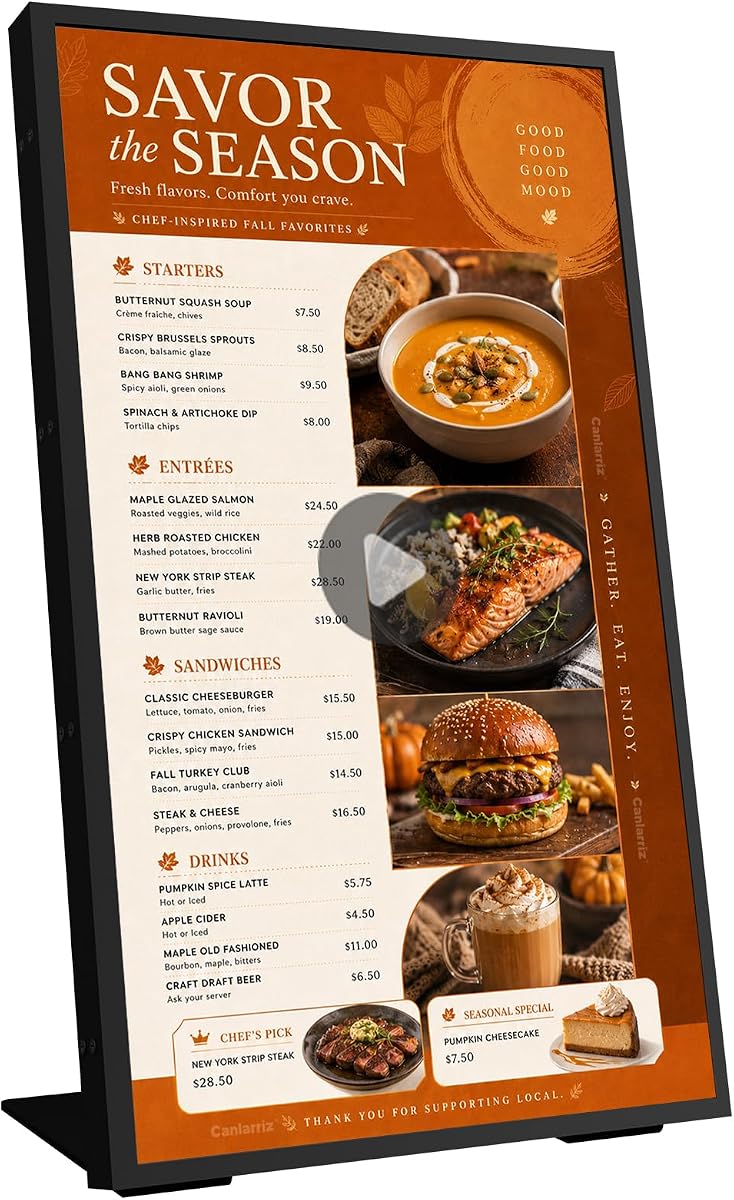

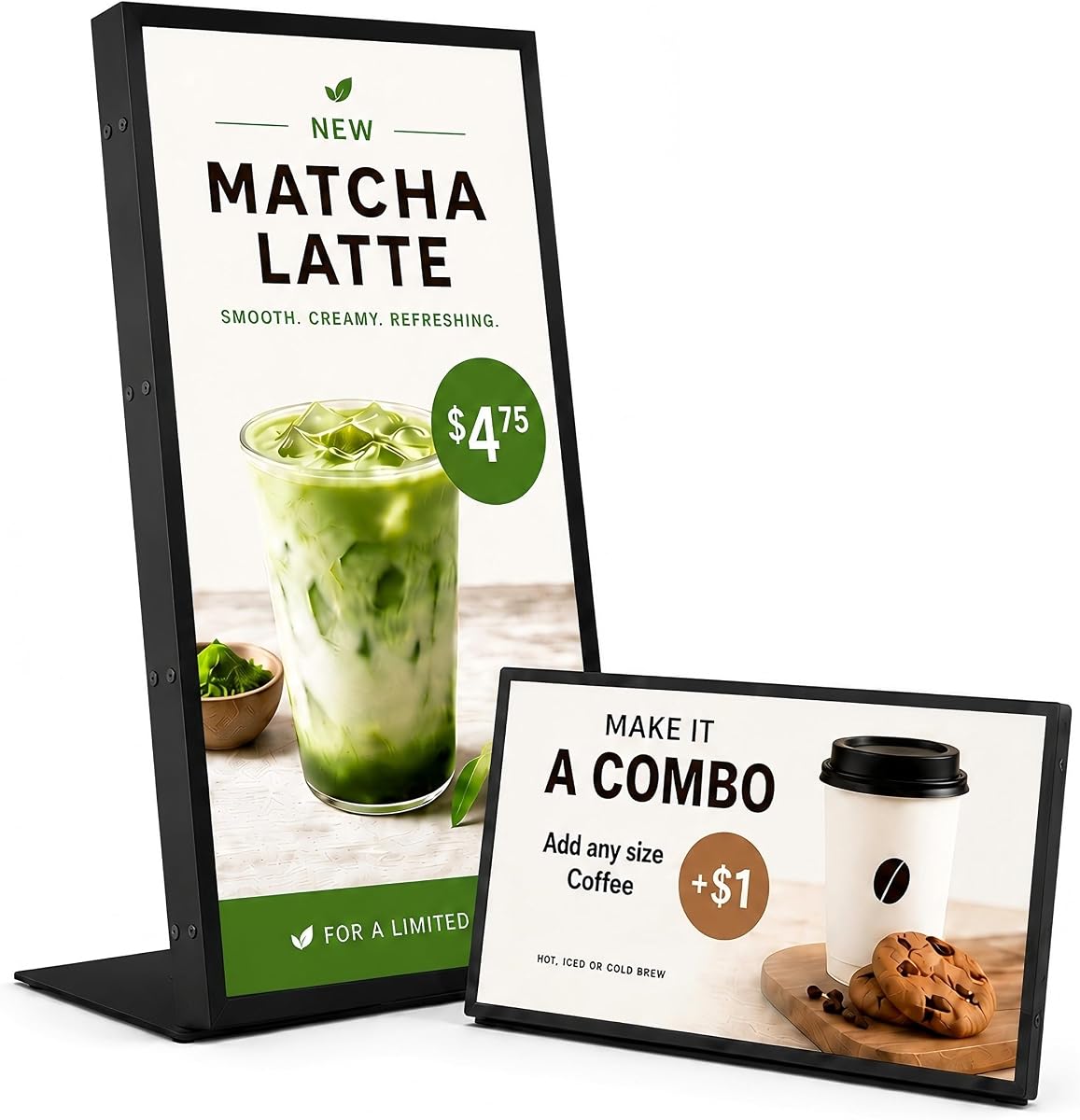


This 18.5-inch commercial digital menu board combines a 700-nit display, Android 12, and cloud-based content management in a countertop-oriented format. Its supplied rating is 3.8, placing it among the more moderately reviewed products in the list, but the stated feature set covers many practical small-business needs.
We may earn a commission when you buy through this link, at no additional cost to you.
The built-in lifetime free CMS is the central attraction. A business can upload content, build playlists, schedule playback, divide the screen, and manage multiple displays through a PC, tablet, or smartphone. USB plug-and-play provides a local option, while HDMI, LAN, USB 2.0, USB 3.0, and TF card connections cover common media and networking needs.
Its 720p HD panel is the main compromise. At this screen size, that resolution can suit menus, price lists, and short promotional loops, although it is less appropriate for buyers who intend to show highly detailed photography or dense text at close range. The 700-nit brightness is a stronger feature for cafés, shops, reception areas, and other bright indoor environments.
This is a sensible option for a business seeking a complete dedicated display rather than a player that requires an external television. It suits cafés, bakeries, salons, clinics, hotel receptions, and retail counters where a freestanding unit, remote CMS, and flexible orientation are more valuable than touch interaction or ultra-high resolution.
The cloud CMS allows promotions and operating information to be updated without physically visiting the display. Playlists, split screens, and scheduled playback make it easier to vary content throughout the day, while USB remains useful when local updates are preferred.
The included desktop stand works in landscape or portrait orientation, allowing the same unit to serve as a horizontal menu board or a vertical welcome and service display. That flexibility makes it easier to match the screen to counters, reception desks, and waiting areas.
We may earn a commission when you buy through this link, at no additional cost to you.
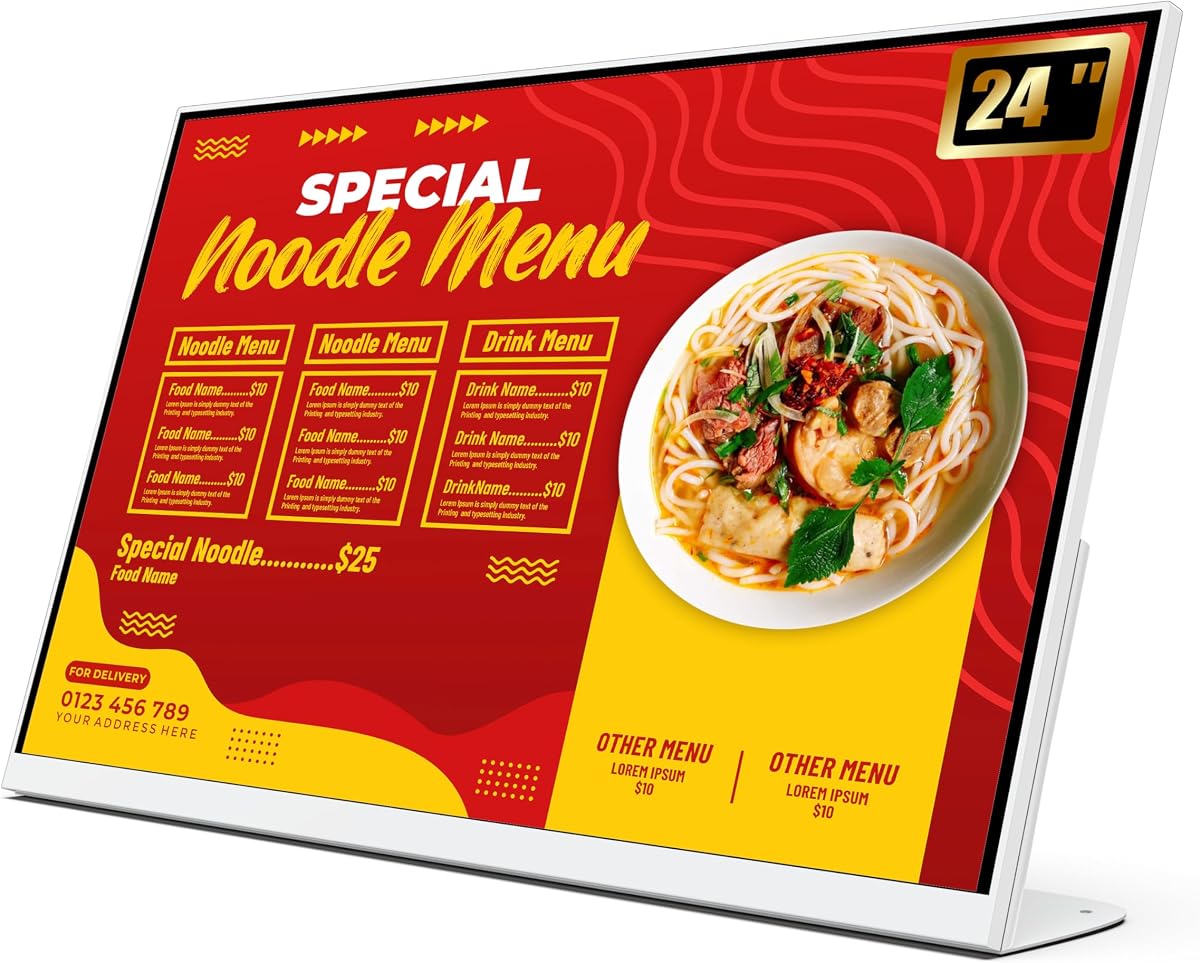
This 24-inch desktop digital menu board pairs a Full HD 1920×1080 screen with Android, CMS-based management, and support for continuous commercial operation. Its supplied rating is 5.0, making it the highest-rated option in this guide and a particularly well-rounded choice for restaurants, milk tea shops, and retail counters.
We may earn a commission when you buy through this link, at no additional cost to you.
Content can be updated through USB, an app, or PC-based remote management, with WiFi and LAN connectivity expanding the options. Split-screen layouts, scheduled power controls, and support for multiple formats are useful for separating menu sections, displaying promotions, and varying content according to the business day.
The 16:9 display uses a wide viewing angle and is designed to show menus, product information, and advertising with clear color and contrast. Commercial materials, 24/7 operation, and heat dissipation are important for busy locations. The supplied feature list does not identify it as a touchscreen, so buyers needing customer interaction should not assume touch functionality.
This model is our overall recommendation because it balances screen quality, content flexibility, counter-friendly size, and commercial operating features without focusing narrowly on one use case. It is especially well suited to cafés, restaurants, ordering counters, and front desks that want a dedicated 24-inch display and remote workflow.
The 1920×1080 resolution provides more room for readable menu copy, product names, prices, and promotional imagery than a lower-resolution panel. Its standard 16:9 format also aligns closely with the proportions of many horizontal menus and presentation graphics.
USB, app, and PC remote updates give staff different ways to keep content current. The cloud-based CMS approach can reduce routine on-site maintenance, while USB remains useful for offline or locally controlled playback.
We may earn a commission when you buy through this link, at no additional cost to you.
The MWE 32-inch indoor kiosk is the most distinctive premium selection because it combines a large Full HD IPS display with a foldable, movable structure. Its supplied rating is 4.6, and the 178-degree viewing angle makes it a strong option for events, exhibitions, restaurants, hotels, shopping centers, and retail promotions.
We may earn a commission when you buy through this link, at no additional cost to you.
Content can begin playing automatically after startup, reducing the need for manual intervention. USB and HDMI inputs support plug-and-play use, while WiFi and the MWE-QIXZOCV CMS enable remote publishing and management. Scheduled power settings, continuous seven-day operation, and automatic looping provide the core functions expected from an unattended sign.
Its strongest advantage is mobility. Built-in wheels and a foldable design make it easier to move between locations, set up for an exhibition, or reposition when a temporary promotional area is needed. The tradeoff is size: a 32-inch screen is less convenient for cramped counters and should not be treated as a compact tabletop panel.
Choose this model when presentation scale, broad viewing angles, and portable deployment matter more than minimizing counter footprint. It is a premium match for businesses needing the same sign to serve both permanent indoor locations and temporary events, provided the available floor area and transport arrangements suit a 32-inch kiosk.
Wheels and the foldable structure reduce the friction of moving a larger display between venues. That makes the kiosk practical for exhibitions, trade shows, and temporary promotional areas where a permanently mounted panel would be inconvenient.
Automatic looping helps the sign keep operating without daily manual intervention. Timed settings can align power use and displayed content with business hours, while remote CMS publishing keeps messages current.
We may earn a commission when you buy through this link, at no additional cost to you.
The EZ AD display player is a budget-oriented way to create a digital menu using an existing HD television. Its supplied rating is 4.1, and although it does not include a screen, it provides a cloud-based platform, 4K content support, and several content creation tools in a compact player.
We may earn a commission when you buy through this link, at no additional cost to you.
The free plan supports image and video formats, includes technical support, and allows up to 50 slides per player. A template builder, video studio, YouTube loader, and mobile app support content creation, while premium plans unlock additional capabilities. Layouts can be customized for vertical screens and divided into slideshow sections with videos and images.
Connectivity includes one HDMI port, Ethernet, two USB Type-A ports, and a memory card reader. Content can be updated wirelessly through the cloud-based website, making the player straightforward to integrate with a television already owned by the business. The main limitation is that buyers must have a suitable display and should account for its size and placement separately.
This is the best budget choice for a cafe, shop, salon, office, or small restaurant that already has a suitable HD television and wants inexpensive remote signage. It is less appropriate for buyers seeking a complete, freestanding commercial panel, but it offers a practical way to modernize an existing screen.
The player connects through HDMI, so an existing HD television can become the visible portion of the signage system. This approach can simplify upgrades and make it easier to place menus on a screen located where customers can see them.
The free plan includes image and video support, technical support, and a 50-slide allowance. A built-in template system and mobile content management reduce the need for advanced design skills, while paid upgrades remain optional.
We may earn a commission when you buy through this link, at no additional cost to you.
This 10.1-inch Android digital signage display offers a compact, interactive option for close-range information. Its supplied rating is 4.0, and its touch operation differentiates it from the non-touch commercial panels in the list, making it relevant for browseable menus, price lists, and reception information.
We may earn a commission when you buy through this link, at no additional cost to you.
WiFi and USB connectivity support both wireless organization and local file transfer. The interface is designed for simple tap-and-swipe browsing, while the operating system allows staff to manage menu pages, price lists, notices, brand slides, and other visual materials without a complicated process.
Its principal strength is space efficiency. The 10.1-inch tabletop format can fit restaurant counters, cafe tables, retail shelves, reception desks, salon service areas, clinic notice zones, hotel lobbies, and trade show booths. The tradeoff is visible size, and the supplied specifications do not state a brightness figure or detailed resolution.
This display is best for businesses that want customer-facing information available at a glance on a small counter or shelf. It can also function as a desktop advertising screen, product showcase, information board, or POS display, although its supplied data does not describe it as a complete point-of-sale system.
Tap and swipe controls make the display more interactive than a conventional static menu panel. The compact structure preserves counter space while allowing visitors or staff to browse supported pages and media.
WiFi and USB support flexible update methods, including compatible wireless transfer and local file management. This is useful for frequently changing price lists, daily specials, notices, and short promotional materials.
We may earn a commission when you buy through this link, at no additional cost to you.
The 18.5-inch countertop digital signage display combines a 1080p screen, 700-nit brightness, and a commercial metal-and-glass enclosure. Its supplied rating is 4.5, making it one of the better-rated dedicated countertop options and an attractive choice for close-range menus in busy indoor businesses.
We may earn a commission when you buy through this link, at no additional cost to you.
Remote CMS publishing allows content to be changed from another location, while USB playback provides a local alternative. Loop playback and scheduling help organize all-day content, and Ethernet, 2.4G WiFi, HDMI, two USB ports, and one LAN port cover common connectivity requirements. Android 10, 2GB RAM, and 32GB storage form the underlying platform.
The product is clearly defined as a display rather than a touchscreen tablet, POS terminal, self-ordering kiosk, or outdoor waterproof unit. That specificity is helpful because it avoids feature confusion, but buyers wanting customer interaction should choose an interactive model instead. It is also limited to indoor countertop environments.
This display is a strong recommendation for restaurants, cafes, bakeries, retail counters, salons, clinics, and front desks that need a polished, freestanding 18.5-inch sign. The Full HD panel, two stand orientations, remote publishing, and USB fallback provide a flexible package for close-range commercial communication.
The 1920×1080-style 1080p presentation provides useful detail for prices, menu descriptions, product names, and service information. A 700-nit panel also supports clear indoor visibility when the counter receives substantial ambient light.
Metal housing, a tempered glass front, and stable stands are appropriate for daily placement at service counters. The stated three-year warranty and first-year replacement support add reassurance for business use.
We may earn a commission when you buy through this link, at no additional cost to you.
The 50-inch digital signage display is built for large-format installations, combining 4K UHD resolution with 1000-nit brightness. Its supplied rating of 3.4 is the second-lowest in the group, so buyers should evaluate the listed capabilities carefully, but the display specifications are impressive for high-visibility commercial use.
We may earn a commission when you buy through this link, at no additional cost to you.
The screen can be divided into two to six zones for videos, social feeds, countdowns, and QR codes. It supports continuous loop playback, image rotation, HDMI plug-and-play, and the Google Play Store. A complimentary CMS allows automatic breakfast, lunch, and dinner menu switching, bulk editing, remote scheduling, and adjustment of brightness, volume, and power.
Its ultra-thin 6.8mm bezel and 3.5cm profile support wall mounting and tiled installations. The all-metal chassis, intelligent heat dissipation, 178-degree viewing angle, and stated 50,000-hour lifespan target demanding commercial use. The tradeoff is scale: a 50-inch screen requires substantial wall space and careful placement.
Choose this model for restaurants, retail environments, exhibition areas, or other locations that need a large, bright menu and promotion display. It is best suited to businesses ready to wall-mount it and manage several content zones, rather than small operators wanting a simple countertop sign.
The combination of 4K UHD and 1000-nit brightness supports detailed visuals and strong indoor visibility. It is particularly relevant to larger rooms where customers view the sign from varied distances and angles.
Dividing the panel into up to six zones lets one installation carry menus, videos, social feeds, countdowns, and QR codes simultaneously. Image rotation and looping add further layout flexibility for changing business requirements.
We may earn a commission when you buy through this link, at no additional cost to you.
The 29-inch Android commercial display offers a middle ground between a countertop panel and a large tiled installation. Its supplied rating is 2.6, the lowest in this comparison, so prospective buyers should review current customer feedback and confirm expectations, although the stated hardware supports a broad range of signage uses.
We may earn a commission when you buy through this link, at no additional cost to you.
A 2K display, 700-nit brightness, 178-degree viewing angle, and 50,000-hour lifespan form the core performance specifications. The screen can be divided into two to six zones for videos, social feeds, countdowns, and QR codes, with 24/7 looping and image rotation for changing formats.
Android supports broader compatibility, and the pre-installed Google Play Store allows immediate operation after startup. The complimentary CMS provides automatic menu periods, bulk editing, remote scheduling, and control of brightness, volume, and power. HDMI plug-and-play works without additional drivers, while 2GB RAM and 32GB storage support local media.
Despite its lower supplied rating, this display is functionally relevant to restaurants, malls, hospitals, offices, churches, stores, hotels, transit areas, and government environments. It makes the most sense for buyers who prioritize a 29-inch format, wall installation, multi-zone layouts, and remote management over a desktop footprint.
A 29-inch panel offers more visual area than a countertop display while remaining less dominant than a 50-inch installation. It can suit mounted menu boards, directories, queue information, and internal communications.
The Google Play Store, HDMI plug-and-play operation, and remote CMS controls support different deployment approaches. Scheduled content, bulk editing, and adjustable display settings are useful for a business with multiple messages and operating periods.
We may earn a commission when you buy through this link, at no additional cost to you.
The Cloud-Controlled 4K media player is designed to make digital menu deployment approachable for businesses without dedicated technical teams. Its supplied rating is 3.0, but the setup process is clearly defined: connect HDMI and power, join WiFi, and begin using the cloud service.
We may earn a commission when you buy through this link, at no additional cost to you.
The free features allow businesses to upload and schedule their own content. A built-in Canvas Designer makes it possible to create menu boards without separate design software, while remote management handles uploads, schedule changes, and event promotions from different locations.
PowerPoint uploads are supported, which can simplify the reuse of existing business material. An AI image enhancer is available through upgrade plans, as are a template builder and other premium tools. As with the EZ AD player, this product does not include a screen, so the cost and placement of a separate television must be considered.
This player suits small retailers, cafes, offices, clinics, and service counters that want simple cloud scheduling and menu design without buying a dedicated commercial panel. It is a practical alternative for businesses that already own a television and prefer to manage signage through a browser or connected workflow.
The short connection process reduces the setup burden for owners and staff without dedicated signage experience. Once connected to a display, the player can receive uploaded and scheduled content through the cloud.
The integrated Canvas Designer provides a direct way to prepare menu boards. PowerPoint compatibility also gives businesses a familiar starting point when adapting existing promotional or product material.
We may earn a commission when you buy through this link, at no additional cost to you.
The mediaDROID+ player is a dedicated digital signage box designed to drive an external screen. Its supplied rating of 4.3 is solid within the group, and its strongest differentiators are 4GB RAM, 16GB storage, a Hexa 6 ARM processor, and a custom Android build intended for continuous signage work.
We may earn a commission when you buy through this link, at no additional cost to you.
The player uses DigitalSignage.com cloud services and includes a custom watchdog for operational reliability. Sixteen gigabytes of local storage cache is intended to preserve playback continuity, while HDMI, WiFi, and Ethernet cover common display and networking arrangements.
Vertical and horizontal screen modes make the device relevant to both standard television-style signage and tall portrait installations. Its trade-off is that it is a media player rather than a complete display, and the supplied platform information centers on an Android OS design that may appeal to buyers seeking a dedicated appliance rather than a general-purpose streaming box.
Choose the mediaDROID+ when an existing screen is available and local caching, memory, and dedicated signage processing matter. It can suit offices, shops, restaurants, and internal communication installations where a dedicated cloud-managed player offers a more specialized alternative to a basic HDMI stick.
The 16GB storage allocation provides room for cached signage media and a local content library. That focus on continuity is valuable for menus, notices, and looping promotional content that must keep displaying reliably.
A Hexa 6 ARM configuration with 4GB RAM is tailored to signage workloads rather than general media browsing. The baked Android operating system, custom watchdog, and dedicated cloud service form an integrated playback system.
We may earn a commission when you buy through this link, at no additional cost to you.
The best digital menu display depends on where customers will view it, what content must run, who will update that content, and whether you need a complete screen or already own a television.
A dedicated display provides a screen, enclosure, stand or mounting system, and commercial playback hardware in one package. It is usually the simpler choice for a new installation because sizing, orientation, and placement have already been considered. A media player is more economical when a suitable HD television is already available and can be positioned where customers need to see the menu.
Choose a complete display for a new countertop, wall, or kiosk installation. Choose a player when reusing existing equipment, testing digital signage gradually, or operating several screens from one cloud account.
Screen size should follow viewing distance and the amount of information shown. Compact 10.1-inch and 18.5-inch displays work well at counters where customers are close. A 24-inch model offers a balanced canvas for menu sections, while 29-inch and 32-inch panels suit wall-mounted or freestanding areas with more distance. A 50-inch display is appropriate for large rooms and multi-zone installations.
Match the panel to the space rather than choosing the largest screen possible. Oversized displays can dominate a counter, complicate installation, and remain difficult for nearby customers to read comfortably.
Resolution determines how much fine text and detailed imagery can appear without looking soft. The 24-inch model offers 1920×1080 Full HD, the MWE kiosk uses a Full HD IPS panel, and the 50-inch screen supports 4K UHD. Two products in the comparison are listed at 720p or 2K, which may still work well for larger fonts and short menu pages.
Prioritize Full HD or higher when showing dense menus, product photography, prices, or QR codes. For simple messages viewed from a distance, resolution matters less than brightness, contrast, and readable typography.
Brightness is especially important in cafes, quick-service restaurants, lobbies, and retail spaces with windows or strong overhead lighting. The dedicated 18.5-inch and 29-inch models list 700 nits, while the 50-inch model reaches 1000 nits. The compact 10.1-inch unit does not state a brightness figure, so buyers should request that detail before choosing it for a bright location.
Higher brightness can improve visibility, but placement still matters. Avoid glare, angle screens away from direct sunlight, and test how menus look under the actual lighting found at the counter or wall mount.
A useful CMS lets a business upload media, arrange playlists, schedule changes, and update several displays without carrying a laptop to each screen. Remote CMS publishing appears in the 18.5-inch 700-nit model, the 24-inch model, the MWE kiosk, the countertop 1080p model, and the larger Android displays. The player options also provide cloud-based content workflows.
Choose based on who performs updates. Cloud tools suit managers and remote teams, while USB playback remains valuable for quick local changes or offline control. Confirm the update method matches the staff's comfort and the business's internet arrangement.
The strongest systems provide more than one way to transfer content. HDMI is common across dedicated displays and players, while Ethernet offers a stable wired network for fixed installations. WiFi reduces cabling, and USB allows direct file loading. Some featured models also include TF card or memory card readers. Multiple options make it easier to keep the sign operating when a network or preferred update route is unavailable.
For permanent installations, assess where the network cable or power can reach and how the screen will be serviced. For portable signs, prioritize wireless control and simple USB media loading.
The correct physical design depends on the location. Countertop units benefit from stable stands and both landscape and portrait options. Wall displays need suitable mounting space and a narrow profile, especially when several panels will be tiled. The 32-inch MWE kiosk stands apart because its foldable, wheeled structure supports movement between events and temporary locations.
Measure the counter or wall before buying, including cable clearance and customer traffic flow. Check whether the display is intended for indoor use and whether a freestanding base, stand, or separate mounting hardware is included.
Commercial signage may operate every day for long periods, so heat management, warranty coverage, local storage, and dependable playback are important. Several dedicated displays state support for 24/7 operation, and the 18.5-inch 700-nit model, 24-inch model, MWE kiosk, 50-inch display, 29-inch display, and 18.5-inch countertop model include stated three-year warranty coverage.
Review warranty terms, replacement support, and the manufacturer's service policy before installation. A long warranty is helpful, but it should complement proper ventilation, stable power, careful handling, and a content workflow that prevents avoidable setup mistakes.
Start by measuring the intended counter or wall area and deciding whether the unit will sit in landscape or portrait orientation. Position the screen where customers can see it without glare, then connect power and the preferred network or media source. Install the CMS or media-player software, confirm that the device appears online, and test the display with a small sample playlist before transferring the full menu.
Create content in a readable order rather than placing every available item on one screen. Use large type, high-contrast backgrounds, consistent prices, and enough open space between sections. Upload images and videos through the CMS or load them by USB, then build a playlist and schedule it around operating hours. Test split-screen layouts and timed commands, and keep a backup copy of the source files and playlist settings.
For daily care, wipe the screen gently with a soft, lint-free cloth and avoid pushing liquid into vents or ports. Keep the housing and vents clear of dust, and do not place the unit where condensation, direct outdoor weather, or excessive heat can affect it. Review playback and connections periodically, update software or media when instructed, and check the display before peak service periods so failed content can be replaced quickly.
Yes, a digital menu display can present menus, prices, daily specials, promotional videos, and brand messages without printing and replacing paper signs. For a polished result, keep the on-screen design simple and readable, and maintain a current digital file as a backup. Printed inserts may still help when a customer needs a detailed takeaway menu.
A digital signage display includes the screen, enclosure, and playback system, while a media player is a small box that sends content to a separate television or monitor. Displays are generally simpler for a new installation, whereas players can be economical for businesses that already own a suitable screen. Check included stands, cables, mounting hardware, and remote-management access before comparing them.
WiFi management is convenient for businesses that change items, prices, or promotions regularly from a phone, tablet, or computer. USB playback is still useful for offline updates, temporary files, or a location with unreliable connectivity. A dependable setup can use both remote and local methods, with the remote workflow handling routine changes and USB serving as a fallback.
A touchscreen makes sense when customers need to browse pages or interact directly with the screen, but it does not automatically create a complete ordering system. The 10.1-inch model supports tap-and-swipe operation, while several other featured displays are display-only. Confirm operating-system compatibility, required ordering software, payment hardware, and whether customers are intended to handle sensitive transactions.
Brightness should be sufficient for the room rather than simply as high as possible. The featured 700-nit and 1000-nit panels are intended to remain visible in bright commercial interiors. For smaller models without a stated brightness figure, test a sample under actual counter lighting and check for reflections before committing to a large installation.
It depends on the model. Several panels are designed for wall mounting or tiled installation, while countertop products include desktop stands. The MWE 32-inch kiosk is uniquely described as foldable, movable, and equipped with wheels for transport. Check the product dimensions, base, weight, stand orientation, and mounting accessories before deciding how the screen will be deployed.
Most of the featured commercial displays support scheduled playback, loop playback, or automatic content starting, while several include timed power settings. These features reduce the need for staff to operate the screen manually. Correct scheduling and a reliable content library are still essential, so test the playlist and power schedule after installation.
Check screen size, resolution, brightness, viewing angle, orientation, ports, CMS access, scheduling, local playback, and warranty terms. Also confirm that the intended space can accommodate the unit and that the content workflow is simple enough for the people who will use it. Current specifications, software availability, and pricing should be verified directly on the product page.
The 24-inch desktop menu board is the strongest all-around choice, combining a 5.0 supplied rating, Full HD clarity, Android CMS support, several update methods, and a counter-friendly format. The EZ AD player is the best budget route when an existing television is available, while the MWE 32-inch portable kiosk offers the most distinctive premium combination of screen size, remote CMS control, and mobile deployment.
Prioritize the factors that will affect daily operation: readability at the intended viewing distance, reliable content updates, a physical format suited to the location, and enough connectivity for both managed and local playback. Larger and brighter panels suit expansive spaces, while compact displays work best where customers view content from close range. A player-based approach can reduce duplication but requires an existing screen.
Ratings, software features, and promotions can change, so review the current product listing and confirm the key specifications before ordering. Most importantly, test a sample menu under the actual lighting and viewing conditions of your business to ensure that the final digital menu display is readable, manageable, and suitable for long-term use.