
UGREEN NAS DH2300
4.5Editor score
Entry-level two-bay design
4GB onboard memory
Up to 64TB capacity
AI-assisted photo organization
Automatic multi-device backups
Discover the best NAS for home media server by comparing storage capacity, networking, media apps, RAID support, expansion, privacy, and ease of use.
A NAS for home media server use brings films, music, photographs, television programs, and personal files into one private, accessible library. The right enclosure should balance usable performance, quiet operation, straightforward administration, dependable protection, and enough room for your collection. It must also fit the way your household streams, shares, and backs up data.
This guide compares ten diskless and bundled NAS options across storage capacity, drive bays, networking, processor and memory specifications, app support, RAID features, surveillance functions, photo management, and setup considerations. The list includes beginner-friendly two-bay and four-bay systems, more advanced creator platforms, and premium enclosures for demanding multi-user workloads.
Each recommendation highlights the product's strongest use case while noting relevant limitations, such as the absence of included drives, reliance on wired Ethernet, or lack of virtual-machine support. The selections show how capacity and headline performance differ across the range, helping you choose the right feature set for your home. Prices and availability can change.
4.5Editor score

4.6Editor score

4.6Editor score
The comparison below organizes all ten options by their most useful media-server characteristics. Pay particular attention to drive-bay count, network speed, application support, and whether storage drives are included before making a final selection.




The UGREEN NAS DXP2800 is a two-bay NAS that combines an Intel N100 quad-core processor, 8GB of DDR5 memory, 2.5GbE networking, and two M.2 NVMe slots. Its 4.6 rating reflects a well-rounded platform for users who want more flexibility than a basic file hub. It is particularly compelling for home media libraries that include large 4K files, extensive photographs, and creator projects requiring more than simple folder storage.
We may earn a commission when you buy through this link, at no additional cost to you.
The enclosure is designed to run Docker applications, virtual machines, and compatible Plex media-server software. That makes it more versatile than entry-level alternatives limited to backups and file sharing. The NVMe slots can complement HDD media storage, while 2.5GbE networking helps reduce bottlenecks when copying large films or accessing files from several devices. AI photo features recognize people, objects, scenes, and locations and can assist with albums and duplicate detection.
Its main limitation is that it is a diskless enclosure, so compatible HDDs and SSDs must be purchased separately. The two-bay design also offers less expansion room than a four-bay model. Nevertheless, the combination of processing power, memory, fast networking, and app support is unusually balanced for a home setup. It provides a sensible middle ground between a simple personal NAS and a specialized creator workstation.
Choose the DXP2800 if you want local media streaming, comprehensive photo management, automated backups, and room to run self-hosted services. It is an especially strong fit for technically comfortable users with mixed computers, phones, tablets, and televisions. For straightforward storage without Docker or virtual machines, a more basic model may be easier, but this is the strongest all-around recommendation in the group.
The DXP2800 can serve as a centralized library for 4K videos, family films, music, and RAW photographs. Docker and virtual-machine support distinguish it from simpler NAS choices, while 2.5GbE networking provides a useful foundation for large-file transfers and multi-device access.
Two M.2 NVMe slots allow compatible flash storage to be added alongside the SATA media drives. AI-assisted recognition, album organization, and duplicate-photo detection also make the system useful for households whose photo library is growing faster than their local device capacity.
We may earn a commission when you buy through this link, at no additional cost to you.
The UGREEN NAS DH2300 is an entry-level two-bay NAS designed for people who want an approachable move away from scattered external storage and cloud-only backups. It carries a 4.5 rating and emphasizes simple setup, automatic backups, photo organization, and private local storage. The enclosure provides up to 64TB of listed capacity when compatible drives are added, making it appropriate for a growing household media collection.
We may earn a commission when you buy through this link, at no additional cost to you.
Its 4GB onboard memory and 1GbE connection are sufficient for basic file serving, photo access, and standard media-library duties. Automatic backups work across Windows, iOS, Android, and macOS, while AI can tag faces, locations, text, and objects and identify similar images. RAID modes, two-factor authentication, permission controls, and encrypted transfers add protection beyond merely keeping files on local drives.
The DH2300 does not support Docker, virtual machines, or SAN Manager, and Plex cannot be run through Docker on this model. Its 1GbE port also means the advertised transfer rate of up to 125MB/s is close to the practical ceiling for conventional gigabit networking. Actual speeds depend on the router, CPU, storage drive, and file size. It uses wired Ethernet, while Wi-Fi requires an external USB adapter.
This is the most straightforward recommendation for a beginner who primarily wants backups, a private photo library, and shared access to personal media. It may not suit someone planning to run many containerized services or handle exceptionally large transfers over a high-speed LAN. For those priorities, spending up to a more capable model would be worthwhile.
The DH2300 centralizes videos, photographs, documents, and music while providing automatic backups for several operating systems. It is built for people who want the ownership and convenience of a NAS without navigating a complex application ecosystem.
Face, location, text, and object tagging can make a large family photo collection easier to search. Duplicate detection and one-tap sharing add convenience, although the system remains focused on personal storage rather than advanced server applications.
We may earn a commission when you buy through this link, at no additional cost to you.
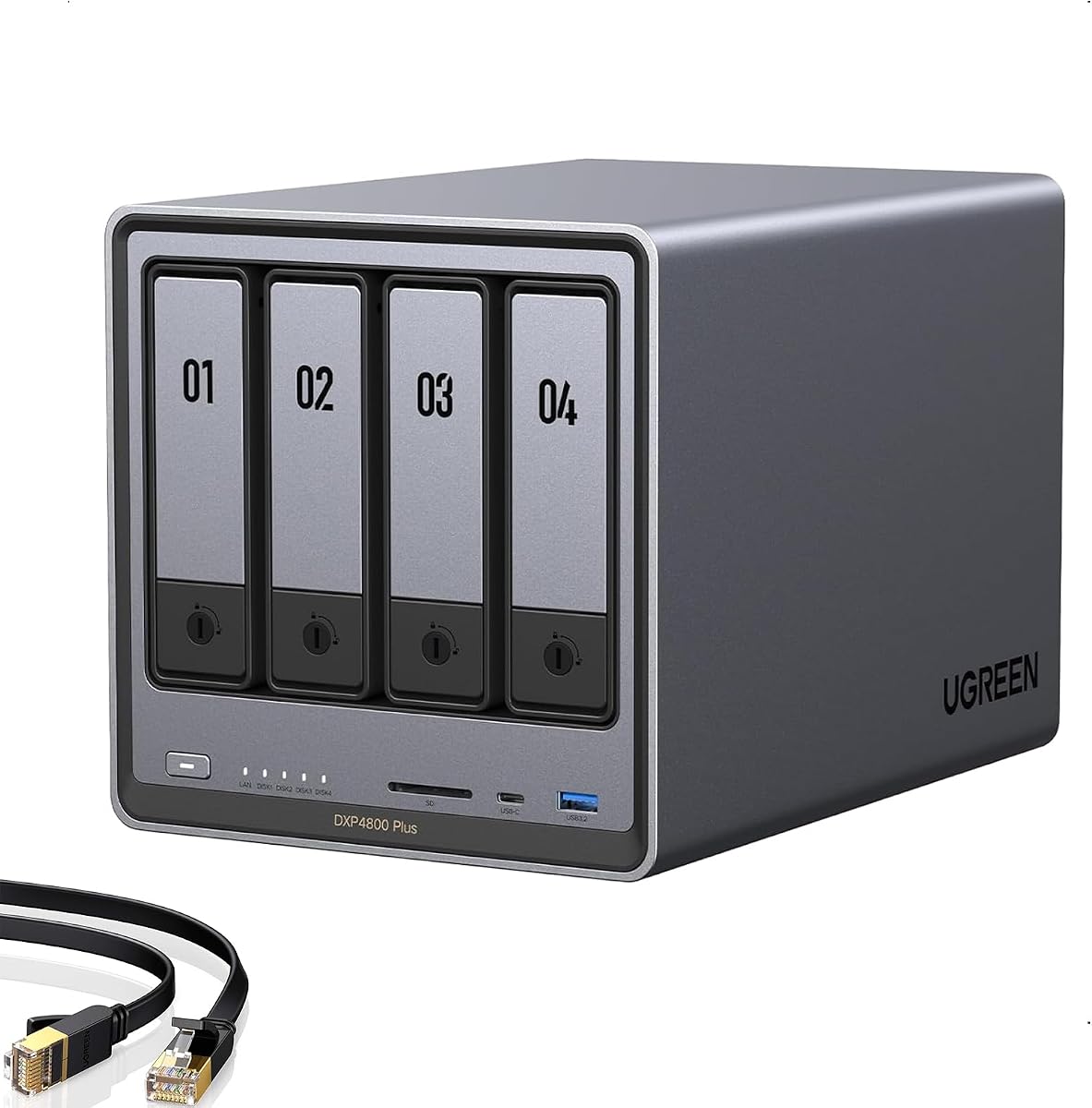
The UGREEN DXP4800 Plus combines four drive bays with 10GbE networking and 10Gbps USB connections, making it an exceptional high-performance option for a home media server. Its 4.6 rating and support for Docker and virtual machines place it in a more advanced class than basic backup-oriented NAS systems. It is aimed at families, creators, and small teams that want substantial capacity without moving beyond an enclosure designed for home use.
We may earn a commission when you buy through this link, at no additional cost to you.
The platform can handle centralized storage, automatic backups, remote access, RAID options, and file collaboration across Windows, macOS, Linux, iOS, Android, Google services, browsers, and compatible smart TVs. Transfers of 1GB can complete in less than a second under the specified 10GbE or 10Gbps USB conditions. AI features organize photos by faces, scenes, objects, and locations, while flexible permissions help separate personal and shared content.
Its headline speed depends on a suitably equipped router, switch, client, storage configuration, and file sizes, so not every household will experience the advertised result. Hard drives are also not included, and maximum capacity is based on RAID 0 rather than the redundancy offered by other RAID configurations. A four-bay system needs a sensible expansion plan because the enclosure cannot accept an unlimited number of drives.
The DXP4800 Plus is a compelling choice for a home media library that includes very large 4K files, extensive active work projects, and several simultaneous users. It also provides enough application flexibility for users interested in Docker-based media services. Choose it when its network and storage potential can be fully used; a gigabit home network may leave some of its potential untapped.
The combination of 10GbE and 10Gbps USB significantly reduces transfer waits for large media files and backups. Matching this speed to clients and network equipment is essential, but the platform is well suited to a properly planned home or small-office network.
With up to 144TB of listed capacity, the four-bay design offers more room for media, backups, and shared work files. RAID choices, encrypted access, and granular permissions make it suitable for households that want convenient storage with room to grow.
We may earn a commission when you buy through this link, at no additional cost to you.
The UGREEN NAS DH4300 Plus is an entry-level four-bay NAS aimed at beginners, home users, and remote workers. Its 4.2 rating is the lowest in this group, but the underlying feature set addresses a clear need: manageable NAS storage with more bays and faster networking than a basic two-bay model. The enclosure supports Docker, though not virtual machines, and can run Plex through Docker with manual setup.
We may earn a commission when you buy through this link, at no additional cost to you.
Its 2.5GbE port and 8GB LPDDR4X memory provide a useful step up for media access, while the listed 1GB transfer in approximately three seconds reflects the potential under suitable conditions. Real-world speed will vary. A magnetic top dust cover, NFC-assisted connection, guided application, and beginner-oriented instructions help reduce setup friction. The included 4K HDMI output also opens possibilities for direct display of compatible media.
The system is diskless, and its 128TB maximum is based on RAID 0. Users who care more about resilience should not interpret that figure as the amount of redundant capacity available in their preferred configuration. It relies on wired Ethernet rather than built-in Wi-Fi. It also lacks virtual-machine support, making it less versatile than the DXP models despite its Docker capability.
The DH4300 Plus fits families that want automatic phone photo and video backups, AI-assisted albums, and enough drive bays for a growing media collection. It is a particularly useful middle option when two drives feel limiting but a premium high-speed platform is unnecessary. Beginners should also be comfortable installing their own compatible drives and configuring RAID themselves.
Real-time phone backups protect growing photo and video collections, while semantic search and recognition of people, objects, pets, and similar images simplify retrieval. These features are particularly useful when many family members contribute media from different devices.
The 2.5GbE connection offers a meaningful improvement over 1GbE for large media files when the rest of the network supports it. Eight gigabytes of memory and Docker support also make the enclosure more capable than a basic personal file server.
We may earn a commission when you buy through this link, at no additional cost to you.
The UGREEN NAS DXP4800 GT is built for creators, technical users, and office teams who want strong processing and networking in a four-bay home enclosure. It pairs an AMD Ryzen Embedded R2514 with four cores, eight threads, operation up to 3.70GHz, and 8GB of expandable DDR4 memory. The enclosure carries a 4.6 rating and is designed to handle media processing, backups, Docker applications, and multi-user activity.
We may earn a commission when you buy through this link, at no additional cost to you.
Dual 10GbE ports can each operate at 10Gbps, or approximately 1.25GB/s theoretically. With compatible network equipment and Link Aggregation, the pair can provide up to 20Gbps aggregate bandwidth, or about 2.5GB/s theoretically. UGREEN OS Pro supports Docker, virtual machines, SAN Manager, Plex, Emby, Jellyfin, Home Assistant, web hosting, and other self-hosted workflows. That flexibility makes the GT attractive for users who want their media server to become a broader home-services platform.
The built-in Surveillance Center works with compatible ONVIF or RTSP cameras and supports live multiview, pan-tilt-zoom control, event detection, recording, and timeline playback. A built-in SD card slot and 10Gbps USB-A and USB-C connections simplify camera and creator-file imports. Storage drives are not included, and Plex requires manual Docker setup. The installed memory is non-ECC, although compatible ECC upgrades are supported.
Buy the DXP4800 GT when high-speed local editing, large media libraries, complex applications, and surveillance are priorities. It is overkill for someone who only needs two shared folders and automatic backups, but it offers one of the most complete feature sets in the guide. Users should confirm that their switches, adapters, and client devices can exploit its networking potential.
Large video files, active editing timelines, and rapid backups benefit from the system's high-throughput networking. Link Aggregation can distribute traffic across compatible equipment, while the processor provides ample headroom for media processing and concurrent users.
The Surveillance Center can store camera footage locally and manage compatible ONVIF or RTSP devices. Docker, virtual machines, and SAN Manager broaden the platform beyond simple streaming, allowing media, smart-home tools, and security recordings to share one enclosure.
We may earn a commission when you buy through this link, at no additional cost to you.
The Synology DS223 is a two-bay diskless NAS positioned as a home and office backup hub. Its 4.6 rating reflects a focused approach to central storage, file sharing, automated backup, and IP-camera monitoring. Rather than emphasizing a broad collection of self-hosted applications, the product focuses on making common household and small-office data tasks straightforward and dependable.
We may earn a commission when you buy through this link, at no additional cost to you.
Users can consolidate files from computers, phones, and external drives, synchronize documents, and maintain version control while avoiding dependence on Dropbox-style services. Automated backup workflows can target multiple destinations, including cloud storage and external drives. For surveillance, compatible IP cameras can be managed with motion alerts, recording schedules, and remote viewing. The enclosure is backed by a two-year warranty and Synology's continuing software updates.
As a diskless model, it does not include storage drives, and the two-bay chassis limits future expansion. The supplied information does not detail its network port, memory configuration, processor, or media transcoding specifications, so buyers should examine the current manufacturer specifications if those factors are decisive. It may also be less attractive than container-capable UGREEN models for users who want to self-host a wide application ecosystem.
The DS223 makes sense for people who value a streamlined Synology ecosystem, dependable backup tools, and straightforward household file management. It is well suited to consolidating a family archive or supporting a small work group that needs shared files and version history. Choose it for simplicity and managed software; consider another option for intensive transcoding, high-speed editing, or extensive virtual-machine use.
Automated backups for Macs, PCs, and mobile devices reduce the risk of keeping important files only on endpoint hardware. Supporting several backup destinations adds flexibility, while the local hub gives users direct control over their stored content.
File sharing, project synchronization, and version control support both family and small-office workflows. Compatible IP cameras can also be transformed into a monitoring system with alerts, scheduled recording, and remote viewing.
We may earn a commission when you buy through this link, at no additional cost to you.
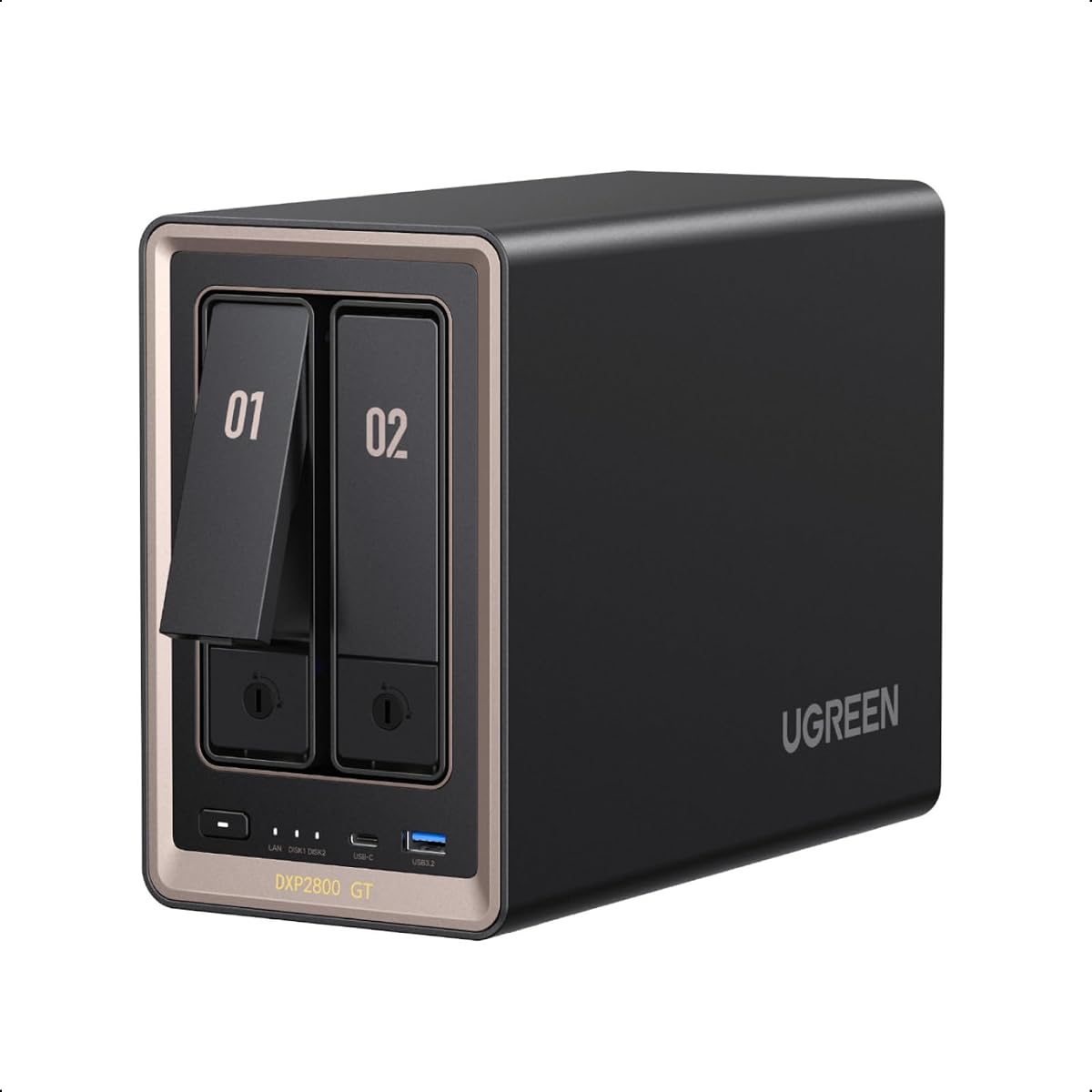
The UGREEN DXP2800 GT puts an AMD Ryzen Embedded R2514 and 10GbE networking into a two-bay enclosure. It is intended for smart-home enthusiasts, creators, and freelancers who want more performance than a basic NAS while retaining a compact two-bay footprint. The system has a 4.3 rating and supports Docker, virtual machines, SAN Manager, and media applications including Plex, Emby, Jellyfin, and Home Assistant.
We may earn a commission when you buy through this link, at no additional cost to you.
The four-core, eight-thread processor can operate up to 3.70GHz, and its 8GB DDR4 memory is expandable to 64GB. This provides a useful foundation for backups, photo libraries, media streaming, file sharing, and multi-device access. A built-in Surveillance Center supports compatible ONVIF and RTSP cameras, with live viewing, continuous recording, event review, and local management of security footage.
The two SATA bays can hold drives of up to 32TB each. Two compatible U.2 NVMe SSDs and two M.2 SSDs add further capacity, resulting in up to 80TB of listed total capacity. Storage is not included, and the initial RAM is non-ECC even though compatible ECC upgrades are supported. Plex runs through Docker and requires manual setup. The two-bay limit also makes long-term expansion more restrictive than on the four-bay GT.
This DXP2800 GT is a strong recommendation for a creator with a two-drive media library, a need for 10GbE performance, and an interest in smart-home or surveillance applications. It is less suitable for families expecting to add many drives over time, but its processor and application support make it unusually capable in a smaller chassis.
The Ryzen Embedded R2514 and 10GbE connection support demanding file operations, backups, and media applications. Memory can be expanded to 64GB, giving advanced users room for additional workloads without moving immediately to a larger enclosure.
Docker, virtual machines, SAN Manager, and the Surveillance Center make the enclosure useful beyond passive file serving. Local recording and locally controlled media applications can simplify access to security footage and household services.
We may earn a commission when you buy through this link, at no additional cost to you.
The Synology DS425+ is a four-bay diskless NAS aimed at users who want a private media hub with business-oriented reliability. Its 4.7 rating is the highest among the ten products reviewed. It supports media streaming, file sharing, centralized repositories, granular access controls, audit logs, automated backups, RAID redundancy, and snapshot technology, making it suitable for a home that also serves as a small creative office.
We may earn a commission when you buy through this link, at no additional cost to you.
The stated performance reaches 278MB/s and supports concurrent access from more than ten users. That makes the DS425+ well suited to serving large files to several people at once, whether they are editing media, reviewing documents, or streaming from shared storage. Compatible IP cameras can be monitored with motion detection and secure remote access, with support listed for up to 30 cameras.
The enclosure is diskless, so compatible drives must be supplied. RAID redundancy and snapshots provide useful layers of protection, but they should be configured carefully; high capacity and high availability are different considerations. A three-year warranty and access to enterprise support provide added confidence for users who regard the NAS as production infrastructure rather than an casual file appliance.
Choose the DS425+ when concurrent access, data governance, surveillance, and long-term Synology support matter more than running a broad Docker ecosystem. It is a strong choice for a family office or creator team that wants centralized control without installing server-class equipment. For a simple two-user household library, some of its business features may remain unnecessary.
Support for more than ten concurrent users and a stated 278MB/s speed makes the DS425+ suitable for demanding shared-library use. The platform is better suited to simultaneous professional access than a lightweight personal NAS.
RAID redundancy, automated backups, and snapshot technology offer complementary defenses against data loss. Granular permissions and audit logs also make the enclosure useful where users need to distinguish personal, family, and work information.
We may earn a commission when you buy through this link, at no additional cost to you.
The Synology DS225+ bundle is one of the few options in the guide that arrives with storage installed. It includes two 4TB Seagate Ironwolf drives for an 8TB bundle, which removes the initial drive-selection and installation step. The NAS has a 4.6 rating and combines an Intel Celeron J4125 quad-core processor with 2GB of non-ECC DDR4 memory.
We may earn a commission when you buy through this link, at no additional cost to you.
Its networking includes one 2.5GbE and one 1GbE RJ45 port, providing a faster connection for compatible clients and a standard port for other equipment. Synology Hybrid RAID provides flexible management when drive sizes differ or one disk fails. The Btrfs file system and snapshot technology add more advanced data-protection options, while DSM 7.3 compatibility with third-party drives broadens storage choice.
The included 2GB memory is expandable to 6GB using a 2GB plus 4GB combination, but buyers with heavier workloads may wish it included more memory from the start. The two-bay enclosure also has less room for expansion than the four-bay alternatives. The Ironwolf drives are NAS-oriented, but users should still maintain a separate backup because RAID is not a substitute for one.
The DS225+ bundle is an attractive recommendation for a new NAS owner who wants a usable two-drive system immediately. It is especially appropriate for a compact family media library where a 2.5GbE connection, Synology management, and straightforward protected storage matter. It is less attractive for users who need many bays, substantial application hosting, or a large concurrent-user environment.
Two included 4TB Ironwolf drives allow a new user to begin building a media library without separately researching and installing drives. The bundle still benefits from planning a proper backup strategy because hardware failure and accidental deletion are different problems.
The 2.5GbE port can accelerate transfers with compatible equipment, while the additional 1GbE port provides useful flexibility. Synology Hybrid RAID simplifies storage management, and Btrfs snapshots provide additional recovery options for compatible workflows.
We may earn a commission when you buy through this link, at no additional cost to you.
The QNAP TS-264 is a two-bay NAS with 8GB of onboard memory, port-trunking support, an M.2 2280 NVMe expansion area, and compatibility for dual screen extensions. Its 4.7 rating ties for the highest in this group. The combination of memory and flexible display support makes it particularly interesting for users who want to combine file storage with 4K high-definition video playback or a productive desktop setup.
We may earn a commission when you buy through this link, at no additional cost to you.
Port trunking can deliver approximately 2.5 times the network speed of a single connection using existing CAT5e cables, with aggregate capability reaching 5Gbps. The included 8GB of RAM helps system performance and multitasking. A compatible M.2 2280 PCIe NVMe SSD or Edge TPU can be added separately to improve NAS performance, giving the system an internal avenue for speed beyond its drive bays.
The screen-extension function can be used for monitoring or 4K playback, which separates the TS-264 from a basic headless file server. However, it is still a two-bay platform, so its storage expansion is limited. The supplied data does not confirm that storage drives are included, meaning purchasers should verify the bundle contents carefully. Actual network performance also depends on the switch, cabling, client devices, and configuration.
The TS-264 suits a technically inclined user who wants more memory and optional NVMe acceleration in a two-bay enclosure. It is also appealing for local media playback and monitor-based workflows. If your priority is maximum bay expansion, choose a four-bay model; if your priority is flexible high-speed networking, onboard memory, and direct display support, the TS-264 offers a distinctive combination.
Eight gigabytes of onboard memory gives the TS-264 a useful foundation for demanding NAS tasks and concurrent activity. It also makes the enclosure more attractive for users who expect to run additional services alongside their media library.
Port trunking can aggregate compatible connections for faster transfers, while dual screen extensions support monitoring and 4K playback. These options are particularly useful in a desk-based setup where the NAS becomes part of the daily computing environment.
We may earn a commission when you buy through this link, at no additional cost to you.
A home media NAS should do more than hold files. The right choice depends on library size, client devices, network infrastructure, desired applications, protection strategy, and how much control you want over maintenance.
Drive bays determine how many SATA hard drives or SSDs you can install, and therefore how easily the system can expand. A two-bay enclosure is often sufficient for a small library or mirrored pair, while four bays provide more room for RAID configurations, cold storage, larger archives, or separate media and backup volumes. The DXP4800 Plus, DH4300 Plus, DXP4800 GT, and Synology DS425+ offer four bays, whereas the DXP2800, DH2300, DXP2800 GT, DS223, DS225+ bundle, and QNAP TS-264 use two.
Choose two bays for simplicity and four bays for flexibility, but leave room for the RAID level and data-protection plan you actually want.
Raw capacity is only part of the storage equation because RAID, snapshots, and reserved space affect usable capacity. The listed limits range from 64TB for the DH2300 to 144TB for the DXP4800 Plus and DXP4800 GT, while the DXP2800 and DXP2800 GT reach 80TB and the DH4300 Plus reaches 128TB. These figures depend on compatible drives and, for the UGREEN models, maximum configurations based on RAID 0. A RAID 0 array offers no drive-failure redundancy.
Estimate the size of your current movies, photos, music, and recordings, then add room for future growth and at least one separate backup destination.
A NAS cannot transfer files faster than the weakest part of its network path. The DH2300 has a 1GbE connection, the DH4300 Plus and DXP2800 use 2.5GbE, and the DXP4800 Plus and DXP4800 GT provide 10GbE options. The QNAP TS-264 supports port trunking, while the DS225+ includes both 2.5GbE and 1GbE ports. Large 4K libraries, active editing, and frequent backups benefit from faster links, but the client device, switch, router, and cabling must support the same standard.
For a modest household library, gigabit Ethernet is often adequate. For large media collections or creative work, invest in matching 2.5GbE or 10GbE equipment on every relevant path.
A file-sharing NAS and a media-server platform are not always the same thing. The DXP2800, DXP4800 Plus, DXP4800 GT, and DXP2800 GT support Docker and virtual machines, allowing compatible tools such as Plex, Emby, Jellyfin, and Home Assistant. The DH4300 Plus supports Docker but not virtual machines, while the DH2300 supports neither. The Synology products emphasize DSM media and backup functionality, and the QNAP TS-264 includes optional high-resolution display features.
Verify the specific media application you intend to use, confirm whether it is native or container-based, and plan for manual setup when a product requires it.
The processor and installed memory influence file transfers, indexing, photo recognition, transcoding, virtual machines, and the number of simultaneous apps the NAS can run. The DXP4800 GT and DXP2800 GT use an AMD Ryzen Embedded R2514 with four cores and eight threads, while the DXP2800 uses an Intel N100 and 8GB of DDR5. The DXP4800 GT is described as capable of local-like 4K and 8K editing workflows, and its 8GB memory can expand to 64GB. The QNAP TS-264 includes 8GB, whereas the Synology DS225+ begins with 2GB.
Light file serving needs less processing power, but advanced indexing, transcoding, virtual machines, and creative workloads benefit from a stronger CPU and additional memory.
RAID improves availability by allowing an array to continue operating after certain drive failures, but it is not a backup. Snapshots can protect against accidental deletion and logical mistakes, while versioned or separate backups provide stronger protection against ransomware, accidental deletion, and enclosure loss. The Synology DS425+ highlights RAID, automated backups, and snapshot technology. The Synology DS225+ supports Synology Hybrid RAID and Btrfs snapshots, while several UGREEN models offer RAID options and security controls.
Use at least two copies of important media, keep one copy away from the NAS, and test that backups can actually be restored.
Beginner-friendly options emphasize guided setup, mobile-device access, automatic phone backups, and AI-assisted photo organization. The DS225+ bundle already includes two 4TB drives, which simplifies the initial build. More advanced platforms offer Docker, virtual machines, SAN Manager, surveillance tools, and self-hosted services, but they also require greater attention to configuration, permissions, storage, and updates. The DXP4800 GT's Plex and other container-based applications require manual setup.
Choose a managed interface for a simpler household installation, or select a flexible platform only if you are comfortable administering its applications.
A media library is only one of the reasons to own a NAS. The DXP4800 GT and DXP2800 GT include a Surveillance Center for compatible ONVIF or RTSP cameras, supporting live views, recording, event detection, and timeline playback. The Synology DS223 and DS425+ also support IP-camera monitoring, with the DS425+ listed as supporting up to 30 cameras. Docker-capable UGREEN systems can also run Home Assistant and other self-hosted services.
Confirm camera protocols, account requirements, storage calculations, and retention policies before using a NAS as a surveillance recorder.
Begin by placing the NAS in a cool, ventilated, stable location with unobstructed access to its power and network connections. Connect it to a wired Ethernet network whenever possible, install compatible drives if the enclosure is diskless, and use the manufacturer's guide to initialize the system. Choose a RAID layout and folder structure that match your protection needs, then create separate libraries for movies, music, photographs, family videos, and work files.
After setup, install the manufacturer's desktop and mobile applications, enable automatic backups from computers and phones, and create separate user accounts with only the permissions each person needs. If you plan to stream media, install the appropriate compatible media application, organize files into recognized folders, and test playback from every television or device you intend to use. Configure remote access carefully, use strong credentials and two-factor authentication where available, and avoid exposing administration interfaces unnecessarily.
For ongoing care, review drive health, storage usage, backup status, and application updates on a regular schedule. Keep the NAS enclosure away from dust, direct heat, and unstable power, and avoid moving it while drives are active. Periodically verify that backups are completing and perform test restores. Keep at least one important copy of irreplaceable media outside the NAS, and remember that RAID, snapshots, and cloud synchronization each solve different problems rather than serving as complete substitutes for one another.
A NAS is useful when you want a permanent, organized media library that multiple household devices can access without juggling external drives. It also provides centralized backups for photographs and family videos, along with local storage that does not depend on a cloud subscription. If you only watch occasional movies and do not need shared storage or automated backup, a simpler media device may be sufficient.
A two-bay NAS can be ideal for a modest collection, with one drive for media and another for mirrored protection or backup. It also leaves room for adding a larger drive later if your storage needs grow. Four-bay systems are preferable when you expect a large 4K library, multiple RAID volumes, or regular expansion without replacing the entire enclosure.
No. RAID can reduce the impact of certain drive failures, but it does not protect against accidental deletion, ransomware, filesystem problems, or the loss of the entire enclosure. Snapshots add another layer of protection, while a separate or cloud-based backup is still necessary for irreplaceable data. The safest approach is to maintain at least two copies in different locations.
For one or two simultaneous 4K streams, a modern gigabit network is usually sufficient, and 2.5GbE provides extra headroom for large libraries. The benefits of 10GbE become more significant with large source files, frequent backups, multiple concurrent users, and active editing. Faster NAS networking also requires compatible client devices, switches, adapters, and cabling.
Several models support Plex through Docker, including the DXP2800, DXP4800 Plus, DH4300 Plus, DXP4800 GT, and DXP2800 GT. The DXP4800 GT requires manual Docker setup, and the DH4300 Plus supports Docker but not virtual machines. The DH2300 cannot run Plex through Docker and is intended for file access and basic personal storage rather than advanced server applications.
Most options in this guide are diskless enclosures, meaning compatible drives must be purchased separately. The Synology DS225+ is the notable bundle and includes two 4TB Seagate Ironwolf drives for an 8TB configuration. Confirm the current package contents before purchasing any other model, and check the manufacturer's compatibility guidance before choosing SSDs or larger-capacity hard drives.
Yes, provided the cameras and NAS support compatible protocols. The DXP4800 GT and DXP2800 GT include Surveillance Center features for compatible ONVIF or RTSP cameras, while the Synology DS223 and DS425+ also support IP-camera monitoring. Consider recording capacity, retention schedules, motion alerts, remote access security, and whether the camera manufacturer restricts local recording.
A NAS provides local control, broad device access, and automatic photo or video backup without making cloud storage the only destination. AI features on several UGREEN models can identify people, objects, places, and duplicate images, making a large library easier to search. Cloud copies can still be useful as an off-site backup, particularly for files that would be difficult or impossible to recreate.
The UGREEN NAS DXP2800 is the strongest overall choice because it balances media-server performance, 2.5GbE networking, useful AI photo tools, and Docker and virtual-machine support without moving to a large premium platform. The UGREEN NAS DH2300 is the most approachable budget option for basic family storage, while the UGREEN DXP4800 GT is the top premium selection for creators who need high-speed networking, extensive application support, and integrated surveillance.
Your priorities should guide the decision. Choose the DH2300 for simple backups and shared personal files, the DH4300 Plus for a beginner-oriented four-bay system, and the DXP4800 Plus when 10GbE performance and high capacity are priorities. The Synology DS225+ bundle is convenient for immediate setup, the DS223 and DS425+ suit users who prefer Synology's managed ecosystem, and the QNAP TS-264 stands out for onboard memory, port trunking, and display extensions.
Before ordering, verify the current product bundle, drive compatibility, network hardware, media application requirements, and protection strategy. Prices, bundles, and availability can change, so check the current listing and manufacturer documentation before purchasing. Most importantly, add storage and backup solutions that match the importance of your media rather than focusing only on enclosure capacity.