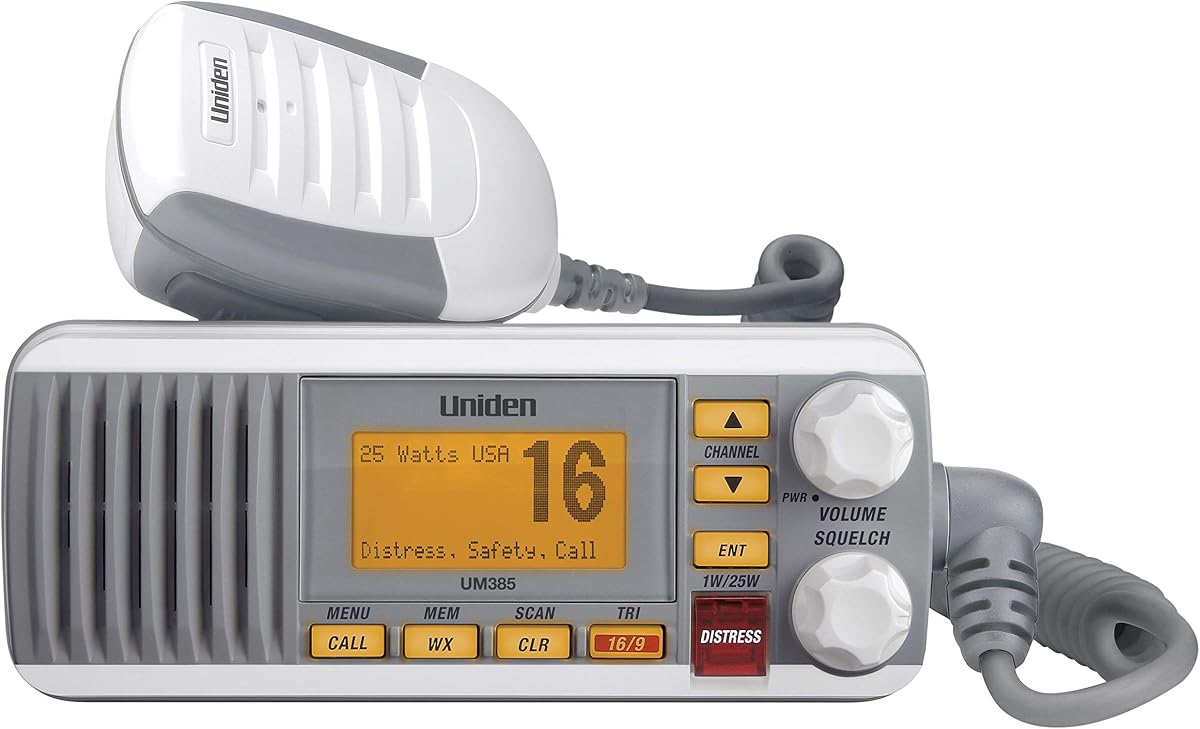
Uniden UM385
4.6Editor score
25-watt fixed-mount power
Triple-watch DSC monitoring
IPX4 splash resistance
Our Dsc VHF Marine Radio guide compares ten leading fixed and handheld models for DSC safety, GPS, range, waterproofing, and ease of use for boaters today.
A DSC VHF marine radio is a boat’s essential link to other vessels, emergency services, weather information, and shore-based operators. The best model combines dependable transmission, accessible controls, accurate positioning features, and protection from rain, spray, or accidental submersion.
We compared ten fixed-mount and handheld options from Uniden, Icom, Retevis, and Standard Horizon. The evaluation focuses on DSC capability, GPS integration, transmit power, channel coverage, waterproofing, audio, navigation functions, charging options, and how well each radio fits different boating environments.
Each pick demonstrates a different priority, from practical fixed-mount value to feature-rich navigation and premium handheld safety. Ratings reflect the supplied customer feedback, while product availability and prices change, so check the current listing before making a final purchase.
4.6Editor score

4.4Editor score

4.9Editor score
This side-by-side overview highlights the most important differences among fixed-mount and handheld VHF marine radios, including power, positioning, water resistance, safety features, and intended use.


The Uniden UM385 combines fixed-mount power with essential marine safety functions and earns a 4.6 rating in the supplied feedback. Its standout qualities include 25-watt transmission, full Class D DSC capability, triple-watch monitoring, international marine channels, and NOAA weather alerts. It is a strong all-around choice for a boat with a permanent helm installation.
We may earn a commission when you buy through this link, at no additional cost to you.
The radio’s distress button, position sending, and position-request functions make it a genuinely useful emergency communication system rather than a basic voice-only unit. Triple watch allows the user to monitor multiple marine channels simultaneously, helping important calls and distress traffic get noticed. The rugged handheld microphone also supports easy transmission from the helm while the operator remains focused on the water.
Its main compromise is installation. Unlike a portable marine radio, the UM385 is designed to remain mounted at the console and requires a reliable power connection, antenna arrangement, and correct DSC programming. Its IPX4 rating protects against rain and splashing water but does not provide the same submersible assurance as an IPX8 model. These limitations are reasonable for a permanently installed unit intended to stay aboard the vessel.
Choose the UM385 when you want a powerful, recognized fixed-mount radio without moving into the premium navigation-radio category. It offers an approachable balance of range, DSC features, channel coverage, and everyday usability. Before installation, confirm console space, antenna compatibility, power routing, and the availability of any required NMEA or GPS connection.
The distress button, position sending, and position requests support several common DSC workflows. Triple watch further helps operators stay aware of activity across multiple channels without replacing the radio’s main channel.
The included rugged microphone supports practical operation from the wheel. Its weather-alert support and broad channel selection make the radio useful beyond routine ship-to-ship conversations.
We may earn a commission when you buy through this link, at no additional cost to you.
The Retevis RM40 is a portable marine radio built around GPS, DSC, and overboard protection, with a 4.0 rating in the supplied feedback. It offers five-watt transmission, an integrated GPS receiver, distress messaging, dual and tri-watch monitoring, and an IP67 waterproof floating design. These features make it especially relevant to anglers, kayakers, and smaller coastal craft.
We may earn a commission when you buy through this link, at no additional cost to you.
GPS updates the radio’s position in real time, allowing preset distress messages to include location information for coast guard and nearby vessels. The MOB function records and shares an overboard location, while the red flashing LCD helps a user identify a radio dropped in the water. Dual and tri-watch modes provide additional monitoring for distress signals and important traffic.
The five-watt output is lower than the six-watt radios in this guide, which can matter when maximum communication range is important. The supplied product information also provides fewer details about display size, battery capacity, included accessories, and charging equipment than it does for many competing models. Buyers should therefore verify those specifications and confirm what is included before ordering.
The RM40 makes the most sense for boaters who prioritize portability, GPS-based emergency information, and floating recovery over maximum transmission output. It is also a practical choice for a fishing vessel where the radio may move between the console and a pocket or tether. Confirm the supplied accessories and intended coastal operating area before purchase.
The integrated receiver continuously supplies position information for DSC emergency functions. Preset distress messages and one-button activation can reduce the number of steps required during a stressful incident.
The IP67 floating construction and red flashing LCD are particularly useful around docks and open water. The MOB feature adds another layer of recovery information for an overboard emergency.
We may earn a commission when you buy through this link, at no additional cost to you.
The Icom M94D integrates DSC with AIS reception and delivers 6 watts of transmit power, giving it a balanced set of safety and situational-awareness features. Its supplied rating is 4.4. The 2,400 mAh lithium battery, up to ten hours of typical operating time, and 1,500 mW speaker output make it well suited to use in noisy marinas and offshore conditions.
We may earn a commission when you buy through this link, at no additional cost to you.
The integrated AIS receiver can display nearby vessel traffic, while AIS target information supports faster setup of individual DSC calls and distress alerts. Simplified GPS navigation allows the radio to store as many as 50 favorite fishing spots or destinations. Those features give the M94D more day-to-day utility than a basic voice and distress radio without requiring a separate fixed installation.
Float’n Flash gives the radio a recovery advantage if it goes overboard, and the distress button can send a precise MOB signal while that function is active. The trade-offs are the larger battery system and handheld format, which may be less convenient for continuous use at a helm. Its 21 USA channel designation also means users operating exclusively under other international channel plans should verify compatibility first.
This is a strong recommendation for boaters who want one handheld to handle emergency DSC, local AIS awareness, navigation waypoints, and ordinary VHF communication. It suits anglers and cruisers who value a broad feature set in a portable device. For fixed-point operation, it can complement rather than replace a mounted radio.
Nearby vessel information appears on the radio screen and helps users make more informed calls. AIS target data can also streamline the process of addressing another vessel through DSC.
The ability to save 50 waypoints turns the radio into a useful companion for repeatable routes and favorite destinations. Users can keep emergency functions and routine navigation tools in one handheld.
We may earn a commission when you buy through this link, at no additional cost to you.
The Uniden UM435BK is a rugged fixed-mount radio with a 4.6 rating and a clear emphasis on water resistance. It is completely submersible, carries an IPX8 rating, supports USA, international, and Canadian marine channels, and includes new four-digit and Canadian B channels. The dual and triple-watch functions add useful monitoring flexibility.
We may earn a commission when you buy through this link, at no additional cost to you.
Its transmit power can be set to 1 watt or 25 watts, allowing the operator to balance range and battery or power consumption depending on conditions. Digital Selective Calling includes position send and request functions, making the radio suitable as a central safety system. Memory channel scanning helps users move quickly between preferred channels without manually recalling each one.
The main trade-off is permanence. This radio is intended to be mounted and connected to a boat’s electrical and antenna systems rather than carried between locations. Its comprehensive channel support is a strength for mixed-area boating, though the user must program and operate the correct channel plan for the region and waterway.
Choose the UM435BK for a boat that needs a durable console unit and values IPX8 submersible protection. It is particularly attractive where weather exposure is a constant concern or where a permanently mounted high-power radio is the preferred architecture. Proper grounding, antenna routing, sealing, and DSC setup remain essential parts of a dependable installation.
The fully submersible design goes beyond ordinary splash resistance. That protection makes the radio suitable for exposed helm locations where rain, washdown, and occasional immersion can be expected.
USA, international, Canadian, four-digit, and Canadian B channel support cover a broad set of operating areas. Users should still select the appropriate channel plan and keep it synchronized with local requirements.
We may earn a commission when you buy through this link, at no additional cost to you.
The Icom IC-M330G pairs a compact fixed-mount chassis with integrated GPS, Class D DSC, and a high 4.9 rating in the supplied feedback. Its palm-sized body is designed for small consoles and tight helm spaces, making it easier to accommodate than a larger full-console radio.
We may earn a commission when you buy through this link, at no additional cost to you.
The built-in GPS/GLONASS/SBAS receiver provides position, course, and speed data for DSC calls and safety functions. Class D DSC continuously monitors Channel 70 for distress, individual, group, all-ships, safety, position, polling, and test calls. The directional keypad and soft keys place frequently used functions within straightforward reach.
Receiver performance is another important strength. More than 70 dB selectivity and improved IMD are designed to support reliable reception in RF-busy marinas and harbors. The new speaker design also delivers loud, clear audio with rich bass and crisp treble, which matters when engines, wind, and marina activity compete with incoming calls.
The IC-M330G is a strong premium recommendation for a boat with limited console space but high expectations for reception, navigation data, and interface quality. Because it is a fixed-mount device, buyers should confirm the available helm area, power requirements, antenna arrangement, and microphone options for their installation.
The palm-sized chassis is the defining advantage. It offers a fixed radio’s always-ready communication while fitting installations where a larger display and control housing would be inconvenient.
The integrated GPS, GLONASS, and SBAS receiver supplies the data needed for DSC communication and safety awareness. This reduces dependence on a separate positioning source during critical calls.
We may earn a commission when you buy through this link, at no additional cost to you.
The Standard Horizon HX210 is a compact floating handheld VHF with a 4.6 rating. Its six-watt maximum output, IPX7 waterproof construction, easy-to-operate menu system, and water-activated emergency strobe make it a straightforward choice for boaters who want a portable voice radio with essential marine functions.
We may earn a commission when you buy through this link, at no additional cost to you.
The high-resolution dot-matrix display provides clear information, while programmable function keys help place frequently used controls within reach. Selectable output levels of 6 watts, 2.5 watts, and 1 watt allow the user to adjust power for different communication and battery situations. USA, international, and Canadian channels broaden its usefulness across regions.
The HX210 also receives weather channels and FM broadcast radio, although those extras should not replace dedicated marine weather monitoring. The supplied feature list does not mention built-in GPS, AIS, waypoint navigation, or man-overboard position sharing. Those omissions distinguish it from feature-rich premium handhelds such as the Icom M94D and Standard Horizon HX890.
This radio is a compelling option for a smaller boat, an emergency backup unit, or users who prefer uncomplicated controls. The package includes an antenna, charging cradle, documentation, and charging cables. Confirm the contents against the current listing, then prioritize proper charging and a routine function check before leaving the dock.
The E20 menu system and programmable keys simplify routine use. A full dot-matrix display helps present channel and status information clearly without making the unit overly complex.
Floating IPX7 construction and a water-activated strobe improve recovery prospects. The emergency light can also make the radio more visible after it goes overboard.
We may earn a commission when you buy through this link, at no additional cost to you.
The Uniden UM725GBT is a feature-rich fixed-mount radio with a 4.3 rating. It combines 25-watt transmission, built-in GPS, Bluetooth connectivity, NOAA weather alerts, DSC, NMEA0183 and NMEA2000 input and output, and an IPX8 waterproof rating. Its unusually large display is designed to make more operating information visible at a glance.
We may earn a commission when you buy through this link, at no additional cost to you.
The built-in GPS receiver supplies position information for emergency signaling, while NMEA connections allow GPS and DSC information to pass to or from other compatible devices and stations. Bluetooth expands the radio’s connection to a smartphone, adding a modern integration point that many basic fixed-mount radios do not offer.
The large 68 millimeter by 38 millimeter LCD is useful at the helm, particularly when viewing multiple pieces of information or operating in rough conditions. The 1-watt and 25-watt settings provide flexibility, and the speaker microphone places controls within the operator’s reach. Users must still configure Bluetooth and NMEA settings correctly for the systems installed on their boat.
The UM725GBT is most appropriate for an owner who wants a permanently mounted radio with extensive connectivity and a large display. It bridges conventional marine communication and modern device integration. Confirm antenna compatibility, NMEA data requirements, mounting clearance, and the role you want the smartphone connection to play before installation.
NMEA0183 and NMEA2000 input and output can connect the radio with compatible navigation and positioning equipment. That broader data path can make DSC and GPS information more useful across the helm.
The 68 by 38 millimeter screen provides more visible working area than typical fixed-mount radios. Clearer information can reduce the need to cycle through multiple menus during routine operation.
We may earn a commission when you buy through this link, at no additional cost to you.
The Standard Horizon HX890 in navy blue is a high-end floating handheld with a 4.6 rating. It combines six-watt transmission, Class H DSC, an integrated 66-channel WAAS GPS receiver, waypoint and route navigation, group monitoring, and IPX8 submersible construction in a rounded, ergonomic case.
We may earn a commission when you buy through this link, at no additional cost to you.
Its 1,800 mAh lithium battery provides up to 11 hours of stated operating time, while selectable six-, two-, and one-watt output lets the user balance communication range and endurance. The 1.7-inch square dot-matrix display supports day and night modes. MOB support, dual and triple watch, NOAA weather channels, and a water-activated white strobe add to its emergency role.
Audio is designed for difficult conditions, with 700 mW output and noise-canceling functions for transmitted and received audio. Two built-in scrambler systems, an FM broadcast receiver, and a micro USB programming jack round out the feature set. The complete package includes a rechargeable battery, alkaline battery tray, wall charger, international adapter, cradle, 12-volt charger, programming cable, belt lip, and lanyard.
This HX890 suits experienced boaters who want more than emergency voice communication from a handheld. Its navigation and group-monitoring functions are particularly useful for cruisers and anglers who repeatedly visit familiar destinations. New users should invest time in learning the menu structure and preserve battery charge during long outings.
The integrated WAAS GPS receiver supports waypoint and route navigation, turning the radio into more than a distress transmitter. Stored routes can help users repeat journeys involving offshore or less familiar destinations.
The group monitor uses DSC group position calls to keep compatible group members informed. Combined with MOB, watch, and emergency lighting features, it supports several safety scenarios.
We may earn a commission when you buy through this link, at no additional cost to you.
The Standard Horizon HX891BTBK is a compact handheld marine radio listed under the HX891BT model designation. It has a 4.6 rating in the supplied feedback and measures 5.43 inches high, 2.6 inches wide, and 1.5 inches deep. Those facts establish it as a portable two-way radio rather than a fixed console installation.
We may earn a commission when you buy through this link, at no additional cost to you.
The restrained dimensions make it easy to compare with other compact marine handhelds in terms of storage, carrying, and helm-space use. A dedicated handheld can remain in a pocket, locker, or life-jacket pocket and still provide a familiar way to communicate when the main installed equipment is inconvenient or unavailable.
The supplied data is unusually limited for this model. It does not state transmit power, channel coverage, DSC class, GPS capability, waterproof rating, battery details, display features, or included accessories. As a result, buyers should not assume that it provides the same navigation, AIS, weather, or emergency functions as the more fully documented HX890 and HX210 models.
The HX891BTBK is best considered for someone who wants a straightforward Standard Horizon handheld and values its compact proportions. Before buying, verify the full product description, regulatory and channel details, DSC functions, water resistance, battery life, charging method, and package contents on the current listing. It may suit a simple backup-radio role, but the sparse specification data makes careful comparison essential.
The radio’s listed dimensions emphasize portability and compact storage. Those proportions can make it convenient to keep accessible without occupying much console or hand-carry space.
Because the supplied listing provides only basic model and dimensional information, buyers should confirm important safety features directly. In particular, verify DSC operation, waterproofing, power, channels, GPS, battery, and included accessories.
We may earn a commission when you buy through this link, at no additional cost to you.
The Standard Horizon HX890 Black is a high-end floating handheld VHF with a 4.6 rating. It combines six-watt transmission, full Class H DSC operation, an integrated 66-channel WAAS GPS receiver, IPX8 submersible construction, and a broad selection of navigation, monitoring, weather, and emergency functions.
We may earn a commission when you buy through this link, at no additional cost to you.
The radio uses a 1.7-inch square dot-matrix display with selectable day and night modes. Waypoint and route navigation make it useful for repeated offshore trips, while group monitoring supports DSC group position calls. MOB functionality, dual and triple watch, NOAA weather channels, an FM broadcast receiver, and a water-activated white emergency strobe strengthen its safety role.
Its 700 mW audio includes noise cancellation for both transmit and receive, which helps intelligibility in noisy conditions. Selectable six-, two-, and one-watt output and an 1,800 mAh battery allow the user to tune power use for the outing. The ergonomic round case measures 2.60 inches wide, 5.43 inches high, and 1.50 inches deep.
The supplied package is extensive, including a rechargeable lithium-ion battery, alkaline battery tray, 110-volt wall charger, 220-volt adapter, charging cradle, 12-volt charger, PC programming cable, belt lip, and lanyard. Two scrambler systems and a micro USB data jack add further utility. Buyers seeking a very capable portable radio will appreciate the breadth, though they should budget time to learn its controls and maintain its charge.
Class H DSC, a WAAS GPS receiver, navigation tools, group monitoring, and multiple watch modes create a feature set closer to a full marine communications system. It is intended for users who want more capability than a basic portable radio.
The included charging options support use at home, in the boat, and across different power environments. The 11-hour stated operating time offers useful endurance when transmit power is managed appropriately.
We may earn a commission when you buy through this link, at no additional cost to you.
The right marine radio depends on the vessel, operating area, crew, and emergency priorities. Compare installation style, transmit power, positioning, water protection, DSC features, battery logistics, and the amount of navigation functionality you actually need.
A fixed-mount radio is always available at the helm, generally draws from the boat’s electrical system, and can use more transmit power without creating an ongoing battery-management burden. It is ideal when the console has room, the antenna can be mounted properly, and the boat has a reliable connection to position data. Handhelds are better for small craft, backup communication, kayaking, fishing from shore, or users who want a radio they can carry away from the console. Some owners use both, but that is a broader purchasing decision rather than a simple replacement choice.
Higher transmit power can improve communication range, particularly between vessels separated by distance, terrain, or obstructions. The fixed-mount selections here offer up to 25 watts, while the handhelds range from five to six watts. More power does not guarantee that a call will be answered, but it can increase the likelihood that another station receives a weak signal. Lower power can be useful for nearby communication and helps manage battery consumption. Look for selectable output settings so the radio can be adapted to different situations.
Digital Selective Calling enables formatted distress, position, group, and individual communications over Channel 70. Look for a clearly accessible distress control and confirm how position data is supplied. An MOB function can add important information when someone falls overboard. DSC is only as useful as its configuration, so proper programming, the correct identifier, and valid position information should be treated as essential setup tasks rather than optional extras.
A built-in GPS receiver reduces uncertainty about the location attached to a distress call. Multi-system support can improve positioning options, while NMEA input and output can share location and DSC information with compatible marine electronics. AIS reception adds a different kind of awareness by displaying nearby vessel traffic and helping users address AIS targets through DSC. Decide whether you need emergency positioning alone or also want waypoints, routes, target information, and integration with a chartplotter.
Water-resistance ratings describe different levels of exposure. IPX4 is designed to resist splashing water, while IPX7 and IPX8 indicate stronger protection against temporary submersion. A floating radio with an automatic strobe is especially valuable because it can help a user locate the device after it goes overboard. Fixed radios should be installed according to their mounting and sealing instructions. Even a highly protected unit is not a substitute for sensible storage, charging, and regular inspection.
A handheld radio is only useful when its battery is ready. Compare stated capacity, expected operating time, included charging equipment, and whether the radio accepts a charging dock or vehicle power. Lithium-ion batteries offer high usable capacity, but they should be kept dry, charged according to the instructions, and replaced when they no longer hold a dependable charge. Fixed installations should use an appropriate fused power source and a clean, secure ground connection.
Marine radios support different international, USA, Canadian, and regional channel plans. Confirm that the radio includes the channels and four-digit or Canadian B channels used in your operating area. NOAA weather channels and alerts are valuable supplements to official forecasts, but they should not be the only source of weather information. Look for dual or triple watch if you want to monitor several marine channels simultaneously while communicating on the primary channel.
A marine radio may need to be operated in wind, rain, darkness, and engine noise. Large displays, illuminated controls, programmable keys, directional keypads, and loud clear speakers can make a major difference. Fixed models should be checked for helm clearance and microphone reach. Handhelds benefit from an easy menu system, readable dot-matrix displays, day and night modes, and controls that can be operated with cold or wet hands. Simplicity is valuable, especially for a device used during an emergency.
Begin by installing or charging the radio according to its manual. For a fixed unit, verify the antenna connection, fuse the power lead correctly, establish a clean ground, and seal cable openings. Program the local marine channel set, set the correct transmit power, and complete the DSC identity and MMSI-related setup required for your vessel. For a handheld, charge the battery fully, attach the antenna securely, and learn how to open the distress menu without transmitting an accidental alert.
Before every outing, test the radio with a documented method that avoids sending an unnecessary distress call. Check channel reception, scan or watch functions, speaker output, GPS position, battery level, and access to the emergency controls. Confirm that the DSC identifier and position source are correct. Keep a written backup of critical settings and download or retain the operating manual in a dry, accessible location.
Keep the microphone, connectors, buttons, and display clean, and protect the radio from salt, dirt, and prolonged sun exposure. Rinse a handheld with fresh water after use in salt water, remove the battery for long-term storage, and store it in a dry place within the manufacturer’s recommended conditions. Inspect fixed-mount seals and wiring regularly, replace a damaged antenna or cable promptly, and have the radio serviced if it fails a functional check.
A DSC VHF radio is highly recommended for virtually every recreational boat because it can transmit a structured distress message and position information. It also supports routine individual and group calls. Requirements vary by jurisdiction, vessel size, operating area, and type of boating activity, so check the applicable local boating regulations.
DSC is a radio communication system that sends structured alerts and calls, including distress messages with position data. AIS is a vessel-tracking broadcast system that helps compatible equipment identify nearby traffic. A radio with an AIS receiver can display that information and make it easier to initiate a DSC call to a selected vessel.
Fixed-mount models suit boats with a permanent console because they stay powered and ready for use. Handhelds suit smaller boats and users who value portability, backup communication, and fishing or kayaking access. Many prudent owners use a fixed model as the primary radio and a floating handheld as a backup.
A floating radio is engineered to remain on the surface if it falls overboard. Models such as the HX210 and HX890 also have emergency lighting, with the HX890 using a water-activated white strobe. These features can help a person locate and retrieve the radio, although they do not replace wearing a properly fitted life jacket.
Runtime varies with battery capacity, transmit power, display use, GPS operation, and the volume of communication. The Icom M94D lists up to ten hours of typical operation, while the Standard Horizon HX890 lists up to 11 hours. Actual results depend on conditions, so carry a charged spare or reliable charging arrangement when possible.
GPS is highly useful because it provides the position included in DSC distress and position messages. It also enables waypoint and route functions on supported models. If the boat already has a compatible GPS or NMEA source, verify that it can be integrated correctly; otherwise, a built-in receiver simplifies setup.
An IPX7 rating means the unit is protected against temporary immersion under defined test conditions, but it does not mean it can be operated underwater or left submerged indefinitely. Follow the manufacturer’s instructions, close all ports, inspect seals, and avoid using the radio in water beyond its specified rating.
Test it before every trip and perform a more thorough inspection at least monthly and before extended journeys. Check power, channel reception, transmit operation, DSC controls, GPS data, battery condition, weather alerts, and antenna connections. Never test the distress button casually because it may transmit an emergency alert.
The Uniden UM385 stands out as the best overall value for a permanently installed console, combining 25-watt transmission, full DSC, triple watch, broad channel coverage, and weather alerts. The Icom M94D is the strongest feature-rich handheld for buyers who want AIS, GPS waypoints, strong audio, and overboard signaling, while the compact Icom IC-M330G is the premium fixed-mount option for tight helm spaces and polished reception performance.
For a portable radio, compare the Retevis RM40, Standard Horizon HX210, HX890, and HX891BTBK based on the safety features you will actually use. For a fixed installation, prioritize power, accurate position data, regional channels, usable controls, and a water-resistance level suited to the helm environment. Proper programming and a regular test routine are as important as the feature list.
Before purchasing, verify the current specification, included accessories, channel plan, DSC configuration, and compatibility with the boat’s antenna and navigation equipment. Prices and availability change regularly, so review the current listing and compare the complete configuration rather than relying on the headline rating alone.