
SOLPERK 20W 12V Solar Battery Charger Kit
4.5Editor score
Complete 12V charging kit
Adjustable 360-degree mount
Weather-resistant construction
Marine solar panels compared for power, efficiency, shading, charging, durability, and installation suitability on boats, RVs, and trailers.
Marine solar panels can keep onboard batteries topped off, support navigation electronics, run cabin accessories, and reduce dependence on shore power. The right model must fit the available roof space, withstand constant sun and salt exposure, and work effectively with the battery chemistry and charge controller already installed.
This guide compares ten marine solar panel options spanning compact 12V maintainers, flexible modules, portable power solutions, and high-output N-Type panels. We evaluated the specifications and construction details supplied for each product, including rated power, cell technology, efficiency, environmental protections, shading features, and installation considerations.
Each pick reveals a different balance of output, footprint, and convenience: some excel at battery maintenance, while others suit larger energy systems. Ratings and availability can change over time, so readers should confirm current specifications, battery compatibility, and retailer information before making a purchase.
4.5Editor score
4.6Editor score

4.8Editor score
The comparison below places all ten options by their most important marine-use characteristics: power output, panel construction, charging approach, and practical installation features.


The Callsun set combines two 200W N-Type modules into a 400W system, giving it the greatest rated output among the products in this guide. It carries a 4.8 customer rating and stands out for 25.6% cell efficiency, bifacial construction, and a dual-module arrangement designed to preserve output when part of a panel is shaded.
We may earn a commission when you buy through this link, at no additional cost to you.
Each module uses advanced monocrystalline N-Type cells with 16BB busbar technology. According to the supplied specifications, that configuration can reduce hot spots and microcrack risks, while the transparent backsheet allows useful rear-side light to contribute additional energy. The bifacial benefit depends on installation conditions, particularly whether the rear surface receives direct, reflected, or diffuse light rather than sitting against an opaque surface.
The anti-shading arrangement divides each panel into independently operating sections. That is particularly helpful on boats and RVs where antennas, vents, storage boxes, or other equipment can cast intermittent shadows. The pair can also be connected in series to reach 47.48V Vmp and 54.62V Voc with an 8.43A operating current, but the receiving charge controller or power station must support those electrical values.
This is the strongest choice for owners who have enough roof or deck area for two modules and need more substantial charging capacity than a compact maintainer can provide. Buyers who only need to preserve a single small battery may find the 23.8-pound modules excessive, and proper series wiring, compatible fusing, mounting hardware, and ventilation should be planned before installation.
The bifacial backsheet can increase collection by using light striking the panel from both sides. Install the modules with an appropriate rear clearance and reflective or open surroundings to maximize the benefit.
The independently operating sections help one shaded section from interrupting all output. They cannot eliminate the consequences of shade, but the design is useful where obstructions cannot be avoided.
We may earn a commission when you buy through this link, at no additional cost to you.
The SOLPERK 20W kit offers one of the most straightforward ways to add solar battery maintenance to a boat, trailer, RV, or vehicle. It has a 4.5 rating and includes a 20W monocrystalline panel, an 8A charge controller, adjustable bracket, alligator clips, mounting pieces, and O-rings in a coordinated package.
We may earn a commission when you buy through this link, at no additional cost to you.
Its A+ monocrystalline cells are listed at 21–30% efficiency, and the controller uses a three-stage charging design intended to prevent overcharging, over-voltage, and short circuits. Indicator lights provide a simple way to check charging status, while the 360-degree bracket makes seasonal angle adjustments practical after initial installation.
Low-iron tempered glass, a corrosion-resistant aluminum frame, and stated resistance to wind, snow, hail, and other weather conditions suit exposed outdoor installations. The panel is also described as waterproof and rustproof, although proper sealing around penetrations and cable entries remains essential in a wet marine environment.
Choose this kit when the objective is dependable low-power maintenance rather than running large appliances. It is particularly suitable for preserving a 12V battery during storage, offsetting small parasitic drains, or keeping a navigation battery charged. It cannot supply meaningful loads for heaters, refrigeration, power tools, or other energy-intensive equipment, so larger systems remain necessary for those applications.
The matching controller, bracket, clips, and hardware reduce the need to source separate components. Confirm battery chemistry and voltage before connecting the leads, and route cables away from sharp edges and moving components.
The 360-degree bracket helps maintain a more favorable sun angle as the vessel or vehicle changes orientation. Periodic adjustment can also compensate for changing solar angles during the year.
We may earn a commission when you buy through this link, at no additional cost to you.
This SUNER POWER 20W maintainer is designed for unattended battery upkeep on boats, cars, dump trailers, campers, trucks, and RVs. Its 4.4 rating reflects a useful balance of automatic controls, charging visibility, broad battery compatibility, and compact maintenance-level output.
We may earn a commission when you buy through this link, at no additional cost to you.
The integrated Ultra-Smart MPPT controller is listed with tracking efficiency up to 99% and peak conversion efficiency up to 98%. A bulk, absorption, and float charging sequence manages the battery automatically, while the charger stops once the battery is full and resumes after discharge. Visual indicators mark 25%, 50%, 75%, and 100% charge levels.
Users can select standard 12V, 12V AGM, or 12V Lithium modes. The stated compatibility list includes flooded, gel, AGM, SLA, VRLA, maintenance-free, and LiFePO4 batteries, making this a flexible option for mixed 12V installations. Protection against overcharge, overdischarge, voltage, current, overload, short circuit, reverse polarity, and excessive temperature adds practical safeguards.
This panel is best for owners who want a self-contained charger with minimal setup. It has pre-designed mounting holes, included suction cups, and plug-and-play cables, although a permanent adhesive or mechanical mount may be more secure on a rough marine surface. Its small output makes it a maintainer rather than a primary energy source.
The controller transitions through the main charging stages and stops at full charge. That automation makes the unit suitable for long storage periods when regular battery checks would otherwise be inconvenient.
Choose the charging mode that matches the connected battery type. The listed lithium mode supports 12V lithium systems, while AGM and standard settings address common lead-acid configurations.
We may earn a commission when you buy through this link, at no additional cost to you.
The Renogy 100W N-Type panel combines 25% cell efficiency with a relatively modest power rating, making it a practical middle ground for marine battery systems. Its 4.7 rating is among the strongest in the guide, and the panel uses grade A+ N-Type cells with 16BB busbar technology.
We may earn a commission when you buy through this link, at no additional cost to you.
The 16BB configuration is intended to improve photoelectric conversion while reducing hot spots and hidden cracks. A low temperature coefficient also minimizes output loss in hot weather, an important consideration for boats and RVs operating in warm climates where roof temperatures can rise substantially.
Environmental specifications include an IP67 rating and testing for 2,400Pa wind loads and 5,400Pa snow loads. Low-iron tempered glass and a corrosion-resistant aluminum frame support outdoor durability, while the listed degradation is no more than 1% in the first year and no more than 0.4% annually. Renogy backs the panel with a 10-year material and workmanship commitment and a 25-year performance guarantee at 80% output.
This is a sensible choice for a smaller battery bank, portable power station, or installation where every square foot matters. It cannot replace a larger array for substantial daily consumption, and it does not include the controller described with some maintainer kits. Marine owners should add a charge controller suited to their battery chemistry and verify the panel's electrical specifications against their system.
The 25% efficiency rating can produce meaningful output without moving to the highest-capacity panels in the list. It is a useful option for smaller cabins, hardtops, trailers, and portable systems.
A low temperature coefficient supports steadier production in hot conditions. Tempered glass, the aluminum frame, and the stated load ratings add resilience for long-term outdoor exposure.
We may earn a commission when you buy through this link, at no additional cost to you.
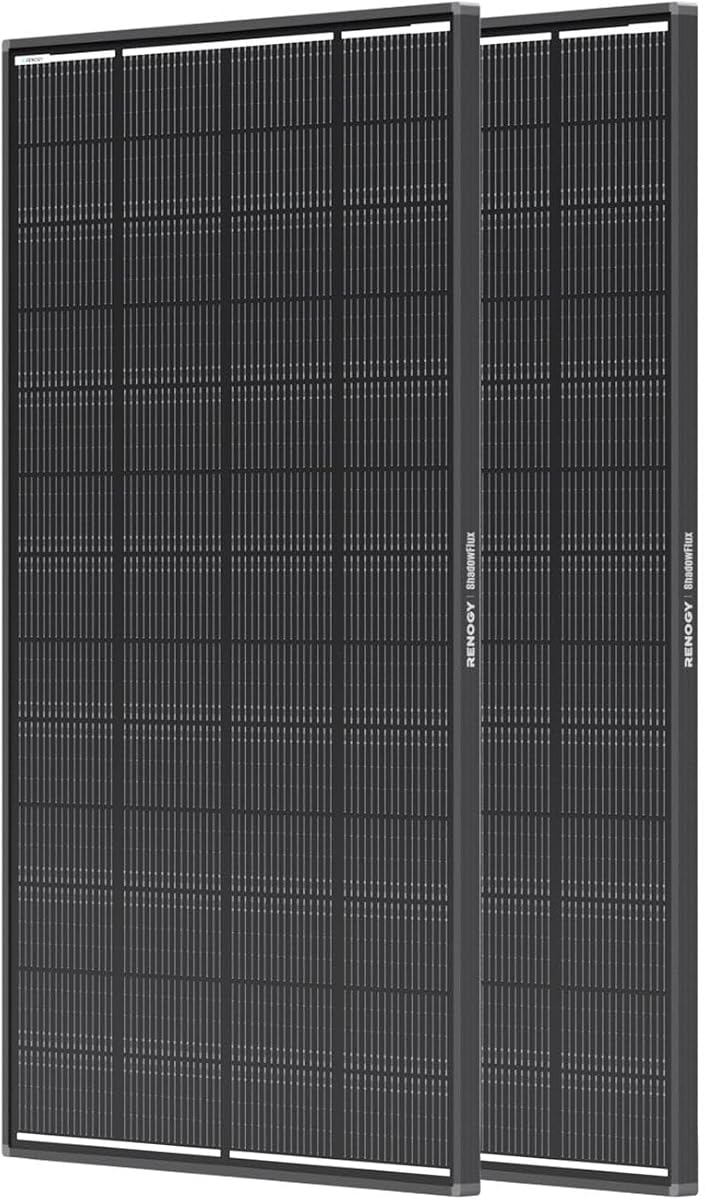
The Renogy ShadowFlux 200W brings together 200W of rated power, 25% N-Type efficiency, and a cell layout designed to reduce the effects of partial shading. Its 4.5 rating makes it a strong general-purpose option for marine roofs, RV installations, and off-grid systems where obstructions are likely.
We may earn a commission when you buy through this link, at no additional cost to you.
ShadowFlux technology is intended to maintain more consistent output when buildings, plants, or surface stains cast shadows over part of the module. It also reduces hot-spot risk, a valuable characteristic for a panel installed near antennas, mast supports, roof vents, or equipment that may interrupt direct sunlight.
Compared with conventional PERC panels of a similar design, the product is listed as 7% smaller and 10% more compact. Its N-Type cells use 16BB technology to improve conversion and reduce microcracks. The panel also has an IP67 rating, enhanced water-vapor resistance, and durability for exposure to snow, rain, and small hail.
A 5-year output warranty and material commitment are paired with a 25-year output warranty that maintains 80% power. Buyers should pay close attention to the distinction between the different warranty components when evaluating long-term coverage. The panel does not include a charge controller, so it is best suited to owners who already have, or intend to install, a compatible controller.
ShadowFlux reduces the effect of localized obstructions, making this model more forgiving of crowded mounting areas. It is still best to minimize shade wherever the layout permits.
The stated reductions in size and weight relative to PERC designs make the panel easier to accommodate on many recreational vessels and RVs. Measure the final installation area rather than relying on wattage alone.
We may earn a commission when you buy through this link, at no additional cost to you.
The Renogy Flexible 200W is built for installation where a rigid rectangle would be awkward. Its 4.5 rating and stated ability to bend within 240 degrees make it especially relevant to curved cabin roofs, rounded surfaces, and portable marine applications where weight and shape matter.
We may earn a commission when you buy through this link, at no additional cost to you.
Half-cut PERC cell technology is used to improve light capture and electrical performance. The listed daily output estimate is an average of 1,000 watt-hours based on five hours of sunlight, which is a theoretical estimate rather than a guaranteed result in every location or season.
The panel weighs approximately half as much as a rigid 200W panel and has a glare-free black appearance. It includes pre-drilled mounting holes and 27.6-inch 12 AWG solar connector cables. An IP67-rated waterproof junction box and connectors support outdoor use, while stated resistance to 2,400Pa wind loads and 5,400Pa snow loads adds environmental durability.
Choose this model when the available mounting area is curved or space is at a premium. It is not a rigid structural roof panel, so it needs a suitable backing and careful adhesive or fastening method that does not trap moisture. The supplied information does not list an integrated controller, so a compatible marine charge controller remains necessary.
The flexible construction reduces the need to build complex brackets around curved cabin tops. Confirm that the chosen adhesive is suitable for both the panel and the vessel's surface.
At roughly half the weight of a comparable rigid module, the panel can also be transported more easily. It is a practical choice for portable systems that must be repositioned as the sun changes.
We may earn a commission when you buy through this link, at no additional cost to you.
The Renogy ShadowFlux 120W offers a useful middle ground between a small maintainer and a full-size house array. With a 4.5 rating, 120W rated output, and 25% cell efficiency, it can deliver more practical charging capacity while preserving a relatively compact footprint.
We may earn a commission when you buy through this link, at no additional cost to you.
Its ShadowFlux design is intended to reduce power loss and hot-spot risk when buildings, plants, or stains partially shade the surface. That makes it relevant to vessels with antennas, storage structures, or cabin fixtures that cannot be relocated. As with every panel, avoiding heavy shade remains the best way to maximize energy yield.
The N-Type 16BB cells are designed to improve conversion efficiency and reduce microcracks. According to the supplied data, the panel is 10% smaller and 10% more compact than PERC alternatives. An IP67 rating and advanced encapsulation provide stated resistance to snow, rain, small hail, and water-vapor exposure.
The warranty description includes five years of materials and craftsmanship coverage plus a 25-year output warranty at 80% rated power. This model suits a single 12V battery, a small battery bank, or a portable power station where a rigid 200W module would not fit. A separate controller compatible with the battery type is required.
The 120W rating is sufficient for many smaller charging needs without approaching the area demands of a large residential-style array. Actual daily generation will vary with weather, angle, and shading.
The anti-shading architecture helps limit the electrical consequences of localized shade. It is particularly useful around marine roofs where masts, rails, and antennas may interrupt sunlight.
We may earn a commission when you buy through this link, at no additional cost to you.
The Renogy ShadowFlux 400W is the most complete high-output conventional panel in this guide. Its 4.6 rating, 400W rating, 25% N-Type efficiency, and shading-focused construction make it a strong choice for larger marine battery banks, RVs, portable stations, and off-grid systems.
We may earn a commission when you buy through this link, at no additional cost to you.
The panel is described as a two-piece 200W setup, with N-Type 16BB cells designed to improve conversion and reduce the effects of hot spots and microcracks. Its space-saving format is listed as 7% smaller and 10% more compact than traditional PERC panels, helping offset the area normally associated with high-power modules.
ShadowFlux technology is intended to preserve reliable production when partial shade from buildings, trees, plants, or surface stains affects the module. An IP67-rated design, advanced encapsulation, and stated resistance to rain, snow, dust, and small hail suit demanding outdoor environments. These protections do not replace sound mounting or correct cable management.
The product is backed by a five-year material and workmanship warranty and a 25-year power output warranty ensuring at least 80% of rated output. It is an excellent pick for users who need more capacity than a 100W or 200W panel can provide but prefer a single high-output product family. Ensure the controller, inverter, and battery bank can accept the panel's voltage and current.
The 400W rating supports larger daily energy needs while remaining appropriate for many recreational installations. The compact construction is valuable on boats and RVs where roof area is limited.
ShadowFlux cell design reduces the impact of partial shade and hot spots. Combined with 25% N-Type cells, it offers a convincing mix of efficiency and installation resilience.
We may earn a commission when you buy through this link, at no additional cost to you.
The SUNER POWER 50W maintainer provides more charging capacity than the similarly designed 20W model while retaining an integrated, automatic design. Its 4.4 rating makes it appealing to owners who want a compact unit that can maintain a battery bank without a separate controller.
We may earn a commission when you buy through this link, at no additional cost to you.
The built-in Ultra-Smart MPPT controller has stated tracking efficiency up to 99% and peak conversion efficiency up to 98%. Bulk, absorption, and float stages organize the charging process, while automatic shutoff and restart help preserve the battery during unattended use. Indicators visually show the 25%, 50%, 75%, and 100% charge levels.
Selectable standard 12V, 12V AGM, and 12V Lithium modes accommodate flooded, gel, AGM, SLA, VRLA, maintenance-free, and LiFePO4 batteries. Built-in protections cover overcharge, overdischarge, voltage, current, overload, short circuit, reverse polarity, and temperature. The waterproof and spark-proof design is particularly relevant near a battery compartment.
This model is best for moderate charging needs that remain above the level of a tiny maintainer but below a full house array. Pre-designed holes, included suction cups, and plug-and-play cables simplify setup, though a permanent secure mount is advisable in rough conditions. It is not designed to power high-draw appliances continuously while the battery is also being charged.
The 50W rating offers useful additional capacity for larger battery banks and prolonged storage periods. It can still be installed as a compact dedicated charging package.
The MPPT controller and selectable charging modes reduce system complexity. Confirm the correct mode before connection and protect the wiring from abrasion and moisture.
We may earn a commission when you buy through this link, at no additional cost to you.
The POWOXI 7.5W is the smallest and most minimalist marine-capable maintainer in the guide. It has a 4.4 rating and is intended for preserving compatible 12V batteries rather than replacing a meaningful source of electrical power.
We may earn a commission when you buy through this link, at no additional cost to you.
Its internal smart protection system and blocking-diode structure are designed to guard against overvoltage, overcharging, and short circuits. The listed conversion efficiency of 25–30% comes with high-transparency glass and a solar silicon construction, while red and green LEDs indicate whether the panel is receiving sunlight and whether the battery connection is active.
Installation is exceptionally flexible because the unit can plug into a 12V cigar-lighter socket or connect directly to the battery using alligator clips. The ABS and polycarbonate frame is described as stronger than a flexible panel and less likely to damage painted surfaces during handling, which is useful around finished marine interiors and decks.
Choose this model for a small battery, seasonal storage, or a lightweight portable kit that can be moved between vehicles and vessels. Its 7.5W output cannot meaningfully recharge depleted large banks or operate significant electronics. It is best viewed as a preservation tool that offsets small standby drains, not a substitute for a larger charging system.
Both socket and alligator-clip options make it easy to use the maintainer with different access points. Select the connection that provides a secure, weather-protected route to the battery.
The low output is suitable for maintaining a healthy battery and reducing standby drain. For deeply discharged or high-capacity banks, choose a panel with substantially more rated power.
We may earn a commission when you buy through this link, at no additional cost to you.
The best marine solar panel for a boat or trailer depends on available space, battery chemistry, expected loads, shading, and whether the objective is maintenance or substantial energy production.
Begin by estimating how much energy the installation must produce. Small navigation devices, lighting circuits, and parasitic drains may be handled by a compact maintainer, while refrigeration, compressors, heaters, inverters, and continuous household loads require a substantially larger array. A useful starting point is to list expected daily consumption in watt-hours, divide by the available peak sun hours, and add a practical reserve for weather, orientation, wiring losses, and partial shade.
Match the panel rating to the system rather than focusing on cell efficiency alone. A high-efficiency panel can still be undersized, while a large panel may overwhelm a small controller or battery bank. Ensure the charge controller supports the panel's electrical output and the battery bank's voltage and chemistry.
Measure the usable area after accounting for hatches, antennas, rails, ventilation, walking space, and mounting hardware. Rigid panels need flat, unobstructed space, while flexible models can conform to curved surfaces but require careful bonding and moisture control. Also consider whether the panel will be tilted, partially shaded, or stored away when the vessel is not in use.
Choose a layout that leaves room for cable routing and service access. Wattage alone does not predict whether a panel will physically fit, so obtain exact dimensions and compare them with the intended installation area before ordering.
N-Type cells offer high efficiency and are well suited to space-constrained installations. The Callsun and Renogy N-Type panels in this guide use 16BB busbar technology, which is designed to improve conversion and reduce hot spots and microcracks. Half-cut PERC technology appears in the flexible Renogy model and can offer strong performance in a lighter, bendable format, but it represents a different construction approach from the rigid N-Type options.
Prioritize efficiency when mounting area is limited. When area is abundant, total output, durability, warranty, and controller compatibility may be more useful points of comparison. Always match the panel technology to the controller and system design rather than selecting on efficiency alone.
Partial shade can sharply reduce output on conventional panel layouts, particularly when obstructions cast shadows across multiple cells. The Callsun dual-module design and the Renogy ShadowFlux models are specifically engineered to reduce the effects of localized shading and hot spots. These features improve resilience, but they do not make a heavily shaded installation equivalent to one with unobstructed sun.
Map shadows at different times of day and seasons before mounting. If possible, relocate antennas, relocate the panel, or increase the number of separately controlled modules to reduce the effect of recurring obstructions.
Some products include a charge controller, while standalone rigid panels generally require one. MPPT controllers can extract more energy from changing conditions than simpler pulse-width-modulation designs, and the SUNER POWER models specify MPPT tracking and conversion efficiency. Integrated controllers are convenient, but the built-in version must still support the battery chemistry and intended current.
For a new installation, select a controller with adequate voltage, current, and battery-mode support. For an existing system, verify that its input range safely accepts the new panel and that the wiring method follows the manufacturer's instructions.
Marine batteries may use flooded, gel, AGM, SLA, VRLA, maintenance-free, or LiFePO4 chemistry. A controller with the wrong charging profile can undercharge, overcharge, or damage a battery. The SUNER POWER maintainers provide selectable 12V, AGM, and lithium modes, while the SOLPERK kit is listed for several rechargeable battery types.
Confirm both the nominal voltage and chemistry before connecting any panel. If the installation uses several batteries, verify whether they are wired in series or parallel and select a controller that supports that arrangement. When uncertain, obtain guidance from a qualified marine electrical professional.
Look for tempered glass, corrosion-resistant frames, sealed junction boxes, and appropriate water-resistance ratings. The listed IP67 or IP68 ratings apply to the stated components or designs, and they do not make the entire installation immune to water. Salt-laden air, standing water, UV exposure, vibration, and repeated flexing can still affect brackets, adhesives, connectors, and cables.
Use marine-grade fasteners where appropriate, seal penetrations, strain-relieve wiring, and keep electrical connections away from standing water. Inspect coatings and seals periodically, especially after severe weather or long storage periods.
Long-term panel warranties can indicate manufacturer confidence, but buyers should read the distinctions between material, workmanship, and output coverage. For example, the Renogy 400W ShadowFlux is described with five years of material and workmanship coverage and a 25-year output warranty at 80% rated output. The 100W N-Type model lists a 10-year material and workmanship commitment with a 25-year performance guarantee at 80% output.
Compare the full warranty terms, not only the longest duration. Also consider the availability of technical support, replacement procedures, and documentation for your battery system. These factors can be as important as the headline efficiency when planning a long-term installation.
Before installation, identify the positive and negative battery terminals, confirm the panel voltage and charge-controller requirements, and disconnect the battery when the manufacturer's instructions call for it. Mount the panel on a clean, stable surface using the specified brackets, holes, or compatible adhesive. Avoid blocking vents and keep the area clear of sharp edges, standing water, and moving equipment.
Route the supplied cables through protected paths, add strain relief at both ends, and use compatible waterproof connectors. Follow the correct charge mode for the battery chemistry. For portable setups, reposition the panel toward direct sunlight and disconnect it before switching between socket and direct battery connections if that is recommended by the manufacturer.
Clean the glass periodically with fresh water and a soft cloth, avoiding abrasive pads and harsh chemicals that could damage coatings. Inspect seals, connectors, brackets, and cables for corrosion, cracks, water ingress, or loose fasteners. Check the charge indicators and battery state regularly, and never use a panel to compensate for a battery that will not hold a proper charge.
The right size depends on your daily energy use, available sunlight, battery bank size, and whether the panel is maintaining a battery or powering larger loads. Compact 7.5W, 20W, and 50W panels are intended mainly for maintenance, while 100W, 200W, and 400W options suit more demanding charging needs. Calculate expected daily consumption, divide by realistic peak sun hours, and allow for system losses before selecting a panel.
Yes, when the panel, charge controller, wiring, and battery voltage are compatible with the specific LiFePO4 battery. The SUNER POWER maintainers list a selectable 12V lithium mode and state compatibility with 12V LiFePO4 batteries. The SOLPERK kit is also listed for lithium battery charging. Always confirm the battery's required charging profile and the controller's supported modes before connection.
It depends on the product. The SOLPERK kit includes an 8A controller, and both SUNER POWER maintainers include a built-in MPPT controller. Standalone rigid and flexible panels listed here do not state that a controller is included, so they generally require one. A suitable controller manages charging stages, protects the battery, and helps prevent overcharging.
A flexible panel can be advantageous on curved cabin tops or other surfaces where a rigid module would be difficult to mount. The Renogy Flexible 200W can bend within 240 degrees and weighs about half as much as a comparable rigid panel. However, it still needs a sound backing and secure attachment method, and installation quality remains critical to long-term performance.
Partial shade can reduce output significantly, but it does not necessarily ruin a panel. Shadow-resistant designs such as Callsun's dual-module layout and Renogy's ShadowFlux technology are intended to reduce the consequences of localized obstructions and hot spots. The best results still come from mounting the panel where it receives the greatest possible direct sunlight.
That is one of the main uses for the 7.5W, 20W, and 50W models in this guide. They are intended to maintain compatible 12V batteries and offset small standby drains during storage or inactivity. They cannot fully recharge a deeply discharged battery bank or operate large appliances, and unattended installations should use sound wiring, protected connections, and the correct battery mode.
Choose a mounting location that promotes drainage and limits standing water, secure the panel without blocking drainage paths, and inspect the frame, glass, seals, junction box, and cables regularly. Use compatible marine-grade hardware and seal any required penetrations according to the installation instructions. An IP rating covers the stated component or design, but it does not replace careful mounting and maintenance.
N-Type cells combined with 16BB busbars are used in several of the higher-output rigid panels to improve conversion efficiency and reduce risks associated with hot spots and microcracks. The listed efficiency figures range from 25% to 25.6% among those products. The benefit is especially useful when installation space is limited or when each panel must produce more energy from a compact area.
The best overall choice in this guide is the Renogy ShadowFlux 400W because it combines high output, 25% N-Type efficiency, partial-shade resistance, and a space-conscious design. The Callsun 400W Bifacial Set stands out for bifacial construction, 25.6% efficiency, and dual-module shading resilience, while the SOLPERK 20W kit offers the most accessible complete maintenance package.
For a smaller system, prioritize the amount of power you actually need, the battery chemistry, and the space available. Compact SUNER POWER and POWOXI maintainers work well for unattended battery upkeep, while the 100W, 120W, 200W, and flexible Renogy options provide more capacity for portable stations, small banks, and RV installations. Always verify controller compatibility and use secure, weather-resistant wiring.
Ratings, configurations, and retailer information can change, and current prices vary over time. Review the latest product specifications, warranty terms, and electrical requirements before buying, especially when connecting a panel to an existing marine electrical system.