
Lowrance Active Imaging 3-In-1
4.6Editor score
CHIRP SideScan DownScan
FishReveal target identification
Wide display compatibility
Compare 10 top Down and Side Imaging Transducer options, evaluating compatibility, imaging features, coverage, mounting, installation, and key specifications.
A down and side imaging transducer gives anglers a more complete view of the water by combining detailed scans beneath the boat with wide coverage to either side. The right unit depends heavily on fish finder compatibility, supported frequencies, mounting style, cable length, and the type of structure or fish-holding cover you expect to locate.
This guide compares ten transducers and one complete fish finder package using the supplied specifications, including imaging capabilities, CHIRP frequency support, coverage, connectors, temperature sensors, and compatible Humminbird or Lowrance displays. It also highlights the distinctions between standalone transducers, specialized variants, and a HELIX 7 G4 system that includes its transducer.
Each review explains who the product is best suited for, what makes it stand out, and where compatibility limitations may matter. The top picks represent a strong all-around option, a feature-focused premium choice, and a value-oriented alternative. Product availability, configurations, and prices can change, so confirm the current listing and your fish finder model before purchasing.
4.6Editor score

5.0Editor score
4.5Editor score
The comparison below places each transducer's core imaging functions, installation design, and compatibility in a single view, making it easier to narrow the field before checking the full reviews.


The Humminbird XM 14 HW CMSI T earns the Editor's Choice position because it combines several of the most demanding imaging features in the roundup. Its listed rating is 5.0, and the product supports compact MEGA Side Imaging+ with both 455 kHz and 1.1 MHz frequencies. That combination is intended to deliver clear side views, strong structural definition, and detailed down imaging for anglers who want to search both the sides and the area directly beneath their boat.
We may earn a commission when you buy through this link, at no additional cost to you.
The transducer is built for compatible XPLORE, APEX, and SOLIX G3 fish finder models, making it a serious upgrade for an owner of one of those systems. Side coverage extends up to 400 feet, while maximum down-imaging depth is also listed at 400 feet. The same unit adds Dual Spectrum 2D CHIRP with a 150 to 220 kHz adjustable range and full, narrow, and wide spectrum modes, so it can function as a broad fish-finding tool as well as a dedicated structure-imaging sensor.
Installation support is handled by a durable transom-mount design, a 20-foot cable, and a secure screw-on connector. A built-in temperature sensor adds useful water-condition information without requiring another sensor. The important trade-off is compatibility: this is not a universal transducer, and its advanced frequencies only make sense when paired with a display that supports the appropriate Humminbird imaging platform and connector.
Choose this model if you own a compatible XPLORE, APEX, or SOLIX G3 unit and want access to MEGA Side Imaging+ and 1.1 MHz detail. It is particularly compelling for anglers who routinely scan submerged brush, rock, channels, and drop-offs at considerable range. Verify your exact display model and its supported transducer types before ordering, but for a compatible modern Humminbird setup, this is the most ambitious imaging package in the list.
The inclusion of 1.1 MHz MEGA Side Imaging+ sets this model apart from several conventional 455 kHz alternatives. It is intended to sharpen side-scan target separation and make submerged structure easier to interpret at longer ranges.
Combining MEGA side imaging, MEGA down imaging, and Dual Spectrum CHIRP reduces the need to change equipment when moving from structure searches to general fish-finding views. The selectable CHIRP modes also let anglers adjust the balance between coverage and detail.
We may earn a commission when you buy through this link, at no additional cost to you.
The Lowrance 000-14489-001 Active Imaging 3-In-1 Transducer is a premium pick for anglers who want more than a basic down and side imaging sensor. It carries a 4.6 rating and combines CHIRP, SideScan, and DownScan with FishReveal technology in one Active Imaging package. That all-in-one design is intended to provide detailed views of structure and cover while also helping users distinguish fish returns from the bottom and surrounding habitat.
We may earn a commission when you buy through this link, at no additional cost to you.
The standout feature is FishReveal Smart Target view, which presents the best of CHIRP sonar and DownScan together. This can make it easier to identify fish arches or targets near timber, rock piles, weed beds, ditches, and drop-offs. Rather than interpreting each sonar style separately, the user gains a combined visual framework that is intended to speed up recognition on the display.
Frequency support includes medium and high CHIRP at 83 and 200 kHz alongside 455 and 800 kHz imaging frequencies. The transducer is compatible with Lowrance HDS LIVE, Elite FS, and Simrad NSS evo3s and GO series displays. That cross-brand support is unusual in this category, although cable, connector, and network requirements still need to match the exact display and installation arrangement.
This is a strong choice for a modern Lowrance or compatible Simrad system where high-resolution side and down views are priorities. It may be overkill for an older or basic display that cannot exploit Active Imaging, but buyers with a compatible unit gain a particularly capable combination of target separation, structural detail, and fish identification. Confirm the required Lowrance networking hardware before installation.
FishReveal combines the information strengths of CHIRP and DownScan so that fish can be recognized in relation to structure. This is especially useful when fish are suspended just above vegetation, near timber, or alongside a difficult drop-off.
Compatibility with HDS LIVE, Elite FS, Simrad NSS evo3s, and Simrad GO displays gives this transducer wider appeal than a model tied to only one unit family. The exact installation still depends on the display's ports, software generation, and required networking cable.
We may earn a commission when you buy through this link, at no additional cost to you.
The Humminbird XM 14 20 MSI T is a well-rounded transducer for anglers with a compatible XPLORE, APEX, SOLIX, or qualifying ONIX fish finder. Its 4.3 rating reflects a capable product that brings together MEGA Side Imaging, MEGA Down Imaging, and DualBeam PLUS sonar. Rather than concentrating on only one direction, it gives the user several ways to examine the water and locate fish-holding features.
We may earn a commission when you buy through this link, at no additional cost to you.
The side-imaging sonar reaches 125 feet to each side of the boat, offering a broad look at submerged structure. DualBeam PLUS combines two sonar beams to provide detail and a generous coverage area for conventional fish finding. Down imaging adds the directly beneath-the-boat perspective needed to inspect drop-offs, weed lines, channels, and other bottom features.
The product includes a built-in temperature sensor and a 20-foot cable, making it installation-ready for a conventional transom arrangement. Its compatibility is broad across several Humminbird families, but users should pay attention to the note that ONIX SI models support only 455 and 800 kHz for side and down imaging. Owning a Humminbird product from the correct generation is therefore more important than the broad family name alone.
This model makes sense for someone who wants a single transducer to handle side scans, down scans, and conventional 2D sonar. It is less suited to buyers seeking the 400-foot side coverage or 1.1 MHz frequency offered by the XM 14 HW CMSI T. Within the Humminbird ecosystem, however, it is a convenient, balanced option for compatible systems.
MEGA Side Imaging, MEGA Down Imaging, and DualBeam PLUS work together to provide both environmental context and direct fish-finding capability. This makes the transducer useful for a full scan of the area around the boat.
Although the transducer is listed for XPLORE, APEX, SOLIX, and certain ONIX SI systems, ONIX SI support is limited to 455 and 800 kHz. Confirm the precise model and imaging mode before installation.
We may earn a commission when you buy through this link, at no additional cost to you.
The Humminbird XNT 9 SI 180 T stands out as a practical option for owners of older but still supported Humminbird side-imaging systems. Its 4.6 rating is strong for a model designed around a long-running platform, and the transducer supplies both side imaging and down imaging from a transom-mounted design.
We may earn a commission when you buy through this link, at no additional cost to you.
The compatibility list includes the HELIX 5 SI GPS, several HELIX 5, 7, and 9 SI GPS versions, and a range of 398C, 598ci, 698ci, 798ci, and 899CI HD SI units. Each supported display operates to the maximum capability of that unit, which is an important qualification when comparing a transducer with newer MEGA and high-frequency systems.
Because the original supplied data emphasizes compatibility rather than a detailed coverage range or frequency table, this review does not assign specifications that are not confirmed. Its chief value is straightforward: it can restore or expand side and down imaging for a compatible legacy Humminbird display without requiring the owner to select a transducer intended for a different connector or generation.
Choose this model if your boat already uses one of the listed HELIX or CI HD SI units and you need a matching side-and-down imaging transducer. It is less compelling for a new installation built around the newest Humminbird platforms, where MEGA imaging options may be more appropriate. Confirm the model number on your unit before ordering.
The broad list of legacy SI-capable displays makes this transducer relevant to boats that have proven fish finder systems but need a replacement or expansion. Matching the established platform can simplify the decision considerably.
The product operates each compatible unit to that display's maximum capability. A transducer's potential is therefore constrained by the electronics, processing, and screen connected to it.
We may earn a commission when you buy through this link, at no additional cost to you.
The Humminbird HELIX 7 G4 GPS is included in this roundup because it arrives as a complete fish finder package with a MEGA Side Imaging transducer included. It has a 4.5 rating and provides 125 feet of side coverage to either side of the boat as well as 125 feet directly beneath the vessel. That makes it relevant to readers who need a complete system rather than only a replacement sensor.
We may earn a commission when you buy through this link, at no additional cost to you.
The listed imaging features include MEGA Side and Down Imaging with a claimed three times the detail of standard imaging sonar. Dual Spectrum CHIRP provides wide and narrow modes, allowing a balance between maximum coverage and focused target separation. A low-Q transducer is included to support detailed two-dimensional views of fish arches and structure.
Beyond sonar, the package includes Humminbird Basemap coverage for more than 10,000 lakes and the continental United States coastlines. It supports premium LakeMaster, CoastMaster, and Navionics charts, while AutoChart Live can create depth-contour, bottom-hardness, and vegetation maps as you move. Eight hours of built-in recording time and compatibility with AutoChart Zero Line SD cards add further flexibility for mapping.
This is an excellent choice for a new installation centered on a HELIX 7 G4 system, particularly if the buyer wants side imaging, down imaging, navigation, and mapping in one package. It is not interchangeable with a standalone transducer, and someone who already owns a compatible display may obtain more value by selecting only the appropriate sensor. The included softkey controls and weather-resistant operating concept also make the system approachable.
The transducer, seven-inch display, navigation functions, and mapping tools are supplied as one coordinated package. This reduces the need to source a separate sensor and helps avoid a compatibility mismatch during a new installation.
AutoChart Live records depth contours, bottom hardness, and vegetation during a trip. Over time, those recordings can build a more personalized map of unfamiliar water rather than relying only on a preloaded chart.
We may earn a commission when you buy through this link, at no additional cost to you.
The Humminbird XNT 9 HW SI T is tailored to anglers who want side imaging, down imaging, and conventional CHIRP in a single HELIX 7 installation. Its 4.5 rating reflects a focused design that avoids trying to support every Humminbird platform. It is listed for HELIX 7 CHIRP SI GPS G4 models, and the supplied information explicitly states that MEGA Side Imaging models are not supported.
We may earn a commission when you buy through this link, at no additional cost to you.
The transducer uses 455 kHz frequencies for side and down imaging, while its Dual Spectrum CHIRP sonar covers a 150 to 220 kHz range. This combination provides clean returns for fish and structure and gives the user both broad environmental views and detailed two-dimensional target information. The advertised feature set makes it particularly useful for anglers moving between conventional sonar and structure imaging.
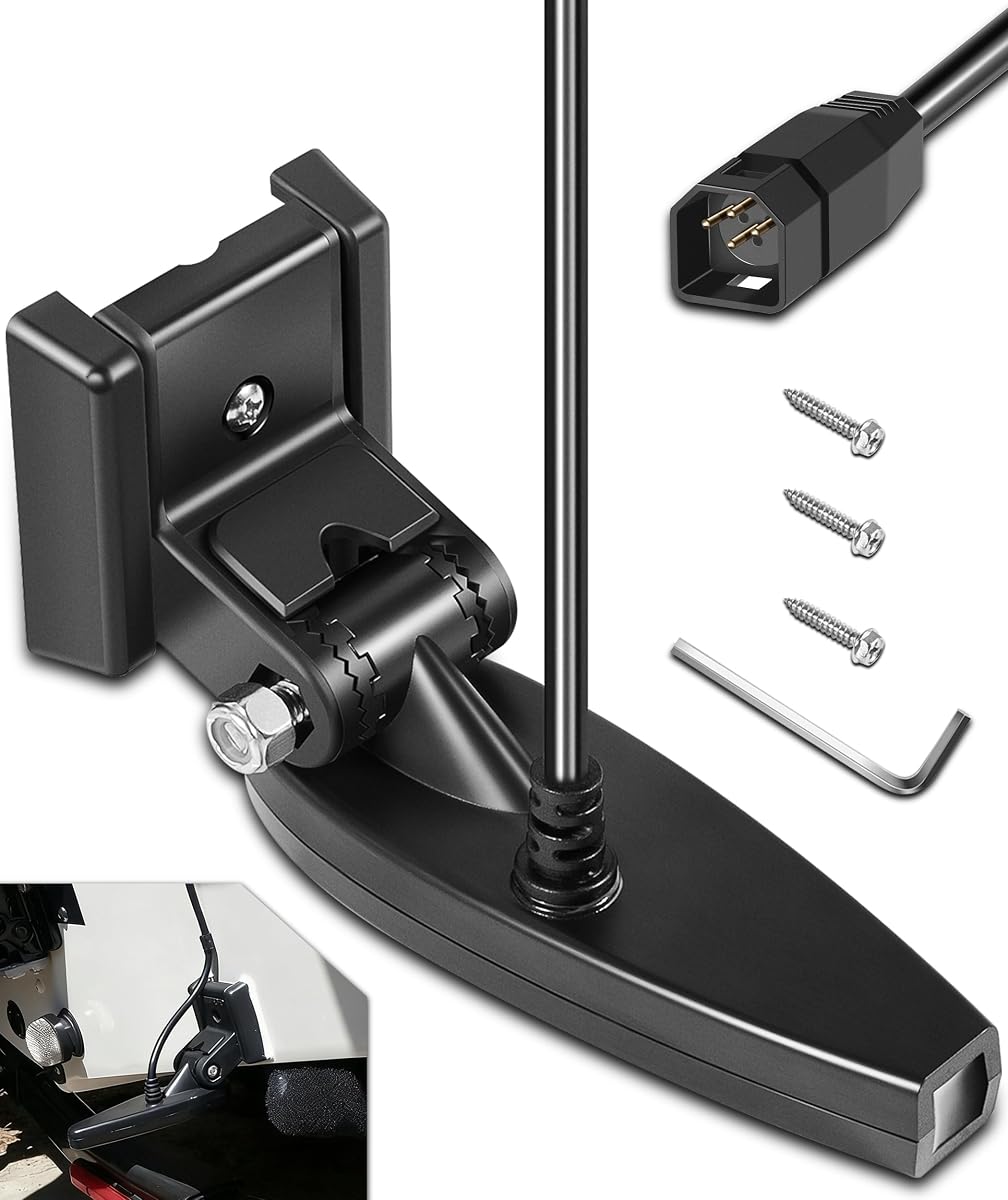
Installation is simplified with a transom mount, mounting hardware, a built-in temperature sensor, and a 20-foot cable. The included accessories mean the buyer does not need to source the basic bracket and sensor provisions separately, assuming the boat and display match the stated configuration.
Choose this model if you own a HELIX 7 CHIRP SI GPS G4 and want a straightforward all-in-one sensor. Do not choose it for a MEGA Side Imaging HELIX 7 model, because the product data expressly rules out that application. It is a better fit for owners who do not need the higher MEGA Side Imaging+ frequencies offered by other transducers in this guide.
A narrow compatibility target can be an advantage when it removes uncertainty. If your display is a HELIX 7 CHIRP SI GPS G4, this transducer's listed features align directly with that unit's imaging platform.
The built-in temperature sensor, mounting hardware, and 20-foot cable cover the major installation components. Boat layout and transom configuration will still determine the final position and cable routing.
We may earn a commission when you buy through this link, at no additional cost to you.
The Lowrance Active Imaging 3-in-1 Transducer with 6-foot Cable, model 000-14814-001, provides a compact installation option for compatible modern Lowrance systems. Its 4.2 rating reflects a capable three-in-one design that supports CHIRP, SideScan, and DownScan. The defining physical difference is its short six-foot cable, which can be useful on smaller boats or installations with a display mounted close to the transom.
We may earn a commission when you buy through this link, at no additional cost to you.
Compatibility is listed for HDS LIVE, HDS Carbon, and Elite Ti2 units. The transducer uses a nine-pin connector and requires an adapter cable, so a buyer should not expect a completely universal plug-and-play connection. The adapter is especially important to verify before installation because cable routing, display location, and available transom space can make a short lead either convenient or restrictive.
Its transom mount supports the standard practice of placing the sensor in clean water behind the vessel. By combining multiple sonar approaches in one housing, it can provide side views of structure, direct down-imaging views, and conventional CHIRP fish-finding information without requiring separate transducers for each mode.
This model is best suited to a Lowrance boat with a compact mounting layout and a display generation listed as compatible. For larger boats or installations where the display sits farther forward, the six-foot lead may be less convenient. Confirm the required adapter, connector routing, and display model before purchase to avoid an incompatible installation.
The six-foot cable can simplify installation when the fish finder display is mounted near the transom. On larger layouts, however, it may be less flexible than the 20-foot cables used by several alternatives.
The required adapter cable is a material part of the installation rather than a minor accessory. Its routing and length should be checked against the boat, display position, and available mounting points.
We may earn a commission when you buy through this link, at no additional cost to you.
The Lowrance Bracket/Fitting kit listing combines Active Imaging 2-in-1 functionality using SideScan and DownScan, making it relevant to the broader down and side imaging category. Its 4.1 rating is lower than the leading products, but the stated specifications describe a capable imaging solution for compatible Lowrance and Simrad displays. The unusual listing name reinforces the importance of checking the actual model details before buying.
We may earn a commission when you buy through this link, at no additional cost to you.
The imaging system supports 455 and 800 kHz frequencies and is intended to produce refined detail and target separation. Its target applications include rock piles, standing timber, weed beds, ditches, and drop-offs. These are common fish-holding structures, and side imaging is particularly useful for identifying their shape and extent while down imaging adds a direct look at what lies beneath the boat.
Listed compatibility includes Lowrance HDS LIVE, Elite Ti, Simrad NSS evo3, and Simrad GO series displays. Because the product data does not provide the same detailed cable, connector, or coverage information shown for the other choices, buyers should confirm the exact transducer configuration and physical components included with the current listing.
This option is most appropriate for someone who already owns one of the listed display families and wants a two-in-one Active Imaging sensor. It may be a sensible alternative to a three-in-one design when CHIRP coverage is not required. Before ordering, verify that the package includes the transducer itself rather than only mounting fittings, since the title refers to a bracket and fitting kit while the description focuses on Active Imaging.
SideScan and DownScan cover the two core structural perspectives without adding the extra CHIRP mode found in the three-in-one products. This can suit an owner whose display and installation priorities focus on imaging rather than conventional sonar versatility.
The concise listing name may create uncertainty about whether the purchase includes a transducer, mounting parts, or a complete installation package. Checking the product images and current package description is important before checkout.
We may earn a commission when you buy through this link, at no additional cost to you.
The Bonbo 710226-1 XNT 9 DI T is the Best Budget pick in this guide for buyers who prioritize down imaging, DualBeam PLUS sonar, and broad Humminbird compatibility over side imaging. It has a 4.5 rating and is designed to work with numerous HELIX DI GPS units, select HELIX, PiranhaMAX, legacy Down Imaging, 788ci HD DI Combo, 597ci HD DI Combo, 596c HD DI, Combo, and 570 DI systems.
We may earn a commission when you buy through this link, at no additional cost to you.
The transducer combines Down Imaging with DualBeam PLUS sonar. For sharp DI views, it uses 75-degree and 45-degree beam angles with 455 and 800 kHz frequencies. Its conventional sonar coverage uses 25-degree and 16-degree beam angles with 200 and 455 kHz frequencies. That mix allows the user to inspect structure directly below the boat while retaining a broad, detailed two-dimensional fish-finding view.
A transom mount, impact-release bracket, required mounting hardware, and 20-foot cable provide a flexible installation foundation. The bracket is designed to hold the sensor securely in rough water, while the generous cable length allows more freedom in display placement. The description also emphasizes that the transducer must be fully submerged while operating because sonar signals cannot pass through air.
Choose this product if your display requires a down-and-2D transducer and you want a value-oriented option with a long cable and extensive model support. It is not a side-imaging solution, so it does not directly meet the need for simultaneous SideScan. It is also important to follow the stated subm requirement fully during operation to protect the transducer from air pinging.
The 75-degree and 45-degree DI beam angles provide a defined view beneath the boat, while 455 and 800 kHz are used to create high-resolution structural images. This is the core reason to choose a dedicated DI unit over a basic 2D sensor.
The stated compatibility covers multiple HELIX generations and several legacy or PiranhaMAX models. Still, buyers should compare the exact display model and connector rather than relying on a general brand match.
We may earn a commission when you buy through this link, at no additional cost to you.
The Humminbird XNT 9 DI T is a well-established down imaging choice for compatible Humminbird systems, earning a 4.6 rating. It combines Down Imaging with DualBeam PLUS sonar in a transom-mounted unit, giving anglers a detailed view below the boat while retaining a conventional sonar perspective for finding fish and structure.
We may earn a commission when you buy through this link, at no additional cost to you.
The down imaging section operates at 455 and 800 kHz and provides a fish-eye view of the bottom directly beneath the boat. DualBeam PLUS uses two beams to balance detail with a generous coverage area. Together, these modes help users locate fish-holding terrain, distinguish targets, and understand the contours around the vessel.
Installation is supported by a built-in temperature sensor and a 20-foot cable. The stated compatible group includes select HELIX Down Imaging models, PiranhaMAX Down Imaging models, legacy Down Imaging models, 788ci HD DI Combo, 597ci HD DI Combo, 596c HD DI, Combo, and 570 DI. This makes it a natural option for owners of those systems who need a matching replacement.
This transducer is recommended for a boat that requires down and 2D sonar but does not need SideScan. Its straightforward configuration can be preferable for anglers who want a focused DI upgrade or a straightforward replacement for an original unit. Verify the exact fish finder model and connector before ordering because the transducer is not designed to support every Humminbird display.
For compatible systems, the XNT 9 DI T adds high-resolution 455 and 800 kHz imaging directly below the boat. That perspective is useful for following contours, locating structure, and seeing fish that conventional sonar may not define as clearly.
The built-in temperature sensor and 20-foot cable cover the main sensor and routing needs. The transom mount keeps the unit in position while the boat is underway, subject to proper adjustment and submersion.
We may earn a commission when you buy through this link, at no additional cost to you.
A useful purchase decision starts with the fish finder you already own, then narrows to the sonar modes, frequencies, coverage, mounting arrangement, and connection requirements you need for the water you fish.
Short on the critical point: match the transducer to the exact display model, connector, and supported frequencies before considering any other feature.
Short on the critical point: choose side coverage that fits your display and fishing area, rather than assuming the largest stated range offers the most useful image.
Short on the critical point: match down-imaging frequency and beam width to your display and the depth and structure you routinely fish.
Short on the critical point: favor CHIRP modes that match your display and fishing style, not simply the largest number of advertised features.
Short on the critical point: select a cable length that comfortably reaches from the transom to the display without tight bends or unnecessary excess.
Short on the critical point: choose a two-in-one, three-in-one, or dedicated DI design based on the sonar views you expect to use regularly.
Short on the critical point: verify the temperature sensor, bracket, hardware, adapter, and connector are included before considering the purchase complete.
Short on the critical point: prioritize the imaging approach that helps you find the specific structure and fish-holding cover present in your usual fishing water.
Begin by identifying the exact fish finder, connector, cable route, and supported imaging modes before installation. Compare the transducer's listed frequency ranges with the display's capabilities, and make sure the mounting location sits behind the boat where the sensor can remain submerged in clean water. Secure the transom bracket, route the cable without sharp bends, and allow enough slack for the boat and motor movement.
Before each trip, inspect the transducer and cable for visible damage, looseness, and excessive marine growth. Clean the sensing face with a soft cloth and fresh water, avoiding abrasive pads or harsh chemicals that could damage the surface. After use, rinse away salt, mud, and debris with fresh water and allow the unit to dry before storage.
The transducer must be fully submerged during operation because sonar signals cannot pass effectively through air. Air pinging can damage the unit, so do not run the fish finder while the transducer is out of the water. At slower speeds or shallow draft, monitor the mounting position carefully, and follow the manufacturer's instructions for the display's specific imaging and sensitivity settings.
Down imaging looks directly beneath the boat and is useful for seeing bottom contours, submerged structure, and fish below the vessel. Side imaging scans to the left and right, revealing fish-holding features such as channels, rock piles, weed edges, and drop-offs over a much broader area. Many modern transducers provide both functions in one housing.
No. Connector type, frequency support, cable design, and software generation must all match the display. The XM 14 HW CMSI T, for example, is listed for XPLORE, APEX, and SOLIX G3, while the XNT 9 HW SI T targets HELIX 7 CHIRP SI GPS G4 units and does not support MEGA Side Imaging models.
Higher frequencies can support more detailed images, but the display, range, water clarity, and intended use still matter. A 455 or 800 kHz imaging system may be ideal for structural detail, while a 1.1 MHz MEGA system is intended to refine side-scan returns. The most suitable unit is the one your display can meaningfully support.
Sonar signals travel through water much more effectively than through air. Operating a transducer while it is exposed to air can produce ineffective readings and may cause air pinging that damages the unit. Keep the sensor fully submerged whenever the fish finder is active.
The correct length depends on the distance from the transom to the fish finder display and the route around the boat. Twenty-foot cables offer substantial installation flexibility, while a six-foot cable may suit a compact arrangement but can be restrictive on a larger vessel. Measure the intended route and leave enough slack to prevent strain or sharp bends.
No, but the Lowrance 000-14814-001 Active Imaging 3-in-1 explicitly requires an adapter cable and has a nine-pin connector. Other Lowrance products may have different connection arrangements, so check the individual listing rather than assuming all models use the same hardware.
Yes. The Bonbo and Humminbird XNT 9 DI T products combine down imaging with DualBeam PLUS sonar, providing both a directly below-boat view and conventional 2D coverage. They simply do not provide side imaging, so they are better suited to anglers who do not need broad left-and-right structure scans.
Rinse the unit with fresh water after use, remove accumulated salt and debris gently, and inspect the cable and mounting bracket for wear or looseness. Avoid abrasive cleaners and harsh chemicals. Keeping the sensing face clean and the connection secure helps preserve image quality and reliable operation.
The Humminbird XM 14 HW CMSI T is the strongest all-around recommendation for a compatible modern Humminbird system, combining MEGA Side Imaging+, 1.1 MHz support, 400-foot side coverage, down imaging, and Dual Spectrum CHIRP. The Lowrance 000-14489-001 Active Imaging 3-In-1 is the feature-focused premium choice for compatible Lowrance or Simrad displays, especially for anglers who value FishReveal. The Bonbo XNT 9 DI T provides the best value-oriented option when down imaging, DualBeam PLUS, a long cable, and broad Humminbird support matter more than side imaging.
The most important buying priority remains exact compatibility. Start with your display model, then decide whether you need side imaging, down imaging, or both and whether CHIRP flexibility improves your particular setup. Also account for connector requirements, mounting space, cable routing, supported frequencies, and the type of cover you fish. A more advanced transducer cannot deliver its intended benefits if the connected unit or installation arrangement is incompatible.
Finally, check the current listing, included components, and price before ordering because product configurations and costs can change. A complete HELIX 7 G4 system may suit a new installation, while a matching standalone transducer is usually the better route for an existing boat. Confirm every technical detail in the current product information and the manufacturer's guidance before mounting or operating the unit.